
Our readers keep the lights on and my morning glass full of iced black tea. As an Amazon Associate, I earn from qualifying purchases.
Specs are compiled from manufacturer listings and verified buyer reviews and can change over time — please confirm the key details on the product page before buying.
Here is the short answer: for most fruit trees, a low-profile border that lets you mow straight over the top beats a tall wall of plastic every time. Grass creeping into the trunk zone steals water and nutrients, and mulch washing away in a storm leaves roots bare. A low border fixes both problems in an afternoon, without trenching.
I’m Min — the founder and writer behind Gadgets Feed. This guide is built by comparing the manufacturers’ published specifications and the patterns across verified customer reviews, so you get each pick’s real strengths and trade-offs instead of marketing spin.
You want a clean line around the trunk, mulch that stays put, and a border your mower rolls over instead of catching. This breakdown of the border around a fruit tree covers height, material, stake counts, and which shapes actually curve.
Our Picks at a Glance

How To Choose The Best Border Around A Fruit Tree
The single biggest mistake people make is buying a border that is too tall. Around a fruit tree you are not trying to build a fence. You are trying to hold mulch in place, stop grass from marching toward the trunk, and still run a mower across the top without clattering into plastic or steel.
Height is your first decision, not your last
Aim for a border that sits low enough to mow over but tall enough to bury below the root level of creeping grass. Three to five inches of board gives you the burial depth without turning the trunk zone into an obstacle course. A ten-inch board is a different tool entirely — that one is for making a raised wall, not a mow-over ring.
Material decides how long it lasts
Recycled HDPE plastic shrugs off sun, frost, and rot. Coated steel gives you the crispest line but demands care with gloves and bends if you force it. Natural eucalyptus log has the warmest look and will not rot the way softwoods do. Rubber-based edging bends around tight trunk curves without cracking.
Stakes, shape, and the curve problem
Straight runs are easy. Circles around a trunk are not. A coiled roll has “memory” — it wants to stay curled — so it needs sun-warming and patience before it lies flat. A pre-formed ring bolts together into a true circle with no fighting at all. Whichever you pick, buy more stakes than you think you need if you are edging anything curved.
Quick Comparison
| Model | Best For | Height | Total Length | Material | Amazon |
|---|---|---|---|---|---|
| MASTER MARK Terrace Board 5 in. x 40 ft.★ Best Overall | All-round tree and bed border | 5 in | 40 ft | HDPE Plastic | Amazon |
| Master Mark Landscape Edging Coil 40 ft. x 4 in.Best Value | Budget curves on a straight run | 4 in | 40 ft | HDPE Plastic | Amazon |
| AGTEK Garden Edging 49FT KitMost Versatile | Long runs with stake backup | 3 in | 49 ft | Plastic | Amazon |
| FOREVER BAMBOO Eucalyptus Log Border | Natural rustic tree rings | 6 in | 6.3 ft | Eucalyptus Wood | Amazon |
| MIXC Garden Edging Border 100FT | Big projects needing stake volume | 2 in | 100 ft | Rubber | Amazon |
| Gardzen 60-Foot Landscape Edging | No-dig tree edging and mulch | 3 in | 60 ft | Plastic | Amazon |
| VEVOR Landscape Edging 10 in. x 60 ft | Deep root and runoff blocking | 10 in | 60 ft | HDPE | Amazon |
| SJPULMO Metal Landscape Edging | Sharp permanent steel lines | 4.5 in | 35 ft | Galvanized Steel | Amazon |
| CORE EDGE Garden Tree Ring 600mm | True circles at the trunk base | 1.6 mm steel | 600 mm diameter | Alloy Steel | Amazon |
In‑Depth Reviews
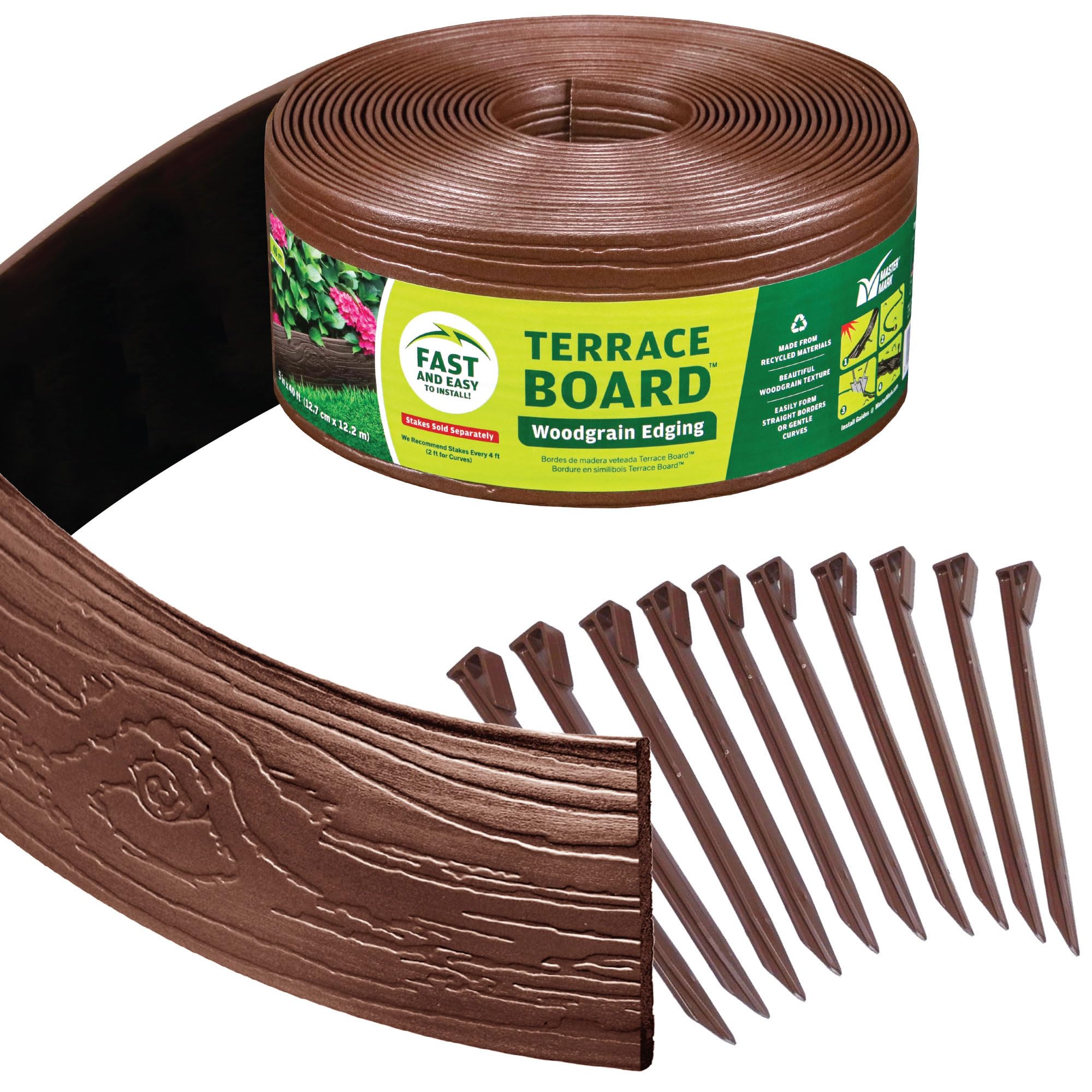
1. MASTER MARK Terrace Board, Landscape Coiled Edging, 5 in. x 40 ft. with 10 Stakes (Black)
Our pick — 4.5★ from 900+ verified ratings; the strongest balance of quality and price.
The five-inch board that finally buries deep enough to stop grass at the trunk
The 5 in height is what makes this board work around a fruit tree. At 5 in tall, this board gives you plenty of material to sink below the root level of creeping grass while still leaving a clean lip above the soil. Around a fruit tree, that combination is what actually keeps the grass line out of the mulch ring instead of letting it creep back in by late summer.
You get a natural-looking garden edge that won’t chip, fade, or rot in soil, because it’s made from HDPE (high-density polyethylene — a tough, waxy plastic). The wood-grain texture makes it read like real wood, not a strip of shiny plastic. The 40 ft coil bends around tree trunks and bed curves, so you can outline a fruit tree without cutting. But it arrives with a curl that fights you until it warms up. Buyers report a simple fix: lay it out in the sun before you dig. Warm plastic relaxes and straightens; cold plastic snaps back into a wave.
The trade-off is the stake count. Ten stakes over 40 ft is fine for gentle curves, but a tight tree ring will want roughly double that, and owners routinely buy extra. If you are circling anything tight, budget for more stakes than the box includes.
What buyers keep coming back for
- HDPE plastic that holds up to sun, frost, rot, and string trimmers without chipping or fading
- 5 in height buries below the root line — the exact depth needed to block creeping grass
- Wood-grain texture gives the natural look of timber without the rotting
- Flexible enough to curve around trunks and bed edges
Where it needs a hand
- Ten stakes is light for tight circles — plan on buying extras
- Arrives curled and needs a warm-up in the sun before it lays flat
Reach for this if: you are edging a mulch ring around a tree, a bed border, or a patio edge and want one board that does all three well without digging deep.
Look elsewhere if: you need a true circle at the trunk base with zero fuss — the coiled roll needs warming and extra stakes to sit straight there.
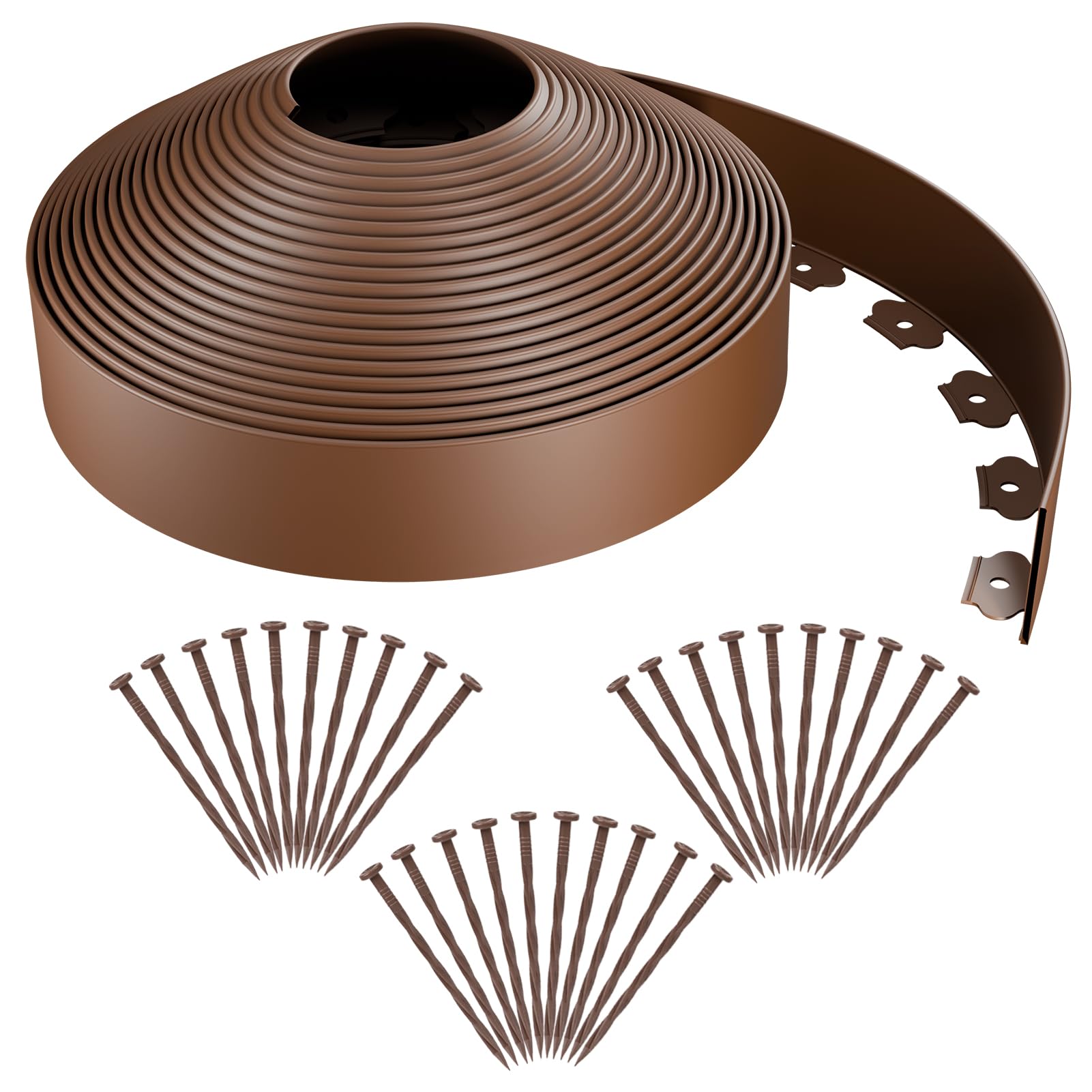
2. Master Mark Landscape Edging Coil (Terrace Board), 40 ft. x 4 in. Tall with 10 Stakes, Brown
Same trusted maker, one inch shorter, and the cheapest way onto a proper tree border
This is the five-inch board’s smaller sibling, and the differences matter. It runs 40 ft at 4 in tall instead of 5 in — and it uses about 5/32 in of thickness in the board itself. Owners say that’s plenty strong for buried edging and a fraction of what steel would run. It’s flexible enough to hold a bed sweep yet stiff enough that a straight run stays straight once seated.
The honest catch is color. Owners who bought six rolls in one order reported two arriving a noticeably lighter shade — the kind of thing you only spot on long continuous runs where two rolls meet. If you are edging a single tree ring, this is a non-issue.
The wood-grain texture reads as real timber. The textured wood grain finishes like real timber and the brown tones disappear into bark and mulch. Warm it in the sun for an hour or so before installing and the coil relaxes into place; skip that step and you will fight it all afternoon.
Where it shines: texture and price combine into the natural-looking tree border that hides its seams better than any plastic edge has a right to.
Set expectations: ten stakes ship in the box, and every owner who curved their border said the same thing — buy more.
The case for it: budget-conscious gardeners edging straight-ish runs around trees, beds, and mulched paths who want the wood look without the wood upkeep.
The reason to pass: a perfect circle at the trunk is not this roll’s strength — it arrives curled and wants sun-time before it sits flat.
3. AGTEK Garden Edging 49FT Landscape Edging Kit 3 Inch Height with 30 Stakes
Forty-nine feet and thirty stakes — the kit built for long runs and lots of grabbing power
The 49 ft length is the headline. At 49 ft this runs 22% longer than the 40 ft Master Mark coil above, which is the difference between finishing a full garden perimeter in one pass and coming up short two-thirds of the way. That extra footage means one kit edges more tree rings, bed lines, and path borders before you have to order again.
The 3 in height is the balance mow-over size. It buries about an inch and a half into the soil to block grass roots, leaves a clean lip above, and stays low enough that a mower deck sails over it without catching. Owners specifically called out how well the 3 in height handles trimmers and mowers, and the flexible plastic bends around corners and curves without kinking.
Where the kit stumbles is the stakes. Owners who staked deeply into hard ground had a few heads snap off — worth watering the soil first and tapping gently with a rubber mallet rather than hammering. For a long border, spacing the included stakes every few holes leaves you short on coverage.
Why it earns a spot
- 49 ft covers a full garden perimeter in one kit, longer than comparable 40 ft rolls
- 30 stakes included — more than most kits at this length ship with
- 3 in height is the mow-over balance: buried below grass roots, low enough to ride over
- Flexible plastic takes tight corners and tree curves without cracking
Where it can disappoint
- Stake heads can snap if hammered hard into hard ground — soften the soil first
- Even 30 stakes fall short on a long border if you space them every hole
The right buy for: anyone running a big perimeter — multiple tree rings, a bed line, and a path border — in one pass who wants the longest kit on this list.
The wrong fit if: you’re edging a single tree ring on soft ground where 30 stakes go unused.
4. FOREVER BAMBOO Natural Eucalyptus Wood Solid Log Border 72 in L x 6 in H

Real eucalyptus logs for the tree border that should look planted, not installed
This is the pick for a tree border that should look planted rather than installed. Six inches high and 6.3 ft long, the border is a solid log of natural eucalyptus from South Africa — a wood that resists rotting and decay far better than softwoods do when it sits against wet soil year-round. Around a fruit tree, that resistance is the point. You want the border to last, not to become the next thing you replace.
It also earns its keep on structure. The heavy-duty logs sit in place without supports — no digging, no trench, no stakes. Roll it out onto the designated spot, form the shape you want, and it holds. Owners found the eucalyptus logs sturdier and easier to work with than the bamboo edging they replaced.
The catch is stability on soft or uneven ground. It arrives with paperclip-style connectors to join sections, not posts, and some bearers found they needed to dig a shallow trench and anchor it with wire or stakes to keep it standing in loose soil. If your ground is firm, ignore that advice. If it is loose, you’ll want a plan.
The look you’re buying: a solid eucalyptus log that reads as a garden feature, not a plastic edge, with the weather resistance real wood rarely has.
The honest limit: it is a decorative border first, a retaining wall never — soft ground will need extra anchoring.
Choose this for: a tree ring or flower bed where the border itself is part of the design and you want natural wood that won’t rot.
Pass on this for: loose sand or sloped ground — you’ll need to trench and anchor it yourself.
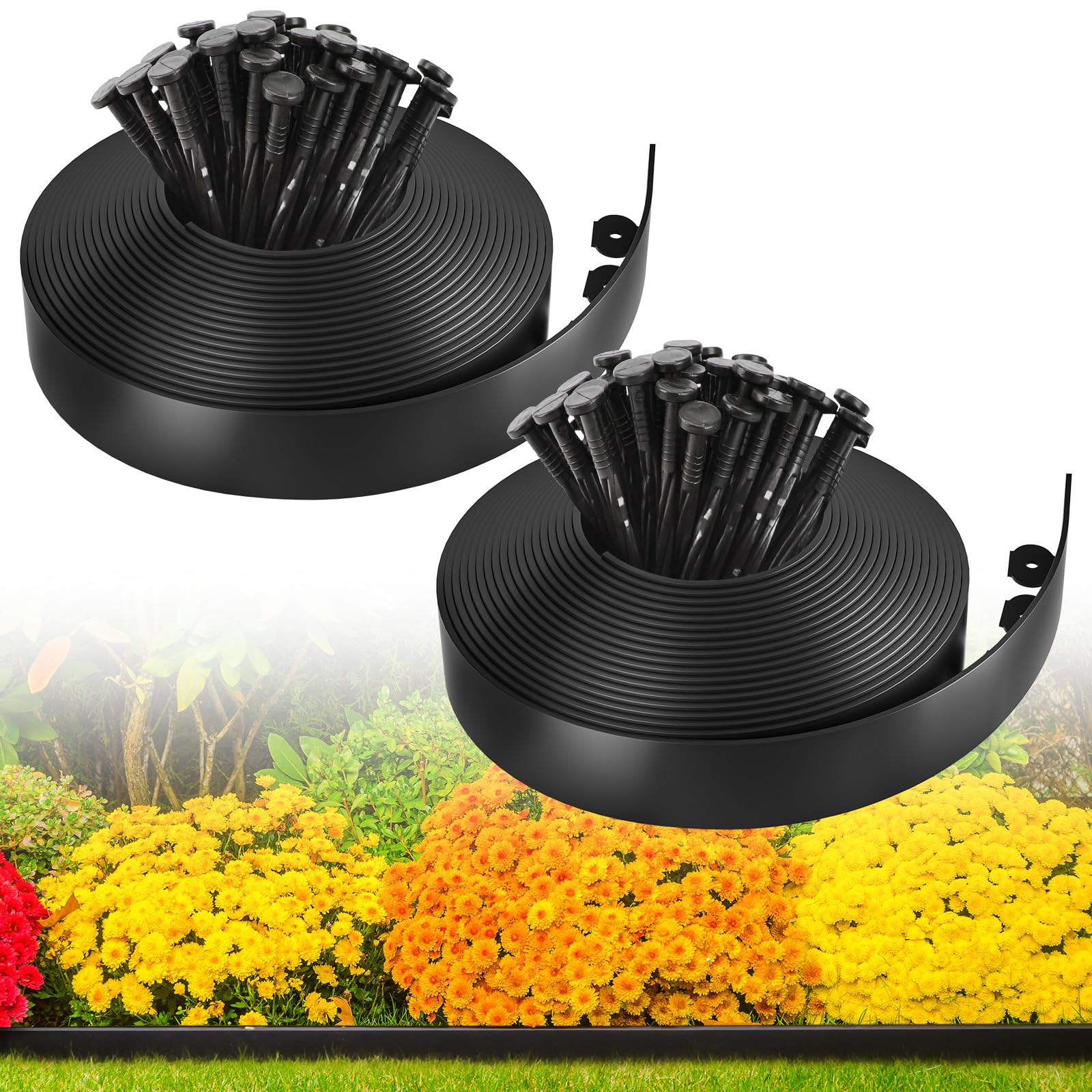
5. MIXC Garden Edging Border, 100FT 2 Inch Tall with 150 Stakes
One hundred feet and a hundred and fifty stakes — the volume kit for edging a whole yard at once
Two numbers define this kit: 100 ft of border and 150 stakes. The roll runs 100 ft and it ships with 150 six-inch spiral stakes, which is roughly five stakes for every four feet of border. That is dense enough that soft, uneven, or stony ground can still hold a firm line, and it is the reason owners keep describing the finish as tidy and professional. Around a tree ring, you can hammer stakes on close spacing and know the curve will not sag.
The material is a rubber-based flexible plastic rather than a rigid board. It bends easily around circular beds, tree rings, and sloped terrain without the curl-battle that HDPE coils give you. Owners specifically praised how well it handles slopes and curves. It also cuts and trims to length, though owners who cut it found it hard and needed a Dremel with a right-angle attachment to get a clean edge.
The honest catch is that the “one roll” of 100 ft usually arrives as two 50 ft rolls. If your border run needs to cross past 50 ft in a single continuous line you will need joiners, which the kit does not include. Plan your layout around the split, or order a joining solution separately.
Why it’s a strong pick
- 100 ft of border plus 150 spiral stakes covers large yards without a second order
- 150 stakes works out to roughly 5 per 4 ft — dense enough for soft or stony ground
- Rubber-based plastic bends around curves, slopes, and circular tree rings with no fight
- Weather-resistant and low to the ground — mowers and wind leave it alone
What to know before you buy
- 100 ft arrives as two 50 ft rolls — no joiners included, so long continuous runs need a separate coupler
- The rubber body is tough to cut cleanly and may need a Dremel
- 2 in height is short for deep grass-root blocking
Reach for this when: you’re edging a whole yard — multiple tree rings, flower beds, and paths — and want the stake count to handle ground that isn’t perfect.
Look elsewhere if: your border needs a single unbroken run past 50 ft, or you need a taller board to bury below grass roots.
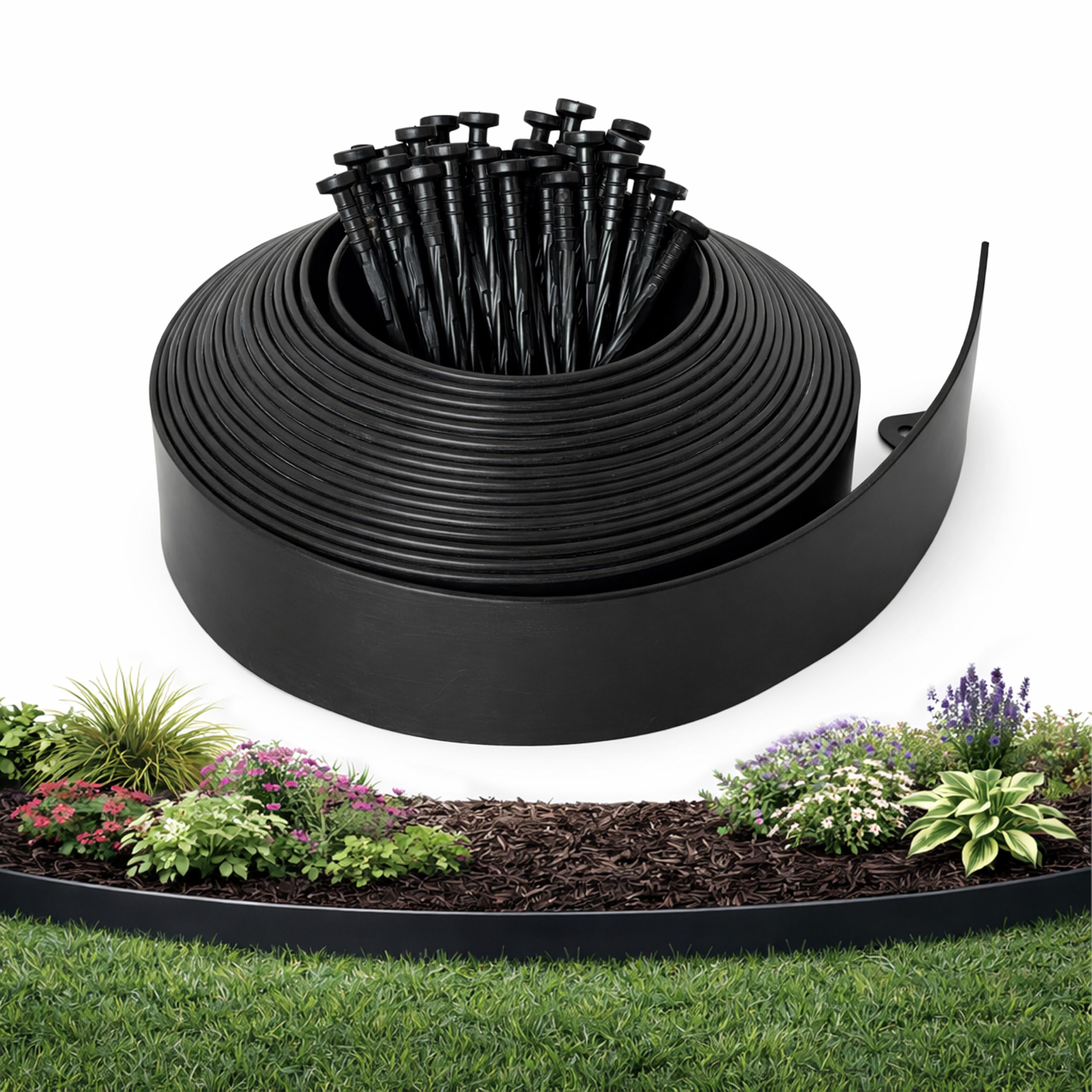
6. Gardzen 60-Foot x 3-Inch Landscape Edging Garden Border with 60 Spikes
Sixty feet of no-dig border at a stake for every foot — the easy-install tree ring kit
The ratio is what makes this one work: 60 ft of border and 60 spikes means one stake per foot of edge, no guessing about spacing. For a tree ring, that density lets you hammer the border into place around the trunk without worrying about gaps, and the 3-inch height buries low enough to hold mulch while sitting flat under a mower. The no-dig design means you stake it down and walk away — no trenching.
Owners used it for everything from fire pit surrounds to separating mulch and rock in flower beds, and the sizing suits those jobs well. The plastic is weather-resistant and easy to cut to length if your layout needs a shorter segment.
Two things to weigh. First, the plastic is on the thin side — an owner using it to hold back 4 inch rock found the edging bowed slightly under the weight and needed reinforcement with longer nails. It’s excellent for mulch and light gravel; heavy stone will push it. Second, it arrives coiled and wants a warm-up in the sun before installation. Lay it flat, let it relax, and skip the frustration.
The budget play: 60 ft with a stake for every foot at a friendly price — the quickest way to ring a few trees and beds without spending much.
One thing to size right: it holds mulch and light gravel easily, but 4 inch rock can bow it without extra reinforcement.
Standout spec: 60 spikes for 60 ft — hand-tuned for no-dig installs where spacing matters.
Skip if: you need to hold back heavy stone or edge a sloped hillside — this one is happiest on flatter ground with mulch-weight fill.
7. VEVOR Landscape Edging, 10 inch Depth 60 ft Recycled HDPE Coiled Terrace Board

Ten inches deep — the board that blocks roots, weeds, and stormwater, not just grass
This is a wall, not a lip. At 10 in tall it delivers more than double the depth of the 4-5 in Master Mark boards, which is a completely different job. Around a fruit tree, that height lets you bury the board halfway and leave the rest standing to block winding grass, invading roots, and the sort of storm runoff that carries mulch off a bed. The manufacturer rates the board at 0.1 in (±10%) thickness with 200 pounds of puncture resistance.
The material is HDPE (that same rot-proof, rust-proof, fadeproof high-density polyethylene) in a recycled formulation, and owners found it tough enough to survive a hurricane while keeping floodwater out of the garden. That is a testimony to what this board can do when the water rises.
Two catches to size honestly. The board is thick and stiff, which makes unrolling it a workout and means any curving run needs sun-time to relax. And thickness has been inconsistent — some owners measured their roll around 2.1-2.2 mm instead of the 2.5 mm the listing advertises. Use that knowledge when planning how much bury depth you’ll get.
The case for the VEVOR
- 10 in depth is the deepest on this list — buries below the root zone of most trees
- HDPE plastic resists rot, rust, and fade; owners mention it surviving hurricane weather
- 60 ft covers long runs without ordering short
- Cuts with garden shears if you need to trim a segment
The real limits
- Unrolling fights you and takes patience; curves need sun-warming first
- Thickness varies — some owners found the roll under spec from the listed 0.1 in
- Requires proper trenching; not a no-dig option
Choose this when: grass roots or runoff are the enemy and you need a real physical wall — around a tree, against a fence line, or along a flooding path.
Skip if: you want a quick no-dig mow-over ring — this one is trench-and-bury work from start to finish.
8. SJPULMO Metal Landscape Edging Border, 10 Packs 42” L x 4.5” H Galvanized Steel
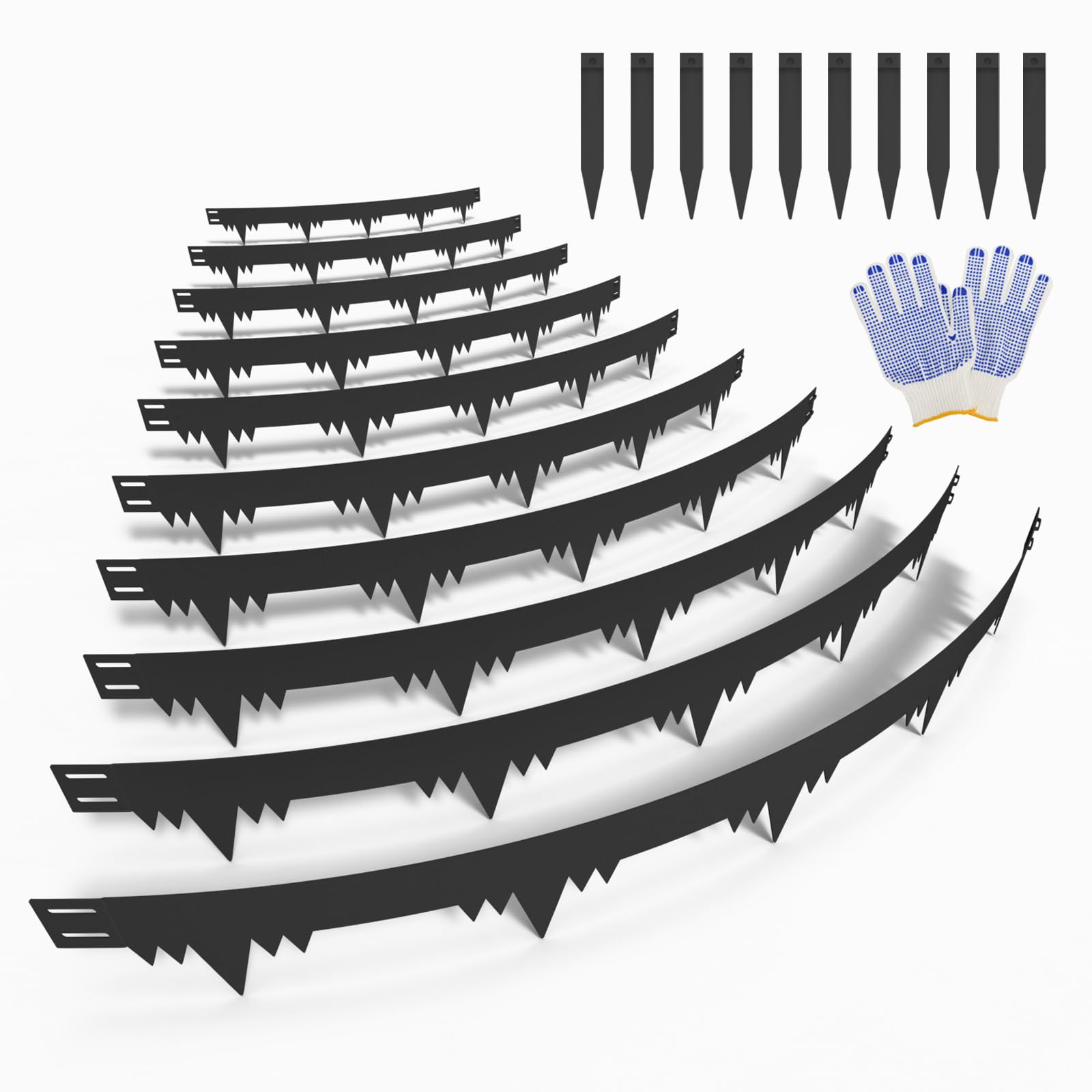
Real galvanized steel, powder-coated black, bent by hand around a tree ring
If crisp lines are the goal, steel wins. Each panel runs 42 in long and 4.5 in tall, with two inches of that above ground and 2.5 in below. Ten panels total 35 ft, connected end to end with latch stakes that lock each section to the next so the border runs as one continuous strip. Around a tree, that means a clean, unmoving line that does not wrinkle or curl the way plastic coils do.
The metal is bendable enough to shape into circles, squares, and irregular curves by hand. Owners trained it around corners, ringed a tree base, and created the sort of clean top edge that reads as professionally installed. The powder coating resists fading, cracking, and rusting, so it holds up through weather without the maintenance a wooden edge would demand.
Two things to know. First, the edges are sharp — wear the included gardening glove when handling and bending, and don’t force the bend past 90 degrees once sections are latched, or they’ll kink instead of curve. Second, this is the most expensive pick on the list, and at 35 ft total it runs shorter than the 40 ft plastic coil. Price is the price of steel; the trade-off is fewer feet.
Why steel wins: a latched, powder-coated strip that stays dead straight or bends a clean circle — the finish nobody mistakes for plastic.
The honest trade: sharp edges need gloves, and 35 ft of steel runs shorter than the 40 ft plastic coils above.
Best for: homeowners who want a permanent, crisp tree ring or bed border and don’t mind paying for galvanized steel that resists rust and fade.
Not for: anyone on a tight budget or edging more than a few feet of bed — the length runs shorter at 35 ft.
9. CORE EDGE Garden Tree Ring, 600mm Diameter Steel Border for Trees and Shrubs

A pre-formed steel ring that bolts into a perfect circle at the trunk — no fighting a coil
Everything else on this list makes you shape the border. This one arrives shaped. It is a 600 mm diameter ring of 1.6 mm steel — the same gauge used in the maker’s domestic edging — supplied as pre-rolled sections that simply bolt together at the base of a tree. Because the teeth anchor straight into the ground, the finished ring sits low enough in the turf that you ride a mower over the top of it without rocking the blade.
For a fruit tree specifically, that geometry is the point. The ring creates a fixed circle exactly where you want the trunk clear of grass and mulch, and it stays that shape. Owners describe bolting the sections into a perfect ring that keeps grass out of the tree’s space.
Two voices to weigh. The steel quality draws praise, and the design sits well. But some owners received theirs with rust already on the surface and no finish coat, and others felt the price ran high for the size. If you want a single, exact circle and the finish quality matters as much as the shape, this is the one — just inspect on arrival.
Why it earns the slot: a true circle arrives pre-formed, bolts into place in minutes, and sits mower-flush around the trunk with zero shaping work.
What to look for on delivery: the steel ring has shipped with surface rust before, so check the finish the day it lands.
Made for: the gardener who wants one perfect circle at the base of a tree, sized to 600 mm, and does not want to shape or fight a coiled roll.
Reconsider if: you need more than one ring, or your tree pit is an irregular shape — this is a fixed circle, not a flexible border.
Understanding the Specs
Height: The Mow-Over Number
Height sets everything. A 3 to 5 inch board buries below the root zone of creeping grass and still lets a mower ride over the top. A 10 inch board is a wall — you trench it in, leave half standing, and it stops roots and runoff, but you cannot mow over it the same way. Match the height to the problem before you match the material.
Stake Count and Spacing
Stakes hold the border in place and define the curve. Kits quote the count, but the useful figure is stakes-per-foot. Around 5 stakes for every 4 ft gives dense support on soft or uneven ground; 10 stakes over 40 ft is bare-minimum on a straight run. For any curved tree ring, always buy extra.
Material: HDPE, Rubber, Steel, or Wood
HDPE plastic sheds rot, rust, and UV damage and bends into curves after a warm-up. Rubber-based plastic flexes around tight shapes and slopes. Galvanized steel gives the crispest, straightest line but arrives sharp and can kink if over-bent. Eucalyptus log brings a natural wood look and resists rot better than softwoods.
Length: How Much You Actually Need
Measure your tree ring’s circumference (π × diameter) or the run of bed line you plan to edge. A 40 ft coil handles several tree rings on its own. Long perimeter jobs need 49 to 100 ft. Over-buy slightly — waste is cheap next to a mid-project order.
FAQ
How tall should a border around a fruit tree be?
Do I need to dig a trench or can I just stake it down?
How many stakes do I need for a tree ring?
Will a plastic border crack in freezing winters?
Is galvanized steel better than plastic around a tree?
Can I mow directly over the border?
Does eucalyptus wood edging rot in wet soil?
Will flexible plastic edging hold a curve around my tree trunk?
How long does plastic landscape edging last outdoors?
What length of edging do I need for a single tree ring?
Final Thoughts: The Verdict
For most fruit-tree borders, the border around a fruit tree winner is the MASTER MARK Terrace Board 5 in. x 40 ft. because that 5 in height buries deep enough to block creeping grass while staying low enough to mow over, and the HDPE board resists rot, fade, and string trimmers through years of weather. If you want the deepest root block and are willing to trench a bit, grab the VEVOR 10 inch board — 60 ft of recycled HDPE that reviewers point out surviving hurricane-level runoff. And for the single cleanest answer around a trunk base, the CORE EDGE 600mm steel tree ring bolts into a perfect circle you can mow straight over. Since a fruit tree’s border tends to stay in the ground for years, one honest nudge: buy a couple more stakes than the kit includes, so the first good rain doesn’t move the work you just did.
How We Picked
We do not accept paid placement. Every pick is matched to a real buyer and a real use-case; we do not hands-on test units.
Sources & Methodology
Specifications: manufacturer listings and product documentation. Review insights: verified customer reviews, as of September 2026. Pricing: not shown on this page (it changes often); check the current price via the retailer link.
As an Amazon Associate, Gadgets Feed earns from qualifying purchases. This does not affect which products we feature.