
Our readers keep the lights on and my morning glass full of iced black tea. As an Amazon Associate, I earn from qualifying purchases.
Specs are compiled from manufacturer listings and verified buyer reviews and can change over time — please confirm the key details on the product page before buying.
You have tried every trick — warming the nipple, handing the bottle off to dad, leaving the room — and your breastfed baby still screams the moment silicone touches their lips. You do not need another bottle; you need a nipple that actually feels, moves, and flows like you do. This guide cuts through the marketing to the six bottles most likely to end the strike, based on how they match a nursing baby’s natural latch and sucking rhythm.
I’m Min — the founder and writer behind Gadgets Feed. This guide is built by comparing the manufacturers’ published specifications and the patterns across verified customer reviews, so you get each pick’s real strengths and trade-offs instead of marketing spin.
if you need a slow flow, a glass body, or an anti-colic vent, the key is a nipple your baby cannot tell apart from you.
Our Picks at a Glance

How To Choose The Best Bottle For Breastfed Baby Who Refuses Bottle
A breastfed baby who refuses the bottle is not being stubborn — their mouth and tongue are trained to your specific shape, rhythm, and milk-release pattern. The wrong bottle feels foreign, flows too fast, or forces them to suck differently. Here is what to look for to end the strike.
Start with the Nipple: Shape, Softness, and Flow
The nipple is the only part of the bottle your baby actually interacts with. You want a wide, breast-shaped base that mimics the latch area of your breast, not a tall narrow tip. Material matters — ultra-soft silicone that feels warm and flexes like skin is far more likely to be accepted than firm rubber or hard plastic. The flow rate must be slow (newborn or Level 1 / Size S) so the milk does not shoot out faster than your letdown, which causes choking, sputtering, and immediate rejection.
Anti-Colic Ventilation: Preventing the Pain That Causes Refusal
A baby who swallows air gets a gassy belly and learns to associate the bottle with discomfort. Look for a vent system — a tiny internal tube, a nipple slit, or a 360° valve — that keeps air bubbles out of the milk. This mimics breastfeeding, where no air enters the mouth. Reviews repeatedly show that babies who refused plain bottles accepted vented ones because the feeding stayed painless.
Bottle Body: Glass, Silicone, or PPSU
Glass (borosilicate) is heat-resistant, stays clean, and never leaches anything, but it is heavier and can break. Silicone (like the Nanobebe) is squeezable, unbreakable, and warms fast. PPSU is a medical-grade plastic that is lightweight and shatterproof. Your choice depends on whether you prioritize durability (PPSU, silicone) or absolute purity of material (glass). All three are BPA-free.
Fewer Parts Means Less Fuss
Some anti-colic systems come with multiple small tubes and rings that must be washed after every feed. If you are already exhausted, a bottle with 3-4 total pieces makes it far more likely you will stick with it instead of reaching for a different bottle out of frustration.
Quick Comparison
| Model | Best For | Capacity | Material | Nipple Flow | Amazon |
|---|---|---|---|---|---|
| Nanobebe Flexy Silicone (2-Pack)★ Best Overall | Softest feel for picky babies | 5 oz | Silicone | Slow (included) | Amazon |
| Philips Avent Natural (SCY900/02)Also Great | Best Overall | 4 oz | Plastic | Slow (Flow 2) | Amazon |
| Dr. Brown’s Options+ Narrow Glass (4-Pack) | Severe gas relief | 4 oz | Borosilicate Glass | Level 1 Slow Flow | Amazon |
| Gulicola Natural Glass (2-Pack) | Durable glass for active parents | 5 oz | Borosilicate Glass | Slow Flow | $31.98Amazon |
| Pigeon PPSU Wide Neck (2-Pack) | Preemie & precise latch | 5.4 oz | PPSU | SS nipple (0m+) | from $35.99Amazon |
| Lansinoh Glass (4-Pack) | Budget-friendly glass set | 5 oz | Borosilicate Glass | Slow Flow (Size S) | Amazon |
In‑Depth Reviews
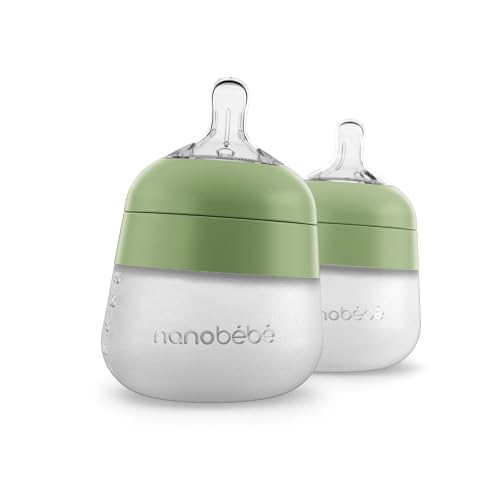
1. Nanobebe Flexy Silicone Baby Bottle, Anti-Colic, 2-Pack, Sage, 5 oz
Our pick — over 4.5★ from 19,000+ verified ratings; the strongest balance of quality and price.
A squeezable silicone bottle that feels warm and familiar, not cold and rigid.
The Nanobebe is different because the bottle itself is made from soft, flexible silicone — the same material as a breast pump flange (the cup that seals around your breast). You can squeeze it gently to mimic the compression of nursing, and it warms up quickly because the thin silicone transfers heat. The 360° Triple Vented non-collapsible nipple is designed so your baby keeps a perfect latch, reducing the gas and fussiness that often makes a breastfed baby reject the bottle. Each bottle holds 5 oz, comes in a 2-pack, and is dishwasher and microwave safe.
Buyers report it “reduced gas, easy to clean, wide opening prevents mess.” The 5 oz capacity matches the Lansinoh glass bottles (5 oz each), but the Nanobebe is a 2-count pack rather than a 4-count. One parent noted it is “good for breastfeeding transition, avoids plastic and glass.” The trade-off is that the silicone body can squeeze milk out if you hold it wrong — you must let your baby control the pressure, unlike the rigid Philips Avent body.
What makes it unique
- Flexible silicone body warms quickly and feels more like skin than plastic or glass
- 360° Triple Vented nipple prevents nipple collapse and reduces air intake
- Stable, non-tip base stays upright on any surface
- Wide opening makes cleaning simple — no special brushes needed
Watch out for
- Soft body can be squeezed accidentally, causing a fast flow — requires a gentle touch
- Only 2 bottles included, so you will be washing more often if you use multiple feeds a day
For the tactile baby: If your baby wants the bottle to feel warm and squeezable, like the real thing, the Nanobebe is the pick over the firmer Philips Avent.
skip it if: You prefer a rigid bottle or need a 4-pack to reduce washing.
2. Philips Avent Natural Baby Bottles with Natural Response Nipples (Slow Flow, Flow 2)
The bottle that only releases milk when your baby actively drinks, just like breastfeeding.
The Philips Avent Natural is built around a smart trick: the nipple tip stays shut until your baby creates suction — this is called the Natural Response design. When they pause to swallow or breathe, the milk stops. No dripping, no choking, and no baby who feels flooded. It uses a soft, wide breast-shaped nipple made of silicone, with an anti-colic valve (a tiny slit in the nipple base) that keeps air away from the tummy. The bottle holds 4 oz and comes with Flow 2 nipples, which are a slow flow rate, meaning the milk comes out at a pace similar to your letdown reflex.
One reviewer noted that “the nipple is soft like breast, so he didn’t reject it.” Another reviewer noted their baby “doesn’t choke while drinking and the nipple flow is perfect.” The 4 oz capacity is 25% smaller than the 5 oz Lansinoh glass bottles, so you will refill more often as your baby’s appetite grows.
Why babies accept it
- Natural Response nipple mimics your letdown rhythm — milk only flows when baby actively sucks
- Soft, wide breast-shaped nipple feels familiar and encourages a deep latch
- Anti-colic valve reduces gas and discomfort after feeding
- No-drip design means no wasted milk on your shirt
The real limits
- 4 oz capacity is small — expect to refill for larger feeds
- Plastic body may not appeal to parents who prefer glass
Your best first try: If your baby is rejecting bottles because they are drowning in fast flow, the Philips Avent puts your baby in control of the pace — sharper at pacing than the Pigeon because it stops milk completely between sucks.
Not for: Parents who need a larger capacity right from the start or want a glass body.
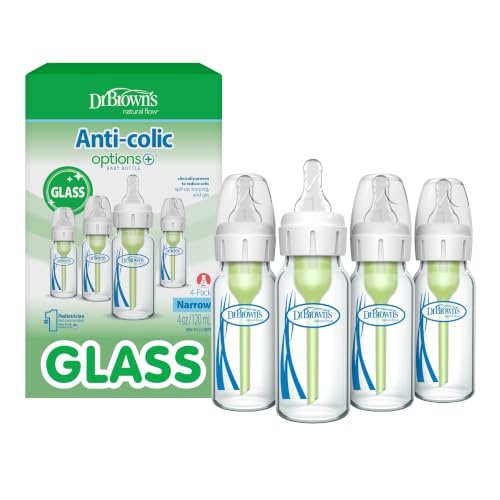
3. Dr. Brown’s Anti-Colic Options+ Narrow Glass Baby Bottle with Level 1 Slow Flow Nipple, 4 oz, 4-Pack
The gold standard in anti-colic feeding for a baby with a gassy belly.
Pediatricians have recommended Dr. Brown’s for years. Its internal vent system — a green tube that sits inside the bottle — creates vacuum-free feeding, which the manufacturer claims reduces colic, spit-up, burping, and gas. The bottle body is made from durable borosilicate glass (a heat-resistant glass that handles rapid temperature changes), so it can go from hot sterilization to cold fridge storage without cracking. The Level 1 Slow Flow nipple lets your baby feed at their own pace, closest to breastfeeding.
One buyer mentioned it “helped with gas from CMPA; no leaking when filled under line.” However, the vent system means multiple pieces to wash: the bottle, nipple, collar, and the green vent insert. A reviewer called it “annoying to wash due to extra pieces.” It is also heavier than silicone or plastic options. Another parent noted the “Size 1 nipple [is] fast for newborn; slower sizes available,” so you can swap to a size T or P if your baby chokes. At 4 oz, it matches the Philips Avent capacity but comes in a 4-pack.
Why it works
- Its clinically proven internal vent system reduces colic and gas better than most competitors.
- Durable borosilicate glass withstands temperature changes
- Consistent, vacuum-free flow mimics breastfeeding
- Breast-like nipple shape encourages a proper latch
The extra effort
- Multiple parts to wash after every feed — the green vent tube and insert
- Heavier than other options; one owner reported it “shattered on tile” when dropped
Reach for it if: Your baby is colicky, gassy, or spitty and you need the most proven anti-colic system available — more effective at reducing air than the Philips Avent’s simpler valve.
Look elsewhere if: You hate washing small parts or need a lighter, more portable bottle.
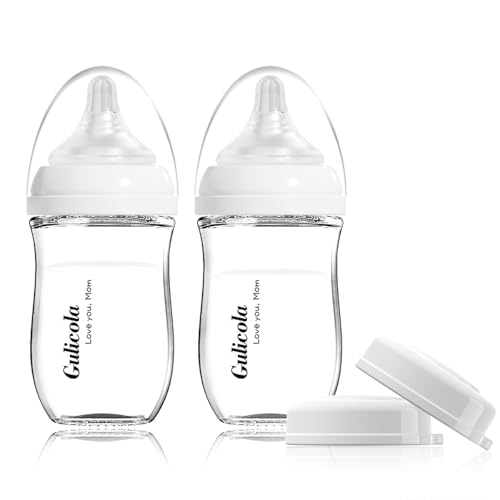
4. Gulicola Natural Glass Baby Bottle for Breastfeeding Babies, Newborn Anti-Colic Bottle Set with Slow Flow Nipple, 5 oz, 2-Pack
The glass bottle that survived drops on slate tile, according to buyers.
The Gulicola is a premium borosilicate glass bottle with a slow flow nipple designed for breastfed babies. The nipple is ultra-soft and mimics the natural feel, flex, and movement of breastfeeding, which helps a baby latch on naturally. Anti-colic vents (small holes in the nipple base) allow your baby to drink continuously without swallowing air bubbles. The bottle has only 4 pieces (bottle, nipple, collar, cap), making it far easier to clean than the 6-piece Dr. Brown’s with its internal vent system.
One customer observed the bottle “survived drops on slate tile,” which is unusual for glass. Another reviewer called it the “best of all glass bottles tested” and noted “no leaks, easy to clean, few parts.” The 5 oz capacity matches the Lansinoh glass bottles (5 oz each), but comes in a 2-pack rather than 4. A honest downside: “ounce markings [are] hard to see in low light,” so night feeds require a light to measure accurately.
Glass done right
- Borosilicate glass is heat-resistant, toxin-free, and surprisingly drop-resistant
- Ultra-soft nipple mimics breastfeeding movement, not just shape
- Only 4 pieces per bottle — simple to clean and reassemble
- Includes storage caps, so you can prep and store pumped milk in the same bottle
Small flaws
- Ounce markings are faint in dim light, making night feeding tricky
- 2-pack only — fine for starter, but you will need more if you feed exclusively by bottle
Best for: Parents who want glass purity without the complexity of the Dr. Brown’s vent system — and who have dropped a glass bottle before. It is the most drop-resistant glass option here.
pass on it if: You need clear markings for measuring or want a larger set of bottles right away.
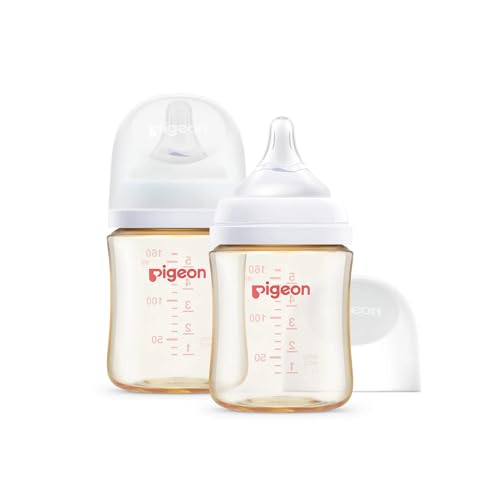
5. Pigeon PPSU Nursing Baby Bottle Wide Neck, Anti-Colic, 5.4 oz (2-Pack), Includes SS Nipples (0m+)
A bottle designed around research on how babies’ tongues actually move while nursing.
Pigeon’s nipple is built on research into three natural tongue movements babies make at the breast: peristaltic motion (wave-like sucking), curling, and extension. The nipple is super soft and flexible, with a “Latch-on Line” — a small ridge that guides your baby’s mouth into the correct position for effective suction. This makes it a top choice for a breastfed baby who cannot figure out how to latch onto a standard bottle nipple. The bottle body is PPSU (a lightweight, medical-grade plastic that is heat-resistant and shatterproof).
One user highlighted it “resolved latching/slow feeding; durable, leak-proof; improved feeding speed.” Another parent noted the downside: “8oz bottle lacks room for 4 formula scoops,” but the 5.4 oz (160 ml) version avoids that issue since it is meant for milk-only feeds. The 5.4 oz capacity is slightly larger than the 5 oz bottles from Lansinoh and Gulicola. It includes the hard-to-find SS (0m+) nipples, the slowest flow available — perfect for newborns and preemies.
Science behind the suck
- Nipple designed around the tongue’s three natural feeding movements — not just breast shape
- Latch-on Line helps baby achieve the correct latch every time
- Lightweight, shatterproof PPSU — a good middle ground between glass and plastic
- Slow-flow SS nipple included for 0m+, prevents choking in newborns
Honest trade-offs
- Premium price for a 2-pack — among the most expensive per-bottle
- PPSU, while durable, is still a plastic — some parents prefer glass for chemical-free confidence
If your baby cannot latch onto any other bottle: The research-backed nipple design gives you the best chance of teaching a resistant baby how to suck from a bottle — the SS nipple is even slower than the Philips Avent Flow 2, making it ideal for newborns.
Not for: Budget-conscious parents or those who insist on glass.
6. Lansinoh Glass Baby Bottles, Anti-Colic, 5 Ounces, 4 Count Bottles for Feeding
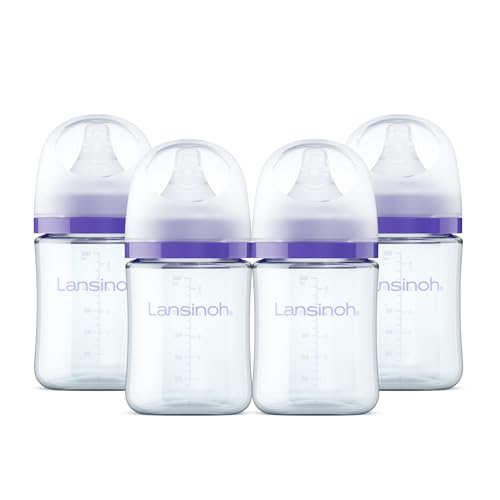
The best value for a complete glass bottle system — 4 bottles, 4 slow flow nipples.
Lansinoh’s glass bottles are a favorite among lactation consultants. The nipple is ultra-soft and strong with a wide, gentle slope that molds to your baby’s mouth, designed to support a secure latch. The air ventilation system (a small hole in the nipple) helps limit air intake, which reduces gas, fussiness, and spit-up. Each 5 oz bottle includes a Size S (slow flow) nipple recommended for 1-3 months. The set includes 4 bottles and 4 nipples, making it the best value in terms of count per bottle — double the bottles of the Gulicola 2-pack for a similar price.
One shopper added the bottles feel “sturdy and high quality” and that they have “dropped them a couple of times on the hardwood floor without any problems.” At 5 oz each, the capacity matches the Nanobebe and Gulicola bottles. A reviewer noted the bottles are “easy to clean (only 4 pieces total)” and “the oz markers are easy to read” — a clear advantage over the Gulicola’s faint markings.
Why it is a great starter set
- 4 bottles right from the start — enough for a full day or more
- Borosilicate glass is sturdy and survived hardwood-floor drops according to buyers
- Air ventilation system reduces gas and supports comfortable feeding
- Nipple is designed with lactation consultants’ input for a secure latch
What to keep in mind
- Heavier than silicone or PPSU bottles — not the most portable option
- Size S nipple may still be too fast for some newborns; extra-slow flow nipples are sold separately
For the parent who wants a full set on day one: This is the most economical way to get 4 glass bottles with slow flow nipples without buying extra parts — the best per-bottle value compared to the 2-pack Gulicola.
it’s not for you if: You have a premature baby who needs an extra-slow flow nipple — those are sold separately.
Understanding the Specs
Flow Rate — The #1 Reason Babies Refuse
Flow rate refers to how fast milk comes out of the nipple. For a breastfed baby, you want the slowest possible flow — typically labeled “Slow Flow,” “Level 1,” “Size S,” or “Newborn.” A nipple that flows too fast causes choking, sputtering, and a negative association with the bottle. A flow that is too slow frustrates an older baby. The Pigeon bottle includes a SS (0m+) nipple that is the slowest on the market, designed for the weakest suck.
Anti-Colic Venting — Why It Matters
An anti-colic vent system lets air escape from the bottle so your baby does not swallow it. Swallowed air causes gas pain, and a baby who associates the bottle with pain will push it away. The vents can be an internal tube (Dr. Brown’s), a nipple slit (Philips Avent), or a 360° valve (Nanobebe). More parts mean more washing but also more effective air removal.
Nipple Material and Shape
The nipple must feel like skin — ultra-soft silicone that is warm to the touch. A wide, breast-shaped base encourages a deep latch similar to breastfeeding. The Nanobebe and Pigeon nipples are among the softest available. The Philips Avent Natural Response nipple is unique because it stays shut until the baby actively sucks, preventing passive dripping that can overwhelm a breastfed baby.
Bottle Material
The three options are borosilicate glass (Lansinoh, Dr. Brown’s, Gulicola), soft silicone (Nanobebe), and PPSU plastic (Pigeon). Glass is inert and easy to clean but heavier and breakable. Silicone is the lightest, fastest-warming option but can be squeezed. PPSU is shatterproof and lightweight but is still a plastic — some parents avoid it for long-term use.
FAQ
Will a different bottle nipple actually make my breastfed baby accept the bottle?
How do I know if the flow rate is too fast for my baby?
Is glass or PPSU better for a breastfed baby?
Do anti-colic vents really reduce gas and fussiness?
My baby is 2 days old — which bottle is best for a newborn?
Can I use a bottle warmer with these bottles?
How many bottles do I actually need to start?
Will these bottles leak in my diaper bag?
Final Thoughts: The Verdict
For most parents, the best bottle for breastfed baby who refuses bottle winner is the Philips Avent Natural because the Natural Response nipple puts your baby in control of the milk flow — no choking, no air, no rejection. If your baby has severe gas issues, the Dr. Brown’s Options+ Glass is the most clinically proven solution. And for a baby who simply cannot latch onto a standard nipple, the Pigeon PPSU with its research-backed SS nipple gives you the best chance of a successful transition.
How We Picked
We do not accept paid placement. Every pick is matched to a real buyer and a real use-case; we do not hands-on test units.
Sources & Methodology
Specifications: manufacturer listings and product documentation. Review insights: verified customer reviews, as of July 2026. Pricing: not shown on this page (it changes often); check the current price via the retailer link.
As an Amazon Associate, Gadgets Feed earns from qualifying purchases. This does not affect which products we feature.
Related Guides
Product prices and availability are accurate as of the date/time indicated and are subject to change. Any price and availability information displayed on Amazon at the time of purchase will apply to the purchase of this product. As an Amazon Associate I earn from qualifying purchases.
CERTAIN CONTENT THAT APPEARS ON THIS SITE COMES FROM AMAZON. THIS CONTENT IS PROVIDED "AS IS" AND IS SUBJECT TO CHANGE OR REMOVAL AT ANY TIME.
Amazon and the Amazon logo are trademarks of Amazon.com, Inc. or its affiliates.