
Our readers keep the lights on and my morning glass full of iced black tea. As an Amazon Associate, I earn from qualifying purchases.
Specs are compiled from manufacturer listings and verified buyer reviews and can change over time — please confirm the key details on the product page before buying.
Your coffee is mostly water. So the bottle you pour into your brewer directly decides if your cup tastes bright and clean or flat and dull. The right mineral mix pulls flavor out of the grounds. The wrong mix leaves you with a brew that is either chalky, bitter, or lifeless.
I’m Min — the founder and writer behind Gadgets Feed. This guide is built by comparing the manufacturers’ published specifications and the patterns across verified customer reviews, so you get each pick’s real strengths and trade-offs instead of marketing spin.
If you want a cup that tastes like the roaster intended, the right choice depends on whether your beans need a high-mineral spark, a neutral canvas, or a silky smooth profile. That is exactly where this guide to the bottled water for coffee steps in.
Quick Picks
- BORJOMI Sparkling Mineral Water — Mineral Powerhouse
- FIJI Natural Artesian Water — Coffee Standard
- Acqua Panna Natural Spring Water — Premium Neutral
How To Choose The Best Bottled Water For Coffee
Picking water for coffee is not about which brand tastes best straight from the bottle. It is about how that water interacts with the coffee grounds during brewing. Three specs control that interaction: total dissolved solids (TDS — the amount of dissolved minerals in the water), pH, and the balance of magnesium versus calcium.
Total Dissolved Solids (TDS)
TDS — the amount of dissolved minerals in the water — matters because it decides how much flavor you extract from the grounds. For coffee, the Specialty Coffee Association recommends a range of 150–250 mg/L. Too low, and the water under-extracts — your coffee tastes sour and thin. Too high, and over-extraction makes it bitter and harsh. Spring and artesian waters naturally fall within that zone; distilled or purified waters do not.
pH Level
The pH scale runs from 0 (acidic) to 14 (alkaline). Coffee itself is slightly acidic, around pH 5. Using water that is too alkaline (above 8) can neutralize those acids and flatten the flavor. A water around pH 7 to 7.5 is the balance — it keeps the coffee’s natural brightness without adding metallic or chalky notes.
Magnesium vs. Calcium Content
Magnesium pulls fruit and acidity out of coffee more effectively than calcium. So waters with a higher magnesium-to-calcium ratio tend to produce a brighter, more aromatic cup. Waters heavy on calcium can still brew well but often yield a fuller body with less clarity. Check the mineral panel on the bottle to see which element dominates.
Quick Comparison
| Model | Best For | Mineral Profile | pH | Units | Amazon |
|---|---|---|---|---|---|
| BORJOMI Sparkling Mineral Water | Bold, mineral-forward brews | Very high sodium & bicarbonate | Alkaline (above 7.7) | 152.16 fl oz | $17.99Amazon |
| FIJI Natural Artesian Water | Clean, balanced all-day coffee | Natural electrolytes, double the top brands | 7.7 | 267.6 fl oz | Amazon |
| Acqua Panna Natural Spring Water | Smooth, neutral brewing base | Special mineral balance, low sodium | Neutral | 267.6 fl oz | Amazon |
In‑Depth Reviews
1. BORJOMI Sparkling Mineral Water
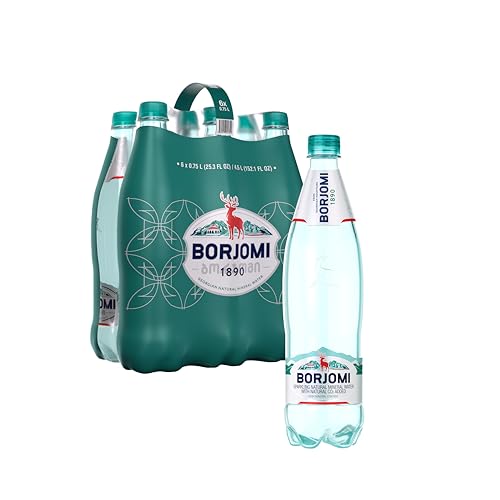
A volcanic-origin water so mineral-dense it changes the entire chemistry of your brew.
BORJOMI comes from Georgia’s Caucasus Mountains, where it naturally carbonates underground and picks up over 60 minerals including calcium, magnesium, and potassium. The result: a fizzy water that, when used for coffee, delivers a distinctly bold, minerally edge. Buyers report it has “very high mineral content (much higher sodium/bicarbonate than Gerolsteiner or Pellegrino),” so it acts more like a flavor additive than a neutral brewing base. The 25.3 oz bottles in a 6-pack give you 152.16 fluid ounces total.
That high sodium and bicarbonate level can overwhelm lighter roasts and make delicate single-origin beans taste muddy. One reviewer noted a “slightly salty taste” and compared it to whiskey versus beer — it is not a water for sipping all day. For dark roasts or a French press, though, the extra minerals accentuate chocolate and earthy notes in a way neutral water cannot. At 9.51 pounds for the pack, this carries far more mineral punch than the 17.47-pound Acqua Panna pack (which is far less mineral-dense).
Use this water if you want your coffee to taste big, mineral-rich, and uncompromising. Not every bean will welcome it.
Where it shines
- class-leading mineral depth for bold, earthy brews
- Natural carbonation adds a unique texture
- Rich in electrolytes for extraction
Where it holds back
- High sodium can overwhelm lighter roasts
- Some recent batches reported flat or chemical taste
- Carbonated water not ideal for all brew methods
Reach for this if: You brew dark French press or espresso and want a water that amplifies chocolate and spice notes.
Skip it for light or fruity single-origin beans that need a clean, neutral extraction.
2. FIJI Natural Artesian Water

The artesian water that gives you a clean brewing slate for almost any coffee style — and keeps your machine scale-free.
FIJI filters through volcanic rock in the remote Fijian Islands, picking up natural electrolytes along the way. The brand claims it has “more than double the electrolytes as the top premium bottled water brands,” which gives it a soft, smooth taste that translates into a balanced coffee cup. Its pH is 7.7 — slightly alkaline but still preserving coffee’s natural brightness without flattening it. Each bottle is 11.15 fluid ounces; the 24-pack gives you 267.6 fluid ounces total.
One buyer uses it in a fabric steamer and reported it worked “without clogging, unlike store-brand water that clogged it.” That same lack of scale and sediment makes it a reliable pick for drip coffee makers, espresso machines, and pour-over kettles — no mineral buildup to clean. The bottles measure 2.13 x 2.13 x 6.38 inches, a much smaller footprint than BORJOMI’s 8.62 x 5.75 x 10.76 inch bottles.
Compared to Acqua Panna, FIJI has a slightly more defined mineral taste — not as neutral, but far less aggressive than BORJOMI. It works well across medium to dark roasts, giving them body without bitterness. If you drink one type of coffee every day, this water provides consistent, reliable brews.
What stands out
- Balanced 7.7 pH preserves coffee acids
- Double electrolytes without added minerals, per the brand
- Leaves no scale in machines, per buyer reports
What to know
- Not as neutral as some spring waters
- Premium price compared to filtered tap
Go for this if: You want one water that works for any roast and keeps your brewer clean.
skip it if: You need a completely blank mineral canvas for very light or experimental roasts.
3. Acqua Panna Natural Spring Water

The spring water that lets your coffee’s own flavor be the star of the show — no mineral interference.
Acqua Panna comes from a protected spring in Tuscany, Italy, and is the most neutral of the three picks. The brand says its “special mineral balance from nature” is designed to complement food pairing, which translates directly to coffee: it extracts the beans’ own flavors without adding anything of its own. Buyers agree; one describes it as having a “smooth, clean taste with no metallic aftertaste; refreshing and easy to drink.” That absence of off-flavors is exactly what a clean coffee brew needs.
This 24-pack of 11.15 fluid ounce bottles delivers 267.6 fluid ounces, matching FIJI’s total volume. But at 17.47 pounds, it is significantly heavier than the 9.51-pound BORJOMI pack — for the same number of bottles. That extra weight comes from the water itself and the thicker plastic, something to consider if you carry cases up stairs. The 2.48 x 2.48 x 6.73 inch bottles are slightly wider than FIJI’s but still fit standard fridge shelves.
For coffee purists testing light roasts, single-origin naturals, or washed Ethiopians, this is the play. Each bean tastes exactly as the roaster intended: no mineral interference, no sodium bump, no carbonation. Compared to FIJI, which adds a slight mineral note, Acqua Panna is a true blank slate. If you rotate through different beans and want each one to show its true character, this is the bottle to grab.
Its edge
- Completely neutral flavor profile
- High volume per pack (267.6 fl oz)
- Fully recyclable bottles
Its limit
- Heavier case (17.47 pounds) than mineral water packs
- Lower mineral content may under-extract very light roasts
Pick this for: Pour-over and AeroPress brewing with single-origin beans where clarity matters most.
Skip it for: Dark espresso blends that benefit from a mineral-heavy water for body.
Understanding the Specs
Total Dissolved Solids (TDS)
TDS tells you how many dissolved minerals are in the water. For coffee, the balance recommended by the Specialty Coffee Association is 150–250 mg/L. Too low, and water under-extracts, leaving your cup sour. Too high, and you get bitter, over-extracted coffee. Spring and artesian waters naturally land in this range; distilled water does not.
pH Level
The pH scale measures acidity versus alkalinity. Coffee itself is slightly acidic, around pH 5. Water that is too alkaline (above pH 8) neutralizes those acids and flattens the taste. Water around pH 7 to 7.5 preserves the coffee’s natural brightness. FIJI sits at a perfectly balanced 7.7, making it a reliable middle-ground choice that keeps your coffee’s natural brightness intact.
FAQ
Can I use sparkling mineral water for coffee?
Will bottled water with high minerals damage my coffee machine?
What is the ideal pH for brewing coffee?
Is spring water better than artesian water for coffee?
How much bottled water do I need for a week of coffee?
Can I use distilled water for coffee?
Does bottled water expire for coffee brewing?
What is the difference between natural spring and natural artesian water?
Final Thoughts: The Verdict
The bottled water for coffee winner for most people is the FIJI Natural Artesian Water. Its 7.7 pH and double electrolytes deliver a balanced brew for medium and dark roasts without scaling your machine — a more versatile choice than the mineral-heavy BORJOMI and more flavorful than the neutral Acqua Panna. If you want a completely neutral base that lets single-origin beans shine, grab the Acqua Panna Natural Spring Water. And for bold espresso or French press drinkers seeking intense mineral depth, the BORJOMI Sparkling Mineral Water delivers a punch no other bottled water here can match.
How We Picked
We do not accept paid placement. Every pick is matched to a real buyer and a real use-case; we do not hands-on test units.
Sources & Methodology
Specifications: manufacturer listings and product documentation. Review insights: verified customer reviews, as of July 2026. Pricing: not shown on this page (it changes often); check the current price via the retailer link.
As an Amazon Associate, Gadgets Feed earns from qualifying purchases. This does not affect which products we feature.
Product prices and availability are accurate as of the date/time indicated and are subject to change. Any price and availability information displayed on Amazon at the time of purchase will apply to the purchase of this product. As an Amazon Associate I earn from qualifying purchases.
CERTAIN CONTENT THAT APPEARS ON THIS SITE COMES FROM AMAZON. THIS CONTENT IS PROVIDED "AS IS" AND IS SUBJECT TO CHANGE OR REMOVAL AT ANY TIME.
Amazon and the Amazon logo are trademarks of Amazon.com, Inc. or its affiliates.