
If you trailer your boat, the bottom paint you choose faces a unique dual life: underwater antifouling performance when launched, and hard, abrasion-resistant durability against bunks and rollers during repeated highway runs. Soft ablatives erode on trailer pads, while hard paints can crack. The right film balances slickness for the ramp, biocides for the slip, and a rock-solid cure that doesn’t flake off on the next tow.
I’m Min — the co-founder and writer behind Gadgets Feed. I’ve spent countless hours cross-referencing marine chemistries, reading through hundreds of boater field reports on epoxy bedliners, hard vinyls, and copper-free ablatives to map exactly which formulations survive the abuse of a trailered hull.
This guide breaks down the spray patterns, cure times, and abrasion resistance that matter most, so you can confidently pick the right best bottom paint for trailered boats for your season on the water and the miles of pavement between launches.
How To Choose The Best Bottom Paint For Trailered Boats
Choosing bottom paint for a trailered boat is different than selecting paint for a boat that stays in a wet slip all season. The coating must handle two harsh environments: submerged marine growth pressure and physical abrasion from carpeted bunks, steel rollers, and road grit during long hauls. A soft ablative paint designed for constant water contact will wear through on the trailer in a season. A hard, slick coating is the answer.
Hard Paint vs. Ablative vs. Epoxy Bedliner
Hard vinyl paints like Interlux Fiberglass Bottomkote NT cure to a tough, burnishable film that resists scuffing from trailer supports. They still release biocide slowly through the paint matrix. Ablative paints are self-polishing and wear away as the boat moves through water, but trailer contact accelerates this wear unevenly. Epoxy coatings such as Fasco Epoxies Super Slick 2000 or polyurethane bedliners like Durabak create a thick, impact-resistant shell that seals rivets and protects against rock strikes. For a boat launched and retrieved weekly, a hard paint or epoxy bedliner offers the longest service life.
Copper-Free Formulations for Aluminum
If your boat has an aluminum hull, outdrive, or trim tabs, copper-based antifouling paints can cause galvanic corrosion when immersed in salt or brackish water. Copper-free paints like TotalBoat Krypton use organic biocides to prevent barnacle and algae growth without the electrochemical risk. They also come in brighter, more stable colors since there’s no copper oxide to tint the paint. For trailered aluminum boats that also spend days in saltwater harbors, a copper-free hard paint is the safest long-term choice.
Cure Time and Launch Windows
Trailered boats are often painted on the trailer, then launched within 24 to 48 hours. Fast-cure formulations like Rust-Oleum Marine Bottom Paint (16 hours to full cure) or TotalBoat JD Select (6 hours) let you get back on the water quickly. Epoxies and polyurethanes often require 24 to 72 hours before the coating is fully cured and ready for immersion. Check the manufacturer’s dry time and water-resistance window; painting just before a weekend trip means choosing a product that cures fast enough to launch on Sunday without waterlogging the film.
Quick Comparison
On smaller screens, swipe sideways to see the full table.
| Model | Category | Best For | Key Spec | Amazon |
|---|---|---|---|---|
| Interlux YBA063/QT Trilux 33 | Premium Hard Paint | Multi-season use on fiberglass | 200 ft² coverage per quart (2 coats) | Amazon |
| TotalBoat Krypton | Copper-Free Hard Paint | Aluminum hulls and outdrives | 125 ft² coverage per quart | Amazon |
| Interlux Fiberglass Bottomkote NT | Hard Vinyl Paint | Long freshwater immersion | 500 ft² coverage per gallon | Amazon |
| Durabak 18 Textured | Polyurethane Bedliner | High abrasion and non-slip deck | 60 ft² coverage per gallon (2 coats) | Amazon |
| Fasco Epoxies Super Slick 2000 | Two-Part Epoxy | Sealing rivets and slick glide | ~30 ft² coverage per quart kit | Amazon |
| TotalBoat JD Select | Ablative Paint | Seasonal saltwater use | 125 ft² coverage per quart | Amazon |
| Rust-Oleum Marine Flat Bottom | Hard Enamel Paint | Budget-friendly trailered boats | 100 ft² coverage per quart | Amazon |
In‑Depth Reviews
1. Interlux YBA063/QT Trilux 33 Antifouling Paint – Black, Quart

Interlux Trilux 33 is a hard, non-ablative antifouling paint that cures to a durable matte finish capable of standing up to repeated trailer bunks and pressure washing. Its copper-free biocide package makes it safe for aluminum outdrives and trim tabs, delivering season-long fouling protection in both salt and fresh water. The 200 ft² coverage per quart for two coats covers a 22-foot hull efficiently, reducing the number of cans needed per job.
Boaters report excellent adhesion to properly prepared fiberglass and wood bottoms, with a finish that resists chipping when the hull contacts trailer rollers. The 36-hour full cure time is longer than some alternatives, so you need to plan painting for early in the week if launching on a weekend. Reviewers note that the paint holds up well even in warm South Florida saltwater, with minimal barnacle attachment after a full season between hauls.
The packing quality is a recurring concern — cans often arrive in thin bags rather than padded boxes, leading to dented rims and leakage. If you buy online, inspect the lid seal immediately. Despite the shipping variable, the film performance is consistently rated as top-tier for a trailered application where you need the paint to stay on the hull, not on the trailer bunks.
Why it’s great
- Copper-free formula is safe for aluminum outdrives and trim tabs.
- Hard finish withstands bunk abrasion without wearing through.
- Excellent coverage per quart for a two-coat application.
Good to know
- Requires a full 36-hour cure before immersion.
- Shipping packaging is often inadequate, risking can damage.
2. TotalBoat Krypton Copper Free Antifouling Bottom Paint (Black, Quart)
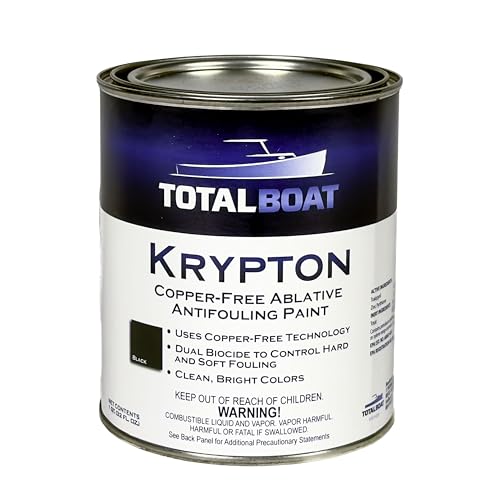
TotalBoat Krypton is a copper-free hard paint specifically designed for aluminum boats, outdrives, and trim tabs. Its eggshell finish resists abrasion from trailer bunks while the organic biocide package prevents barnacle and slime buildup in salt, brackish, and fresh water. The 125 ft² coverage per quart allows two thin coats on a 16-foot fiberglass skiff with some left over, and the paint applies smoothly by brush or HVLP sprayer when thinned with TotalBoat Thinner 101.
A Sailing magazine test found Krypton had the least growth accumulation among copper-free paints after two years of immersion, a testament to its biocide efficacy. Boaters on aluminum hulls praise its adhesion to zinc chromate primer and note that it does not accelerate galvanic corrosion. The paint dries to a uniform, slightly textured eggshell that hides minor surface imperfections and covers scratches from shallow grounding well.
One caveat is UV sensitivity — after several months of direct sunlight exposure in high-altitude climates, the blue variant showed fading and blistering on exposed surfaces. The black color tested here is more stable, but if your boat spends weeks on the trailer in full sun, a UV-resistant topcoat or a non-painted storage cover is advisable. For a trailered boat that sees alternating cycles of water and sun, Krypton offers excellent protection where it counts most: underwater.
Why it’s great
- Copper-free and safe for all aluminum hull components.
- Superior fouling resistance proven in independent marine tests.
- Smooth, even application with brush or spray gun.
Good to know
- Not UV-stable in direct sunlight for prolonged dry storage.
- Coverage may require a full gallon for larger 30+ foot hulls.
3. Interlux Fiberglass Bottomkote NT, 1 Gallon, Blue

Interlux Fiberglass Bottomkote NT is a hard vinyl antifouling paint that delivers a glossy, burnishable finish suitable for fiberglass and wood boats. The gallon container provides 500 ft² of coverage, which translates to two generous coats on a 27-foot cabin cruiser with leftover paint. Its hard film is less prone to wearing through on trailer bunks than softer ablative paints, making it a strong candidate for boats that are launched weekly and stored on the trailer between trips.
Reviewers report that after three years in fresh water, the hull showed only about 5 percent algae and quagga mussel growth, significantly outperforming expectations. The paint applies with a 3/8-inch nap roller, but its low viscosity requires a steady hand to avoid drips. The biocide odor is strong — a half-face respirator with organic vapor cartridges is mandatory, not optional. Mixing with a drill-powered stirrer ensures the copper particles are evenly suspended for consistent antifouling action.
The price per gallon is competitive with marine store prices, and Amazon packaging has improved with lid clips and tape to prevent leaks during shipping. For the trailered boater who wants a hard, durable film that can be power-washed mid-season without stripping the coating, Bottomkote NT offers outstanding value and proven longevity across multiple seasons of mixed immersion and trailer handling.
Why it’s great
- Exceptional value per gallon for large hulls.
- Hard vinyl finish resists trailer bunk abrasion.
- Proven multi-season performance in fresh water.
Good to know
- Strong biocide fumes require full respiratory protection.
- Water-thin viscosity demands careful roller technique.
4. Durabak 18 Textured Non-Slip Coating (White, Gallon)

Durabak 18 is a one-part, moisture-cure polyurethane coating with recycled rubber granules that create a tough, non-slip textured surface. While it lacks antifouling biocides, it functions as an ultra-durable bedliner for boat bottoms, decks, and even trailer surfaces that are exposed to direct sunlight. The white gallon covers roughly 60 ft² with two coats, and the material bonds aggressively to prepared fiberglass, aluminum, concrete, or wood without a separate primer.
Boaters using it on aluminum hulls report excellent impact resistance — the textured layer absorbs rock strikes and bunk abrasion without chipping. The semi-gloss finish stays cooler than dark colors under summer sun, and the UV stability of Durabak 18 is a clear advantage over standard iron oxide bottom paints. Application requires a special stipple roller or a brush; xylene cleanup is straightforward, but overspray from spraying is difficult to remove once cured.
One tradeoff is coverage — the thick texture means a gallon goes less distance than a thin film coating. For a 14-foot jon boat, two coats used almost the entire gallon. It is not an antifouling paint, so if you leave the boat in the water for weeks, visible growth will occur. However, for a trailered boat that is in the water only 48 to 72 hours at a time, Durabak eliminates the need to repaint every season and makes hull cleanup as simple as a garden hose spray-down.
Why it’s great
- Extreme abrasion resistance from recycled rubber texture.
- UV-stable and suitable for prolonged dry storage.
- Seals leaky rivets and prevents water intrusion.
Good to know
- No antifouling biocide — growth will occur with long immersion.
- Low coverage rate per gallon compared to thin-film paints.
5. Fasco Epoxies Super Slick 2000 Epoxy Bottom Coating (Quart Kit)
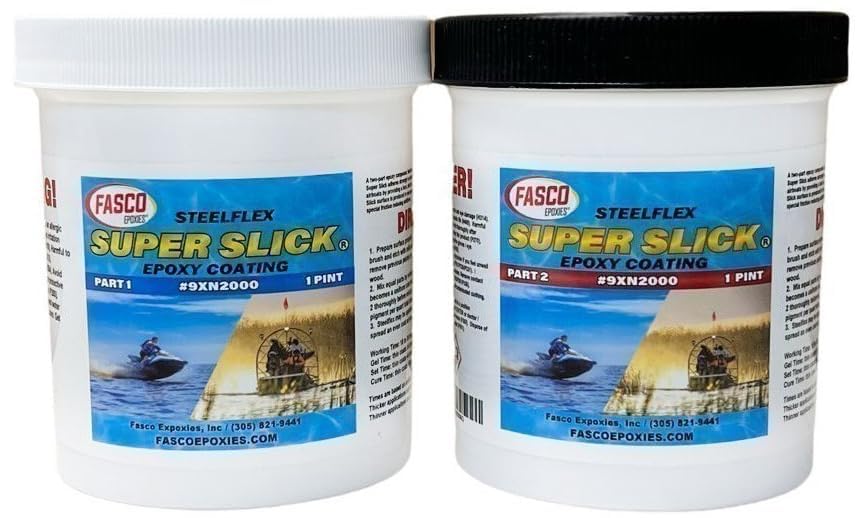
Fasco Epoxies Super Slick 2000 is a two-part epoxy coating fortified with PTFE that cures to an exceptionally slippery finish. It is formulated for airboats, jon boats, and aluminum hulls that encounter mud, grass, sand, and shallow water. The 1:1 mix ratio is straightforward, and a single thin coat on a 14-foot jon boat seals all rivets, ribs, and pinholes, creating a waterproof barrier that also reduces friction on the trailer bunks.
Boaters report that the coating dramatically reduces sticking when beaching on rocky shores, and the boat slides off the trailer so easily that you must secure the winch strap before backing down the ramp. The epoxy film also serves as a sacrificial layer on the bottom — scratches from gravel bars affect the epoxy, not the bare aluminum. The quart kit covers approximately 30 ft², which is enough for one generous coat on a small skiff or two thin coats on a canoe.
The main challenge is pot life — the epoxy thickens quickly after mixing, so you need to work fast with a brush or pour-and-spread technique. Some users noted surface crinkling when applied in high-humidity conditions or when the mixed batch sat too long before application. Proper surface prep with aluminum brightener is critical for adhesion. If you need a slick, sealing coating that handles abrasive trailer contact and shallow-water scraping, this epoxy delivers in a way typical paints cannot.
Why it’s great
- PTFE-infused epoxy creates the slickest available finish for quick ramp releases.
- Seals leaky rivets and pinholes completely.
- Excellent abrasion resistance against mud, sand, and rocks.
Good to know
- Short pot life requires fast, efficient application.
- Low coverage per quart kit compared to standard paints.
6. TotalBoat JD Select Ablative Antifouling Bottom Paint (Black, Quart)

TotalBoat JD Select is a water-based ablative antifouling paint that wears away gradually as the boat moves through the water, exposing fresh biocide and minimizing the paint buildup that requires sanding between seasons. The low-VOC formula produces minimal odor and cleans up with soap and water, making it suitable for DIY boaters who paint in their driveway without full respirator gear. Coverage is 125 ft² per quart, and it can be recoated in 6 hours with a full cure ready for launch.
Boaters using JD Select in the Sea of Cortez and other warm saltwater environments report one season of effective barnacle and weed resistance with a single coat on small hulls. The flat black finish goes on smoothly with a brush or 3/16-inch nap roller, and the water-based formulation allows easy thinning with up to 10 percent water. For a trailered boat that only stays in the water for a few days at a time, the ablative action is slower, extending the life of the coating across multiple seasons.
The primary drawback for trailered use is that the paint is designed to abrade in the water, and trailer bunks will accelerate this wear unevenly. If your boat is on the trailer for weeks between launches, the exposed areas at the bunk contact points will degrade faster than the rest of the hull. For seasonal trailered boats that get a fresh coat every spring, JD Select offers a clean, low-fume application experience at a reasonable cost per quart.
Why it’s great
- Water-based formula with low odor and easy soap-and-water cleanup.
- Fast 6-hour recoat time for quick weekend projects.
- Smooth, even coverage without lumps or runs.
Good to know
- Soft ablative film wears unevenly on trailer bunk contact points.
- Shipping packaging lacks padding — cans may arrive leaking.
7. Rust-Oleum 396967 Marine Flat Boat Bottom Antifouling Paint (Quart, Black)
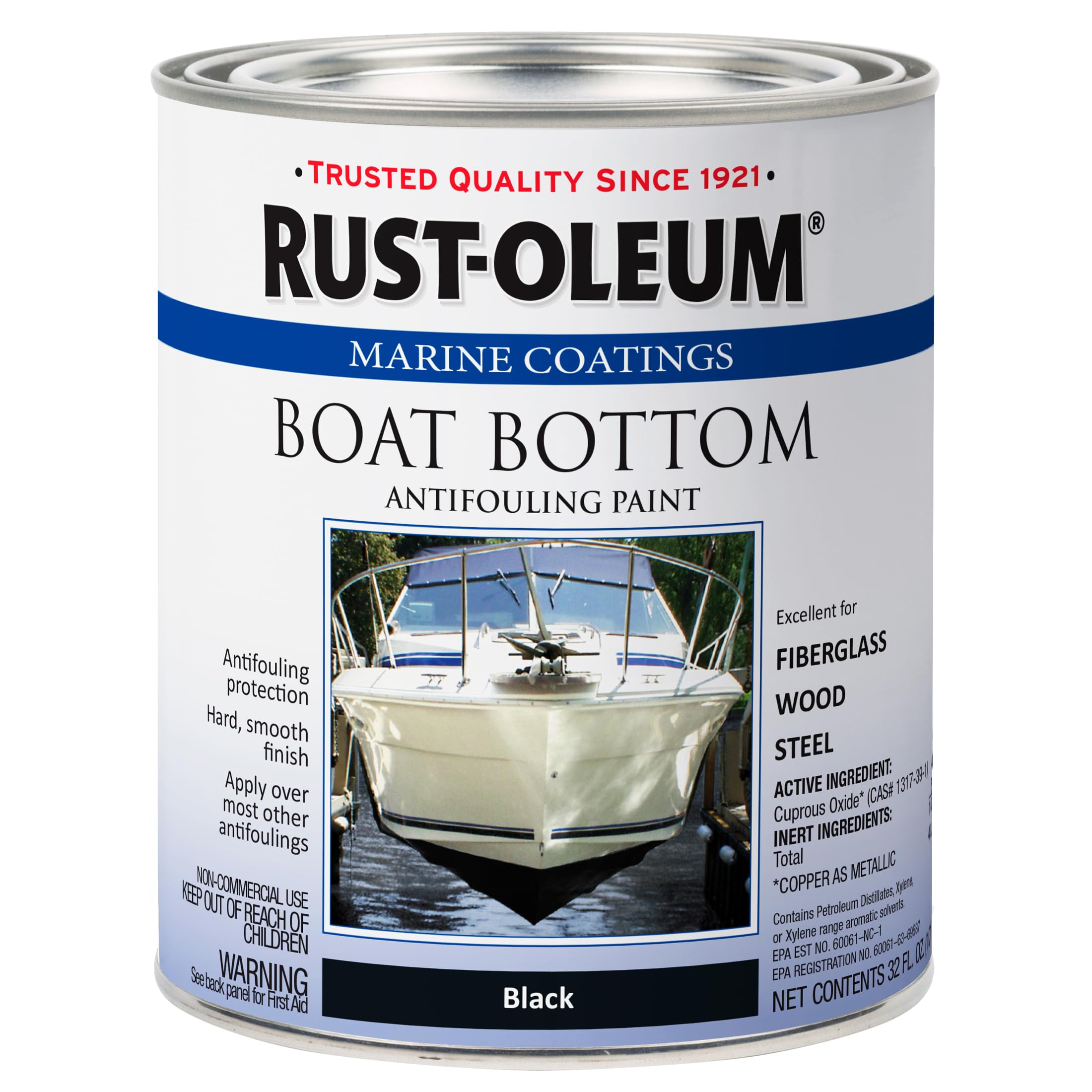
Rust-Oleum Marine Flat Boat Bottom Antifouling Paint is a hard enamel coating formulated to prevent fouling on fiberglass, wood, and steel surfaces. It releases copper slowly to discourage barnacles, algae, and marine growth while curing to a smooth, flat finish that handles the physical contact of trailer bunks reasonably well. A single quart covers up to 110 ft² with a 16-hour cure time before launching, allowing for a same-weekend paint-and-launch routine.
Boaters in South Florida report that two quarts applied to a 22-foot center console with a diver cleaning once a month resulted in minimal barnacle attachment after an entire year in hot saltwater. The 4-hour recoat window enables two thin coats in a single afternoon. The paint is noticeably thick and requires thorough mixing with a paddle stirrer to keep the copper particles in suspension — a few reviewers noted that unmixed sections led to uneven antifouling coverage.
The packaging handling is a standout — Rust-Oleum uses extra clips and seals that prevented spillage even after the cardboard box suffered carrier damage. The hard finish also withstands power washing without stripping, a key feature for trailered boats that need a mid-season clean. For the budget-conscious boater who wants functional antifouling performance without paying premium prices, Rust-Oleum delivers a durable, effective coating that keeps the hull clean and trailering smooth.
Why it’s great
- Hard enamel finish resists bunk abrasion better than soft ablatives.
- Fast 4-hour recoat and 16-hour launch window.
- Robust packaging with extra clips prevents shipping leaks.
Good to know
- Requires extremely thorough mixing for consistent copper dispersion.
- Thick consistency may need thinning for spray application.
FAQ
Can I use a standard ablative bottom paint on a boat that sits on a trailer for weeks between launches?
How do I prepare my aluminum hull for copper-free bottom paint?
What roller nap is best for applying hard bottom paint?
How many coats of bottom paint do I need for a trailered boat?
Final Thoughts: The Verdict
For most users, the best bottom paint for trailered boats winner is the Interlux YBA063/QT Trilux 33 because it combines a hard, abrasion-resistant film with copper-free biocide safety for aluminum components and outstanding coverage per quart. If you want a super-slick epoxy that seals leaky rivets and slides off the trailer like butter, grab the Fasco Epoxies Super Slick 2000. And for a UV-stable, impact-resistant bedliner that keeps your hull protected even during long dry storage, nothing beats the Durabak 18 Textured Coating.