
Our readers keep the lights on and my morning glass full of iced black tea. As an Amazon Associate, I earn from qualifying purchases.
Specs are compiled from manufacturer listings and verified buyer reviews and can change over time — please confirm the key details on the product page before buying.
Bowfishing is a completely different game from target shooting or deer hunting — you are firing at a moving fish through a layer of water that bends your arrow’s path, often from a rocking boat or a muddy bank. The bow you choose for this job needs to handle repeated shots in tough conditions (mud, water, direct sun) without seizing up or losing its sting, and the right kit comes with a reel and line built for pulling a heavy gar or carp back to the surface.
I’m Min — the founder and writer behind Gadgets Feed. This guide is built by comparing the manufacturers’ published specifications and the patterns across verified customer reviews, so you get each pick’s real strengths and trade-offs instead of marketing spin.
The picks here are the models that actually survive a season on the water — the honest bowfishing bow that hits hard without falling apart.
Our Picks at a Glance


How To Choose The Best Bowfishing Bow
Picking a bowfishing bow depends on a few decisions that are different from picking a hunting or target bow. You are shooting at close range through an optically dense medium (water), the arrow is attached to a fishing line, and you might get the riser wet or muddy every single trip. Here is what to focus on.
Recurve vs. Compound for the Water
A recurve bow is simpler, lighter, and has fewer moving parts to fail when splashed — many experienced bowfishers prefer it because you can clear mud or debris with a quick rinse. A compound bow gives you higher let-off (the percentage of weight you hold at full draw), meaning you can sit at full draw longer waiting for a fish to swim into range. The trade-off is more complexity and a higher price tag.
Draw Weight and Adjustability
You need enough poundage to drive the arrow through water and penetrate a fish’s body, but not so much that you fatigue after a few shots. Most bowfishing rigs land between 30 and 55 pounds. Adjustable draw weight (some models allow a range like 15-45 lbs) lets a single bow serve a beginner and a stronger shooter, or let you dial it down for a long day of shooting.
The Reel and Line Matter as Much as the Bow
The reel is what pulls your arrow (and your fish) back. A simple hand-wrap reel or bottle reel is cheapest and most rugged — no complex gears to clog with mud. A spin reel (like a small fishing reel) retrieves faster but adds weight and needs more maintenance. Pre-spooled line strength matters too: 60-pound test is okay for small fish, but big carp or gar will snap it, pushing serious shooters toward 150-pound tournament line.
Durability and Build Materials
A bowfishing bow takes more abuse than any target bow. Aluminum risers hold up well; composite limbs are lighter and resist moisture. The finish should handle sun and occasional submersion without peeling or corroding. A no-slip grip is crucial because sweaty or wet hands cannot afford to lose control at the shot.
Quick Comparison
| Model | Best For | Draw Weight | Axle-to-Axle | Let-Off | Amazon |
|---|---|---|---|---|---|
| Cajun Fish Stick RTF★ Best Overall | Best Overall Starter | 45 lbs | 56″ (recurve) | N/A (recurve) | Amazon |
| CenterPoint TyphonPremium Performer | Premium Performer | 55 lbs | N/A (compound) | N/A | Amazon |
| PSE KingFisherBrand Favorite | Trusted Recurve Brand | 45 lbs | 56″ (recurve) | N/A (recurve) | Amazon |
| PANDARUS L2 Kit | Adjustable Compound Value | 15-45 lbs | 34.2″ | 70% | Amazon |
| Motion Zeus Kit | Compact All-in-One | 15-45 lbs | 34.2″ | 70% | Amazon |
| Lanneret L2 Compound | Budget Compound | 15-45 lbs | 34.2″ | 70% | Amazon |
| Muzzy Vice V2 | Long-Range Power | 30-60 lbs | 30″ | 75% | Amazon |
| Cajun Sucker Punch Pro | Compact Premium | 50 lbs | 31″ | 65% | Amazon |
| SPG Recurve Kit | Budget Intro | 40 lbs | N/A (recurve) | N/A (recurve) | Amazon |
In‑Depth Reviews
1. Cajun Bowfishing Fish Stick RTF Kit
Our pick — over 4★ from 300+ verified ratings; the strongest balance of quality and price.
The workhorse recurve that thousands of beginners and veterans trust on the water.
The Fish Stick gives you a complete ready-to-fish package so you can start shooting today. It includes a 56-inch recurve bow (that means the bow is 56 inches from tip to tip when unstrung, giving you a smooth draw), a drum reel pre-spooled with 60-pound test line (strong enough for common carp but not for trophy gar), a roller rest, and an arrow tipped with a Piranha point. The high-grade aluminum riser (the central handle piece) and composite limbs (the flexible top and bottom parts) handle mud and bumps well, and the no-slip rubber grip keeps your hold steady even when your hands are wet.
What wins owners over is the build quality for the money — the bow draws smoothly at its 45-lb peak, and it has threaded holes (manufactured screw mounts) that accept upgraded reels like the Cajun Winch Pro or AMS models. At 5 pounds it is light enough to carry all day along a river bank. The mixed feedback on the hand reel is fair: it works but is slow, so many owners swap it for a spin reel (a fast gear-driven reel) after the first season.
Real-world trade-off: The kit arrow is a basic fiberglass shaft that can snap under heavy abuse. Buyers report that one owner reported the nock (the plastic part at the back of the arrow that clips onto the string) breaking after a dozen trips. Grab a few spare arrows and consider an enclosed rest — and you have a rig that outshoots anything near its price.
Who it fits: The first-time bowfisher who wants a proven, simple recurve that comes complete and needs nothing else to start shooting today.
2. CenterPoint AVCT40KT Typhon Complete Kit
The highest-draw-weight compound in the lineup, built for serious fish.
The Typhon delivers 55 pounds of draw weight — more than any other kit here — so you can drive an arrow through deeper water and bigger fish like large gar. It includes everything you need: the compound bow, sight, and reel package. The aluminum and fiberglass build keeps the weight at just 5 pounds, and the ambidextrous design (it fits right or left hand) makes it a rare find for lefty shooters who struggle to find ready-to-fish rigs.
Owners who get a good unit call it a fantastic performer, praising its power and how quickly they were shooting fish. The catch with the Typhon is consistency: a few owners mention the bow breaking on the second draw or the reel line being hard to replace. The 4.4-star average with only a couple dozen ratings tells you it is a narrow-but-devoted audience — you are buying a high-power compound at a mid-range price, and that means checking everything on arrival.
The honest caveat: If you love the idea of 55 lbs but worry about customer service, factor that into your choice. This bow rewards the patient buyer who inspects the kit carefully.
Reach for this if: You need the extra poundage for big carp or gar, and you are comfortable with a compound bow’s setup complexity.
Look elsewhere if: You want a simpler recurve that has zero mechanical parts to fail.
3. PSE Archery KingFisher Recurve Package
The 56-inch recurve from a legendary archery brand, made in the USA.
PSE’s KingFisher has the same 56-inch length and 45-lb draw weight as the Fish Stick above, but the build is different: a precision-machined riser and limbs covered in a DK’D camo pattern (a digital camouflage print) that helps you stay hidden from fish in clear, shallow water. The package includes a drum reel with 66 feet of 60-pound test line (enough for medium fish in open water), the Fish Stick arrow with safety stop and slide (a device that keeps the arrow from sliding off the line), and finger savers (soft rubber guards on the string) pre-installed.
The feedback loop on this one is mixed. Several buyers love the bow itself — it is a genuine PSE product at a price that undercuts most compound kits. But one owner reported a limb splitting after two trips, and PSE does not sell replacement limbs for this model.
The bottom line: The KingFisher is a solid recurve bow that looks great and shoots well — if you get a properly assembled unit. Open the box immediately, check the rest and string, and return it if anything is off.
Best for: Shooter who trusts the PSE name and is willing to double-check the kit on arrival.
Not for: Anyone who wants a guaranteed out-of-box experience with zero hassle — check the Fish Stick instead.
4. PANDARUS L2 Bowfishing Bow Kit

A fully adjustable compound bow kit that goes from 15 to 45 lbs — one bow for the whole crew.
The PANDARUS L2 is a compact compound bow (a bow with wheels and cables that reduce the effort to hold it at full draw) with a 34.2-inch axle-to-axle length (the distance between the two cam wheels, making it easy to swing in tight spaces) and a 70% let-off (so you hold only 30% of the 45-lb peak weight at full draw — about 13.5 lbs). That let-off helps when you are waiting for a fish to swim into range. The draw length adjusts from 18 to 29.5 inches (covering most adult and teen arm spans), so a teenager and an adult can share the same bow by swapping settings. The kit includes a 1-pin sight, brush arrow rest, spin doctor reel (a fast gear-driven reel), reel seat, compound bow case, and three fiberglass Piranha arrows.
Quality is the top praise from owners — 14 buyers call it out as a well-made bow for the price. The drawbacks are the assembly manual (multiple people call it the worst they have seen) and the arrow rest, which can let the arrow fall off during the draw if you do not adjust it correctly. Compared to the Fish Stick recurve, this PANDARUS gives you more adjustability and a higher let-off, but it also introduces the complexity of setting up a compound bow.
Smart move: Watch a YouTube video on compound bow setup before you unpack this kit — the manual alone will frustrate you. Once it is tuned, the bow draws smooth and shoots true.
Reach for this if: You want a compound bow with a broad adjustment range for multiple family members, and you are patient with initial setup.
5. Motion Zeus Bowfishing Bow Kit

Shows up almost fully assembled, with three arrows and a reel that handles big fish.
The Motion Zeus kit shares the same 34.2-inch axle-to-axle frame and 70% let-off as the PANDARUS L2, but it adds a reel with about 40 meters (roughly 131 feet) of high-abrasion-resistant line — enough to fight big fish from the depths without the line fraying. The bow comes with three fiberglass arrows (double the number most kits include), and customers note that the bow draws smooth and shoots accurately right from the start.
Compactness is the headline here: it is lightweight, manageable for beginners, and easy to maneuver on a crowded boat. The main pain point reported is the lack of detailed assembly instructions — the kit assumes you already know how to set up a compound bow. A few owners had the reel fail after some use, but the seller replaced the entire kit without issue. This is a 15-45-lb bow that genuinely serves the beginner and grows with them as they dial the weight up.
One catch: The arrows have barbed tips (prongs that hook into the fish) that cause severe injury if mishandled — this is not a catch-and-release tool. Know your local regulations.
Reach for this if: You want a compact, ready-to-shoot compound kit with extra arrows and a seller who stands behind the product.
6. Lanneret L2 Compound Bow Fishing Kit
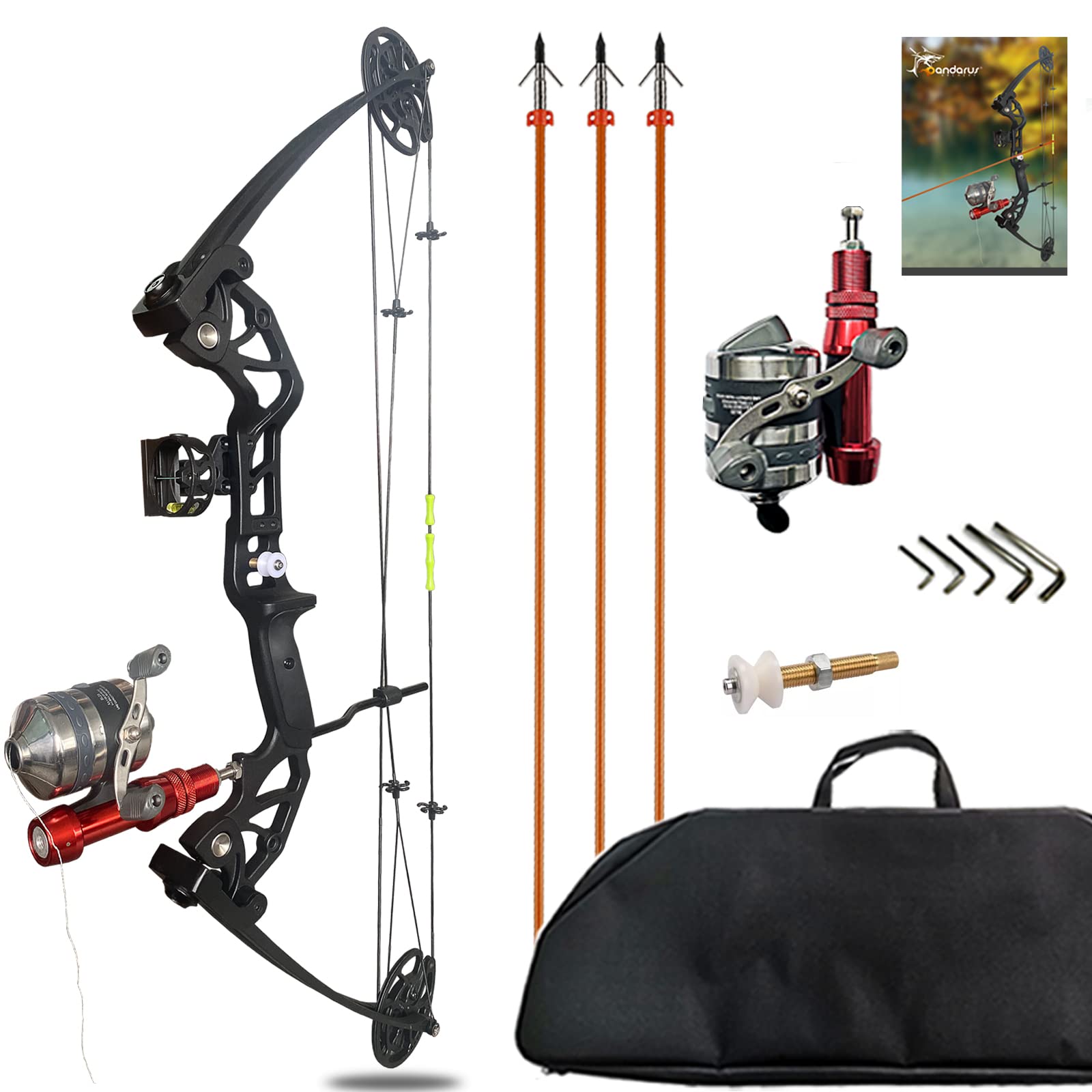
The cheapest fully adjustable compound bow kit — if you are lucky, it is a steal.
The Lanneret L2 offers the same 15-to-45-lb adjustable draw weight and 70% let-off as the PANDARUS and Motion Zeus, at the lowest price of any compound in this guide. The riser is a strong aluminum alloy, and the right-handed model includes a one-hand-operated fishing reel. For a beginner who does not want to spend much to try bowfishing, this hits a tempting price point.
Value is what owners praise most — only 5 highlighted that, but it is the top positive aspect. The durability picture is rougher: multiple reviewers point out the string popping off after two or three shots, and the bow breaking entirely after just a couple of draws. The review pages sum it up: great if you get a good unit, but the quality control is inconsistent. Unlike the Fish Stick (which has 30 positive quality mentions), this bow’s highest aspect count (10) is actually marked “Mixed” by Amazon.
The honest read: This is a gamble at the price. If you are handy with a bow press (a tool used to unstring and work on compound bows) and want a project, it can work. If you need to shoot fish on day one, the Fish Stick or Motion Zeus are safer bets.
Best for: The tinkerer on a tight budget who is comfortable tuning a compound bow and understands they might need to replace the string.
Not for: Anyone who values reliability over the lowest possible cost.
7. Muzzy Bowfishing Vice V2 Spin Kit

The compound bow that fires arrows at 320 fps and adjusts from 30 to 60 lbs.
The Muzzy Vice V2 is the most powerful compound in this guide, with a draw weight range of 30 to 60 lbs and an arrow speed of 320 fps (feet per second — so the arrow reaches the fish fast, reducing the chance it deflects off the water surface). At 30 inches axle-to-axle and just 3.2 pounds, it is compact and light enough to swing fast on a moving boat. The pre-installed XD Pro Push-Button Reel is spooled with 150 feet of 150-pound Tournament Line (the strongest line in any kit here, designed to haul in big fish like alligator gar without snapping).
Quality is the most-mentioned positive (35 owners praise the build), and the bow is adjustable in both draw length (24.5 to 31 inches) and draw weight, so it can fit a wide range of shooters. The durability complaints are real — 29 owners flagged the bowstring breaking early or the reel failing after a few dozen shots. The arrow rest also needs flipping to stop the arrow dropping during the draw. This is a premium bow that demands careful setup and occasional part upgrades.
Compared to the Fish Stick: The Muzzy offers far more power and adjustability but also more mechanical parts that can go wrong. The Fish Stick is simpler and more forgiving for a beginner; the Muzzy is for the shooter who wants max performance and is okay wrenching on their gear.
Reach for this if: You need a fast, adjustable compound for long-range shots on big fish and you are comfortable tuning a bow.
Look elsewhere if: You want a low-maintenance rig — the recurve kits above are simpler.
8. Cajun Bowfishing Sucker Punch Pro

The compact Cajun with 50 lbs of draw weight in a 31-inch package.
The Sucker Punch Pro is Cajun’s premium offering: a 31-inch axle-to-axle compound that hits 50 lbs of draw weight with a 65% let-off (so you hold about 17.5 lbs at full draw, saving your arms during a long wait). It comes with the Cajun Winch Pro reel, a Brush Fire arrow rest (a type of rest that holds the arrow securely in bumpy conditions), a red fiberglass Piranha arrow, and a Picatinny rail (a metal mounting strip) for adding sights or a line puller. The Glow in The Dark Cajun Camo finish stands out visually and helps you find the bow in low light.
Owners rave about the bow’s accuracy and power — one describes a successful 35-to-50-foot shot on a 15-lb carp. The recurring complaint is the Winch Pro bottle reel (a simple hand-crank drum reel), which jams on retrieval and sometimes locks up mid-shot. Buyers sum it up: “Love the bow, hate the reel.” If you buy this kit, budget for a replacement reel (many switch to an AMS spin reel) and consider it a buy-once, mod-once platform.
The honest trade-off: The bow frame is excellent, but the reel needs an upgrade from the start. Factor that into the total cost.
Best for: The shooter who wants a compact, powerful compound and is willing to swap the reel for something more reliable.
9. SPG Recurve Bow Fishing Kit
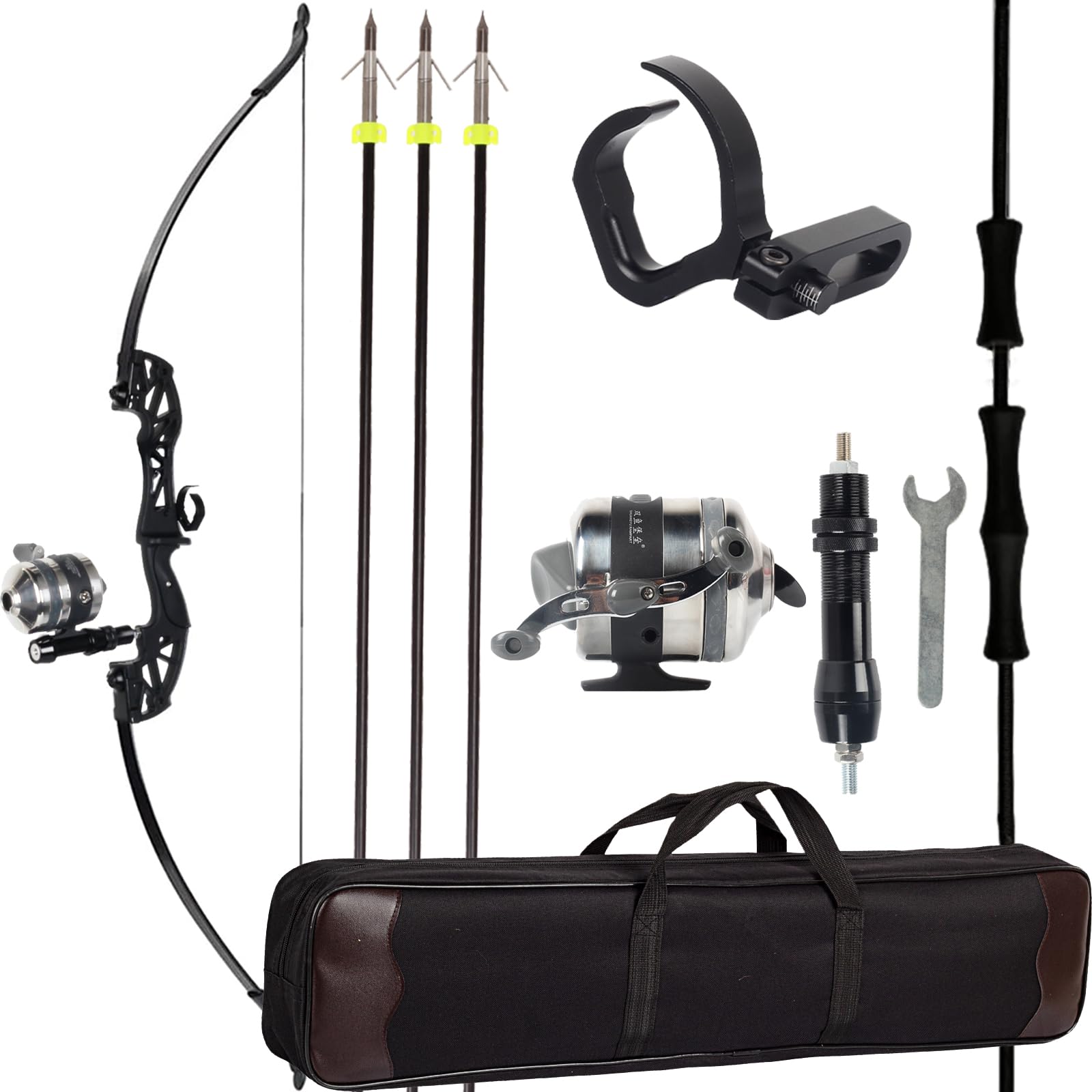
The absolute entry-level recurve kit at the lowest price — a true budget gamble.
The SPG kit includes a 40-lb recurve bow, a replacement bowstring with a pre-installed finger saver, a fishing reel and reel mount, arrow rest, three fishing arrows, a bow bag, and a wrist strap. It is ambidextrous (fits both left and right hands), so lefties do not need to search for a mirror-image model.
The feedback is honest: this is a “fun for a relaxing day” kit, not a daily driver. Multiple shoppers say the reel retention piece (the part that holds the reel in place) broken on arrival, screws falling off during the first session, and arrows that veer sideways beyond a few feet because of poor weight balance. The bow itself works, but the overall quality feel is closer to a toy than a tool — as owners note, do not depend on it for serious fishing.
Compared to the Fish Stick (a 4.2-star recurve): The Fish Stick costs more but has 30 positive quality mentions and proven durability.
Best for: Someone who wants to try bowfishing for under a hundred bucks and is okay with the risk of broken parts.
skip it if: You want to actually catch fish reliably — spend a bit more on the Fish Stick.
Understanding the Specs
Draw Weight (Pounds)
This is how much force you need to pull the bowstring back to its full draw position. A 45-lb draw weight means you are holding 45 pounds of resistance at full draw (unless the bow has let-off). For bowfishing, 40-50 lbs is the balance — enough to pierce water and penetrate a fish, but not so heavy that you cannot hold it steady while waiting for a target.
Let-Off (%)
Only compound bows have this. It is the percentage of the draw weight that “lets off” once the bow is at full draw. A 70% let-off on a 45-lb bow means you only hold about 13.5 lbs at full draw. That matters when you are holding the bow at full draw for several seconds waiting for a fish to swim into range — a high let-off saves your arms from fatigue.
Axle-to-Axle Length
The distance between the two axles on a compound bow, measured in inches. A shorter axle-to-axle (around 30-34 inches) makes the bow easier to maneuver on a crowded boat or in tight spaces along a bank. A longer axle-to-axle (56 inches on a recurve) gives you a smoother draw and more stability, but it is harder to swing sideways in tight quarters.
Arrow Speed (FPS)
Measured in feet per second, this tells you how fast the arrow leaves the bow. A higher speed (like 320 fps) means the arrow travels flatter and reaches the fish faster, reducing the effect of water refraction (the bending of light as it enters the water) that can throw off your aim. Slower bows require more compensation for arrow drop over longer shots.
FAQ
Can I use a regular hunting compound bow for bowfishing?
What draw weight do I need to shoot through water?
Recurve vs compound for bowfishing — which is better for a beginner?
Can left-handed shooters use these bowfishing bows?
What is “let-off” on a compound bow, and why does it matter for fishing?
How do I maintain a bowfishing bow after a trip?
What type of fishing line should I use on a bowfishing reel?
What is the difference between a bottle reel and a spin reel?
Can I use a bowfishing bow for target practice or hunting?
How do I choose the right arrows for my bowfishing bow?
Final Thoughts: The Verdict
Across the board, the bowfishing bow winner is the Cajun Fish Stick RTF