
A high ankle sprain isn’t your average roll—it tears the syndesmosis ligament above the joint, creating pain that radiates up the shin and takes weeks longer to heal than a lateral sprain. Standard compression sleeves do nothing for this injury; you need a brace that restricts rotation while allowing controlled flexion for walking or sport.
I’m Min — the co-founder and writer behind Gadgets Feed. For this guide I analyzed the stabilizing mechanisms, strap architectures, and shell rigidity of seven braces engineered specifically to prevent the painful external rotation that re-injures high ankle sprains.
After comparing lace-up systems, figure-8 straps, semi-rigid stays, and molded shells, this is the definitive breakdown to identify the best brace for high ankle sprain for your specific recovery phase and activity level.
How To Choose The Best Brace For High Ankle Sprain
A high ankle sprain demands a brace that resists external rotation—not just inversion/eversion. The wrong brace gives false confidence and delays healing. Focus on three criteria that directly address syndesmosis mechanics.
The Strap System: Figure-8 vs. Basic Wrap
A figure-8 strap configuration wraps over the dorsum and around the heel, creating a mechanical block against the talus rotating outward. Basic hook-and-loop wraps only compress the joint and provide negligible rotational resistance. For Grade I or early Grade II high sprains, a brace with dual figure-8 straps is the minimum viable support level.
Rigidity: Removable Splints vs. Molded Shells
Removable semi-rigid splints let you dial support down as you progress through rehab—critical for high sprains where total immobilization can atrophy the peroneal muscles. Molded TPU shells (like the DonJoy POD) offer the highest rotational resistance but limit dorsiflexion more, making them better for unstable Grade II and Grade III sprains where the primary goal is preventing any rotational load.
Fit Profile: Shoe Compatibility Matters
A bulky brace that forces you into a half-size-up shoe can alter your gait and shift load to the opposite hip and knee. Look for a low-profile build with an open heel design that sits flush inside a standard sneaker or cleat. If the brace changes your shoe size by more than half a step, you’ll compensate with a limp that stresses the syndesmosis differently.
Quick Comparison
On smaller screens, swipe sideways to see the full table.
| Model | Category | Best For | Key Spec | Amazon |
|---|---|---|---|---|
| Med Spec ASO | Premium Lace-Up | Proven rotational control | Figure-8 straps + CoolFlex | Amazon |
| DonJoy POD | Molded Shell | Highest roll protection | Molded TPU + EVA liner | Amazon |
| Bauerfeind MalleoTrain | Medical Compression Knit | Daily wear & recurrence prevention | Viscoelastic massage pads | Amazon |
| Ultra 360 | Figure-8 Lace-Up | Volleyball/basketball athletes | Mimics athletic taping | Amazon |
| Ossur FormFit | Speedlace Stabilizer | Post-operative immobilization | Single-pull speedlace | Amazon |
| Swede-O Ankle Lok | Reinforced Lace-Up | Budget-friendly stabilization | Removable side stabilizers | Amazon |
| AGPTEK Adjustable | Entry-Level Lace-Up | Everyday value with splints | Dual stabilizers + quick lace | Amazon |
In‑Depth Reviews
1. Med Spec ASO Ankle Stabilizer
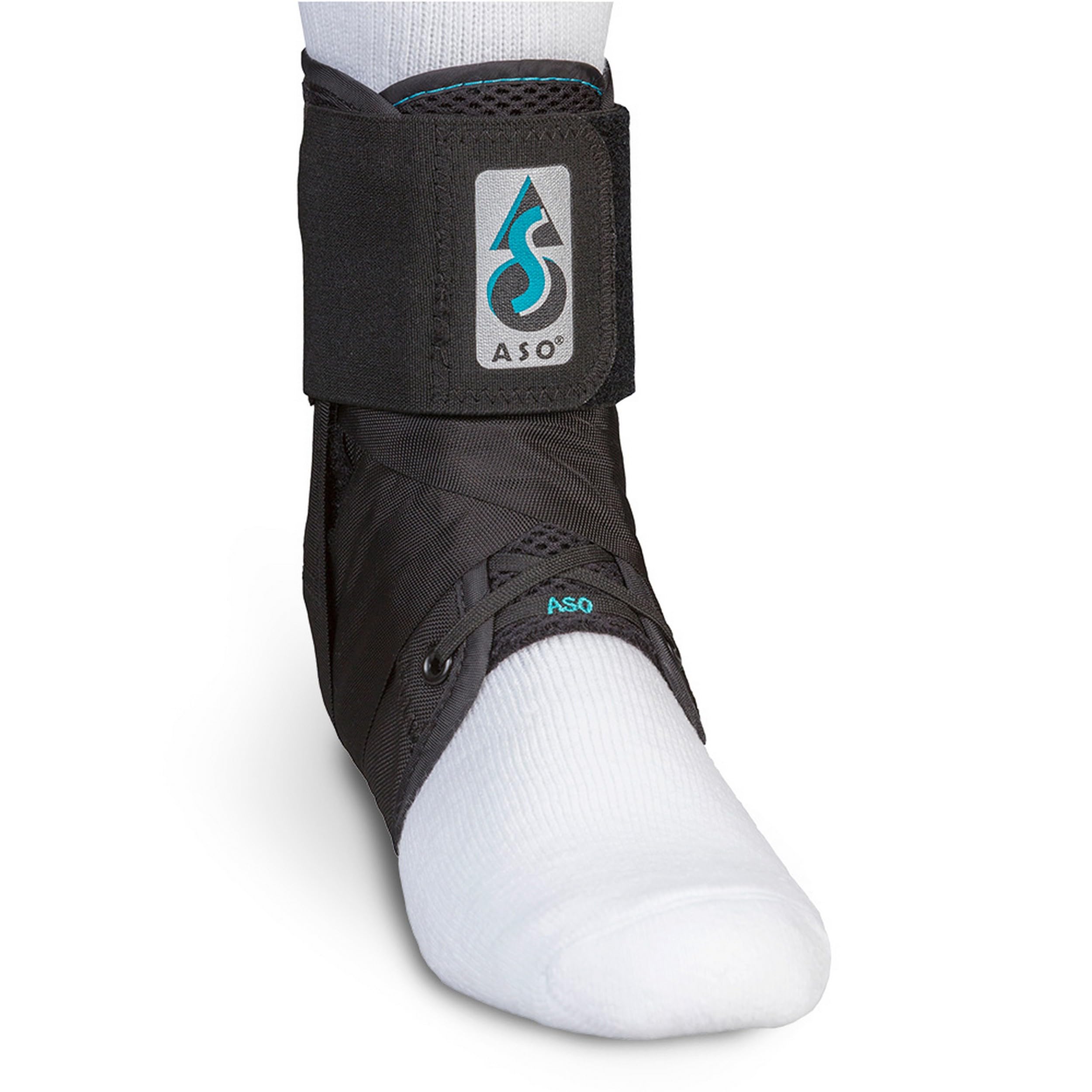
The Med Spec ASO has been an athletic trainer staple for decades, and its figure-8 strap configuration is the gold standard for resisting external rotation in high ankle sprains. The CoolFlex padding and durable nylon construction keep it breathable during extended wear, and the bilateral design means one brace fits either foot—useful if you need to swap sides during recovery. Weighing only 169 grams, it doesn’t add noticeable fatigue during walking or light sport.
Physical therapists frequently recommend the ASO over cheaper alternatives because its lace-up system allows you to tension the dorsal and heel sections independently, mimicking the feel of a professional tape job. That independent tension is crucial for a high sprain: you cinch the heel lock tight to prevent talar rotation while keeping the forefoot loose enough for natural push-off. Users with peroneal tendonitis also report marked relief because the cross-over straps offload the peroneal sheath.
The trade-off is that the ASO does not fit inside slip-on shoes or very narrow sneakers without loosening the laces significantly. You’ll need a shoe with a standard to wide toe box. Velcro durability is excellent—multiple users report years of consistent closure without fraying—but the laces are long and require a bit of practice to tie evenly on the first attempt.
Why it’s great
- Independent heel and forefoot tension mimics athletic taping
- Figure-8 straps directly counteract syndesmosis rotation
- Lightweight enough for multi-sport use
Good to know
- Does not fit slip-on or very narrow shoes
- Lengthy laces require technique to tie evenly
2. DonJoy Performance POD Ankle Brace
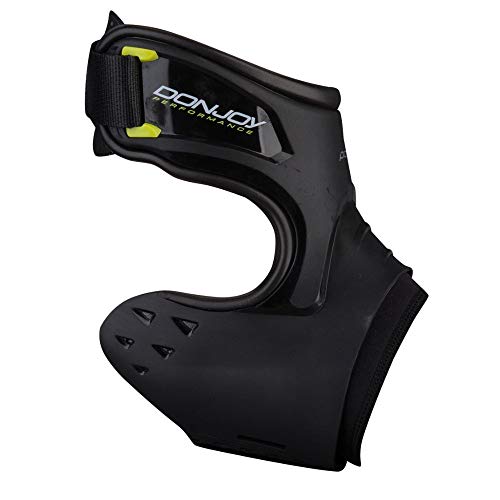
The DonJoy POD takes a fundamentally different approach: a molded TPU shell that wraps the lateral and medial malleoli, paired with a super-soft EVA liner that hugs the foot without pressure points. The “On Demand” technology means the shell stays compliant during normal walking but stiffens the instant inversion or rotation exceeds a safe threshold—exactly the behavior needed for Grade II high sprains where the syndesmosis needs protection during unexpected weight shifts.
Where the POD excels is its low-profile design. The TPU shell is only a few millimeters thick at the edges, so it fits inside most standard sneakers and even Xtratuf boots without forcing a half-size change. Users with high insteps report a snug fit across the dorsum, though some had to cut a small slit in the sock for circulation around the extensor tendons. The right/left specific molding ensures the shell contours to the medial malleolus—an area where generic braces often gap and lose rotational resistance.
Durability is high, but the POD is not for mild sprains. The shell’s stiffness can feel excessive for Grade I sprains where you want a fuller range of motion. Several sports-medicine professionals also note that the brace is best for inversion/eversion control rather than pure syndesmosis compression—if your primary issue is tibiofibular widening, you may want a brace with more direct lace compression over the distal tib-fib joint.
Why it’s great
- Molded TPU shell locks rotation without bulky strapping
- Fits inside regular athletic shoes and boots
- On-demand stiffness protects during unexpected weight shifts
Good to know
- Overkill for Grade I sprains where mobility is preferred
- High instep users may need sock adjustments
3. Bauerfeind MalleoTrain Ankle Support

Bauerfeind’s MalleoTrain represents the top tier of medical-grade compression bracing. Rather than using straps or shells, it relies on a proprietary circular-knit compression matrix embedded with two anatomically contoured viscoelastic massage pads that sit over the medial and lateral malleoli. These pads redistribute pressure during gait and actively massage the peroneal tendons and deltoid ligament, stimulating proprioceptive feedback that helps retrain the ankle’s natural stability reflexes.
The standout feature for high ankle sprains is the “comfort zone” on the instep—a relief channel that prevents the brace from digging into the dorsal neurovascular bundle. This matters because a tight brace across the instep can compress the superficial peroneal nerve, causing numbness that masks pain signals. The MalleoTrain avoids that entirely. It’s machine-washable, FSA/HSA eligible, and made in Germany with a knit that holds its shape after dozens of wash cycles—a longevity advantage over glued-strap braces that delaminate over time.
The limitation is that the MalleoTrain does not provide the same rotational lock as a lace-up with figure-8 straps. For a Grade III high sprain with syndesmosis widening, this brace should be used during the later rehab phase rather than acute immobilization. It also comes at a higher price point, and the pull-on design means you cannot micro-adjust the compression across different zones the way you can with a lace-up system.
Why it’s great
- Viscoelastic pads provide targeted proprioceptive feedback
- Instep comfort zone prevents nerve compression
- Machine-washable knit maintains shape over time
Good to know
- Rotational control is moderate, not maximized
- Pull-on design offers limited zone-specific adjustability
4. Ultra 360 Lace Up Ankle Brace
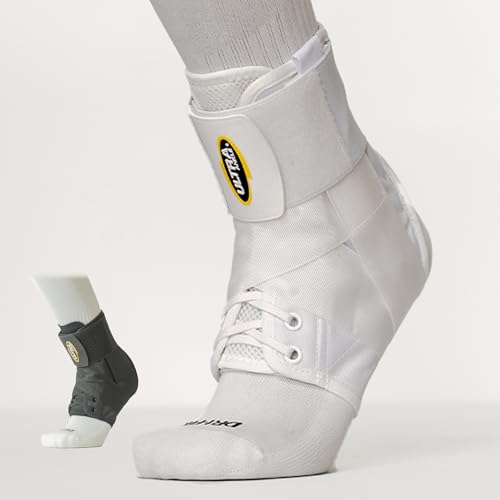
The Ultra 360 bridges the gap between a trainer-grade tape job and a retail lace-up brace. Its defining architecture is the pair of adjustable figure-8 straps that cross over the anterior talofibular ligament and the syndesmosis simultaneously, creating a sling that limits both inversion and external rotation. The lace-up base lets you dial the dorsal tightness separately from the heel lock—critical for high sprain patients who need the heel locked but the forefoot free for cutting movements.
Designed specifically with volleyball and basketball athletes in mind, the breathable nylon construction and slim profile allow it to slip inside most high-top sneakers and even low-cut cleats without shifting the footbed. Multiple verified purchaser reports from volleyball parents and coaches confirm that athletes wearing the Ultra 360 reduced the severity of re-sprains compared to basic elastic sleeves. The figure-8 straps are reinforced with a non-slip backing that prevents them from migrating toward the Achilles during lateral shuffles.
The main downside is that the figure-8 straps can be tricky to tension symmetrically on the first few wears—overtightening the heel loop can create a pressure ridge under the peroneal tendons. The included sizing guide is reliable, but users between sizes should size up if they plan to wear the brace for more than two hours at a time. Durability is solid for the price, though the hook material on the straps may lose some grip after six months of heavy training.
Why it’s great
- Dual figure-8 straps isolate syndesmosis and ATFL protection
- Low-profile design fits in sneakers and cleats
- Non-slip strap backing prevents migration during lateral movement
Good to know
- Figure-8 straps require practice for even tensioning
- Hook material may degrade after heavy seasonal use
5. Ossur FormFit Ankle Brace

The Ossur FormFit is a favorite among orthopedists for its speedlace system—a single pull tightens the entire lace bed evenly, eliminating the uneven pressure distribution common with traditional lacing. The semi-rigid stays on both sides provide enough structure to prevent talar rotation without the full bulk of a hinged brace. For high ankle sprains, this means you can achieve consistent, repeatable compression across the distal tibiofibular joint every time you put it on.
Users with chronic syndesmosis irritation from running or hiking report that the FormFit provides the confidence to return to activity without the constant fear of re-rolling. The thick but form-fitting construction does fit under most shoes, though patients with very narrow heels may experience some heel lift during rapid directional changes. The figure-8 elastic strap adds an extra layer of ant-rotation support, and the stays are removable once you progress into the functional rehab phase.
The Achilles heel of the FormFit is stitching durability under daily use. Several long-term users report that the heel seam began to separate after about a year of constant wear, and a smaller number experienced ripping in the lace eyelet area after six months. Sizing also requires careful ankle circumference measurement—users who rely solely on shoe size often end up with a brace that shifts during activity.
Why it’s great
- Speedlace system provides even, repeatable compression
- Semi-rigid stays prevent talar rotation during running
- Figure-8 elastic strap adds syndesmosis-specific rotation resistance
Good to know
- Stitching durability may falter with daily use beyond a year
- Requires precise ankle circumference measurement for proper fit
6. Swede-O Ankle Lok Reinforced Laced Ankle Brace
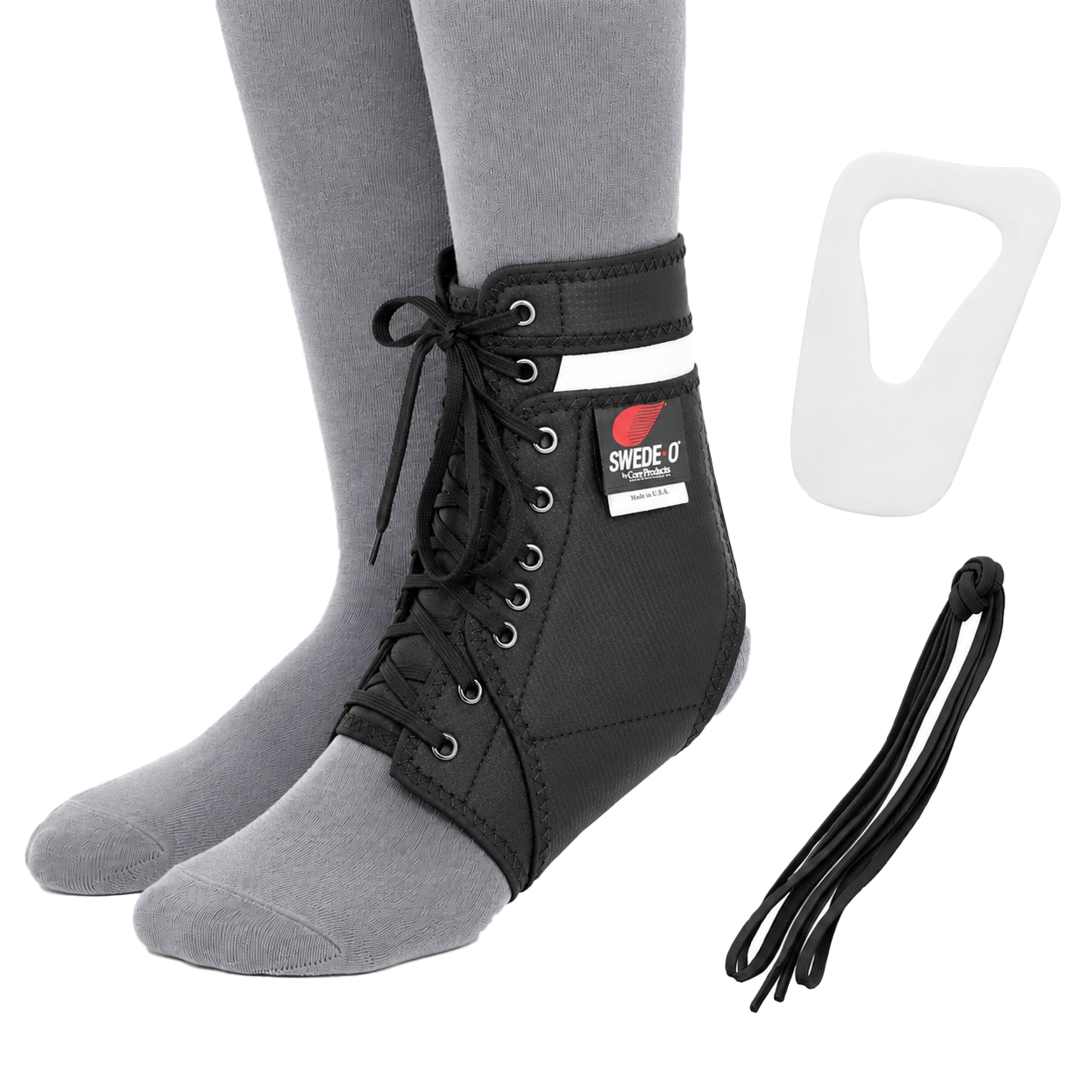
The Swede-O Ankle Lok is one of the most established lace-up braces on the market, manufactured in the USA with a bilateral design that fits either ankle. Its reinforced lacing system runs through metallic eyelets and a nylon lace-lock mechanism that prevents the laces from loosening during activity—a common failure point in cheaper braces. The removable side stabilizers are stiff enough to prevent inversion/eversion but flexible enough to allow the small amount of dorsiflexion needed for a normal gait.
For high ankle sprains, the Swede-O provides adequate stabilization for Grade I injuries and early Grade II recovery at a lower price point. The full elastic back panel reduces the risk of blistering around the Achilles, and the open heel design improves comfort during prolonged sitting or walking. Users with chronic ankle instability from old high sprains often keep one in their gym bag as a proactive measure before high-impact training sessions.
The primary drawback is the difficulty of putting the brace on and taking it off—the reinforced lacing and tight heel pocket make the process fiddly, especially if you have limited ankle range of motion post-sprain. Additionally, the brace is relatively bulky; you will almost certainly need a wide-width shoe to accommodate it. Customer service responsiveness has also been inconsistent, with some international buyers reporting difficulty with warranty claims.
Why it’s great
- Metal eyelet lace-lock prevents loosening during play
- Removable side stabilizers allow rehab progression
- Full elastic back reduces Achilles blister risk
Good to know
- Difficult to don/doff with limited post-injury range of motion
- Bulky profile requires wide-width footwear
7. AGPTEK Adjustable Lace-Up Ankle Brace
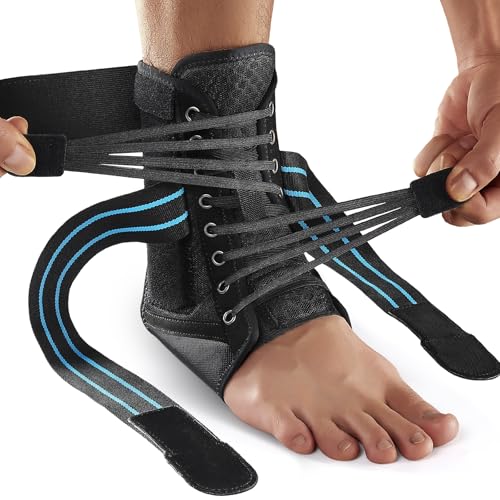
The AGPTEK brace enters the market with a strong value proposition: reinforced dual side stabilizers, an X-cross compression strap system, and a top wrap that together create a 360-degree support envelope. The quick-lace system uses elastic laces with dual-direction hook-and-loop fasteners that cinch down in about one second—a genuine convenience for athletes who change gear quickly between drills or for patients who struggle with traditional lace fiddling.
For high ankle sprains, the removable lateral splints let you customize the level of rotational resistance. Keep the splints in for rigid protection during the acute phase, or remove them for increased mobility during later-stage rehab or low-intensity daily wear. The honeycomb ventilation zones in the nylon Oxford fabric provide noticeably better breathability than solid neoprene braces, reducing sweat accumulation during extended wear.
The trade-off for the low price is in long-term construction refinement. The hook-and-loop straps are adequate but not as abrasion-resistant as premium alternatives—users who wear the brace daily for heavy training may find the strap texture wearing smoother after several months. The sizing also runs slightly small; several buyers with size 9 feet found the large fit snug, suggesting you should follow the circumference measurement rather than shoe size when ordering.
Why it’s great
- 1-second quick-lace system is genuinely convenient
- Removable splints allow support level adjustment
- Honeycomb ventilation reduces sweat during extended wear
Good to know
- Strap texture may degrade faster with daily heavy training use
- Sizing runs small, measure ankle circumference not shoe size
FAQ
Can I wear a brace for high ankle sprain during basketball or volleyball?
How tight should a high ankle sprain brace be?
When can I switch from a rigid brace to a compression sleeve after a high sprain?
Final Thoughts: The Verdict
For most users, the brace for high ankle sprain winner is the Med Spec ASO because its independent heel and forefoot tension combined with proven figure-8 strap geometry provides the best balance of rotational resistance, adjustability, and shoe compatibility. If you need maximum shell-level stability for an unstable Grade II or III sprain, grab the DonJoy Performance POD. And for premium daily wear during the later rehab phase when your main enemy is proprioceptive loss rather than acute rotation, nothing beats the Bauerfeind MalleoTrain.