
A lateral collateral ligament (LCL) injury is a specific type of knee trauma that often gets misdiagnosed as a general sprain. Unlike an ACL tear, which creates a feeling of the knee giving way forward, an LCL injury manifests as instability on the outside of the joint—a painful lateral gapping that makes cutting, pivoting, or even walking on uneven ground feel unreliable. A standard compression sleeve or a front-facing patella strap does nothing for this sideways instability. You need a brace engineered with rigid side stabilizers or hinges to directly control that lateral movement.
I’m Min — the co-founder and writer behind Gadgets Feed. I’ve spent hundreds of hours dissecting the engineering, material science, and real-world performance data of knee braces to identify which designs truly counteract lateral instability without sacrificing mobility.
Finding a reliable best brace for lcl injury requires understanding hinge geometry, chassis rigidity, and how the anti-migration system keeps the pivot point locked over your lateral joint line during dynamic movement.
How To Choose The Best Brace For LCL Injury
The lateral collateral ligament is essentially a rope on the outside of your knee that prevents the tibia from sliding sideways relative to the femur. When that rope is stretched or torn, every lateral movement—cutting in basketball, stepping off a curb, even a dog pulling on a leash—creates a gapping sensation. The brace you choose must replicate that rope’s function without migrating down your calf.
Hinge Type and Lateral Stiffness
An LCL brace requires a rigid lateral upright. Polycentric hinges that mimic the knee’s natural rolling-and-gliding motion are the gold standard because they stay aligned with the femoral condyle throughout the range of motion. A simple single-axis hinge creates a shear force at the joint line—exactly where your LCL is injured. Look for dual-hinge systems or four-point leverage frames like those on the DonJoy BIONIC FULLSTOP, which create a mechanical advantage to resist varus stress (the force that tears the LCL).
Anti-Migration Chassis Design
A brace that slides down 2 cm is a brace that no longer protects your LCL. The chassis must include silicone gripper strips, a pre-curved anatomical shape, or a wrap-around design that anchors above the gastrocnemius bulge. Wraparound designs like the BioSkin use elastic straps above and below the knee to create a traction system that resists the downward pull of movement. If a brace lacks an anti-migration feature—like a simple sleeve with pockets for stabilizers—it will migrate within minutes of moderate activity.
Measurable Specs: Hinge Material and Weight
For LCL-specific bracing, the hinge material directly correlates to fatigue resistance. Aircraft-grade aluminum (used in the BioSkin) offers the best strength-to-weight ratio, reducing brace weight while maintaining stiffness. Heavier steel hinges (common in post-op braces like the Brace Direct T Scope) provide maximum rigidity but add noticeable mass that can cause the brace to rotate around the leg. A brace between 0.15 kg and 0.37 kg is optimal for daily wear without migration issues.
Quick Comparison
On smaller screens, swipe sideways to see the full table.
| Model | Category | Best For | Key Spec | Amazon |
|---|---|---|---|---|
| DonJoy Performance BIONIC FULLSTOP | Premium Hinged | Return-to-sport LCL stability | Four-point leverage system | Amazon |
| Brace Direct T Scope Premier | Post-Op / Immobilization | Post-surgical LCL recovery | Telescoping frame, 17″-27″ | Amazon |
| BioSkin Wraparound Hinged | Premium Wraparound | All-day wear under clothing | Aluminum hinges, 0.37 kg | Amazon |
| Shock Doctor Knee Brace 875 | Mid-Range Hinged | Heavy-daily support for ACL/MCL/LCL | Bilateral dual hinges, 16 oz | Amazon |
| Vive Hinged Knee Brace | Mid-Range Hinged | Lateral knee support during pickleball | Heavy-duty hinges, neoprene blend | Amazon |
| DonJoy Drytex Sport Hinged | Value Hinged | Breathable ligament support | Drytex fabric, 0.03 oz | Amazon |
| Galvaran Professional Knee Brace | Entry-Level Hinged | MCL/LCL recovery with budget | Memory-spring stabilizers, 0.15 kg | Amazon |
In‑Depth Reviews
1. DonJoy Performance BIONIC FULLSTOP Knee Brace

The DonJoy Performance BIONIC FULLSTOP is engineered with a four-point leverage system that trains the knee to stay out of the at-risk varus position—precisely the vector that stresses the LCL. The hinge technology uses a dampening cycle that resists the terminal 10 degrees of extension, preventing the lateral gapping that occurs during the heel-strike phase of gait. This is not a sleeve with pockets; it is a mechanical brace that actively controls varus thrust.
Users recovering from lateral meniscus surgery and Grade 2 LCL sprains report that the brace eliminates the sensation of the knee “shifting” or “rolling” during lateral cutting movements. The anti-migration system, which includes a silicone-free compression layer and adjustable cross-straps, keeps the fulcrum locked over the joint line. The 2.45-pound weight is noticeable but justified by the level of varus control—comparable to a custom-fitted DonJoy brace but at a fraction of the prescription price.
One notable limitation: the strap system uses a hook-and-loop design that some users found degraded within weeks under high-frequency wrestling or football use. For moderate-to-heavy sports (three times per week), the straps may need replacement within a season. However, for LCL-specific instability during return-to-sport protocols, the mechanical advantage of the four-point leverage system is unmatched in this price tier.
Why it’s great
- Four-point leverage system directly counteracts varus stress.
- Dampening hinge prevents hyperextension during lateral movement.
- Anti-migration technology keeps hinge aligned with LCL insertion.
Good to know
- Strap stitching may unravel under heavy, daily sport use.
- Does not stop hyperextension in cases of extreme joint laxity.
2. Brace Direct T Scope Premier Post Op Knee Brace
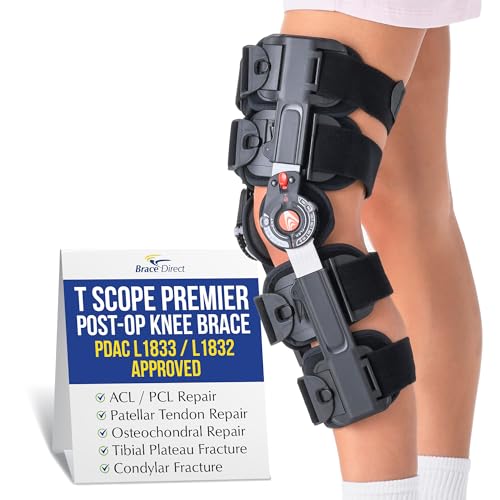
The Brace Direct T Scope Premier is a telescoping post-operative brace designed specifically for the immobilization phase after LCL repair or reconstruction. The frame extends from 17 to 27 inches, accommodating thigh circumferences up to 30.5 inches, which allows the brace to maintain alignment with the lateral knee regardless of leg length variations. This is critical post-LCL surgery because any lateral shift in the brace position can apply shear force to the freshly repaired ligament.
The quick-clip buckle system is a practical improvement over traditional wraparound braces, particularly during the tender post-surgery phase when bending is painful. Users report that the brace reliably locks at 90 degrees of flexion and zero degrees of extension, preventing the knee from falling into the varus position during sleep or while using an iWalk crutch. The lightweight chassis (relative to hospital-issued braces) significantly improves compliance for 24/7 wear.
The foam pads on the inner frame are not made of neoprene and may degrade over time with sweat exposure. Additionally, the brace is reported to interfere with iWalk crutch fitment on some leg shapes. However, for the specific use case of post-operative LCL immobilization where range-of-motion control is non-negotiable, this brace provides better fit and functionality than standard hospital-issue options.
Why it’s great
- Telescoping frame adjusts to multiple leg lengths for precise lateral hinge placement.
- Quick-clip buckles allow easy application during post-op tenderness.
- Reliably locks at 90/0 degrees for varus protection during immobilization.
Good to know
- Inner foam pads are not neoprene and may degrade over time.
- Does not fit well with some iWalk crutch models.
3. BioSkin Wraparound Hinged Knee Brace
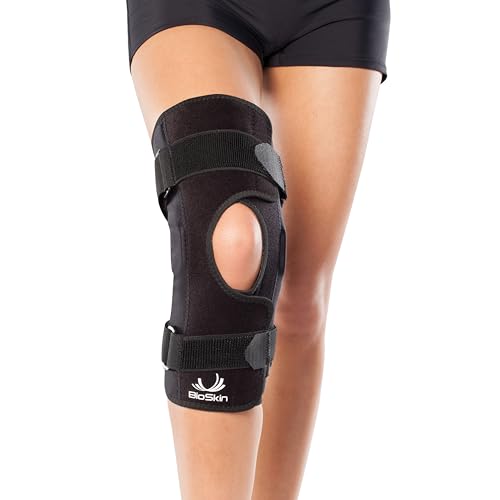
The BioSkin Wraparound Hinged knee brace uses aircraft-grade aluminum side hinges that provide lateral stiffness without the bulk of steel or plastic frames. At just 0.37 kilograms, the brace is light enough for all-day wear under jeans or work pants, yet the aluminum hinges resist varus stress comparably to heavier prescription braces. The wraparound design eliminates the need to pull a sleeve over the leg—a significant advantage for individuals with post-surgical swelling or limited range of motion.
The elastic straps above and below the knee create a traction-based anti-migration system. Users report that the brace stays in place during light court sports and long walks, unlike sleeve-style braces that slide down after 15 minutes of activity. The open-back design also improves ventilation, reducing the sweat buildup that can cause skin irritation under neoprene braces.
Some users note that the Velcro material on the inner thigh can cause chafing, particularly during high-repetition activities like running. Additionally, the brace may require sizing up if your thigh circumference is at the top of the size chart range—the aluminum hinges do not stretch like fabric. For lateral instability that requires a discreet, low-profile brace for daily wear, the BioSkin is the best choice among non-prescription options.
Why it’s great
- Aircraft-grade aluminum provides lateral stiffness at low weight.
- Wraparound design allows easy application without pulling over the leg.
- Elastic straps create effective anti-migration traction above and below the knee.
Good to know
- Velcro on inner thigh may cause chafing during extended wear.
- Size up if your measurements are near the top of the range.
4. Shock Doctor Knee Brace 875

The Shock Doctor 875 features heavy-duty bilateral dual hinges that provide medial and lateral stabilization, making it directly applicable to LCL injuries where side-to-side control is the primary need. The four-way stretch Lycra mesh chassis offers breathability that reduces moisture buildup during extended wear, and the pre-curved anatomical design ensures the hinges sit flush against the femoral condyles rather than digging in. The 16-ounce weight is noticeable but reasonable for the level of hinge protection.
Users with ACL/MCL tears and associated LCL laxity report that the Shock Doctor 875 feels significantly more stable than Mueller or basic McDavid braces. The easy-grip tabs allow accurate tightening adjustment even during activity, which is critical when the brace naturally loosens as the neoprene warms up. One user noted that the brace survived a full year of indoor handball three times per week—the seams remained intact and the hinges only slightly loosened, which is excellent durability for a neoprene hybrid brace.
The primary limitation is sizing sensitivity: the brace stretches over time, so ordering one size smaller than the measurement chart suggests is common advice. Some users also report that the Velcro straps limit full knee flexion during deep squats or kneeling. For mid-range LCL support during court sports, the Shock Doctor 875 offers the best balance of hinge stiffness and breathability.
Why it’s great
- Dual bilateral hinges provide direct varus and valgus stabilization.
- Four-way stretch Lycra mesh reduces moisture and odor.
- Durable enough for 1+ year of frequent court sport use.
Good to know
- Sizes run large; order one size smaller than measured.
- Straps limit full knee flexion during deep range of motion.
5. Vive Hinged Knee Brace with Side Stabilizers
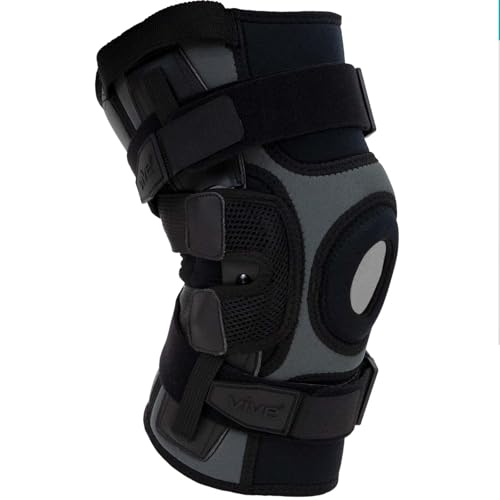
The Vive Hinged Knee Brace uses heavy-duty hinges that are specifically designed to prevent hyperextension and manage varus stress, making it a solid mid-range option for LCL instability. The chassis construction (52% neoprene, 30% nylon, 10% polyester, 8% spandex) provides a balance of compression and flexibility, with the open patella design improving ventilation and reducing pressure on the kneecap. The side handles and buckle closure system allow for quick application and removal, which is useful for individuals who need to wear and remove the brace multiple times per day.
One user reported that this brace provided the best lateral knee support they had found for playing pickleball 3-4 days per week, specifically citing extra stability that kept them injury-free. The ability to trim the straps to size is a practical feature that allows users to customize the fit without excess material bunching under clothing. However, some users found the brace extremely stiff initially, making it painful to put on and limiting knee bending for stairs.
The brace’s tendency to rotate or slide down during activity is a recurring concern for larger individuals, as the neoprene chassis lacks silicone grippers or elastic anti-migration straps. The open patella opening can also become misaligned if the brace rotates, which can cause discomfort. For lateral support during lateral-movement sports like pickleball or walking, the Vive brace works well, but active users with heavy thigh musculature may need to re-adjust it frequently.
Why it’s great
- Heavy-duty hinges effectively prevent varus stress during lateral court sports.
- Trim-to-size straps allow custom fit without bulky excess folding.
- Open patella design improves ventilation compared to full neoprene sleeves.
Good to know
- Can be very stiff initially, limiting knee flexion for stairs.
- May rotate or slide down without dedicated anti-migration features.
6. DonJoy Drytex Sport Hinged Knee Brace
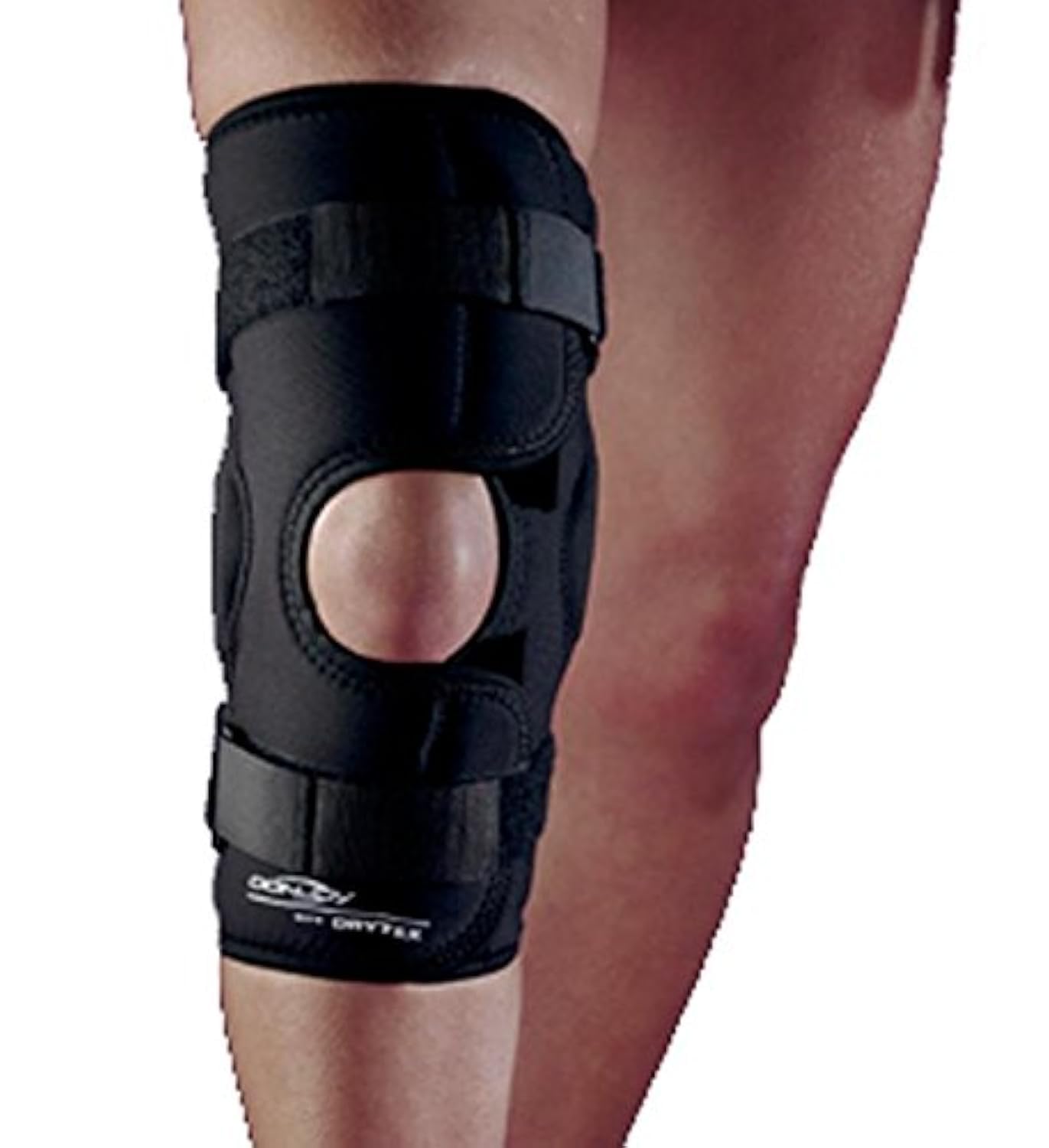
The DonJoy Drytex Sport is a lightweight hinged brace that uses a proprietary breathable fabric to manage moisture during activity. The side hinges provide basic medial and lateral support suitable for Grade 1 LCL sprains or prophylactic use during return-to-activity phases. The fabric is significantly thinner and more flexible than neoprene braces, which makes it comfortable under pants and less heat-retentive during summer.
Users who have worn this brace as a replacement for a stretched-out identical model report that it provides adequate support for walking and light activity, though it is not designed for heavy cutting sports. The open-back design allows for ventilation behind the knee, reducing the chafing that can occur with neoprene braces. However, the back seam near the knee cutout can rub on bare skin during extended wear.
The brace’s fit depends entirely on accurate thigh and calf circumference measurements—some users found the sizing unreliable, with the brace being either too loose to provide lateral support or too tight to wear comfortably. The hinges are less rigid than aluminum or steel options, so for anything beyond a low-grade sprain, the Drytex Sport may not provide sufficient varus resistance. It is best suited for individuals who need a lightweight, breathable brace for daily walking support rather than sport-level LCL stabilization.
Why it’s great
- Drytex fabric is highly breathable and comfortable in warm conditions.
- Flexible enough to wear under pants without visible bulk.
- Open-back design reduces moisture and chafing behind the knee.
Good to know
- Back seam near cutout can rub on bare skin.
- Sizing is inconsistent; hinge rigidity may be insufficient for Grade 2+ sprains.
7. Galvaran Professional Knee Brace

The Galvaran Professional Knee Brace uses four memory-spring stabilizers on both sides to provide lateral support at a weight of just 0.15 kilograms—the lightest brace in this comparison. The design includes meniscus pads sewn into the outer knee position, which can offload pressure from the lateral compartment. The two-way cross strap system allows for a custom fit that keeps the stabilizers aligned with the LCL without excessive migration.
Users with ACL and meniscus repairs report that the brace provides excellent support with no bunching behind the knee, a common problem with bulky wraparound braces. The mesh weave technology improves breathability, preventing the itching and sweating that often occur with neoprene-only braces. The lightweight construction means the brace can be worn for extended periods without causing fatigue in the quadriceps.
The primary limitation is sizing: one user found the brace too small despite ordering based on the size chart, suggesting that the brace runs small. The memory-spring stabilizers, while effective for ligh-to-moderate lateral support, do not provide the same rigidity as polycentric hinges. For Grade 1 LCL strains or as a transitional support brace during the later stages of recovery, the Galvaran is an excellent budget-friendly option that provides surprising lateral stability for its weight.
Why it’s great
- Ultra-lightweight (0.15 kg) with memory-spring lateral stabilizers.
- Mesh weave fabric prevents sweat and itching during extended wear.
- Two-way cross straps allow precise fit adjustment for LCL alignment.
Good to know
- Runs small; size up from chart recommendations.
- Memory-spring stabilizers are less rigid than true polycentric hinges.
FAQ
Will a basic compression sleeve help my LCL injury?
Can I wear a hinged LCL brace for both knees if I have a bilateral injury?
How do I measure my knee to ensure the lateral hinge sits correctly?
Is a post-op brace necessary for non-surgical LCL management?
Final Thoughts: The Verdict
For most users, the best brace for lcl injury winner is the DonJoy Performance BIONIC FULLSTOP because the four-point leverage system is the only non-custom brace that can actively control varus stress during dynamic sport movement. If you want a discreet, all-day brace that fits under clothes and still resists lateral migration, grab the BioSkin Wraparound Hinged. And for post-surgical recovery where range-of-motion control and alignment are non-negotiable, nothing beats the Brace Direct T Scope Premier.