
A brake line flaring tool is one of those purchases you make only when a rusted line snaps or a fitting refuses to seal. The wrong tool produces crooked flares, crushed tubing, and leaks that bleed down your brake pedal overnight. The right tool delivers a perfect 45-degree cone every time, letting you finish the job in one shot without a second trip to the parts store.
I’m Min — the co-founder and writer behind Gadgets Feed. I’ve spent countless hours comparing the clamping mechanisms, die quality, and flare consistency across every major brake line flaring tool on the market to separate the tools that deliver from the ones that slip.
This guide breaks down seven of the best models available today, covering everything from affordable home-use kits to professional-grade systems, so you can confidently choose the best brake line flaring tool for your next brake job without wasting time or money.
How To Choose The Best Brake Line Flaring Tool
A brake line flaring tool is a simple mechanical device, but small differences in clamp design, die quality, and included adapters determine whether you get a leak-free seal or a frustrating hour of failed attempts. Here are the three critical factors to evaluate before buying.
Clamp Mechanism: Vice-Grip vs. Screw-Down
The most common failure in budget flaring tools is tube slippage. A clamp that doesn’t hold the tube dead center causes off-axis flares that won’t seal. Look for a screw-down clamp with a positive locking feature or a vise-style assembly that grips the tube evenly. Tools with a T-handle clamp or a dedicated vise mount typically produce more consistent results than lever-operated clamps.
Flare Types and Die Availability
Most modern vehicles use double (SAE) flares on steel lines and bubble (ISO) flares on metric systems. A good tool supports both, but the die count matters. Kits covering 3/16″ through 1/2″ cover the vast majority of automotive applications. If you work on European cars, ensure the kit includes metric dies for 4.75mm and 6mm tubing. Single-flare dies are only useful for non-automotive tubing like copper refrigeration lines.
Build Quality and Material
The yoke (the C-shaped frame that holds the die) must be forged or machined steel, not cast pot metal. A cast yoke can crack or bend under the high clamping force required for steel brake lines. Chrome-plated alloy steel swivels and hardened steel flaring bars resist wear after dozens of flares. Repairability and warranty also matter — some manufacturers offer lifetime warranties that cover die replacement.
Quick Comparison
On smaller screens, swipe sideways to see the full table.
| Model | Category | Best For | Key Spec | Amazon |
|---|---|---|---|---|
| OTC 6502 | Premium Kit | Master coverage SAE & metric | 3/16″ to 5/8″ + metric dies | Amazon |
| TGR Professional | Premium | Perfect flares with minimal effort | 3/16″, 1/4″, 5/16″, 3/8″ dies | Amazon |
| Lisle 33260 | Mid-Range | On-vehicle repairs in tight spaces | 3/16″ and 1/4″ only | Amazon |
| SEEKSELF | Mid-Range | Vise-mounted precision flares | 4 split dies 3/16″ to 3/8″ | Amazon |
| Wostore | Mid-Range | 7 sizes + bubble flare capability | 3/16″ to 5/8″ + 10 metric dies | Amazon |
| Capri Tools | Budget | Quick 1/4″ double flares | 1/4″ tubing only | Amazon |
| OTC 4503 | Budget | Affordable 5-adapter kit | 3/16″ to 1/2″ adapters | Amazon |
In‑Depth Reviews
1. OTC 6502 Master Brake Flaring Tool Kit

The OTC 6502 is the most comprehensive flaring kit in this lineup, covering single, double, and bubble flares across both standard (3/16″ to 5/8″) and metric (4mm to 14mm) sizes. The arbor press design and fine-thread adapters produce cleaner flares with less effort than the cheaper bar-and-anvil kits. The included tube cutter and deburring tool are functional, though serious users may upgrade the cutter to a rigid model.
Owners consistently report that the 6502 outperforms parts-store kits, delivering leak-free seals on everything from 3/16″ copper-nickel to 5/16″ steel brake lines. The hard case keeps all 14 adapters organized, and the lifetime limited warranty backs the investment. The only catch is that the tool requires a vise for mounting — it’s not designed for under-car use.
Preparation is key: chamfer the tube end evenly, apply grease to the die, and set the correct stick-out length. A few practice flares on scrap tubing help dial in the technique. For mechanics who work on both domestic and import vehicles, this is the do-everything solution that eliminates the need for a second tool.
Why it’s great
- Comprehensive size range from 3/16″ to 5/8″ plus metric
- Finer threads produce cleaner, more consistent flares
- Lifetime warranty and professional-grade build
Good to know
- Requires a vise for mounting; not portable for on-vehicle work
- Included tube cutter is adequate but not premium
2. TGR Professional Brake Line Flaring Tool

The TGR Professional is the closest thing to a set-and-forget flaring tool. The T-handle screw clamp locks the tube in place without any play, and the hardened steel dies accept 3/16″, 1/4″, 5/16″, and 3/8″ tubing. It produces single, bubble, and double 45-degree flares, and each tool ships pre-tested from the factory with a sample flare included as proof of calibration.
User feedback is overwhelmingly positive — first-attempt success is the norm, even for beginners. The tool mounts in a vise and uses a lever-driven press that applies force evenly. Instructions are sparse, but a quick YouTube search fills the gap. Reviewers note that the TGR is identical in design to the Eastwood flaring tool but costs significantly less.
Tips from experienced users: deburr the tube thoroughly, dip the end in light grease before flaring, and clean the fitting with brake cleaner after. The TGR handles Ni-Copp and steel lines equally well, making it a top choice for anyone restoring a classic car or fabricating custom brake lines from scratch.
Why it’s great
- Pre-tested factory sample ensures correct operation
- Consistent first-attempt success across multiple flare types
- Identical design to premium brands at a lower cost
Good to know
- Not designed for under-vehicle use; requires a vise
- Instructions are basic; supplemental video needed
3. Lisle 33260 Flaring Tool

The Lisle 33260 solves the biggest limitation of most flaring tools: it works in tight spaces. The low-profile vise assembly clamps directly onto the tubing without needing a bench vise, making it ideal for on-vehicle repairs where you can’t remove the line. It creates single or double flares on 3/16″ and 1/4″ tubing, the two sizes that cover the vast majority of automotive brake applications.
Reviewers praise the secure clamping action — the tube stays centered without slipping, even on hard OEM steel lines. The built-in depth stop and included deburring tool speed up the process. The 33260 handles copper-nickel and mild steel lines well, but it does not work on stainless steel tubing. It also does not support bubble (ISO) flares or metric sizes.
The design is compact enough to carry in a service truck or stash under a seat. For DIYers who only work on American or Japanese vehicles, the limited size range is rarely an issue. The lifetime warranty from Lisle adds peace of mind. If you need a tool for emergency roadside repairs or cramped engine bays, this is the one to grab.
Why it’s great
- Low-profile design works in tight, on-vehicle locations
- No vise required; clamps directly onto the line
- Depth stop ensures correct tube stick-out every time
Good to know
- Limited to 3/16″ and 1/4″ sizes only
- Does not work on stainless steel tubing
4. SEEKSELF Professional Brake Line Flaring Tool Kit

The SEEKSELF tool is a vise-mounted system that covers 3/16″, 1/4″, 5/16″, and 3/8″ tubing with four split dies. The split dies use a limiting hole design that prevents them from slipping sideways during the flare — a common problem with cheaper two-piece die blocks. The long lever handle applies force by turning left, which right-handed users find more natural and ergonomic.
Real-world results are impressive: users report perfect double flares on stainless steel brake lines and aluminum fuel lines on the first try. The tool body is machined from high-quality steel and feels solid in the hand. The included hard case keeps everything organized, and the paper instruction manual provides clear setup guidance. The package weighs 8.75 pounds, reflecting the heavy-duty construction.
One important note: the tool is not suitable for use under the car — it must be clamped in a sturdy vise. The SEEKSELF requires a few practice flares to get comfortable with the technique, but once dialed in, it produces consistent, leak-free results. For home hobbyists who want professional-grade flares without professional-grade spending, this kit hits the sweet spot.
Why it’s great
- Anti-slip limiting holes keep split dies aligned
- Ergonomic left-turn handle reduces effort
- Works well on stainless steel and aluminum tubing
Good to know
- Must be mounted in a vise; not for on-vehicle use
- Requires practice to master the correct technique
5. Wostore Professional Brake Line Flare Kit

The Wostore kit is the most size-diverse option in this roundup, offering dies for 3/16″ through 5/8″ in standard sizes plus 10 metric sizes from 4.75mm to 10mm. It handles single, double (SAE), and bubble (ISO) flares, making it a genuine universal solution for both domestic and import vehicles. The forged steel yoke and hardened steel flaring bar are built for repeated use, and the T-handle provides good leverage.
Customer reviews highlight excellent results on bubble flares, with many users reporting that the Wostore produced perfect flares where cheaper kits failed. The included tubing cutter and reamer are functional and help maintain clean cuts. The storage case keeps the 17 total dies organized. However, the handle is on the shorter side, so the tool works best when mounted in a vise rather than used hand-held on the vehicle.
A few users reported difficulty flaring lines already installed on the car due to leverage limitations. A small minority received units with clamp slippage, though that seems to be an outlier. For a home mechanic working on multiple vehicles spanning different eras and regions, the Wostore delivers the widest coverage at a mid-range price point.
Why it’s great
- Extensive die set covers SAE and metric sizes
- Produces excellent bubble (ISO) flares
- Sturdy forged steel yoke and flaring bar
Good to know
- Short handle reduces leverage for on-vehicle use
- Best results achieved when mounted in a vise
6. Capri Tools 1/4 in. Double Flaring Tool
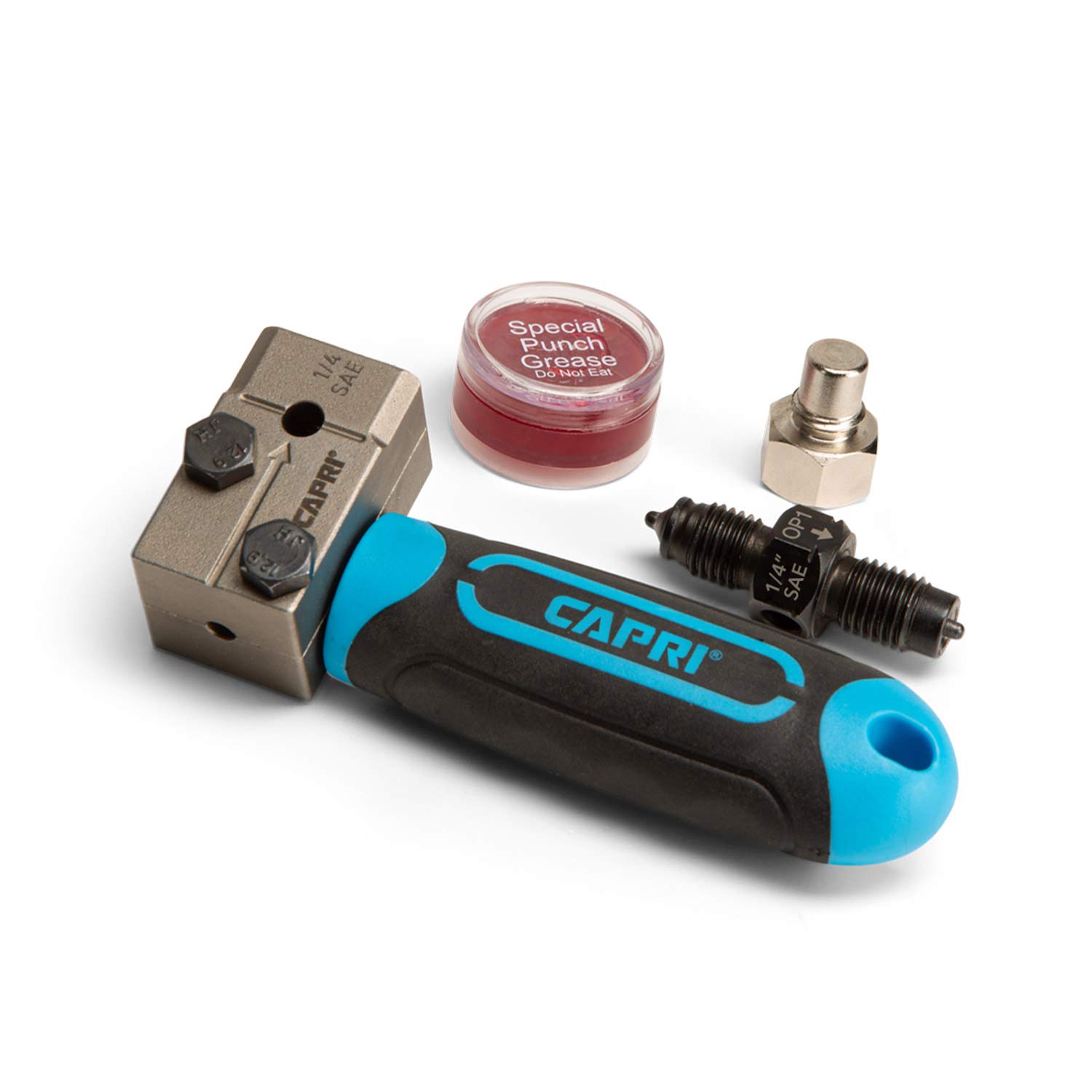
The Capri Tools flaring tool is a single-purpose specialist designed exclusively for 1/4″ tubing. It creates 45-degree SAE double flares on non-stainless steel, nickel, and copper tubing. The compact design — just 4.6 inches long — lets it fit into tight spots both on and off the vehicle, and the detachable die allows it to be used with a bench vise for extra stability.
Users consistently praise the integrated depth stop, which eliminates guesswork on tube stick-out. The clamp holds the tube securely without marring, and the positive stop mechanism prevents over-flaring. Reviewers note that it produces perfect flares on the first try, even for beginners. The tool requires only a 10mm and 17mm wrench to operate, keeping the setup simple.
The obvious trade-off is the limited size range. If you only need to flare 1/4″ lines, this tool is faster and easier to use than a multi-die kit. However, if you also need to flare 3/16″ lines (common on many cars), you’ll need a second tool. For a dedicated brake line repair on a single vehicle, the Capri Tools unit saves time and frustration.
Why it’s great
- Depth stop ensures correct flare height every time
- Compact design fits in tight, on-vehicle spaces
- Detachable die allows vise mounting for extra leverage
Good to know
- Only works on 1/4″ tubing; no 3/16″ capability
- Not compatible with stainless steel lines
7. OTC 4503 Double Flaring Tool Kit

The OTC 4503 is the classic entry-level flaring kit that has been on automotive store shelves for decades. It includes five adapters covering 3/16″ through 1/2″ and creates both single and double flares on copper, aluminum, brass, and soft steel tubing. The chrome-plated alloy steel swivel reduces friction, and the forged, heat-treated steel yoke is durable enough to last through multiple projects.
Long-term owners confirm that the 4503 delivers consistent results when used correctly: deburr both inside and outside the tube, cut it perfectly square, and avoid overtightening the clamp (which causes egg-shaped flares). The included blow-molded case keeps everything organized, and the compact size makes it easy to store. It works well for Ni-Copp tubing, though steel lines require extra muscle to tighten the clamp.
The main compromises are the clamp mechanism, which can leave small marks on the tubing (cosmetic only), and the tendency for the flare to come out slightly off-center if the clamp isn’t perfectly aligned. Some users recommend not fully compressing the inverted flare for a better seal on softer tubing. For occasional use on a single vehicle, the OTC 4503 offers the best value in this lineup.
Why it’s great
- Proven design used by DIYers for decades
- Five adapters cover most common brake line sizes
- Affordable entry point with durable forged steel yoke
Good to know
- Requires careful technique for perfectly centered flares
- Clamp can mar tubing surface on hard steel lines
FAQ
Can I use a single flare tool for brake lines?
What is the difference between a double flare and a bubble flare?
Why does my flaring tool keep slipping off the tube?
Do I need a separate tool for stainless steel brake lines?
Final Thoughts: The Verdict
For most users, the best brake line flaring tool winner is the OTC 6502 because it covers SAE and metric sizes, produces clean double and bubble flares, and is backed by a lifetime warranty. If you need a tool that works in tight, on-vehicle spaces, grab the Lisle 33260. And for sheer foolproof reliability at a fair price, nothing beats the TGR Professional.