
The difference between a brick and an airy, tangy sourdough loaf often comes down to temperature control and the machine’s ability to handle a long, wet fermentation. Sourdough starters are alive, demanding specific conditions that generic bread programs just can’t deliver. A dedicated machine for this task manages the delicate autolyse, the gentle folds, and the final proofing that give that signature open crumb and complex flavor.
I’m Min — the co-founder and writer behind Gadgets Feed. For this guide, I analyzed over 40 customer reviews and cross-referenced technical specifications like heating element placement, motor torque, and custom programmability to find the machines that truly respect the sourdough process.
After hours of sifting through specs and real-world baking feedback, my goal was to find the best bread machine for sourdough that handles wet doughs without collapsing and delivers a consistently tangy, open crumb.
How To Choose The Best Bread Machine For Sourdough
Sourdough isn’t like quick bread or sandwich loaf baking. The long fermentation times, high hydration levels, and fragile starter make specific machine features non-negotiable. You need a unit that can either follow a precise custom temperature curve or has a dedicated sourdough cycle that builds in a slow bulk ferment and a gentle degassing step.
Custom vs. Dedicated Sourdough Programs
A dedicated sourdough button is convenient, but a fully programmable custom mode gives you total control over each phase: the autolyse rest, the stretch-and-fold intervals, and the final proofing temperature. Machines with a custom memory setting let you save your perfect 12-hour bulk ferment profile, so you don’t have to reprogram it every time. If you only bake once a week, a dedicated program is fine, but frequent bakers should prioritize a unit with a user-defined cycle.
Heating Configuration for Crust Evenness
Single bottom heaters create a dense, pale top crust and a thick, hard bottom. Sourdough needs top-and-bottom heating to develop a uniform, golden-brown crust with a crisp exterior and a moist, airy interior. Look for machines advertising “dual heater” or “360° convection” technology. This is a primary factor in whether your loaf looks artisan or like a standard bread tin loaf.
Pan Material and Dough Release
Sourdough is a sticky, high-hydration dough. A nonstick ceramic pan is the gold standard here. It releases the loaf cleanly without tearing the delicate crumb structure. PTFE-free ceramic coatings also avoid the chemical concerns associated with older nonstick pans. A standard nonstick pan will work, but you’ll likely need to use parchment paper to avoid sticking, which can affect the final shape and crust formation.
Quick Comparison
On smaller screens, swipe sideways to see the full table.
| Model | Category | Best For | Key Spec | Amazon |
|---|---|---|---|---|
| KBS 19-in-1 | Fully Programmable | Customizing every stage of fermentation | 650W motor, ceramic pan, custom mode | Amazon |
| CUCKOO CBM-AAB101S | Auto-Mix Dispenser | Hands-free add-in distribution | Nut dispenser, fast bake cycle | Amazon |
| Brod & Taylor Sourdough Home | Starter Keeper | Maintaining starter health for weekly bakers | Heats & cools 41-122°F, compact | Amazon |
| Neretva 15-in-1 | Dual Heater | Even top-to-bottom crust baking | 2.2lb capacity, 2 heaters, ceramic pan | Amazon |
| Briskind BM8206 | Glass Touch Panel | Easy-to-read interface and quiet operation | Glass panel, ceramic pan, sourdough starter menu | Amazon |
| Cuisinart CBK-110NAS | Compact Stainless | Small kitchens needing a reliable basic unit | 12 programs, compact footprint, 2lb capacity | Amazon |
| VEVOR 19-in-1 | Budget Ceramic | Affordable entry into sourdough baking | Ceramic pan, 19 programs, ingredient reminder | Amazon |
In‑Depth Reviews
1. KBS 19-in-1 Programmable Bread Maker

The KBS is built for the sourdough enthusiast who wants absolute control over every minute of fermentation. Its custom mode lets you program the autolyse, bulk rise, degas, shape, and final proof independently, saving the profile for the next bake. The 650W motor and 316 stainless steel housing mean it won’t walk across the counter during the intense knead required for high-hydration doughs.
The real win here is the ceramic pan, which releases sticky sourdough loaves without parchment paper or a fight. The 360° planetary mixing paddle mimics hand kneading by covering the entire pan surface, which is critical for developing gluten structure in wet doughs without overheating the mix. User reports consistently highlight that the ceramic non-stick surface survives dozens of bakes without peeling.
On the downside, the housing is thin and the machine can vibrate on a smooth countertop. The 15-hour delay timer works, but the custom mode’s interface is dense and requires reading the manual carefully. A few users noted that the fruit dispenser is jarring when it opens, so you might choose to add inclusions manually for a quieter process. For dedicated sourdough bakers, the programmability is unmatched at this tier.
Why it’s great
- Customizable cycle stores your sourdough profile for consistent results
- Ceramic pan releases wet doughs flawlessly without sticking
- 650W motor handles stiff and wet doughs without slowing down
Good to know
- Thin housing can slide on smooth counters during kneading
- Custom mode interface is complex for first-time users
- Fruit dispenser noise is loud compared to the quiet motor
2. Brod & Taylor Sourdough Home

This is not a bread maker in the traditional sense; it is a dedicated starter fermentation station. The Sourdough Home heats and cools (41-122°F) to keep your starter at the perfect biological activity level, whether you feed it daily or every five days. For bakers who struggle with cold winter counters or overly warm summer kitchens, this solves the single biggest variable in sourdough success.
The sealed door and self-regulating thermoelectric system maintain a stable environment without the temperature swings of a proofing box. Users report that a starter kept in this unit at 45°F with a 1:4:4 feeding ratio stays healthy for nearly a week without needing a fridge. The exterior stays cool to the touch, and the interior fits a standard 1-quart jar, which makes cleanup trivial.
Its limitation is its singular focus: it won’t mix, knead, or bake your bread. You still need a stand mixer or traditional baking setup for the final loaf. If you bake less than three times a week, the Sourdough Home reduces starter waste and saves you from fridge-dormancy cycles. It pairs perfectly with a custom-cycle bread maker, making it a specialist tool for dedicated sourdough bakers.
Why it’s great
- Maintains starter health for weekly infrequent feeding schedules
- Cools during summer and heats in winter for year-round consistency
- Compact design fits easily on a countertop without taking up oven space
Good to know
- Does not mix, knead, or bake any dough
- Only fits a single 1-quart jar or container
- Interior seam can trap moisture if not wiped down regularly
3. Neretva 15-in-1 Bread Machine
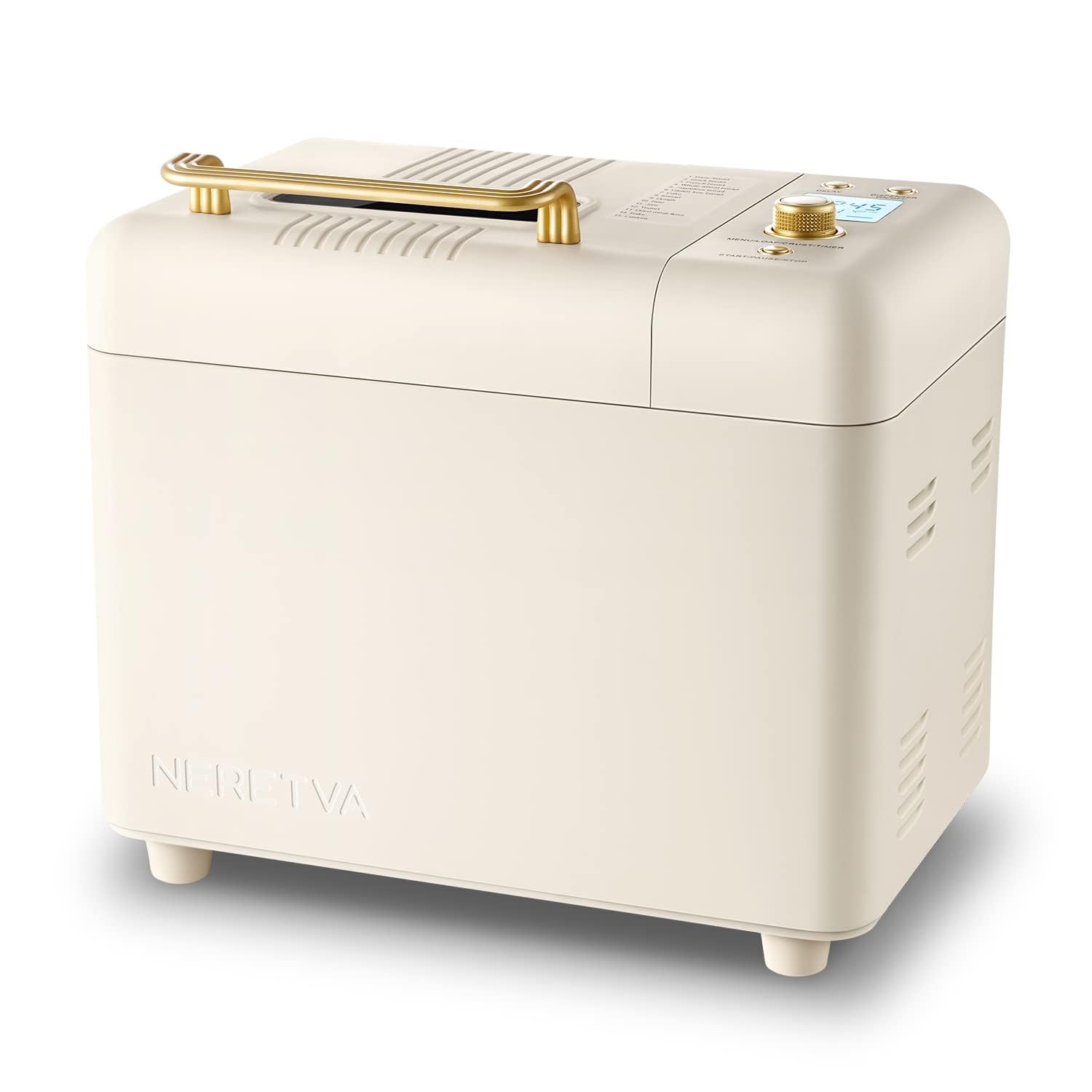
The Neretva distinguishes itself with top and bottom heating elements, a feature that directly benefits sourdough crust quality. Single-heater machines often yield a pale, soft top and a tough bottom, but this unit bakes evenly from both directions, producing a uniform golden-brown crust with a crisp exterior. The 600W motor keeps noise under 40 dB, which is quieter than most competitors during the kneading cycle.
Its 2.2-pound capacity is the largest in this comparison, accommodating loaves that serve up to seven people. The ceramic nonstick pan is free from harmful chemicals and releases sourdough without tearing. The automatic fruit and nut dispenser is a nice addition for adding seeds or dried fruit to the dough at the optimal point in the knead, but you can skip using it entirely for a pure sourdough loaf.
Some users noted that the kneading arm leaves a small hole in the bottom of the loaf, though the included removal tool makes it easy to extract. The machine’s weight (15.8 pounds) keeps it stable on the counter. The 15-hour delay timer is reliable, but the control panel lacks the intuitive feel of touchscreen models. For bakers who prioritize crust color and even baking, the dual heaters make a measurable difference.
Why it’s great
- Top and bottom heaters create an even golden crust on sourdough loaves
- 2.2lb capacity is ideal for large families or weekly meal prep
- Quiet motor at under 40 dB won’t disrupt your household
Good to know
- Kneading arm leaves a small hole in the bottom of the loaf
- Control panel buttons are less responsive than glass touchscreens
- Heavy unit is difficult to move around the kitchen frequently
4. CUCKOO CBM-AAB101S

CUCKOO brings a strong reputation from the rice cooker world into bread making, and this model’s high-wattage heater bakes loaves up to 20 minutes faster than standard machines. For sourdough, this means a shorter final proof-to-bake transition, which can help maintain an open crumb structure. The built-in automatic nut and fruit dispenser drops inclusions during the later stages of kneading, preventing them from being crushed.
The nonstick pan is genuinely easy to clean, and the paddle removal hook makes it simple to extract the mixing arm from the baked loaf. With 15 menu options, including a gluten-free setting that works well for alternative flour sourdoughs, this machine is beginner-friendly. The control panel is straightforward: select the bread type, crust darkness, and timer, then walk away.
This unit is on the noisier side during kneading, with several users mentioning they move it to a laundry room to avoid the sound. The compact footprint (8.85″ deep) is a strong selling point for tight counter space. It lacks a fully custom cycle, so if you need to fine-tune fermentation temperatures, you’sre limited to the preset programs. For standard sourdough bakers who want convenience and speed, it is a reliable choice.
Why it’s great
- High-wattage heater reduces total bake time for busy mornings
- Automatic nut dispenser distributes inclusions evenly without crushing
- Compact footprint saves valuable counter space in small kitchens
Good to know
- Noise level during kneading is higher than most competitors
- Lacks a fully programmable custom cycle for advanced fermentation control
- Nonstick pan is durable but requires hand washing to maintain coating
5. Briskind BM8206

The Briskind stands out with its angled glass touch panel and white backlit LCD screen, which is far easier to read in dim kitchen light than standard LED displays. It offers a dedicated sourdough starter menu and a custom setting that allows you to program each stage of the bake. The ceramic nonstick pan is horizontal, creating a traditional loaf shape that slices evenly for sandwiches.
Users frequently praise the machine’s stability — it is heavy and stays planted on the counter during the vigorous kneading required for sourdough. The quiet operation and mute alert beep function make it suitable for overnight baking without waking the household. The auto-adjust temperature sensor monitors fermentation and tweaks heating to maintain optimal conditions.
One oddity: it lacks an automatic fruit dispenser but beeps when you should add inclusions manually. The pan can be tricky to lock into place initially, requiring a clockwise twist that isn’t intuitive. The custom mode is powerful but the recipe booklet is somewhat generic, so you might need to experiment with hydration levels. For bakers who value a clear interface and quiet operation, the Briskind is a solid mid-range contender.
Why it’s great
- Angled glass touch panel with backlit LCD is easy to read in low light
- Dedicated sourdough starter menu and fully custom programmable cycle
- Heavy, stable construction stays put during high-hydration kneading
Good to know
- No automatic fruit dispenser; relies on an audible chime for manual add-ins
- Ceramic pan requires a tricky twist-lock motion to install securely
- Recipe booklet lacks sourdough-specific hydration guidance
6. Cuisinart CBK-110NAS

Cuisinart’s entry offers a compact vertical design that takes up minimal counter space while still producing up to a 2-pound loaf. It has 12 menu programs, including a basic cycle that many users adapt for sourdough by carefully timing the add-ins and proofing stages. The LCD display shows the countdown timer clearly, and the 60-minute keep-warm cycle is useful for delayed serving.
The removable nonstick vertical pan and kneading paddle are easy to clean, though the paddle tends to stick in the pan after baking and requires a soak to remove. The machine is moderately noisy, and the beep for add-ins is loud. For sourdough, the lack of a dedicated program means you’ll need to manually pause the cycle or use the custom timer to extend the bulk fermentation.
Some customers reported weak suction cups on the feet, causing the machine to shift during kneading, though Cuisinart replaced those units under warranty. The touch-sensitive panel can be accidentally triggered mid-cycle if brushed. It is a solid entry-level option for bakers who already know their sourdough timings and don’t mind working around a basic interface.
Why it’s great
- Compact vertical design fits easily under cabinets or on tight counters
- Removable pan and paddle make cleanup straightforward after baking
- Reliable 15-hour delay timer for planning around your schedule
Good to know
- No dedicated sourdough program requires manual timer adjustments
- Paddle sticks stubbornly in the pan and needs soaking to release
- Weak suction feet can cause the machine to move during kneading
7. VEVOR 19-in-1 Bread Maker

The VEVOR brings an impressive 19 function programs and a ceramic nonstick pan at an entry-level price point. It includes a gluten-free setting and a dedicated whole wheat program, both of which can be adapted for sourdough variations. The 15-hour delay timer and 1-hour keep-warm cycle are standard, but the ingredient addition reminder beeps at the right moment for adding inclusions during the kneading stage.
The food-grade ceramic inner pot is heat-resistant and the Teflon mixing blades are safe, but customer feedback reveals inconsistency. While some users rave about the quiet operation and the dual paddles for thorough kneading, others report the back paddle falling off during operation, embedding itself into the loaf. The bread pan has also been reported to stick inside the machine, requiring the entire unit to be inverted to remove the loaf.
For a beginner looking to experiment with sourdough without a large investment, this machine works well for basic loaves. However, for wet, sticky sourdough starters, the construction quality issues become a risk. The warranty and customer support from VEVOR are mixed according to reviews. It is best suited for bakers who will use it for standard doughs and occasionally try sourdough, not for daily sourdough specialists.
Why it’s great
- 19 program menus provide wide versatility for different bread styles
- Ceramic pan is heat-resistant and PFOA-free for healthier baking
- Ingredient reminder beep helps time add-ins during the kneading cycle
Good to know
- Kneading paddle can detach during operation and end up in the loaf
- Bread pan may get stuck in the machine, making removal difficult
- Quality control is inconsistent across units and customer support is hit-or-miss
FAQ
What is the ideal fermentation temperature for sourdough in a bread machine?
Can I use a regular bread machine program for sourdough?
Why does my sourdough loaf have a thick, burnt bottom crust?
Do I need a separate device to keep my sourdough starter alive?
Final Thoughts: The Verdict
For most users, the best bread machine for sourdough winner is the KBS 19-in-1 Programmable Bread Maker because its fully customizable cycle lets you fine-tune every stage of the sourdough process, from autolyse to final proof. If you want a stable, even-baking machine with dual heaters and a large capacity, grab the Neretva 15-in-1. And for dedicated sourdough bakers who struggle with starter consistency, nothing beats the Brod & Taylor Sourdough Home for keeping your starter alive and active between bakes.