
Tripping a breaker and running back and forth to the panel in the dark is a ritual every homeowner knows too well. A breaker finder eliminates that walk of shame by letting you stand at the panel and scan for the exact switch tied to any outlet or light fixture, all without shutting off power to the entire house.
I’m Min — the co-founder and writer behind Gadgets Feed. I’ve spent hundreds of hours analyzing circuit tracing technology, comparing receiver sensitivity, signal filtering methods, and accessory compatibility to separate the tools that lock onto a breaker on the first pass from the ones that make you guess.
Whether you are labeling a new panel or troubleshooting a dead outlet, the right tool saves frustration and keeps your work safe. This guide breaks down the top contenders for the best breaker finder by focusing on accuracy, build quality, and real-world performance in residential panels.
How To Choose The Best Breaker Finder
Not all breaker finders work the same way. The cheapest models may detect a signal, but they often lack the sensitivity adjustment and noise filtering needed in a crowded 20-slot panel. Before you buy, focus on three factors that determine whether the tool is a time-saver or just another gadget in the drawer.
Receiver Sensitivity and Two-Pass Scanning
The receiver is the brain of the operation. A receiver that offers adjustable sensitivity lets you fine-tune detection in panels where wires run tightly side by side. Tools that require a two-pass scanning method — a first pass to learn the ambient signal level and a second pass to pinpoint the exact breaker — deliver significantly better accuracy on a densely packed bus bar.
Built-In GFCI Testing and NCV Detection
A transmitter that doubles as a GFCI outlet tester is a practical addition because it verifies wiring conditions and confirms the GFCI trips at the correct threshold. Non-contact voltage (NCV) detection in the receiver adds a safety layer, letting you confirm a circuit is dead before you touch wires. These extras justify a mid-range or premium price tag over a bare-bones unit.
Accessory Kit and Storage Case
Standard three-prong plugs cover most outlets, but light socket adapters, alligator clips, and 3-to-2 prong adapters expand compatibility to fixtures and bare wires. A durable EVA or molded case keeps the transmitter, receiver, and small accessories together so you are not hunting for a missing adapter mid-job.
Quick Comparison
On smaller screens, swipe sideways to see the full table.
| Model | Category | Best For | Key Spec | Amazon |
|---|---|---|---|---|
| Klein Tools ET310 | Premium | Trusted pro build quality | Transmitter docks into receiver | Amazon |
| Fluke BK120 SmartTrace | Premium | Fluke reliability & dual NCV | Transmitter AC-powered (no internal battery) | Amazon |
| KAIWEETS KT301P | Premium | Large LCD and full accessory kit | Backlit LCD voltage display (30-150V) | Amazon |
| Ideal 61-535 | Mid-Range | cULus certified with NCVT | NCVT in receiver tip (80-300V) | Amazon |
| focemta FTCT01 | Mid-Range | LCD display for signal strength | Dual-function LCD (voltage + signal strength) | Amazon |
| NOYAFA NF-827 | Budget | Adjustable sensitivity on a tight budget | Receiver sensitivity adjustment dial | Amazon |
| AstroAI ABCBFET120BK | Budget | Best value kit with storage case | Two-pass scanning with audio/visual alerts | Amazon |
In‑Depth Reviews
1. Klein Tools ET310 AC Circuit Breaker Finder

The Klein ET310 is the tool that electricians reach for when precision matters. Its two-part system uses a transmitter that plugs into the outlet and a receiver that scans the panel, and the transmitter docks securely into the receiver for storage — a small design win that keeps components from separating in a work bag. The visual and audible alerts are bright enough to cut through a noisy job site.
Operating on 90-120V AC circuits, the built-in GFCI outlet tester verifies wiring conditions and confirms GFCI trip functionality without needing a separate tool. The receiver runs on a single 9V battery, and at 7.2 ounces, it does not weigh down your hand during a full panel-labeling session. Several users note that accuracy improves when you move the receiver slowly across each breaker slot.
Klein’s reputation in the electrical industry is backed by decades of industrial tool design, and the ET310 carries that DNA into a consumer-friendly form factor. The trade-off is that a dedicated carrying case is sold separately, so you will need to supply your own pouch or box if you want to keep the kit organized on long jobs.
Why it’s great
- Docking transmitter prevents lost components
- Bright visual feedback for dim panels
- Trusted brand with pro-grade build
Good to know
- No carrying case included
- Requires slow passes for best accuracy
2. Fluke BK120 SmartTrace Breaker Finder

The Fluke BK120 takes a different engineering approach: its transmitter draws power directly from the AC outlet, meaning no internal batteries to replace in the sending unit. The SmartTrace system uses an auto-calibrating first scan to learn the panel’s background noise, then locks onto the correct breaker on the second pass with a reported accuracy that outpaces most competitors in the mid-range tier.
This unit is a 4-in-1 tool that includes a breaker finder, dual-sensitivity NCV detector, socket tester, and a bright LED flashlight. The dual-sensitivity NCV mode is particularly useful for detecting voltage on terminal strips and supply cords, making it a safer choice for commercial environments where CAT III-rated tools are standard.
The Fluke brand carries a premium that professionals recognize immediately. The BK120’s receiver runs on batteries, but the transmitter does not, so you never face a dead transmitter mid-job. The only catch is the higher entry cost, which pays for the certification pedigree and the elimination of one potential failure point.
Why it’s great
- Transmitter powered by AC — no batteries needed
- CAT III-rated NCV for professional safety
- Auto-calibrating two-pass scan
Good to know
- Higher upfront investment
- No carrying case included
3. KAIWEETS KT301P Circuit Breaker Finder
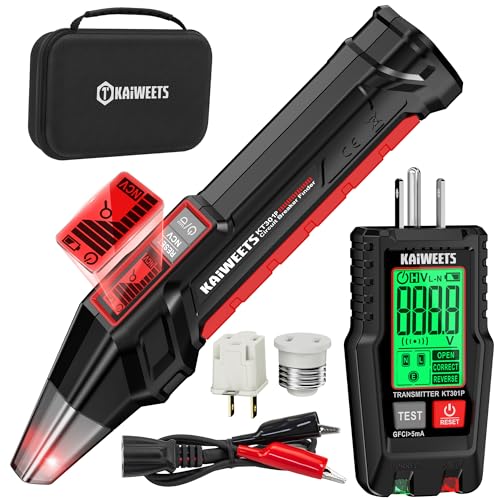
The KAIWEETS KT301P makes a strong argument for digital diagnostics. Its large backlit LCD screen displays real-time voltage from 30 to 150V and signal strength simultaneously, which removes the guesswork of relying solely on beeps and LEDs. The auto-hold function retains the latest outlet test results and voltage reading even after you unplug the transmitter.
Beyond breaker finding, the transmitter doubles as a GFCI outlet tester that diagnoses seven common wiring faults, including open ground and reverse polarity. The receiver includes a non-contact voltage test mode, so you can quickly confirm live circuits before working on a wire. The complete accessory kit comes with a 3-prong to 2-prong adapter, light socket adapter, and alligator clip adapter, all packed in a durable carrying case.
User feedback highlights that the tool requires a reset between uses to maintain accuracy on a new circuit, a step that is not clearly spelled out in the manual. Once you internalize that workflow, the KT301P delivers consistent results and represents a strong value for its feature density.
Why it’s great
- Large backlit LCD for voltage and signal strength
- Seven wiring fault diagnostics
- Full accessory kit with carrying case
Good to know
- Needs reset between circuit scans
- Manual omission on reset procedure
4. Ideal 61-535 Digital Circuit Breaker Finder

The Ideal 61-535 is a no-nonsense tool built for electricians who need certification-grade equipment. It carries cULus 1436 certification and a CAT II 150-Volt safety rating, which is rare in this price tier. The receiver tip includes non-contact voltage testing from 80V to 300V, and the audible alerts can be muted — a small detail that matters when you are working in a quiet occupied space.
The transmitter tests outlet wiring configurations with green and red LEDs and includes a GFCI test function. A built-in work light operates independently of the tester functions, so you can illuminate a dark panel without draining the battery reserve meant for scanning. The receiver also auto-powers off after five minutes of inactivity.
One user-reported quirk is that the receiver must be power-cycled before scanning a new circuit, which adds a step to the workflow. The tool also lacks a carrying case, so you will want to supply your own pouch to keep the transmitter and receiver paired. Despite those ergonomic gripes, the Ideal delivers consistent, accurate breaker identification that professionals expect.
Why it’s great
- cULus 1436 certified safety rating
- Mute function for quiet operation
- Independent work light
Good to know
- Power cycle required between circuits
- No carrying case
5. focemta FTCT01 Circuit Breaker Finder with LCD

The focemta FTCT01 brings an LCD screen to the budget-conscious buyer without sacrificing diagnostic depth. The dual-function display shows real-time voltage from 90V to 135V and signal strength simultaneously, which helps you distinguish between the target breaker and a neighboring slot with a weaker signal. The red and green indicator LEDs on the transmitter diagnose six common wiring faults.
This kit is genuinely ready to use out of the box — it ships with a 9V battery for the receiver and two AAA batteries for the transmitter, plus a small screwdriver for the battery compartment. The impact-resistant ABS housing keeps the weight at just 0.9 pounds, and the included carrying case holds everything neatly. The transmitter has a sealed battery compartment that meets IEC61010-1 safety standards.
Some users noted a learning curve regarding the angle at which the receiver must be held for a consistent reading, and LED lighting in the room can cause signal interference on certain circuits. Turning off nearby dimmers or LED fixtures resolves the issue in most cases, but it is worth factoring into your first few uses.
Why it’s great
- LCD shows both voltage and signal strength
- Batteries and screwdriver included
- Lightweight with carrying case
Good to know
- Angle-sensitive receiver reading
- LED lighting can cause interference
6. NOYAFA NF-827 Circuit Breaker Finder

The NOYAFA NF-827 stands out in the entry-level segment because of its adjustable receiver sensitivity dial. That physical control lets you dial back the gain when scanning a panel with tightly routed wires, reducing the chance of false positives on adjacent breakers. The receiver also includes non-contact voltage detection and a flashlight for dark panels.
The transmitter plugs into a 90-120V AC outlet and doubles as a GFCI tester. The accessory kit includes a 3-prong to 2-prong grounding adapter, a light socket adapter, and an alligator clip adapter, all stored in a custom EVA case. The transmitter’s LED panel communicates test status to help you avoid misoperations.
User reports consistently praise the NF-827 for value, but some note that when the target breaker’s wire runs close and parallel to another circuit, both breakers can trigger a signal. In those cases, the sensitivity adjustment helps isolate the correct slot, but it is not a one-touch solution. The auto-shutdown feature helps preserve battery life after the job is done.
Why it’s great
- Adjustable sensitivity for crowded panels
- EVA carrying case included
- NCV and flashlight in receiver
Good to know
- False signals on parallel wire runs
- Not a pinpoint lock-on design
7. AstroAI ABCBFET120BK Circuit Breaker Finder
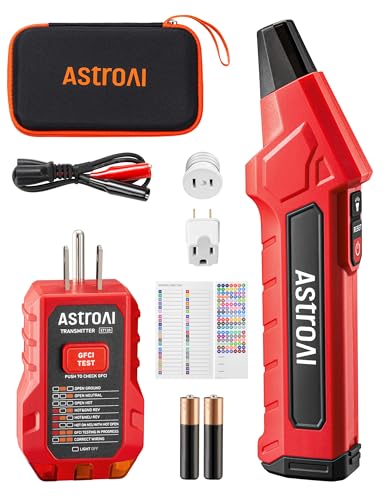
The AstroAI ABCBFET120BK is the definition of a complete budget kit. It includes a transmitter, receiver, light socket adapter, 3-to-2-prong plug, alligator clip adapters, and a set of breaker labels — all organized in a foam-lined EVA storage case. The receiver uses a two-pass scanning method: a first slow pass across the panel to learn the background signal, then a second pass to detect the correct breaker with audio and visual alerts.
The integrated GFCI outlet tester checks wiring conditions and confirms GFCI functionality, and the receiver’s built-in LED light makes reading panel labels in dim basements straightforward. The kit supports 90-120V AC circuits at 50/60Hz, covering the vast majority of North American residential panels. Auto-shutdown and low-battery alerts prevent surprises during use.
User feedback consistently highlights the tool’s accuracy and the value of the included accessories for the price. The slight drawback is that the receiver must be held flat and perpendicular to the breakers for single-breaker accuracy — tilting the tip can cause the signal to bleed onto adjacent slots. For the price, this is a minor accommodation that delivers reliable results.
Why it’s great
- Everything in one foam case
- Two-pass scanning improves accuracy
- Includes breaker labels and adapters
Good to know
- Receiver angle sensitive for single-breaker lock
- Low-battery alert only on receiver
FAQ
How does a two-pass breaker finder work differently from a single-pass model?
Can a breaker finder work on a sub-panel or a 240V circuit?
Why does my breaker finder beep on two different breakers in the panel?
Final Thoughts: The Verdict
For most users, the best breaker finder winner is the Klein Tools ET310 because it combines pro-grade build quality, a docking transmitter design, and a reliable GFCI tester into a package that electricians and serious DIYers trust immediately. If you want a large digital display that shows voltage and signal strength at a glance, grab the KAIWEETS KT301P. And for a budget-friendly kit that includes every adapter and a storage case, nothing beats the value of the AstroAI ABCBFET120BK.