
A plateau in your sport isn’t always in your legs or your lungs — it’s often in the muscles you never see. The diaphragm and intercostals, the unsung engines of every sprint, climb, and rep, respond to targeted resistance just like any other skeletal muscle. A dedicated breathing trainer imposes that resistance, forcing your respiratory system to work harder so that during real competition, every breath feels effortless and oxygen delivery peaks.
I’m Min — the co-founder and writer behind Gadgets Feed. I’ve spent hundreds of hours analyzing the biomechanics of respiratory muscle training and cross-referencing clinical studies against real-world athlete feedback to separate devices that genuinely build endurance from those that just restrict airflow.
A good device builds measurable VO2 max gains and reduces perceived exertion during high-intensity intervals. That is precisely what you will find in this roundup covering the breathing trainer for athletes.
How To Choose The Best Breathing Trainer For Athletes
The market is split between simple inspiratory muscle trainers and more sophisticated dual-action units that resist both inhalation and exhalation. Your sport and training style dictate which approach yields the biggest return on investment.
Dual-Action vs. Inspiratory-Only Resistance
Pure IMT devices load only the inspiratory muscles (diaphragm, external intercostals). Dual-action trainers add expiratory resistance, recruiting the abdominal and internal intercostal muscles that control forceful exhalation under duress. For runners and cyclists who need rapid, full breath cycles, dual-action builds a more complete respiratory motor pattern.
Resistance Range and Programmability
Look for a device offering at least five distinct resistance levels. A narrow range (two or three clicks) leaves you under-challenged within weeks as your diaphragm adapts. Premium units like the POWERbreathe offer a graded spring mechanism, while others use variable air valve orifices. The best choice lets you increase load in small increments so you can progress linearly without plateaus.
Portability and Hygiene
An athlete trains on the road, so the unit must survive a gym bag without damage. Silicone mouthpieces are standard, but check whether the device can be fully disassembled for washing. Mold accumulation in the airway is a real risk with daily use. Units that allow tool-free disassembly and hot-water sterilization earn higher marks for long-term practicality.
Quick Comparison
On smaller screens, swipe sideways to see the full table.
| Model | Category | Best For | Key Spec | Amazon |
|---|---|---|---|---|
| Maximus Lung Trainer | Dual-Action | VO2 max & endurance athletes | 5 levels, DART dual airflow | Amazon |
| POWERbreathe MR | Inspiratory | Competitive performance & recovery | Medium resistance spring (tunable) | Amazon |
| TRAININGMASK 2.0 | Altitude Simulator | Stamina & simulated elevation | 36 adjustable resistance levels | Amazon |
| The Breather Pink | Dual-Action | Beginner-friendly guided training | 6 levels, app-based coaching | Amazon |
| Bigbreathe IMT/PEP | Medical-Grade Dual | Rehab & mucus clearance | Independent IMT & PEP valves | Amazon |
| Expand-A-Lung (3 Pack) | Dual-Action | Value & family use | Dual-way adjustable knob, USA design | Amazon |
| coher Workout Mask | Resistance Mask | Affordable intro to resistance breathing | Silicone/nylon, head strap design | Amazon |
In‑Depth Reviews
1. Maximus Lung Trainer

The Maximus uses patented DART (Dual Airflow Resistance Technology) to restrict airflow equally during both inhalation and exhalation — a rare feature in a sub-60-dollar package. Its five numbered valve settings range from 25% to 75% restriction, and the 1-ounce body clips directly to a waistband so you can train during movement. Real-world data from users shows a 26.47% improvement in VO2 max over six months alongside measurable reductions in 2.5-mile bike times.
Each click of the numbered dial produces a distinct change in draw resistance, unlike some competitors where settings feel nearly identical. The plastic housing is impact-resistant enough for gym bag carry, and the valve is easy to disassemble for cleaning. A nose clip is recommended for full seal, but the device works well with practice.
For athletes chasing performance metrics — runners, cyclists, MMA fighters — the Maximus delivers the clearest progression of any dual-action trainer in its tier. The five-level system forces real adaptation without the confusion of 36 unlabeled clicks found on some masks.
Why it’s great
- Proven VO2 max gains (26%+ in user reports)
- Ultralight 1-oz design for active use
- Distinct 5-level numbered resistance scale
Good to know
- Requires nose clip for full seal
- Inhale and exhale resistance adjust together
2. POWERbreathe MR (Medium Resistance)

The POWERbreathe MR is the gold standard for inspiratory muscle training, used by respiratory therapists and competitive athletes alike. Its spring-loaded valve offers a single but highly precise resistance level — choose Light, Medium, or Heavy based on your baseline strength. The Medium resistance model suits most trained athletes; users report progressing from zero to setting one (roughly 70% force increase) within five weeks of twice-daily sessions.
The mouthpiece is formed from synthetic rubber with a non-slip texture, and the unit comes with a carrying case for hygiene. Sterilization is straightforward: boil water weekly and submerge the valve assembly. The device is exclusively inspiratory — it does not load the exhalation phase — which makes it ideal for sports where a powerful, efficient inhale is paramount, such as swimming or rowing.
Several users also note a secondary benefit: lowered resting blood pressure after three months of consistent use, likely due to strengthened vagal tone from controlled breathing mechanics. At just over two hundred grams, it’s heavier than a simple tube but substantively more durable.
Why it’s great
- Clinically validated inspiratory resistance mechanism
- Measurable strength progression tracked by users
- Boilable for deep sterilization
Good to know
- Expiratory muscles not targeted
- Single fixed resistance level per model
3. TRAININGMASK 2.0 Turn Flow

The TRAININGMASK 2.0 mimics hypoxic (low-oxygen) conditions by restricting airflow through two patented Turn Flow valves with 36 on-the-fly adjustment settings. This is not a mouthpiece — it is a full-face mask that covers both mouth and nose, creating negative pressure that forces the diaphragm to work harder with each breath. The hook-and-loop closure allows a custom fit on head sizes from small to large.
The mask’s primary advantage is that it stays on during dynamic movement — sprints, burpees, heavy squats — without shifting. Users report an “extremely effective multiplier of misery” that transforms a moderate workout into a lung-burning challenge. The silicone material conforms to facial contours, though athletes with beards may experience seal leakage. The head strap pulls near the ears, which can interfere with over-ear headphones.
Clinical studies back simulated altitude training for improving oxygen uptake and cardiovascular fitness, and the 2.0 model has been refined to reduce the nose bridge pressure reported in earlier versions. This device is best suited to athletes who want to overload the entire respiratory system during actual training rather than during separate breathing drills.
Why it’s great
- 36 micro-adjustable resistance levels
- Secure fit for high-intensity movement
- Clinically studied altitude simulation effect
Good to know
- Head strap can conflict with earbuds
- Beards compromise face seal
4. The Breather Pink

The Breather Pink pairs a six-level dual-action resistance trainer with a smartphone coaching app that paces your inhale/exhale timing and records session history. This combination makes it one of the most accessible devices on the market for athletes new to respiratory training. The app removes guesswork: it sets a cadence, tracks your rep count, and adjusts pace as your endurance improves.
The hardware itself is simple: a clear plastic cylinder with a silicone mouthpiece, six adjustable vents, and a valve that resists both directions. Users note that the device significantly improved breathing strength, speech therapy outcomes, and swallowing control. The five-minute daily requirement (two sessions) is low enough to maintain consistency even during travel.
One notable gap is the lack of a carry case — several reviews mention the device getting damaged on the go. A dedicated case is not included despite the mid-range price point. The pink color variant is the same as the standard model and performs identically; color choice does not affect resistance performance.
Why it’s great
- Included guided app removes training uncertainty
- Low time commitment (5 min/session)
- Independent inhale and exhale resistance control
Good to know
- No storage case included
- Plastic body less impact-resistant than competitors
5. Bigbreathe IMT/PEP Breathing Exerciser

Bigbreathe separates itself by offering independently adjustable inspiratory (IMT) and expiratory (PEP) valves — a design usually seen in clinical pulmonary rehabilitation. You can set a light inhale resistance and a heavy exhale resistance or vice versa, tailoring the load to specific respiratory weaknesses. The device is built for structural simplicity with tool-free disassembly under running water, a critical feature for athletes prone to sinus issues.
At 1.76 ounces and roughly the size of a large marker, it is the lightest dual-action device on this list. The compact body is easy to slip into a pocket or small gym bag compartment. Users recovering from respiratory conditions find the PEP function particularly useful for loosening mucus, while athletes without lung pathology use the IMT valve to target diaphragm strength.
The instructions have been a consistent pain point — several reviews note confusion about how to adjust the valves without visual guidance. Once mastered, however, the device offers the most customization of any trainer in its price bracket. The fully manual, battery-free construction ensures zero maintenance beyond cleaning.
Why it’s great
- Fully independent IMT and PEP adjustment
- Ultralight and truly pocketable
- Tool-free cleaning with hot water
Good to know
- Instructions are sparse and confusing
- Not designed for use during exercise
6. Expand-A-Lung (3 Pack)
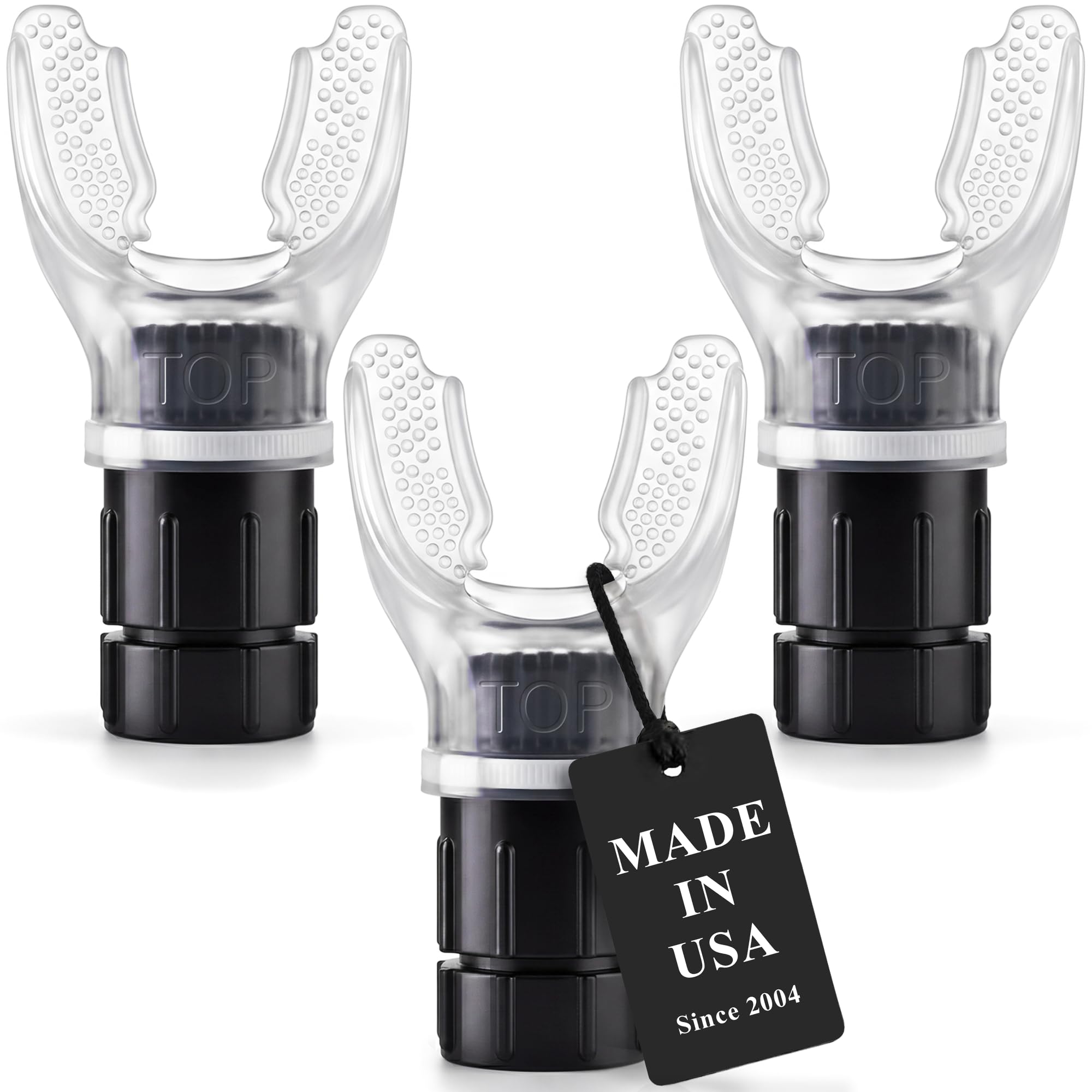
The Expand-A-Lung has been in production since 2004 and remains one of the most straightforward dual-action trainers on the market. A single rotation knob adjusts resistance for both inhale and exhale simultaneously, eliminating the confusion of separate valve settings. This 3-pack gives an athlete a unit for home, one for the gym bag, and a spare for a training partner or family member — a practical move for consistent daily use.
The mouthpiece is made from food-grade silicone that resists rust and degredation, and the 4-inch body fits any pocket. Users have reported measurable improvements in lung capacity, with one asthma-prone user noticing cessation of wheezing and easier steep inclines after two weeks. The device works both directions — a feature not all value-tier trainers offer.
The adjustment knob provides a wide range, but some users feel the detents are not distinct enough — it can be difficult to precisely return to a previous setting. The absence of numbered markings means you rely on muscle memory for progression tracking. Still, for the price of a single competing device, you get three units with a proven track record.
Why it’s great
- Three units for shared or multi-location training
- Proven design with two decades of use
- Dual-way resistance in a simple package
Good to know
- No numbered resistance scale — hard to track exact load
- Knob detents feel vague between settings
7. coher Workout Breathing Mask

The coher Workout Mask is an entry-level face mask with adjustable resistance valves, designed to increase respiratory load during running, cycling, and general fitness. It is made from a combination of silicone and nylon fabric with a head strap closure, and it fits most adult face sizes. For athletes on a tight budget, this is the least expensive way to experience resistance breathing during active training.
Users report that the mask holds up well for daily 2-to-5-mile runs over several months, though the fabric begins to droop slightly after extended sessions. The mask is less intrusive than some full-face designs and does not cause the same discomfort reported with cheaper cloth exercises masks. It is also functional enough for scuba conditioning prep, according to one verified review.
The coher does not offer the precise resistance increments of a dedicated mouthpiece trainer, and the material will wear faster than a solid plastic device. For the athlete who wants to test the concept of hypoxic training before investing in a premium unit, however, it provides a functional and durable entry point. Just manage expectations on breath measurement and long-term durability.
Why it’s great
- Lowest cost entry into resistance breathing
- Comfortable for daily 2-5 mile runs
- Works for running, cycling, and scuba prep
Good to know
- Fabric wear shows after months of use
- No fine-tuned resistance stages
FAQ
Will a breathing trainer improve my VO2 max faster than interval training alone?
Can I use a respiratory trainer during my actual workout or only at rest?
How do I know which POWERbreathe resistance level — Light, Medium, or Heavy — is right for me?
Final Thoughts: The Verdict
For most users, the breathing trainer for athletes winner is the Maximus Lung Trainer because its DART dual-flow technology, five precise resistance levels, and sub-ounce weight deliver the best balance of proven performance gains and portability. If you want clinical-grade inspiratory strength with a tunable spring mechanism, grab the POWERbreathe MR. And for athletes who prefer to simulate altitude during their actual workout, nothing beats the TRAININGMASK 2.0.