
Our readers keep the lights on and my morning glass full of iced black tea. As an Amazon Associate, I earn from qualifying purchases.
Specs are compiled from manufacturer listings and verified buyer reviews and can change over time — please confirm the key details on the product page before buying.
If you are cutting brick, block, or pavers, the saw you buy decides whether you finish the wall this weekend or spend it fighting a blade that wanders and a motor that trips the breaker. Match the saw’s blade diameter and cut depth to the material you’re cutting. A light handheld wet saw handles brick and tile beautifully. A big wheeled cutter is what you want for slab and reinforced concrete. Everything in this guide gets sorted on that basis.
I’m Min — the founder and writer behind Gadgets Feed. This guide is built by comparing the manufacturers’ published specifications and the patterns across verified customer reviews, so you get each pick’s real strengths and trade-offs instead of marketing spin.
Blade size, amperage, wet versus dry cutting, and bevel range are what separate a tool that lasts from one that quits mid-job. I have ranked these nine so you can find the right brick cutting saw fast.
Our Picks at a Glance

How To Choose The Best Brick Cutting Saw
Picking the right saw for brick depends on four things: how deep you need to cut, whether you are working indoors or out, how much power your outlet can supply, and if you want gas or electric. Get those four right and you won’t buy a saw that stalls on your material.
Cut depth and blade diameter drive everything
A 14-inch blade cuts deeper than a 5-inch blade. That sounds obvious, but the practical ceiling matters. The Husqvarna K770 cuts to a maximum depth of 5 inches. The Makita 4101RH tops out at 1-5/8 inches at 90 degrees. For cutting brick paving or tile, a shallow depth is fine. For slicing through a brick wall in one pass, you need the larger blade and the depth that comes with it.
Wet cutting versus dry cutting
Water does two jobs: it keeps dust out of the air and it cools the diamond blade so it lasts longer. Wet cutting matters most when you are working near a house, inside a basement, or on a job where airborne silica dust is a health concern. A built-in water feed system, like the one on the XtremepowerUS 3200W or the Evolution R12DCT, handles this automatically. Dry cutting is simpler for outdoor work but generates more dust and heat.
Your breaker can only handle so much
A saw that draws heavy current will trip a standard household breaker. Several saws here run on 15 amps. The more powerful models, including the Evolution R14DCT, need a 20A outlet and a heavier circuit. Before you buy, check what your garage or job site can actually supply, because a saw that trips a 15A breaker mid-cut stalls the job. Running a long extension cord adds resistance and makes tripping worse, so use the shortest, thickest cord you can.
Quick Comparison
| Model | Best For | Blade Size | Cut Depth | Power Source | Amazon |
|---|---|---|---|---|---|
| Husqvarna K770 Gasoline Grinder★ Best Overall | Off-grid and outdoor masonry | 5 inches | 5 inches | Gasoline | Amazon |
| POWERTEC 4.5″ Handheld Tile SawBest for Tile & Stone | Tile, granite, and countertop work | 4.5 inches | — | AC (12A/1400W) | Amazon |
| XtremepowerUS 9-Inch Electric Concrete SawBest Value Cutter | Whole-wall cuts on a tight budget | 9 inches | 3-1/2 inches | AC (1800W) | Amazon |
| Steel Force KPC 3551 14″ Cut-Off Saw | Occasional home jobs, not daily use | 14 inches | — | AC (15A/2600W) | Amazon |
| XtremepowerUS 3200W 16″ Cut-Off Saw | Reinforced concrete and block on a budget | 16 inches | — | AC (3200W/20A) | Amazon |
| Evolution R12DCT 12″ Concrete Saw | Dust-controlled cutting near homes | 12 inches | 4-1/2 inches | AC (15A) | Amazon |
| Evolution R14DCT 14″ Concrete Saw | Deep cuts on heavy-duty jobs | 14 inches | 5-1/8 inches | AC (20A) | Amazon |
| Makita 4101RH 5″ Masonry Saw | Precision tile and travertine work | 5 inches | 1-5/8 inches at 90° | AC (7.9A) | Amazon |
| Husqvarna K4000 Power Cutter Saw | Indoor cutting where gas is banned | 14 inches | 5 inches | AC | Amazon |
In‑Depth Reviews
1. Husqvarna 967682101 K 770 Gasoline Grinder, Orange
Our pick — over 4.5★ from 400+ verified ratings; the strongest balance of quality and price.
The gas-powered workhorse that starts on the third pull and keeps cutting through dust, debris, and abuse.
When you are cutting brick and block far from an outlet, gas is the only answer. The K770 runs on gasoline, so there is no cord to trip over, no breaker to trip, and no outlet to find. Its 5-inch blade delivers a maximum cut depth of 5 inches — deep enough for most brick walls in a single pass. The engine is built with a cast magnesium crankcase and a 3-bolt joint attaching the cutting head, which Husqvarna says provides higher torsional rigidity than a 2-bolt solution.
What wins people over here is raw reliability. A mason running three units off-grid reports that the K770 saves time on every job. Another buyer who had used both Stihl and Hilti cutoff saws calls this the toughest, most reliable of the group. The semi-automatic belt tensioning system removes the guesswork from maintenance, and the active air filtration system with a maintenance-free Durastarter contributes to long service intervals. Weighing 22.4 pounds, it sits in the same weight class as the XtremepowerUS 9-inch saw at 22 pounds — a difference of only 2%, so neither is meaningfully lighter on a long day.
The honest catch: no blade is included, so budget for a 5-inch diamond blade separately. You also need to match the blade to the material — a soft stone like sandstone wants a hard steel bond, and a hard stone like granite wants a soft steel bond. The heavy dust this saw generates means safety gear is not optional. Occasional users will also find it heavy to carry all day at 22.4 pounds. For anyone who needs cordless, fuel-independent runtime, the K770 is the benchmark.
What earns its keep
- Cord-free gas power works anywhere, including off-grid job sites
- 5-inch maximum cut depth handles most brick and block walls
- Semi-automatic belt tensioning reduces maintenance guesswork
- 22.4-pound weight matches the best in its class for portability
Where it asks for more
- Blade not included — a real cost most buyers discover after opening the box
- Heavy dust output means full safety gear is mandatory
- At 22.4 pounds, not ideal for all-day overhead or ladder work
Get this if: you need a self-contained gas saw that runs anywhere without a cord or outlet — masons working off-grid or on sites without power.
Think twice if: you are working indoors or in a confined space where gasoline fumes are not acceptable.
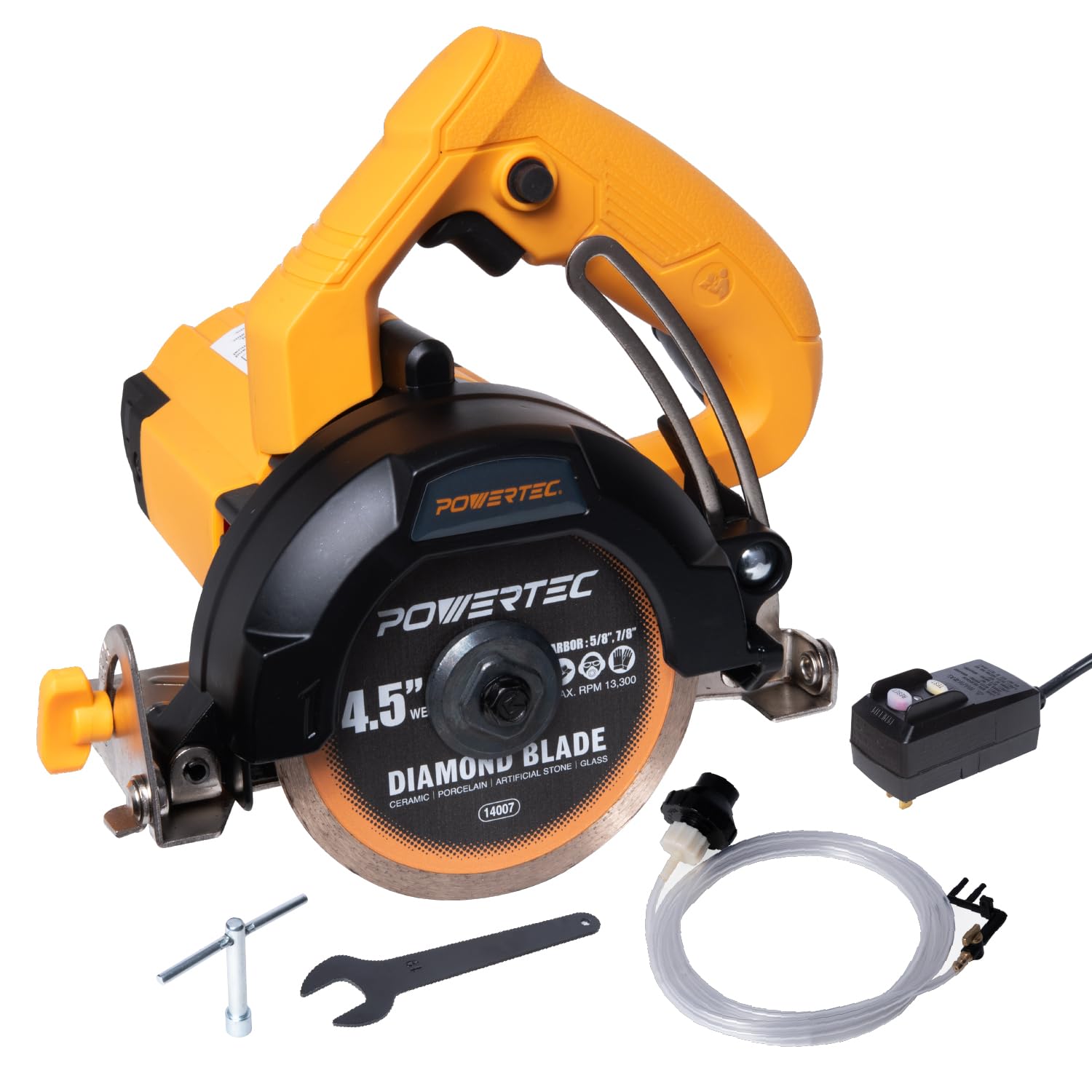
2. POWERTEC 4.5″ Handheld Tile Saw, 12A/1400W Wet/Dry Masonry Saw
The compact wet saw that makes countertop cutting feel like a pro job — at just 9.5 pounds.
If your work is tile, granite, or porcelain rather than full brick walls, this is a smarter fit than a giant wheeled cutter. It packs a 12A/1400W motor turning up to 12,000 RPM, driving a 4.5-inch continuous diamond wet-cutting blade on a 7/8-inch arbor. The wet-cutting system uses a metal control valve to adjust water flow, which cools the blade, reduces dust, and prevents tile chipping. At 9.5 pounds, you can carry it up a ladder or hold it overhead — unlike the Evolution R14DCT at 30.6 pounds, which needs wheels to move around.
The quality earns the most praise here — buyers who were new to wet saws report it feels like a professional-grade tool. It cuts through granite countertops with ease. The GFCI plug cuts power instantly if it contacts water or overloads, which is genuinely useful when you are spraying water on an electrical tool. Included are a standard 3/4-inch brass garden hose fitting, a 0-45 degree bevel, and depth adjustment. Setup is straightforward once you know one thing: the included blade has a removable reducer ring that must come off before it fits the 7/8-inch spindle.
The fit-and-finish story is more mixed. Some units arrive with the platform unable to reach exactly 90 degrees, and the depth cam lock is weak enough that a few users applied thread-locker to stop the platform shifting. The included blade chips porcelain for some buyers. The nozzle is plastic but sits hidden under the blade guard. It is a saw best suited to homeowners and hobbyists rather than daily commercial work.
The precision angle: a 4.5-inch blade on a 9.5-pound body with adjustable wet feed is exactly what countertop and backsplash work needs — light enough to guide by hand, wet enough to keep dust and chipping in check.
The honest limit: if you are cutting brick pavers all day every day, the plastic water fitting and shifting platform will wear before you finish the project.
Reach for this if: you are cutting granite, tile, or stone for a kitchen or bath remodel and want pro-grade results without a full-size wet saw.
Look elsewhere if: you need to cut depth beyond 1-5/8 inches or tackle reinforced concrete slabs — this saw is built for surface stone work.
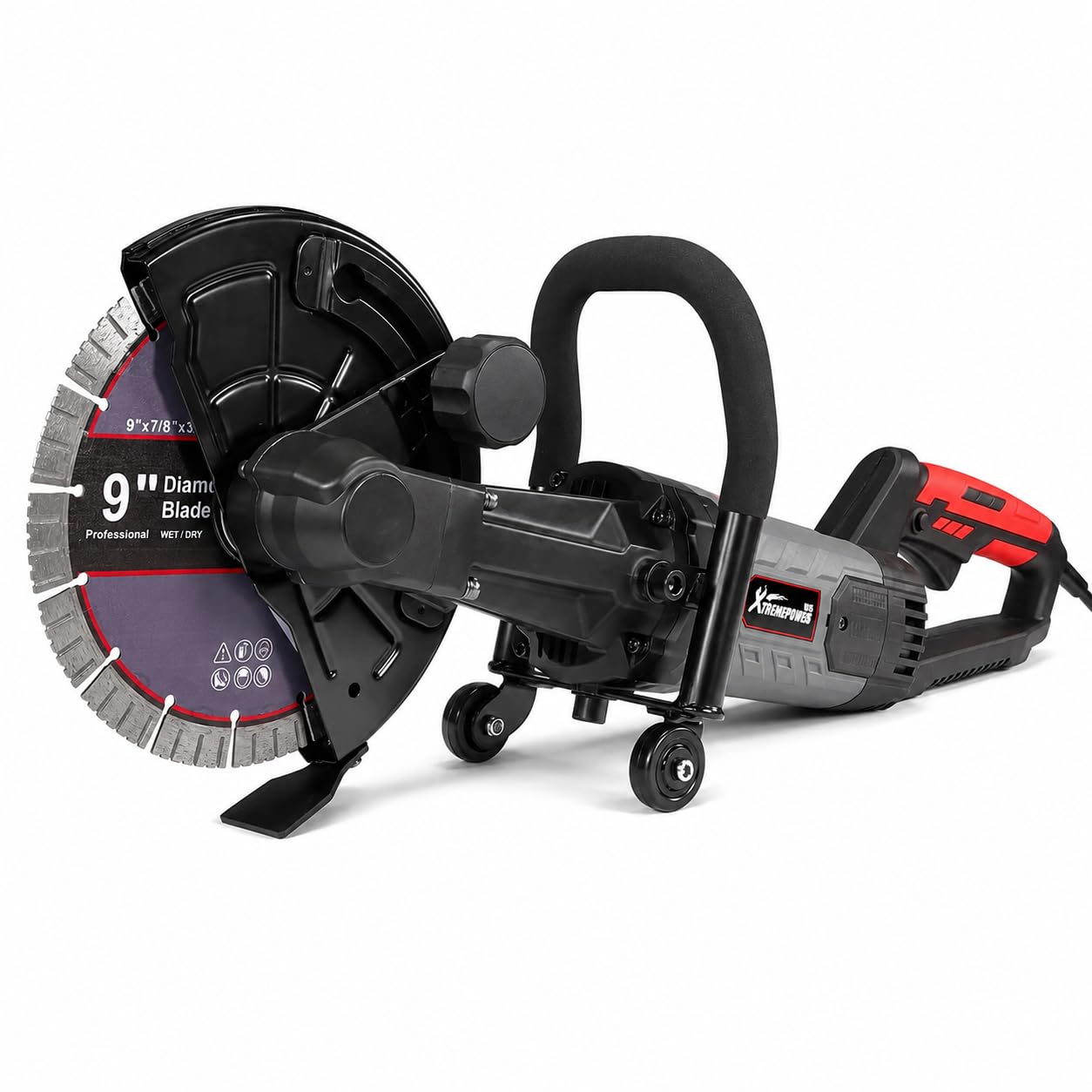
3. XtremepowerUS 9-Inch Electric Concrete Saw, 1800W Cut-Off Circular Saw
A 9-inch diamond blade and 1,800 watts of electric power — no gas, no fumes, cuts through reinforced concrete.
Here is a saw that gives you a genuine concrete-cutting capability without the gasoline hassle. The 1800W electric motor delivers consistent power with no fuel mixing, no pull cord, and no exhaust fumes. The included 9-inch segmented diamond blade is designed for concrete, brick, stone, masonry, and pavers. It measures 34 inches long, 10 inches wide, and 19.25 inches tall — noticeably larger than the compact POWERTEC at roughly 10 by 9 by 8 inches — so it takes up real shop space but it also brings a bigger blade.
What owners keep coming back to is the blade life and the low fuss. One buyer with a steel-reinforced concrete job reports it cut through 4 to 5 inches with the included diamond blade with no problem — a job most people expect to need a rental machine for. The dual-handle design with a trigger switch and safety lock gives you control across long horizontal cuts, and the adjustable blade guard and built-in guide rollers help keep the line straight. Running on AC means you never worry about the tank.
Two caveats before you buy: It weighs 22 pounds — the same as the Husqvarna K770 — and one buyer found it heavy enough to return because the 3-1/2-inch cut depth was not deep enough for their specific job. If your cuts are deeper than 3-1/2 inches, you will need a larger wheeled cutter. The corded electric power means you also need to manage the extension cord to keep the cut clean.
What it does well
- Included 9-inch segmented diamond blade means usable from the start
- 1,800W electric motor with no fuel mixing or exhaust
- Guide rollers and dual handles help keep cuts straight
The trade-offs
- 3-1/2-inch max cut depth is shallower than a 14-inch wheeled saw
- 22 pounds is heavy to hold overhead or carry up ladders for long
- Cord management adds a step versus a gas saw
Good fit for: homeowners and contractors who need a reliable electric cutter for concrete, brick, and block where 3-1/2-inch depth covers the job.
skip it if: your cuts run deeper than 3-1/2 inches or you need to freehand a long horizontal cut without a ledge to rest the saw on.
4. Steel Force KPC 3551 Portable 14″ Wet/Dry Electric Corded Circular Concrete Saw

A 14-inch corded cutter for occasional jobs — with a water system that needs some patience.
Fourteen inches of blade with a 15 amp motor and a 2,600-watt rating is a lot of cutting capability in a corded package. The Steel Force handles granite, porcelain, and concrete at 4,300 RPM and cuts a clean 90-degree line. It ships with a 14-inch general-purpose segment diamond blade and both 1/2-inch and 3/4-inch water hose adapters. For homeowners who only need a big cutter a few times a year, the 14-inch blade depth is tough to top at this price point.
What buyers report most is that it works but asks for patience. Cutting performance is the most-discussed subject, and the pattern is clear: it does the job if you feed it slowly. It also runs without exhaust fumes, which a few buyers chose specifically for indoor work in basements and garages. The ergonomic handle design is comfortable to grip through a long cut.
The real catch is the water system. Multiple owners mention the spray attachments leak or blow off under pressure, and a few re-rigged the setup with their own valves and fittings to make it work properly. Some units trip the inline GFCI breaker during heavier cuts. The durability story is mixed — the saw suits occasional home projects but is not built for daily commercial abuse. If you are buying this for a serious stone-fabrication shop, you already know this is not that tool.
Where it delivers: a full 14-inch blade, 15-amp motor, and both water adapters for the price is a lot of cutting surface — enough for home slab and drain projects on a tight budget.
Where it asks for work: the water attachments and GFCI breaker are the two things most owners end up tinkering with to get a good experience.
Good value for: DIY homeowners cutting concrete for a spare room, drain, or door sill who do not mind solving a water-leak or valve issue.
Not the pick for: stone fabricators or contractors cutting every day — the durability and water fittings here do not hold up under that duty cycle.
5. XtremepowerUS 3200W Electric 16″ Concrete Cut Off Saw

A 16-inch blade and a 3200W motor that cut a 70-year-old basement slab, provided you have a 20A outlet to feed it.
When the job is a full slab, a big retaining wall, or cutting rebar-reinforced concrete, blade size is everything. This 16-inch cutter is the largest in the group, with a 3200W motor and a 20-amp current draw. It handles stone, reinforced concrete, pavings, and bricks. Customers note cutting through a 4-inch limestone slab in a single pass and sawing through 5-3/4-inch limestone with ease, with the blade staying true and free of wobble.
What earns trust here more than any spec is reliability — that is the quality that comes up most in owner feedback, and it is backed up by a soft-start feature that eases the saw into the cut and prevents the alarming amp spike that trips breakers on cheaper saws. The built-in water feed system with a metal control valve keeps dust down to almost nothing, and the mud flap over the motor vents keeps the grunt clean. There is also a GFCI built into the cord for automatic safety shutoff.
Two real limits. It weighs 40 pounds, so this is a two-hand tool and heavy to reposition vertically. And it draws a full 20 amps, so a standard 15-amp household circuit will not run it — a 12-gauge cord on a 20-amp breaker is the reliable setup. The included manual is also known for having pages that reference a different machine entirely. If you can supply 20 amps and have a ledge to rest the saw on for horizontal cuts, this saw punches far above its price class.
Why buyers trust it
- 16-inch blade cuts through thick slabs and reinforced concrete
- Soft-start prevents the inrush amp spike that trips breakers
- Built-in water feed with metal valve keeps dust nearly zero
- Purported GFCI in the cord for automatic safety protection
Know before you buy
- 40 pounds is heavy to position — best used vertically with leverage, not overhead
- Requires a 20A circuit; will trip on a 15A household breaker
- No blade lock — plan on wrench and Allen key for blade swaps
Right for: cutting thick concrete slabs, retaining wall caps, and reinforced block where a 16-inch blade and a 20A feed are available.
Skip if: you cannot supply a 20-amp circuit or a horizontal ledge for the saw — this is not a freehand overhead tool at 40 pounds.
6. Evolution R12DCT 12″ Concrete Saw with Water Fed Dust Suppression

The dual-sided water system that keeps indoor brick and block cutting clean enough to work near finished spaces.
The R12DCT is built around one big idea: cut brick and block without coating the job site in dust. Dual-sided water delivery suppresses dust in accordance with OSHA regulations, and the wet dust control is the thing owners rave about most. The 15A electric motor means no pull cords, no fuel, and no servicing. A 12-inch premium diamond blade is included and cuts masonry, brick, roof tile, pavers, stone, concrete, and steel-reinforced concrete. The 4-1/2-inch cut depth covers most brick and block walls in a single pass.
Reliability is the strength that shows up most in owner feedback, closely followed by build quality. A 30-year contractor who had been running a gas Stihl picked this up specifically for indoor work and says it ran fine on a 15-amp circuit after popping once on a 20-amp. Another owner used it to cut 40 linear feet of 4 to 5-inch slab poured in 1956 with no issues, and reports the water mist kept both the dust down and the blade cool.
Two things to plan for. The saw draws heavy current during operation, and it needs a full 20-amp circuit or a large generator to run at its best — a 15-amp line will not reliably feed it under load. A few owners also note the hose connector drips unless the O-ring is seated well, and the wrench storage bracket can break. Neither issue stops the cut; they are the kind of details that need attention on an otherwise solid machine.
The dust story: dual-sided water delivery plus a metal valve gives this saw a genuine OSHA-compliant dust-control capability — the feature that makes it practical for cutting brick inside a finished home.
The electrical catch: the motor’s 15A draw under load means you need a properly sized circuit and a short, heavy extension cord or the saw will chatter on startup.
Pick this if: you are cutting brick, block, or pavers in or near a home and want the dust controlled at the blade rather than filling the room.
Look elsewhere if: your circuit is a standard 15-amp household line — the R12DCT pulls power it will not get there.
7. Evolution R14DCT 14″ Electric Concrete Saw
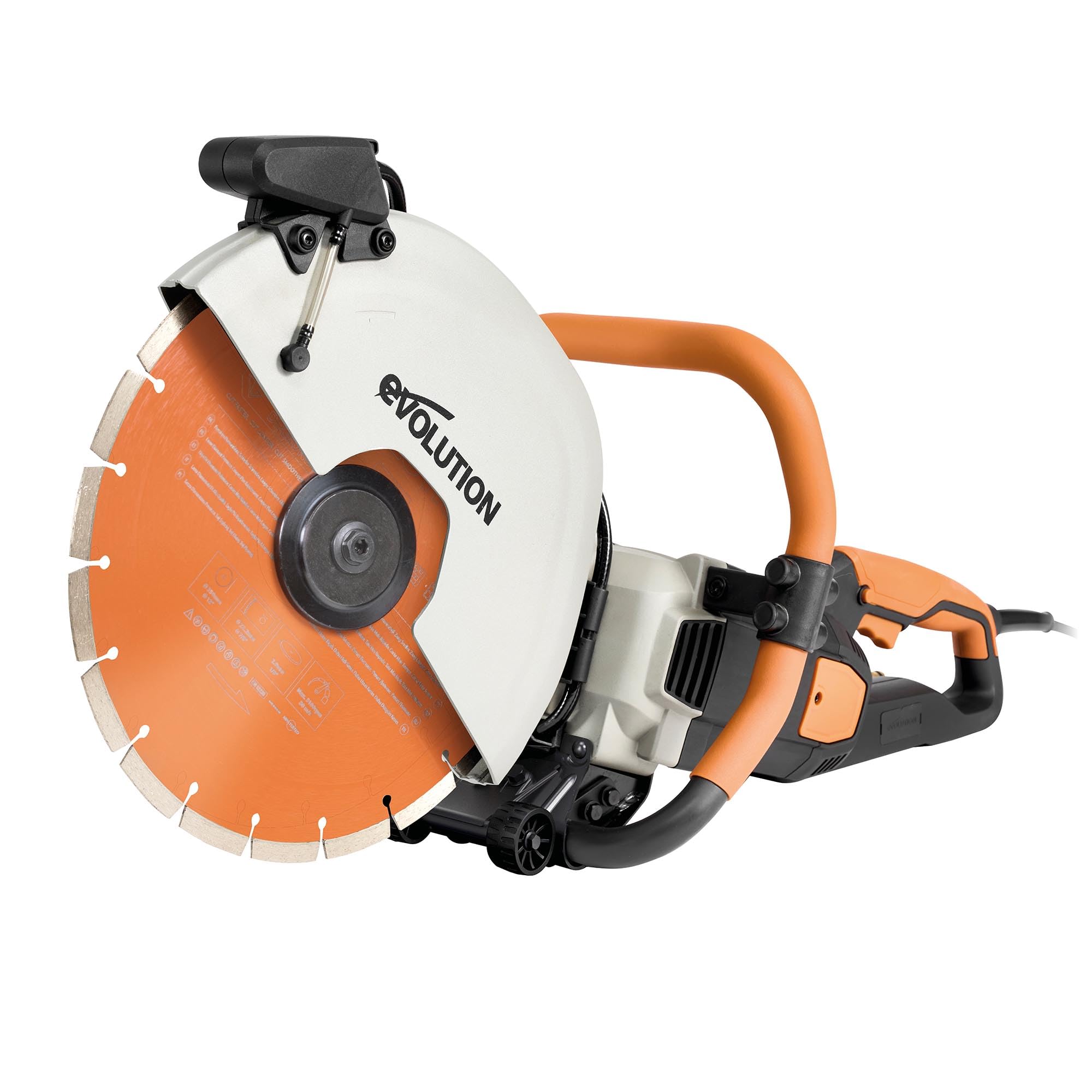
The deepest-cutting electric saw here — 5-1/8 inches of blade depth with gas-like power and no fumes.
If you need maximum depth on concrete and brick without a gas engine, this is the saw. The 14-inch blade with a 20-amp motor cuts to a depth of 5-1/8 inches — deeper than the R12DCT’s 4-1/2 inches and the XtremepowerUS 9-inch’s 3-1/2 inches. A 5-position rotating blade guard and a wheeled skid plate let you handle both vertical and horizontal cuts. The auto on/off dust suppression system turns the water on when the saw spins up and off when it stops, so you never waste water with the tool idle.
Owners consistently report the motor is stronger than expected for its class — one describes the supplied blade holding up well under freehand horizontal cuts in a basement wall. A few mention an active overload protection light that turns red when the saw is overworked, and owners keep theirs green to protect the blade. For jobs that used to require a gas saw, this delivers comparable torque without the fumes or fuel. The 3-year warranty with Power Protect Technology is one of the strongest coverage offers in this category.
Two things you should know before buying. It is a 30.6-pound saw, which is heavy but balanced on the skid plate. And it ships with a 20-amp plug that requires a 20-amp outlet — it is not compatible with 15-amp outlets. Owners cutting in basements have run it on a dryer outlet or a properly rated circuit. Buyers wanting the same brand with a lighter footprint on standard circuits should look at the R12DCT instead.
The case for it
- 5-1/8″ cut depth — deepest available on a corded electric saw in this comparison
- Auto on/off water control eliminates manual valve fiddling
- 3-year warranty with Power Protect Technology
The catch
- Requires a 20A outlet — not compatible with standard 15A household circuits
- 30.6 pounds is heavy to maneuver freehand
- Depth control relies on the guard, not a dedicated depth-stop gauge
Built for: contractors and serious DIY cutters who need the deepest single-pass cut on brick, block, and concrete and can supply a 20A outlet.
Consider the R12DCT instead if: your site has only a 15A circuit or you want a lighter saw for overhead work.
8. Makita 4101RH 5″ Masonry Saw

The 6.6-pound precision cutter that keeps dust off the job and cuts travertine and granite without drama.
If you are cutting tile, travertine, or trim brick rather than full slab, this is the saw that earns its keep. The 7.9 AMP motor spins a 5-inch blade to a maximum cut depth of 1-5/8 inches at 90 degrees and 1 inch at 45 degrees. It weighs just 6.6 pounds, making it one of the lightest saws here — a fraction of the 40-pound XtremepowerUS 16-inch cutter. The special cover over the motor housing is engineered to keep water out when you are cutting wet, and a GFCI plug cuts power automatically if it detects a fault. The 15 feet of tubing, water pressure regulator, and water valve are included, so you are ready to go from the start.
What reviewers point out most is the dust control — one homeowner cut 3/8-inch tile and 1/2-inch sheetrock with no dust using a water hose and a shop vac to catch the slurry. An absolute beginner cutting 1-1/4 inch travertine reports it handled the job fine, because if you can run a regular circular saw you can run this one. Another owner did an entire patio in 16-inch concrete pavers with no complaints. The Makita build quality — solid construction and a powerful motor — is the consistent theme in owner feedback.
The honest catches: The water connection is plastic where a professional-grade brass fitting would be more durable, and the blade foot is only on one side, making straight freehand cuts harder to manage — you need a thin straightedge that clears the motor housing. For stone-industry use, shoppers say the saw wears out faster than they would like; it is a homeowner and light-contractor tool rather than a shop machine.
The precision angle: 1-5/8-inch cut depth at 90 degrees on a 6.6-pound body means you get the accuracy that a full-size cutter cannot deliver, and the water system keeps the cut area clean enough for interior work.
The honest limit: 1-5/8 inches is a shallow cut — this saw cuts accurately, not deeply, and the single-sided foot demands a thin straightedge for straight lines.
Pick this if: you are doing travertine, tile, or trim brick work where precision and light weight matter more than depth and speed.
Look elsewhere if: you need to cut reinforced concrete or go deeper than 1-5/8 inches in a single pass — that job calls for a 14-inch or larger wheeled cutter.
9. Husqvarna K4000 Power Cutter Saw

The 14-inch electric cutter built for confined indoor work where a gas saw is impossible.
The K4000 takes a 14-inch blade to a maximum cut depth of 5 inches. What separates it from a gas cutter is the 23-pound electric build with a constant-flow water valve — an integrated regulator that controls water volume to the blade, keeping the dust bound without drowning the cut. There is no exhaust smell, so the K4000 is designed for interior work in basements, warehouses, and tents where gas saws cannot go. The rear handle has the power cord inlet tucked underneath, and pop-up carbon brushes protect the collector from rotor issues, extending service intervals.
Performance and build quality are the strengths owners name most. One plumber reports that after swapping the stock blade for a higher-quality one, the saw worked flawlessly through multiple uses. A homeowner who bought it for indoor warehouse work praises the overload sensor that stops the saw if you jam it into the concrete. Another owner cut roughly 100 feet of 5-inch reinforced concrete and reports the K4000 handled the job well when the saw was allowed to do the work at its own pace. On a 20-amp breaker it runs great; on a 15-amp breaker it will not.
What you need to plan for. It is a power-hungry saw that wants a 20-amp feed, and the water intake quick coupler is a known weak point that a few owners have had to replace. Keep the water system clean — debris can clog it and require repeated flushing. And like any high-power wet saw, blade choice matters. Delivering a good cut depends on matching the diamond blade to the material being cut.
What it earns
- Runs indoors without the exhaust fumes of a gas cutter
- 14-inch blade with 5-inch max cut depth for thick walls and slabs
- Constant-flow water valve controls dust with no manual adjusting
- Pop-up carbon brushes extend service intervals and reduce downtime
What to watch
- Needs a 20-amp circuit — 15-amp household breakers will not run it
- Water intake quick coupler is a known fragility point
- Blade is not included and must be matched to the material
Reach for this if: you are cutting concrete or block indoors or in a confined space where gasoline fumes rule out a gas saw.
Look elsewhere if: your power supply is limited to a 15-amp circuit or you need a blade included from the start — this one asks you to bring both.
Understanding the Specs
Blade Diameter and Cut Depth
Blade diameter is measured across the disc and directly limits how deep the saw can cut. A 4.5-inch blade on the POWERTEC handles tile and countertop work. A 14-inch blade on the Evolution R14DCT reaches 5-1/8 inches of cut depth, which is what lets it slice a brick wall in a single pass. If you need the deepest possible cut, pick the largest blade you can find that fits your power supply. Cut depth specs vary — some are published as a maximum, some are not listed at all.
Amperage and Your Circuit
Amperage rating tells you how much current the saw draws, which decides whether a standard household breaker can run it. The Makita 4101RH draws 7.9 amps and runs on a standard circuit. The Evolution R14DCT and XtremepowerUS 3200W both draw enough to require a 20-amp outlet, and will trip a 15-amp household breaker. Before you buy, check what your garage or job site can actually supply. A saw that trips a 15A breaker mid-cut stalls the job.
FAQ
Can a brick cutting saw also cut concrete and stone?
Do I need a 20-amp circuit to run a concrete saw?
Is wet cutting better than dry cutting for brick?
What cut depth do I need for a brick wall?
Does a brick cutting saw come with a blade?
Gas or electric — which is better for brick cutting?
How much does a brick cutting saw weigh?
Can I use a brick cutting saw indoors?
What size diamond blade should I get for cutting brick?
Why does my concrete saw keep tripping the breaker?
Final Thoughts: The Verdict
For most buyers cutting brick, block, and pavers away from an outlet, the brick cutting saw winner is the Husqvarna 967682101 K 770 Gasoline Grinder because it runs anywhere without a cord and cuts to a 5-inch depth, backed by owners who call it the toughest and most reliable saw in their fleet. If clean indoor cutting and dust control matter most, grab the Evolution R12DCT with its dual-sided water delivery. And for deep single-pass cuts on thick slabs and reinforced concrete, the Evolution R14DCT is the one to reach for at 5-1/8 inches of blade depth. Whichever you pick, confirm your circuit’s amperage and your blade’s material match before the first cut.
How We Picked
We do not accept paid placement. Every pick is matched to a real buyer and a real use-case; we do not hands-on test units.
Sources & Methodology
Specifications: manufacturer listings and product documentation. Review insights: verified customer reviews, as of September 2026. Pricing: not shown on this page (it changes often); check the current price via the retailer link.
As an Amazon Associate, Gadgets Feed earns from qualifying purchases. This does not affect which products we feature.