
The telltale rings of dark, withered grass expanding daily despite your watering schedule—that’s Brown Patch, a fungal disease that thrives on warm, humid nights and nitrogen-heavy feeding. It attacks cool-season grasses like tall fescue and Kentucky bluegrass, as well as warm-season lawns like St. Augustine and zoysia, leaving behind dollar-sized or large irregular patches that can merge into blighted zones. The path to recovery isn’t guessing with generic sprays; it requires a fungicide with a specific active ingredient, a proven mode of action, and a delivery method suited to your lawn’s size and your tolerance for mixing.
I’m Min — the co-founder and writer behind Gadgets Feed. I’ve spent countless hours dissecting fungicide labels, cross-referencing active ingredient concentrations, and analyzing hundreds of verified buyer reports to isolate what actually halts Rhizoctonia solani (the pathogen behind Brown Patch) from the products that just claim to.
This guide details seven targeted solutions, from ready-to-use liquid to professional-grade granular, so you can confidently choose the best brown patch fungicide for your turf and climate.
How To Choose The Best Brown Patch Fungicide
Selecting an effective fungicide requires matching the active ingredient to the disease cycle, the formulation to your lawn’s size, and the application method to your tolerance for measuring and mixing.
Active Ingredient: Propiconazole vs Azoxystrobin
Propiconazole is a sterol inhibitor (DMI fungicide) that moves systemically through the plant, providing 14 to 28 days of curative and preventative control against Brown Patch. It is excellent for quick knockdown when you see active lesions. Azoxystrobin is a QoI fungicide (strobilurin) that halts spore germination and is more effective as a preventative, often used rotationally to prevent fungal resistance. Many premium products contain one or the other; never combine both without verifying label compatibility.
Formulation: Liquid Concentrate vs Granular
Liquid concentrates (like those from Quali-Pro or Dow AgroSciences) require mixing with water and a sprayer, offering precise coverage and immediate rain-fastness once dried. They are ideal for curative treatments on spots up to about 15,000 square feet. Granular formulations (like The Andersons Prophesy) are spread with a broadcast spreader and need to be watered in immediately. They are better for preventative blanket applications on large lawns (over 10,000 sq ft) but offer slower uptake and less control during an active severe outbreak.
Curative vs Preventative Timing
If brown, sunken rings are already expanding, you need a curative product with propiconazole at a high label rate (often 2 oz per 1,000 sq ft) applied immediately. If you are applying before summer heat stress to protect healthy grass, a granular azoxystrobin product applied when night temperatures consistently exceed 60°F provides up to 28 days of preventative coverage. Applying a preventative product on an active outbreak will almost always disappoint.
Quick Comparison
On smaller screens, swipe sideways to see the full table.
| Model | Category | Best For | Key Spec | Amazon |
|---|---|---|---|---|
| Quali-Pro Propiconazole 14.3 | Liquid Concentrate | Curative Brown Patch on lawns up to 15,000 sq ft | 14.3% Propiconazole MEC | Amazon |
| Dow AgroSciences Eagle 20EW | Liquid Concentrate | Systemic control on ornamentals and turf | 20% Myclobutanil | Amazon |
| Atticus Gunner 14.3 MEC | Liquid Concentrate | Low-odor curative treatment | 14.3% Propiconazole MEC | Amazon |
| The Andersons Prophesy | Granular | Preventative coverage on large lawns | Propiconazole on DG Pro | Amazon |
| Fertilome Liquid Systemic II | Ready-to-Use Spray | Quick spot treatment on small areas | 32 oz RTU bottle | Amazon |
| Monterey Complete Disease Control | Liquid Concentrate | Organic-compliant garden and lawn | OMRI Listed, 16 oz concentrate | Amazon |
| Heritage G Fungicide | Granular | Professional preventative for athletic fields | 0.31% Azoxystrobin, 30 lb bag | Amazon |
In‑Depth Reviews
1. Quali-Pro Propiconazole 14.3 Fungicide

Quali-Pro’s Propiconazole 14.3 is the benchmark for curative Brown Patch control. Its microemulsion concentrate (MEC) formulation delivers 14.3 percent propiconazole in a low-odor, tank-stable solution that resists settling and provides excellent plant coverage. Users treating active brown patch on St. Augustine and Bermuda grass report visible new root growth within one week of the first application at the label rate of 2 oz per 1,000 square feet, with full recovery after a second application 14 days later.
The 32-ounce bottle covers roughly 16,000 square feet at the curative rate, making it the most cost-effective option for mid-to-large lawns facing an active outbreak. The MEC formulation also makes it an excellent tank-mix partner with other fungicides for rotation programs, and it is labeled for use on cool- and warm-season grasses, trees, shrubs, and ornamentals. Multiple verified buyers noted that it stopped aggressive Brown Patch that weaker store-brand concentrates had failed to suppress.
A key consideration is temperature: users caution against applying in extreme heat above 90°F, as propiconazole can stress the grass under heat duress. The product requires full PPE (respirator, goggles, gloves) during mixing and spraying, and the label instructs avoiding runoff into waterways. For a lawn already in distress, this is the therapy that works.
Why it’s great
- Visible recovery within 7 days on actively spreading Brown Patch
- MEC formulation stays mixed, resists wash-off after drying
- Covers up to 16,000 square feet at curative rate from one bottle
Good to know
- Must wear full PPE during application
- Avoid use when temperatures exceed 90 degrees
- Concentrate requires a pump sprayer for mixing
2. Dow AgroSciences Eagle 20EW Fungicide

Eagle 20EW from Dow AgroSciences uses 20 percent myclobutanil, a different DMI active ingredient than propiconazole, which makes it an ideal rotational partner to prevent fungal resistance. It is a systemic emulsifiable concentrate that moves from the roots to new growth, protecting unsprayed foliage from Brown Patch, Dollar Spot, Anthracnose, and Powdery Mildew. Verified buyers report it eliminated both shot-hole disease in ornamentals and severe powdery mildew on peaches when applied after leaf emergence.
The 16-ounce pint covers roughly 8,000 to 10,000 square feet depending on the label rate, and users note that its concentrated nature means a little goes a long way—some reported the bottle lasting multiple seasons on medium-sized lawns. One user treated an oak tree for blight by mixing it with imidacloprid and liquid fertilizer in a drench bucket, seeing no recurrence after one year. It is also labeled for use on apples, stone fruits, and grapes, making it a versatile option for homeowners with mixed turf and orchard areas.
Mixing is complex—the label uses ounces per acre and per 100 gallons, requiring careful calculation. Users recommend reviewing the conversion chart ahead of time. Like all DMI fungicides, it requires full PPE, and some buyers noted that it works best when applied early in the disease cycle rather than as a rescue treatment on severely damaged turf.
Why it’s great
- Different mode of action (myclobutanil) for resistance management
- Systemic uptake protects new growth from Brown Patch
- Labeled for turf, ornamentals, and fruit trees in one product
Good to know
- Mixing rates are complex and require careful calculation
- 16 oz bottle covers smaller lawns (under 10,000 sq ft) at curative rates
- Full PPE is mandatory during handling
3. Atticus Gunner 14.3 MEC Propiconazole
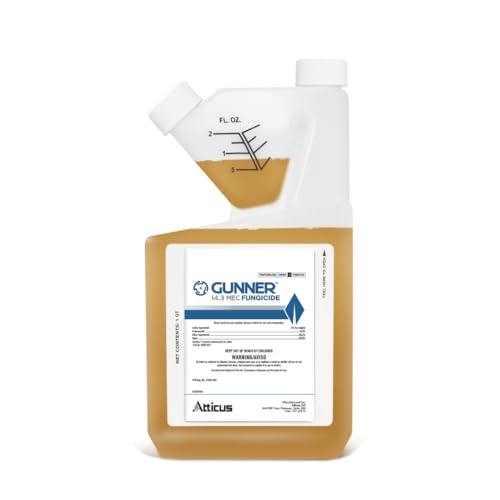
Atticus Gunner 14.3 MEC delivers the same 14.3 percent propiconazole found in the pro-level Banner Maxx, but in a microemulsion formulation specifically designed for low odor and superior tank stability. The MEC particles are extremely small, meaning the emulsion won’t separate or settle in the spray tank—you won’t have to re-agitate mid-application. Once dry, the spray is rainfast and resistant to wash-off, making it suitable for humid climates where unpredictable afternoon storms are common.
The 32-ounce bottle treats up to 16,000 square feet at the curative rate, and users have reported successful control of Powdery Mildew and early-season Brown Patch with two applications in late spring. One experienced buyer noted this is their second purchase, confirming that the results warranted a repeat buy. The low-odor profile is a real advantage for homeowners who dislike the strong chemical smell of other propiconazole concentrates, especially when spraying near outdoor living spaces.
Some users found the label print extremely small, making it difficult to read mixing instructions—a common complaint across concentrated fungicides. It is also not for sale in Alaska, DC, Hawaii, Puerto Rico, or Vermont, so check regional restrictions before ordering. For a curative product that keeps your yard smelling fresh post-treatment, Gunner is a solid choice.
Why it’s great
- Low-odor MEC formulation ideal for residential use near patios
- Rainfast after drying, resistant to storm wash-off
- Same active ingredient as professional Banner Maxx
Good to know
- Label print is extremely small, may require magnifier to read
- Not registered for sale in several states and territories
- Requires pump sprayer and full PPE for mixing
4. The Andersons Prophesy Propiconazole Granules
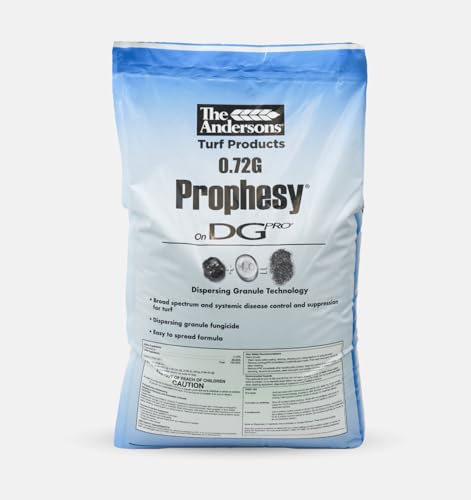
The Andersons Prophesy is a granular formulation of propiconazole coated onto their patented DG Pro (dispersible granule) technology, which delivers more particles per square foot for uniform coverage. This is a preventative-minded product—you apply it with a broadcast spreader, water it in, and let the systemic active ingredient move into the grass blades over several days. The 25-pound bag covers up to 10,000 square feet, making it the highest-volume option for large lawns.
Verified buyers report excellent results against Red Thread and Necrotic Ring Spot after a single application, and several note that the granules are essentially the same professional formula sold at nursery supply stores for significantly less. One user with a history of summer melt-out in Colorado bluegrass saw the lawn fully recover after two applications spaced 30 days apart. The granular format eliminates the need for mixing, measuring, and sprayer cleanup—just fill the spreader, calibrate, and water.
The biggest downside is the price point, which some buyers feel has climbed substantially due to inflation. Granular fungicides also require immediate watering to activate, and they are slower to show visible results compared to liquid concentrates. For large-scale preventative application on a healthy lawn heading into summer stress, this is the most convenient option.
Why it’s great
- No mixing or spraying—apply with a standard broadcast spreader
- DG Pro technology ensures even particle distribution
- Excellent for large-area preventative treatment (up to 10,000 sq ft)
Good to know
- More expensive than liquid concentrates per square foot
- Must be watered in immediately after application to activate
- Slower curative response compared to liquid formulations
5. Fertilome Liquid Systemic Fungicide II RTS
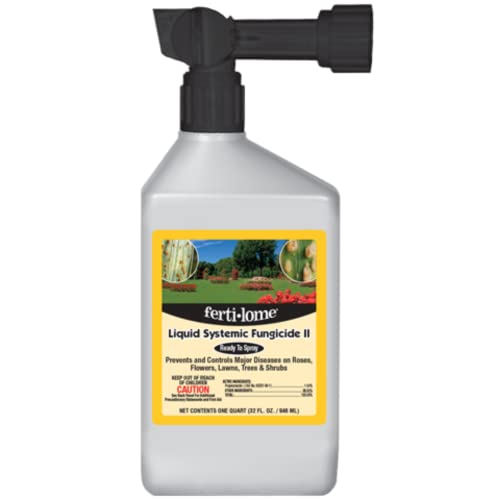
Fertilome Liquid Systemic Fungicide II comes in a ready-to-use (RTS) 32-ounce spray bottle that requires zero mixing, measuring, or special equipment. It contains propiconazole as its active ingredient and is labeled for a broad spectrum of diseases including Brown Patch, Dollar Spot, Take All Patch, and Leaf Spot. For homeowners with small lawns or isolated patches of Brown Patch—say, a 500-square-foot area around a tree or a flower bed border—this is the most straightforward option: twist the nozzle and spray to runoff.
Verified buyers reported immediate success on fire blight in Crimson Maples and yellowing leaves on Live Oaks after one treatment. However, the RTS format means you are paying a significant premium for water weight: the 32-ounce bottle contains a lower concentration of active ingredient compared to concentrates, so its coverage area is limited. One user found it surprisingly effective on dandelions, though that is not a labeled use, so stick to the intended fungal targets.
The convenience comes with a trade-off: you cannot adjust the mixture ratio for severe outbreaks, and the bottle will only cover a few hundred square feet of dense turf. For a quick spot treatment on a small patch of Brown Patch without dragging out a sprayer, this works—just know that for larger areas, a concentrate is far more economical.
Why it’s great
- Zero mixing required—spray directly from the bottle
- Effective on Brown Patch, Dollar Spot, and Leaf Spot
- Ideal for small spot treatments under 500 square feet
Good to know
- Expensive per square foot compared to concentrates
- Limited coverage area—32 oz won’t cover a whole lawn
- Not adjustable for curative high-rate spot treatment
6. Monterey Complete Disease Control
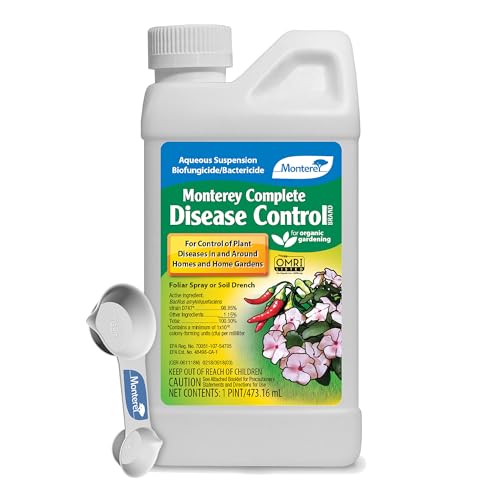
Monterey Complete Disease Control is an OMRI Listed liquid concentrate that uses a biological mode of action to prevent and stop Powdery Mildew, Rust, Leaf Blight, Brown Rot, and Leaf Spots on vegetables, fruits, ornamentals, and turf. It also colonizes root hairs to help prevent disease-causing fungi and bacteria from establishing. For gardeners managing Brown Patch on a lawn adjacent to edible crops, this is the only option on the list that is compatible with organic gardening standards under the USDA National Organic Program.
Users report excellent results on tomato plants in the humid south, where it drastically slows fungal progression and enables a full harvest. One user who applied it as a soil drench on peaches saw outstanding control of Peach Leaf Curl. The 16-ounce concentrate needs to be mixed with water and applied as a foliar spray or root drench, and a measuring spoon is included. It is a slower-acting product compared to synthetic propiconazole, so it works best as a preventative or at the very first sign of disease rather than on a full-blown Brown Patch outbreak.
Some buyers noted that while it slowed the spread of cucumber leaf spot and bean anthracnose, it did not eliminate existing infections entirely. It also carries EPA warning labels for skin and eye irritation, so PPE is still recommended. If you need an organic-compliant solution for a lawn with vegetable beds, this is your best match.
Why it’s great
- OMRI Listed for use in organic gardening systems
- Can be used as a soil drench for root-zone protection
- Safe for use on vegetables, fruits, and turf near edible crops
Good to know
- Slower curative action than synthetic propiconazole
- May require multiple applications to suppress established infections
- Still requires PPE despite organic labeling
7. Heritage G Fungicide (Syngenta)

Heritage G from Syngenta contains 0.31 percent Azoxystrobin, a QoI (strobilurin) fungicide that works by inhibiting spore germination at a different biochemical site than propiconazole. It is a granular formulation designed for golf courses, athletic fields, parks, and large residential lawns. The 30-pound bag covers up to 10,000 square feet, and its mode of action makes it exceptional as a preventative treatment when applied before heat and humidity trigger Brown Patch outbreaks.
Verified buyers with Colorado bluegrass lawns that had suffered August melt-out for years reported that Heritage G completely saved the turf after two applications 30 days apart. One user described it as the only product that stopped four different fungal pathogens after store brands had failed entirely. The granular format requires a spreader and immediate watering, and the label specifies that multiple seasonal treatments are needed for full-season protection. Experienced users recommend alternating Heritage G (Azoxystrobin) with a propiconazole product every three weeks to prevent fungal resistance.
The 30-pound bag is heavy and pricey, and a significant drawback is toxicity: Azoxystrobin is highly toxic to birds and amphibians, so avoid over-application near ponds or bird habitats. For large-scale, professional-grade preventative control of Brown Patch on expansive lawns or recreational turf, Heritage G is the top-tier standard.
Why it’s great
- Unique mode of action (Azoxystrobin) for resistance rotation
- Professional grade used on golf courses and athletic fields
- Proven to save lawns after multiple store-brand failures
Good to know
- Heavy 30-pound bag requires a large spreader and strength to handle
- Highly toxic to birds and amphibians—avoid water runoff into ponds
- Requires multiple seasonal applications for full coverage
FAQ
Can I apply a Brown Patch fungicide when rain is forecast within 24 hours?
How often should I apply propiconazole to keep Brown Patch from returning?
Will Brown Patch fungicide damage my grass if applied in 90-degree heat?
Can I use a liquid fungicide through a hose-end sprayer instead of a pump sprayer?
Is it safe to re-seed my lawn after applying a propiconazole fungicide?
Final Thoughts: The Verdict
For most users, the best brown patch fungicide winner is the Quali-Pro Propiconazole 14.3 because its high-concentration MEC formulation delivers fast, reliable curative results on active outbreaks while covering up to 16,000 square feet per bottle. If you need a professional-grade preventative with a different mode of action for resistance management, grab the Heritage G Fungicide. And for organic-compliant protection around vegetable beds, nothing beats the Monterey Complete Disease Control.