
Our readers keep the lights on and my morning glass full of iced black tea. As an Amazon Associate, I earn from qualifying purchases.
Specs are compiled from manufacturer listings and verified buyer reviews and can change over time — please confirm the key details on the product page before buying.
The hardest part of brushing a cat is not the fur — it is getting the cat to stay. A brush that scratches, tugs, or snaps at tangles ends every session in five seconds flat. This guide cuts straight to the brushes that cats actually tolerate, and it tells you in plain words which one fits your cat’s coat.
I’m Min — the founder and writer behind Gadgets Feed. This guide is built by comparing the manufacturers’ published specifications and the patterns across verified customer reviews, so you get each pick’s real strengths and trade-offs instead of marketing spin.
You can stop guessing which pin length or tooth count your cat needs. Here is a clear, plain-English look at the brush for cats that earns its spot on your shelf.
Our Picks at a Glance

How To Choose The Best Brush For Cats
The brush that works on your cat is the one your cat allows you to finish with. That sounds obvious, but it is the single fact that separates a grooming tool you use weekly from one that sits in a drawer. Coat length, skin sensitivity, and how much your cat hates being handled decide everything that follows.
Match the tool to the coat, not to the breed
Short-haired cats shed loose hairs that sit on top of the coat — a soft rubber brush or a fine-toothed slicker glides those off in a minute or two. Long-haired cats and double-coated breeds push dead undercoat up from below, which is where a rake with two rows of teeth earns its keep. If the fur is matted instead of just loose, you need the wider spacing of a dematting side first, then a finer side to thin what is left.
Why pin length decides comfort
A pin is the individual metal tooth on the brush head, and its length controls how deep the brush reaches. The general rule from the makers themselves: choose shorter pins for hair around an inch and a half or shorter, and longer pins for coats with longer hair. Short pins on a long coat skate across the top and never touch the loose undercoat. Long pins on a short coat can dig into skin.
The rounded-tip rule for sensitive cats
Sharp wire tips scratch skin, and one bad scratch teaches a cat to run from the brush for months. Rounded, polished pins slide through tangles without catching. If your cat already flinches when you reach for a brush, rounded tips are the fix — not a firmer hand.
Cleaning method changes how often you actually brush
A brush you have to pick clean by hand gets used less. Push-button self-cleaning models retract the bristles so collected fur drops off in one motion, which keeps the whole session to a couple of minutes. Rakes with no release button require a comb to strip the teeth, and that extra step is the most common reason a good tool ends up unused.
Quick Comparison
| Model | Best For | Brush Type | Pin / Tooth Detail | Self-Cleaning | Amazon |
|---|---|---|---|---|---|
| Chris Christensen Mini Grooming Brush★ Best Overall | Long & double coats | Pin brush on slicker body | 16mm or 27mm rounded polished pins | No | Amazon |
| OEFEO Self-Cleaning Slicker BrushEasiest Cleanup | Mess-free deshedding | Slicker brush | Tipped stainless steel bristles | Yes | Amazon |
| Maxpower Planet Dog Grooming RakeUndercoat Powerhouse | Dense double coats | Dual-sided undercoat rake | 9-tooth and 17-tooth sides | No | Amazon |
| Kong Rubber Brush for Cat | Short-haired, sensitive cats | Rubber curry brush | Soft rubber bristles | No | Amazon |
| Freshly Bailey Deshedding Comb | Short & medium coats | Deshedding comb | Close-set teeth | No | Amazon |
| Hertzko Self Cleaning Slicker Brush | Long & short coats, mats | Slicker brush | Angled fine bristles | Yes | Amazon |
| SleekEZ Dog Brush for Shedding | All coat types | Patented blade-style tool | 5-inch edge | No | Amazon |
| FelineFun Cat Brush | Mats & tangles on long coats | 2-in-1 undercoat rake | Two density sides, rounded teeth | No | Amazon |
| Chris Christensen Mark I Slicker Brush | Faces, legs & small areas | Slicker brush | 12mm stainless steel pins | No | Amazon |
In‑Depth Reviews
1. Chris Christensen Mini Grooming Brush
Our pick — over 4.5★ from 800+ verified ratings; the strongest balance of quality and price.
The pin brush built for hands that tire and cats that flinch.
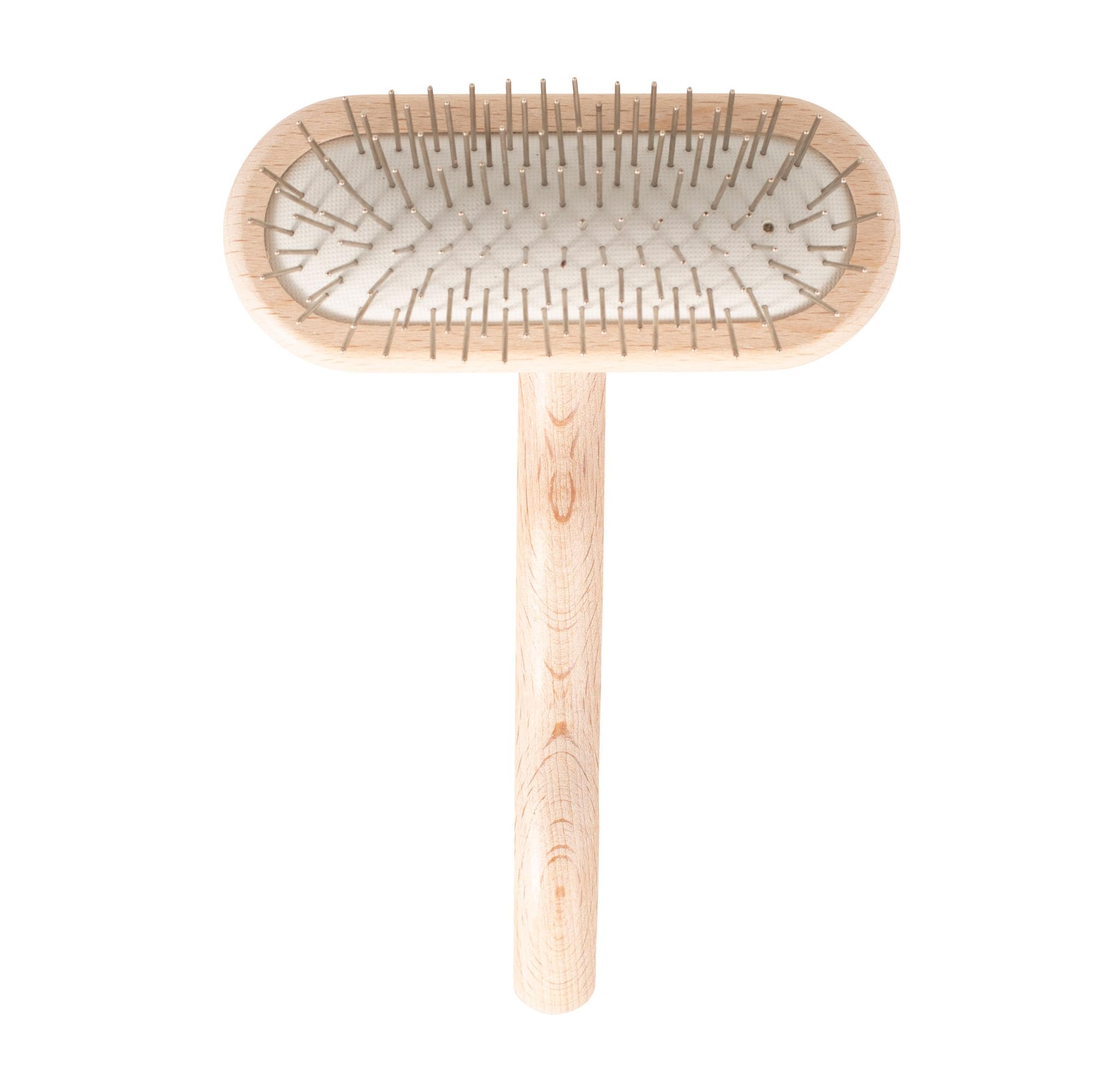
If your cat turns into a wrestling match the second a brush appears, start here. This brush solves the problem from both ends at once: the pins are round-ground and polished so they will not scratch or irritate skin, and the T-shaped body means your wrist moves down instead of side to side. The mini size pairs a 6.5-inch body with a 4-inch head, easy to steer around a cat’s face, chest, and back legs.
Pin length is the decision you have to make, so here it is in plain terms. For hair 1.5 inches or shorter, order the 16mm pins; for longer coats, order the 27mm pins. That choice matters more than anything else on this page, because a long pin reaches the loose undercoat that sits beneath the top layer, while a short pin only smooths the surface. Each brush also has one air vent hole in the cushion, which lets the pad flex as it moves.
The reviews back the design rather than the marketing. Owners of double-coated Labs, poodles, and long-haired German shepherds describe reaching the undercoat and cutting down matting and shedding, with one buyer reporting a 3–4 inch coat staying mat-free on a three-day brushing schedule. What wins people over most is build quality — undeniably the number-one theme in the feedback. As owners put it: “This brush is great for getting small tangles out of my dogs hair and the overall texture of her hair is smoother and has fuller body.” The honest catch is that no pin brush fixes an already-matted coat; this one is for keeping a healthy coat healthy, and it is hand-made in Germany with a 6-month warranty against manufacturer defects.
mini size for small dogs
- Rounded, polished pins that will not pull, scratch, or tug at the coat
- T-body shape cuts wrist motion — built for owners with carpal tunnel, wrist fatigue, or arthritis
- 16mm pins for coats under 1.5 inches, 27mm for longer hair, so you match the coat exactly
- Works on double coats and on the legs, where most slickers fail
gentle on sensitive skin
- Only two head sizes in the line — the 4-inch mini head means more strokes on a big cat or a very dense coat
- Order the wrong pin length and it will skate over the top of a long coat instead of reaching the undercoat
- No self-cleaning button, so you comb the fur out by hand after each session
small breeds: you want one refined brush for a long or double coat, or your hands get sore holding a standard slicker.
large dogs: the coat is already matted, or you refuse to spend an extra minute clearing fur from the pins.
2. OEFEO Self-Cleaning Slicker Brush for Dogs and Cats
Fur leaves the brush before it ever reaches your hand.
Fur removal is the chore that ends grooming sessions early, and this brush attacks it with a single button. Press the self-cleaning release and the collected fur lifts away from the bristles in a sheet, so you are not picking hairs out of steel one at a time. That release button is the whole reason the tool exists, and it delivers: buyers report a malamute’s coat clearing in seconds, with one saying “what a difference it makes with my malamutes fur!”
The working end is straightforward. Tipped stainless steel bristles run in the direction of hair growth at light pressure, gathering loose shedding hair into the brush instead of letting it drift across the couch. The shaped TPR (a rubbery, grippy plastic) handle has textured sides, and a hanging hole at the top keeps the brush within reach beside the rest of your supplies.
What buyers describe most is quality, followed closely by how well it functions, and the ease of cleaning ranks right behind. Corgis and beagles both come up in the feedback, and the brush handles undercoat as readily as surface fur. The trade-off worth knowing: bristle stiffness draws mixed feelings — a good fit for most coats, but a cat with thin, sensitive skin may find a softer tool more welcome. The handle also arrives with a slightly greasy film on some units, which rinses off in a few seconds.
one hand cleaning: the button sits where your thumb already is, so you can clear the head without setting the brush down or hunting for a comb.
bristles may bend: collected hair drops in one mass rather than scattering, which matters if you groom anywhere near a carpet.
easy cleanup: you groom often and want the cleanup step to take seconds, not minutes.
thick coats: you have a cat with especially delicate, thin skin.
3. Maxpower Planet Dog Grooming Rake
Two tooth counts on one head, so mats and shedding each get their own side.
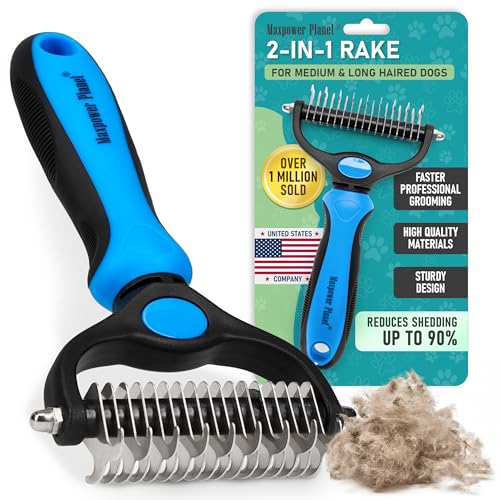
This is the tool you buy when the fur is winning. One head carries a 9-teeth side for stubborn mats and tangles, and a 17-teeth side for thinning and deshedding once the knots are gone. Start coarse, finish fine — that order is written into the design. The teeth themselves are sharpened but finely rounded, built to move through knots and loose hair without scratching skin.
What sells it for double-coated cats is the sheer volume. Owners mention pulling clumps of undercoat off after a week indoors, and build quality is the most-discussed theme in the feedback. A Turkish Kangal and Great Pyrenees owner clears the undercoat in a single brushing with no pain to dog or wrist. A husky owner calls it the best money spent on the pet and regrets not buying it sooner. The rake body runs 6.6 by 3.9 by 2 inches and weighs 4 ounces, light enough to keep going through a long session, and a non-slip rubber base keeps it steady on the shelf.
The honest catch is twofold. There is no release button, so clearing the teeth by hand is fiddly and loose hair can drop mid-stroke — brush somewhere easy to sweep. And while many cats purr through sessions, some need slow introduction, and not every cat takes to a rake’s teeth on first contact.
heavy shedders: dense double coats that dump undercoat year-round, and anyone fighting fur clumps on the floor.
short hair: your cat is short-haired with only light shedding, or you refuse to sweep up after grooming.
4. Kong Rubber Brush for Cat
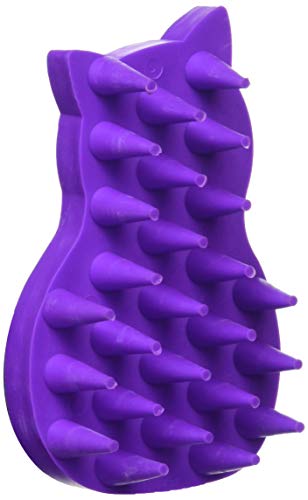
Soft rubber that bends to the body, so a wary cat gets touched and not combed.
For a short-haired cat who hates the feel of metal, this is the entry point. The bristles are soft rubber, thin enough to conform to the shape of the animal rather than scraping across it, and the whole tool is small in the hand — 2.8 by 1.3 by 4.4 inches. Customers note cats tolerating belly and face brushing without a scratch, and one 35-year pet owner calls it the best brush they have owned.
What it does well is pull loose fur and undercoat off short coats while feeling like petting, which is why picky cats tolerate it. A British Shorthair owner describes the cat running to the mat for a brush session. Brush quality is what buyers call out most by a wide margin, with the ease of getting a skittish cat to accept it close behind.
The catch is real but small: rubber does not grab and hold fur the way a slicker does, so light hairs can drift into the air as you go. Groom in an open area or over a hard floor and it stops being an issue. For a long coat or a genuine mat, this is the wrong tool — it is a comfort-first brush for short hair and daily light deshedding.
gentle cats: a short-haired cat who dislikes hard bristles and needs a gentle daily once-over.
tangled fur: long coats, matted patches, or anyone who wants fur held inside the brush during a session.
5. Freshly Bailey Short Hair Deshedding Brush
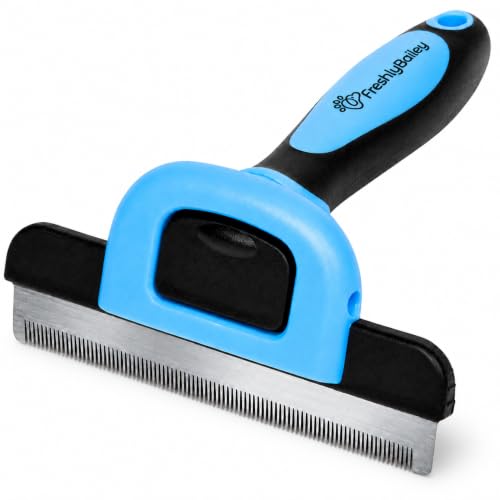
Built for the cats whose hair is short but everywhere anyway.
Short hair still sheds, and this tool was designed specifically for short to medium coats. The head measures 5.5 by 4 by 1.9 inches and weighs 4.16 ounces, and the anti-slip grip was made with comfort in mind — the maker notes it suits arthritic hands and keeps the tool from slipping mid-stroke. The teeth run close together to lift old undercoat and loose hair in a few passes.
On a short coat, dead hair sits near the surface, so close-set teeth do the job a rake would need to dig for. Reviewers point out the comb gliding through without snags, and a black lab owner pulls enough hair to fill a second dog while keeping a firm grip. Cats get the same treatment: one owner sums up a session simply as a cat who “enjoyed the session.” Build quality is the most-praised element of the feedback, with shedding reduction right behind it.
Where it stumbles is length. This is a short-to-medium hair tool by design, and a long or double coat will overwhelm the closely spaced teeth — that is a job for a rake like the Maxpower Planet above. On the coats it was built for, though, it turns a ten-minute brushing into a two-minute one.
smooth coats: short and medium coats that shed year-round, especially if your hands ache holding a smaller tool.
long hair: long-haired or double-coated cats, where closely spaced teeth will choke on the density.
6. Hertzko Self Cleaning Slicker Brush
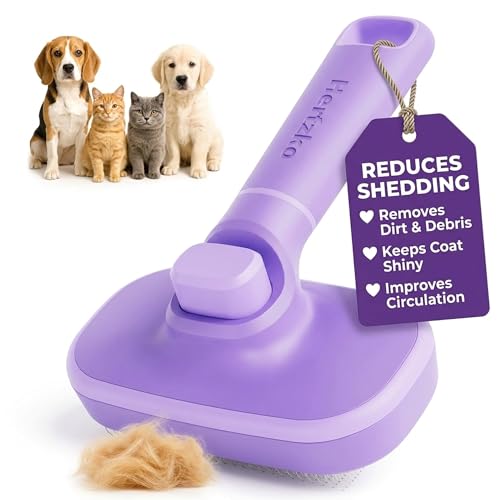
The one that turns matted cats into purring ones, according to the review pages.
Among the most-cited brushes in this category, the Hertzko earns its following on two things: fine angled bristles that work through both long and short fur, and a push-button retraction that dumps collected hair in one motion. The body measures 5.8 by 3 by 10 inches and weighs 3.2 ounces, light enough to hold for the full session.
This is the slicker people reach for when the coat is genuinely a mess. One owner with four cats, two long-haired, resolves a mat other brushes could not touch, and the cats now crowd the brush. Another owner reports cats who hated grooming now purr as if the brush were a massage. The bristles are fine and angled, so they massage the skin while they detangle. What buyers praise most is build quality, and the push-button cleanup sits right behind in the feedback — the retraction pulls bristles back into the head so fur lifts off cleanly after every stroke.
The honest caveat sits in that same button. Its responsiveness draws mixed feedback — the click-and-release is exactly what some owners love, while others find the press stiff. And the bristles, fine as they are, are not for laundering a cloth: brush gently, or a sensitive cat will object. This is a slicker, so on the densest double coats it works the surface and mid-coat well, but a rake still handles the deepest undercoat.
self cleaning button: cats with long, mat-prone fur get real results — this is the brush the long-coat owners keep coming back to.
button sticks: some units press easily and some take a firm thumb; it is the one variable the reviews can’t agree on.
quick cleanup: your cat has long fur, tangles fast, and you want cleanup handled by a button.
thick mats: you need deep undercoat removal on a double-coated breed — pair this with a rake instead.
7. SleekEZ Dog Brush for Shedding
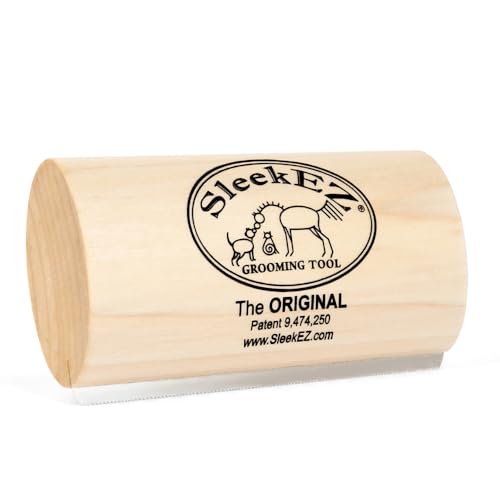
No bristles at all — just a blade edge that grabs hair at the tips.
This one works like no other tool on the list. Instead of pins or teeth, a 5-inch edge uses a patented design to grab hair at the tips and lift it out without tugging at the skin. The body runs 5.5 by 3 by 1.5 inches at 4 ounces, with an ergonomic wooden handle. It is made in the USA, and it claims all fur types and hair lengths.
The reviews bear out that range. Owners describe it working on heavy-shedding long and thick coats, and on cats that hated every other brush. What buyers talk about most is quality, with shedding control a close second. One reviewer’s dog, which avoided every other tool, sits still for this one, and the reviewer is struck by how much hair comes off before it lands on the floor.
Two quirks are worth knowing before you buy. The edge is sharp enough to scratch hands if you grip it wrong, and on high settings it can leave a bald patch on a thin-coated cat, so use light pressure. A separate, real plus: it doubles as a carpet rake and works on couches, cars, and beds. That same edge will scratch hardwood, so take it to soft surfaces instead.
shedding season: you want one tool that handles the cat, the couch, and the car mats — and a cat that won’t sit still for anything else.
sensitive skin: your cat has a thin coat or you brush near bare hardwood.
8. FelineFun Cat Brush for Dematting & Deshedding

Two densities on a single head — one to cut mats, one to thin the coat after.
When a coat has moved past tangles into real mats, this is the tool built for it. The lower-density side works as a dematting rake for stubborn knots and tangles; the higher-density side thins and desheds when you flip it over. All teeth have dull rounded ends, so the steel cuts through a knot without pulling at the skin. The body measures 7.2 by 3.2 by 1.47 inches and weighs 5 ounces, with an anti-slip wooden grip.
Owners point to the mat-handling as the reason they bought it. One owner with an older cat who had stopped grooming herself describes the comb working gently on mats and detangling the undercoat; another calls it a safer option than scissors on a Maine Coon mix, and less traumatic for a rescued feral cat than a trip to a groomer. Quality is what buyers mention most, with value for money running right behind — the two-sides-in-one-head design saves buying a dematting tool and a rake separately.
The honest gripe from a few owners is the shape: the head is not curved, so working along a cat’s back takes longer than a contoured brush would. Call it a fair trade for the mat-fighting cutting power.
matted fur: you are dealing with real matted patches on a long-haired cat and want to avoid scissors or a professional groomer.
short coats: your cat only needs a light daily sweep — the aggressive teeth are more tool than a smooth, tangle-free coat needs.
9. Chris Christensen Mark I Slicker Brush
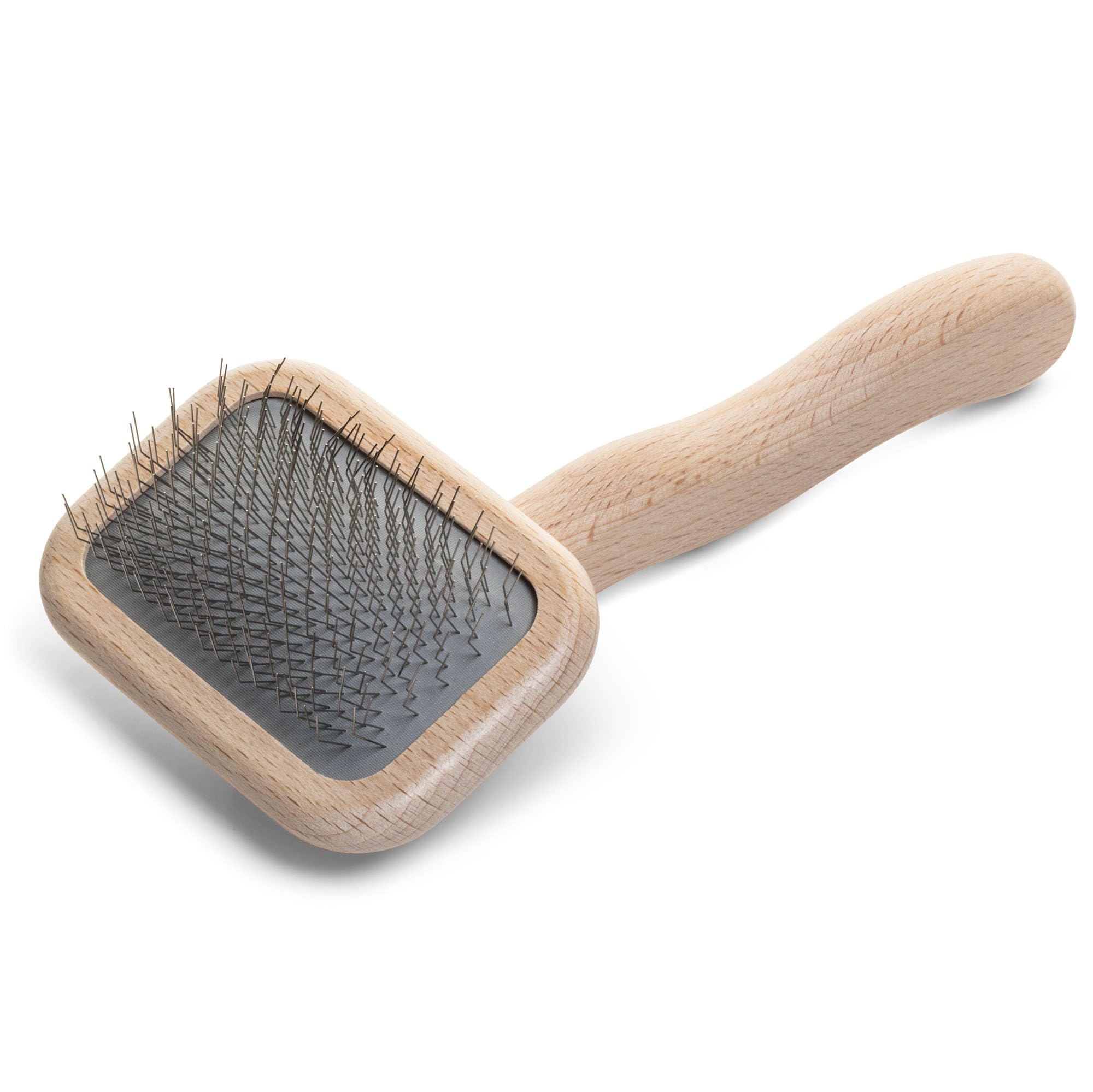
A tiny slicker for the spots a full-size brush can never reach.
The Mark I is what you keep when a brush has to fit into a space the size of a cat’s ear. It pairs a 6.5-inch lightweight Beechwood body with an extra-small 2.75-inch head, and the 12mm stainless steel pins sit in an ultra-soft, highly flexible pad over a 1/4-inch foam base. That cushioning is why it feels soft against skin rather than rigid. The short pins suit short hair, which is exactly the point: this is the tool for faces, muzzles, armpits, paws, and the fine detail work a big slicker simply cannot make contact with.
Owners of cats confirm the sizing is the whole appeal. Two shedding cats — a British Shorthair and a Ragdoll that dislike being brushed — tolerate this one when nothing else works. A Maine Coon owner describes a cat who loves it and a tool that saved a coat with severe knots. What the reviews praise most is effectiveness, with comfort right behind it. A poodle owner sums up the point of a small head exactly: “it works really well for the small spaces like tail, feet and ears. Well made too. Doesn’t seem to hurt her delicate skin.”
Two things to know. The price is high for a small tool, and honest value-for-money reactions in the feedback are mixed; owners who defend it point to the build and to a pet staying comfortable, which is the whole reason someone buys it. It is also a short-pin tool, so on a long, dense coat it works the surface — for a deep undercoat pull, pair it with the T-brush on this list.
professional slicker brush: crevices a full slicker cannot touch — tail, feet, ears, face, and the tiny mats that start in those spots.
higher price: a hand-made German brush with a Beechwood handle and a 1/4-inch foam cushion under the pins, which is the reason it feels soft, not scratchy.
show dogs: you brush a long-haired cat or a finicky one and need precision around the face and feet.
budget buyers: you want one brush to cover the entire body — a larger tool belongs alongside this one.
Understanding the Specs
Pin Length & Coat Depth
Pins are the individual metal teeth on a slicker brush, and their length decides how far the brush reaches into your cat’s fur. Shorter pins — around 12mm to 16mm — suit short hair and detail work on faces and paws. Longer pins, like the 27mm option, are for coats with longer hair, where they can get down to the loose undercoat rather than skating across the top. Choosing the right length for your cat’s coat matters more than any other spec on the brush.
Pin Finish & Cat Tolerance
Rounded, polished pin tips slide through tangles instead of scratching skin, which is what turns a brush from an object your cat resists into one it accepts. Sharp, unpolished wire tips scratch, and one bad snag can teach a cat to flinch from the brush for months. If your cat is already uncooperative, tips that are round-ground and polished are the single most important feature to check, ahead of almost anything else.
Self-Cleaning vs. Manual Cleanup
Self-cleaning brushes have a button that retracts the bristles so collected fur drops off in one motion — a real time-saver if you brush your cat regularly, since it removes the need to pick hairs out by hand. Brushes without that feature, like rakes and pin brushes, must be cleared manually after each session. A rake’s teeth fill up quickly and fur can fall mid-stroke, so a brush that cleans itself can legitimately mean the difference between keeping up with a routine and abandoning it.
Rubber vs. Steel Bristles
Rubber bristles on a curry-style brush bend and conform to the body, which makes them gentle on short-haired cats and easy to accept. They hold fur less well, so light hairs can drift into the air during use. Steel bristles grip and gather fur more effectively, holding the loose hair inside the brush head until you clear it, but the tips need to be polished for comfort. Pairing the right bristle material to your cat’s coat and tolerance is the key decision behind every pick on this list.
FAQ
What kind of brush is best for a short-haired cat?
How do I know which pin length to order for my cat?
Is a self-cleaning brush worth it for cats?
What brush removes mats from a long-haired cat?
Why does my cat hate being brushed and what helps?
Can I use a dog brush on my cat?
How often should I brush a cat?
Does a deshedding tool actually reduce shedding around the house?
What is the difference between a slicker brush and an undercoat rake?
Is a rubber brush gentle enough for an older or sensitive cat?
Final Thoughts: The Verdict
For most cat owners, the brush for cats winner is the Chris Christensen Mini Grooming Brush. It solves the two problems that end grooming sessions — pins that scratch and hands that tire — with rounded polished pins and a T-body that cuts wrist motion, and the 16mm and 27mm options let you match the coat exactly. Cats who hate slickers still sit still for it, and it keeps a longer coat mat-free on a regular routine.
If cleanup is the chore that keeps you from brushing, grab the OEFEO Self-Cleaning Slicker Brush. Its push-button release drops fur in a sheet, so the whole session stays short and mess-free. For short-haired cats who flinch at hard bristles, the Kong Rubber Brush is the one to reach for, soft and gentle enough that a picky cat will tolerate it.
How We Picked
We do not accept paid placement. Every pick is matched to a real buyer and a real use-case; we do not hands-on test units.
Sources & Methodology
Specifications: manufacturer listings and product documentation. Review insights: verified customer reviews, as of September 2026. Pricing: not shown on this page (it changes often); check the current price via the retailer link.
As an Amazon Associate, Gadgets Feed earns from qualifying purchases. This does not affect which products we feature.