
Our readers keep the lights on and my morning glass full of iced black tea. As an Amazon Associate, I earn from qualifying purchases.
Specs are compiled from manufacturer listings and verified buyer reviews and can change over time — please confirm the key details on the product page before buying.
You do not need to spend a fortune to make your car’s audio system sound crisp, loud, and distortion-free. The real trick is knowing which specs actually matter so you pick a 4-channel amp that delivers clean power to your speakers without blowing your budget on features you will never use.
I’m Min — the founder and writer behind Gadgets Feed. This guide is built by comparing the manufacturers’ published specifications and the patterns across verified customer reviews, so you get each pick’s real strengths and trade-offs instead of marketing spin.
Whether you are upgrading a daily driver or building a full stereo system from scratch, this roundup breaks down the top contenders for a budget 4 channel amp so you can match the right amplifier to your speakers and your install space.
Our Picks at a Glance


How To Choose The Best Budget 4 Channel Amp
The single biggest mistake people make with a budget amp is looking only at the highest wattage number on the box. What you actually need to match is the RMS power at the impedance your speakers run at — that is the number that tells you how much clean, continuous power the amp can send to your doors, tweets, or sub without distorting.
RMS Power Over Peak Power
Peak power is a marketing number that tells you what the amp can handle in a split-second burst before it burns up. RMS power (Root Mean Square — the actual continuous output the amp delivers song after song) is the spec you need. If your speakers are rated at 60 watts RMS each, an amp that delivers 60 watts RMS x 4 at the right impedance gives you the cleanest volume with zero clipping risk.
Class D vs Class AB Efficiency
Class D amps use switching technology that runs cooler and draws less current from your car’s electrical system, making them ideal for tight spaces or vehicles with a smaller alternator. Class AB amps sound warmer to some ears but generate more heat and demand more power. For a budget 4-channel amp, Class D is usually the smarter pick unless you specifically want the older-school sound signature.
Physical Size and Mounting Flexibility
A 4-channel amp that measures 11 inches long might not fit under a compact car seat or inside a motorcycle saddlebag. Always check the item dimensions against your intended mounting spot before you buy. A smaller footprint often matters more than an extra 50 watts of power when your install space is tight.
Quick Comparison
| Model | Best For | RMS Power (4-Ohm) | Class Type | Dimensions | Amazon |
|---|---|---|---|---|---|
| Recoil DI550.4Best Value | Compact clean installs | 80W x 4 | Class D | 7.48 x 5.90 x 1.77 in | $89.99Amazon |
In‑Depth Reviews
1. Crunch GP-2000.4
Big power claims in a small Class AB chassis — but reliability is a gamble.
The Crunch GP-2000.4 advertises 2000 watts max (500 watts x 4 at 2 ohms) and has the most aggressive power-to-size ratio in this group at 11.5 x 8 x 2.28 inches. It operates in multiple wiring configurations: 4-channel stereo, dual stereo bridged, or stereo plus bridged mono, and the variable electronic crossover runs at 12 dB per octave. Some customers note great sound quality, with one owner driving rear 400W 6×9-inch speakers and two 500W 12-inch subs with clear bass and crisp highs.
The big red flag is reliability. One verified buyer wrote that the amp stopped working after four uses — volume cut out at 14 and never returned, even though the power LED stayed on. Others experienced no issues, but with an average rating of 4.4 stars from 323 ratings and at least one documented early failure, this is the highest-risk pick in the list. If you want maximum wattage for the lowest price and are okay rolling the dice, the GP-2000.4 delivers on paper. If long-term dependability matters more, one of the Class D options above is a safer bet.
Big claims, small footprint: At 2000 watts max and 11.5 inches long, this is a lot of advertised power in a relatively compact Class AB package.
Hit-or-miss durability: A buyer reported it died after four uses, which is a stark warning against expecting years of trouble-free service from this model.
Pick this only if: You need the highest advertised wattage for the absolute lowest spend and are prepared to replace it if it fails early.
Hard pass if: Reliability is your top priority — the SounDigital or Recoil options are much safer long-term bets.
2. Recoil DI550.4
The compact workhorse that runs cool and fits nearly anywhere.
Clean, continuous power is what makes speakers sing, and the Recoil DI550.4 delivers 80 watts RMS x 4 at 4 ohms — enough to push a full set of door speakers without the distortion that usually comes from straining a cheaper amp. At 7.48 x 5.90 x 1.77 inches, it is one of the smallest full-featured 4-channel amps in this roundup, so tucking it under a seat or inside a glovebox is genuinely easy.
Buyers report using this amp for two years straight, running four 6.5-inch Pioneer drivers and two super tweeters for about four hours at a time in parking lots, with zero problems. The Class D design and high-speed MOSFET power supply help it stay cool even after heavy use, which matters when the amp is buried in a tight space with limited airflow. On the downside, an audio-savvy reviewer measured the actual signal-to-noise ratio at around 85 dB instead of the advertised 95 dB, meaning you might hear a faint hiss in a dead-quiet vehicle.
Punch-in-a-box: For a budget-friendly price, you get genuine 80W RMS per channel, a tiny footprint, and reliable thermal performance that outlasts many amps at twice the cost.
One wrinkle: The hi-level input setup is a bit fiddly, and if silence matters in your car, the slightly lower SNR could be an issue.
Reach for this if: You need a small, efficient amp that powers a mid-range speaker set cleanly without taking up much space or cooking itself.
Look elsewhere if: You are an audiophile chasing dead-quiet background noise in a silent cabin.
3. SounDigital 800.4 EVO 4.0

The tiny powerhouse built for motorcycles and tight builds.
SounDigital built this 800.4 EVO 4.0 specifically for places other 4-channel amps cannot go: motorcycle saddlebags, under dashboards, inside ATV compartments. It measures 9.84 x 4.72 x 2.36 inches — and its conformal-coated internals resist moisture and vibration that would wreck a standard car amp. The total RMS output is 800 watts across four channels, which one buyer proved by running Orion 350-watt RMS speakers with no struggle.
Harley riders and powersport users dominate the reviews here, with one customer calling it a perfect upgrade on a 2013 Street Glide pushing 6×9-inch speakers in the bags. The adjustable high-pass and low-pass filters let you dial in the exact frequency range for each channel, so your tweeters never get low-end rumble and your door speakers never strain on bass they cannot handle. The only trade-off is that at a higher price point, it sits at the premium edge of the budget category.
Built for the rough stuff: 800 watts RMS, moisture-proofed guts, and a chassis shorter than many competitors — this is the amp to buy if your install space is exposed to weather or built on two wheels.
The cost to play: You pay more upfront than for a basic car-audio amp, and the freestanding mounting (no brackets included) needs a little creativity.
Pick this for: Power-sports builds, compact cars, or any install where dirt, rain, and bumps are part of the daily drive.
skip it if: Your budget is set at the absolute entry level and your install is a standard car interior with plenty of room.
4. Taramps TS 800×4

The crowd-favorite that wakes up any speaker set without breaking a sweat.
With 800 watts RMS at 2 ohms and a 4.7-star average from 917 ratings, the Taramps TS 800×4 has the strongest user approval in this list. Buyers consistently mention that it brought their system alive, with one reviewer saying their Kicker door speakers sounded cleaner and louder right after hookup. The Class D chassis is a compact 6.89 x 5.43 x 1.89 inches and weighs only 1.9 pounds despite delivering more usable power.
It includes both RCA and high-level inputs, so you can connect it to a factory stereo that lacks RCA pre-outs. The amplifier also features a fixed crossover with input/output settings to keep your speakers safe. The one catch to know: Taramps recommends a 40A fuse or circuit breaker, so you need to factor that into your install plan.
The people have spoken: Nearly 1,000 ratings and a 4.7 average — real owners mention clean power, easy hookup, and a noticeable upgrade in speaker clarity.
Watch for: The fixed crossover is less flexible than fully adjustable filters, and its full power requires a 2-ohm speaker load.
Best suited for: Anyone upgrading door speakers on a factory or aftermarket radio who wants a proven, compact amp with high owner satisfaction.
Not ideal if: You need per-channel variable crossover slopes or plan to run only 4-ohm speakers.
5. Recoil DI1200-4

The amp that delivers 150 clean watts per channel in a compact Class D shell.
At 2400 watts max, the Recoil DI1200-4 pumps out 210 watts RMS x 4 at 4 ohms — meaning it can drive more demanding speakers or run a wider dynamic range without strain. One reviewer noted that it delivers clean 150W x 4 at 4 ohms with no audible motor noise, which is rare for a budget-priced high-output amp. The MOSFET power supply and 4-way protection circuitry let it run for hours at moderate volume without thermal shutdown.
The terminals are described as tight, making thicker gauge wire a bit of a squeeze, and the plain look will not win any beauty contests. But buyer reports of zero failures across multiple installs suggest the internals are solid. It lacks a remote knob for the rear channels, so you may need an inline RCA volume controller if you want to fade on the fly.
Serious headroom: 210W RMS per channel at 4 ohms gives you the overhead to run high-power component sets or bridge channels for a beefy sub.
Small gripes: Terminal blocks are cramped for thick cable, and there is no included remote level control for the rear channels.
Grab this for: A mid-range build where you want more clean RMS power than typical budget amps offer, and you are comfortable with a tight wiring bay.
Pass on it if: You need a remote subwoofer level knob from the start or prefer a flashy chassis design.
6. Pioneer GM-A6704

A trusted name in car audio that balances warmth with everyday reliability.
Pioneer’s GM-A6704 is a Class AB 4-channel amp rated at 60 watts RMS x 4 at 4 ohms, and 190 watts RMS x 2 in bridged mode. Class AB amplifiers typically run warmer than Class D, but this unit stays cool enough that one owner has been running it for three years in a cheap car with door speakers and a Kicker 8-inch woofer, still sounding great. The variable high-pass and low-pass filters let you tune the frequency range per channel, so your door speakers are not trying to reproduce sub-bass they were never designed for.
Reviewers highlight its bridging flexibility (1, 2, or 3-channel modes) and the clean distortion-free output as the main reasons they picked it over other amps in the same price range. If you are looking for a simple straightforward install with a reliable brand name, this is a safe choice. The trade-off is that with 60W RMS per channel, it is not the most powerful option in this list — it is a solid entry-level performer, not a high-SPL monster.
Dependable and straightforward: Pioneer’s decades of car audio experience show in this amp’s clean crossover design and reliable Class AB circuit.
Modest power output: At 60W RMS per channel, it will not drive high-power component sets to their full potential without clipping.
Pick this if: You want a brand you know, need a simple reliable amp for a basic speaker upgrade, and value adjustability over maximum wattage.
Consider another if: You plan to bridge the amp for a powerful subwoofer and need more than 190W RMS bridged.
7. Pioneer GM-A4704
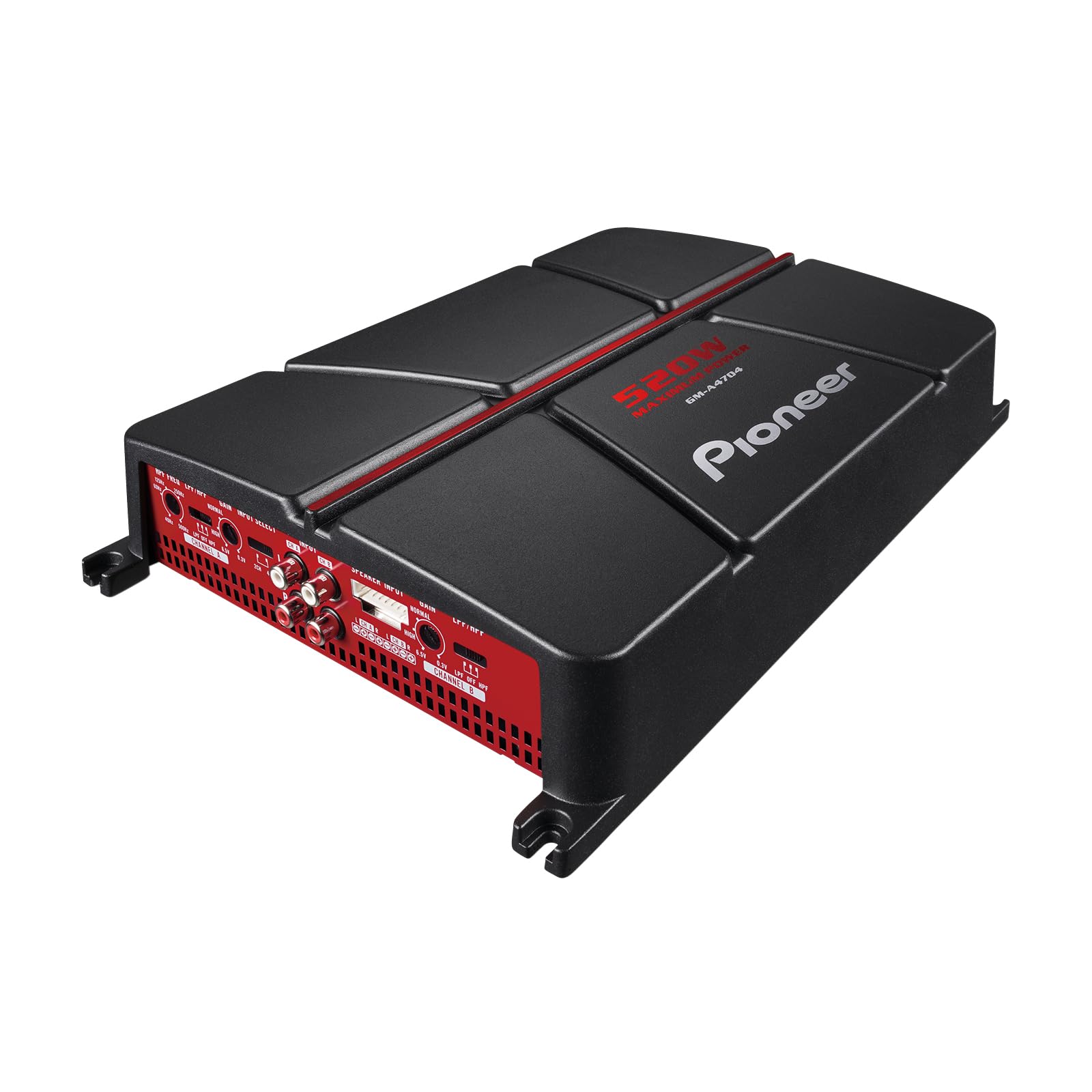
The entry-level Pioneer that thumps hard on a 30-amp fuse budget.
Rated at 40 watts RMS x 4 at 4 ohms and 130 watts RMS x 2 bridged, the GM-A4704 is the most affordable 4-channel amp from a major brand in this roundup. One owner reported that it thumps hard with dual 12-inch subs in a sealed box, drawing only 30 amps of current and never clipping — a strong performance for an amp with such modest numbers on paper. The Class AB design keeps crossover distortion low, and the variable high-pass filter helps protect small speakers from damaging low frequencies.
Another reviewer replaced a problematic Rockford amp with this Pioneer and praised how cool it runs in comparison. At 4.4 pounds and 8.5 x 12.88 x 2.38 inches, it is not the smallest option, but it fits in most trunk or under-seat locations. The main limitation is that 40W RMS per channel is gentle — you will not drive a set of high-power components to concert levels without pushing the amp into distortion.
Low-cost, low-strain: A lightweight Class AB amp that runs cool, draws minimal current, and has a reliable Pioneer build behind it.
Gentle by nature: 40W RMS per channel means this is best for efficient factory-replacement speakers, not competition-level components.
Reach for this if: You are on the tightest budget, need a simple reliable brand-name amp for a basic speaker swap, and are not chasing high SPL.
Pass if: You plan to run power-hungry aftermarket components or want enough headroom to bridge for a subwoofer.
Understanding the Specs
RMS Power vs Peak Power — the real number
RMS (Root Mean Square) is the continuous power an amplifier can deliver to your speakers over time without distorting or overheating. This is the spec you match to your speakers’ power handling. Peak power is a burst value the amp can hit for a fraction of a second and is mostly a marketing number. Ignore the peak wattage on the box and look at the RMS rating at the impedance (4 ohms or 2 ohms) your speakers run at.
Class D vs Class AB — heat and efficiency
Class D amplifiers use switching transistors that run much cooler and draw less current from your car’s electrical system, making them ideal for compact installs and vehicles with limited battery capacity. Class AB amps sound warmer to some ears but generate more heat and demand more from your alternator. For a budget 4-channel amp, Class D is usually the smarter choice unless you specifically prefer the older-school Class AB sound signature or have ample mounting space with good airflow.
Crossovers — the difference between clean and muddy sound
A crossover (high-pass filter or low-pass filter) lets you send only the right frequencies to each speaker. A high-pass filter blocks low bass from reaching small door speakers so they do not distort, while a low-pass filter sends only bass to a subwoofer. Variable crossovers let you adjust the cutoff frequency to match your specific speakers — that flexibility is a key feature to look for in a budget 4-channel amp.
Bridging — getting more power to one channel
Bridging lets you combine two amplifier channels into one more powerful channel. For example, a 4-channel amp bridged to 2 channels delivers roughly double the RMS power per channel. This is useful when you want to run a single subwoofer off two bridged channels while the remaining two channels power your door speakers. Not all amps bridge cleanly, so check the manual for the exact bridged RMS rating.
FAQ
What size 4-channel amp do I need for my car speakers?
Can I use a 4-channel amp for only two speakers?
How do I know if a 4-channel amp will fit in my car?
What is the difference between a 2-ohm and 4-ohm 4-channel amp?
Do I need a special wiring kit for a budget 4-channel amp?
Will a cheap 4-channel amp damage my speakers?
How long should a budget 4-channel amp last?
Can I install a 4-channel amp myself?
What gauge wire should I use for a 4-channel amp?
Is a Class D or Class AB 4-channel amp better for a beginner?
Final Thoughts: The Verdict
For most people, the best budget 4 channel amp is the Recoil DI550.4 because it combines genuine 80W RMS per channel, a tiny footprint that fits almost anywhere, and proven reliability from owners who have run it for years without issues. If you need a weather-resistant amp for a motorcycle or powersport build, the SounDigital 800.4 EVO 4.0 delivers 800 watts RMS in a moisture-proofed chassis that can handle the elements. And for the highest clean RMS power in this price range, the Recoil DI1200-4 gives you 210 watts RMS per channel for speaker setups that need real headroom.
How We Picked
We do not accept paid placement. Every pick is matched to a real buyer and a real use-case; we do not hands-on test units.
Sources & Methodology
Specifications: manufacturer listings and product documentation. Review insights: verified customer reviews, as of July 2026. Pricing: not shown on this page (it changes often); check the current price via the retailer link.
As an Amazon Associate, Gadgets Feed earns from qualifying purchases. This does not affect which products we feature.
Related Guides
Product prices and availability are accurate as of the date/time indicated and are subject to change. Any price and availability information displayed on Amazon at the time of purchase will apply to the purchase of this product. As an Amazon Associate I earn from qualifying purchases.
CERTAIN CONTENT THAT APPEARS ON THIS SITE COMES FROM AMAZON. THIS CONTENT IS PROVIDED "AS IS" AND IS SUBJECT TO CHANGE OR REMOVAL AT ANY TIME.
Amazon and the Amazon logo are trademarks of Amazon.com, Inc. or its affiliates.