
Our readers keep the lights on and my morning glass full of iced black tea. As an Amazon Associate, I earn from qualifying purchases.
Specs are compiled from manufacturer listings and verified buyer reviews and can change over time — please confirm the key details on the product page before buying.
If your car’s factory speakers sound muffled or distorted, swapping in a pair of 6.5-inch coaxials (speakers that combine a woofer and tweeter in one unit) is the fastest upgrade for better drive-time audio. The cheapest options can sound surprisingly good, but you must match the speaker’s power handling and mounting depth to your car’s doors, not just pick the flashiest cone. This guide focuses on budget-friendly 6.5-inch pairs that deliver clear highs and real bass without needing a new amplifier.
I’m Min — the founder and writer behind Gadgets Feed. This guide is built by comparing the manufacturers’ published specifications and the patterns across verified customer reviews, so you get each pick’s real strengths and trade-offs instead of marketing spin.
We’ve distilled the owner feedback and spec sheets down to the handful of budget 6.5 speakers that actually earn their place in your door panels with clean sound and honest value.
Our Picks at a Glance


How To Choose The Best Budget 6.5 Speakers
Choosing the right 6.5-inch speakers for your car depends on three measurable factors: the power your stereo or amp actually sends them, the space behind your door panel, and how the speaker handles daily driving vibrations. Ignore marketing wattage and focus on these specs instead.
Match the Power to Your Stereo
If you are running a stock head unit, you don’t need a speaker that claims 300 watts. That figure is peak power, a brief burst. What you actually need is a speaker with high sensitivity, measured in decibels, because that tells you how loud it plays from a small amount of power. A higher sensitivity number, like 90dB, means cleaner sound at normal listening volumes without an amplifier.
Check the Mounting Depth Before You Cut Anything
The physical size behind the speaker, called mounting depth, is the most common hidden trap. A deeper magnet can hit your window mechanism or door frame, forcing you to cut metal or buy spacers. Measure the gap in your door first, then look for a “shallow profile” design if you’re tight on space.
Look for Build Quality Signals
The materials tell you how long the speaker will survive. A poly injection or polypropylene cone resists moisture and flex better than cheap paper, and a rubber surround, the ring around the cone, keeps bass punchy without rotting over time. These details determine whether you replace them in a year or keep them for years.
Quick Comparison
| Model | Best For | Sensitivity | Power | Mounting Depth | Amazon |
|---|---|---|---|---|---|
| PRV AUDIO 6MB100-4★ Best Overall | Shallow factory fits | 90dB | 200W RMS | 2.32 inches | Amazon |
| BOSS CH6530Crowd Favorite | Crowd-pleasing value | 90dB | 300W (pair) | 2.1 inches | Amazon |
| Pioneer TS-F1634RName-Brand Pick | Stock radio upgrades | 88dB | 200W Max | — | Amazon |
| RECOIL RCX65 | Crisp highs on a budget | — | 200W (pair) | — | Amazon |
| BOSS CH6520B | Window-rattling bass | 90dB | 250W | 2.1 inches | Amazon |
| RECOIL MS65-4P | Midrange purists | — | 600W Max (pair) | — | Amazon |
| ORION CB653 | Low-frequency depth | 88dB | 240W | — | Amazon |
| Infinity REF-6532EX | Balanced, smooth highs | — | 55W (handling) | — | Amazon |
In‑Depth Reviews
1. PRV AUDIO 6.5 Inch Car Speakers (6MB100-4)
Our pick — over 4.5★ from 350+ verified ratings; the strongest balance of quality and price.
The shallow-profile pro-audio pair that slips into tight factory spots without cutting panels.
This pick wins on fit and clean output. Its shallow mounting depth of 2.32 inches is designed to drop into many factory locations, so you can often skip the cutting that deeper speakers demand. It handles 200 Watts RMS (the sustained power it can take) across a frequency range of 90 – 10,000 Hz, with a sensitivity of 90dB — meaning it plays loudly and cleanly even from a stock head unit’s modest power. Owners call the sound clear, and several note the pair produces real bass at 90Hz.
The trade-off is physical, and buyers report it plainly: “it has a very small magnet.” A small magnet keeps the profile shallow, but it also means this isn’t a speaker you should hammer with a big external amp. “I wouldn’t put too much power through it,” one buyer warns. Think of it as a high-efficiency upgrade for a factory or lightly-amplified system, not a competition SPL (sound pressure level) build. It is a 4-ohm speaker, so it matches the standard impedance most car stereos expect.
What makes this the top pick is how rarely anyone has to reach for a grinder. The standard frame size fits 6.5-inch openings in many vehicles, and the “beefy for the price” build wins praise for being “easy to install” and “very reliable.” You get pro-audio voicing, factory-friendly packaging, and strong value for the money.
What owners rave about
- Sound quality is the most-praised trait, with clean, clear output at volume
- Easy, secure install with a standard frame and shallow 2.32-inch depth
- 90dB sensitivity means loud, clean sound from a stock stereo
The honest trade-offs
- Small magnet limits how much external amp power it can safely take
- Midbass driver design means you pair it with a tweeter for full-range sound
Reach for this if: you want a true drop-in upgrade for a stock system with clean output and no panel cutting.
Look elsewhere if: you plan to feed it big power from a high-wattage external amplifier — the small magnet is the hard limit.
2. BOSS Audio Systems CH6530 6.5 Inch Car Speakers
The entry-priced 3-way pair that buys you clean highs and a whole lot of volume.
This is the value king of the list, and the reason is in the spec sheet: a 4-ohm impedance, 90dB sensitivity, and a frequency response of 100 Hz to 18 KHz. That 90dB figure means it gets respectably loud from a factory radio, which is how most people run it. The 3-way design splits the work across a.50-inch piezo tweeter (a type of tweeter that uses a crystal), a 1-inch polyimide dome midrange, and the main poly injection cone, so you get dedicated drivers for highs, mids, and lows instead of one cone doing everything.
This is also the pick with real marketplace momentum — it’s a rare big-seller in this price bracket, with enough owner feedback to show clear patterns. The consensus praise centers on “crisp sound” and “great value.” For an older daily driver, the effect is dramatic: owner reports in a 2005 Civic describe excellent highs, clear mids, and even noticeable bass without a subwoofer, with the pair matching the factory system’s size. Owners mention fitting them into a 2004 Scion XB front doors with an adapter ring, where they matched the OEM size exactly.
The catch is honesty about the right tool for the job. Durability gets the most negative feedback, and the correct polarity is critical — wire it wrong and you lose bass or risk damage. The wiring itself is thin, a few owners note, and the 1.3 Lbs. weight per pair tells you these are built to a price. BOSS backs them with a 3-year platinum warranty through Amazon, which softens the risk. This is a fantastic first upgrade, not a forever speaker for a high-power build.
Fit-and-forget value: a loud, clear, genuinely cheap 3-way upgrade that makes an old car feel new. Know the limits: the thin wiring and modest durability mean you should respect the power rating and get the polarity right on install.
3. Pioneer F-Series TS-F1634R
A balanced-sound Pioneer that’s engineered to work right off a stock head unit.
If you want a recognizable brand name without the premium price, this is the pair. It delivers 200W max (25W nominal) at a 4-ohm impedance, and its 88dB sensitivity rating means it plays distortion-free at higher volumes even with the lower power a factory stereo puts out. The 2-way coaxial design combines a woofer and tweeter into a single frame that sits in the standard 6.5-inch diameter location, which is why it’s such a common direct replacement for blown factory speakers.
Owner reports show this is the go-to for swapping out dead factory drivers in everything from a 2012 Hyundai Santa Fe to a 2013 FRS, with people describing “crisp, balanced, punchy” sound and clear vocals that stay clean at highway volume. It’s not subwoofer-level bass, but it’s “respectable.” The spring-clip terminals plus precrimped spade connectors make wiring genuinely easy. Build quality gets mixed marks from some, and durability sees a few negative comments, so this is a great daily-driver upgrade rather than a competition piece.
Where Pioneer’s 88dB sensitivity sits versus the PRV’s 90dB is a small but real gap — the PRV needs less power to reach the same loudness, which matters if your stereo is the weakest link. The Pioneer instead leans on brand engineering and a clean, balanced voicing that reviewers sum up as “superb speakers for the money” when you want a name you trust. For most factory replacement jobs, it lands as a perfectly balanced, low-stress choice.
Trusted-brand balance: smooth treble, clear vocals, and easy spring-clip wiring make this the safest name-brand swap. Not for high-power builds: its 88dB sensitivity needs a bit more from the head unit, and durability has mixed reviews.
4. RECOIL RCX65 Echo Series 6.5-Inch Coaxial Speakers
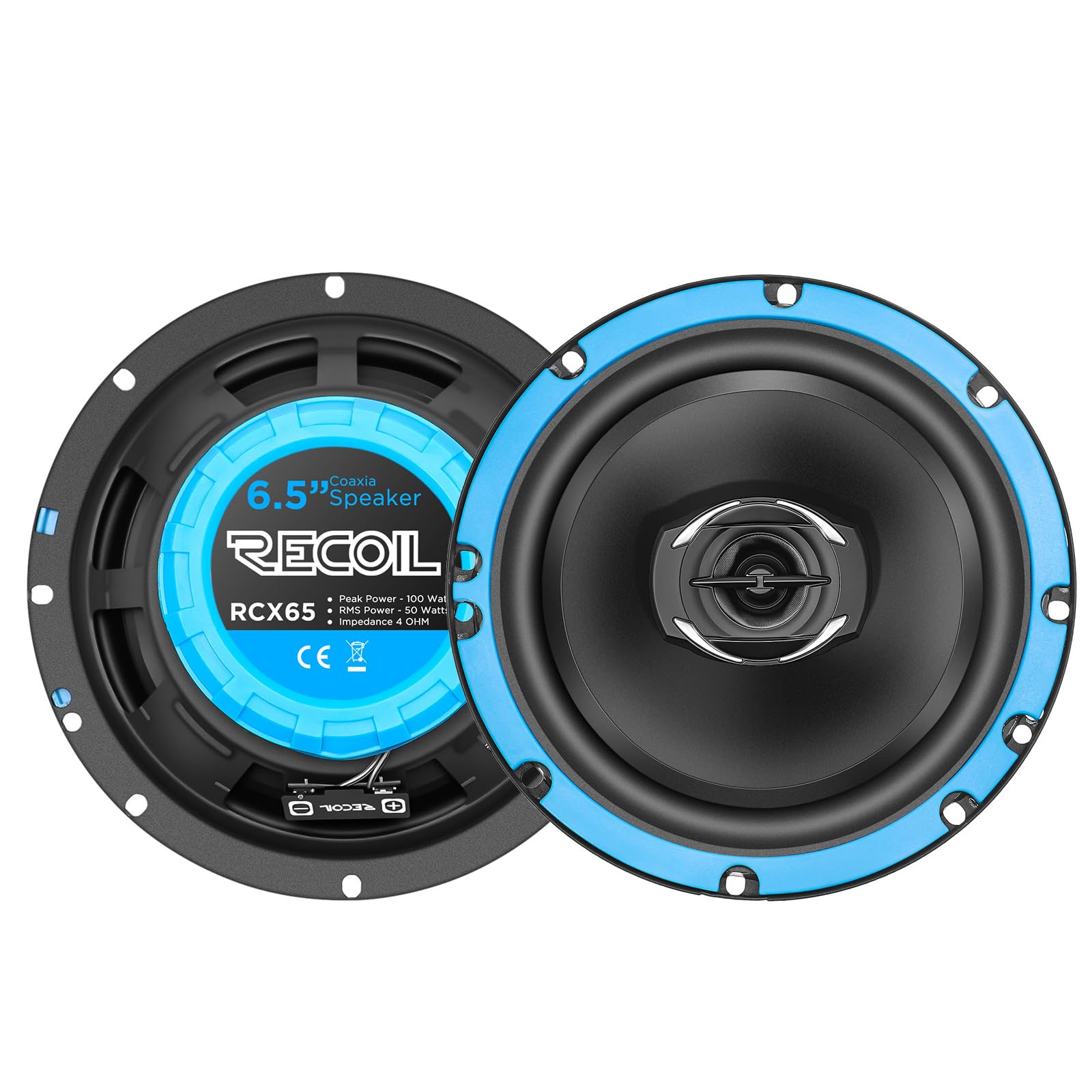
A polypropylene-cone pair with silky PEI tweeters built for fatigue-free long drives.
RECOIL’s Echo Series leads with a 2-way full-range coaxial design rated at 200W peak and 100W RMS per pair, and the real star is that PEI (polyetherimide) dome tweeter with a built-in crossover. That combination produces “smooth & fatigue free” highs, which owners single out — sound quality is the dominant praise, with people describing “clear sound” that “can’t be beat” even on a stock radio with no amplifier. The lightweight thermal-formed polypropylene cones and butyl rubber surrounds work together for accurate output and “deeper mid-bass impact.”
This is a speaker that loves a clean, properly-set-up system, and that’s also its one demanding trait. Owners who run amplifiers note you need a 120Hz high-pass filter on the amp and shouldn’t push past 50-60W, because the coaxial tweeter’s resistor is the weak point above that. The fit gets negative feedback from a few, including a 98 Tacoma compatibility gripe, so measure your mounting depth first. Durability also has a small but real pattern of capacitors blowing, so treat this as a well-voiced pair that rewards careful configuration.
Compared to the bigger-brand options, this one trades a little brand recognition for a genuinely premium-sounding high end that customers note outperforms pricier rivals. If you’re building a system where you control the amp settings and want smooth highs without spending triple on a name brand, this is the sleeper pick.
Best for: DIY system builders who will set the amp’s high-pass filter and want silky highs on a budget. Think twice if: you plan to run them hard on a big amplifier without careful tuning, or you can’t confirm your door’s depth.
5. BOSS Audio Systems CH6520B 6.5 Inch Car Speakers

The pair that rattles the windows with heavy bass while keeping vocals clear at full tilt.
This black 2-way setup is the heavier-hitting sibling in the BOSS budget line, carrying 250W of peak power with a 4-ohm impedance and a 90dB sensitivity that keeps it loud on factory power. The frequency response spans 100 Hz to 18 kHz, and the build uses a poly injection cone, rubber surround, and stamped basket with a 1-inch polyimide tweeter. At 2.9 Lbs. per pair, it’s a chunky, solid-feeling speaker that owner reports describe as “strong bass” that truly “rattles windows” in a truck while vocals stay “clear at max volume.”
The standout praise is value for money: in a 92 Miata, a pair of these with a cheap single-DIN head unit and no amp “bumps the entire car,” per one owner. They also fit well in many doors — the mounting hole is 5.5 inches with a 2.1-inch depth — though some trucks need minor mount adjustment. BOSS backs it with the same 3-year platinum warranty through Amazon, which is a solid safety net at this price.
The honest catch shows up in a couple of ways. Durability is the recurring negative, with multiple owners reporting the speaker wire broke on its own, which is a manufacturing-quality miss you should check on arrival. One box also arrived missing the adapter wires and screw bag, so inspect the packaging before you start the install. If you want maximum bass for minimal money in an older car, this is your pair — just be ready to verify the hardware is all there.
Party-starter value: heavy, window-rattling bass and clear vocals for very little money, no amp required. Check the box: the recurring gripe is wiring that can fail and the occasional missing adapter bag.
6. RECOIL MS65-4P 6.5-Inch Midrange Pro Audio Speakers

A high-efficiency midrange that sounds clean as studio headphones at full volume.
This is a different breed of budget speaker: a dedicated midrange driver meant for people who already have a system plan. It delivers 600W Max and 300W RMS at 4 ohms per pair, and the defining hardware is the 1.5-inch high-temperature Kapton voice coil, built to handle extreme heat and hold its structural integrity for a longer life. Owners describe the sound as “clear, crisp, powerful” and even “clean as” a set of name-brand speakers they compared it against, with one reporting no distortion at full volume.
The key to open up this pair is feeding it correctly. Owners are explicit that it shines with a matching amplifier; a 2-ohm amp pushing 200W per channel is the balance, and you should avoid amps under 100W RMS. It’s also worth using sound deadening material to preserve the midbass, which is where this driver lives. It’s not a full-range speaker — it lacks deep subwoofer-level bass — so plan to pair it with a sub and tweeters for the complete picture.
Fit gets positive marks overall, with owners trimming just 1/8″ for an Audi S6 and dropping it into a 04 Santa Fe with the factory amp. Build quality and durability are genuinely mixed in the feedback though: some call them “well-built,” others say the construction “could be better,” and a couple of units didn’t last long. This is the pick for the enthusiast who wants pro-audio output from a stock location and understands it’s a component, not a whole system.
Grab it if: you’re building a real system with an amp and want powerful, clean midbass that out-sounds its price. skip it if: you want a simple drop-in replacement for your stock radio with no amplifier — this driver needs power and a plan.
7. ORION Cobalt CB653 6.5″ 3-Way Coaxial Car Speakers
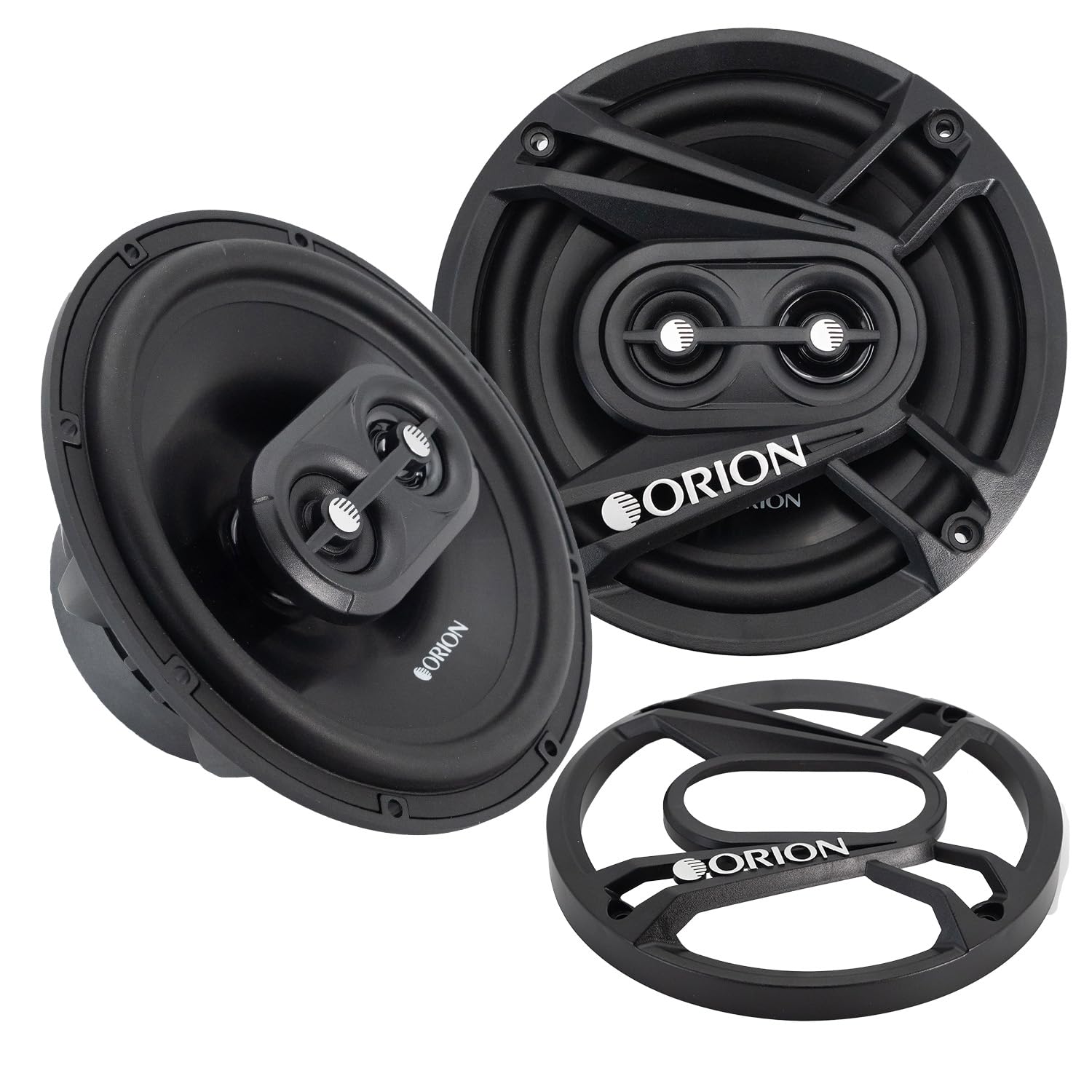
The 3-way Orion tuned to reach deepest — down to 75Hz — for rich, low-end tone.
ORION’s Cobalt takes the 3-way concept and pushes it further down the frequency range. This 6.5-inch coax handles up to 240W of peak power with 60W RMS at a 4-ohm impedance, and its wide frequency response of 75Hz-20kHz reaches lower than most budget pairs, which is why it delivers “rich, deep tones” from the woofer while the dedicated midrange and tweeter handle everything above. The 88dB sensitivity keeps it clear and crisp, and the build uses a durable butyl rubber surround with a precision polypropylene cone for distortion-free audio.
Owner reports back up the spec sheet on the highs and mids, with “crisp highs and mids” as a recurring theme and plenty of “real loud with clean sound” verdicts. It’s a “big improvement” over the cardboard factory speakers, per several buyers, and it’s been running in a daughter’s car for about 7 months with zero issues. The 88dB sensitivity is note against the 90dB options — it needs a touch more power to match their volume, though few people notice in practice.
The honest red flags come from longevity. Reliability is flagged as mixed, and one owner had a pair fail twice, with one speaker rattling and another blown a couple of weeks after a warranty replacement. Fit also gets mixed marks, so measure your mounting hole. It’s a smaller seller than the BOSS, but for the price it brings a noticeably deeper low-end reach that the 2-way designs can’t match.
Deep-digging value: a 3-way design that reaches down to 75Hz for richer bass than typical budget pairs. Warranty roulette: reliability is the mixed note here, so keep your receipt handy and confirm the fit first.
8. Infinity REF-6532EX Reference 6.5-Inch Coaxial Speakers
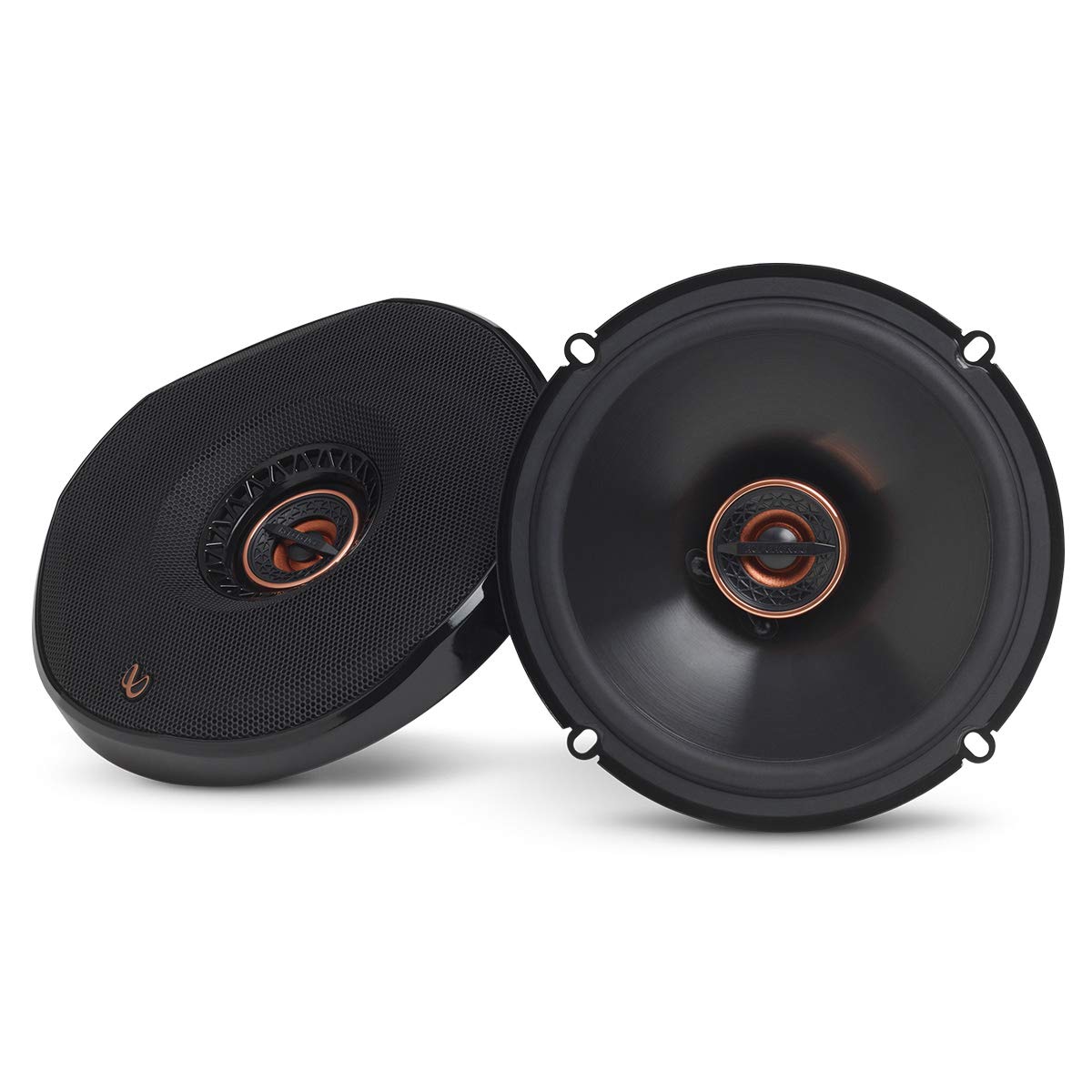
The step-up Infinity with textile tweeters and oversized woofers for refined, musical sound.
Infinity is the premium tier here, and it earns that spot with engineering rather than raw wattage. The REF-6532EX uses edge-driven textile tweeters for “smooth, clear highs” that avoid the harshness budget piezo tweeters can produce, and its oversized Plus One woofers give more surface area for higher bass output and enhanced midrange performance. This is a highly-regarded two-way coaxial known for balanced, musical sound that improves the longer you play it — owners note it shines after a break-in period of about a month, with “crisp highs” and improved bass.
This is the pick for the “moderate dollars, serious sound” buyer. A 2001 Chevy Suburban owner calls it a “fantastic upgrade,” and a 99 Tacoma owner describes it as a “huge improvement” over 20-year-old stock. The newer baskets are “tune to fit most factory speaker locations,” which helps with install, though you may still need a wiring adapter and occasionally to drill mounting holes. The honest limitation is power: it handles only about 55W, so it’s “great up to 50W,” which makes it perfect for a strong factory system but NOT for a big external amp.
The one consistent complaint is the mounting hardware, with some packages missing parts. And like any speaker with this kind of low-end grunt, a few owners found they needed sound deadening material in certain vehicles to control midrange resonance. If you want the most refined, musical sound on this list and you’re running near-stock power, this is the one — it’s the upgrade that makes you hear details in songs you thought you knew.
Reach for this if: you want genuinely smoother highs and richer midrange and you’re running a stock or lightly-amplified system. Look elsewhere if: you’re feeding a high-wattage amp, or you don’t want to deal with possibly sourcing your own mounting hardware.
Understanding the Specs
Sensitivity (dB)
This is how efficiently a speaker turns power into volume, measured in decibels. A higher number, like 90dB, means it plays louder and cleaner from the low wattage a factory stereo provides. Don’t fixate on peak wattage claims — for a stock head unit, sensitivity is the spec that actually matters. Between the 88dB models like the Pioneer and ORION and the 90dB models like the PRV and BOSS, the louder pair will sound more easy at normal volumes without an amp.
Mounting Depth
This is the physical space the speaker’s magnet needs behind the door panel, measured in inches. If your door only has 2 inches of clearance, a speaker with a deep magnet simply won’t fit without cutting metal or adding spacers. The PRV AUDIO’s shallow 2.32-inch profile exists specifically to solve this problem for factory locations. Measure your door’s gap before you order, or look for speakers that advertise a shallow or low-profile design.
FAQ
What does 4-ohm impedance mean for my car stereo?
Will these 6.5-inch speakers fit my car without cutting?
Do I need an amplifier to run budget 6.5-inch speakers?
Is a 3-way speaker better than a 2-way?
What is RMS power and why does it matter more than peak power?
Why does one of the RECOIL speakers need a high-pass filter?
Do I need sound deadening material with new door speakers?
How long do budget 6.5-inch car speakers last?
Final Thoughts: The Verdict
For most buyers, the budget 6.5 speakers winner is the PRV AUDIO 6MB100-4 because its 90dB sensitivity and 2.32-inch shallow depth deliver clean, loud sound and an easy factory fit for a small price. If you want the proven name-brand balance and smooth treble that works straight off a stock radio, grab the Pioneer TS-F1634R. And for the shopper who wants the most refined, musical sound on a budget and plans to run a modest system, the Infinity REF-6532EX is the one to reach for.
How We Picked
We do not accept paid placement. Every pick is matched to a real buyer and a real use-case; we do not hands-on test units.
Sources & Methodology
Specifications: manufacturer listings and product documentation. Review insights: verified customer reviews, as of August 2026. Pricing: not shown on this page (it changes often); check the current price via the retailer link.
As an Amazon Associate, Gadgets Feed earns from qualifying purchases. This does not affect which products we feature.