
A budget amplifier has to do one thing well: turn a low-level signal into enough clean wattage to make your passive speakers sing without adding hiss, distortion, or noise-floor hum. The challenge is that the budget-amp shelf is flooded with exaggerated peak-power claims and undersized power supplies that can’t deliver sustained current. Finding the one that actually produces rated power into a real speaker load at under requires separating honest engineering from marketing theater.
I’m Min — the co-founder and writer behind Gadgets Feed. I’ve spent hundreds of hours cross-referencing amplifier datasheets, customer power measurements, and real-world component quality reports across the sub- category to identify the models that deliver genuine, usable wattage rather than inflated peak numbers.
After comparing seven contenders on measurable specs and verified performance, I’ve built this guide to the best budget amplifier options that actually respect your speakers and your wallet.
How To Choose The Best Budget Amplifier
The budget amplifier market is crowded, but the real difference between a good buy and a paperweight comes down to three specific areas: the amplifier chip inside, the power supply feeding it, and the input flexibility you actually need. Ignore the peak-power claims in bold font on the box and focus on these categories instead.
Amplifier Chip and Topology
Nearly every modern budget amplifier uses a Class D topology. The chip at its heart — the TPA3255, TPA3116, or a proprietary design — dictates the maximum clean output, distortion floor, and thermal behavior. The TPA3255 from Texas Instruments has become the gold standard in this price range, delivering over 100 watts per channel into 4 ohms with total harmonic distortion below 0.1% when paired with a proper power supply. Chips like the TPA3116 are older and typically cap out around 50 watts per channel. If you see an amplifier advertising 600 or 800 peak watts without naming the IC, be skeptical — it likely uses a generic chip running well beyond its linear region.
Power Supply Voltage and Current
A Class D amplifier is only as good as the DC supply feeding it. A 24-volt, 4.5-amp adapter can realistically push about 50–60 watts per channel into 4 ohms. A 36-volt, 6-amp supply can reach 100–120 watts per channel. A 48-volt supply with a GaN (gallium nitride) brick pushes even further. Many budget-friendly amplifiers ship with under-sized power adapters that starve the chip — the amplifier may claim 200 watts, but the supply can only deliver 80. Always check the included power adapter specifications (voltage and amperage) rather than the amplifier’s printed peak wattage.
Input Connectivity and Extra Features
Bluetooth version matters for audio quality and latency. Bluetooth 5.0 or higher supports aptX and AAC codecs, which reduce compression artifacts compared to older SBC-only connections. If you want to connect a turntable, look for a built-in phono preamp (RIAA equalization) so you don’t have to buy an external stage. A subwoofer pre-out is critical if you plan to run a 2.1 system. For desktop use, optical or coaxial digital inputs let you bypass your computer’s internal DAC. Mic inputs and karaoke effects are fun for parties but add circuitry that can degrade the main audio path if poorly implemented.
Quick Comparison
On smaller screens, swipe sideways to see the full table.
| Model | Category | Best For | Key Spec | Amazon |
|---|---|---|---|---|
| Fosi Audio MC331 | Premium | Desktop tube sound | 105W x2 4Ω with DAC | Amazon |
| Ampapa D1 | Premium | 2.1 system with VU meter | ~80W 8Ω, TPA3255, HPF | Amazon |
| AIYIMA A07 MAX | Mid-Range | Pure power, stereo/mono | 300W x2 4Ω, TPA3255 | Amazon |
| Donner MAMP2 | Mid-Range | All-in-one with phono | 60W x2 RMS, Bluetooth 5.3 | Amazon |
| Pyle PDA77BU | Mid-Range | 4-channel with karaoke | 800W peak, 4-channel | Amazon |
| Fosi Audio BT20A | Budget | Simple Bluetooth setup | 100W x2 max, 24V supply | Amazon |
| Viprh AS-336BU | Budget | Karaoke with 4 mic inputs | 400W RMS, dual voltage | Amazon |
In‑Depth Reviews
1. Fosi Audio MC331 Tube Integrated Amplifier with DAC
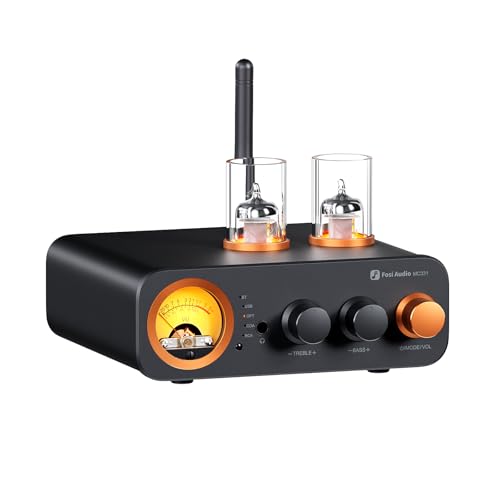
The Fosi MC331 packs a tube pre-amplifier stage using 5725W and 6J1 vacuum tubes, a Texas Instruments DAC chip, and a Class D output section into a chassis that fits on a desktop without looking like lab equipment. It delivers 105 watts per channel into 4 ohms — enough to drive bookshelf speakers to room-filling levels in a medium-sized living room. The integrated DAC accepts USB, optical, coaxial, and Bluetooth inputs, meaning you can connect a computer, TV, and phone simultaneously and switch between them with the remote.
The tube stage provides gentle harmonic distortion that warms the midrange and softens digital edge without rolling off treble detail. The VU meter adds real-time level feedback and visual appeal. Output impedance is low enough to drive most bookshelf speakers without damping-factor concerns. The pre-out allows adding a powered subwoofer for a 2.1 system. Build quality uses a full metal chassis with quality potentiometers — the volume knob has a smooth, weighted feel.
The included 24-volt, 4.5-amp power supply limits peak output versus a 36-volt solution, and some buyers have reported stock tube failure within days. Replacing the tubes with known-good NOS or premium 5725W variants costs roughly –40 but transforms the soundstage depth. The remote has perceptible latency — about two seconds — and requires direct line-of-sight. For desktop or near-field listening where you want tube character without the size and heat of a full integrated, the MC331 is the most complete package at this price point.
Why it’s great
- Warm, detailed tube sound with audible midrange richness
- Versatile inputs: Bluetooth, USB, optical, coaxial, RCA
- Compact all-metal chassis with functional VU meter
Good to know
- Stock vacuum tubes may fail within the first week
- Remote has 2-second latency and requires line-of-sight
- Included 24V supply limits maximum power output
2. Ampapa D1 2 Channel Bluetooth Amp
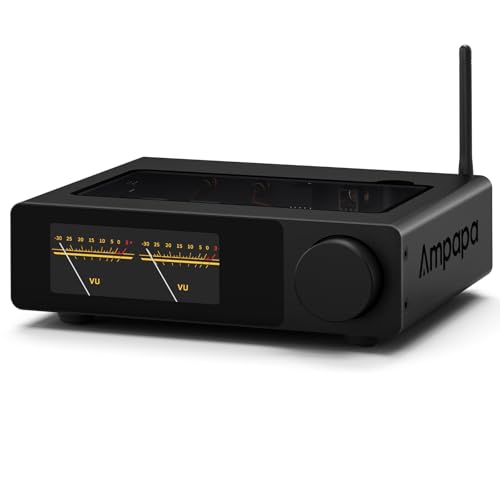
The Ampapa D1 is a collaboration with Douk Audio that takes the proven A5 platform — centered on the TPA3255 chip with PFFB (Post-Filter Feedback) technology — and adds a digital OLED VU meter with seven visual styles, a TRS balanced input, Bluetooth 5.2, and tone controls. Real-world measurements show approximately 80 watts per channel into 8 ohms, which is honest and usable power. The PFFB circuit reduces load dependency, meaning the frequency response doesn’t shift when you change speakers.
The adjustable high-pass filter (30–200 Hz) is the standout feature for 2.1 systems. It removes low frequencies from the main speaker outputs so your bookshelf speakers don’t waste energy trying to reproduce bass they can’t handle, while the PRE-OUT sends a full-range signal to a powered subwoofer. This lets you integrate a sub without buying an external crossover. The socketed NE5532 op-amps can be swapped for LM4562 or MUSES8902 units to adjust the sonic signature toward greater clarity or smoothness.
Build quality uses an aluminum chassis with a glass top panel that provides access to the op-amp sockets. The GaN 48-volt, 5-amp power adapter is more efficient and cooler-running than traditional bricks. The auto-standby feature activates after five minutes of inactivity and cannot be disabled — it requires pressing the remote or power button to wake the unit. The display auto-dims but stays active. If you’re building a 2.1 desktop or living room system and want real subwoofer integration without external DSP, this is the most capable option under .
Why it’s great
- Adjustable high-pass filter for proper subwoofer integration
- TRS balanced input reduces noise with long cable runs
- GaN 48V/5A power supply for clean, high-current delivery
Good to know
- Auto-standby after 5 minutes cannot be disabled
- Glass top panel can fall out if unit is inverted
- Output lower over Bluetooth than wired inputs
3. AIYIMA A07 MAX 2 Channel Stereo Amplifier

The AIYIMA A07 MAX is a no-frills power amplifier built around the Texas Instruments TPA3255 Class D chip, paired with an NE5532 op-amp and high-quality Japanese Elna and German WIMA capacitors. In stereo mode, it produces 300 watts per channel into 4 ohms (107 watts measured at 4 ohms with the included 36-volt supply). A bottom-mounted switch converts the amplifier to mono mode, where it delivers 600 watts into a single channel (190 watts measured at 4 ohms) — allowing you to pair two units for a high-power mono-block setup.
The signal-to-noise ratio reaches 110 dB, which means the noise floor is effectively inaudible at any normal listening distance. There is no hiss when changing volume and no turn-on pop. The volume pot uses a logarithmic taper with smooth damping, though the attenuation is uneven — very little output from fully closed to about 9 o’clock, then a rapid increase from 1 o’clock to maximum. There are no tone controls or Bluetooth; it is a pure power amplifier with a single RCA input and a 3.5mm line output for daisy-chaining.
The heatsink design uses side and bottom vents that prevent dust accumulation while keeping the case temperature around 98–100°F during normal operation. The amplifier stays warm regardless of volume level because the output devices are always biased on. Upgrade paths include swapping the NE5532 for Sparkos or MUSES op-amps, or upgrading the power supply to a 48-volt, 10-amp unit for significantly more headroom. If you want the most clean, honest wattage per dollar and don’t need features, the A07 MAX is the benchmark in this category.
Why it’s great
- Measured 107W x2 at 4 ohms with stock 36V supply
- Switchable mono mode for high-power single-channel use
- SNR of 110 dB with no audible noise floor
Good to know
- No Bluetooth, tone controls, or remote included
- Volume pot has uneven taper in the first half of rotation
- Runs warm (98-100°F) even at idle
4. Donner MAMP2 Stereo Audio Amplifier
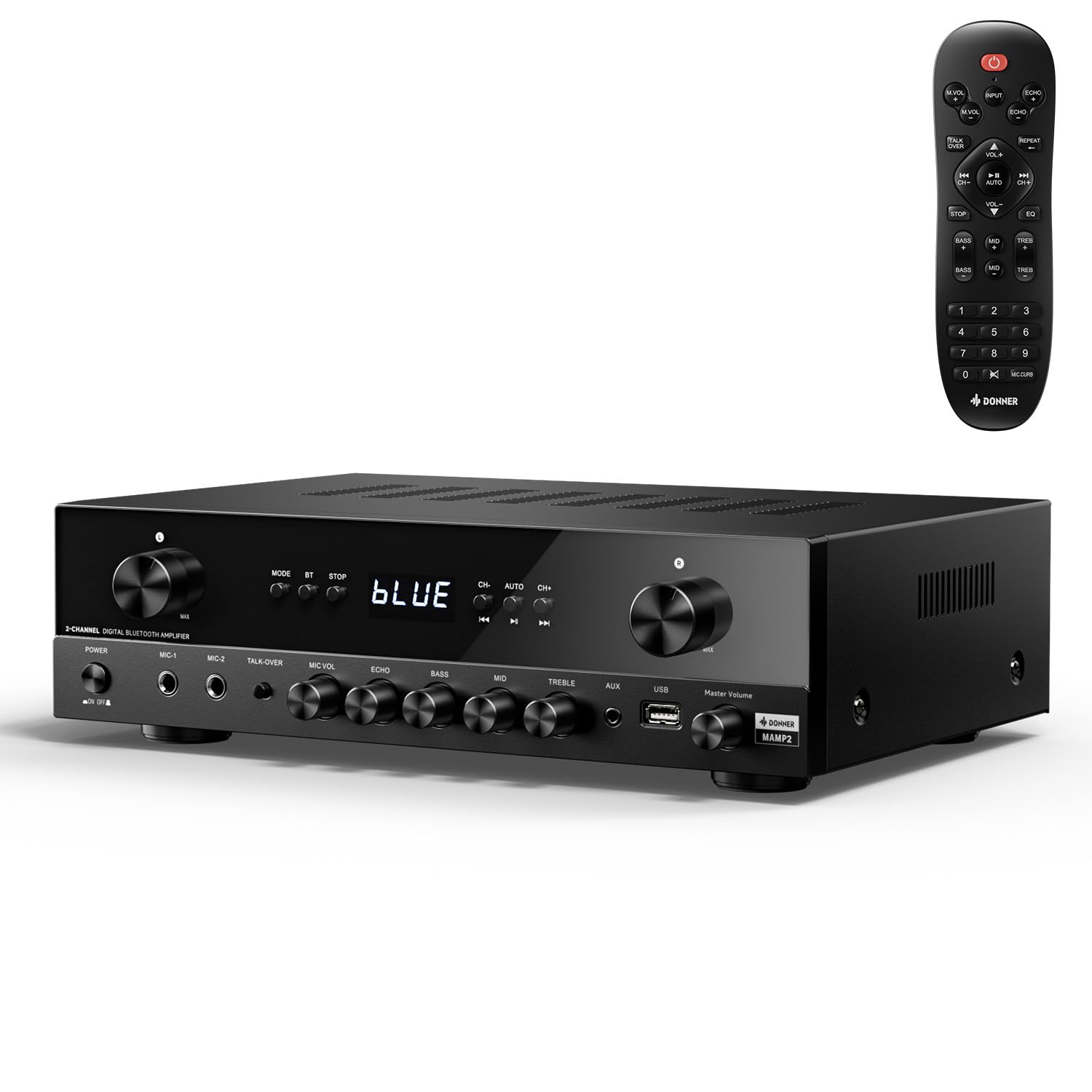
The Donner MAMP2 is a full-featured stereo receiver that covers almost every input a home system needs: Bluetooth 5.3, USB, optical, coaxial, FM radio, two 1/4-inch microphone inputs, a phono input with RIAA equalization, and RCA. The amplifier section delivers 60 watts RMS per channel into 8 ohms — honest, continuous power that drives most bookshelf speakers to satisfying levels. The dual-mic setup with independent reverb and the Talk Over function makes this a credible karaoke and PA solution for small gatherings.
The phono stage is the highlight for turntable users. It uses a discrete op-amp-based RIAA circuit that provides enough gain for moving magnet cartridges without the thinness or noise common in built-in phono stages at this price. The treble, midrange, and bass EQ controls are fully independent and work across all input modes — including Bluetooth — which is rare at this price tier. The FM tuner supports direct frequency entry via the remote, sidestepping the tedious scanning process of most budget receivers.
Connectivity limitations include a single RCA line input, which means you cannot simultaneously connect a CD player and a tape deck without an external switch. The binding posts are closely spaced and may not accept larger banana plugs. The subwoofer output is non-switchable and always active, so if your sub has a standby mode, you must power it down separately before the receiver to avoid a thump. Despite these quirks, the MAMP2 offers the most input versatility for under , especially if you need a phono stage and karaoke features in one box.
Why it’s great
- Built-in phono stage for turntable connectivity
- Bluetooth 5.3 with independent EQ across all inputs
- Dual mic inputs with reverb and Talk Over for karaoke
Good to know
- Single RCA line input limits simultaneous source connection
- Binding posts may not fit large banana plugs
- Optical input failed for some users
5. Pyle PDA77BU Home Stereo Receiver

The Pyle PDA77BU is a four-channel amplifier rated at 800 watts peak power, designed specifically for setups that need to drive multiple pairs of speakers or create a distributed audio zone. The amplifier uses Bluetooth 5.0 for wireless streaming from phones and tablets. The front panel includes dual 1/4-inch microphone jacks with independent volume controls, plus reverb and delay adjustments for karaoke use. An LED display provides real-time feedback on source selection and volume level.
The 800-watt peak rating translates to roughly 75–100 watts RMS total across all four channels with a clean signal. Users have measured zero distortion at full volume with a 1kHz test tone, which suggests the power supply is reasonably matched to the output stage for this price point. The amplifier accepts audio from USB drives and SD cards with native MP3 playback, removing the need for a separate media source. The included remote controls volume, source selection, and EQ presets from across the room.
White noise is more prominent than with premium Class D units — the noise floor sits higher due to the less sophisticated input filtering. The front-panel aesthetics include a large “Karaoke BT Amplifier” branding that some users find visually busy. The Bluetooth connection on some units requires re-pairing after the TV is turned off. For users who need to power four speakers for an open-plan space or want an all-in-one karaoke box with FM radio and media playback, the PDA77BU covers the most use cases in a single chassis at a mid-range price.
Why it’s great
- Four-channel output for multi-room or multi-speaker setups
- Dual mic inputs with independent reverb and delay controls
- USB/SD card MP3 playback without external source
Good to know
- Higher noise floor than dedicated stereo Class D amps
- Bluetooth may require re-pairing when switching sources
- Peak power rating significantly exceeds real-world RMS output
6. Fosi Audio BT20A Bluetooth Stereo Amplifier

The Fosi Audio BT20A is the entry-level benchmark in the budget amplifier category — a compact Class D unit measuring roughly the size of a trade paperback that delivers 100 watts per channel maximum into 4 ohms from a 24-volt, 4.5-amp power supply. In real-world use with 8-ohm bookshelf speakers, you get approximately 50 clean watts per channel, which is enough for near-field listening and moderate living room volume. The Bluetooth connection uses a reliable chipset that pairs quickly and maintains a stable link up to 30 feet through walls.
The front panel provides independent bass and treble control knobs that offer ±12 dB of adjustment, allowing you to compensate for room acoustics or speaker voicing. The all-black aluminum chassis fits on a shelf without sticking out. Setup is genuinely plug-and-play: connect speaker wire to the binding posts, plug in the power supply, pair your phone, and adjust the tone controls. Multiple customers report that this small amplifier breathed new life into old passive speakers they thought were dead.
The Bluetooth module overrides the AUX input when a device connects, so you cannot simultaneously use a wired TV signal and wireless phone streaming without manually reconnecting. The power supply brick is relatively large compared to the amplifier itself. There is no subwoofer output, no remote control, and no digital inputs. For a simple, affordable way to make passive speakers play music wirelessly with minimal fuss, the BT20A remains one of the most consistently recommended units in its price tier.
Why it’s great
- Extremely compact size fits any shelf or desk
- Independent bass and treble knobs for room compensation
- Proven Bluetooth reliability with fast pairing
Good to know
- Bluetooth overrides AUX input when connected
- No subwoofer output, remote, or digital inputs
- Power supply brick is larger than the amplifier itself
7. Viprh AS-336BU 2000W Stereo Audio Amplifier
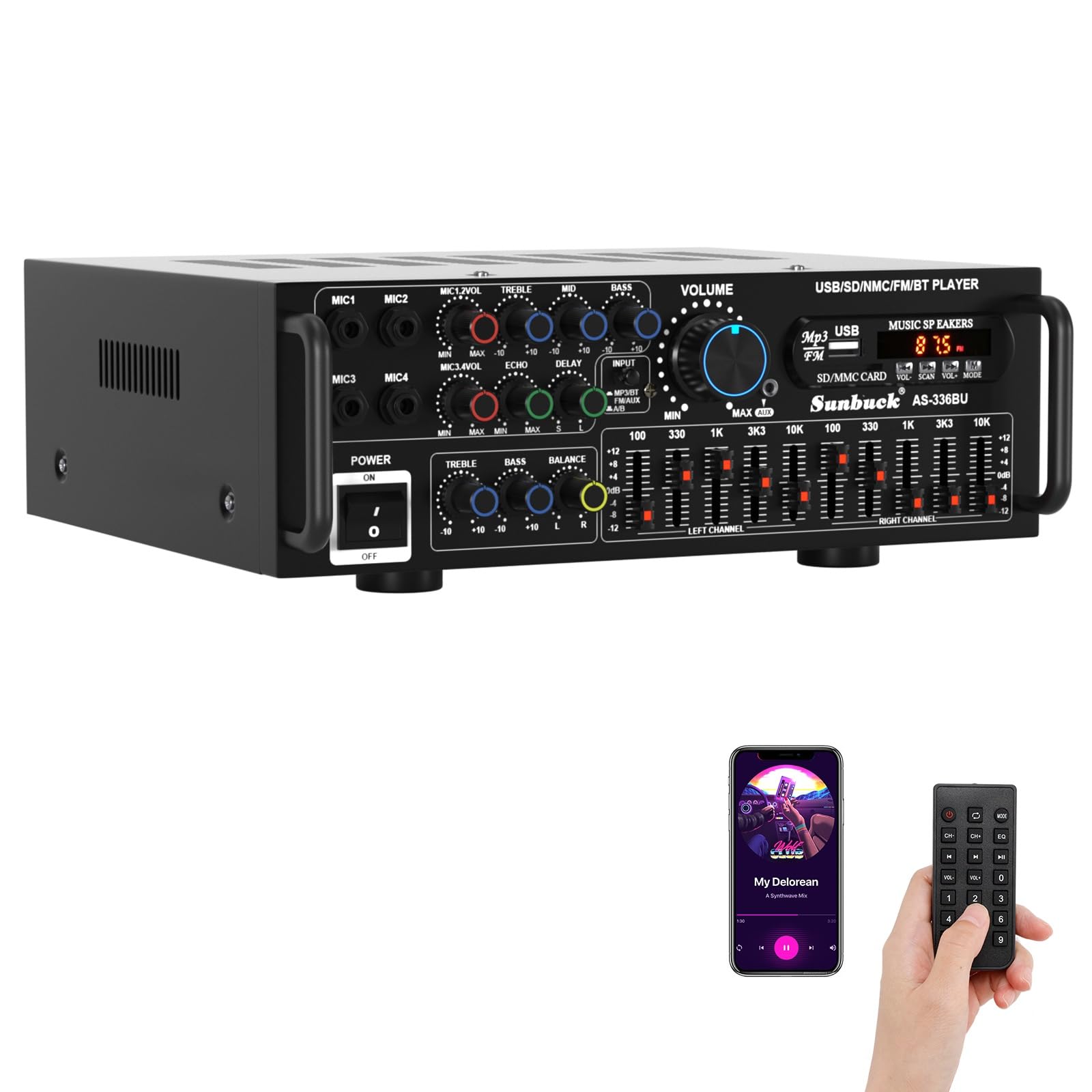
The Viprh AS-336BU is a high-power amplifier marketed at 2000 watts peak (400 watts RMS) with a focus on karaoke and party use. It includes four microphone inputs with individual reverb and delay controls plus a five-band EQ mixer for fine-tuning vocal presence. The amplifier supports both 110V AC home power and 12V DC car power, making it usable for tailgating, camping, or mobile setups. The chassis measurements of 11.4 by 9.4 inches fit in tighter car trunks or shelves.
Input connectivity covers AUX/DVD for TV and computer sources, plus USB and SD card media playback for independent music streaming. The LINE output lets you daisy-chain to additional amplifiers or active subwoofers. A remote control handles basic volume and source switching from a distance. The front panel provides balance and fine-tuning knobs for precise speaker adjustment. Users report decent volume levels with no audible white noise at moderate listening levels.
Real-world power delivery is significantly below the 2000-watt peak claim — independent measurements suggest the amplifier produces roughly 25–40 watts per channel into 8 ohms before distortion becomes audible. The construction is lightweight at 7 pounds, reflecting the use of a smaller transformer than the peak rating implies. The four mic inputs and 5-band EQ make this useful for karaoke events where microphone count matters more than audiophile-grade sound. If your primary need is driving a few pairs of speakers for a party with multiple vocalists, this is the only unit under that handles four mics simultaneously.
Why it’s great
- Four mic inputs with individual reverb for group karaoke
- Dual-voltage operation (110V AC and 12V DC) for mobile use
- USB/SD media playback and 5-band EQ mixer
Good to know
- Real-world output around 25-40W per channel, not 2000W
- Lightweight build may concern buyers expecting high-power transformers
- Inconsistent power claims versus actual measured performance
FAQ
Can a budget amplifier damage my speakers?
What does the TPA3255 chip do that cheaper chips cannot?
Do I need a separate DAC with a budget amplifier?
Is Bluetooth on a budget amplifier good enough for serious listening?
Can I connect a subwoofer to a budget stereo amplifier?
Final Thoughts: The Verdict
For most users, the best budget amplifier winner is the Fosi Audio MC331 because it integrates a tube pre-amplifier, a quality DAC, and reliable Class D power in a compact desktop form factor that sounds genuinely warm and detailed. If you want the most versatile input selection including a built-in phono stage for your turntable, grab the Donner MAMP2. And for raw, honest power without any features to fail, nothing beats the AIYIMA A07 MAX.