
Our readers keep the lights on and my morning glass full of iced black tea. As an Amazon Associate, I earn from qualifying purchases.
Specs are compiled from manufacturer listings and verified buyer reviews and can change over time — please confirm the key details on the product page before buying.
The good news is that the market has shifted fast in your favor. The latest affordable models pack accurate satellite tracking, big readable screens, and enough run time to cover a century ride without blinking, all for well under what you’d pay for a single premium-brand replacement mount. You just need to know which specs to look past and which ones to lock onto.
I’m Min — the founder and writer behind Gadgets Feed. This guide is built by comparing the manufacturers’ published specifications and the patterns across verified customer reviews, so you get each pick’s real strengths and trade-offs instead of marketing spin.
The right budget bike computer delivers a clear, sunlight-readable screen, multi-satellite GPS lock in seconds, and battery endurance measured in dozens of hours, not in single-digit race-day estimates.
Our Picks at a Glance


How To Choose The Best Budget Bike Computer
A smart cheap bike computer starts with one honest question: how much data do you actually need while you’re riding? Look for models that give you a large, easy-to-read LCD, reliable multi-satellite GPS that locks quickly, and battery life measured in days, not hours.
Battery Life Is the Real Scorekeeper
Spec sheets list battery life in “hours of continuous use” — but that number varies wildly, from 25 hours all the way up to 100 hours on some units. For a rider doing a weekly 3-hour ride, even the lowest figure covers a month of riding between charges. The real-world drain from always-on GPS and automatic backlight can be heavy, so look for a figure above 30 hours if you want to charge less than once a week.
Display Size and Sunlight Readability
The screen is your dashboard. A 2.3-inch display shows the basics, while a 2.6-inch or 2.8-inch screen gives you room for speed, distance, and one or two extra fields without squinting. Anti-glare coatings and automatic backlight make the difference between a readable ride and one where you’re constantly shading the screen. The most important spec here isn’t just the diagonal — it’s whether the pixel type (FSTN or segment code LCD) stays crisp in direct sun.
Sensor and App Connectivity
ANT+ is a wireless protocol that connects your computer to external sensors like heart rate monitors, cadence sensors, and power meters. Bluetooth handles the connection to your phone and the brand’s app for syncing ride data to platforms like Strava. If you plan to add sensors later, an ANT+ slot is essential. If you just want GPS logs, basic Bluetooth syncing is enough.
Quick Comparison
| Model | Best For | Display Size | Battery Life | Weight | Amazon |
|---|---|---|---|---|---|
| iGPSPORT BSC100S★ Best Overall | Overall Value + Features | 2.6″ | 40 Hours | 67 Grams | Amazon |
| CYCPLUS M3Max Endurance Pick | Maximum Battery Endurance | 2.8″ | 100 Hours | 0.14 kg | Amazon |
| iGPSPORT BSC100S (V2)Sensor Ready | Big Screen + Sensor Support | 2.6″ | 40 Hours | 65 Grams | Amazon |
| CYCPLUS M2 | 70-Hour Battery Life | 2.5″ | 70 Hours | 68 Grams | Amazon |
| COOSPO BC107 | Reliable Sensor Integration | 2.4″ | — | 0.14 kg | Amazon |
| Bikevee 2.4″ | Simple GPS + Low Weight | 2.4″ | 28 Hours | 50 Grams | Amazon |
| Bikevee 2.4″ (V2) | Easy Set Up + Accuracy | 2.4″ | 28 Hours | 50 Grams | Amazon |
| XOSS G+ | ANT+ Sensor Pairing | 1.8″ | 25 Hours | 101 Grams | Amazon |
| COOSPO BC26 | Entry-Level Simplicity | 2.3″ | 25 Hours | 54 Grams | Amazon |
In‑Depth Reviews
1. iGPSPORT BSC100S
Our pick — over 4★ from 750+ verified ratings; the strongest balance of quality and price.
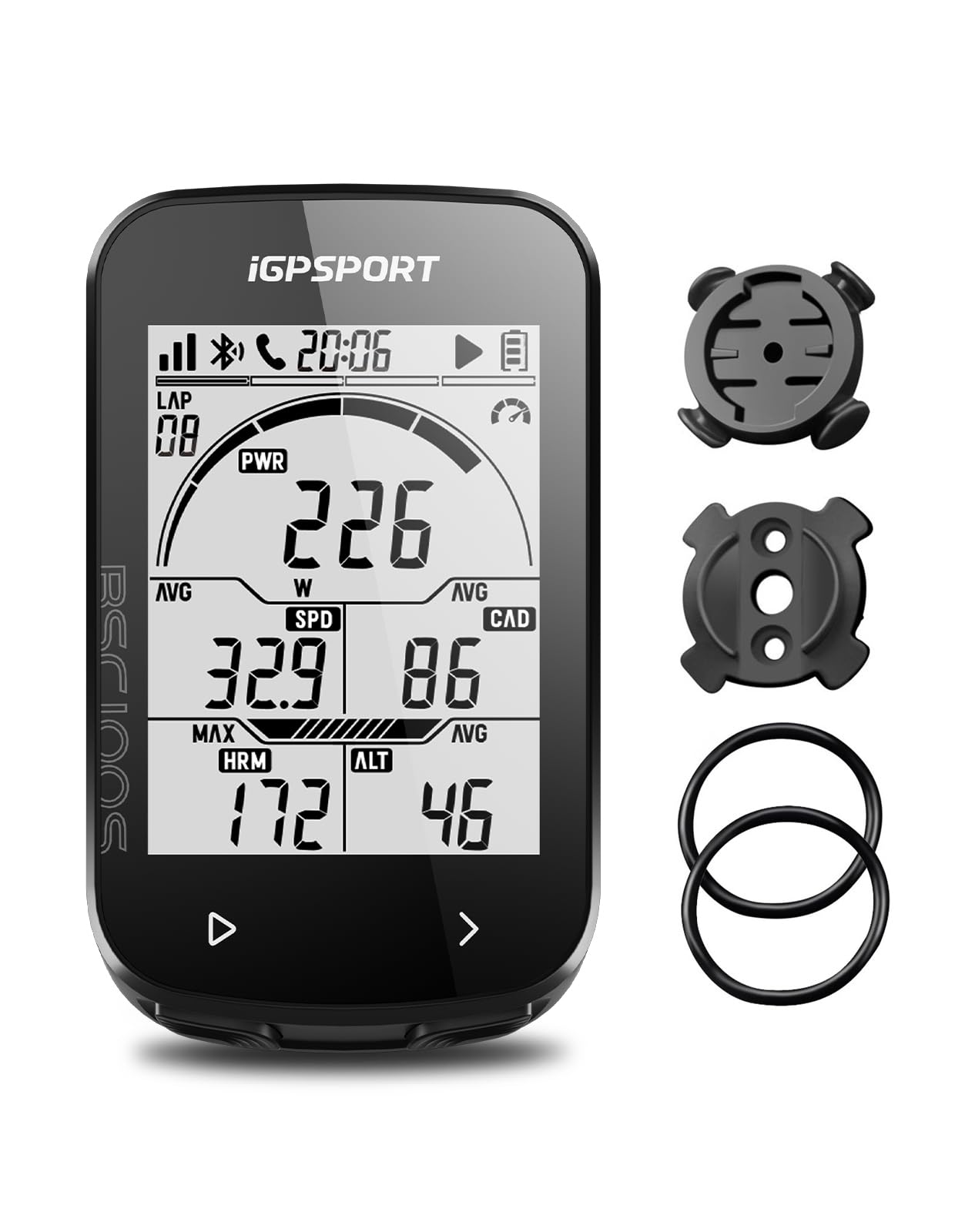
The iGPSPORT BSC100S delivers a huge 2.6-inch screen with a 40-hour battery, all at a price that undercuts the big names by a mile.
This is the unit that keeps surprising owners ride after ride. The 2.6-inch anti-glare LCD is one of the largest you’ll find on any bike computer, making it easy to read current speed, average speed, and distance without squinting. A Type-C charging port (though the cable is not included) cuts recharge time compared to the older micro-USB ports that many competitors still use.
What really wins people over is the functionality — owners consistently point to how well it works from the start. It supports five satellite systems (GPS+Beidou+GLONASS+GALILEO+QZSS) for fast and accurate positioning, even under tree cover. It pairs with ANT+ sensors and Bluetooth 5.0, so you can connect speed, cadence, and heart rate sensors or a power meter. And data syncs easily to Strava and Komoot via the iGPSPORT app. One buyer summed it up on the review pages: “great battery life (no drop under 25 miles).” The only recurring caveat is the manual, which owners find near-useless, and a molded mount that can break if handled roughly. But at this price, the value proposition is hard to argue with.
What Owners Celebrate
- 2.6-inch anti-glare screen is big enough to read at a glance while riding
- 40-hour battery with Type-C charging lasts through multi-day tours
- Supports 5 satellite systems plus ANT+ and Bluetooth 5.0 sensor pairing
- Syncs smoothly with Strava and Komoot
What’s a Trade-Off
- The included manual is nearly useless — owners recommend using the online version or the app
- The rubber-band mount and molded arms can break if you’re not gentle; an aftermarket mount may help
Reach for this if: you want the best combination of a large clear screen, 40-hour battery, and full sensor compatibility without paying premium-brand prices.
Look elsewhere if: you need turn-by-turn navigation or a fully customizable data page — this unit is a data-logger, not a route-follower.
2. CYCPLUS M3 GPS Bike Computer
The CYCPLUS M3 offers a massive 100-hour battery, the largest screen in this lineup, and customizable data fields.
If you measure your rides in days rather than hours, the M3 is built for you. Its 1500mAh battery delivers up to 100 hours of runtime — that’s nearly three times the endurance of the 40-hour iGPSPORT BSC100S — and it recharges fully in just 2.5 hours via USB-C. The 2.8-inch segment code FSTN glass screen is the largest in this roundup and stays readable in direct sunlight. It automatically senses ambient light and adjusts the backlight, so you never have to fumble with a button when the trail ducks into a tunnel.
Owners appreciate the customizable data display — you can prioritize 8 key metrics per page through the CYCPLUS FIT app, with 4 regular and 4 customizable data fields. It supports ANT+ sensors for speed, cadence, heart rate, and power, and syncs with Strava. The recurring feedback on reliability is worth noting; some buyers report that the device can freeze during ride saves, occasionally losing data. The setup process also receives mixed reviews, with the time set only in 15-minute increments and the app sometimes defaulting to metric units. For a first-time buyer willing to invest a little patience in setup, the endurance and screen size are class-leading at this price tier.
The endurance king: a 100-hour battery that charges fully in 2.5 hours and a 2.8-inch anti-glare screen that’s the biggest and most readable in this guide. The trade-off is that the software reliability isn’t as polished as the iGPSPORT — an occasional freeze mid-save can lose data.
Best for: ultra-endurance riders, bikepackers, and commuters who want to charge once a month.
skip it if: you need flawless ride-saving reliability on every single ride without any app friction.
3. iGPSPORT BSC100S (V2)
A near-twin to the top pick, this version adds 10 automated control functions but keeps the same 2.6-inch screen and 40-hour battery.
This is essentially the same hardware as product 1 — a 2.6-inch anti-glare display, 40-hour battery, and five-satellite GPS — but it emphasizes automation over manual control. It includes 10 auto functions like automatic backlight, auto record, auto pause, auto sleep, auto lap, and auto return to the home page. The idea is that you set it up once and then just ride, with no button pressing along the way.
Owners say it syncs easily to Strava and pairs with ANT+ sensors like power meters, heart rate monitors, and speed/cadence sensors. It’s the best choice for riders who want a low-maintenance experience. Performance and value are the two most-praised aspects, with many owners calling it an excellent starter computer. One owner described it as a “good starter computer, it works well, display is straightforward.” The only real downside initial tracking can be a little off for ascent and distance in the first few rides — some owners mention it overestimates elevation by a couple thousand feet on an 18-mile loop. After about five rides, the data aligns with Strava. A small patience period is all it needs.
Automated riding: 10 auto-control functions (including auto start-stop and auto lap) mean less fiddling on the handlebars. The catch is a brief break-in period during the first few rides while the GPS settles.
Reach for this if: you want the big screen and long battery life of the top pick but prefer automated functions over manual button-pushing.
Look elsewhere if: you want perfect elevation data from mile one without a few rides to calibrate.
4. CYCPLUS M2

A 70-hour battery life and a 2.5-inch anti-dazzling screen make the M2 a serious travel companion for extended tours.
The M2 sits in a balance between battery endurance and price. Its 1000mAh lithium battery powers 70 hours of continuous use, putting it well ahead of the 40-hour competition while staying below the niche 100-hour ceiling. The 2.5-inch anti-dazzling LCD screen is slightly smaller than the 2.6-inch BSC100S units, but the bezel is nearly invisible, giving it a modern look. It supports up to 12 different data fields across three switchable pages, including current speed, max speed, average speed, ascent, power, altitude, gradient, and heart rate, all via ANT+ sensors.
The device connects via Bluetooth to the CYCPLUS FIT app for Strava sync, and owners consistently note that the display is easy to read with large speed numbers. The IPX6 waterproof rating is a step down from the IPX7 on many competitors, meaning it can handle rain but shouldn’t be fully submerged. The most common issue cited by owners is a failure after several months — some units stop recording time and distance, locking up around 12 minutes into a ride. It’s not a universal problem, but it appears often enough to be the watchpoint on this otherwise capable unit.
Long-haul specialist: 70 hours of battery with a clear 2.5-inch anti-dazzling screen. The durability watchpoint is that a small number of units stop recording properly after several months of use.
Best for: multi-day tourers who need battery endurance between the 40-hour and 100-hour classes at a mid-range price.
pass on it if: you need a computer with IPX7 waterproofing — the M2 is IPX6-rated and not submersible.
5. COOSPO BC107

The BC107 focuses on rock-solid ANT+ sensor integration and quick satellite locking, all packed into a compact 2.4-inch body.
If you already own ANT+ sensors — a heart rate strap, speed sensor, cadence sensor, or power meter — the BC107 is the budget computer that treats them as a priority. It uses GPS and BeiDou positioning (with two modes: GPS-only or combined GPS/BeiDou) for fast and accurate tracking. The 2.4-inch display is on the smaller side compared to the 2.6-inch iGPSPORT, but the segment code LCD is crisp and readable in direct sun. It also features an automatic backlight that activates when ambient light drops.
Owners rave about the reliability — it’s the single most-praised aspect, with many saying it performs like a computer costing twice as much. One owner noted that after 500 miles over 10 days, the battery was still at 75%. The setup process gets a mixed response, with some finding it straightforward and others calling it slightly tricky. A key limitation is that the BC107 only supports ANT+ connections, not Bluetooth for sensors — Bluetooth is reserved for app syncing only, so if your sensors are Bluetooth only, look elsewhere. The temperature sensor also tends to read a few degrees high, as the unit sits in direct sun.
Why It Stands Out
- Reliable ANT+ sensor pairing with fast GPS/BeiDou satellite lock
- Remarkable real-world battery performance (500 miles at 75% remaining reported)
- Clear 2.4-inch display with automatic backlight
One Thing to Know
- ANT+ only for sensors — no Bluetooth sensor pairing (Bluetooth is only for app syncing)
Reach for this if: you already own ANT+ sensors (heart rate, cadence, speed, power) and want a reliable budget computer that integrates them smoothly.
Look elsewhere if: your sensors are Bluetooth-only or you need turn-by-turn navigation.
6. Bikevee 2.4″ GPS Bike Computer
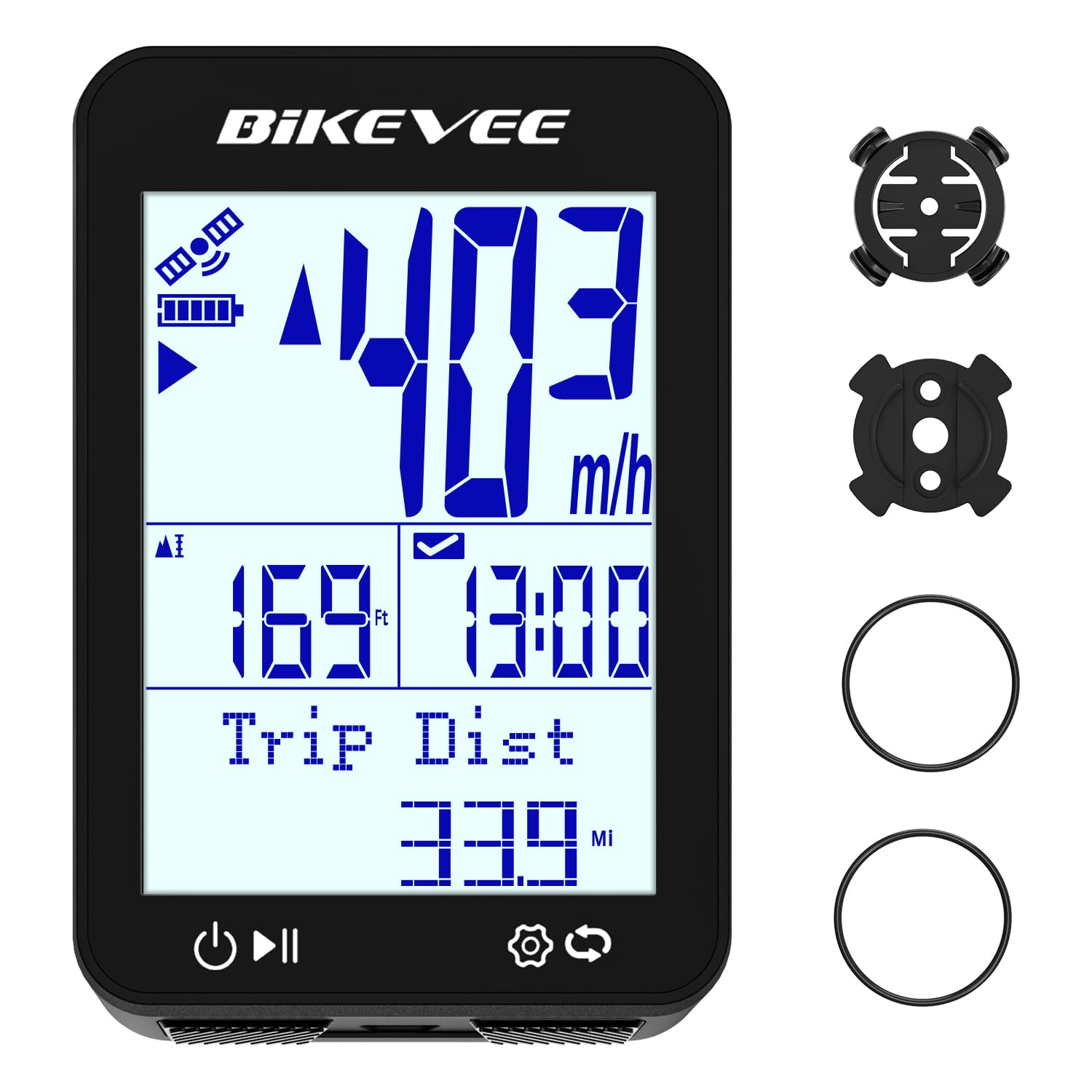
At just 50 grams, the Bikevee is the lightest unit here while still offering a 28-hour battery and GPS-based speed tracking.
This GPS computer is all about minimalist simplicity. It uses GPS positioning only (no wheel magnets or wiring) and has an automatic start-stop function — so the moment you start pedaling, it begins recording. The 2.4-inch LCD screen is large enough to show speed, distance, ride time, and average speed, all with automatic backlight for low-light conditions. The 650mAh battery delivers 28 hours of riding time, and a USB-C cable is included, which is a nice touch that some more expensive units skip.
Owners praise the easy setup, accurate GPS speed and distance tracking, and the clear display. The unit is available in 9 languages, making it a good choice for international riders. The most common feedback is that while the basic metrics are reliable, there are no advanced features — no Bluetooth, no navigation, no heart rate monitor support. It also lacks elevation gradient if that matters to you. The mounting system gets mixed marks for security; some owners find it hard to keep the unit from slipping over rough terrain. For a pure no-frills speed and distance tracker, this is a top pick at an entry-level price.
Pure simplicity: 50 grams, GPS-only setup, automatic start-stop, and a 28-hour battery. The trade-off is that there is no Bluetooth, no sensor pairing, and no navigation — the most basic reliable tracker in the lineup.
Best for: riders who just want speed, distance, and time data without any app or sensor complexity.
it’s not for you if: you want to connect heart rate monitors, cadence sensors, or sync to Strava — the above model (iGPSPORT) does all that for a small step up in budget.
7. Bikevee 2.4″ GPS (V2)
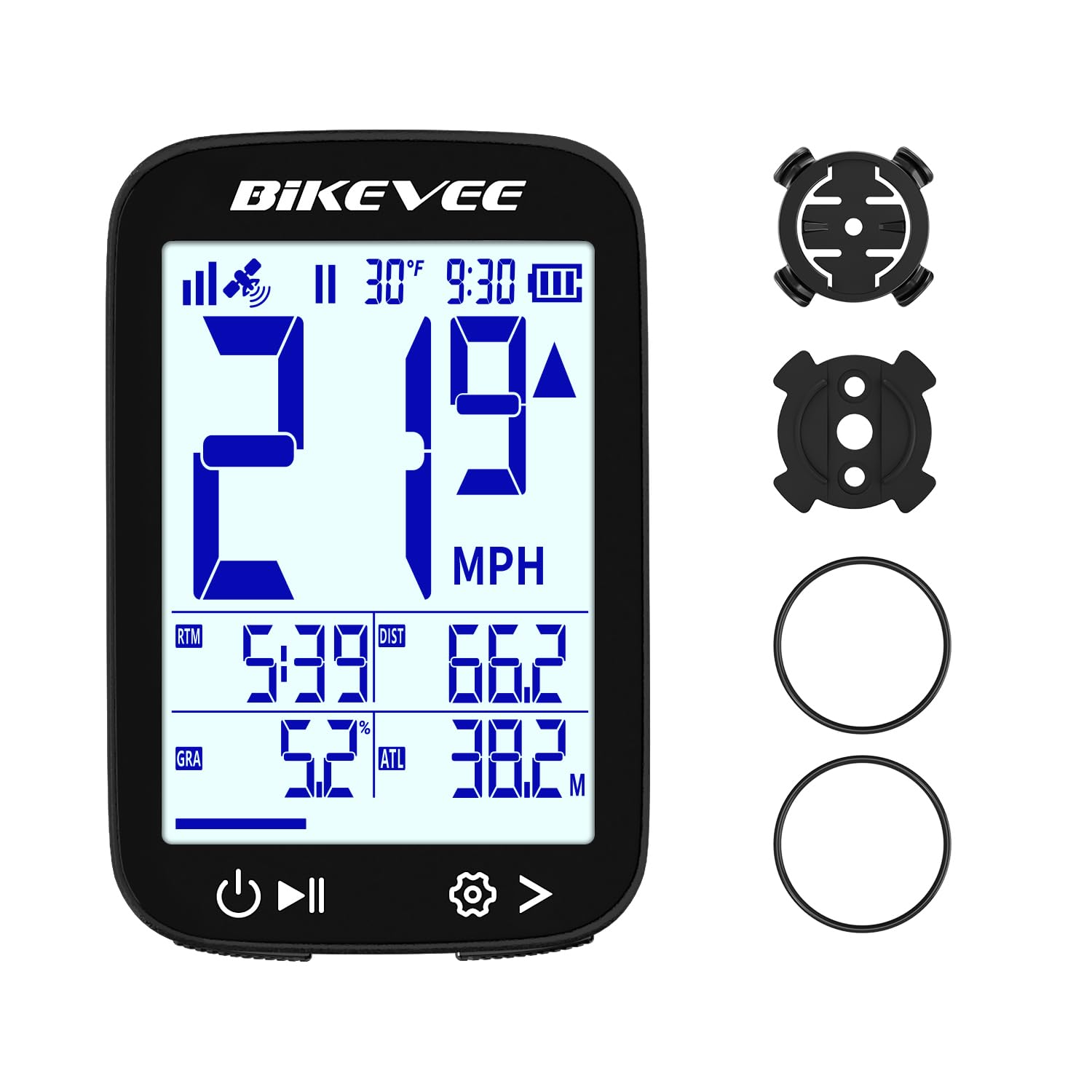
Nearly identical to product 6, this Bikevee version adds temperature and altitude tracking to the basic speed and distance formula.
Where product 6 sticks to the raw essentials, this version layers on additional ride data including temperature, altitude, and gradient ascent. It still has the same 2.4-inch LCD screen with automatic backlight, the same 28-hour battery from its 650mAh cell, and the same GPS-only wireless setup with no wheel magnets. The key difference is the extra data fields, making it a better fit for riders who want some elevation and temperature context on their route.
Owners consistently single out the accuracy and fast satellite acquisition — one owner noted it locked onto satellites faster than their previous Polar and Lezyne units. The display layout puts speed in the upper center with smaller readings for incline and distance below, making it easy to glance at the most important number. The biggest limitation is that the display has only 3 preset screen modes, and none are customizable. Some owners also mention that the altitude reading can be off by about 30 meters and the temperature reads roughly 5-6°F high, though the core speed and distance tracking is very accurate — within 0.10 miles over a 32-mile ride against two other GPS units.
Data-rich simplicity: adds temperature, altitude, and gradient to the basic GPS formula while maintaining the same 28-hour battery and 50-gram weight. The trade-off is no customizable data pages and somewhat optimistic temperature and altitude readings.
Reach for this if: you want speed, distance, and some altitude/temperature context without paying for a full-featured computer.
Look elsewhere if: you need reliable absolute altitude for climbing — the iGPSPORT BSC100S has better accuracy in this area.
8. XOSS G+

The XOSS G+ packs ANT+ and Bluetooth sensor support and Strava syncing into a compact 1.8-inch unit that trades screen size for low cost.
If you need to pair with ANT+ sensors (heart rate, cadence, speed) and sync everything to Strava, but your budget is extremely tight, the G+ gets you there. The 1.8-inch screen is noticeably smaller than the 2.4- or 2.6-inch competitors — about the size of a large postage stamp — which means data fields are cramped. Speed and distance are easy enough, but secondary info like altitude is tiny. The screen does have an automatic backlight, and the device itself is IPX7 waterproof.
The unit weighs 101 grams, making it the heaviest in this guide by a significant margin — nearly double the 50-gram Bikevee. The 500mAh battery delivers 25 hours of GPS use, which is on the shorter end. Owners praise the fast GPS lock (some report under 10 seconds) and the clean wireless installation. The quality and value are well-regarded, but the reliability picture is more complex; a significant number of customers note the device stopping function after a few months. The G+ is a capable unit when it works, but the failure reports are common enough to make it a higher-risk pick than the iGPSPORT or COOSPO options for the same budget range.
Why It’s a Contender
- Fast GPS lock (<10 seconds reported by owners)
- ANT+ and Bluetooth sensor support with Strava sync
- Clean, wireless installation with automatic backlight
The Watchpoints
- 1.8-inch screen is small — secondary data fields are hard to read while riding
- Heavier than most competitors at 101 grams
- Reliability is mixed, with some units failing after a couple of months
Best for: riders who already have ANT+ sensors and want the lowest-cost way to get heart rate, cadence, and Strava syncing on a handlebar.
look elsewhere if: screen readability matters — the small 1.8-inch display and cramped layout will frustrate riders used to large-field computers.
9. COOSPO BC26

The BC26 is purpose-built for entry-level riders who want accurate GPS tracking and a clear display without any sensor pairing complexity.
COOSPO designed the BC26 explicitly for the first-time GPS computer buyer. It has a 2.3-inch segment code FSTN glass screen that is sunlight-readable and includes an automatic backlight that senses darkness. The dual GPS positioning (GPS + BeiDou) records your ride map and syncs to Strava via the CoospoRide app. The 25-hour battery life is average for this class — 15 hours short of the 40-hour iGPSPORT BSC100S — but for a rider doing hour-long commutes, that’s still weeks of use between charges.
Owners consistently praise how easy the display is to read and how quickly it connects to satellites — one owner described “excellent battery life, connects to satellites in minutes.” The key limitation is that the BC26 does NOT support any external sensors (no heart rate monitor, no cadence sensor, no speed sensor). It is purely a GPS tracker paired with your phone. It also lacks a speed alarm that can be set. The extension mount is not included and must be purchased separately. For a cyclist who just wants to track speed, distance, and route without any accessories or complex app configuration, the BC26 hits the target perfectly.
True entry-level: a 2.3-inch clear display, dual GPS, and a 25-hour battery — but zero sensor support. If you don’t own any bike sensors and don’t plan to buy them, this is a clean, reliable way to track your ride.
Reach for this if: you want a dead-simple GPS tracker with no sensor setup, no wheel magnets, and a clear screen that syncs to Strava.
Look elsewhere if: you plan to add heart rate, cadence, or power sensors in the future — the BC26 cannot pair with them.
Understanding the Specs
Battery Life (Hours of Continuous GPS Use)
This is the single most important endurance number on a bike computer. A 25-hour battery covers roughly eight 3-hour rides between charges. A 40-hour battery doubles that to over two weeks of daily commuting. A 100-hour battery like the CYCPLUS M3 can go a full month. Real-world drain depends on factors like automatic backlight usage, sensor pairing, and GPS refresh rate, but start with the manufacturer’s figure and subtract about 10% for a realistic day-to-day estimate.
Display Size and Type
Measured diagonally in inches, screen size directly impacts how much data you can read at a glance. A 2.3-inch or 2.4-inch screen typically shows 3-4 data fields comfortably. A 2.6-inch or 2.8-inch screen can show 6-8 fields without squinting. The screen type also matters — FSTN glass (found on the COOSPO BC26 and CYCPLUS M3) is a high-contrast technology that stays readable in direct sunlight, while basic segment code LCDs can wash out in bright light. Anti-glare coatings are a big plus.
GPS Satellite Systems
Most budget computers support GPS plus one or two additional satellite constellations like GLONASS (Russian), BeiDou (Chinese), or Galileo (European). More satellites mean faster position lock (the time from power-on to “ready”) and better accuracy in urban canyons, tree cover, or mountain valleys. A computer that supports 5 systems (like the iGPSPORT BSC100S) will lock on significantly faster than a GPS-only unit in challenging environments.
ANT+ vs Bluetooth Connectivity
ANT+ and Bluetooth serve two different roles on a bike computer. ANT+ is a low-power wireless standard used to connect external sensors (heart rate monitor, cadence sensor, speed sensor, power meter). Bluetooth connects the computer to your phone for data syncing and app features. A computer like the COOSPO BC107 supports ANT+ sensors but only uses Bluetooth for app syncing — so your heart rate strap must be ANT+, not Bluetooth. Check which standard your sensors use before buying.
FAQ
Will a budget bike computer sync with my existing heart rate monitor or cadence sensor?
How long does a budget GPS bike computer battery actually last in real-world riding?
Can I upload my ride data from a budget bike computer to Strava?
What size bike computer screen do I need for easy reading while riding?
Do I need a wheel magnet or wiring to install a GPS bike computer?
How accurate is the speed and distance on a cheap GPS bike computer compared to a Garmin or Wahoo?
Are budget bike computers waterproof for riding in rain?
What’s the difference between an entry-level GPS computer and a premium model like a Garmin Edge?
How do I set up a budget bike computer to show speed in miles per hour instead of kilometers per hour?
Can I use a budget bike computer on an electric bike?
Final Thoughts: The Verdict
Across the board, the budget bike computer winner is the iGPSPORT BSC100S because it delivers a big 2.6-inch screen, 40-hour battery, and ANT+ sensor support at a price that leaves the big-brand competition in the dust. If you want maximum battery endurance — enough to charge once a month — grab the CYCPLUS M3 with its 100-hour battery and 2.8-inch display. And for entry-level riders who just want a clear screen and reliable GPS without any sensor complexity, the COOSPO BC26 is the simplest way to start tracking rides on a tight budget.
How We Picked
We do not accept paid placement. Every pick is matched to a real buyer and a real use-case; we do not hands-on test units.
Sources & Methodology
Specifications: manufacturer listings and product documentation. Review insights: verified customer reviews, as of July 2026. Pricing: not shown on this page (it changes often); check the current price via the retailer link.
As an Amazon Associate, Gadgets Feed earns from qualifying purchases. This does not affect which products we feature.