
It happens every time: you plug in a pair of budget bookshelf speakers, drop the first track, and brace for thin, boxy sound that belongs in a dorm-room garage sale. But this category has quietly evolved, and the line between “cheap” and “good” has never been blurrier — or harder to navigate without a solid spec sheet in hand.
I’m Rikta — the co-founder and writer behind Gadgets Feed. I’ve spent years analyzing frequency response curves, crossover topologies, and driver materials across the budget bookshelf market, looking for the models that actually deliver on their claims rather than just looking the part. (And Homer 🐱 approved the test playlist from his warm spot atop the amp stack.)
Whether you’re building a desktop workstation or a simple living-room stereo, getting this wrong means living with listener fatigue and muffled vocals. This guide cuts through the noise to help you genuinely choose the best budget bookshelf speakers for your space and playback preferences without wasting a cent.
How To Choose The Best Budget Bookshelf Speakers
Picking the right pair on a budget means focusing on a few non-negotiable specs rather than getting distracted by LED rings or marketing buzzwords. The decision boils down to what type of connectivity you need (powered vs passive), the speaker’s physical size relative to your room, and how much natural low-end extension you truly expect from a compact enclosure.
Powered vs. Passive — Which One Belongs on Your Desk?
Powered speakers have an amplifier built-in, so you only need a source device and a power outlet. This is the simplest route for desktop use with a computer, turntable, or TV. Passive speakers require a separate amplifier or receiver, which adds cost and complexity but allows you to upgrade either component independently later. In the budget tier, powered models tend to offer better value because the amplifier is tuned specifically for that driver set.
Driver Size and Crossover Quality
A 4-inch woofer will produce noticeably deeper bass extension compared to a 3-inch driver, but the crossover design — the electronic circuit that splits frequencies between the woofer and tweeter — matters just as much. A well-designed crossover with film capacitors and air-core coils reduces distortion and creates a seamless transition between highs and mids. Many budget speakers skimp here, leading to a harsh or “honky” midrange.
Enclosure Build and Bass Porting
MDF wood cabinets are superior to plastic because they dampen internal vibrations that muddy the sound. Look for a rear- or front-firing bass port; rear ports need a few inches of clearance from the wall, while front ports work better in tight bookshelf placements. In this price range, a solid cabinet and thoughtful port design often separate the keepers from the returnable boxes.
Quick Comparison
On smaller screens, swipe sideways to see the full table.
| Model | Category | Best For | Key Spec | Amazon |
|---|---|---|---|---|
| Micca RB42 | Passive | Hi-Fi desktop with external amp | 4″ long-throw woofer, silk tweeter, 10-element crossover | Amazon |
| Edifier MR3 | Powered | Hi-Res nearfield monitoring | 3.5″ mid-low driver + 1″ tweeter, 52Hz – 40kHz | Amazon |
| Edifier R1280T | Powered | All-purpose 2.0 with remote control | 13mm silk dome tweeter + 4″ full-range driver | Amazon |
| Mackie CR3.5 | Powered | Content creation and nearfield listening | 3.5″ woven woofer + silk dome tweeter, Tone knob | Amazon |
| Ortizan C7 | Powered | Music production and balanced monitoring | 3.5″ carbon fiber woofer + 0.75″ silk tweeter, TRS input | Amazon |
| OHAYO 60W | Powered | Versatile desktop with EQ control | 0.75″ silk dome tweeter + 3″ carbon fiber driver, 30Wx2 | Amazon |
| Electrohome Huntley | Powered | Budget turntable or TV companion | 3″ drivers, rear ported wood cabinet, Bluetooth 5 | Amazon |
In‑Depth Reviews
1. Micca RB42 Reference Bookshelf Speaker (Dark Walnut, Pair)

The Micca RB42 delivers bass weight that defies its compact cabinet thanks to a long-throw 4-inch woofer with a coated paper cone and a large rubber surround. The 10-element crossover using film capacitors and air-core coils ensures a smooth transition to the 0.75-inch silk dome tweeter, producing a balanced and non-fatiguing sound signature that has drawn comparisons to speakers costing substantially more.
These passive speakers are notoriously power-hungry for their size — reviewers consistently recommend driving them with at least 50 to 60 watts RMS to unlock their full dynamics and avoid a thin, strained upper register. The dark walnut wood cabinet is solidly constructed with a magnetic mesh grille, and the rear-mounted port requires reasonable wall clearance to avoid chuffing at higher volumes.
Bass extension is genuinely surprising for a 4-inch driver, making a subwoofer optional for most musical genres. However, the RB42’s inefficiency means pairing it with a weak amplifier will produce disappointing results, so factor the cost of capable amplification into your total system budget before making this pick your daily driver.
Why it’s great
- Exceptional bass depth and clarity for a 4-inch driver
- High-quality 10-element crossover with film caps and air-core coils
- Solid MDF cabinet with magnetic grille and attractive wood veneer
Good to know
- Requires a powerful external amplifier (50W+) to perform well
- Low sensitivity means it can be easily overdriven on modest gear
- Rear port needs space from the wall to avoid distortion
2. Edifier MR3 Powered Studio Monitor Speakers (White)

The Edifier MR3 brings Hi-Res Audio certification and a remarkably flat frequency response spanning 52Hz to 40kHz into an affordable powered package. Each channel delivers 18W RMS through a 3.5-inch mid-low driver paired with a 1-inch tweeter, producing clean, neutral sound with zero audible hiss at normal listening levels — a rare trait in this bracket.
Connectivity is generous for the price: balanced TRS inputs, RCA, AUX, and Bluetooth 5.4 with multi-point pairing allow simultaneous connection to a computer and smartphone. The Edifier ConneX app adds toggleable Monitor, Music, and Custom EQ modes along with bass and treble sliders, giving nearfield listeners fine-grained control without coloring the sound inadvertently.
Reviewers consistently praise the MR3’s clarity at low volumes and its ability to reveal detail without harshness, making it suitable for extended editing sessions and casual listening alike. The white MDF cabinet looks clean on a desk, and the front-panel headphone output is a convenience that competitors often omit. Its relatively small driver limits chest-thumping bass, but for accurate monitoring in a small room, this is a serious contender.
Why it’s great
- Hi-Res certified with flat response from 52Hz to 40kHz
- Bluetooth 5.4 multi-point plus TRS, RCA, and AUX inputs
- App-based EQ with Monitor, Music, and Custom modes
Good to know
- Limited low-end extension compared to larger 4-inch or 5-inch drivers
- Bluetooth pairing process can be slightly finicky initially
- Volume is controlled by physical knob, not fully via connected device
3. Edifier R1280T Powered Bookshelf Speakers (Black)

The Edifier R1280T is a stalwart of the budget powered speaker category, pairing a 13mm silk dome tweeter with a 4-inch full-range driver inside a high-density MDF cabinet finished with a wood-effect vinyl wrap. The total output of 42 watts RMS is ample for a bedroom, small office, or living room setup, and the two AUX inputs let you switch between a turntable and a computer without reaching behind the cabinet.
A handy remote control adjusts volume from across the room, while bass and treble knobs sit on the side of the active speaker for quick tonal shaping. Reviewers consistently note the natural, relaxed sound signature that avoids listener fatigue, though the bass response is polite rather than punchy — those wanting low-end rumble will want to pair these with a subwoofer.
Setup is straightforward with the included speaker wire, and the classic black aesthetic blends with most decor. The absence of Bluetooth is the biggest omission here, but for a purely wired 2.0 system with a remote and side-panel EQ, the R1280T delivers dependable performance that has kept it relevant across several iterations.
Why it’s great
- Versatile dual AUX inputs with remote control convenience
- Analog bass and treble adjusters for easy tonal balancing
- Warm, non-fatiguing sound suitable for extended listening
Good to know
- No Bluetooth or wireless connectivity of any kind
- Bass extension is modest; a subwoofer is recommended for bass-heavy genres
- Side-panel controls can be hard to reach in tight shelving
4. Mackie CR3.5 Creative Reference Powered Studio Monitors

The Mackie CR3.5 packs studio-monitor heritage into a compact 3.5-inch form factor with a thoughtful set of features that bridge the gap between content creation and casual listening. The woven woofer and silk dome tweeter produce clean, articulate sound with enough low-end presence to feel solid, and the front-facing volume knob with integrated power LED keeps essential controls within easy reach.
What sets the CR3.5 apart is the “Location Switch” that optimizes the speaker’s frequency response for desktop (nearfield) or bookshelf (far-field) placement — a genuinely useful tool that most competitors lack. The Tone knob gradually boosts bass and treble for a more consumer-friendly sound, while the transparent default position maintains the flat response expected for monitoring duties. TRS, RCA, and 3.5mm inputs plus a front headphone jack cover nearly every source scenario.
Reviewers praise the clarity and detail these monitors extract from recordings, with many noting that they sound far larger than their dimensions suggest. The included foam isolation pads help decouple the speakers from the desk, tightening the low end. The plastic build is a step down from all-wood cabinets, but the acoustic performance per size is tough to beat at this tier.
Why it’s great
- Unique Location Switch optimizes sound for desktop or bookshelf placement
- Tone knob adds bass and treble boost without muddying the mids
- Compact size with front volume knob, aux, and headphone output
Good to know
- Cabinet is mostly plastic, not solid MDF
- 3.5mm and RCA inputs only — no balanced TRS or Bluetooth
- Bass is solid for size but will not match a 4-inch or larger driver
5. Ortizan C7 Dual-Mode 2.0 Studio Monitors (White)
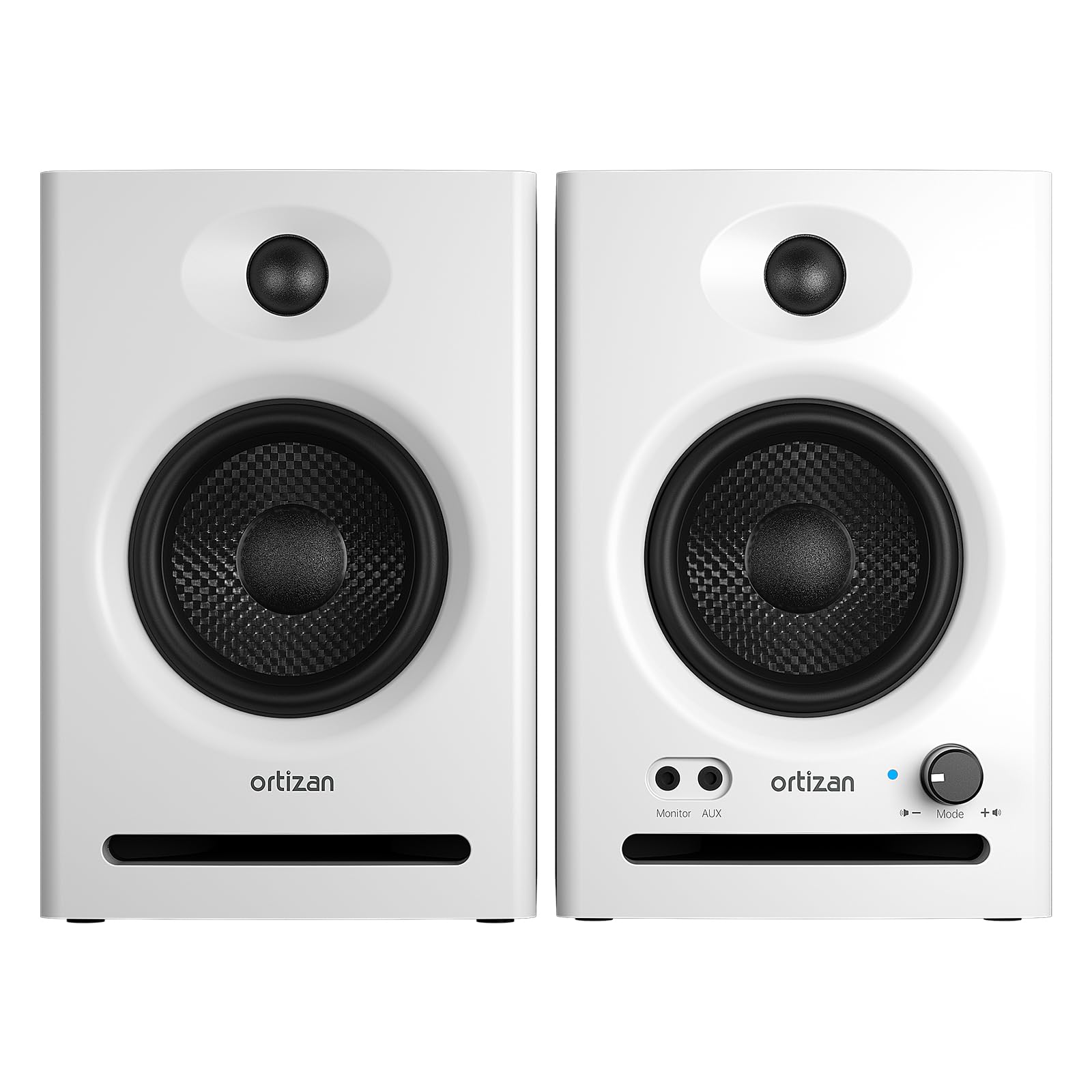
The Ortizan C7 punches above its weight class by pairing a 3.5-inch carbon fiber mid-bass driver with a 0.75-inch silk dome tweeter inside an ABS-and-wood composite cabinet, all driven by a built-in 24-bit DAC that handles digital audio via USB-C. This setup minimizes signal loss and delivers a near-flat frequency response that reviewers compare favorably to studio monitors at double the price.
Versatile connectivity is the C7’s party trick: 6.35mm TRS balanced inputs for professional gear, RCA and 3.5mm AUX for consumer sources, and Bluetooth 5.3 for wireless streaming. A front-panel headphone output and a toggle between Monitor mode (flat response) and Music mode (slightly enhanced lows and highs) let you switch between production and playback without adjusting cables.
Most reviews highlight the revealing midrange and treble detail, with bass extension down to roughly 45Hz — respectable for a 3.5-inch driver. The volume knob has a stepped feel that some find imprecise, and there is a faint idle hiss that is noticeable only in very quiet rooms. For the nearfield producer or gamer who needs balanced inputs, USB audio, and Bluetooth in one box, the C7 delivers genuine functionality.
Why it’s great
- Built-in 24-bit USB DAC for direct digital audio input
- Full suite of connectivity: TRS balanced, RCA, AUX, Bluetooth 5.3
- Near-flat frequency response with optional Music mode for casual listening
Good to know
- Volume knob jumps in steps rather than smooth rotation
- Faint idle hiss present in very quiet environments
- No LDAC or AptX codec support for high-resolution Bluetooth
6. OHAYO 60W Computer Speakers (Black)

The OHAYO 60W speakers deliver a surprising amount of control for their price tier, with independent treble and bass knobs on the front panel that let you sculpt the sound to your liking without diving into software EQ. The 0.75-inch carbon fiber silk dome tweeter and 3-inch carbon fiber full-range driver are housed in a premium MDF wooden enclosure that reduces cabinet resonance, resulting in cleaner midrange reproduction than similarly priced plastic alternatives.
Connectivity includes Bluetooth 5.3 for wireless convenience alongside USB, RCA, and 3.5mm AUX inputs — five total connection options — making this a strong candidate for desktop users who want to toggle between a PC, a turntable, and a smartphone. The main speaker houses the amplifier and control circuitry, while the passive speaker connects via the included speaker wire. Rear bass ports help extend low-end depth, but the 3-inch drivers have natural excursion limits.
Reviewers consistently highlight the clean, non-static sound and energy efficiency, with draw dropping below 1 watt at full volume. The missing ingredient is deep sub-bass, as these drivers simply cannot reproduce frequencies below roughly 70Hz with authority. For general desktop music, gaming, and video calls, the OHAYO offers strong value with physical EQ knobs that many competitors omit entirely.
Why it’s great
- Physical treble and bass knobs for real-time EQ adjustment
- Five input options including Bluetooth 5.3 and USB
- MDF wood cabinet reduces unwanted resonance
Good to know
- 3-inch drivers limit low-frequency extension
- 3.5mm analog input sounds hollow compared to USB and Bluetooth
- Rear bass ports need clearance from walls for optimal performance
7. Electrohome Huntley Powered Bookshelf Speakers (EB10B)

The Electrohome Huntley embraces a classic retro wood aesthetic with a handcrafted acoustically tuned cabinet that houses 3-inch drivers and a rear port for enhanced bass response. As an all-in-one powered system with Bluetooth 5, RCA, and Aux inputs, it is designed for simplicity: plug a turntable, TV, or computer into the back and start listening immediately without any external amplifier or complicated setup steps.
Customer feedback consistently notes that the Huntley outperforms expectations given its approachable price point, delivering warm, natural sound that works well for speech, podcasts, and background music. The 3-inch drivers produce clear mids and presentable highs, but the bass output is polite rather than powerful — listeners accustomed to larger speakers or subwoofer-assisted setups may find the low end underwhelming for genres like electronic or hip-hop.
The included 6-foot power cord and 8-foot speaker wire give flexibility in placement, and the touch control interface on the main speaker is simple enough for casual users. The compact footprint makes the Huntley easy to fit on a bookshelf or desktop. For buyers whose priority is an affordable, no-fuss speaker pair for casual music and TV dialogue, the Huntley gets the job done without breaking the bank.
Why it’s great
- Plug-and-play powered design with Bluetooth 5, RCA, and Aux
- Warm, natural sound profile suitable for speech and background music
- Classic wood cabinet with rear port for enhanced bass in a small package
Good to know
- Limited low-end extension; lacks deep sub-bass
- No separate EQ controls for bass and treble adjustment
- Small 3-inch drivers can sound strained at high volume levels
FAQ
What amplifier power do passive budget bookshelf speakers need?
Can I use powered bookshelf speakers with my existing AVR receiver?
Should I worry about rear bass ports in a bookshelf placement?
Final Thoughts: The Verdict
For most users, the winner of the budget bookshelf speakers category is the Edifier MR3 because it delivers Hi-Res certified accuracy, versatile connectivity including Bluetooth 5.4 and balanced TRS, and app-based EQ control at a price that represents exceptional value for desktop monitoring and casual listening alike. If you need deep, authoritative bass from a passive system with high-quality crossover components, grab the Micca RB42 and pair it with a capable 50-watt amplifier. And for the broadest tonal flexibility with physical EQ knobs and five connection options, nothing beats the OHAYO 60W.