
Getting sharp, bright photos indoors without a flash is the holy grail of entry-level photography. Most budget cameras crumble the moment the lights go down, delivering noisy, blurry messes that make your phone look like a pro rig. This guide pinpoints the affordable models that genuinely handle dusk, dim interiors, and nighttime street scenes.
I’m Min — the co-founder and writer behind Gadgets Feed. My market research focuses on dissecting sensor sizes, lens apertures, and ISO performance metrics to separate the real low-light contenders from the marketing hype.
After analyzing hundreds of hours of technical data and real-world user feedback across seven leading models, I’ve built the definitive list for the best budget camera for low light.
How To Choose The Best Budget Camera For Low Light
Selecting a budget camera for dim conditions requires looking beyond flashy marketing numbers. The three pillars of low-light performance are sensor size, lens aperture, and stabilization. Understanding these will keep you from buying a camera that fails the moment the sun sets.
Sensor Size: The Light Bucket
The physical size of the sensor determines how much light it can capture. A larger 1-inch or APS-C sensor gathers significantly more light than the tiny sensors found in compact point-and-shoots. For budget low-light cameras, an APS-C sensor (found in the Canon EOS R100 or Sony a6000) is your best bet for clean images at higher ISOs.
Maximum Aperture: The Light Spigot
Aperture, measured in F-stops, controls how wide the lens opens. A lens with a maximum aperture of F/2.0 (like the Sony ZV-1F) lets in over twice as much light as a standard F/3.5 kit lens. This is the single most impactful spec for shooting handheld in low light without a tripod.
Image Stabilization: The Blur Killer
Optical image stabilization (OIS) mechanically counteracts hand shake, allowing you to use slower shutter speeds without blur. The Panasonic LUMIX FZ80D’s POWER O.I.S. is a prime example — it makes a huge difference when shooting at full zoom or in dimly lit rooms.
Quick Comparison
On smaller screens, swipe sideways to see the full table.
| Model | Category | Best For | Key Spec | Amazon |
|---|---|---|---|---|
| Sony ZV-1F | Premium Compact | Vlogging & dim interiors | 1-inch Sensor & F/2.0 Lens | Amazon |
| Canon EOS R100 | Mirrorless | Beginner interchangeable lens | APS-C 24.1MP & Dual Pixel AF | Amazon |
| Sony a6000 | Mirrorless | Action & fast AF in dim light | 179-point Phase Detection AF | Amazon |
| Canon EOS Rebel T7 Kit | DSLR Bundle | Budget bundle with accessories | APS-C 24.1MP & Wi-Fi | Amazon |
| Canon Rebel T7 Body | DSLR | Learning DSLR basics on budget | 9-point AF & ISO 6400 | Amazon |
| Sony a3000 | Mirrorless | Good image quality for price | APS-C 20.1MP & OSS Lens | Amazon |
| Panasonic LUMIX FZ80D | Bridge Superzoom | Extreme zoom in good light | 60x Optical Zoom & OIS | Amazon |
In‑Depth Reviews
1. Sony ZV-1F Vlog Camera for Content Creators and Vloggers White

The Sony ZV-1F is the undisputed champion in this lineup for pure low-light performance at a reasonable cost. Its 1-inch sensor is physically much larger than conventional compact camera sensors, and pairing that with a fixed F/2.0 ultra-wide 20mm lens means it gathers a huge amount of light. This combination allows you to shoot handheld in dimly lit cafes or at golden hour without cranking up the ISO to noisy levels.
Beyond the sensor and lens, the ZV-1F features Sony’s reliable Eye-AF and autofocus tracking, ensuring your subject stays sharp even in challenging lighting. The 3-capsule directional microphone with a windscreen makes it a top choice for vloggers, and the side-articulating touchscreen is perfect for framing self-shots in the dark. It delivers stunning 4K video and impressive stills that defy its size.
The trade-off is fragility and battery endurance. Users report a battery life around 45 minutes of continuous video, so a spare pack is essential. The body feels less robust than a chunky DSLR, demanding careful handling. However, for anyone prioritizing low-light image quality in a truly portable package, this is the premium pick that justifies its position.
Why it’s great
- Large 1-inch sensor provides class-leading light capture
- Fast F/2.0 lens perfect for dim interiors
- Reliable Eye-AF and 4K video quality
Good to know
- Battery life is short (~45 min video)
- Fragile build requires careful storage
2. Canon EOS R100 Mirrorless Camera RF-S18-45mm F4.5-6.3 IS STM Lens Kit

The Canon EOS R100 brings the advantages of a large APS-C sensor to the mirrorless world at an entry-level price point. The 24.1-megapixel CMOS sensor, powered by the DIGIC 8 processor, delivers excellent image clarity and natural bokeh that makes low-light portraits pop. Its Dual Pixel CMOS AF covers 143 zones with face and eye detection, keeping focus accurate even when light levels drop.
This camera is built for mobility — it’s the smallest and lightest body in the EOS R series, making it easy to carry for evening events or dusk walks. The kit lens includes optical image stabilization with up to 4 stops of shake correction, a critical feature for handheld low-light shooting. It also offers 4K video at 24 fps and Full HD at 60 fps, providing solid video options for creators.
The kit lens has a relatively slow maximum aperture of F/4.5-6.3, which means you’ll be fighting for light in very dim scenes compared to a fast prime lens. The battery lasts a full day for casual shooting but no charger is included in the box. For beginners who want room to grow into a full mirrorless system with strong low-light potential, the R100 is a compelling starting point.
Why it’s great
- APS-C sensor offers great high-ISO performance
- Compact and lightweight mirrorless design
- Fast and accurate Dual Pixel AF system
Good to know
- Kit lens is slow at F/4.5-6.3
- No battery charger included
3. Sony Alpha a6000 Mirrorless Camera w/ 16-50mm and 55-210mm Power Zoom Lenses

The Sony a6000 remains a legendary performer even years after its release, particularly for its lightning-fast autofocus system. With 179 phase-detection points covering the frame, it locks onto subjects in near-darkness faster than many modern cameras. The 24.3MP APS-C sensor delivers superb dynamic range and color accuracy, making it a favorite among enthusiasts who shoot in varied lighting.
Its 11 fps burst rate is phenomenal for capturing action in low light, such as indoor sports or moving subjects at dusk. The built-in OLED electronic viewfinder provides full 100% coverage, so you can compose accurately even when the rear LCD is hard to see. This bundle with both the 16-50mm and 55-210mm lenses gives you a versatile range for portraits and distant subjects.
The biggest pain point is battery life, which yields only about 310 shots per charge — investing in spare Wasabi power packs is almost mandatory. The menus are famously dense, and the small grip can be awkward with larger lenses. Users also note that noise becomes noticeable above ISO 800. Despite these quirks, the a6000’s AF speed and sensor quality make it a top-tier contender for dim settings.
Why it’s great
- Ultra-fast 179-point phase detection AF
- Excellent dynamic range from 24.3MP APS-C sensor
- Fast 11 fps burst for low-light action
Good to know
- Short battery life (~310 shots)
- Noticeable noise above ISO 800
4. Canon EOS Rebel T7 DSLR Camera with 18-55mm Lens, Shoulder Bag, and 64GB Card
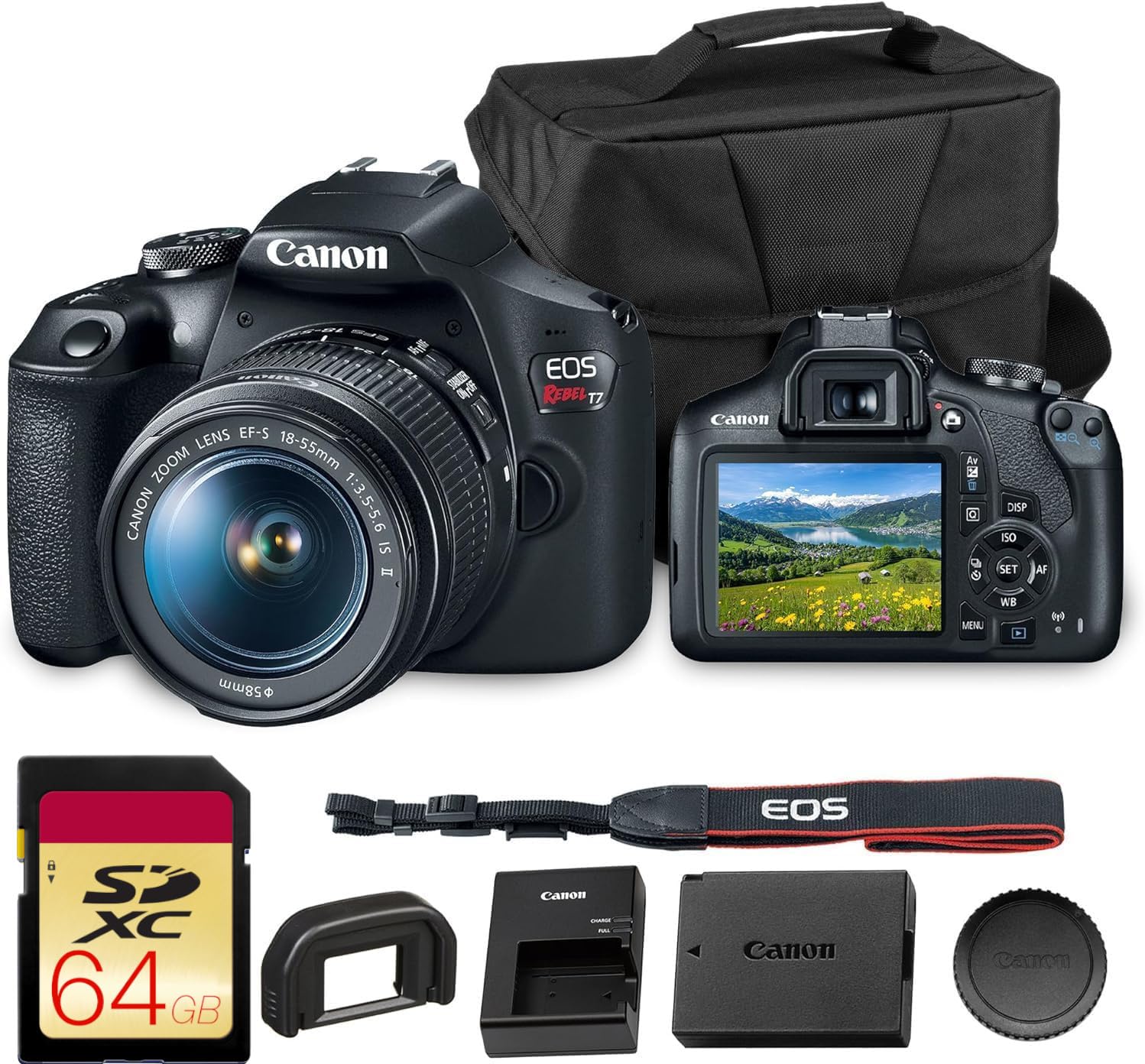
This Canon EOS Rebel T7 bundle delivers exceptional value by including a shoulder bag and 64GB memory card alongside the capable 24.1MP APS-C camera body. The DIGIC 4+ processor provides fast operation and reduced noise, which helps maintain image clarity in low-light situations. The optical viewfinder offers a bright, lag-free view that is particularly useful when shooting in dim environments where EVFs can struggle.
The built-in Wi-Fi and NFC make it seamless to transfer your evening shots to a smartphone for quick sharing or backup via the Canon Camera Connect app. The camera is designed with a comfortable grip and a simplified menu system that helps beginners understand exposure settings quickly. Its 3.0-inch LCD screen is adequate for composition and review, and the long-lasting battery supports extended evening photo sessions.
The 18-55mm kit lens is a standard variable aperture F/3.5-5.6, which is not exceptionally fast for low light. Autofocus is limited to a 9-point system, which feels dated for tracking moving subjects in the dark. The optical viewfinder is great, but the lack of a touchscreen or articulating LCD limits creative angles. This kit is best for the budget-conscious beginner who wants a complete package to start learning night photography.
Why it’s great
- Full bundle with bag and 64GB card included
- APS-C sensor for solid low-light quality
- Bright optical viewfinder for dim conditions
Good to know
- Kit lens has slow variable aperture
- Only 9-point AF system
5. Canon EOS Rebel T7 DSLR Camera EF-S 18-55mm f/3.5-5.6 IS II Lens Kit

The standard Canon EOS Rebel T7 kit is the camera that introduced millions to DSLR photography, and for good reason. Its 24.1-megapixel CMOS sensor with an ISO range of 100-6400 (expandable to 12800) provides a solid foundation for experimenting with low-light shots. The DIGIC 4+ image processor delivers decent noise control, making it a reliable tool for learning how to balance aperture, shutter speed, and ISO in dim settings.
Built-in Wi-Fi and NFC are present for easy photo transfers, and the optical viewfinder offers a direct, crisp view that helps when composing in challenging light. The camera is lightweight and comfortable for prolonged handheld use, which is crucial when you are trying to hold steady for slower shutter speeds. Its long battery life is a major plus for extended night shoots or events.
The 9-point AF system is the weakest link for low-light action, struggling to track subjects that move quickly in darkness. The lack of 4K video and a non-articulating screen feel dated compared to mirrorless competitors. Low-light performance is decent for the price but users note grain at higher ISOs. This remains a fine entry-level DSLR for learning without breaking the bank.
Why it’s great
- 24.1MP APS-C sensor for good image quality
- Long battery life for extended sessions
- Intuitive controls perfect for beginners
Good to know
- 9-point AF struggles in dim light
- No 4K video recording
6. Sony Alpha a3000 ILCE-3000K 20.1 MP Mirrorless Digital Camera

The Sony a3000 is an older model that still delivers impressive image quality for its price point, thanks to its 20.1MP Exmor APS-C sensor. This larger sensor gives it a significant edge over similarly priced compact cameras when capturing detail in low light. The kit includes an 18-55mm OSS (Optical SteadyShot) lens, providing built-in stabilization that is a genuine help for handheld night photography.
The camera body features a comfortable, dependable grip that makes it easy to hold steady for longer exposures. It records Full HD video and offers a full suite of manual controls, giving you the flexibility to dial in the exact settings needed for dim scenes. The electronic viewfinder, while low-resolution, is useful for framing shots in bright conditions where the LCD washes out.
Its age shows in several areas. The battery life is notoriously poor, draining 20-30% per hour, and charging via USB takes up to five hours with no external charger included. The EVF and LCD resolutions are both very low by modern standards, which can make critical focusing challenging. Image quality is good up to ISO 400 but deteriorates above ISO 800. It is a capable starter mirrorless, but battery management is a constant chore.
Why it’s great
- APS-C sensor for great value image quality
- Comfortable and stable grip for low-light handheld
- Built-in OSS lens stabilization
Good to know
- Very poor battery life
- Low-resolution EVF and LCD
7. Panasonic LUMIX FZ80D Point and Shoot Digital Camera

The Panasonic LUMIX FZ80D is a bridge camera that excels in good-light scenarios thanks to its incredible 60x optical zoom (20-1200mm equivalent). Its POWER O.I.S. (Optical Image Stabilizer) is highly effective at suppressing hand-shake vibration, even when you are fully zoomed in at 1200mm. This makes it a fantastic travel companion for daytime wildlife, landscapes, and macro shots.
The camera features a 2,360K-dot large live viewfinder that remains clear in bright sunlight, and it can shoot 4K video. The Post Focus feature is a clever tool that lets you select your focus point after taking the shot, which can be handy for macro work. It is lightweight for a superzoom, making it easy to carry on long hikes without a tripod.
Low light is where this camera falls flat. The small sensor produces grainy, noisy images even at low ISO settings, and this problem is magnified at the telephoto end. The autofocus is slow in dim conditions, and the interface is not the most intuitive. Users consistently report that the FZ80D is best reserved for well-lit outdoor use. It is a poor choice for nighttime or interior photography.
Why it’s great
- Unbeatable 60x optical zoom range
- Powerful image stabilization for telephoto
- Lightweight for a superzoom bridge camera
Good to know
- Poor low-light image quality, grainy at base ISO
- Slow autofocus in dim environments
FAQ
Is an F/2.0 lens significantly better than F/3.5 for low light?
Why does the Panasonic FZ80D have poor low light despite having a large zoom?
Can I improve the low light of my Canon Rebel T7 without buying a new camera?
Final Thoughts: The Verdict
For most users, the best budget camera for low light winner is the Sony ZV-1F because its large 1-inch sensor and blazingly fast F/2.0 lens can handle dim scenes that completely baffle other options in this price tier. If you want interchangeable lenses and a bigger APS-C sensor for ultimate flexibility, grab the Canon EOS R100. And for incredibly fast autofocus to track moving subjects in the dark, nothing beats the Sony a6000.