
Our readers keep the lights on and my morning glass full of iced black tea. As an Amazon Associate, I earn from qualifying purchases.
Specs are compiled from manufacturer listings and verified buyer reviews and can change over time — please confirm the key details on the product page before buying.
When you shoot macro on a budget, your real worry is getting close enough to capture the tiny details that matter. The cameras here solve that in different ways: some are rugged compacts with built-in ring lights, while others are interchangeable-lens DSLRs you can expand later. Your choice hinges on if you need a camera that works underwater or one that lets you attach a dedicated macro lens down the road.
I’m Min — the founder and writer behind Gadgets Feed. This guide is built by comparing the manufacturers’ published specifications and the patterns across verified customer reviews, so you get each pick’s real strengths and trade-offs instead of marketing spin.
Editor’s note: macro capability here is matched flexibly, so some picks use a dedicated macro mode or lens compatibility rather than the exact term searched — each one still gets you genuinely close to your subject.
Our Picks at a Glance

How To Choose The Best Budget Camera For Macro Photography
Macro photography is less about zooming and more about how close the lens can physically focus. Before you compare megapixels, you want to know the minimum focusing distance — the closest you can stand to a flower petal or insect wing while still getting a sharp image.
Focus Distance: The Real Macro Number
A camera with a macro mode might let you shoot from a few centimeters away, which magnifies tiny details dramatically. Some rugged compacts here reach around 1 cm from the lens, which is genuinely close — closer than most smartphone lenses can manage on their own.
Lighting: What Ring Lights and F-Stops Do for You
When you shoot from centimeters away, your own body or the lens can block ambient light. That is why some tough cameras build LED ring lights right around the lens barrel, giving you bright, even illumination on insects, coins, or plant details without extra gear. A wider aperture, like f/2.8, also lets in more light so you can keep shutter speeds fast enough to freeze tiny moving subjects.
System vs. Fixed: Think About Growth
A fixed-lens camera is ready the moment it leaves the box, but you cannot upgrade the glass later. An interchangeable-lens body needs a macro lens added, yet it opens a whole ecosystem of optics. If you plan to stay in macro for years, the body-first route often makes more sense even when the starting kit lens is not itself a macro lens.
Quick Comparison
| Model | Best For | Megapixels | Macro Approach | Autofocus Points | Amazon |
|---|---|---|---|---|---|
| Nikon D7500★ Best Overall | Interchangeable-lens quality | 20.9MP | Macro lens compatible | 51 | Amazon |
| Canon Rebel T7Best Value | Beginner DSLR value | 24.1MP | EF/EF-S macro lens | 9 | Amazon |
| Canon EOS R50 | Compact mirrorless pair | 24.2MP | Close-up video mode | 651 | Amazon |
| OM System TG-7 | Underwater macro | — | 1cm microscope mode | 50 | Amazon |
| PENTAX WG-90 | Tough LED-ring close-ups | 16MP | 6-LED ring, 1cm stand | 9 | Amazon |
| Nikon COOLPIX P1100 | Distant-to-close range | 16MP | 1cm close focus | 179 | Amazon |
In-Depth Reviews
1. Nikon D7500 DSLR with 18-140mm Lens
Our pick — over 4.5★ from 650+ verified ratings; the strongest balance of quality and price.
The enthusiast body that treats macro lens growth as a long-term plan, not a passing hobby.
The defining spec here is the autofocus: 51 AF points with 15 cross-type sensors, a 5.7x jump over the PENTAX WG-90’s 9 points. That density matters when your subject is a tiny moving insect and you need the camera to lock focus before it flutters off.
Picture quality is the thing owners rave about — the phrase “class-leading” shows up in the spec sheet, and the review chatter echoes it, calling out low-light performance and a fast, accurate autofocus system. The kit lens, an AF-S DX NIKKOR 18-140mm f/3.5-5.6G ED VR model, is reported to stay sharp across all its ranges. Buyers report no issues after eight months of daily use, from mid-2025 into early 2026.
Be honest with yourself: this is a 2017 camera sold at today’s prices, so it lacks the newest tech. Several owners note it is larger and heavier than compact rivals. Yet the value is clear: the D7500 holds a strong 4.8-star average, the highest rating in this lineup, signaling that its age has not dulled its appeal for anyone who wants to attach dedicated macro glass later.
versatile zoom workhorse
- Low-light image quality that owners consistently praise
- Weather-sealed build paired with a sharp 18-140mm kit zoom
- 4K UHD video with stereo sound and 4K time-lapse built in
dated autofocus system
- Heavier and bulkier than mirrorless or compact rivals
- Setup has a learning curve, so complete beginners may struggle
- Kit lens is not itself a macro lens, so add close-focus glass later
action and reach: you want one body that handles low light beautifully and leaves room to add a true macro lens over time.
low-light sports: you want a grab-and-go camera with macro built in, with no extra lenses to buy.
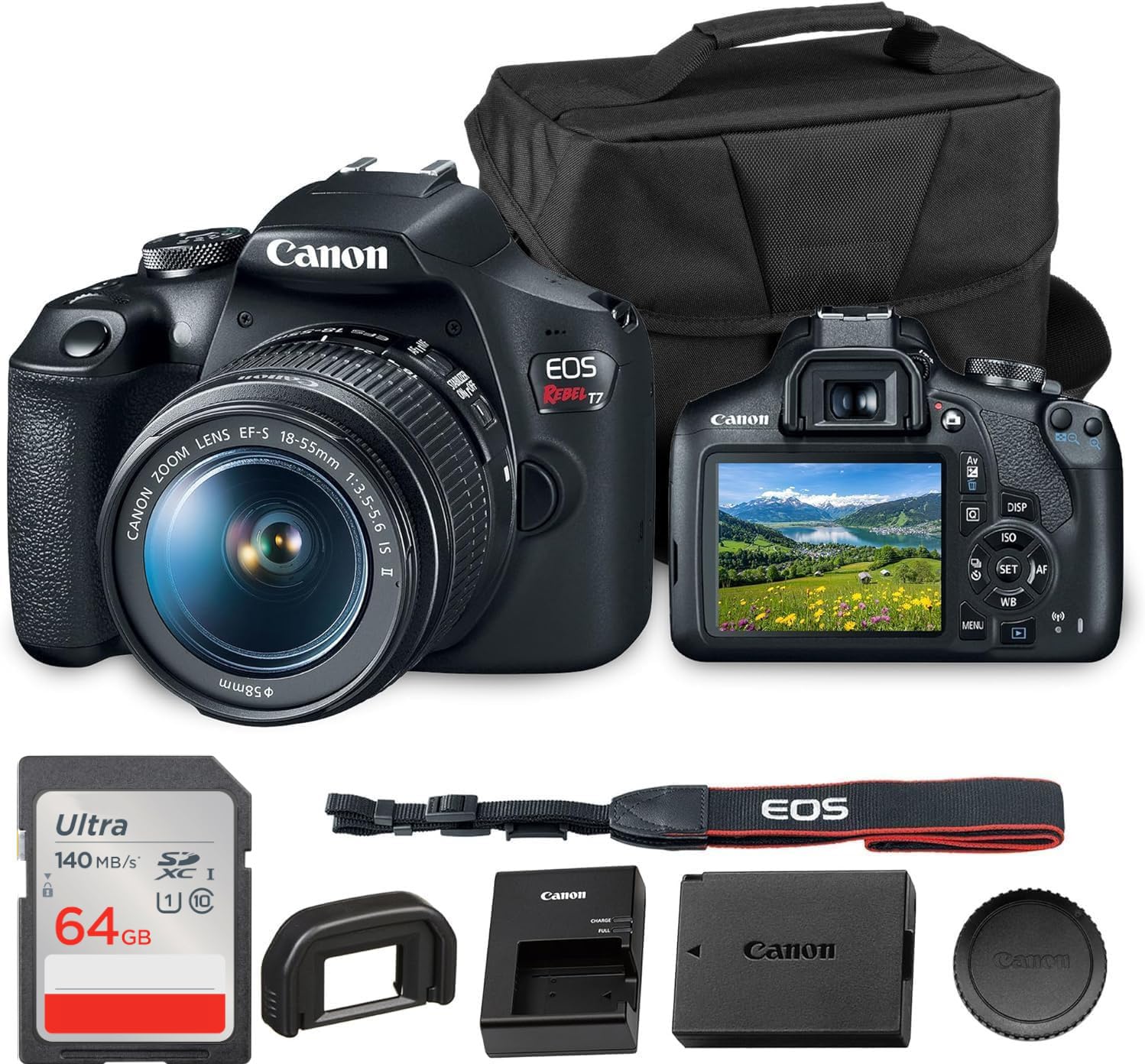
2. Canon EOS Rebel T7 DSLR 18-55mm Bundle
A beginner-friendly DSLR whose real macro power arrives the moment you mount an EF-S macro lens.
The Rebel T7 packs a 24.1MP APS-C sensor — a 51% megapixel advantage over the PENTAX WG-90’s 16MP — backed by the DIGIC 4+ image processor. For macro work, that resolution means you can crop into a flower’s center and still keep printable detail.
Quality is the top praise by a wide margin across the reviews, followed closely by value for money — this bundle arrives with a 64GB memory card, shoulder bag, battery charger, and the LP-E10 battery. Owners describe it as easy to use even on autofocus, and several mention it handled action shots of dogs without fuss. Built-in Wi-Fi and NFC let you push images straight to your phone for quick sharing.
Its 9 autofocus points feel basic next to the R50’s 651, so tracking a fast-moving bug in macro may frustrate you. Think of this camera as a system starter: the included 18-55mm lens is not a macro lens, but full compatibility with Canon’s EF and EF-S lineup—which includes dedicated macro glass—is where its real potential lies.
budget-friendly starter: the least intimidating way into a full DSLR system, with a resolution edge over most rugged compacts in this list.
basic feature set: budget for a dedicated macro lens to truly open up its close-focus potential.
3. Canon EOS R50 Mirrorless 2-Lens Kit

The mirrorless route to macro, with 651 autofocus points that make tiny subjects far easier to track.
Autofocus is the headline here: 651 points versus 9 on the Canon Rebel T7 — a massive gap that translates to faster, more reliable locking onto small moving subjects. Pair that with the Dual Pixel CMOS AF II system and a 24.2MP APS-C sensor, and you have a genuinely capable close-up tool in a small body.
Owners consistently describe images that need no editing, with the mirrorless viewfinder letting you preview exactly how a shot will look before you press the shutter. The two-lens kit adds range with the RF-S 18-45mm f/4.5-6.3 IS STM and RF-S 55-210mm f/5-7.1 IS STM lenses, though neither is a dedicated macro optic.
The bundle stretches further with a Deco Gear travel case, a 128GB SanDisk memory card, and a cleaning cloth. Its Match-Close-Up video function is the standout for macro work — it shows a magnified view during recording, ideal for product detail shots and vlogs. The trade-off: owners note the body feels lightweight and a bit plasticky, and one reported the bundled screen protector arrived unusable.
vlogging and travel: content creators who want a compact mirrorless body for macro video and product close-ups.
pro-level video: you want the deepest lens ecosystem now — the RF-S line is younger than Canon’s EF mount library.
4. OM SYSTEM Tough TG-7

The toughest macro camera here, shooting from 1 centimeter away at depths most cameras never survive.
What makes the TG-7 special for macro is its variable macro system: four macro modes that magnify subjects from as close as 1 cm off the lens, plus a dedicated underwater microscope mode. Paired with a high-resolution F2.0 lens and 4x optical zoom, it captures details most compacts cannot reach.
Buyers describe its microscope mode as incredible, and the camera earns strong marks for quality, image quality, and overall durability. Its 50 autofocus points — a big step up from the PENTAX WG-90’s 9 — help with framing in tricky underwater lighting. It is waterproof to 15 meters, shockproof from 2.1 meters, and freezeproof down to -10°C.
The recurring caution is around sand and saltwater: owners warn that sand can jam the dials and saltwater makes buttons sticky without a fresh rinse afterward. The LCD also scratches more easily than owners would like. Those are real habitat limitations, not defects — treat it well at the beach and it keeps shooting.
rugged underwater champ
- 4K video plus 120 fps slow-motion capture
- Underwater HDR and microscope modes built for close-up work in the deep
- Crushproof to 100 kilogram-force, so drops and roof falls are survivable
small sensor limits
- Sand jams dials and saltwater stiffens buttons without rinsing
- Low-light performance is weaker than larger-sensor cameras
- Optical zoom tops out far below a DSLR superzoom
5. PENTAX WG-90 Waterproof Camera

The LED-ring specialist that lights up tiny subjects at 1 centimeter without any extra flash gear.
Six LEDs arranged around the lens barrel deliver bright, even illumination exactly where macro photography needs it most — on the subject itself. The included Macro Stand holds a focusing distance of one centimeter, so extended observation of tiny details feels easy rather than cramped.
Durability is the defining trait across owner reports, with one noting the camera delivered solid photos and a battery charged only twice in roughly a year. It is engineered to survive drops from 1.6 meters, freezing down to -10°C, and submersion to 14 meters for up to two hours — a spec set that owners describe as rare at this price point. Its 5x optical zoom covers a 5mm to 25mm focal range with a wide f/2.8 aperture.
The honest reality, confirmed across reviews, is that its auto settings make poor decisions about aperture versus shutter speed, so the best shots come in manual mode. Owners mention that once you learn its settings, it offers many of the same features you would expect from a DSLR. Photo quality splits opinion, so expect to dial in your own adjustments rather than rely on the default programs.
casual outdoor use: your macro subjects live outdoors — wet, dusty, sandy, or freezing environments — and you need the ring light built in.
serious underwater shots: you want reliable auto modes straight from the start and will not spend time learning manual settings.
6. Nikon COOLPIX P1100 Superzoom

One lens that pulls birds from across a field and still focuses down to 1 centimeter for macro detail.
The P1100 covers an extraordinary range: a 125x optical zoom reaching an equivalent 24-3000mm, yet its close-focus macro mode still gets within about 1 cm of a subject. That dual personality — ultra-telephoto wildlife plus macro — is what makes it stand apart from every other pick here.
The dedicated Bird-watching Mode sits right on the mode dial, optimizing settings for feathered subjects. Dual Detect Optical VR image stabilization delivers steadiness equivalent to shooting at a shutter speed 4.0 stops faster, so handheld shots at extreme zoom stay usable. Owners describe 3000mm zoom reach that rivals pro gear for wildlife photography, with sharp outdoor results the top recurring praise.
The trade-offs are honest ones: owners disagree on the weight, some calling it very light and others heavy. Sharpness drops at the very top of the zoom range, autofocus is only fair for fast-moving subjects, and indoor shots struggle. This is a specialist tool, best for someone who shoots nature across both distance extremes rather than pure macro alone.
birding and moon: a single all-in-one body that spans wildlife telephoto and 1 cm macro without ever swapping lenses.
fast-moving subjects: pure macro is your only goal — a dedicated macro compact will beat it for close-ups at a lower price.
Understanding the Specs
Megapixels and Sensor Size
Megapixels decide how much detail a photo holds and how far you can crop before quality fades. A 24.1MP sensor, like the one in the Canon Rebel T7, lets you crop into a tiny flower center and still print cleanly. A 16MP sensor on a rugged compact suits point-and-shoot macros you do not plan to enlarge much.
Aperture and the f-stop Number
The aperture controls how much light reaches the sensor — a lower number like f/2.8 lets in more light than f/5.6. For macro work, a wide aperture keeps your shutter speed fast enough to freeze tiny moving subjects, and it helps when your own body blocks ambient light as you lean in close. Fixed-lens compacts like the PENTAX WG-90 open to f/2.8, while kit zoom lenses often start around f/3.5.
Focusing Distance and Macro Mode
Macro power is defined by how close the lens can focus, not how much it zooms. A camera that reaches 1 cm from the subject, like the OM System TG-7 or Nikon COOLPIX P1100, magnifies tiny details dramatically. Some cameras add a digital microscope mode or a macro stand to hold that minimum distance steady during long sessions.
Autofocus Points and Speed
Autofocus points are the spots where the camera can lock focus; more points make it easier to track a small, moving subject across the frame. The Canon EOS R50 carries 651 points versus the Rebel T7’s 9, so it locks onto moving insects far more reliably. For static subjects like coins or plants, even a 9-point system holds up fine.
FAQ
What does macro mode actually do on a budget camera?
Is a 16MP sensor enough for macro photography?
Which is better for macro, a DSLR or a rugged compact?
How close can the PENTAX WG-90 focus for macro shots?
Do I need a ring light for macro photography?
Can the Canon Rebel T7 shoot macro with its kit lens?
Is the OM System TG-7 good for underwater macro shots?
How durable are budget macro cameras for outdoor use?
Final Thoughts: The Verdict
For most buyers, the strongest budget camera for macro photography is the Nikon D7500 because its image quality and autofocus system—the highest-rated option in this list—give you room to grow with dedicated macro glass. If you want macro built in without ever buying another lens, the OM System TG-7 shoots from 1 cm underwater and on land. For a rugged LED-ring alternative that lights its own subjects, the PENTAX WG-90 is the one to grab outdoors.
How We Picked
We do not accept paid placement. Every pick is matched to a real buyer and a real use-case; we do not hands-on test units.
Sources & Methodology
Specifications: manufacturer listings and product documentation. Review insights: verified customer reviews, as of September 2026. Pricing: not shown on this page (it changes often); check the current price via the retailer link.
As an Amazon Associate, Gadgets Feed earns from qualifying purchases. This does not affect which products we feature.