
Our readers keep the lights on and my morning glass full of iced black tea. As an Amazon Associate, I earn from qualifying purchases.
Specs are compiled from manufacturer listings and verified buyer reviews and can change over time — please confirm the key details on the product page before buying.
Starting a YouTube channel shouldn’t mean emptying your savings on a camera with features you’ll never use. the balance for vlogging has dropped in price — you can now get a 1-inch sensor (a large image chip that captures more light), 4K video, and a built-in gimbal (a motorized stabilizer that keeps shots smooth) for what used to buy an entry-level point-and-shoot. This guide cuts through the spec sheets to find the budget camera for youtube that fits how you’ll actually shoot: talking to a lens, walking around, and grabbing clips in low light without needing a film degree.
I’m Min — the founder and writer behind Gadgets Feed. This guide is built by comparing the manufacturers’ published specifications and the patterns across verified customer reviews, so you get each pick’s real strengths and trade-offs instead of marketing spin.
We have separated the pocket gimbal cameras from the interchangeable-lens mirrorless bodies so you can match the tool to your style, and we flag which one is the crowd favorite — 4.7 stars across 550+ owners.
Our Picks at a Glance


How To Choose The Best Budget Camera For YouTube
Picking a vlogging camera is about matching the hardware to your real routine, not chasing the biggest number. A camera that requires a rig to hold is a camera you will leave at home. Start with the type of content you make, then let the specs below narrow the field.
Fixed Lens vs. Interchangeable Lens
This is the fork in the road. Fixed-lens pocket cameras, like the gimbal models here, are turn-on-and-shoot with no lens buying later. Interchangeable-lens mirrorless bodies give you room to grow — you can swap in a brighter lens for low light — but you pay more upfront and carry more weight. If you want the simplest path to upload-ready footage, lean fixed. If you want a camera that grows with your skills, lean mirrorless.
Sensor Size and Stabilization
The sensor is the heart of image quality. A 1-inch CMOS sensor is the current budget benchmark because it captures far more light than a phone sensor, which is why it handles dim interiors and sunset shots without turning grainy. For motion, a 3-axis mechanical gimbal physically floats the camera to cancel shake — that is what keeps your walking shots smooth. Digital stabilization just crops the frame and can look wobbly on fast movement.
Autofocus That Actually Works
When you are talking to the lens, autofocus is everything. Look for face and eye detection that locks onto you and stays locked as you move. The best budget cameras use phase-detect autofocus points spread across the sensor, which tracks reliably. A camera that hunts for focus mid-sentence will ruin more takes than a slightly softer lens.
Quick Comparison
| Model | Best For | Sensor | Video Spec | Stabilization | Amazon |
|---|---|---|---|---|---|
| Canon EOS M50 Kit★ Best Overall | Beginners who want a classic mirrorless | APS-C (EF-M 15-45mm) | 4K UHD 24P, HD 120P | Lens-based IS | Amazon |
| Xtra Muse ComboSteadiest Value | Action shooters wanting a pocket gimbal | 1″ CMOS | 4K/120fps | 3-Axis Gimbal | Amazon |
| Canon PowerShot V10Compact Pick | Pocket-sized casual vloggers | 1″ BSI CMOS (15.2MP) | 4K up to 30 fps, FHD 60 fps | IS On / Enhanced modes | Amazon |
| DJI Osmo Pocket 3 | Solo creators who want reliable tracking | 1″ CMOS | 4K/120fps | 3-Axis Gimbal | Amazon |
| Sony ZV-1F | Selfie-style vloggers wanting a wide lens | 1″ CMOS (20mm F2) | 4K video | Digital (optical steady) | Amazon |
| Sony ZV-E10 Body | Creators planning to upgrade lenses | APS-C (24.2MP) | 4K30, 1080p120 | Lens-based | Amazon |
| Sony A6100 Kit | Hybrid photo+video beginners | APS-C (24.2MP) | 4K movie, 11 fps burst | Lens-based | Amazon |
| Canon EOS R50 Bundle | New creators wanting a complete kit | APS-C (RF-S 18-45mm) | Oversampled 4K | Lens-based IS | Amazon |
In‑Depth Reviews
1. Canon EOS M50 Mirrorless Vlogging Camera Kit
Our pick — over 4.5★ from 550+ verified ratings; the strongest balance of quality and price.
The mirrorless starter that makes beginners look steadier than their skill level
The Canon M50 stands out because it pairs a proper interchangeable-lens system with autofocus that does the thinking for you. Its 143 autofocus points and eye-detection AF keep your face sharp while you talk to the lens, which is the feature that matters most for solo vlogging. You also get 4K UHD 24P for detail-rich footage and HD 120P when you want smooth slow-motion clips of your B-roll.
Owners consistently call it a reliable everyday workhorse, and the praise for build quality and value dominates the feedback. The kit includes the 15-45mm EF-M lens, and the white body color is a genuine rarity that people love. It is the crowd favorite here — 4.7 stars across 550+ owners — and the reason it wins is consistency: it just works, take after take, whether you shoot in a dim room or a sunny park.
The honest trade-off is that the EF-M lens lineup is thin, though adapters exist if you ever want to expand. One owner summed up the experience as crisp pictures, fast autofocus, and easy WiFi and Bluetooth sharing — three things a new YouTuber cares about on day one.
Why it wins
- 143-point autofocus with eye detection keeps faces locked
- 4K UHD 24P plus HD 120P slow motion in one body
- Built-in OLED viewfinder with touch and drag AF
Know before buying
- EF-M lens selection is limited compared to other mounts
- Some owners note slight cropping issues in photo mode
Reach for this if: you want a real mirrorless camera with a changeable lens and autofocus that handles the hard part, all without a steep learning curve.
Look elsewhere if: you want a camera that slips into a jeans pocket — this body and lens combo is compact but not pocket-sized.
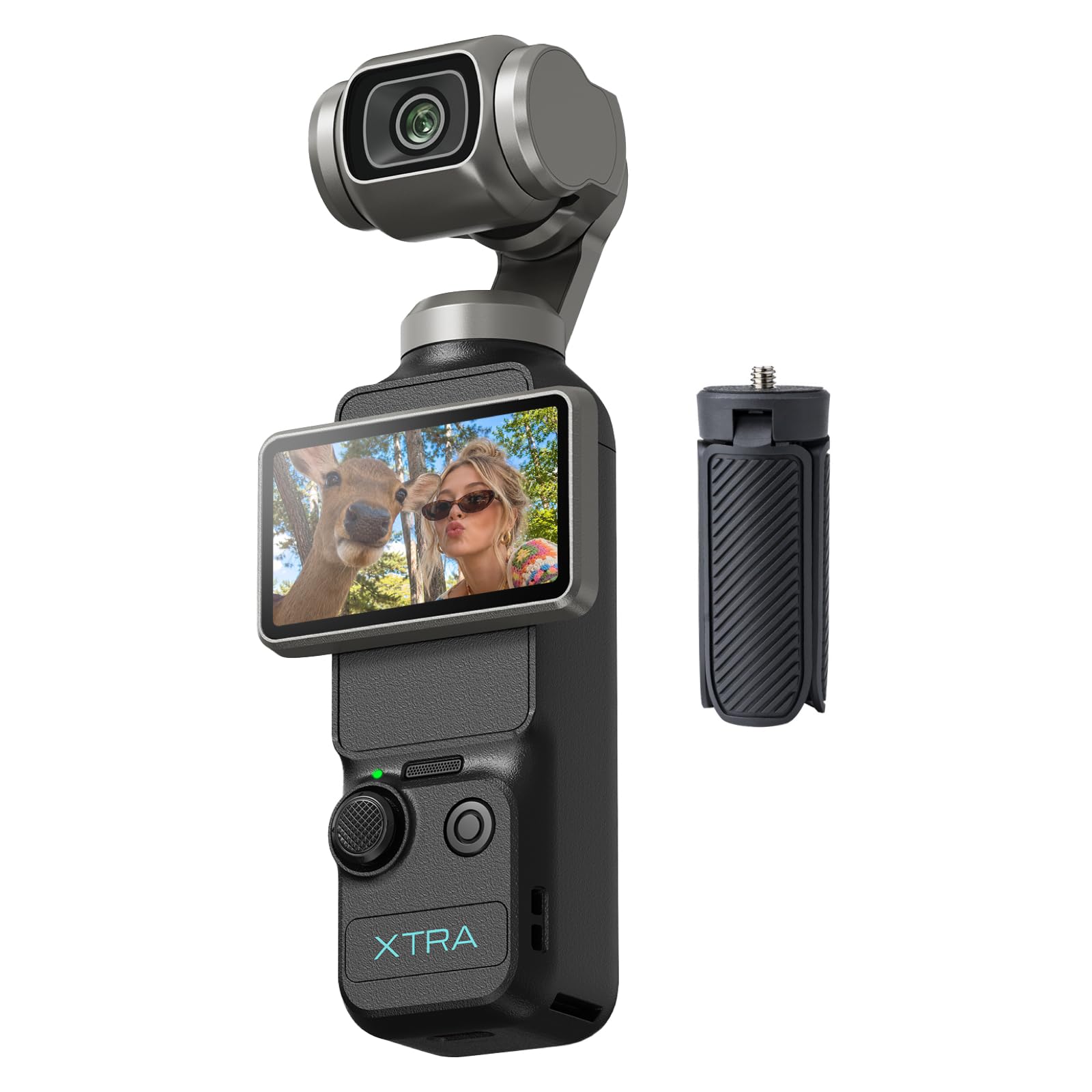
2. Xtra Muse Vlogging Camera with Mini Tripod Combo
A pocket gimbal that delivers DJI-style smoothness for a fraction of the price
The Xtra Muse gives you the same 1-inch CMOS sensor and 4K/120fps video as the DJI Osmo Pocket 3, but with one key difference: it costs significantly less. The built-in 3-axis gimbal is the headline feature, and it genuinely cancels out the shake of running, dancing, or hiking — the exact scenarios that wreck phone footage. A 2-inch touchscreen lets you switch between horizontal and vertical framing, which is essential for feeding both YouTube and TikTok.
The thing everyone raves about is the sheer image quality per dollar — owners describe it as performing like a much more expensive competitor at a fraction of the cost. It also uses the same accessory thread as the DJI Pocket 3, so you can mount it on standard gear. The build quality and touchscreen ease-of-use get consistent praise from people who call it a beginner-friendly instant setup.
Weighing just 281 g (about the same as a small water bottle), it is genuinely travel-friendly. The honest caveat is battery life — it is serviceable but not class-leading, so you will want a spare for long shoot days.
What wins people over
- 1-inch CMOS captures crisp 4K/120fps detail
- True 3-axis gimbal keeps running and dancing shots smooth
- Pocket-sized at 281 g with face and object tracking
The trade-off
- Battery life is decent but not all-day
- Microphone connectivity is a mixed bag for some owners
For you if: you want gimbal-smooth 4K in your pocket and you are happy to skip the premium brand tax.
Not for you if: you plan one continuous multi-hour stream — you will want a battery handle or spare batteries.
3. Canon PowerShot V10 Compact Vlogging Camera
A creator studio that folds flat enough to live in a fanny pack
The PowerShot V10 is the camera you grab when you want zero setup. Its 15.2-megapixel 1-inch back-illuminated CMOS sensor delivers strong low-light performance, and the fixed 19mm wide-angle lens (35mm equivalent) means you never have to think about framing — everything fits, even at arm’s length. The clever folding stand is the defining feature: it opens in front or back for hands-free shooting anywhere, turning a bench or table into a tripod.
Owners use it for everything from travel diaries to product reviews, and the recurring praise is for video and audio quality in a body that fits a pocket or bag. It has 4K capture up to 30 fps and Full HD up to 60 fps via the 8-bit 4K camera, plus 14 movie color filters to set the mood. The three-microphone setup includes a center mic that helps cancel background noise, so your voice stays clear in noisy spots.
The catch is a real one: there is no zoom while filming, which several owners mention as the main limitation. Battery life is rated at about 2 hours, which is fine for short shooting sessions but not for all-day coverage.
Standout feature: the retractable front-facing screen plus folding stand means you are never hunting for a surface to prop your camera on.
The limitation: no optical zoom and a ~2-hour battery make it a grab-and-go companion, not a marathon rig.
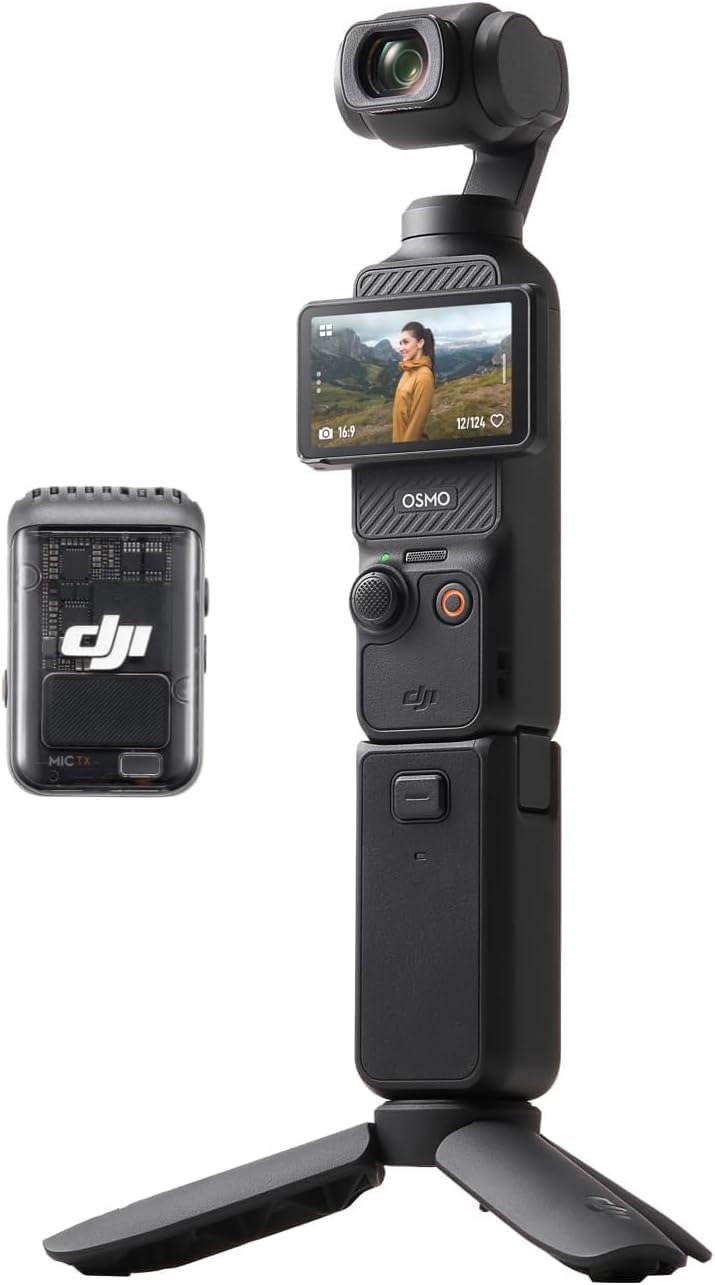
4. DJI Osmo Pocket 3 Creator Combo
The gimbal camera that makes solo creators look like they have a camera crew
The DJI Osmo Pocket 3 is the benchmark that other pocket gimbals measure themselves against, and for good reason. The 1-inch CMOS sensor and 4K/120fps recording give you sharp, cinematic footage, while the 3-axis mechanical stabilization keeps it buttery even when you are dancing or chasing pets. The rotating 2-inch touchscreen flips to vertical for social clips, and the DJI OsmoAudio feature lets it connect directly to two DJI Mic 2 transmitters for broadcast-quality sound without extra gear.
ActiveTrack 6.0 (a subject-tracking system that locks onto you) is the killer feature for solo filming — it keeps you center-frame as you move, so you can set the camera on a tripod, jump, and spin without drifting out of shot. The battery handle extends runtime beyond the built-in 166 minutes. Owners say the low-light quality genuinely beats their phone, with one calling it “insane video quality in a tiny camera.”
The Creator Combo packages the DJI Mic 2 transmitter, a battery handle, a mini tripod, a wide-angle lens, and a carrying bag into one box you can grow into. The caveat is that this is the premium end of the budget spectrum, and the gimbal is a delicate mechanism — treat it carefully when it is not in its protective case.
Why it leads the pack
- 4K/120fps with a 1-inch sensor in a pocketable body
- ActiveTrack 6.0 keeps you locked center-frame while moving
- Connects directly to two DJI Mic 2 transmitters for pro audio
The catch
- Premium price within the budget category
- Gimbal mechanism is fragile if dropped without care
Choose this if: you are a solo creator who wants reliable subject tracking and clean audio in one small, travel-ready package.
Think twice if: your budget is tight — the Xtra Muse above gives you very similar specs for less, but without the DJI tracking polish.
5. Sony ZV-1F Compact Digital Camera

The ultra-wide selfie camera built for talking at arm’s length
The Sony ZV-1F is designed for one scenario: you holding the camera at arm’s length and talking to it. The ultra-wide 20mm lens (a lens that captures a very wide field of view) gets everything in the frame even in that cramped position, and the F2 aperture (a wide lens opening that lets in more light) creates defocused backgrounds — that creamy blur behind you that screams “professional.” The large 1-inch sensor handles low light well, and the side-articulating touchscreen (a screen that flips out to face you) makes composing selfies easy.
what separates it is the audio focus. The directional 3-capsule microphone (a mic that picks up sound from one direction) with the wind screen accessory is genuinely usable for outdoor vlogging, so you can skip buying an external mic at first. Owners consistently describe it as the perfect beginner upgrade from a phone, with one calling it a “perfect vlogging companion” thanks to the one-press background defocus and reliable Eye AF tracking (autofocus that locks onto your eyes).
The limitations are honest ones: there is no optical zoom because the lens is fixed, and the digital-only stabilization can look shaky on walking shots — this is a sit-and-talk camera, not a run-and-gun one. Battery life is the other common complaint, with owners recommending a spare for long days.
Best at: capturing a sharp selfie vlog with clean built-in audio and a blurry background at the press of a button.
Not for: walking vlogs or zoom shots — the fixed wide lens and digital stabilization have limits.
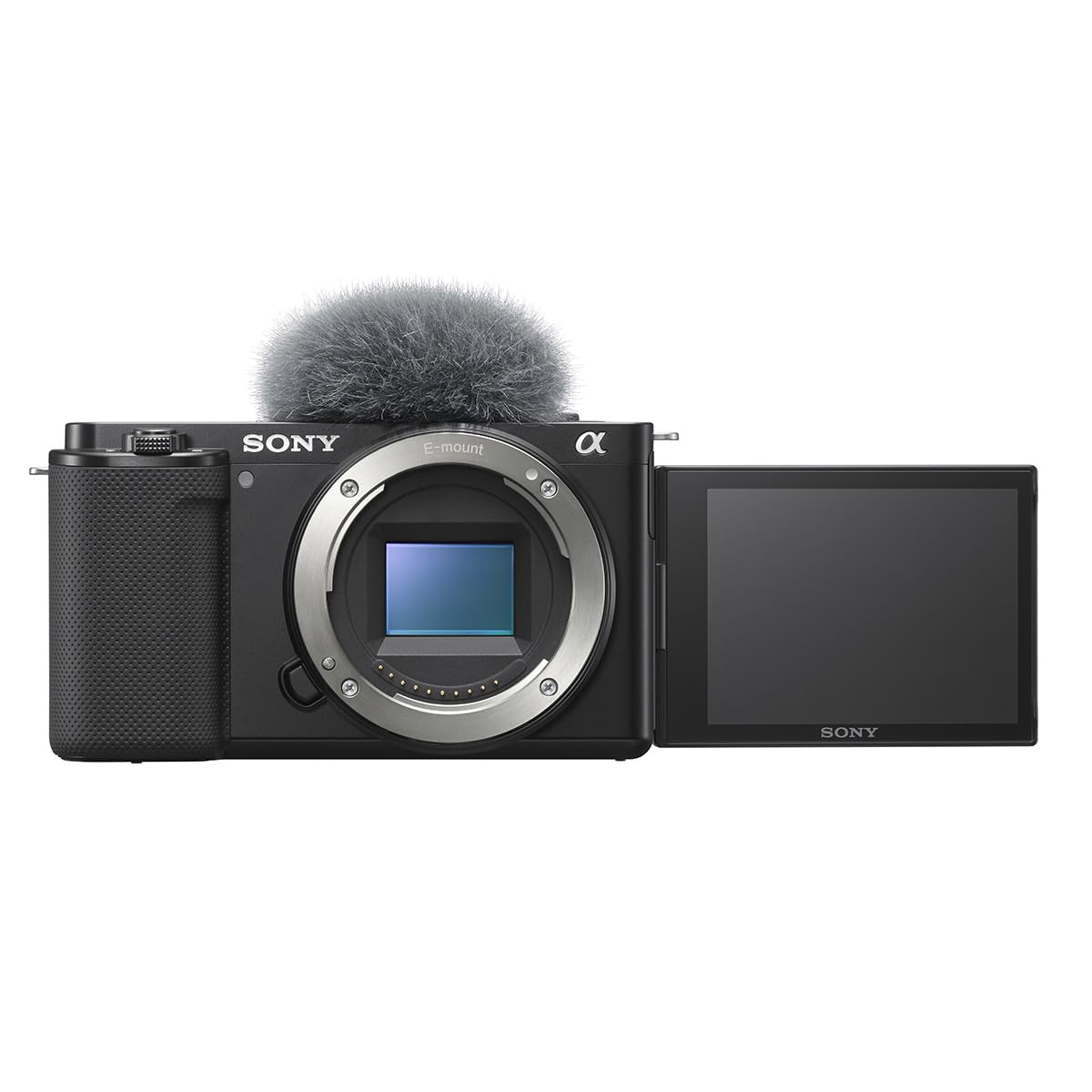
6. Sony ZV-E10 APS-C Mirrorless Camera Body
A creator-focused mirrorless body that rewards the buyer who plans to grow
The ZV-E10 is the vlogger’s version of a serious mirrorless camera (a camera with interchangeable lenses and no mirror inside). The 24.2MP APS-C Exmor CMOS sensor (a large image chip) with the fast BIONZ X processor delivers 4K Movie oversampled from 6K with full pixel readout — that means you get sharper, more detailed 4K than a cheaper sensor could manage. It also shoots 1080p120 (high-definition video at 120 frames per second) for slow-motion B-roll. The Product Showcase setting transitions focus from your face to an object you hold up, which is gold for review channels.
It is built for livestreaming too: you can plug in a single USB cable and go live with no extra hardware or software. The 3-capsule directional mic is solid for a built-in, and the 3.0-inch vari-angle touch LCD flips around to face you. Owners highlight the sharp 4K and reliable autofocus with Sony lenses, and several say it does not overheat even in long sessions — a real advantage over some rivals.
The trade-off is that this is a body only — you need to buy a lens separately, and the autofocus works best with Sony’s own glass. It also lacks in-body stabilization, so you will rely on the lens for steadiness. This is a camera for someone who knows they will invest in lenses down the road.
Best for: creators who plan to build a lens collection and want a body that punches above its class for both video and livestreaming.
Consider another pick if: you need a ready-to-shoot kit with a lens in the box and stabilized video from the camera body itself.
7. Sony Alpha A6100 Mirrorless Camera with 16-50mm Lens

A hybrid that locks focus in 0.02 seconds and never lets go
The A6100 is for the creator who wants one camera that does video and still photography brilliantly. Its claim to fame is the world’s fastest autofocus at 0.02 seconds, backed by 425 phase-detection and 425 contrast-detection points covering 84% of the sensor. For vlogging, the Real-time Eye AF tracks human and animal eyes, so it holds focus on your face or your dog even as you move around. The 180-degree tiltable 3-inch touchscreen faces forward, and Touch Tracking lets you tap any subject to keep it sharp.
It is a strong hybrid because of the 11 fps continuous shooting at the full 24.2MP resolution with AF and AE tracking — that burst speed is what separates it from pure video cameras. The 24.2MP APS-C Exmor sensor with front-end LSI reaches ISO up to 51,200, which covers dim indoor shoots. Owners call it the best value crop-sensor camera for beginners and travelers, with image quality that earns compliments from casual users.
The recurring gripe is the menu system — it is powerful but not friendly, and several owners find it convoluted. The kit lens is also a bit fragile, so treat it carefully. This is a camera for someone willing to learn a steeper interface in exchange for speed and flexibility.
Why choose it: 0.02-second autofocus with animal eye tracking (a feature that locks focus on an animal’s eyes) is class-leading here for creators who also shoot pets or fast-moving subjects.
Fair warning: the menu takes time to learn, and the kit lens demands gentle handling.
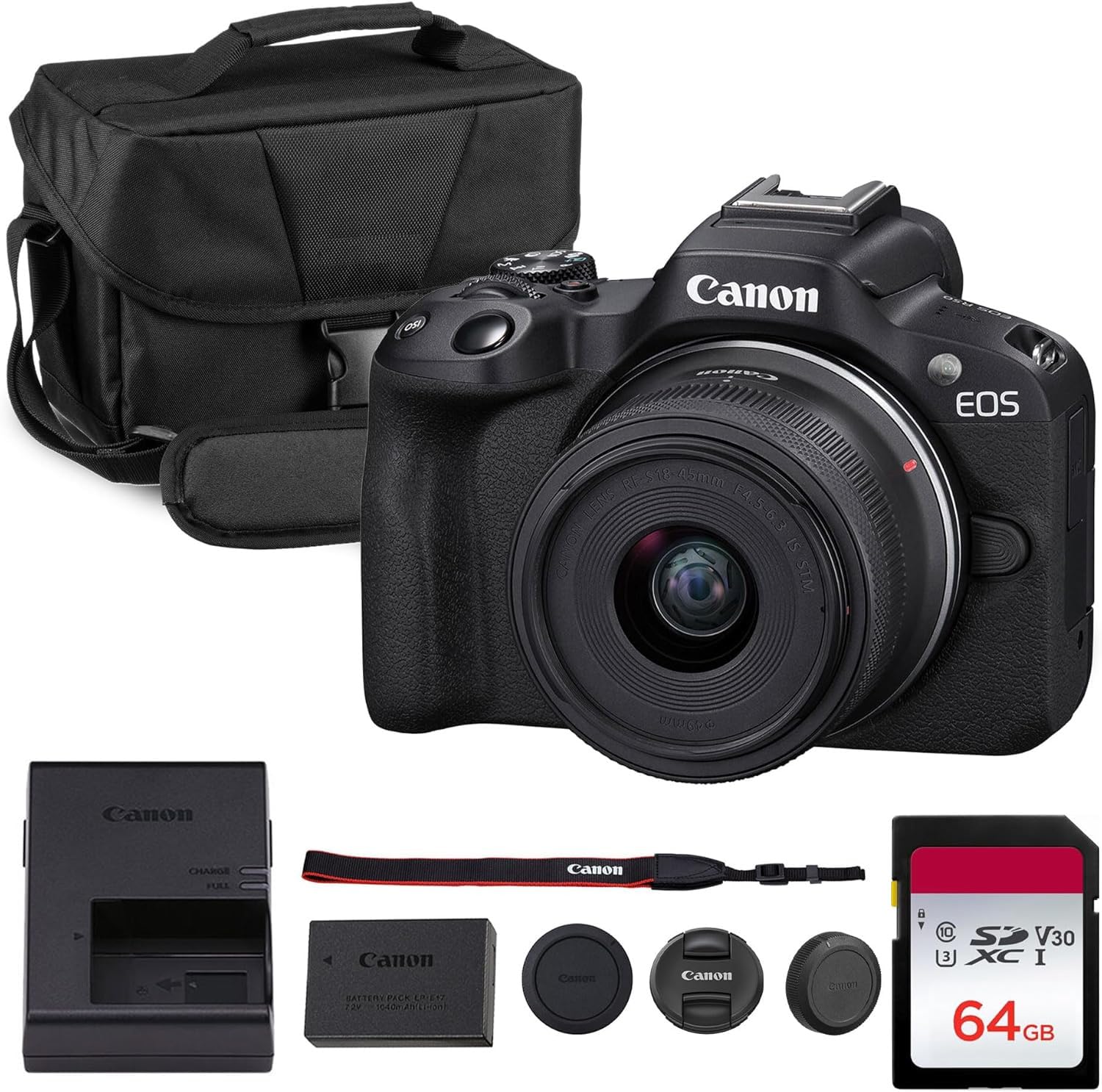
8. Canon EOS R50 Mirrorless Camera with 18-45mm Lens Bundle
The complete beginner kit that bundles everything you need to start today
The R50 bundle answers the most common beginner question — “what else do I need?” — by putting it all in one box. You get the APS-C mirrorless camera with the 18-45mm RF-S lens, plus a 64GB UHS-I SDXC memory card and a shoulder bag. The lens covers wide to standard focal lengths, so it handles daily vlogs, portraits, and street shooting. The oversampled 4K with Dual Pixel AF II delivers sharp footage with reliable face and eye detection — the autofocus system Canon is known for.
It is built with new creators in mind. The Creative Assist guides walk you through settings in plain terms, and the vertical video mode preps clips for social platforms directly in-camera. At just over a pound with the kit lens, it is light enough to carry all day, and the vari-angle touchscreen flips out for selfie framing. Owners consistently praise the fast autofocus and image quality, with several calling it a worthy replacement for the Canon G7X without the heavy price.
The honest limitation is that it is a beginner-focused body — advanced users will miss in-camera stabilization. The 18-45mm lens is sharp, but for different shots you will eventually want an additional lens, which the RF mount supports well.
Grab this if: you want a true out-of-the-box experience with memory card and bag included, plus Canon’s trusted autofocus for clean vlogs.
skip it if: you need in-body stabilization for walking shots — the R50 relies on lens stabilization and steady hands.
Understanding the Specs
1-inch CMOS Sensor
The sensor is the light-capturing chip inside the camera. A 1-inch CMOS sensor is physically larger than a phone’s sensor, which means it collects more light in dim conditions. For a budget vlogging camera, this is the single biggest jump in image quality you can buy — it is why night scenes and indoor shots stay clear instead of turning into a grainy mess.
3-Axis Gimbal vs. Digital Stabilization
Stabilization is what keeps your footage from looking like a shaky home video. A 3-axis gimbal physically floats the camera on tiny motors that counteract your hand movements — this is the smooth, gliding look you see in pro vlogs. Digital stabilization crops the image and software-smooths it, which works for gentle movement but can wobble when you walk fast. A gimbal wins for active shooting; digital is fine for sit-and-talk content.
Autofocus Points and Eye Detection
Autofocus points are the spots on the sensor where the camera can lock focus. More points mean the camera can track a moving subject across a wider area. Eye detection is the feature that finds your face and keeps it sharp — essential when you are talking to the lens and moving around. A camera with reliable eye tracking will save you from re-filming takes where you drifted out of focus.
4K Frame Rates Explained
4K is the video resolution — roughly four times the pixels of Full HD. The frame rate, like 24p or 120fps, is how many still frames the camera records per second. 4K at 24p gives a natural, film-like look for standard vlogs. A high frame rate like 120fps lets you slow the footage down into smooth slow motion. If you shoot a lot of B-roll, a camera with a higher frame rate gives you more creative options.
FAQ
Should I get a gimbal camera or a mirrorless camera for my first vlog setup?
Do I need an external microphone for a budget vlogging camera?
What is a good frame rate for YouTube videos?
Is the DJI Osmo Pocket 3 worth the premium over the Xtra Muse?
Can I use a mirrorless camera for livestreaming?
How important is image stabilization for a vlogging camera?
What memory card do I need for 4K video?
How long does the battery last on these cameras?
Is a fixed lens or interchangeable lens better for a beginning YouTuber?
Do these cameras work well in low light?
Final Thoughts: The Verdict
For the majority of shoppers, the strongest budget camera for youtube is the Canon EOS M50 because it is the crowd favorite — 4.7 stars across 550+ owners — and it pairs a changeable lens with autofocus that handles the hard part for you. If you want gimbal-smooth 4K in your pocket without the premium price, grab the Xtra Muse. And for a solo creator who wants reliable subject tracking and pro audio in one travel-ready package, the DJI Osmo Pocket 3 is the one to reach for.
How We Picked
We do not accept paid placement. Every pick is matched to a real buyer and a real use-case; we do not hands-on test units.
Sources & Methodology
Specifications: manufacturer listings and product documentation. Review insights: verified customer reviews, as of August 2026. Pricing: not shown on this page (it changes often); check the current price via the retailer link.
As an Amazon Associate, Gadgets Feed earns from qualifying purchases. This does not affect which products we feature.