
A decent camera is the difference between saving a memory and just taking a snapshot. But when your budget is tight, the fear of ending up with a blurry, plasticky, or feature-starved box is real. The trick is knowing exactly which specific features matter and which are just marketing fluff that adds cost without value.
I’m Min — the co-founder and writer behind Gadgets Feed. I’ve spent many hours analyzing the technical specifications, user feedback, and real-world performance data across the sub- camera space to find the handful of models that genuinely deserve your attention.
This guide cuts through the noise, comparing sensor sizes, zoom ranges, autofocus systems, and video capabilities to help you confidently pick the best budget camera for your specific needs without wasting a dollar.
How To Choose The Best Budget Camera
Picking a camera on a tighter budget forces a series of trade-offs. The key is to prioritize the feature that matches your primary use case — whether that’s zoom reach, image quality in low light, video capabilities, or the ability to upgrade lenses later. Ignore the megapixel race and focus on the sensor size and lens quality.
Sensor Size: The Real King of Image Quality
A larger sensor physically captures more light, resulting in cleaner images with less noise when the sun goes down, and better background blur (bokeh) for portraits. Among budget cameras, you will typically find three sensor sizes: the small 1/2.3-inch type in most bridge and compact cameras, the larger 1-inch type in premium compacts like the Sony ZV-1F, and the even larger APS-C or Micro Four Thirds sensors found in DSLR and mirrorless models. An entry-level DSLR with an APS-C sensor, even if older, will almost always beat a new bridge camera with a tiny sensor in image quality, especially indoors or at dusk.
Lens Versatility vs. Interchangeable Lenses
A bridge camera like the Kodak PIXPRO AZ255 comes with a built-in lens that boasts an incredible 25x zoom range — perfect for capturing a bird on a distant branch or a performer on a stage. You never need to buy another lens. On the other hand, a DSLR like the Nikon D3100 or Canon EOS R100 comes with a basic 18-55mm kit lens. This is a flexible starting point, but the real power is in the lens mount, which lets you swap in a portrait prime, a telephoto zoom, or a macro lens as your skills grow. Decide now if you want one all-in-one solution for today or a system you can build over the next few years.
Autofocus Speed and Accuracy
For capturing moving subjects like kids or pets, you want a camera with reliable continuous autofocus. The Canon PowerShot SX530 uses a basic contrast-detect AF system, which can be laggy at full zoom. In contrast, the Canon EOS R100 uses Dual Pixel CMOS AF (phase-detection) which is significantly faster and smoother, especially when recording video. The Sony ZV-1F features impressive Eye-AF that locks onto eyes and tracks them across the frame. Check the autofocus technology — it’s the difference between a sharp shot and a frustrating blur.
Quick Comparison
On smaller screens, swipe sideways to see the full table.
| Model | Category | Best For | Key Spec | Amazon |
|---|---|---|---|---|
| Panasonic LUMIX G85 | Mirrorless | Hybrid shooting & video | 16MP MFT / 5-Axis IBIS / 4K | Amazon |
| Sony ZV-1F | Compact | Vlogging & content creation | 20mm f/2.0 / 1″ Sensor / Eye-AF | Amazon |
| Canon EOS R100 | Mirrorless | Entry-level mirrorless & quality | 24.1MP APS-C / Dual Pixel AF | Amazon |
| Canon EOS Rebel T7 (Bundle) | DSLR | Beginner DSLR with accessories | 24.1MP APS-C / Wi-Fi / 3fps | Amazon |
| Canon EOS 2000D / T7 Bundle | DSLR | All-in-one starter kit | 24.1MP APS-C / 1080p / DIGIC 4+ | Amazon |
| Canon EOS Rebel T7 | DSLR | Reliable family DSLR | 24.1MP APS-C / NFC / 9pt AF | Amazon |
| Canon PowerShot SX530 | Bridge | Super-zoom reach | 16MP CMOS / 50x Zoom / Wi-Fi | Amazon |
| Nikon D3100 | DSLR | Budget DSLR learning tool | 14.2MP APS-C / EXPEED 2 | Amazon |
| Kodak PIXPRO AZ255 | Bridge | Ultra-budget super zoom | 16MP / 25x Zoom / AA Batteries | Amazon |
In‑Depth Reviews
1. Panasonic LUMIX G85

The Panasonic LUMIX G85 is the dark horse of the budget camera market, offering professional-grade stabilization in a compact mirrorless body. Its 5-axis In-Body Image Stabilization (IBIS) works in tandem with the lens-based OIS to produce handheld 4K footage that looks like it was shot on a gimbal — a rare capability at this price tier. The 16-megapixel Micro Four Thirds sensor delivers sharp, detailed images with excellent dynamic range for the class, and the lack of a low-pass filter gives you a noticeable bump in fine-detail resolving power over other 16MP sensors.
Videographers will appreciate the unlimited 4K recording, a dedicated mic jack, and features like Peaking and zebra stripes that are usually reserved for much more expensive cameras. The weather-sealed magnesium alloy body gives you the confidence to shoot in light rain or dusty conditions, which is something you simply don’t get from plastic bridge cameras. The kit lens, a 12-60mm Power O.I.S., is versatile and sharp, covering a useful wide-to-telephoto range that handles landscapes and portraits alike.
Battery life is one area where the G85 falls short of a DSLR — expect around 300 shots per charge, so a spare battery is essential for a full day out. The autofocus, while reliable in good light, can hunt in low-light conditions, particularly when shooting 4K video. Despite these small compromises, the G85 offers a feature set that rivals cameras costing double, making it the smartest long-term investment for a budding enthusiast who wants serious video and photo capability from a single body.
Why it’s great
- Exceptional 5-axis IBIS for blur-free handheld shots and video.
- Weather-sealed, robust build quality with a magnesium alloy frame.
- 4K video recording with a microphone input and useful pro-level tools.
Good to know
- Smaller Micro Four Thirds sensor means less background blur compared to APS-C.
- Autofocus can struggle in dim environments, especially for 4K capture.
- Below average battery life; carrying a spare is strongly recommended.
2. Sony ZV-1F

The Sony ZV-1F was engineered from the ground up for content creators who need a pocket-sized powerhouse for vlogging and social media clips. Its defining feature is the ultra-wide 20mm f/2.0 lens, which keeps your face and background in frame even when holding the camera at arm’s length. The large 1-inch sensor captures significantly more light and detail than the tiny sensors in most compact cameras, producing clean footage with a natural defocused background effect at the press of a button.
Sony’s Eye-AF and real-time tracking autofocus are a class-leading feature here — the camera locks onto a subject’s eye and holds focus tenaciously, even as they move around the frame. The directional 3-capsule microphone, paired with the included deadcat windscreen, delivers surprisingly clear audio that saves you from needing an external mic for most casual shoots. The side-articulating touchscreen makes composing self-shots effortless, and the Product Showcase mode instantly pulls focus to an object you hold up to the lens.
The biggest trade-off for its compact size is the fixed lens — there is no optical zoom at all, so you must physically move closer to your subject. This makes it unsuitable for wildlife or sports photography. Digital stabilization works well for static handheld clips but introduces a noticeable crop and jittery effect when you walk. Also, expect only around 45 minutes of continuous recording from the battery, so shooting on the go requires spare batteries and a charging plan.
Why it’s great
- Ultra-wide 20mm f/2.0 lens is perfect for selfie-style vlogging and low light.
- Industry-leading Eye-AF tracking keeps faces and eyes in sharp focus.
- Excellent built-in audio with a windscreen reduces the need for external mics.
Good to know
- Fixed lens means absolutely no optical zoom — not for far-away subjects.
- Digital stabilization only; walking shots will look shaky.
- Battery life is short for video; multiple spares are a requirement.
3. Canon EOS R100

The Canon EOS R100 is the gateway to Canon’s modern RF mount, giving you a 24.1MP APS-C sensor paired with the responsive Dual Pixel CMOS AF system. This autofocus technology is a significant step up from older entry-level DSLRs — it uses phase-detection pixels on the sensor itself to provide fast, smooth, and accurate focusing during both stills and video. The 143 autofocus points and integrated eye and face detection mean you can trust the camera to keep your subject sharp without fiddling with manual focus points.
Being a refurbished unit from Canon gives you professional restoration and warranty support at a fraction of the retail price. The RF-S 18-45mm kit lens is compact and light, making the entire setup incredibly portable for travel or everyday carry. The camera can shoot 4K video (with a crop) at 24 fps and Full HD at 60 fps, providing solid video foundations for a beginner looking to grow their skills within a modern mirrorless ecosystem that has a clear upgrade path to full-frame RF bodies.
The lack of a fully articulating touchscreen is the most notable omission — you only get a static, non-touch 2.36-million dot LCD, which makes shooting from low or high angles awkward. The single SD card slot and lack of in-body image stabilization mean you are reliant on lens-based stabilization or a tripod for sharp shots in dim light. For someone stepping up from a smartphone and wanting a compact, modern interchangeable-lens system, the R100 is a very compelling entry point.
Why it’s great
- Dual Pixel CMOS AF provides fast and accurate phase-detection autofocus.
- Compact and lightweight body that is perfect for travel and daily carry.
- Modern RF mount offers a clear upgrade path to higher-end Canon bodies.
Good to know
- No fully articulating touchscreen; limited flexibility for vlogging or odd angles.
- No in-body image stabilization, so low-light shots require a steady hand or tripod.
- 4K video is cropped and limited to 24 fps.
4. Canon EOS Rebel T7 DSLR (Bundle)
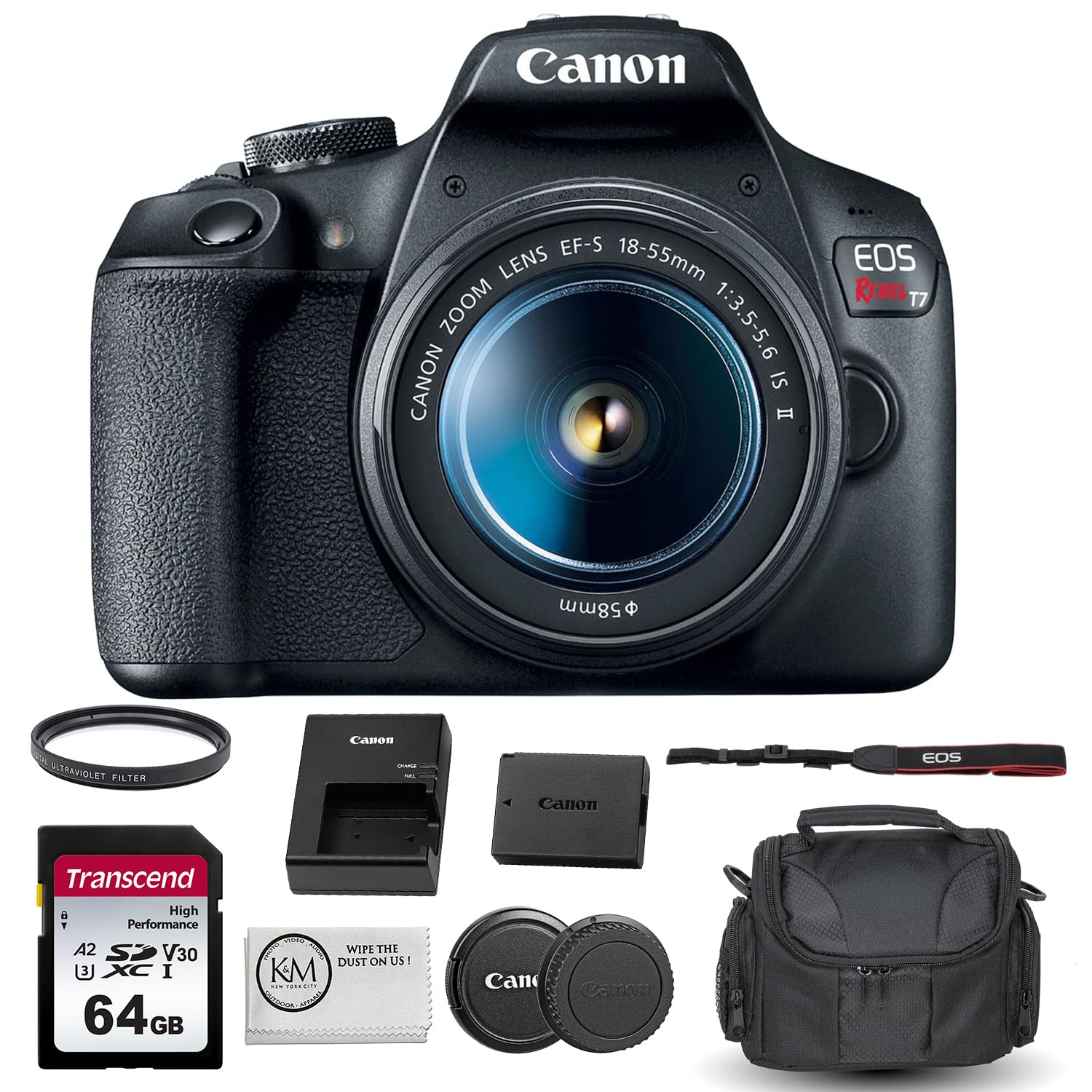
This Canon EOS Rebel T7 bundle is the quintessential entry-level DSLR experience, wrapped in a package that includes everything you need to start shooting the day it arrives. The 24.1-megapixel APS-C sensor captures sharp, colorful images with a level of detail that immediately separates it from a smartphone, especially when you use the optical viewfinder to compose shots. The DIGIC 4+ processor keeps operations snappy and provides a sensitivity range up to ISO 6400 (expandable to 12800), which is genuinely usable for indoor and evening photography.
Built-in Wi-Fi and NFC make transferring photos to your phone for social media sharing a simple, cable-free process. The optical viewfinder offers a clear, lag-free view of your subject with approximately 95% frame coverage, which is a fundamentally different and more engaging shooting experience than using a rear LCD. The included accessories like the 64GB memory card, camera bag, UV filter, and cleaning cloth add tangible value, saving you the typical additional cost of outfitting a new camera system. Users consistently praise its performance in low-light museum settings, where it dramatically outperforms smaller-sensor bridge cameras.
The 9-point autofocus system is basic by modern standards and relies on a single central cross-type point for accuracy, which feels dated when tracking erratic subjects. Continuous shooting at 3 frames per second is slow for action sports. The kit bundle includes a basic UV filter that can degrade image quality, so you may want to replace it with a higher-quality option. Still, for a family wanting a reliable, easy-to-use camera that delivers excellent photos with minimal learning curve, this bundle is a fantastic deal.
Why it’s great
- Includes all essential accessories (memory card, bag, filter) for immediate use.
- Large APS-C sensor delivers excellent image quality, especially in low light.
- Built-in Wi-Fi and NFC for simple photo sharing to a smartphone.
Good to know
- 9-point autofocus system is primitive; struggles with fast-moving subjects.
- Slow continuous shooting rate of 3 fps limits action photography.
- Included UV filter is basic and may slightly reduce image sharpness.
5. Canon EOS 2000D / Rebel T7 (Essential Bundle)

The Canon EOS 2000D (also known as the Rebel T7 in some markets) is the most affordable entry into the world of Canon DSLRs, and this essential bundle supercharges it with a carry case, tripod, LED video light, and a 64GB memory card. The core camera is a 24.1MP APS-C shooter with a DIGIC 4+ processor that handles basic photography and 1080p video capture reliably. The kit lens, an EF-S 18-55mm f/3.5-5.6 DC III, is a solid all-purpose starting point for landscapes, group shots, and portraits.
One of the most overlooked features of this specific model is its use of Canon’s industry-standard EF lens mount, which provides access to one of the largest and most affordable second-hand lens ecosystems in the world. You can pick up a used Canon 50mm f/1.8 STM prime lens for next to nothing and instantly transform your camera into a portrait machine with beautiful background blur. The included LED video light is a genuine help for indoor or evening video recordings, filling in harsh shadows that would otherwise require a separate studio purchase.
The 9-point autofocus system is the same basic one found in older models, and it is prone to hunting in dim light. The 2.7-inch LCD screen has a relatively low 230,000-dot resolution, which makes manual focus checking in Live View difficult. The 3 fps burst rate is slow, and the plastic build feels lightweight but not rugged. For someone who wants to learn the fundamentals of exposure and composition on a full-size camera without risking much money, this bundle delivers the highest possible bang for the buck.
Why it’s great
- Comprehensive kit with tripod, LED light, bag, and memory card included.
- Access to Canon’s huge and affordable EF lens ecosystem.
- Excellent image quality from the 24.1MP APS-C sensor for the price.
Good to know
- Basic 9-point AF system struggles in low light and with moving subjects.
- Low-resolution 2.7-inch LCD screen with only 230,000 dots.
- Slow 3 fps burst rate and plastic build quality feel entry-level.
6. Canon EOS Rebel T7

The Canon EOS Rebel T7 stands as one of the most popular entry-level DSLRs because it distills the classic Canon DSLR experience — an optical viewfinder, a large APS-C sensor, and straightforward controls — into a simple, effective package. Its 24.1MP sensor paired with the DIGIC 4+ processor produces Canon’s characteristic color science, with vibrant JPEGs straight out of the camera that require minimal post-processing. The 18-55mm IS II kit lens includes image stabilization, which helps keep handheld shots sharp at slower shutter speeds.
Built-in Wi-Fi and NFC are included, allowing you to quickly transfer your favorite shots to a phone or tablet for social sharing or backup. The optical viewfinder offers a clear, real-time view of your subject without the lag or battery drain of an electronic viewfinder, which many enthusiasts prefer for action photography. The camera also supports the EOS Utility Webcam Beta software, turning the T7 into a high-quality 1080p webcam for Zoom calls and streaming — a practical bonus in a work-from-home world.
The 9-point autofocus system is the same basic one found in its predecessor, and it is noticeably slower and less accurate than the phase-detect systems found on mirrorless rivals. The 3-inch LCD has a 920,000-dot resolution, which is decent but not touch-sensitive. The plastic body feels solid enough but lacks any weather sealing. It is a straightforward, no-frills DSLR that performs its core task — taking great still images — without fuss, making it a solid choice for a family camera or a student learning the craft.
Why it’s great
- Signature Canon color science produces vibrant, share-ready JPEGs.
- Optical viewfinder provides a clear, battery-efficient shooting experience.
- Can be used as a high-quality 1080p webcam with free Canon software.
Good to know
- 9-point autofocus is dated and less capable than modern mirrorless systems.
- LCD screen is not a touchscreen, limiting menu navigation speed.
- No weather sealing, so caution is needed in wet or dusty environments.
7. Canon PowerShot SX530 HS

The Canon PowerShot SX530 HS is a classic bridge camera that solves one problem brilliantly: getting you impossibly close to far-away subjects without needing to buy multiple lenses. Its 50x optical zoom (24-1200mm equivalent) is the headline act, allowing you to fill the frame with a bird at the top of a tree, capture details on a performer’s face from the back of a stadium, or bring distant mountain peaks into clear view. The 16MP CMOS sensor and DIGIC 4+ processor work together to produce clean images, especially when the sun is shining.
Built-in Wi-Fi and NFC let you transfer images wirelessly to your phone for quick sharing, a feature that adds significant convenience for travel. The dedicated movie button gives you instant access to 1080p Full HD video recording. The large 3-inch LCD screen has a 461,000-dot resolution, which is adequate for composition and review, and it offers a wide-angle viewing angle that is useful for group shots. As a refurbished unit, this model offers substantial savings over its original retail price, making the incredible zoom range accessible to a wider audience.
The small 1/2.3-inch sensor is the Achilles’ heel of this camera — as the light fades, image quality drops off quickly, with visible noise and loss of detail, especially at the long end of the zoom. The contrast-detect autofocus can be slow to lock on, particularly when zoomed all the way in. It uses a proprietary battery rather than standard AAs, and battery life is only mediocre. For the enthusiast whose primary need is daylight reach, however, the SX530 HS remains a capable and affordable tool.
Why it’s great
- Massive 50x optical zoom range (24-1200mm) for distant subjects.
- Built-in Wi-Fi and NFC for easy wireless photo transfers to a phone.
- Dedicated movie button for instant 1080p video recording access.
Good to know
- Small 1/2.3-inch sensor produces noisy images in low light.
- Contrast-detect autofocus is slow, especially at full zoom extension.
- Proprietary battery with average life; no option for standard AAs.
8. Nikon D3100

The Nikon D3100 is a legendary entry-level DSLR that, even years after its release, remains a fantastic learning tool for a budget-conscious photographer. Its 14.2MP APS-C CMOS sensor, paired with the EXPEED 2 processor, produces images with natural color reproduction and surprisingly good noise control up to ISO 1600. The included AF-S DX 18-55mm VR lens features Vibration Reduction, which effectively compensates for camera shake and helps you capture sharper handheld images in dimmer conditions than you could without it.
One of the D3100’s strongest assets is the vast compatibility with Nikon’s F-mount lens system, one of the largest and most affordable used lens ecosystems available. An old 50mm f/1.8D lens can be adapted easily for stunning portraits. The camera can shoot 1080p Full HD video at 24 fps and includes an integrated monaural microphone. The Guide Mode, a built-in tutorial system that walks you through different shooting scenarios, is genuinely useful for absolute beginners learning about aperture, shutter speed, and ISO.
The 11-point autofocus system is a step up from some contemporaries but is still basic and lacks the cross-type sensors needed for reliable low-light lock-on. The 3-inch fixed LCD has a low 230,000-dot resolution that makes critical focus checking difficult. Live view autofocus is painfully slow. As a discontinued, renewed model, the D3100 lacks modern features like built-in Wi-Fi or NFC, so you will need a third-party card reader or USB cable to transfer photos. It is a bare-bones DSLR that wins on pure image quality and price, not speed or convenience.
Why it’s great
- Renewed price offers incredible value for a true APS-C DSLR experience.
- Vast, affordable Nikon F-mount lens ecosystem for future upgrades.
- Guide Mode is excellent for teaching beginners exposure basics.
Good to know
- Low-resolution 230k-dot LCD screen makes manual focus difficult.
- No built-in Wi-Fi, NFC, or Bluetooth; requires cable for file transfer.
- 11-point AF system is basic and struggles in very low light.
9. Kodak PIXPRO AZ255

The Kodak PIXPRO AZ255 is the ultimate budget-friendly entry point for anyone who prioritizes zoom reach above all else. Its 25x optical zoom (24-600mm equivalent) lets you transition from a sweeping landscape to a tight close-up of a distant subject with a simple twist of the lens barrel, covering a range that would cost hundreds of dollars more in a DSLR lens. The 16-megapixel CMOS sensor is paired with Optical Image Stabilization, which is essential for keeping your telephoto shots sharp without a tripod.
The camera operates on readily available AA batteries — four are included to get you started. This is a genuine advantage for travel or extended field use where you cannot always charge a proprietary lithium-ion pack; you can simply buy a fresh set of lithium or rechargeable NiMH AAs at any convenience store and keep shooting. The camera records 1080p Full HD video, and the 24mm wide-angle lens is genuinely wide enough for group selfies and interior shots. User reviews consistently highlight how surprisingly clean the zoom quality is for a camera at this price point.
The plastic body feels light and a bit toy-like, and the 2.7-inch LCD has a low resolution that makes fine detail checking difficult. The autofocus system is basic and can struggle in low light. It uses SD, SDHC, and SDXC cards up to 512GB, but users caution against buying a Kodak brand memory card due to formatting issues. The compact design won’t fit in a pocket, but it is comfortable to hand-hold for long periods. For a first camera for a child, a travel companion for days when you don’t want to carry expensive gear, or a simple super-zoom for the backyard, the AZ255 is an unbeatable value.
Why it’s great
- Incredible 25x optical zoom range in one compact, all-in-one body.
- Uses standard AA batteries, simplifying travel charging and replacement.
- Remarkably clean zoom quality for a camera at this entry-level price.
Good to know
- Plastic body feels less durable than competing DSLR or bridge models.
- Autofocus is slow and struggles in low-light shooting conditions.
- Memory card not included and Kodak brand cards may have formatting issues.
FAQ
Is it better to buy a used DSLR or a new bridge camera for the same price?
How many megapixels do I really need in a budget camera?
What does a refurbished or renewed camera warranty cover?
Can I use a budget camera as a webcam for streaming?
Final Thoughts: The Verdict
For most users, the best budget camera winner is the Panasonic LUMIX G85 because it delivers a near-professional feature set — 4K video, 5-axis in-body stabilization, weather sealing, and a mirrorless form factor — for a price that rivals basic entry-level gear. If you want the ultimate in vlogging convenience with best-in-class autofocus and a pocket-friendly size, grab the Sony ZV-1F. And for the purest bang-for-your-buck in a classic DSLR package that includes all the accessories you need to start shooting immediately, nothing beats the Canon EOS Rebel T7 Bundle.