
Our readers keep the lights on and my morning glass full of iced black tea. As an Amazon Associate, I earn from qualifying purchases.
Specs are compiled from manufacturer listings and verified buyer reviews and can change over time — please confirm the key details on the product page before buying.
Buying a budget camera means you will get a tool that does some things well and cuts corners elsewhere. The trick is picking the right trade-off for the kind of photos or videos you actually want to take. Do you need a lens that reaches across a soccer field, autofocus that keeps up with a running kid, or a camera that starts recording polished vlogs the second you press the button?
I am Min, the writer behind Gadgets Feed. This guide compares published specs from each manufacturer and patterns across verified customer reviews. You get real strengths and real limits, not marketing claims.
Your decision depends on three things: how far the lens reaches, how fast the autofocus locks on, and how the camera feels in your hands. This roundup of budget cameras shows you exactly what each model does best and where it cuts a corner.
Quick Picks
- Sony ZV-1F Vlog Camera for Content Creators and Vloggers — Best Overall
- Canon EOS R50 Mirrorless Camera Kit with 18-45mm Lens — Best Value
- Kodak PIXPRO Astro Zoom AZ528-BK 16 MP Digital Camera — Best Reach
- Canon EOS R100 Mirrorless Camera with RF-S18-45mm Lens Kit — Best Entry Mirrorless
- Canon EOS Rebel T7 DSLR Camera with EF-S 18-55mm f/3.5-5.6 IS II Lens — Classic Starter DSLR
How To Choose The Best Budget Camera
Every budget camera forces a trade-off between reach, speed, and image quality. Here are the three specs that matter most when you spend carefully.
Optical Zoom vs Digital Zoom
Optical zoom uses the glass inside the lens to magnify a subject — that is the only kind that keeps your photo sharp at full reach. Digital zoom (cropping and enlarging the image) turns every distant bird or player into a blurry mess. On any budget camera, check the optical zoom number. The Kodak AZ528 with 52x optical zoom brings you close to a subject a standard kit lens cannot reach, but you pay for that reach with a smaller sensor that gathers less light.
Autofocus Points
The autofocus system uses small sensors across the frame to lock onto your subject. More points mean the camera can track a moving target across the whole screen instead of just the center. A beginner DSLR with 9 autofocus points (like the Canon T7) forces you to keep your subject dead-center — fine for portraits, frustrating for kids and pets. A camera with 143 or 425 points gives you a much better chance of tracking a runner or a dog as it moves across the frame.
Sensor Size and Low-Light Performance
Most budget cameras use a 1-inch or an APS-C (Advanced Photo System type-C) sensor. An APS-C sensor (found in the Canon R100, Rebel T7, and R50) is physically larger, so each pixel catches more light. That means cleaner photos indoors, at dusk, or under cloudy skies. A smaller 1/2.3-inch sensor (in a bridge camera like the Kodak AZ528) works fine in bright sunlight but struggles after sunset. If you shoot mostly in good light, the smaller sensor saves you money; if you shoot indoors or at golden hour, spend extra for the bigger sensor.
Quick Comparison
| Model | Best For | Optical Zoom / Lens | Autofocus Points | Max Video Resolution | Amazon |
|---|---|---|---|---|---|
| Kodak PIXPRO AZ528 | Wildlife & sports on a budget | 52x optical, 24mm wide | 25 | 1080p Full HD | $279.99Amazon |
| Canon EOS R100 | Entry-level mirrorless learner | 18-45mm kit lens | 143 | 4K up to 24 fps | $469.00Amazon |
| Canon EOS Rebel T7 | Classic DSLR beginner | 18-55mm kit lens | 9 | Full HD 1080p | $579.00Amazon |
| Sony ZV-1F | Vloggers & content creators | 20mm ultra-wide, F2 | 425 | 4K | $598.00Amazon |
| Canon EOS R50 | Versatile creator with upgrade path | 18-45mm kit lens | 99 | Oversampled 4K | $849.99Amazon |
In‑Depth Reviews
1. Sony ZV-1F Vlog Camera for Content Creators and Vloggers

A vlogging camera that nails focus, backgrounds, and audio straight from the start.
If your plan is to start a YouTube channel or shoot talking-head videos, the Sony ZV-1F is built for exactly that. The ultra-wide 20mm lens lets you hold the camera at arm’s length and still have your face and the background in the shot — no selfie-stick needed. A large 1-inch sensor (about the size of a fingernail) and an F2 aperture (a wide opening that lets in more light) give you that blurred-background look (called bokeh) with a single press of a button. The Eye AF and autofocus tracking (technology that locks onto a face and follows it) keep your face sharp as you move around. Buyers report the “20mm ultra-wide lens, one-press background defocus, and reliable Eye AF” make it a low-maintenance camera for daily content.
The autofocus system is the star — its 425 contrast-detection points (sensors that find edges to lock focus) completely outpace the 9-point system in the Canon Rebel T7. That means the ZV-1F can lock onto a moving subject across nearly the entire frame, while the T7 forces you to keep the subject centered. A directional 3-capsule microphone (three tiny microphones that pick up sound from the front) and a windscreen accessory (a foam cover that reduces wind noise) clean up audio without an external mic. The side-articulating touchscreen (a screen that flips out and rotates) makes selfie composition straightforward.
There is no built-in flash, and owners mention battery life runs about 45 minutes, so you will want spare batteries for a full day of shooting. It is also not the most versatile camera for traditional still photography or cinematic work — one buyer called it “not the best for real cinematography as it’s just not super diverse.” For vlogging that looks polished with zero fuss, this is the pick.
Vlogging Made Simple
- Ultra-wide 20mm lens captures face and background at arm’s length
- One-press background defocus for instant bokeh
- 425-point autofocus tracks your face reliably
Limits to Know
- No built-in flash for low-light stills
- Battery lasts roughly 45 minutes per charge
- Not versatile for traditional photography or cinematic work
Best suited for: Vloggers and content creators who want polished video with minimal editing — the autofocus and audio are ready to go.
Look elsewhere if: You need a single camera for both wildlife photography and vlogging; the fixed 20mm lens cannot zoom.
2. Canon EOS R50 Mirrorless Camera Kit with 18-45mm Lens
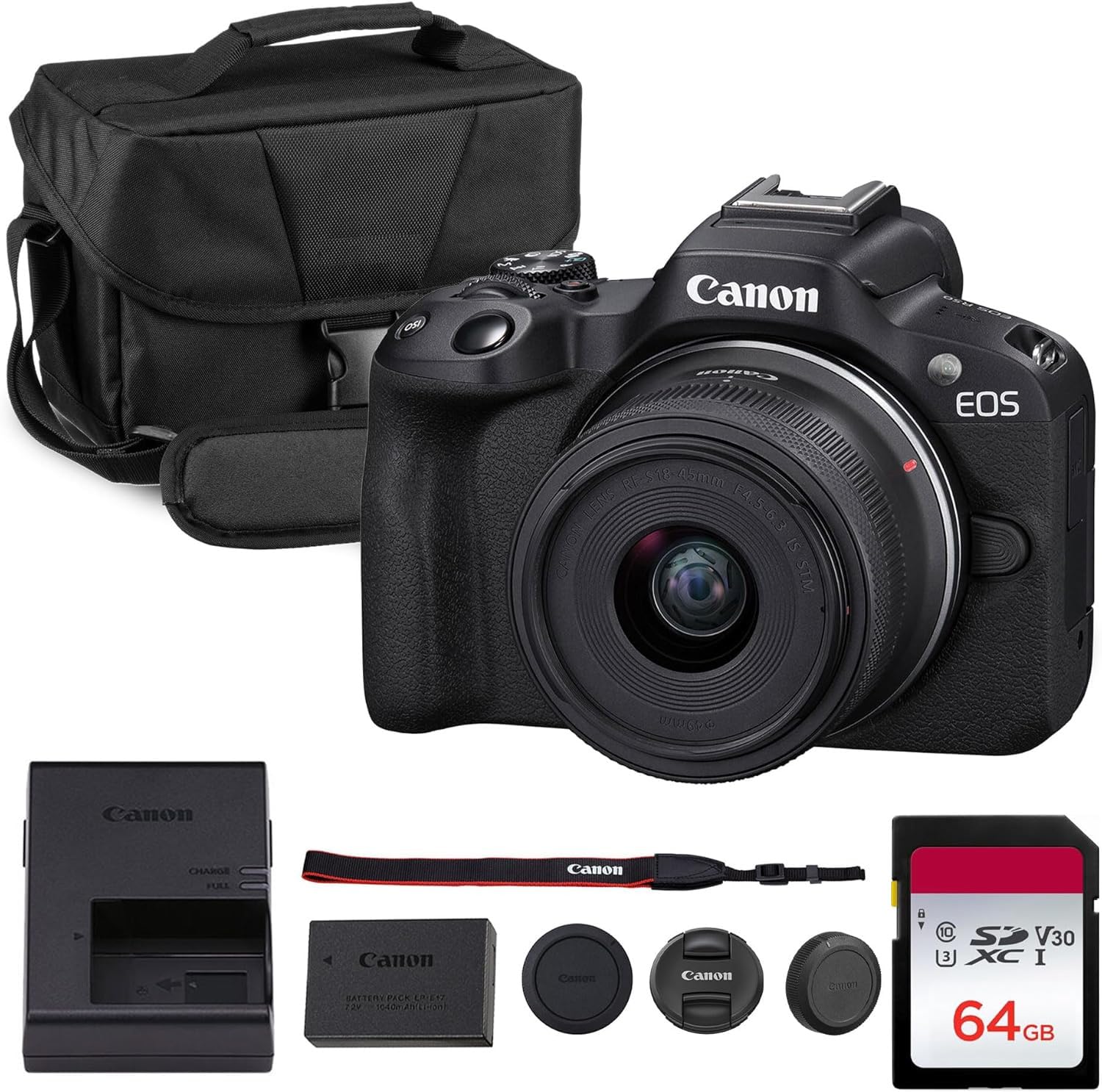
A mirrorless body that grows with you — sharp 4K video and fast tracking for less than most serious options.
The Canon EOS R50 delivers oversampled 4K video (it reads more pixel data than it needs and combines it for a cleaner final image) and Dual Pixel CMOS AF II (Canon’s phase-detection autofocus system that uses special pixels on the sensor to lock focus fast). It detects faces, eyes, and animals. With 99 autofocus points, it beats the 9-point system in the Rebel T7 hands down, letting you track a moving pet or child across the frame without constantly recomposing. The included RF-S 18-45mm lens (a Canon starter lens for their mirrorless system) covers wide-angle to standard portrait lengths, making it a flexible starter kit for daily content and street shooting.
Creative Assist mode gives on-screen guidance for exposure and color, and built-in vertical video shooting means footage fits Instagram and TikTok without rotating in post. Reviewers consistently call it “great for beginners” and note the autofocus speed is a standout feature. The kit also bundles a shoulder bag and a 64GB memory card, saving you a separate purchase. One buyer cautioned that the camera lacks in-body stabilization (IBIS — a system that steadies the sensor to reduce shake) and the buffer (temporary memory) fills quickly in burst mode (continuous shooting). You will want a steady hand for long telephoto shots and avoid holding the shutter too long at 6.5 fps (frames per second).
If you plan to upgrade lenses over time, the RF mount gives you access to Canon’s growing lens lineup. The R50 is a compact, capable platform that does not box you into beginner features.
Why It Works for Beginners
- Oversampled 4K video produces clean, detailed footage
- 99-point Dual Pixel AF II tracks faces, eyes, and animals
- Includes shoulder bag and 64GB memory card
The Trade-Offs
- No in-body image stabilization; relies on lens stabilization
- Buffer fills quickly during continuous burst shooting
- Kit lens aperture is slow (F4.5-6.3) in low light
Reach for this if: You are starting out but want a body that can grow with you — interchangeable lenses and excellent 4K make this a long-term investment.
Pass it by if: Your priority is extreme zoom reach for wildlife; you will need to buy a separate telephoto lens.
3. Kodak PIXPRO Astro Zoom AZ528-BK 16 MP Digital Camera
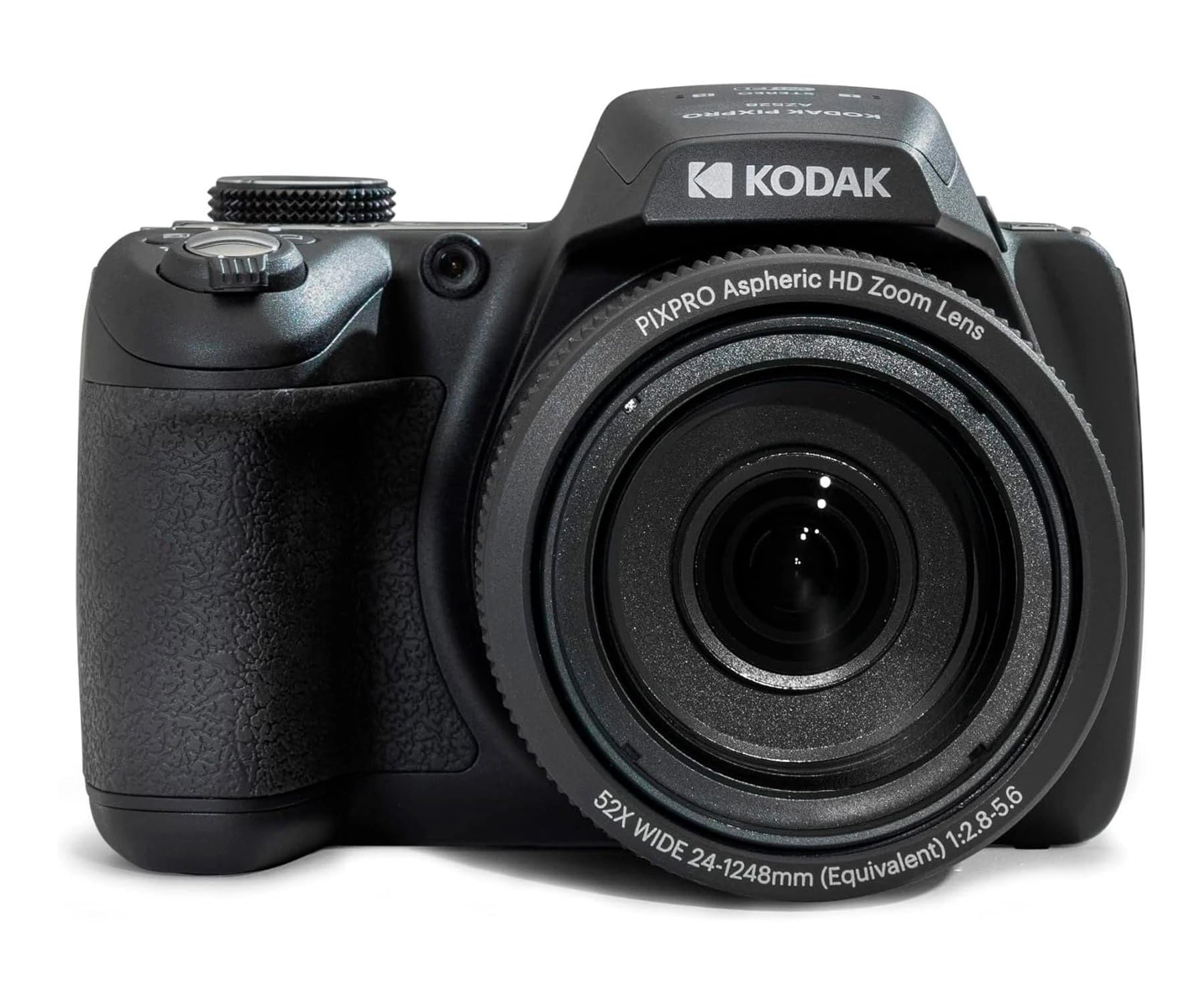
Fifty-two times zoom brings distant birds and players into clear view at a price that leaves money in your pocket.
The Kodak PIXPRO AZ528 is built for one thing: getting you close to subjects that are far away. Its 52x optical zoom combined with a 24mm wide-angle lens (great for capturing a broad scene) means you can shoot sweeping landscapes and then zoom into a bird on a branch 100 yards away — all without changing lenses. The 16-megapixel backside-illuminated (BSI) CMOS sensor (a chip that wires the back of each pixel to catch more light) improves low-light performance compared to older designs. Built-in optical image stabilization (OIS — a system that uses moving lens elements to counteract shaky hands) helps at full telephoto reach. Customers note “when you have it zoomed in, you have to have steady hands or it is very blurry.” That is true of any long-zoom camera, but a monopod or bracing against a tree helps at 52x. The camera shoots 6 frames per second in burst mode (continuous shooting) and records 1080p Full HD video — it does not offer 4K.
Wi-Fi lets you transfer photos to your phone for quick sharing, and the rechargeable Li-Ion battery supports a full day in the field. The autofocus system uses contrast-detection (which finds focus by looking for the sharpest edge) with 25 points. That is a step up from the 9-point system in the Canon T7 but far behind the 425-point system in the Sony ZV-1F. In practice, the AZ528 locks on reliably in good light but hunts more in dim conditions. One reviewer noted “SCN>Pet Mode” for pet photography and noted the body scuffs easily but wipes clean. A fast-charging USB-C port is included, so you can top up from a power bank in the field. If you need maximum reach on a tight budget, this is the only camera in this roundup that can match it.
What the Zoom Delivers
- 52x optical zoom reaches subjects other budget cameras cannot
- 16MP BSI CMOS sensor with built-in OIS for steadier telephoto shots
- Wi-Fi for instant photo transfer and remote viewfinder
The Reality of Long Zoom
- No 4K video — maxes at 1080p Full HD
- 25-point contrast AF hunts in low light
- Steady hands or a tripod are essential at full zoom
Perfect for: Wildlife watchers, bird photographers, and sports fans who cannot afford a super-telephoto lens for a DSLR.
Not for: Low-light shooters or anyone who needs 4K video — the smaller sensor and 1080p limit hold it back after sunset.
4. Canon EOS R100 Mirrorless Camera with RF-S18-45mm Lens Kit

The smallest and lightest EOS R-series body that lets you swap lenses without swapping budgets.
The Canon EOS R100 is the most affordable entry point into Canon’s mirrorless RF mount system (the socket where you attach lenses). At the core is a 24.1-megapixel APS-C CMOS sensor (the same physical size as the sensor in the pricier R50) paired with the DIGIC 8 image processor (the chip that handles color, noise, and speed). That combination delivers natural background blur (bokeh) and 4K video at up to 24 fps (frames per second). Where the R100 really stands apart from a DSLR like the Rebel T7 is autofocus: the Dual Pixel CMOS AF covers a wide area with 143 zones, offering human face and eye detection plus animal and vehicle detection. That is far more flexible than the 9-point system on the T7. You can track a dog running across a field or a car driving past. Continuous shooting hits 6.5 fps (frames per second) in One-Shot AF (autofocus locks on the first frame and stays there), which is competitive for this price class.
Buyers consistently note the R100 is “perfect for beginners” and that image quality is excellent for the price. One verified review pointed out “battery lasts a day; no charger included.” The camera charges via USB-C and ships with a battery but no wall charger, so plan accordingly. The body is the smallest and lightest in the EOS R series, making it genuinely pocketable in a jacket or small sling. For someone who wants to learn composition and lens selection without spending R50 or R8 money, the R100 is the logical first step.
Starter Mirrorless Strengths
- 24.1MP APS-C sensor with natural bokeh for portraits
- 143-point Dual Pixel AF with face, eye, animal, and vehicle tracking
- Smallest and lightest EOS R body — easy to carry daily
Budget Compromises
- No charger included — charges via USB-C cable only
- 4K limited to 24 fps; no 4K 60 fps option
- Kit lens aperture (F4.5-6.3) struggles indoors without extra light
Best for: Someone who wants a mirrorless system they can grow into — the RF lens mount opens up a whole ecosystem of glass.
skip it if: You need a camera that comes with a charger in the box or shoot fast motion at 4K 60 fps.
5. Canon EOS Rebel T7 DSLR Camera with EF-S 18-55mm f/3.5-5.6 IS II Lens

The tried-and-true DSLR formula — optical viewfinder, long battery life, and a proven lens system.
The Canon EOS Rebel T7 is the classic DSLR (Digital Single-Lens Reflex — a camera that uses a mirror to reflect the scene into an optical viewfinder) experience. You look through an optical viewfinder that shows the actual scene through the lens (with about 95% coverage), not an electronic screen. Many learners prefer it for composing shots without draining the battery. The 24.1-megapixel APS-C sensor matches the R100 and R50 for resolution, and built-in Wi-Fi and NFC (Near-Field Communication — a short-range wireless tap-to-connect) let you transfer images to your phone. The 18-55mm f/3.5-5.6 IS II kit lens includes optical image stabilization (reduces blur from hand shake). The camera can also double as a webcam using Canon’s EOS Utility Webcam Beta Software.
The most notable difference between the T7 and the mirrorless options above is autofocus. The T7 uses a 9-point AF system with AI Servo AF (continuous autofocus for moving subjects). It works for stationary subjects and slow motion but feels dated compared to the 143-zone system in the R100 or the 425-point system in the Sony ZV-1F. For soccer games or running kids, you will need to keep the subject near the center of the frame. Reviewers praise the “sharp images” and “easy controls” and note the camera is “great for beginners.” One buyer switching from a Sony A7IV called the T7 “cheaper, easier, lighter” for product photography. The battery lasts significantly longer than mirrorless competitors — a full day of shooting on a single charge is realistic. The trade-off is size: the T7 is bulkier than any mirrorless camera on this list.
DSLR Advantages
- Optical viewfinder with ~95% coverage — no battery drain for composing
- 24.1MP APS-C sensor produces sharp, vibrant images
- Built-in Wi-Fi and NFC for phone transfers
Where It Shows Its Age
- 9-point AF system is limited for moving subjects
- No 4K video — maxes at Full HD 1080p
- Bulkier body than any mirrorless alternative here
Who still picks this: Traditionalists who want an optical viewfinder and long battery life for learning exposure basics.
Who should not: Anyone shooting fast-moving subjects (kids, pets, sports) or who plans to record video — the autofocus and lack of 4K will frustrate.
Understanding the Specs
Optical vs Digital Zoom
Only optical zoom keeps your image sharp when you magnify a distant subject. Digital zoom crops the photo and enlarges it, turning every pixel into a block. The Kodak AZ528 with 52x optical zoom gets you closer without losing clarity. A camera with weak optical zoom and heavy digital zoom produces soft, grainy images at any real distance.
Autofocus Points
Autofocus points are small sensors spread across the camera’s view. When you half-press the shutter, the camera uses them to detect contrast or phase difference and lock focus. More points (425 on the Sony ZV-1F, 9 on the Canon T7) mean the camera can track a moving subject across the whole frame instead of only the center. For moving subjects like kids, pets, or wildlife, a higher point count yields a much higher keeper rate.
Sensor Size
The physical size of the image sensor directly affects low-light performance and background blur. An APS-C (Advanced Photo System type-C) sensor (used in all Canon interchangeable-lens models here) has about 10 times the surface area of the 1/2.3-inch sensor in the Kodak AZ528. That larger area catches more light per pixel, so you get cleaner images indoors, at dusk, and in shadow. The 1-inch sensor in the Sony ZV-1F sits between these two — larger than a phone sensor but smaller than APS-C.
Burst Shooting
This is how many still frames the camera captures per second in continuous mode. 6 fps (the Kodak AZ528) means you can fire off six photos in one second and pick the sharpest. That is useful for birds in flight or a child scoring a goal. The Sony ZV-1F does not list a burst rate for stills; its strength is continuous autofocus in video, not high-speed photo bursts.
FAQ
Can a budget camera shoot good 4K video?
How important is optical image stabilization in a budget camera?
Which budget camera is best for wildlife photography?
Do budget cameras work well in low light?
Can I use Canon EF lenses on the R100 or R50?
Is a mirrorless camera better than a DSLR for a beginner?
What memory card speed do I need for 4K video on a budget camera?
Can I use a budget camera as a webcam for streaming?
Final Thoughts: The Verdict
For most people, the budget cameras winner is the Sony ZV-1F because it delivers polished vlogging results with zero learning curve — 425 autofocus points and a 20mm ultra-wide lens mean you hit record and get usable footage immediately. If you want extreme reach for wildlife, the Kodak PIXPRO AZ528 with 52x optical zoom is the only camera here that can pull distant subjects into the frame without a second mortgage. And for a beginner who wants to learn interchangeable-lens photography, the Canon EOS R100 gives you the RF mount ecosystem and 143-point autofocus at the lowest entry price.
How We Picked
We do not accept paid placement. Every pick is matched to a real buyer and a real use-case; we do not hands-on test units.
Sources & Methodology
Specifications: manufacturer listings and product documentation. Review insights: verified customer reviews, as of July 2026. Pricing: not shown on this page (it changes often); check the current price via the retailer link.
As an Amazon Associate, Gadgets Feed earns from qualifying purchases. This does not affect which products we feature.
Related Guides
Product prices and availability are accurate as of the date/time indicated and are subject to change. Any price and availability information displayed on Amazon at the time of purchase will apply to the purchase of this product. As an Amazon Associate I earn from qualifying purchases.
CERTAIN CONTENT THAT APPEARS ON THIS SITE COMES FROM AMAZON. THIS CONTENT IS PROVIDED "AS IS" AND IS SUBJECT TO CHANGE OR REMOVAL AT ANY TIME.
Amazon and the Amazon logo are trademarks of Amazon.com, Inc. or its affiliates.