
Our readers keep the lights on and my morning glass full of iced black tea. As an Amazon Associate, I earn from qualifying purchases.
Specs are compiled from manufacturer listings and verified buyer reviews and can change over time — please confirm the key details on the product page before buying.
If your factory radio has finally given up — crackly speakers, a dead display, or no way to play your phone — you do not need to spend a fortune to fix it. A single-DIN or double-DIN replacement with Bluetooth gets you hands-free calling, music streaming, and a USB port for charging, usually in an afternoon with basic tools. The tricky part is that cheap head units vary wildly in build quality, so this list focuses on the ones that actually hold up in a daily driver.
I’m Min — the founder and writer behind Gadgets Feed. This guide is built by comparing the manufacturers’ published specifications and the patterns across verified customer reviews, so you get each pick’s real strengths and trade-offs instead of marketing spin.
From tiny single-DIN units that fit shallow dashes to feature-packed double-DIN receivers, here is what actually holds up when you replace your factory setup with a budget car radio.
Our Picks at a Glance


How To Choose The Best Budget Car Radio
Replacing a car radio is one of the few upgrades you can still do yourself in a driveway. But the cheap end of the market is crowded with units that look identical on the box and behave very differently after six months. The four things below are what actually separate a head unit that lasts from one that ends up in a drawer.
Match the size to your dash first
Single-DIN radios are the slim, rectangular units that fit most older cars, trucks, and tractors. Double-DIN radios are twice as tall and use a wider screen area — they fit newer dashboards and any opening already sized for a double-height factory radio. Getting this wrong is the single most common reason a radio ends up returned, so measure the opening before you buy.
Chassis depth decides how painful the install is
A shallow chassis slides into tight dash cavities without you having to hack away at plastic behind the dash. Some head units list a depth under four inches; others run deeper and require more wrestling. If you drive something with a cramped dash, a short-depth receiver is worth prioritizing over wattage numbers.
Look at Bluetooth version and pairing stability
Bluetooth is the feature you will use every single day, and it is also the one buyers gripe about most across this category. Units that pair two phones at once give you hands-free calling on both lines. Expect the first pairing to take a few seconds on nearly every unit in this price range — that is normal, not a defect.
Understand what preamp outputs open up
Preamp outputs are the RCA jacks on the back that send a clean signal to an external amplifier or subwoofer. If you plan to keep your stock speakers and never add a sub, you can ignore them. If you want to add a sub later, having at least one dedicated rear or sub preamp output saves you from buying a second radio down the road.
Quick Comparison
| Model | Best For | Form Factor | Power Output | USB Charging | Amazon |
|---|---|---|---|---|---|
| Sony DSX-A410BT★ Best Overall | Dual-phone Bluetooth calling | Single DIN | 4 channels | Front USB | Amazon |
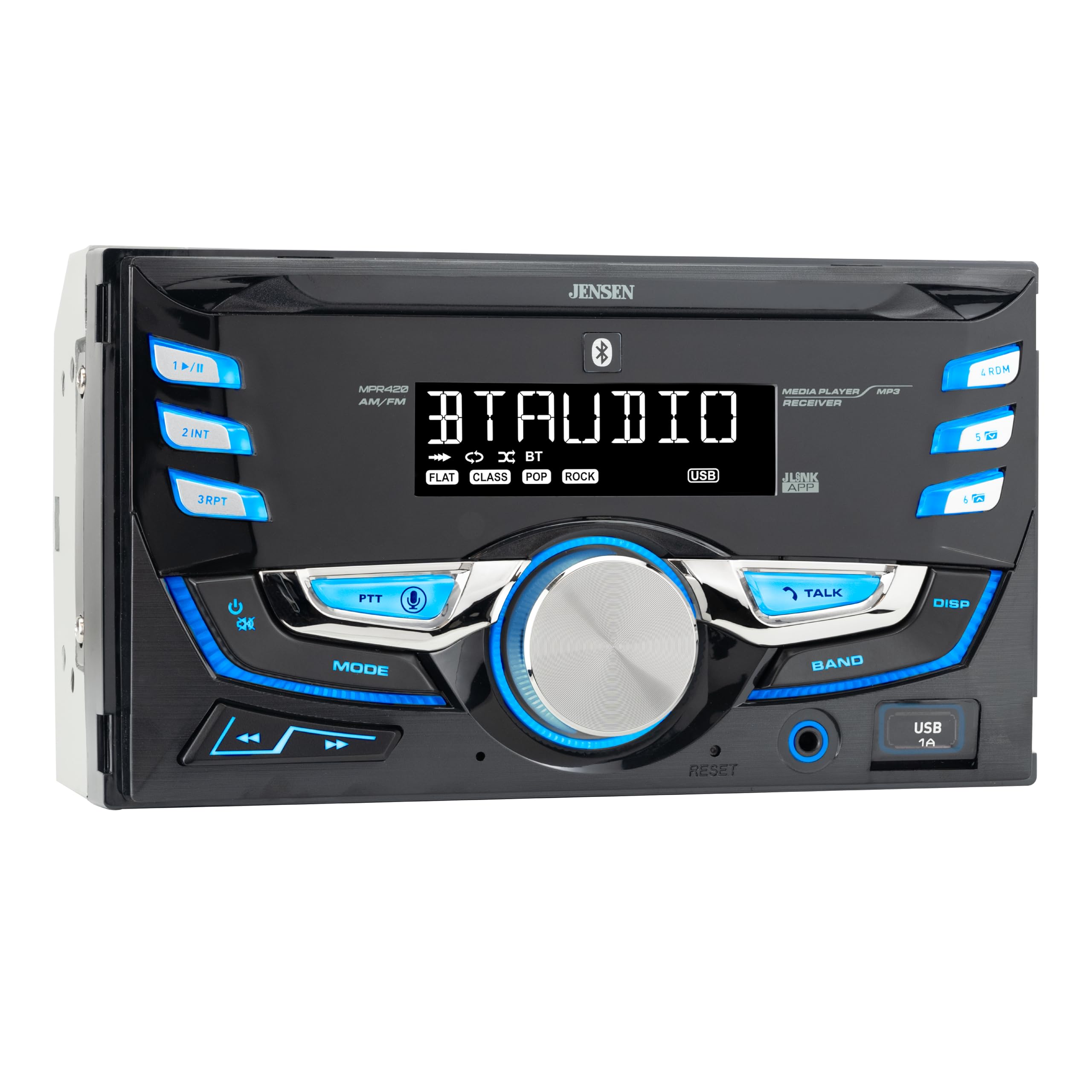
| Jensen MPR420Budget Champion | Newer trucks and double-DIN dashes | Double DIN | 4 speakers | USB playback and charging | Amazon |
| JBL Celebrity150Amp Builder’s Pick | Amp and sub builders | Single DIN | High-voltage preamp | USB playback | Amazon |
| Pioneer MVH-S110BT | Shallow dash spaces | Single DIN | 50W x 4 | Front USB Type A | Amazon |
| BOSS Audio 750BRGB | Color-matching your interior | Single DIN | 60W x 4 Max | USB port | Amazon |
| Pioneer MVH-S230BT | Compressed audio cleanup | Single DIN | Built-in amp | USB input | Amazon |
| JVC KD-SX27BT | Fine-tuning your sound signature | Single DIN | 100W (50W/channel) | USB 1.5A | Amazon |
| Kenwood KMM-BT270U | Simple controls, big buttons | Single DIN | 200W Max | USB charging | Amazon |
| JVC KW-SX88BT | Older cars that want no touchscreen | Double DIN | 50W x 4 | USB 1.5A | Amazon |
In-Depth Reviews
1. Sony DSX-A410BT Single Din Bluetooth Front USB AUX Car Stereo
Our pick — 4.5★ from 400+ verified ratings; the strongest balance of quality and price.
The dual-phone Bluetooth receiver that handles your calls without asking you to look down.
If two people share your car, this is the radio that makes that easy. You can pair two smartphones at the same time — the first phone gets full navigation, music, and calls, while the second phone can make and receive hands-free calls on the move. Voice control means you can change tracks or take a call by talking rather than tapping a small button at speed.
Sound quality is what wins people over here. Owners consistently describe their factory speakers waking up after the swap, and the same unit has reportedly spent over a year and nearly 200 hours in a tractor without a hiccup, as buyers report: “still works great.” There is also a front USB and a 3.5mm AUX input for wired playback, plus support for WMA files.
The honest catch is pairing speed. Bluetooth connects reliably but can lag a few seconds on the first handshake, and the button layout takes a learning curve — previous/next and pause are placed where your thumb does not naturally reach. Budget for a separate wiring harness too, since the box does not include one for every vehicle.
What works in daily driving
- Two phones paired at once with full hands-free calling on both lines
- Voice control for music, directions, and contacts without touching the dash
- Front USB plus 3.5mm AUX gives you wired fallback when Bluetooth is slow
- Excellent radio reception and reliable Bluetooth over months of use
What to plan around
- Bluetooth can take a few seconds to connect on the first pairing
- Button layout takes getting used to, especially at night
- You will likely need an extra wiring harness for your specific vehicle
- Second paired phone is calls-only, no music streaming from that line
Reach for this if: you share the car with a partner or family member and want both phones connected for calls and music without fumbling.
Look elsewhere if: you need a double-DIN fit or a built-in CD player — this is a mechless single-DIN unit.
2. Jensen MPR420 Double DIN Bluetooth Car Stereo
The double-DIN bargain that fills a factory opening without draining your wallet.
Double-DIN dashes are common in trucks built after the mid-2000s, and this Jensen slots right in. The 7-character LCD shows your preset and app info, and the shallow depth means less wrestling behind the dash — a real advantage if your truck’s cavity is tight. Bluetooth pairs automatically when your phone comes into range, and a dedicated voice button summons Siri or Google for music or navigation.
What buyers value most here is simply the price-to-performance ratio — a fully featured double-DIN for less than most single-DIN rivals. The mic is built into the face panel, so no external wiring, and owners mention the Bluetooth sync being fast and stable once paired. Jensen also backs it with a 2-year warranty that extends to 4 years once you register the product.
The trade-offs are real and worth pacing. The AM/FM tuner can sound weak or blurry depending on your area, and the display is functional rather than fancy — the clock is dim. A few owners have run into ground-loop humming through the speakers, which is usually a wiring fix rather than a defective unit.
Where the value lands: a double-DIN body with voice assistant support and a USB port that charges your phone, all for a budget-friendly price. The 7-character LCD is basic but readable, and the shallow chassis makes installation easier than most double-DIN units.
What to weigh: if you rely on AM radio or need a bright clock display, other picks on this list will serve you better. For a straightforward upgrade in a newer truck, this does the job.
Best fit: truck and SUV owners with a factory double-DIN opening who want a budget-friendly upgrade with voice assistant support.
Know before you buy: the AM tuner is the weak spot, and the built-in mic needs a louder speaking voice than some units.
3. JBL Celebrity150 Single DIN Bluetooth Car Media Receiver
The clean-signal head unit that lets your amp do the heavy lifting.
If you already have an amplifier and subwoofer, this JBL is built for your setup. The high-voltage preamp output sends such a strong RCA signal that some owners had to turn their amp gain down after installing it — a problem most budget receivers do not have. It also has RCA outputs for front, rear, and sub, plus a dedicated signal wire for your amp, so you can run everything off this one head unit.
Measuring just 1.97 inches deep, it is one of the slimmest single-DIN units on this list. The detachable face adds theft deterrence, and the unit supports Bluetooth, USB, AUX, SD card, and FM radio. Multiple owners have installed it in older vehicles like a 2002 Buick Century, and it has a reputation for playing loud without distortion at full volume.
The honesty note is that this is a specialist tool. The built-in amp is modest, so if you run door speakers directly off the head unit you may need to push the volume past three-quarters to get real sound. The display is basic, the volume knob has a slightly loose feel, and there is no sub crossover on the unit itself.
Who it serves: anyone building a system around an amp and sub. The preamp output quality and RCA flexibility are the whole point here, and the price-to-performance ratio for that use case is hard to argue with.
The catch: if you plan to drive speakers directly off the head unit, the modest built-in amp will feel weak — this pick rewards buyers with external amplification.
Pick this if: you have or plan to add an amplifier and subwoofer and want the cleanest RCA signal in this price range.
Pass if: you are running stock door speakers off the head unit alone — you will want more built-in power.
4. Pioneer MVH-S110BT 1-Din Digital Media Car Stereo with Bluetooth
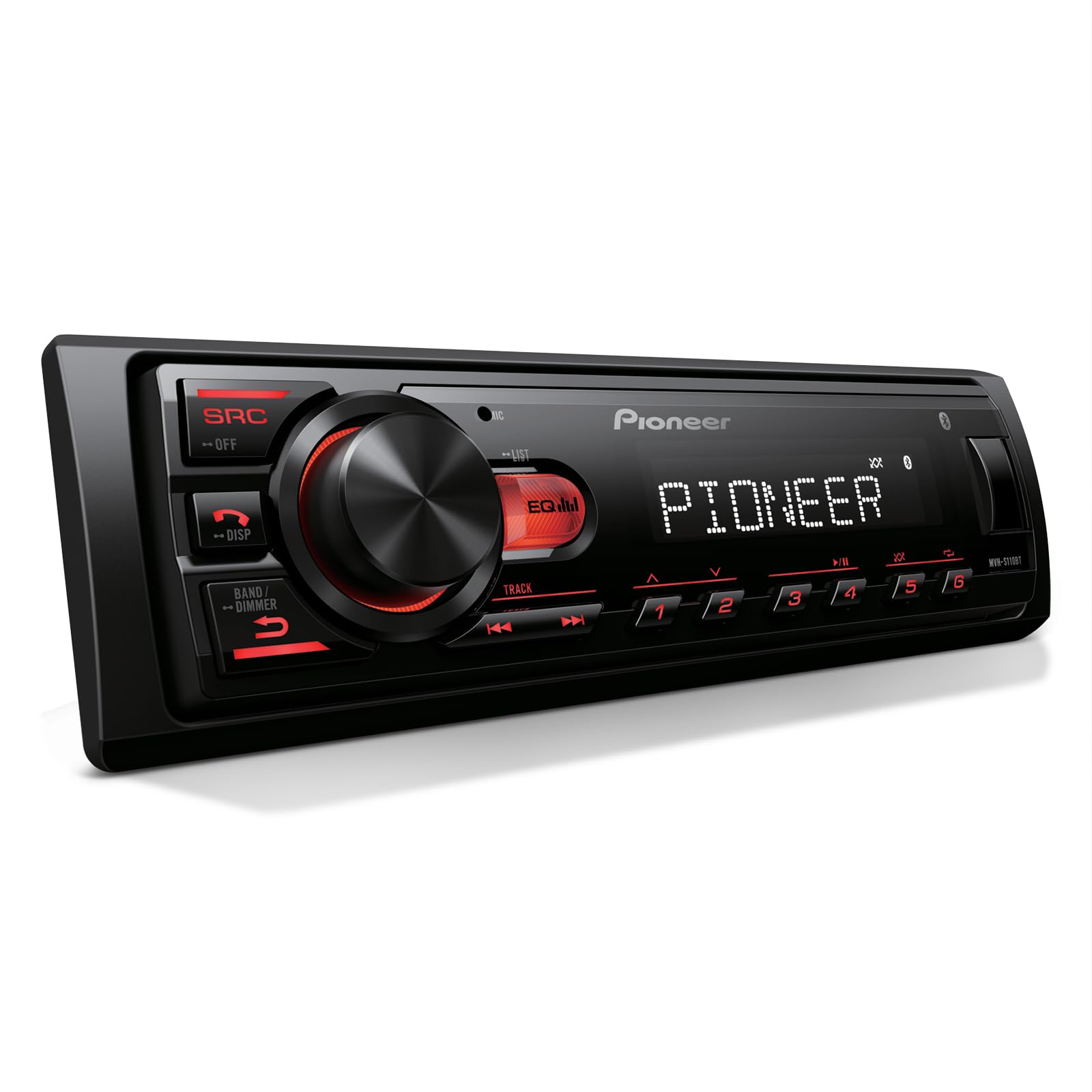
A short-chassis single-DIN that slides into tight dashboards without cutting plastic.
Semi trucks, old pickups, and anything with a cramped dash cavity are exactly what this Pioneer was designed for. The MOSFET amplifier (a built-in chip that boosts sound to your speakers) pushes up to 50 watts to each of four speakers, and the front USB port handles FLAC, MP3, and WMA files. Dedicated EQ keys give you quick bass, treble, and balance adjustment without digging through menus.
Customers note the upgrade being obvious the moment they plug in — a semi-truck driver swapped out the factory unit and got instant sound improvement over what was there before. Bluetooth pairing can be finicky on the first attempt, though once connected the streaming holds up. If pairing fails, the trick that works is having the pass key show on both the radio and your phone, then confirming both at the same time.
The chassis depth is what makes this a standout — short enough for tight installs where deeper units would demand dash modification. Weighing in at 1.1 pounds, it is also light enough that the mounting bracket does not work hard. There is no CD player here, so this is a streaming-and-USB-only setup.
What earns its spot: the compact short-chassis design that fits cramped dashes, plus the 50W x 4 output and FLAC file support for higher-quality USB playback than most budget receivers offer.
What to expect: first-time Bluetooth pairing takes patience, and the radio is bare-bones on features — no CD player, no touchscreen, no advanced EQ.
For you if: your dash is shallow or awkward and you need the slimmest fit without hacking plastic, and you mostly stream from your phone or play music off a USB stick.
Not the one if: you still use CDs or want a large touchscreen with menu-driven controls.
5. BOSS Audio Systems 750BRGB Single DIN Bluetooth Car Stereo

A color-changing single-DIN that still plays your old CDs.
If you are one of the last holdouts with a CD collection, this is one of the few budget head units that still has a disc slot. Beyond that, the 750BRGB offers over 16 million color combinations for the faceplate lighting — a genuine feature if you have custom interior lighting and want the console to match. There is also a push-to-talk button that summons Siri or Google through Bluetooth, plus USB and AUX inputs for streaming.
The built-in amp pushes 60 watts x 4 to your speakers, and the 2.75-pound body feels substantial for a budget receiver. Bluetooth pairs quickly with Android phones, and the front and rear preamp outputs give you room to add an amp later. Reviewers point out the sound being clear and a solid upgrade over an older factory unit.
The honest trade-off is durability. Long-term reliability shows up as a mixed aspect, and one unit reportedly failed after a stretch of extreme heat and again after about a year of use — this is not the longest-lived unit on the list, though plenty of owners get years of service. The LCD also does not display song, artist, or album text, and the brightness has no dim option, so nighttime drives can be hard on the eyes.
Where it shines: lighting customization and the rare CD player make this a fit for buyers who care about looks or still spin discs. Pairs fast, sounds solid, and includes 3-year Platinum dealer warranty coverage through Amazon.
Where it holds back: long-term reliability is not this unit’s strongest suit, and the brightly lit display has no brightness control — pick another option if you drive a lot at night.
Good match for: buyers who still use CDs, or anyone who wants to color-match the head unit to custom interior lighting.
Think twice if: you need long-term durability as the top priority or drive long distances at night and want a display you can dim.
6. Pioneer MVH-S230BT 1-Din Car Stereo with Bluetooth, USB, AM/FM Radio

The budget Pioneer that cleans up compressed audio and fits tight dashes.
Advanced Sound Retriever is the headline feature here — a processing mode that restores detail lost when music is compressed into MP3 or streaming formats, so tracks from your phone sound fuller than they would on a bare-bones receiver. The chassis is under four inches deep, which makes it a fit in older cars where space behind the dash is at a premium. It also plays MP3, WMA, AAC, and WAV files.
What this radio does exceptionally well is drive more volume and bass out of stock speakers than the factory unit could. Owners running it in vehicles like a 2001 Ford F-250 and an older Beetle report the built-in amp overpowering the original head unit with more bass and higher usable volume. Bluetooth connects instantly in daily use, and the USB port lets you play from a flash drive or charge your phone.
The feature list is thin and that is intentional. There is a 5-band EQ and a bass boost, but no advanced tuning, which is fine if you just want good sound and not a laboratory. A few shoppers say Bluetooth dropping occasionally, and the unit is not the most durable build in this category — you may want a case or dash kit that keeps it protected.
Why owners keep it
- Advanced Sound Retriever restores detail lost in compressed streaming audio
- Under-4-inch chassis slips into tight old-car dashes
- Built-in amp hits harder than most factory radios on original speakers
- USB plays MP3, WMA, AAC, WAV, and FLAC from a flash drive or phone
Where it comes up short
- Only a 5-band EQ and bass boost — no advanced tuning options
- Some owners experience occasional Bluetooth disconnections
- Durability is a concern for buyers who want a very long service life
Suits: drivers of older vehicles with tight dashes who want a budget-friendly head unit with sound cleanup and enough power for stock speakers.
May not suit: tinkerers who want deep EQ and crossover control, or those prioritizing durability above features.
7. JVC KD-SX27BT Car Stereo with Bluetooth, 100W Digital Media Receiver

A 13-band EQ and 100W amp that turn a basic upgrade into a real system.
This JVC is the pick for the tinkerer. Inside is a 100W amplifier pushing 50 watts per channel, a 13-band equalizer for shaping your sound signature precisely, and K2 technology plus Time Alignment to make sure every speaker’s sound reaches your ears at the same moment. It connects two phones with full-time hands-free calling and up to five Bluetooth devices at once, and the 1.5A USB port charges fast enough to actually gain battery on longer drives.
Where it earns its keep is power over a factory radio. Owners describe the built-in amplifier dwarfing the original unit, with more bass and higher clean volume once the JVC is in. The physical design is also friendly: a large knob, logically placed buttons, and a display with programmable brightness that dims when your headlights come on. The clock even auto-sets via FM radio signal.
Two flaws show up repeatedly. Bluetooth pairs inconsistently on the first try for some phones, and the display becomes hard to read in bright sun. The JVC Remote app has also been problematic for owners of older Android phones, so plan on using the physical controls if your phone is not current.
What wins people over: the 13-band EQ and 50W-per-channel output give serious tuning control that most budget head units do not. Time Alignment and K2 processing are genuinely rare at this price point, and the display dimming is a thoughtful touch.
The honest caveat: display visibility in direct sunlight is a real weak point, and Bluetooth pairing can be choppy until you establish the connection ritual that works with your phone.
Worth grabbing if: you want deep sound-shaping control and a punchy built-in amp without a separate external amplifier.
Choose something else if: you drive sunny roads often and need a display you can always read, or you rely on an older Android phone for app control.
8. Kenwood KMM-BT270U Bluetooth Digital Media Car Stereo Receiver

The one you can install and operate without ever opening the manual.
Some receivers make you feel like you are programming a computer. This Kenwood goes the other way. Big buttons, large-text menu, and a straightforward layout mean the controls click without a manual, and the 13-band equalizer still gives you room to dial in your sound. The built-in MOSFET amplifier pushes a rated 200 watts max across your speakers, enough to noticeably wake up factory speakers that sounded thin on the old radio.
Bluetooth here is one of the standout strengths of the entire list. Multiple buyers report it staying connected without missing a beat, and the detachable face plate adds theft deterrence when you park somewhere questionable. The USB port charges your phone or plays from a flash drive, and the high-contrast LCD is one of the cleaner displays in this price range.
What to weigh upfront: the display is designed for function, not flash — this is not a touchscreen or a big-screen unit. Reliability has been a mixed signal for some owners, and the price feels high for a unit without CD playback or advanced features. If you value simplicity over feature count, that trade is worth it.
What stands out: controls you can learn in five minutes, reliable Bluetooth, and 200 watts of built-in power are the combination that makes this a genuine everyday radio. Owners have installed it in everything from a 92 Ford Festiva to a golf cart.
Keep in mind: the feature set is intentionally simple — it does not include a CD player, touchscreen, or high-end tuning options. That simplicity is a feature if you want it and a limitation if you do not.
Great for: anyone who wants a no-fuss head unit where every button does one obvious thing and Bluetooth just works.
Skip if: you want a screen-driven interface, CD playback, or advanced audio tuning beyond a 13-band EQ.
9. JVC KW-SX88BT Bluetooth Double DIN Car Stereo, 200W Digital Stereo Receiver

A no-nonsense double-DIN with real audio shaping and zero touchscreen fuss.
If a giant touchscreen is not what you want in your dash, this JVC occupies the double-DIN space with buttons instead. The 50W x 4 amplifier drives four speakers cleanly, and the 13-band EQ with digital time alignment and K2 technology gives you serious sound shaping. It pairs two phones at once, has a detachable face, and includes a 1.5A USB for fast charging plus a front AUX input for wired connections.
Owners mention the sound quality being genuinely better than the factory radio and the appearance looking clean and OEM-like once installed. The customizable color illumination and a pair of 2.5-volt preamp outputs for a rear speaker or sub give you room to grow the system. Installation in older cars like a Subaru Forester or 2002 Saturn SL1 has been reported as working out well, especially with the shallow chassis making the fit less painful.
Two things to know before ordering. The interface is not intuitive and the manual is required for setup — this is not a unit you can guess your way through. Steering wheel control integration is also a pain point, and the external mic cable routing can be inconvenient. Reliability has shown up as a mixed aspect, so buy knowing you want to protect the unit.
What you are buying
- Double-DIN body with real buttons instead of a touchscreen
- 13-band EQ with digital time alignment and K2 processing
- Two phones paired at once with hands-free calling
- Shallow chassis, customizable illumination, and a 1.5A fast-charge USB
What you are trading off
- The menu interface requires the manual — not beginner-friendly
- Steering wheel control integration is a reported pain point
- External mic cable routing adds an extra step during install
- Reliability is a mixed aspect, so treat this unit with care
Best for: double-DIN dash owners who want a button-driven receiver with strong EQ and preamp flexibility for future expansion.
Consider alternatives if: you need your steering wheel controls to work without extra modules, or you want an interface that teaches itself.
Understanding the Specs
Single DIN vs Double DIN
These are size standards for the radio opening in your dash. A single-DIN unit is the slim, standard rectangle that fits most cars, trucks, and tractors built before the mid-2000s. A double-DIN unit is twice as tall and uses more vertical space — typically found in newer vehicles or any dash already designed for a double-height factory radio. Measure your opening before ordering, because this is the one spec that will send a radio straight back to the seller if you get it wrong.
Preamp Outputs and Amplifier Power
Two separate numbers get printed on a head unit’s box: the built-in amp rating — how much power the radio sends directly to your speakers — and the preamp output voltage — the strength of the signal it sends to an external amplifier. The built-in amp rating tells you how loud your stock speakers will go. Preamp outputs matter only if you plan to add a sub or external amp later. Higher preamp voltage is generally cleaner, which is why some buyers had to turn their amp gain down after installing a high-voltage unit.
USB Charging Current
A 1.5A USB port charges your phone about as fast as a standard wall charger would, so your battery level climbs while you drive. Lower-rated ports (like 1A) keep a phone topped off but may not actually add charge while you are streaming music at the same time. If you rely on your phone for navigation and streaming on long drives, look for the 1.5A figure specifically.
Equalizer Bands and Time Alignment
An EQ lets you boost or cut specific frequency ranges to shape your sound. A 5-band EQ covers the basics; a 13-band EQ lets you carve out narrow problem frequencies like a boomy door panel or a harsh tweeter. Time Alignment is a separate feature that delays the signal to the speakers closest to you so all sound seems to arrive at your ears at once — worth having if you care about imaging and stage depth.
FAQ
Will a single-DIN radio fit in my car if the factory unit is double-DIN?
Do I need a wiring harness adapter to install a budget car radio?
How long do budget car radios usually last?
Can I connect two phones to a Bluetooth car stereo at the same time?
Why does my new car radio have Bluetooth connection issues?
What is the difference between MOSFET amplifier and preamp output on a car radio?
Do budget car radios support subwoofers?
Is a 50W x 4 car radio loud enough for stock speakers?
Can I use a budget car radio with an older vehicle that has no existing Bluetooth?
Do I need a separate microphone for Bluetooth hands-free calling?
Final Thoughts: The Verdict
The Sony DSX-A410BT takes the top spot because it nails the core job better than anything else here. Two phones paired at once with full hands-free calling is a feature most budget radios do not offer, and the sound quality and radio reception hold up over extended use. Pick up the Sony DSX-A410BT if dual-phone Bluetooth and voice control matter to you.
If you are building a system with an amplifier, the JBL Celebrity150 gives you the cleanest preamp signal in this price range. For deep EQ control and punchy output without adding an external amp, the JVC KD-SX27BT is the one to reach for. And if you want a double-DIN with no touchscreen and simple buttons, the Kenwood KMM-BT270U gets you there.
How We Picked
We do not accept paid placement. Every pick is matched to a real buyer and a real use-case; we do not hands-on test units.
Sources & Methodology
Specifications: manufacturer listings and product documentation. Review insights: verified customer reviews, as of September 2026. Pricing: not shown on this page (it changes often); check the current price via the retailer link.
As an Amazon Associate, Gadgets Feed earns from qualifying purchases. This does not affect which products we feature.