
The headphone jack on your phone or laptop is a bottleneck. It delivers compromised voltage, limited current, and noise that masks the detail your earphones are capable of. A dedicated DAC (Digital-to-Analog Converter) and amplifier bypasses that noisy internal circuitry to deliver cleaner power, wider soundstage, and significantly lower distortion — turning a pair of modest IEMs into a revelation.
I’m Min — the co-founder and writer behind Gadgets Feed. I’ve spent months analyzing the technical specifications, decoding chip implementations, and cross-referencing real-world owner feedback on the most competitive portable DAC/amp options under the premium tier to identify the ones that genuinely outperform their price bracket.
If you are looking to extract every last drop of fidelity from your streaming library or high-resolution files without spending triple digits, this guide to the best budget dac amp options separates the genuinely capable performers from the gimmicky dongles that just add another layer of digital noise.
How To Choose The Best Budget DAC Amp
Picking a portable DAC/amp in this segment requires looking past the chip name printed on the box. While an ESS ES9281AC or Cirrus Logic CS43198 is a good start, the actual implementation — the power delivery, the output impedance, and the analog filtering — determines what you will hear. Here are the critical filters to apply.
Output Power and Headphone Impedance
The most common mistake beginners make is assuming all dongle-style DAC/amps can drive full-size headphones. A budget DAC amp with an output around 30–40mW into 32Ω is perfect for sensitive IEMs but will run out of current the moment you plug in a pair of 300Ω Sennheisers. For power-hungry over-ears, look for at least 120mW on the balanced 4.4mm output. Balanced outputs effectively double the voltage swing, providing significantly more headroom for demanding transducers.
Balanced vs. Single-Ended Outputs
A 3.5mm single-ended output shares a common ground, which makes it more susceptible to crosstalk and noise from the source device. A 4.4mm or 2.5mm balanced output separates the left and right channels completely, delivering lower noise floor and a noticeably cleaner signal path. If your IEMs or headphones support balanced cables (most aftermarket cables do), a budget DAC amp with a 4.4mm option will always sound more open and blacker in the background.
DAC Chip and Decoding Support
Don’t chase the highest PCM number — 32-bit/384kHz is already overkill for human hearing. What matters more is support for DSD256 or DSD512 if you play native DSD files, and MQA support if you subscribe to Tidal’s Master tier. The ESS Sabre family (ES9281AC, ES9038Q2M) tends to have a slightly more analytical, detailed signature, while Cirrus Logic chips (CS43198, CS43131) often sound more musical and natural with a warmer tilt.
Build Quality and Connectivity
The physical connector is the #1 failure point on dongle DACs. A USB-C connector that is soldered directly to the PCB without strain relief will eventually develop channel dropout after months of pocket carry. Look for metal housings and braided cables as signs of better durability. Also confirm your phone supports USB OTG (On-The-Go) audio — most modern Android phones do, but some like the Google Pixel 8 series have known compatibility issues with certain DAC chips.
Quick Comparison
On smaller screens, swipe sideways to see the full table.
| Model | Category | Best For | Key Spec | Amazon |
|---|---|---|---|---|
| FiiO KA1 | USB Dongle | Compact entry-level Hi-Res | 32-bit/384kHz + DSD512 | Amazon |
| Moondrop Dawn Pro 2 | USB Dongle | App-based PEQ tuning | Dual CS43198 + 4.4mm balanced | Amazon |
| Questyle M12i | USB Dongle | iPhone/MFi ecosystem | ESS ES9281AC + MFi Certified | Amazon |
| Fosi Audio DS1 | USB Dongle | High-impedance headphones | ES9038Q2M + 220mW (4.4mm) | Amazon |
| Douk Audio K5 | Desktop DAC | Desktop PC Hi-Fi station | ES9038Q2M + 560mW (6.35mm) | Amazon |
| CrinEar Protocol Max | USB Dongle | PEQ enthusiasts & power users | Dual CS43198 + 600mW (4.4mm) | Amazon |
| S.M.S.L DS100 | Desktop DAC | Multi-input source switching | CS43131 + XMOS XU-316 | Amazon |
In‑Depth Reviews
1. FiiO JadeAudio KA1

The FiiO KA1 is the entry-level reference point that defines what a budget USB dongle DAC should deliver. Inside its tiny 43x15x8mm aluminum housing lives a capable DAC that handles 32-bit/384kHz PCM and DSD512 decoding, plus full MQA 8x rendering for Tidal Masters. The single 3.5mm output puts out enough clean power to drive sensitive IEMs like the Moondrop Aria or the 7Hz Salnotes Zero to satisfying listening levels without introducing hiss or background noise.
Build quality is where the KA1 earns its place as the top pick — the all-metal chassis and braided Type-C cable feel substantially more durable than the plastic dongles that dominate this price tier. Owners consistently report a noticeable improvement in clarity, soundstage width, and bass definition compared to standard phone headphone jacks, even on compressed streaming sources like Spotify. The unit draws minimal power from your device, so battery drain is not a concern for daily commutes.
The main compromise here is the single 3.5mm output — there is no 4.4mm balanced connection, which means you cannot unlock the extra voltage swing that higher-impedance headphones require. Owners also note the device runs warm during extended listening at high sample rates, which is normal for a class-A-biased amplifier but worth flagging if you leave it plugged in overnight. The accompanying app offers minimal functionality and can be ignored entirely.
Why it’s great
- Excellent sound quality lift over phone/laptop jacks with true Hi-Res and MQA
- Compact, all-metal build with braided cable feels premium for the price
- Minimal battery drain and strong device compatibility across Android, Windows, and macOS
Good to know
- Only 3.5mm single-ended output — no 4.4mm balanced connection
- Runs warm at high sample rates; cable stress relief could be more robust
- Cannot charge the phone while the DAC is in use
2. Moondrop Dawn Pro 2
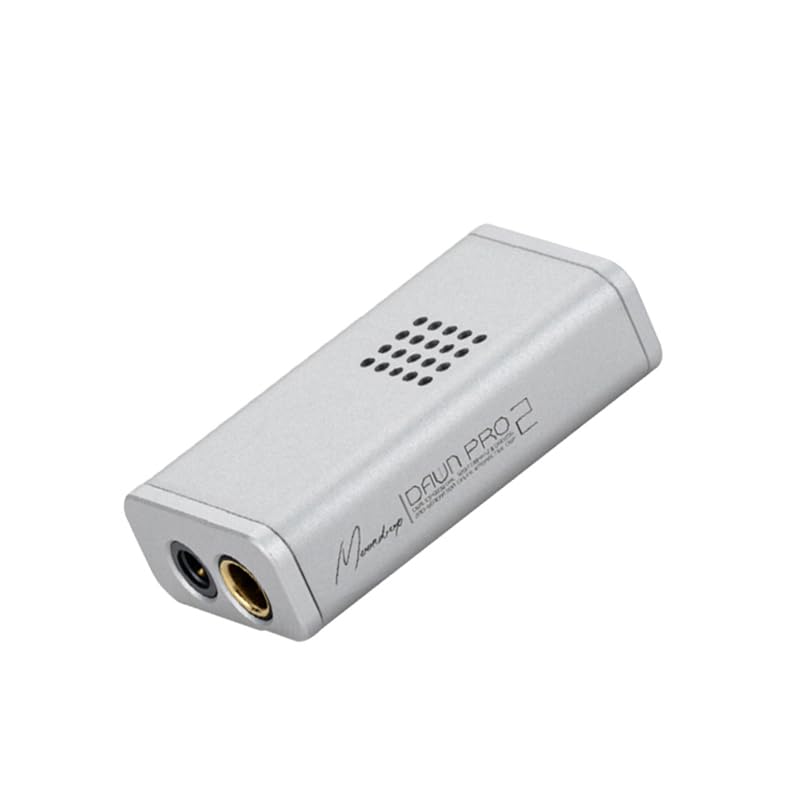
The Moondrop Dawn Pro 2 uses dual Cirrus Logic CS43198 flagship DAC chips in a genuinely compact USB-C dongle format, paired with a 100-level lossless volume control that keeps signal integrity intact as you dial the level. The 3.5mm single-ended output drives most IEMs cleanly, but the real value lives in the 4.4mm balanced output, which delivers a measured 4Vrms and 124mW per channel — more than enough headroom to properly energize Audeze LCD-X or Sennheiser HD599 without distortion.
What sets the Dawn Pro 2 apart from other dongles at this level is the companion MOONDROP app that provides a browser-based parametric EQ interface. You can adjust filter type, frequency point, gain, and Q value for each of multiple bands, then sync the profile directly to the device. This means you can correct for a headphone’s frequency response quirks — taming a peak in the upper treble or adding a subtle bass shelf — without adding any additional software latency on the source itself.
Aviation-grade aluminum alloy housing with CNC machining gives it a dense, cool-to-the-touch feel that inspires confidence, and the heat dissipation vents are positioned above the chipset to prevent thermal throttling. The main drawback reported by users is that the EQ settings reset to default every time the dongle is unplugged — a quirk that becomes tedious if you switch between devices frequently. A small number of units have also exhibited finicky 4.4mm connector seating that requires a precise insertion angle to achieve full output.
Why it’s great
- Dual CS43198 chips with 4.4mm balanced output delivering clean 4Vrms
- App-based parametric EQ allows per-headphone tuning without PC software
- Solid aluminum construction with good thermal management
Good to know
- EQ profiles reset when the device is disconnected
- Occasional QA issues with 4.4mm jack seating depth
- App EQ interface has a learning curve for beginners
3. Questyle M12i

The Questyle M12i is the first dongle DAC in this guide to carry official MFi (Made for iPhone/iPad) certification, meaning it communicates over the Lightning-to-USB-C chain with guaranteed iOS compatibility and power consumption within Apple’s strict limits. Inside, the ESS ES9281AC flagship DAC supports PCM up to 768kHz/32-bit and native DSD512, paired with Questyle’s patented Current Mode amplifier technology that achieves a noise floor below -130dB — effectively inaudible even with ultra-sensitive multi-driver IEMs.
That sub-130dB noise floor is the defining feature here. Most budget DACs in this tier have a noise floor around -110dB to -115dB, which can become audible as a faint hiss when no music is playing, especially with BA-driver IEMs. The M12i eliminates that entirely, delivering a black-silence background that lets micro-detail emerge naturally. The frequency response extends beyond 80kHz without roll-off, which is technically Hi-Res compliant but more importantly ensures phase linearity throughout the audible band.
Owners report that the M12i punches above its price in terms of separation and transparency, trading some dynamic slam and bass punch compared to the higher-end M15i but exceeding expectations for the form factor. The included USB-C to USB-A converter ensures broad compatibility with desktop PCs and older laptops. The main caveat is the reported fade-in effect on playback start or track skip — users note the first two seconds of a song are sometimes attenuated before full volume locks in, which is distracting when switching tracks frequently.
Why it’s great
- Ultra-low noise floor (-130dB) eliminates hiss with sensitive IEMs
- MFi certification guarantees seamless iPhone/iPad compatibility
- Current Mode amp technology delivers clean, detailed sound exceeding the price tier
Good to know
- Noticeable fade-in effect at the start of each track
- Draws significant battery from the phone during use
- Some units have exhibited soldering QA issues on the 3.5mm jack
4. Fosi Audio DS1

The Fosi Audio DS1 installs the ESS ES9038Q2M DAC chip — a premium part often found in desktop components costing several times more — into a compact dongle enclosure, and backs it with a genuine 220mW of output power through the 4.4mm balanced connection. That power figure is measured into 32Ω, which is enough headroom to drive 300Ω Sennheiser HD 600-series headphones to satisfying listening levels without pushing the amplifier into its distortion ceiling, a rare capability in the budget segment.
The dual-output topology (3.5mm single-ended + 4.4mm balanced) gives the DS1 flexibility that few competitors at this price match. The 3.5mm output is adequate for sensitive IEMs, while the 4.4mm delivers the voltage swing needed for demanding planars or high-impedance dynamics. THD+N is rated at under 0.0006%, and the signal-to-noise ratio exceeds 120dB, which translates to a clean, open sound with well-defined, fast bass and articulate highs that avoid the harshness typical of early ESS Sabre implementations.
The main trade-off is heat generation — users consistently report the DS1 becomes noticeably warm during extended listening, especially when driving high-impedance loads on the balanced output. The volume control buttons provide stepped adjustment independent of the source, but there is no visual indicator of the current volume level, making it easy to accidentally startle yourself with a loud signal after unplugging. Compatibility with certain phones, notably the Google Pixel 8 series, is unreliable, with some units producing ear-splitting static.
Why it’s great
- 220mW from 4.4mm balanced output drives 300Ω headphones comfortably
- ESS ES9038Q2M chip delivers reference-grade detail and low THD+N
- Dual 3.5mm and 4.4mm outputs for flexible IEM/headphone pairing
Good to know
- Runs hot during extended high-load use
- No visual volume level indicator on the device
- Incompatibility issues reported with Google Pixel 8 series
5. Douk Audio K5

The Douk Audio K5 breaks the dongle mold entirely — this is a desktop DAC/preamp/headphone amplifier with a wider feature set than any portable USB stick can offer. It uses the same ES9038Q2M DAC chip as the Fosi DS1, but pairs it with a SA9312 DSP processor, OPA1678 low-pass filter op-amp, and a SGM8262 amplifier stage to deliver 560mW per channel into 32Ω through a 6.35mm headphone jack. That is enough clean power to drive 600Ω headphones to satisfying levels with high/low gain modes to match.
The connectivity is what distinguishes the K5 from the rest of this list. It accepts USB-C and SPDIF optical inputs, and outputs through optical, RCA (for powered speakers), and both 6.35mm and 3.5mm headphone jacks. The tone control section adds bass and treble adjustment with a midpoint detent and a PURE bypass switch that removes the tone circuitry from the signal path entirely for purist listening. The USB-C port can power the unit directly, but an included external power adapter ensures stable voltage for demanding loads.
The all-aluminum chassis is substantially larger than a dongle but still compact enough at 3.74 x 3.62 inches to sit neatly beside a monitor. The LED indicators clearly show the current sampling rate and input mode. The main drawbacks are the form factor — this is not portable and requires a desk setup — and a small number of owner reports about defective 3.5mm headphone mini-jack outputs on early units. The 6.35mm jack, however, works flawlessly and delivers distortion-free, crystal-clear audio.
Why it’s great
- 560mW output power drives 600Ω headphones with gain switching
- USB, optical, RCA, and dual headphone jacks for complete desktop integration
- Tone controls with PURE bypass offer tonal flexibility without signal degradation
Good to know
- Non-portable desktop form factor requires desk space
- Some early units had QA issues with the 3.5mm headphone output
- Requires separate power adapter for full output (included)
6. CrinEar Protocol Max
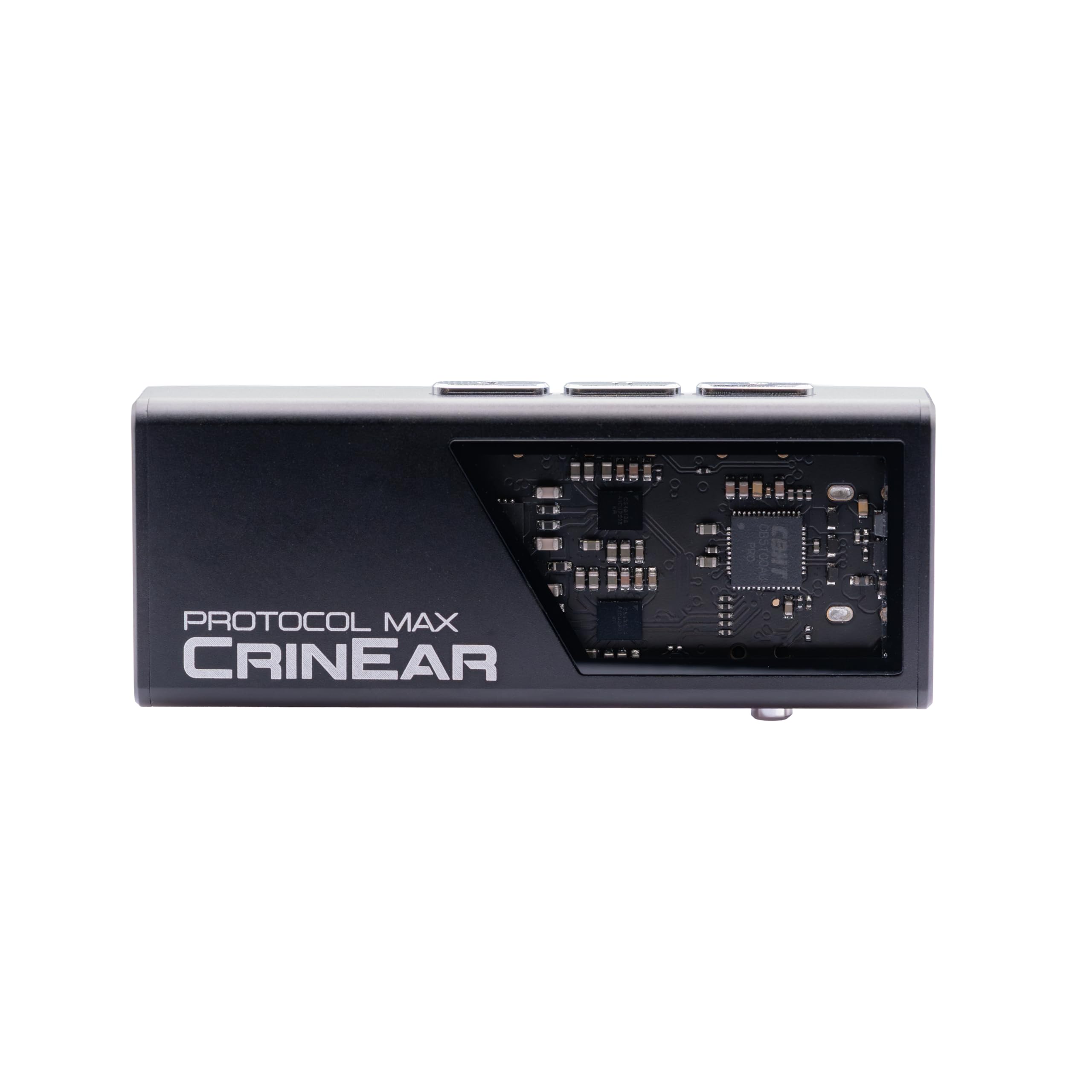
The CrinEar Protocol Max is the most powerful dongle in this lineup by raw output specs — 600mW through the 4.4mm balanced connection — and the most feature-rich, with a browser-based 10-band parametric EQ that saves profiles directly to the device’s onboard memory. Dual Cirrus Logic CS43198 DAC chips handle decoding up to 32-bit/384kHz and DSD256, while dual SG Micro SGM8262-2 operational amplifiers do the heavy lifting for current delivery.
The 10-band PEQ is the headline feature. You connect the Protocol Max to a PC via USB-C, open the configuration page in a browser, and adjust center frequency, Q-factor, and gain for each of the 10 bands. The EQ is fully parametric, not graphic, meaning you can surgically correct a 6kHz peak in your headphones or add a gentle 20Hz shelf without affecting adjacent frequencies. Once saved, the profile persists on the device even when connected to a different source — no app installation required.
The dual power modes (Eco and Boost) let you trade between battery drain and headroom. In Boost mode, the Protocol Max powers Sennheiser HD 650 to punishing levels at just 25% volume on the 4.4mm output. Eco mode reduces current draw for sensitive IEMs where 600mW would be overkill. The build is sleek aluminum, and the volume/pause controls are integrated into the chassis. The compromise is significant battery drain on phones, especially in Boost mode, and the EQ setup requires a desktop browser — there is no mobile companion app.
Why it’s great
- 600mW balanced output is the most powerful in this budget tier
- 10-band PEQ with device-persistent profiles eliminates need for source software
- Dual power modes optimize for battery life or maximum headroom
Good to know
- Significant phone battery drain in Boost mode
- EQ configuration requires a desktop browser; no mobile app
- Some early units had channel buzzing issues that were resolved via replacement
7. S.M.S.L DS100

The S.M.S.L DS100 is a miniature desktop DAC that prioritizes source flexibility and ultra-low distortion over raw output power. It uses the Cirrus Logic CS43131 DAC chip — a single-chip solution that combines DAC and headphone amplifier in one package — paired with the third-generation XMOS XU-316 USB controller that handles PCM up to 32-bit/768kHz and native DSD256. Total harmonic distortion is measured at 0.00017% (-115dB), which is genuinely reference-grade and competitive with desktop DACs costing triple the price.
Connectivity is the DS100’s strongest card. It accepts USB, optical (TOSLINK), and coaxial digital inputs, with automatic input switching and a front-panel button to cycle between sources. Outputs include both a 6.35mm and a 4.4mm headphone jack, plus RCA line outputs for connecting to a separate amplifier or powered monitors. The volume knob is analog and remembers its position even after the unit loses power, a detail that many desktop DACs at this level get wrong. The CK-03 clock processing circuit reduces jitter effectively, keeping timing errors below audible thresholds.
The aluminum chassis is CNC-machined with gold-plated connectors and measures just 3.5 inches square, making it genuinely compact for desktop use. The DS100 can drive 600Ω headphones with its 7Vrms output, though the 61mW into 16Ω specification means it pairs better with high-impedance dynamics than with power-hungry planar magnetics. Windows users must install the dedicated driver from the SMSL website, as USB Audio Class 2.0 is not natively supported on that platform. The headphone amplifier section is clean but not the last word in dynamics compared to dedicated desktop amps.
Why it’s great
- Ultra-low THD of 0.00017% (-115dB) for reference-grade clarity
- USB, optical, and coaxial inputs with volume memory on power loss
- XMOS XU-316 controller supports 768kHz PCM and native DSD256
Good to know
- Windows requires manual driver installation from SMSL website
- Limited output power (61mW @16Ω) for very demanding planars
- Requires separate 3.5mm adapter for IEM users who prefer that connector
FAQ
Do budget DAC amps make a noticeable difference on Spotify or Apple Music?
Can a budget USB dongle DAC drive 300-ohm headphones like the Sennheiser HD 600?
What is the difference between single-ended and balanced output?
Final Thoughts: The Verdict
For most users looking for a portable upgrade, the best budget dac amp winner is the FiiO KA1 because it delivers the most balanced combination of sound quality, build durability, and universal compatibility at an entry-level price point. If you want the flexibility of app-based parametric EQ and a 4.4mm balanced output, grab the Moondrop Dawn Pro 2. And for dedicated desktop use with multiple source inputs and reference-grade distortion figures, nothing beats the S.M.S.L DS100.