
Our readers keep the lights on and my morning glass full of iced black tea. As an Amazon Associate, I earn from qualifying purchases.
Specs are compiled from manufacturer listings and verified buyer reviews and can change over time — please confirm the key details on the product page before buying.
You want a dash cam that actually helps when something goes wrong — a plate you can read, a clip that survived the crash, a camera that did not cook in a hot car. Everything else is marketing. The nine picks below all sit in the affordable end of the market, and each one earns its spot for a different reason: some shoot in 4K (3840×2160 pixels, enough detail to pull a plate off a still image), some watch three angles at once, and a few are simply the cheapest thing that still works every single day.
I’m Min — the founder and writer behind Gadgets Feed. This guide is built by comparing the manufacturers’ published specifications and the patterns across verified customer reviews, so you get each pick’s real strengths and trade-offs instead of marketing spin.
Two specs decide almost every dash cam purchase: the resolution you record at and how the camera survives heat, because a recorder that quits in July is worth nothing. Below you will find the full breakdown of each pick, what owners genuinely think, and the honest limits nobody puts on the box. This is the practical, no-hype shortlist of the best budget dash cam for everyday drivers.
Our Picks at a Glance

How To Choose The Best Budget Dash Cam
Buying cheap does not mean buying blind. Three or four specs do almost all the work in this category, and if you get them right the rest is detail. If you get them wrong, you end up with a camera that records a blurry grey smear exactly when you need a licence plate.
Resolution: what the numbers really buy you
Resolution is simply how much detail the sensor captures. A 1080P camera records 1920×1080 pixels, which is sharp enough to show the shape of a car and the colour of a light, but it can struggle to resolve a plate on a moving vehicle at distance. Step up to 1440P or 4K and you are buying the ability to zoom into a frozen frame and still read the registration. A 4K sensor packs in four times the pixels of 1080P, which is why the premium picks here lead with 4K front cameras while budget models stick to 1080P or 1440P.
Heat: the silent killer of cheap dash cams
A dash cam lives on your windscreen, in direct sun, behind glass. That is brutal for small electronics. The best budget dash cams use a supercapacitor — a component that stores power without the flammable gel inside a lithium battery — because it handles heat far better than a battery does. A camera with a lithium cell can work fine in mild weather and fail after a summer. If you park outside in a hot climate, this one spec matters more than resolution.
Night vision, aperture and the honest limit
Night footage is the hardest thing a dash cam does. The key number is aperture, written as an f-number, and a smaller number means a bigger hole that lets in more light. F1.8 and F1.55 are the values you will see here, and both gather more light than the slower lenses found on the cheapest generic cams. No budget camera turns a dark road into daylight, and any review claiming otherwise is overselling. What good night vision actually delivers is a readable plate under streetlights and a clear outline of a vehicle in near-darkness.
Coaching versus rear versus cabin cameras
Think about what you need to prove. A single front camera proves what happened ahead of you. Add a rear camera and you cover tailgating and rear-end hits. Add a cabin camera and you also record what goes on inside — the reason rideshare and taxi drivers choose a three-channel setup. More channels means more wiring, so weigh that against how much of the car you actually want on record.
Quick Comparison
| Model | Best For | Front Resolution | Field of View | Memory Support | Amazon |
|---|---|---|---|---|---|
| 4K+4K+1080P 3 Channel Dash Cam (Terunsoul)★ Best Overall | Full three-angle coverage | 4K front, 4K rear, 1080P cabin | 170° front | Up to 512 GB | Amazon |
| Avylet 2K Dash CamBest for Discreet Fit | Discreet daily recording | 1440P | 150° | Up to 128 GB | Amazon |
| JOMISE J6 4K Dash CamBest Night Clarity | Clear plates day and night | 4K | 170° | Up to 256 GB | Amazon |
| Galphi M2 3 Channel Dash Cam | Rideshare and cabin coverage | 2.5K | 160° | Up to 512 GB | Amazon |
| RexingUSA V1 Basic | Simple one-camera setup | 1080P | 170° | — | Amazon |
| Milerong Dual Dash Cam Front and Inside | Driver-and-passenger recording | 1080P | 170° | Up to 64 GB | Amazon |
| FAIMEE 4K Dash Cam | 4K front plus rear detail | 4K | 170° | Up to 256 GB | Amazon |
| 70mai A800SE | Fast Wi-Fi transfers | 4K | 140° | Up to 512 GB | Amazon |
| 70mai A810 Lite | Remote access and GPS | 4K | 140° | Up to 512 GB | Amazon |
In‑Depth Reviews
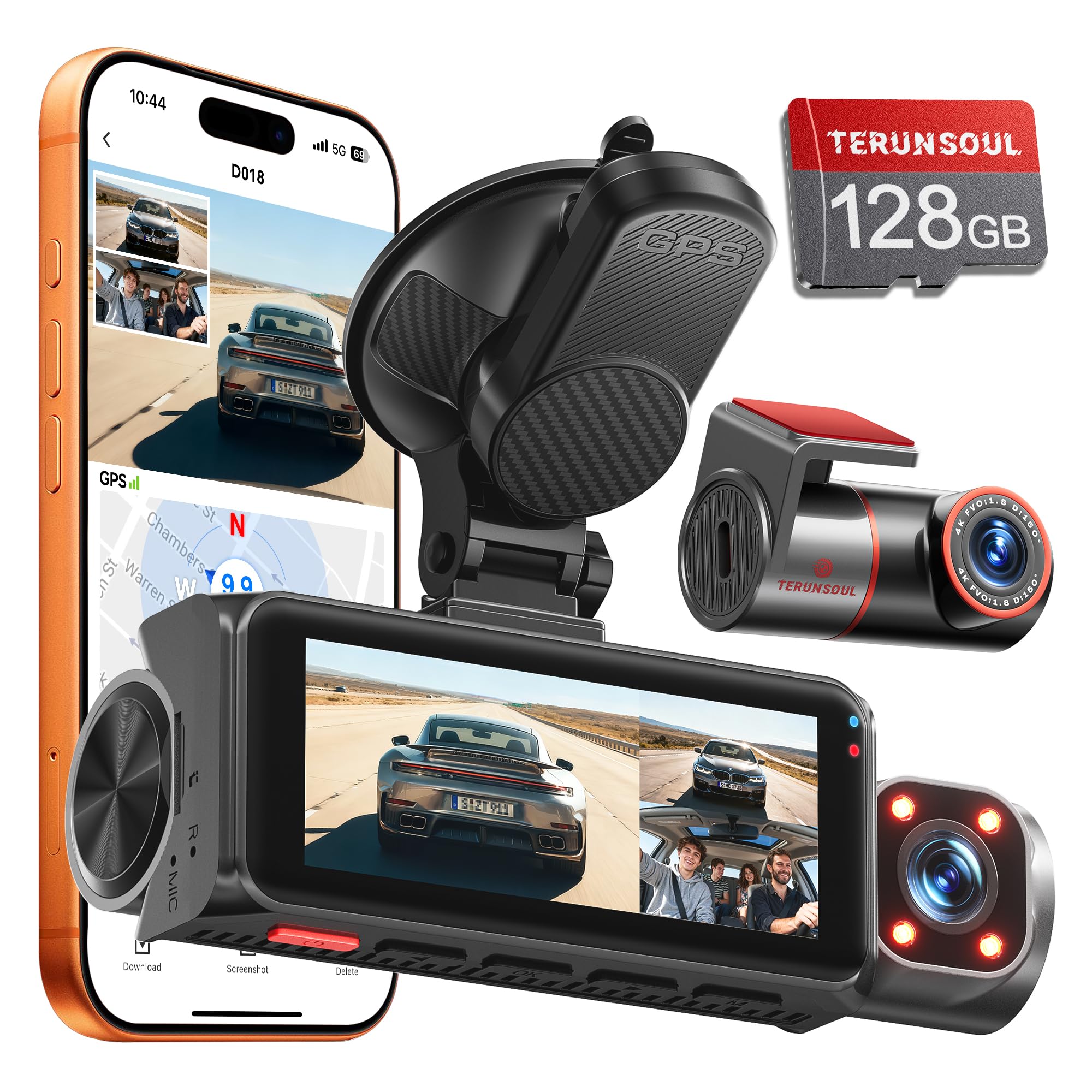
1. 4K+4K+1080P 3 Channel Dash Cam, Free 128GB Card, Terunsoul
Our pick — over 4.5★ from 200+ verified ratings; the strongest balance of quality and price.
Three cameras, three angles, and the highest owner satisfaction on this whole list.
Here is the pick that covers absolutely everything: a 4K front camera, a second 4K camera for the rear, and a 1080P cabin camera for the interior. That is genuine triple coverage — road ahead, road behind, and everyone inside the car — which is why it takes the top spot. The cabin lens pairs with four infrared lights, so it keeps recording a usable image of the interior even in complete darkness. For rideshare drivers, that is the difference between “the passenger said” and a clip everyone can watch.
You see more of the road with a 170-degree field of view (the angle the lens sees) on the front lens, and 150 degrees on the rear and cabin lenses — so fewer blind spots at junctions and roundabouts. It also comes with a 128GB card already in the box rather than making you buy one, and the slot accepts up to 512GB — a big jump over the 128GB ceiling on the Avylet further down this list, so you can archive weeks of driving before anything gets overwritten. Footage moves to your phone over dual-band Wi-Fi 6 (5.8GHz plus 2.4GHz), which is the newer, faster flavour of Wi-Fi, at transfer speeds quoted up to 20MB/s.
What wins people over is the overall build and image quality — it is far and away the most-discussed strength here. Setup is rated just as highly, with owners describing a straightforward job of sticking the front and rear units to the glass. Night vision gets the same warm reception, and the free app handles everything from settings to over-the-air updates without a computer. The 3.18-inch screen uses a laminated panel that cuts reflections. Built-in GPS stamps your speed and location onto the footage, which can matter when an insurer asks what actually happened. The catch: the 24-hour parking monitor needs a separate hardwire kit, which is not included, so the always-on watch feature is an extra step rather than something you get on day one. It holds 4.8 stars across 200+ ratings, the highest on this list.
What earns it first place
- 4K front, 4K rear and 1080P cabin in one kit — full coverage with no add-ons
- 128GB card included and support up to 512GB
- Four IR lights keep the cabin visible in the dark
- Dual-band Wi-Fi 6 with transfer speeds quoted up to 20MB/s
Where it asks more of you
- Parking mode needs a hardwire kit sold separately
- Three cameras means more cabling to route than a single-lens unit
Get this if: you want the fullest possible picture of every journey and you are happy to add a hardwire kit later for overnight parking.
Look elsewhere if: you only need one camera pointed forward and would rather not route extra wires.
2. Avylet 2K Dash Cam 1440P
The one you forget is there until you need it — small, sharp, and easy to live with.
At 1440P resolution, which works out at 2560×1440 pixels, this camera reads plates, road signs and traffic details clearly. The screen measures just 1.5 inches on the diagonal, and the whole unit tucks behind your rearview mirror without stealing your view of the road. That compact footprint is the thing buyers keep coming back to — it is the stand-out praise in the owner feedback, ahead of the picture quality itself. If you have ever driven with a bulky cam dangling in your eyeline, you will appreciate the difference immediately.
You get fewer blind spots from the 170-degree lens, and the F1.6 aperture — a wider opening than the F1.8 lens on the RexingUSA V1 Basic below, so it lets in more light — is paired with a six-element glass lens for scratch resistance and heat tolerance. WDR, which stands for wide dynamic range, automatically balances the exposure so bright headlights and dark shadows in the same frame both stay readable. The field of view covers 150 degrees. Records at frame rates of 1, 2, 5 and 10 FPS (frames per second, how many images it captures each second) depending on mode.
You can manage settings, watch a live feed and play back footage directly on the camera itself as well as your phone, and the app needs no subscription. It even accepts over-the-air firmware updates without a computer or cable. As buyers report: “Compact dash cam, easy setup, good screen, swivel mount for unobstructed wide-angle rear view, includes 32GB SD card.” Two honest notes from the owner pool: the app asks for broad phone permissions, and on older cars the camera’s Wi-Fi can knock out your CarPlay connection while it is running. Neither stops the recording — they are small friction points on an otherwise tidy little unit.
The real-world read: Daytime footage is crisp and legible, and the swivel mount lets you aim the lens where you actually want it rather than where the bracket happens to point.
Worth knowing: The card slot tops out at 128GB, which is the smallest ceiling among the multi-channel picks here — fine for daily driving, tighter if you hoard clips.
Perfect match for: drivers who want a near-invisible camera that records plainly and never distracts.
Think twice if: you run CarPlay on an older head unit or want a camera that also watches the rear and cabin.
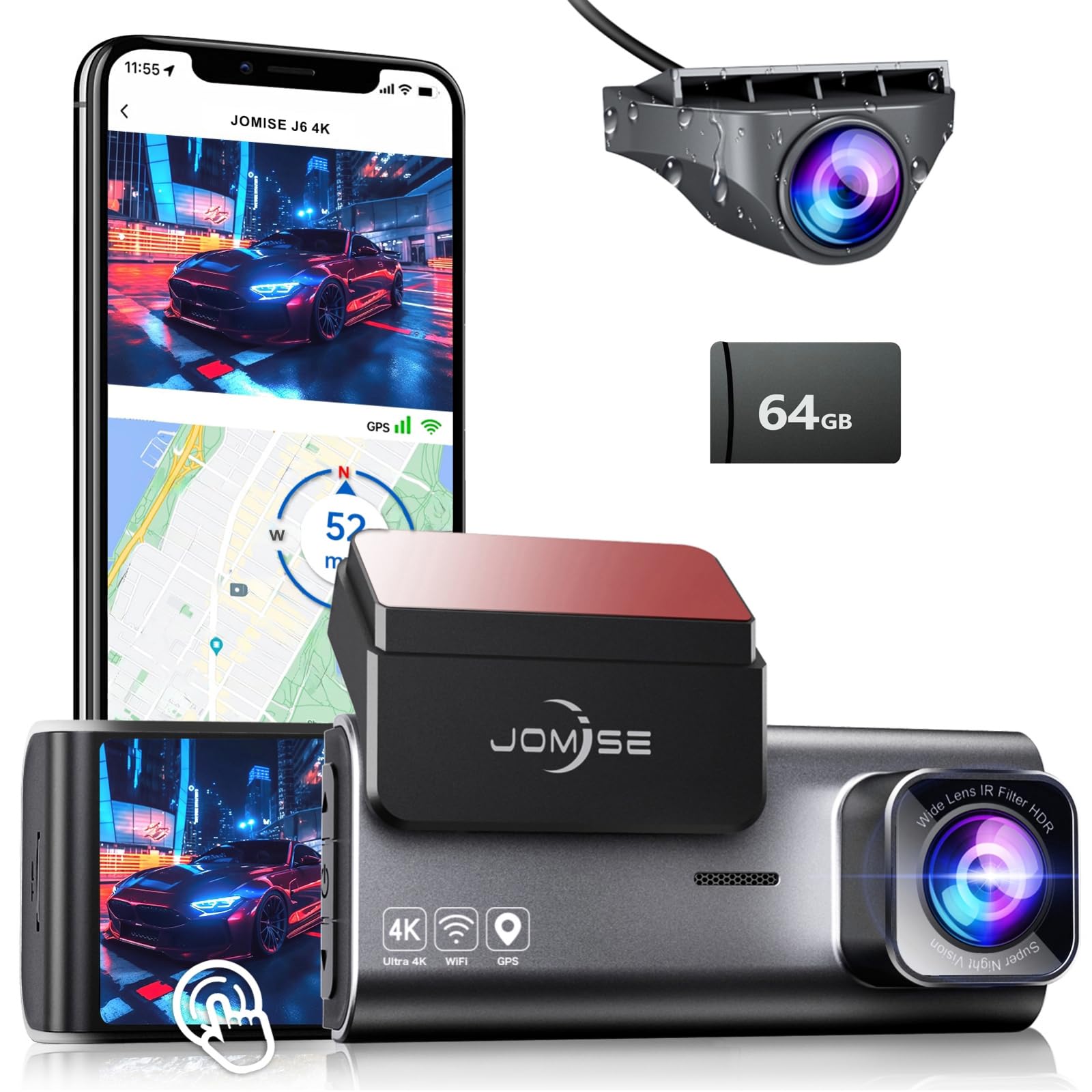
3. JOMISE J6 4K Dash Cam Front and Rear
Pair a 4K front with a 1080P rear and you get evidence from both ends of the car.
A 64GB card is already fitted, so this one records the moment you plug it in. The front camera shoots in 4K at a 170-degree angle; the rear runs 1080P at 140 degrees and is rated IP68, a waterproofing standard that signals a sealed housing built for the outside of the car. The STARVIS 2 sensor — a light-sensitive image chip — works alongside an F1.6 aperture and WDR to cut noise in dark tunnels and on unlit roads. The front and rear both log plates, and a single button press locks the current clip so a hit-and-run cannot be overwritten.
Instead of a lithium battery, this one uses a supercapacitor, a component that stores power without the heat-sensitive gel a battery carries. JOMISE quotes an operating range from -4°F to 158°F, which matters if your car bakes in a summer car park. The built-in GPS logs route, speed and timestamps for the front footage, and recording runs at 30 FPS — the smooth, standard frame rate. Maximum card size is 256GB. Wi-Fi lets you preview and download clips to the app without pulling the card or touching a computer.
Owners rate the build quality highest of all, with image quality following right behind — that is the strongest signal in the feedback. The rear camera is one recurring soft spot: bright headlights behind you can wash it out, though plates still tend to come through. Bright oncoming traffic on the front lens draws some glare complaints too. And one recurring gripe is app setup — the listing itself notes the app has been renamed to 「Road Cam」, so follow that name rather than the older one printed in the manual. JOMISE covers non-accidental faults for 12 months.
Where it stands out: front-and-rear coverage at 4K and 1080P respectively, with a 64GB card fitted and a heat-tolerant supercapacitor doing the heavy lifting.
The honest limit: the app name change catches some buyers off guard, and the rear lens can flare under strong headlights at night.
The right buy for: anyone in a hot climate who wants both ends of the car recorded and prizes night plate readability.
Probably not for: buyers who want the cabin covered as well — that job belongs to the three-channel picks on this page.
4. Galphi M2 3 Channel WiFi Dash Cam
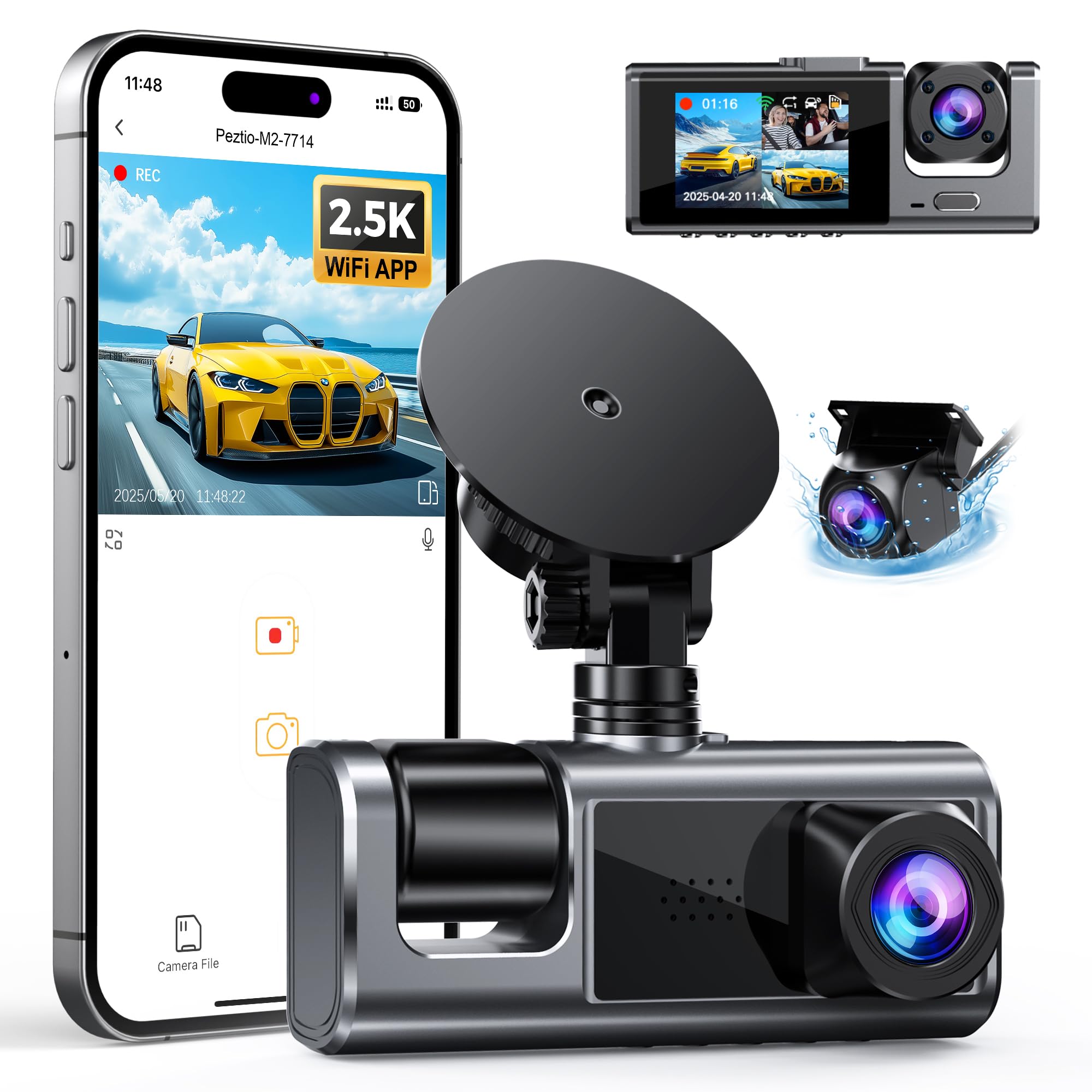
Three rotating cameras, crisp plates, and the quickest install on this list.
Front, inside and rear, all in one slim body — the M2 records 2.5K up front and 1080P for both the cabin and rear lenses, so a rideshare shift or a family road trip is fully documented. The Sony IMX sensor and IR cabin camera keep the interior visible in low light, and three adjustable heads let you angle each lens exactly where you need it. That flexibility suits sedans, SUVs, trucks and minivans alike.
Storage is the easy part: this one accepts up to 512GB of microSDXC (a high-capacity card format), which is the joint-highest ceiling here alongside the Terunsoul and the two 70mai units. The free app needs no subscription — adjust settings, watch live, and download footage straight to your phone. A Type-C hardwire kit open up the 24-hour parking mode, which keeps recording at a low frame rate after the ignition is off. You also get spoken status notifications so you are not staring at the screen while driving.
Setup and picture quality rank as the top strengths in the owner feedback, with value and reliability close behind — an unusually balanced set of positives. One thing worth flagging: the packaging no longer includes an SD card, so budget for one unless you already own a spare. A handful of units have needed a replacement, and the brand has handled those without argument. Buyers also note it needs continuous power — it is not wireless — and at least one owner received a C-to-C cable to sort that out.
Why drivers pick it
- 2.5K front plus 1080P cabin and rear, all three lenses adjustable
- Accepts up to 512GB of storage for long recording stretches
- Voice notifications keep you informed without looking down
- Works across cars, SUVs, trucks and minivans
Small print to know
- No memory card in the box — buy one separately
- Parking mode needs the Type-C hardwire kit, sold separately
Made for: rideshare and taxi drivers, or anyone who wants a triple-camera safety net with room to grow the storage.
Not the pick if: you want the card included and would rather not source a hardwire kit for parking coverage.
5. RexingUSA V1 Basic 1080p Dash Cam

One lens, 1080P, and the cleanest no-fuss install in this whole roundup.
Not every driver needs three cameras. If a single forward view is all you want, this is the one to reach for: Full HD 1080P recording at 30 frames per second, which is the standard smooth frame rate for road footage. The F1.8 aperture and WDR keep night images sharp without needing extra light, and the 170-degree lens cuts the blind spots that a narrow lens leaves at junctions and car parks.
A built-in G-sensor — a motion sensor that feels a sudden jolt — locks the current clip the moment it detects a collision, so the footage cannot be wiped by the loop recording that overwrites older files. The parking monitor wakes the camera and records when it senses vibration. The body sits low and hidden on the windscreen, and the 2.4-inch LCD screen lets you check and replay clips on the spot. Rexing backs it with an 18-month warranty and live phone support.
What owners value most is that it simply works, with image quality a close second. Repeated owners mention a lot here — there are drivers on their third unit, with the oldest still running through Houston heat after years of service. Be clear-eyed about the resolution, though: 1080P footage can struggle to resolve distant plates and faces, so this camera is about proving the sequence of events, not zooming into a registration across an intersection. An occasional unit gives up early; treat the 18-month warranty as your safety net.
top-tier job: reliability and setup, which is the top praise in the feedback — it records, it hides, and it does not fuss.
Set expectations: the detail ceiling stops at 1080P, so distant fine print on plates may not survive a zoom.
Best for: first-time buyers and anyone who wants one dependable camera facing forward with a warranty behind it.
Step up if: you need to read plates at distance or cover the cabin and rear — spend a little more and get a multi-channel kit.
6. Milerong Dual Dash Cam Front and Inside

A no-app, no-Wi-Fi pair of lenses for drivers who just want it to record.
No Bluetooth, no Wi-Fi, no app, no GPS, no subscription — this dash cam is deliberately simple. It comes with a 64GB card already included, so there is nothing else to buy on day one. The front lens covers 170 degrees and the cabin lens 140 degrees, both recording dual 1920×1080 video at 30 frames per second. For a driver who finds phone apps fiddly, that stripped-back design is a genuine feature rather than a shortfall.
Night work is handled by an F1.8 aperture plus four IR lights (infrared lamps that record in the dark without visible beams) with WDR balancing the exposure. The camera can capture the driver and passengers even in complete darkness, and there is a toggle if you would rather keep the interior in normal colour than the grey IR view. The G-sensor locks footage on a collision, and loop recording overwrites the oldest files so you never run out of space. Parking mode wakes it to shoot a burst of video on impact — a hardwire kit is needed for round-the-clock operation.
Buyers prize the overall quality most, with value close behind — the sense that this delivers a lot for the outlay. The honest trade-off runs through the rest of the feedback: recording reliability and video quality get a mixed reception, so it is worth treating this as a starter camera that proves basics rather than a precision evidence tool. A few customers note the suction mount can slip in high heat, and the unit is rated for a maximum of 125°F — if you park in desert heat day after day, look for a model with a supercapacitor (a heat-resistant power component that replaces the battery) instead. For everyone else, it is cheap, complete, and quick to fit with no app to fumble with.
What it does well
- Front and cabin cameras with a 64GB card included
- No app, no subscription, no Wi-Fi login to deal with
- Four IR lights keep the cabin visible in the dark
- Plug into the cigarette lighter and it starts recording automatically
Worth weighing
- Video quality and recording reliability draw mixed reviews
- Rated only up to 125°F, so it is not built for extreme desert heat
A solid starting point for: new drivers, occasional users, and anyone who wants dual-camera coverage without an app.
Consider upgrading if: you park in relentless summer heat or need footage sharp enough to read plates at range.
7. FAIMEE 4K Dash Cam Front and Rear

4K up front, 2K out back, and more hot-climate survival stories than any rival here.
FAIMEE pushes both cameras up the resolution ladder: a 4K front sensor at 3840×2160 and a 2K rear at 2304×1296, with 170-degree lenses that cover up to six lanes of traffic. The F1.8 aperture, WDR and night vision work together to keep footage sharp when the light drops or the contrast spikes between glaring headlights and dark road. A 64GB high-endurance card ships in the box, and the slot accepts up to 256GB.
You get speed, route and location coordinates logged straight into your footage with built-in GPS (a satellite position tracker), while dual-band Wi-Fi at 5.8GHz and 2.4GHz keeps the phone connection fast and stable — the same dual-band approach as the Terunsoul at the top of this list. A 3-inch IPS screen sits on the body, and the stick-on mount tucks the whole thing discreetly behind your mirror. Loop recording overwrites the oldest clips automatically, and the G-sensor (a small motion sensor that detects a bump) locks the current file the instant it feels an impact so the important footage is preserved. Time-lapse mode records at a low frame rate for round-the-clock parking coverage, though the hardwire kit is a separate buy.
Installation is the standout in the owner feedback — most people are done in under twenty minutes, cords hidden — with overall quality running neck and neck for the top mention. The 4K footage draws consistent praise for detail, and one owner reports the camera paid for itself inside a week. The recurring nuisance is the crash detection, which can be a touch sensitive and buzz on every bump; if that wears on you, dial it back in the menu. The on-screen menu wording has also drawn a few grumbles.
The headline: 4K front and 2K rear, GPS logging and dual-band Wi-Fi, all with a 64GB endurance card in the box.
A small adjustment: the G-sensor fires easily — most owners simply lower its sensitivity.
A clean fit for: drivers who want high-resolution coverage on both ends of the car and value detailed GPS records.
skip it if: you want to avoid fiddling with sensitivity settings or need the cabin on camera too.
8. 70mai A800SE 4K Dash Cam Front and Rear

A 4K front camera and a rear lens that swivels to watch the cabin or the road behind.
The rear camera here is the clever bit: it can be angled to record either inside the cabin or behind the car, so you get to decide what the second lens watches. The front shoots 4K at 140 degrees and the rear 1080P, capturing plates, signs and driving detail from more than one angle. A 128GB card comes fitted, and the slot takes up to 512GB — four times the 128GB ceiling on the Avylet above, so you can keep far more footage before anything cycles out.
Night work leans on a 7-layer glass lens, an F1.55 aperture and dual HDR, the exposure-balancing tech that keeps dark tunnels and glaring rain readable. The G-sensor locks clip on impact, loop recording handles the overflow, and a 24-hour parking monitor is available as an optional add-on rather than a standard fit. Built-in Wi-Fi 6, the newest flavour of the wireless standard, is quoted at up to five times the transfer speed of older Wi-Fi cams, so downloads to your phone are quick. ADAS — advanced driving assistance, in plain terms lane-departure and forward-collision voice alerts — nudges you when you drift or close in too fast, and over-the-air updates keep the software current. Recording runs at 24 or 30 FPS depending on mode.
Reliability is the most-praised trait in the feedback, with video quality a whisker behind — owners lean on the phrase set-and-forget for good reason. Installation draws warm words too, and the 18-month warranty covers early failures. The honest caveat is night resolution: several owners find the low-light footage softer than the daytime 4K, with plates harder to read on badly lit or fast-moving roads. Connectivity and cable length both pull mixed notes, so if your car has an awkward power-socket position, plan your route before you start.
Strong on: flexible rear-lens aiming, a 128GB card in the box, and Wi-Fi 6 downloads that are quoted far faster than standard Wi-Fi units.
The trade-off: night detail softens, and the parking monitor is an optional extra rather than included.
Well matched to: frequent drivers who move a lot of footage and want the second lens to watch wherever they choose.
Less ideal for: night-heavy driving where you need maximum low-light plate detail — the 70mai A810 Lite or JOMISE edge ahead there.
9. 70mai A810 Lite 4K Dash Cam

Credit-card sized, 4K up front, and it answers to your voice while you drive.
This one comes with a 64GB card fitted and records 4K at 3840×2160 up front with 1080P out back, so both ends of the journey are covered. The F1.55 aperture and HDR cut headlight glare and pull detail out of dark stretches. Add a three-mode GPS receiver — GPS, GLONASS and BDS, three satellite systems working together — and it logs speed, route and location straight into the playback. Voice control lets you start and stop recording hands-free, which keeps your eyes on the road.
The camera draws power from a supercapacitor rather than a battery, which is the heat-tolerant choice. Wi-Fi 6 at 5GHz transfers at up to 25MB/s, quoted faster than the 20MB/s figure on the Terunsoul at the top of this list, so moving a big clip to your phone is a quick job. The free app handles live view, playback, settings, GPS data and over-the-air updates. Parking mode covers two styles: G-sensor clips that lock on impact, and time-lapse recording for continuous low-power watch, with low-voltage protection built in to guard your car battery. The footprint is a compact, credit-card-sized shape at 9.76 ounces, and 70mai covers it with an 18-month warranty.
What owners single out most is the functionality — the sheer amount of features working as promised — with installation close behind. The 4K front camera earns repeated praise for reading plates and signs day and night, and it has already proved its worth for more than one owner in a real accident within days of fitting. Two caveats worth knowing: the main camera cable runs short for some vehicles, so check your routing, and connectivity pulls mixed notes, with a few drivers needing to switch off CarPlay to connect the app. Both are small snags on an otherwise well-rounded unit.
Where it leads: 5GHz Wi-Fi 6 at up to 25MB/s, three-mode GPS, voice control and a heat-tolerant supercapacitor in a compact body.
The honest catch: the main cable is on the short side, and a few drivers disable CarPlay to pair the app.
Built for: drivers who want fast downloads, precise GPS logs and hands-free control in a near-invisible unit.
Check first if: your car has an unusually long cable run or you rely on CarPlay during every trip.
Understanding the Specs
Resolution and field of view
Resolution is the pixel count the sensor captures, and higher numbers mean more detail to zoom into when you freeze a frame — 1080P shows the shape of things, 1440P reads signage, and 4K lets you pull a plate off a still image. Field of view is the angle the lens sees, expressed in degrees; 170 degrees is the widest you will find here and covers the most lanes, while 140 and 150 degrees trade a little width for less edge distortion. Wider is not automatically better — it spreads the same pixels over more ground. Pick the field of view that matches what you want to catch, and match resolution to how much detail you need to extract later.
Specialist vehicle CCTV systems
The storage ceiling is the largest card size a camera can read, and it decides how far back your footage reaches before loop recording overwrites the oldest files. Capacities here run from 128GB to 512GB, and a 128GB card can hold days of driving at typical settings. The aperture, written as an f-number, controls how much light the lens gathers — smaller numbers like F1.8 or F1.55 mean a bigger opening and better night footage. Loop recording is what keeps the card from filling: it erases the oldest clip as new ones arrive. The G-sensor locks the current file when it feels a jolt, so crash footage survives the overwrite. Parking mode is the always-on watch for when you are away, and it almost always needs a separate hardwire kit to run without draining a car battery.
FAQ
Do I need a hardwire kit for parking mode?
Is 1080P good enough for a budget dash cam?
What is the difference between a supercapacitor and a battery dash cam?
How much storage do I actually need in a dash cam?
Will a dash cam work in extreme heat or cold?
Do I need Wi-Fi and an app on a dash cam?
Can a dash cam record if the car is bumped while parked?
Is GPS in a dash camuseful or just a gimmick?
Do three-channel dash cams need more wiring than single-lens ones?
What happens to old footage when the memory card fills up?
Final Thoughts: The Verdict
For most drivers, the budget dash cam winner is the Terunsoul 4K 3 Channel Dash Cam because it records the road ahead, the road behind and the cabin all at once, ships with a 128GB card, and holds the highest owner satisfaction of any unit here. If night clarity and heat tolerance matter most to you, the JOMISE J6 is the one to reach for, with its STARVIS 2 sensor (a low-light image sensor) and -4°F to 158°F working range. And for the best mix of 4K front and rear detail with GPS and dual-band Wi-Fi, the FAIMEE 4K Dash Cam is the pick that keeps more drivers happy over the long haul.
If you want the safest first purchase and you are not sure what your car needs, start with the Terunsoul — it holds 4.8 stars across 200+ ratings, and the included 128GB card is one less thing to buy on install day. Whichever you choose, check your climate first, confirm the cable runs reach your rear window, and pick the resolution that matches the detail you actually need to prove.
How We Picked
We do not accept paid placement. Every pick is matched to a real buyer and a real use-case; we do not hands-on test units.
Sources & Methodology
Specifications: manufacturer listings and product documentation. Review insights: verified customer reviews, as of September 2026. Pricing: not shown on this page (it changes often); check the current price via the retailer link.
As an Amazon Associate, Gadgets Feed earns from qualifying purchases. This does not affect which products we feature.