
Our readers keep the lights on and my morning glass full of iced black tea. As an Amazon Associate, I earn from qualifying purchases.
Specs are compiled from manufacturer listings and verified buyer reviews and can change over time — please confirm the key details on the product page before buying.
If you fish from a kayak, a small boat, or even the shore, you face one stubborn problem: you have no idea what is happening under the water. You are casting blind. A budget depth finder changes that by telling you exactly how deep the water is and often where the fish are, without draining your wallet. The hard part is that most cheap models look similar on a store page but perform very differently once you drop a line.
I’m Min — the founder and writer behind Gadgets Feed. This guide is built by comparing the manufacturers’ published specifications and the patterns across verified customer reviews, so you get each pick’s real strengths and trade-offs instead of marketing spin.
After sorting through the specs and real-world feedback, these six picks make up the honest lineup for anyone searching for the best budget depth finder that actually earns its spot in your tackle box.
Our Picks at a Glance


How To Choose The Best Budget Depth Finder
Not all depth finders under a hundred bucks are the same. Some are castable sonar pods that send data to a handheld screen, while others are permanently mounted in your boat’s dashboard. Your choice depends on where you fish and how much setup you want to deal with.
Depth Rating vs. Real-World Use
A model rated for 300 feet might struggle in very thick ice or murky water, while a 147-foot unit works fine in a pond or shallow lake. The number on the box is the best-case scenario — check reviews for what it actually does in the conditions you fish.
Transducer Type: Castable vs. Wired
Castable (wireless) transducers are thrown into the water and send data to a screen on your wrist or boat. They are great for kayaks and shore fishing but have a shorter wireless range. Wired transducers mount to your boat’s transom and give a constant, more reliable reading at higher speeds.
Display Quality and Battery Life
A larger color screen helps you see bottom contours and fish icons more clearly, but it also drains the battery faster. Models with a rechargeable handheld unit usually last between 4 and 10 hours per charge, which is enough for a full day trip. Check if the unit uses standard batteries or a proprietary charger — losing a special magnetic charger can ruin a trip.
Quick Comparison
| Model | Best For | Max Depth | Display Size | Weight | Amazon |
|---|---|---|---|---|---|
| DANOPLUS Portable Wireless★ Best Overall | Pond and castable use | 147 ft | 2.4 in | 5.28 oz | $72.99Amazon |
| Humminbird 407860-1 HDR 650Also Great | Permanent dash install | 600 ft | 1.25 in | 0.73 lb | $92.99$169.99Amazon |
| FishPod 5X Bluetooth | Phone-screen fishing | 199 ft | 5 in | 0.05 lb | $86.65$90.96Amazon |
| Hawkeye DT1H Handheld | Open water & black ice | 300 ft | 3.5 in | 16 oz | $74.42$80.72Amazon |
| Yoocylii Xf-08 Handheld | Kayak and quick setup | 164 ft | 3.5 in | 10.4 oz | $99.99Amazon |
| LUCKY Portable FF-1108 | Budget all-in-one | 147 ft | 2.4 in | 0.33 lb | $82.89Amazon |
In‑Depth Reviews
1. DANOPLUS Portable Fish Finder DP-104
A lightweight 5.28-ounce castable finder that is the lightest and simplest entry point here.
The DANOPLUS DP-104 is a wireless castable system with a 2.4-inch color LCD screen and a sonar sensor that detects depth down to 147 feet. Buyers report it gives accurate depth readings in a pond and sends fish alerts for moving fish and even turtles. The sonar covers a 90-degree angle and the wireless sensor has a built-in light that turns on in water to attract fish. At 5.28 ounces, it is dramatically lighter than the Hawkeye DT1H at 16 ounces, making it easy to toss in a pocket or tackle bag.
The included rechargeable batteries in both the screen and the bobber are a plus, but one reviewer lost the small magnetic charger and was frustrated that it did not use a standard USB-C port. The fish alarm works as described, though some users noted it occasionally flags grass or debris as fish. For a quick and cheap way to start reading depth from the bank or a small kayak, this is the most beginner-friendly option on the list.
The Upside
- Lightweight at 5.28 oz — easy to carry anywhere
- Rechargeable sensor and screen save money on batteries
- Fish alarm works, buyers got real alerts for fish and turtles
The Downside
- Proprietary magnetic charger is easy to lose
- Sometimes confuses underwater grass with fish on the display
- Maximum depth of 147 ft is a third of the Hawkeye’s range
Pick this for: a first-time depth finder for pond fishing, shore fishing, or as a portable backup.
Pass if: you want to fish deeper than 147 ft or prefer a standard USB-C charger.
2. Humminbird 407860-1 HDR 650 In Dash Digital Depth Sounder
The permanent fix that reads deeper than anything else here — down to 600 feet.
This is for the boater who wants a clean, reliable depth reading built right into the dashboard. The Humminbird HDR 650 goes to 600 feet, at 600 feet versus the DANOPLUS model at 147 feet, so it handles far more than lakes and rivers. Buyers report it gives an accurate depth reading stationary up to about 10 mph, and with proper transducer placement it works well at idle and above 35 mph. The trade-off in depth capability is the tiny 1.25-inch LCD display — at 1.25 inches it is significantly smaller than the FishPod’s 5-inch screen.
Installation means mounting a transom transducer, so this is not for the grab-and-go kayak angler. The sealed waterproof design and included white, black, and chrome bezels let it blend into any boat dash. One reviewer on a 34-foot boat noted the included cable was long enough for a clean install. This is your pick if you want one depth finder that stays in the boat and reads deeper water without any fuss.
The 600-foot workhorse: Reliable depth at a wider range than any budget wireless unit, but the display is small and you are wiring it in permanently.
Speed limitation to know: It loses depth reading at planing speeds (around 26 mph in some setups) due to transducer placement on the hull.
Reach for this if: you own a boat with a dash panel and want a single durable depth sounder that reads down to 600 feet and requires no charging.
Look elsewhere if: you fish from a kayak, paddleboard, or the shore and need a portable wireless unit.
3. FishPod 5X Bluetooth Fish Finder with AI Technology

Turns your phone into the biggest screen in this test — a 5-inch display that beats everything else.
The FishPod does not have its own screen. Instead it streams sonar data via Bluetooth to your smartphone, so you get a 5-inch display that is 4.0x the size of the Humminbird’s 1.25-inch screen. The included TraxNut mounting system lets you attach it to any 1/4 x 20 bracket. Owners mention the depth and temperature readings were accurate compared to a Lowrance unit, and the simple Bluetooth connection works beyond 30 feet. The unit itself weighs 0.05 pounds, versus the Humminbird at 0.73 pounds.
It offers four preset operating modes — FishEcho to filter out debris, BottomScan to read bottom contour and composition, and a Vertical Flasher mode for ice fishing. One reviewer noted the plastic attachment ear felt too weak for heavy casting. The maximum measuring depth is 199 feet, which is a third of the Humminbird’s 600 feet but plenty for most inland waters.
Phone-first design: You get the biggest, sharpest display by using your own device, but you rely on a Bluetooth connection and the plastic mounting point is fragile.
Depth limit trade: 199 feet max depth covers most lakes but falls short of deeper offshore or Great Lakes fishing.
This fits if: you already take your phone on the water and want the richest display for under a hundred bucks.
This is not if: you prefer a dedicated handheld screen and plan to fish deeper than 200 feet.
4. Hawkeye DT1H Handheld Depth Finder with Temperature, 300 Feet

A tough 300-foot handheld that works on open water and black ice — tested by buyers.
The Hawkeye DT1H is the heaviest unit here at 16 ounces, at 16 ounces versus the DANOPLUS wireless model at 5.28 ounces, but that weight comes from a rugged build that customers note handles real abuse. It reads depth down to 300 feet and shows water or air temperature with a slide switch. Reviewers point out it works well on black ice and open water but fails on white ice due to air pockets and very thick ice over 3 feet. The 3.5-inch LCD display is a solid middle ground — larger than the Humminbird’s 1.25-inch screen but smaller than the FishPod’s 5-inch display.
It floats and comes with a wrist strap, so you are not losing it overboard. One reviewer who verified its accuracy against a survey-grade GPS called it reliable. The main catch is that you must hold it vertical for a reading, and the temperature reading needs one to two minutes of immersion for accuracy. This is a straightforward, no-app, no-Bluetooth tool for anyone who wants a simple depth check before dropping crab pots or anchoring.
What buyers praise
- Works on black ice and open water without setup
- Verified accurate against survey-grade GPS
- Floats and has a wrist strap for safety
What to watch for
- Fails on white ice (air pockets) and ice over 3 feet thick
- Must hold unit perfectly vertical for a reading
- Some units failed on first use; warranty registration is required within 15 days
Grab this for: ice fishing on black ice, checking depth from a small boat or dock, or a durable handheld you can trust without a phone app.
skip it if: you fish mostly on white ice or want a wireless castable sonar with a phone display.
5. Yoocylii Xf-08 Handheld Fish Finder
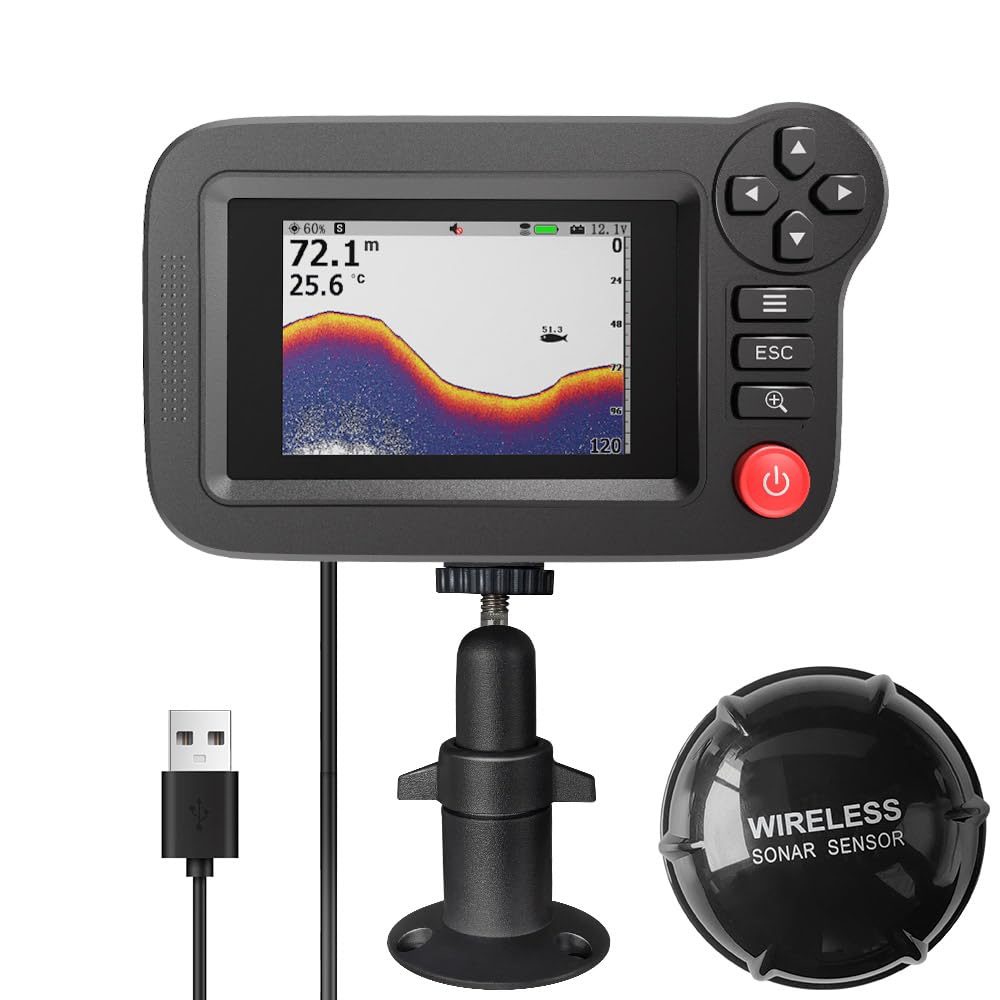
A 3.5-inch color LCD with a 164-foot depth rating in a compact package aimed at kayak anglers.
The Yoocylii Xf-08 packs a 125 KHz sonar sensor that reads down to 164 feet, with a wireless range between 328 and 656 feet. That wireless range is longer than the LUCKY model’s 150-meter rated range, giving you more freedom on the water. The 3.5-inch display runs at 480×320 resolution, which shoppers say is easy to see in bright daylight. One reviewer on a kayak simply floated the transducer behind and got good depth readings while paddling.
The IP67 waterproof probe turns on automatically when it touches the water, so you do not need to fumble with switches. A few buyers noted that the locking nut on the bottom stripped out quickly and the antenna joint felt fragile. The unit uses four standard batteries (no built-in rechargeable), which some users found convenient and others felt drained too fast. It includes a mounting bracket and a lanyard, so you can attach it to a kayak or keep it close while wading.
Kayak-friendly design: A bright, readable screen and long wireless range make it easy to use from a moving boat, but the build quality on the antenna and locking nut is a weak point.
Battery trade-off: Standard AA batteries are easy to replace but can drain quickly if you forget to power down.
Best suited for: kayak fishing and shore angling where you want a portable handheld with a good screen and long wireless range.
Not ideal for: ice fishing or anyone who hates replacing standard batteries mid-trip.
6. LUCKY Portable Fish Finder FF-1108
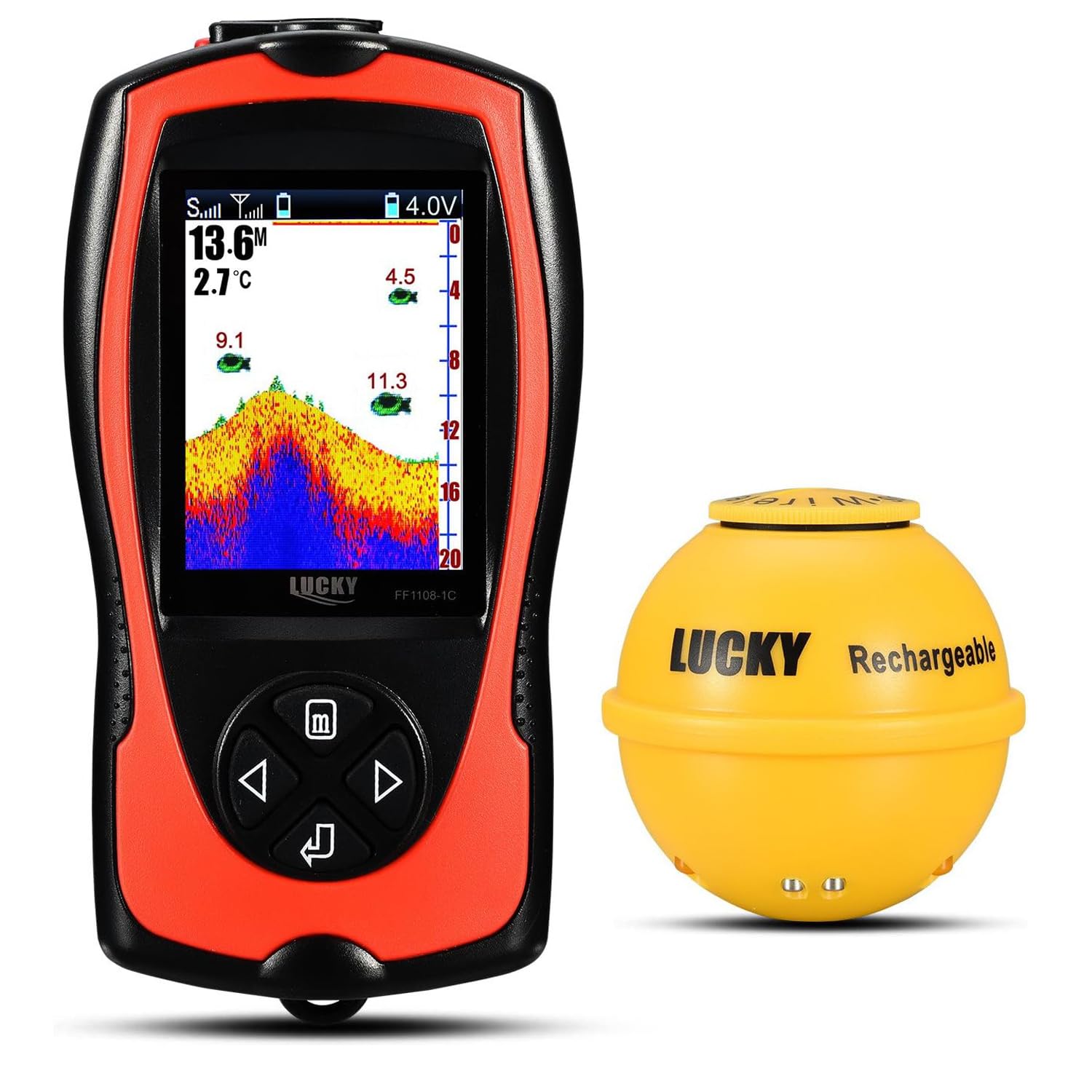
A budget-friendly all-in-one with a simulation mode so you can learn before you drop a line.
The LUCKY FF-1108 pairs a 2.4-inch TFT color display with a wireless sonar transducer that reaches 147 feet deep and has a wireless operating range of 492 feet (150 meters) — so you are not tied to your float. The sensor has a fish-attractive lamp and a clear replacement cover so you can see it in the dark. The handheld unit lasts 4 hours on a full charge, and the sonar sensor lasts 10 hours. One buyer mentioned after 4 hours of moderate use the handheld was at 80% battery and the sonar was still full.
It includes a simulation mode that lets you practice all the settings — sensitivity, depth alarm, fish icon display — without getting wet. Some buyers found that the sonar struggles to distinguish debris from fish in weedy water, calling it mainly useful for water temperature and depth readings. The included cables and car charger cover most power options. For the price, this is the most feature-packed way to test whether a wireless depth finder fits your fishing style without a large commitment.
Packed with features for the price: Simulation mode and long sensor battery life make this a safe entry, but sonar accuracy in debris-heavy water is hit-or-miss.
Depth and range are solid: 147 feet max depth and 150-meter wireless range cover most inland fishing, matching the DANOPLUS model and beating it in wireless range.
Reach for this if: you are on a tight budget and want a rechargeable wireless system with a simulation mode to learn the ropes.
Look elsewhere if: you fish in very weedy or debris-filled water where false fish alarms would frustrate you.
Understanding the Specs
Maximum Measuring Depth
This is the deepest water the sonar can read under ideal conditions — clear, calm water with a clean bottom. Budget models range from 147 feet up to 600 feet. Do not treat this as a guarantee. In murky water, heavy weeds, or very thick ice, the real-world depth will be less. If you fish shallow ponds or lakes under 100 feet deep, a 147-foot model is plenty. If you fish deep reservoirs or the Great Lakes, aim for 300 feet or more.
Wireless vs. Wired Transducer
A wireless (castable) sonar sensor is thrown into the water and sends data to your screen via radio frequency or Bluetooth. It is great for kayaks and shore fishing because there are no cables to trip over. The downside is limited range — usually 150 to 200 meters — and the risk of losing the sensor. A wired transducer mounts permanently to your boat’s transom and gives a constant, more reliable reading at higher speeds, but requires drilling and wiring.
Display Size and Readability
A larger screen (3.5 inches or bigger) makes it easier to see bottom contours and fish icons without squinting. But bigger screens drain batteries faster and make the unit heavier. A 2.4-inch screen is fine for quick depth checks, while a 5-inch screen (like the FishPod that uses your phone) gives the best detail. Always check whether the screen is readable in direct sunlight — some budget LCDs wash out in bright conditions.
Battery Type and Life
You will see three types: built-in rechargeable, replaceable AA/AAA, or proprietary battery packs. Rechargeable units save money over time but need a power source between trips. A proprietary magnetic charger is the most fragile setup because losing that cable means the unit is useless until you find a replacement. Standard battery-powered units are more reliable on the water since you can always buy fresh batteries at a gas station, but they cost more over the long run.
FAQ
How deep can a budget depth finder actually read?
Can I use a castable depth finder for ice fishing?
What is the difference between a fish finder and a depth finder?
Will a budget depth finder work through the hull of my boat?
How long does the battery last on a wireless depth finder?
Can I use a budget depth finder from the shore?
What does the fish alarm actually detect?
Do I need a special charger for my depth finder?
Final Thoughts: The Verdict
Across the board, the best budget depth finder winner is the Humminbird 407860-1 HDR 650 because it delivers the deepest reading (600 ft) and a proven reliable wired design for permanent boat installation. If you want a portable wireless system with a big phone-based display, grab the FishPod 5X Bluetooth Fish Finder. And for the most rugged, straightforward handheld that works on black ice and open water, the standout is the Hawkeye DT1H Handheld Depth Finder.
How We Picked
We do not accept paid placement. Every pick is matched to a real buyer and a real use-case; we do not hands-on test units.
Sources & Methodology
Specifications: manufacturer listings and product documentation. Review insights: verified customer reviews, as of July 2026. Pricing: not shown on this page (it changes often); check the current price via the retailer link.
As an Amazon Associate, Gadgets Feed earns from qualifying purchases. This does not affect which products we feature.
Related Guides
Product prices and availability are accurate as of the date/time indicated and are subject to change. Any price and availability information displayed on Amazon at the time of purchase will apply to the purchase of this product. As an Amazon Associate I earn from qualifying purchases.
CERTAIN CONTENT THAT APPEARS ON THIS SITE COMES FROM AMAZON. THIS CONTENT IS PROVIDED "AS IS" AND IS SUBJECT TO CHANGE OR REMOVAL AT ANY TIME.
Amazon and the Amazon logo are trademarks of Amazon.com, Inc. or its affiliates.