
A clogged vacuum filter kills suction, wastes time, and burns through replacement bags. A dedicated cyclone separator fixes that by spinning heavy debris into a collection bucket before it ever reaches your shop vac. For woodworkers, drywall finishers, and garage tinkerers, a budget dust collector is the single upgrade that pays for itself in filter savings alone.
I’m Min — the co-founder and writer behind Gadgets Feed. I’ve spent hundreds of hours analyzing airflow rates, cyclone efficiency claims, bucket capacities, and port compatibility across dozens of models to separate marketing hype from genuine workshop value.
Whether you’re hooking up to a planer or a sandblaster, the right budget dust collector keeps your workspace breathable and your tools running at peak performance without emptying your wallet on consumables.
How To Choose The Best Budget Dust Collector
Not all separators are created equal. The cheapest bucket-lid cyclone will catch big chips but let fine dust pass straight through to your filter. For a true budget dust collector, you need to balance bucket volume, port size, and the separator’s internal geometry. Here’s what matters most.
Cyclone Efficiency and Fine Dust Capture
The best separators claim 99% or higher capture rates because they use a tapered cone design that accelerates the airstream. Straight-wall bucket lids often choke on fine particles like drywall dust or cement. Look for models with a dedicated cyclonic cone — the more aggressive the spiral, the less fine dust reaches your vacuum’s HEPA filter.
Bucket Capacity and Material
A 6-gallon poly bucket works for small workshops, but a 10-gallon stainless steel or translucent bucket lets you see the fill level and avoids collapse from vacuum pressure. Larger capacity means fewer trips to the trash, but also a bigger footprint — measure your floor space before committing.
Port Compatibility and Hose Size
Most shop vacs use a 2-1/2″ or 1-7/8″ hose. Some budget dust collectors include adapters for both, but others force you to buy extra couplers. If you plan to connect to a planer or table saw with a 4″ dust port, ensure the separator supports that larger diameter or you’ll choke airflow and lose separation efficiency.
Quick Comparison
On smaller screens, swipe sideways to see the full table.
| Model | Category | Best For | Key Spec | Amazon |
|---|---|---|---|---|
| DEWALT DXVCS002 | Cyclone Separator | Small workshop woodworking | 6-gallon poly bucket, 99.5% efficiency | Amazon |
| VEVOR DC15 | Blasting Cabinet Collector | Sandblasting media reclamation | 1.6 HP motor, 1.8-gal capacity | Amazon |
| Rockler Dust Right | Cyclone Separator | High-volume chip collection | 10-gal translucent bucket | Amazon |
| WEN DC3401 | Standalone Collector | Planer and table saw dust control | 660 CFM, 12-gallon bag | Amazon |
| DEWALT DXVCS003 | Cyclone Separator | Heavy-duty debris separation | 10-gal stainless steel tank | Amazon |
| Oneida AXD002 | Cyclone Retrofit | Upgrading 1-3HP dust collectors | 99%+ fine dust capture | Amazon |
| Mullet Tools 1900-110 | High-Speed Cyclone | Concrete and fine dust extraction | Seamless parabolic cone | Amazon |
In‑Depth Reviews
1. DEWALT Dust Separator DXVCS002

The DEWALT DXVCS002 pairs a 6-gallon poly bucket with a claimed 99.5% cyclone separation rate, meaning nearly all wood chips, drywall debris, and even water bypass your shop vac entirely. The four-caster base rolls smoothly under a workbench, and the dual-port design accepts both 1-7/8″ and 2-1/2″ hoses without extra adapters. Real-world reports confirm 75-95% capture on table saw and drywall dust, with filter changes dropping to near zero.
Assembly takes about ten minutes — the lid latches securely, and included hose holders keep the intake organized. The poly bucket handles abuse from rocks and metal shavings without cracking. Users report that the included hose is somewhat stiff in cold weather, but the overall kit saves dozens of filter replacements per year. The 3-year limited warranty adds confidence for continuous workshop use.
At this price point, the DXVCS002 delivers the best blend of mobility, separation efficiency, and build quality. It’s the natural upgrade for anyone replacing a homemade bucket separator or tired of vacuuming their vacuum’s filter every session. Pair it with a standard shop vac and you have a two-stage system that rivals far more expensive standalone units.
Why it’s great
- Exceptional 99.5% separation keeps vacuum filters pristine
- Compact rolling base fits tight workshop spaces
- Handles wet debris, metal shavings, and fine concrete dust
Good to know
- Included hose can kink under strong vacuum suction
- 6-gallon bucket fills quickly with planer chips
- Requires an external shop vac to operate
2. VEVOR Dust Collection System DC15

The VEVOR DC15 is a dedicated dust collector and media reclaimer for sandblaster cabinets, not a universal shop vac separator. Its 1.6 HP motor pulls abrasive-laden air through a 2-inch inlet, spinning dust and reclaiming glass beads, aluminum oxide, or walnut shells for reuse. The 1.8-gallon capacity is small by design — it matches the typical dust output of a sandblasting session before needing a dump.
Construction uses cold-rolled steel with a powder-coated finish that resists corrosion from abrasive media. Owners of Harbor Freight 40/60 lb cabinets report an exact bolt-hole fit, though the unit ships with a blank mounting template that requires drilling a 2-inch hole. Noise levels are typical for an industrial motor — hearing protection is mandatory. Some units arrived with minor shipping damage, but the build is solid enough to withstand daily commercial use.
This is a niche tool for anyone serious about blasting. A standard shop vac lacks the static pressure to reclaim media efficiently, so the VEVOR fills a specific gap. If you’re upgrading from a vacuum-based dust collection setup, you’ll notice faster media recovery and a clearer view through your cabinet window during long blasting sessions.
Why it’s great
- Properly reclaims blasting media, not just collects dust
- Rugged steel construction survives abrasive environments
- Direct fit for popular Harbor Freight cabinets
Good to know
- Deafening noise level requires hearing protection
- Small 1.8-gallon drum needs frequent emptying
- Instructions are minimal and poorly translated
3. Rockler Dust Right Separator
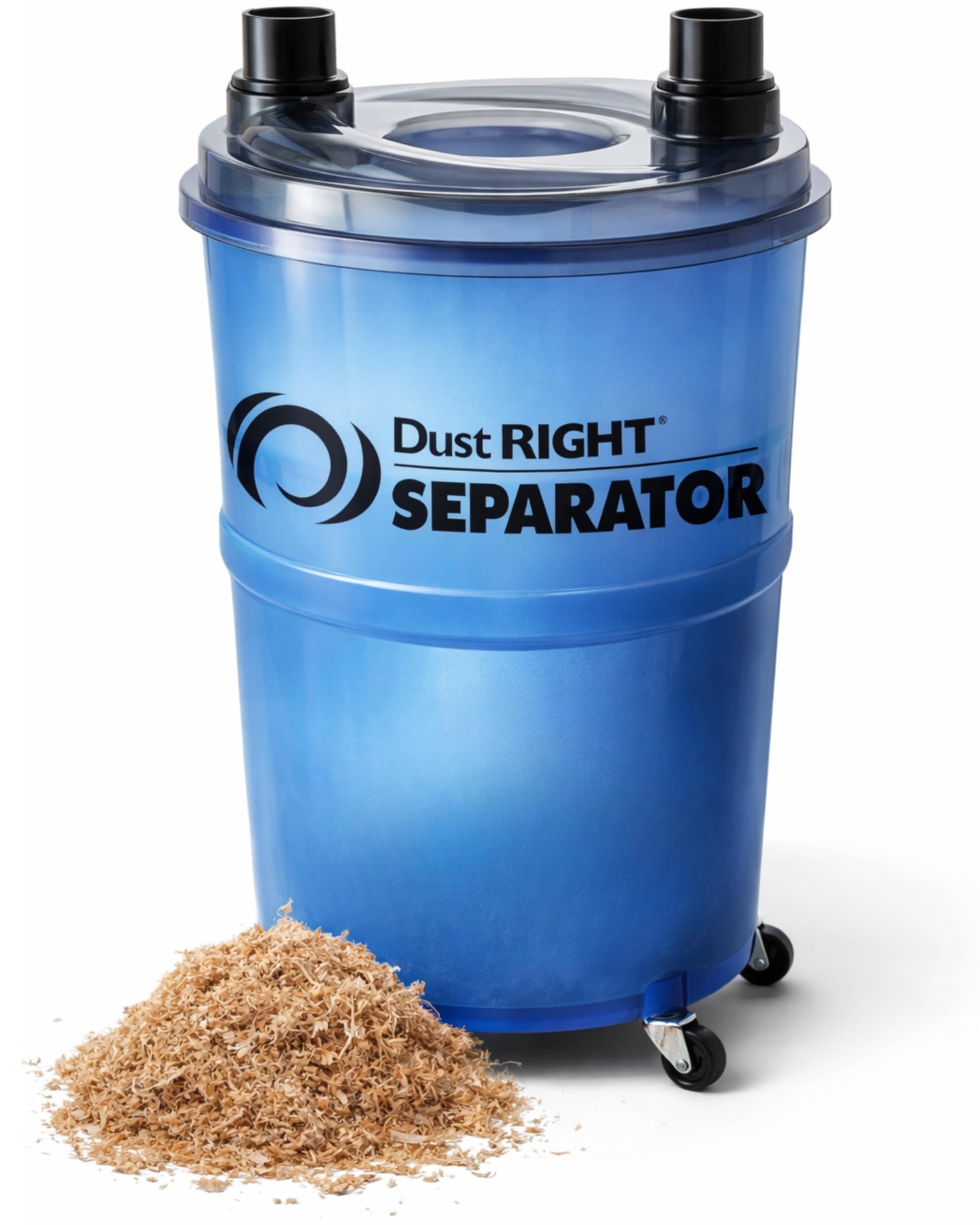
The Rockler Dust Right uses a 10-gallon translucent bucket that you can inspect at a glance — no guessing when it’s full. The five-caster base is more stable than a four-caster design, especially when loaded with dense planer chips. The cyclone cone creates effective separation for wood shavings and sawdust, though fine cement or drywall particles tend to bypass the separator and end up in your shop vac’s filter.
Assembly is straightforward, and the included 36-inch Flex-Form hose holds its shape around corners. A common issue is the lid cracking under vacuum pressure in cold shops — some users report multiple lid failures. Rockler’s customer service is responsive, but the plastic lid durability is a weak point compared to the DEWALT’s poly bucket or a metal lid. For big chip collection on a planer or jointer, the 10-gallon capacity is a real time-saver over smaller buckets.
Shoppers upgrading from a cheap bucket-lid cyclone will notice the improved stability and larger drum. Just plan for potential lid replacement if you work in unheated conditions. For dedicated woodworkers producing heavy chip loads, the Dust Right holds enough debris to finish a full project without interruptions.
Why it’s great
- High-visibility translucent bucket shows fill level clearly
- Five-caster base provides exceptional stability
- Large 10-gallon capacity reduces emptying frequency
Good to know
- Lid may crack under strong vacuum in cold environments
- Fine dust passes through to the vacuum filter
- Hose connection lacks a locking mechanism
4. WEN DC3401 Dust Collector

Unlike the cyclone separators above, the WEN DC3401 is a complete standalone dust collector with its own 5.7-amp motor and 6-inch impeller that moves 660 CFM. The 4-inch dust port directly connects to planers and table saws, while the 12-gallon zippered collection bag captures both chips and fine dust. For small shops without a central dust system, this unit eliminates the need for a separate shop vac.
The brushed motor does require occasional brush replacement — some heavy users burned through a set within a month of continuous operation. Air throughput is impressive, though static suction is lower than a dedicated shop vac, so hose runs should be kept under 10 feet. The lockable swivel casters and onboard carry handle make it easy to reposition between tools. Noise is noticeable but typical for a motor of this class.
For around the same price as a cyclone-plus-shop-vac combo, the DC3401 provides a self-contained solution with higher CFM than most wet/dry vacs. It’s best suited for woodworkers who already have a separate shop vac for wet pickup and want dedicated dust collection for stationary power tools. Just budget for periodic brush replacement if you run it full-time.
Why it’s great
- High 660 CFM airflow outperforms most shop vacs
- Self-contained unit needs no external vacuum
- Compact footprint with wall-mount option saves floor space
Good to know
- Motor brushes wear out quickly under heavy use
- Suction drops significantly with long or narrow hoses
- Filter is only 5-micron — fine dust may escape into the air
5. DEWALT DXVCS003 Dust Separator

The DEWALT DXVCS003 is the big brother of the DXVCS002, upgrading from a 6-gallon poly bucket to a 10-gallon stainless steel tank that resists dents and won’t collapse under cyclone suction. The 99.5% separation efficiency carries over, making this a serious upgrade for workshops producing heavy chip loads or dealing with abrasive debris. The stainless bucket also handles water, mud, and metal shavings without degradation.
Users report that after weeks of continuous sanding and planing, the shop vac’s interior remains completely clean — every bit of debris stays in the tank. The 2-1/2″ and 1-7/8″ port compatibility means it works with nearly any shop vac on the market. Assembly is under 15 minutes, and the four-caster base rolls smoothly despite the heavier steel tank. The larger footprint is the main trade-off — it takes up noticeably more floor space than the 6-gallon version.
For buyers who want a ‘buy once, cry once’ cyclone separator that will survive a lifetime of workshop abuse, the DXVCS003 justifies its higher price with superior materials and capacity. It’s particularly valuable for contractors who move between job sites and need a tank that won’t crack in a cold truck bed. Pair it with a high-CFM dust extractor for professional-grade results.
Why it’s great
- Stainless steel tank is virtually indestructible
- Massive 10-gallon capacity for long sessions
- Virtually no debris reaches the vacuum filter
Good to know
- Larger footprint requires dedicated floor space
- Heavier than poly-bucket alternatives
- Requires an external shop vac to function
6. Oneida Air Systems AXD002

Oneida’s AXD002 is a retrofit cyclone designed to bolt onto existing 1 HP to 3 HP single-stage dust collectors — like Harbor Freight, ShopFox, or Grizzly units — converting them into a two-stage system. The integrated air ramp and neutral-vane inlet maintain ultra-high separation efficiency for fine dust, not just chips. Over 99% of debris ends up in a collection drum instead of coating your filter pleats.
The polypropylene body is lightweight at 7.7 pounds, but the build quality is evident in the smooth internal surfaces that prevent dust bridging. Installation requires cutting a 4-inch or 5-inch hole in your chosen drum lid and sealing the gasket — some users recommend a plywood plate for a perfect seal. The included 4-inch reducer adapters make it compatible with most collectors, though you’ll need to source your own 55-gallon drum or similar container.
Owners who’ve installed this on a Harbor Freight 1 HP collector report dramatically less dust in the shop and far fewer filter cleanings. The cyclone adds some airflow resistance, but a pleated filter offsets the pressure drop. If you already own a single-stage dust collector, this retrofit is a smarter investment than buying a whole new system.
Why it’s great
- Retrofits common 1-3HP collectors into two-stage systems
- Captures fine dust above 99%, not just chips
- Made in the USA with proven cyclone engineering
Good to know
- Requires drilling and sealing a drum lid
- Adds resistance that may reduce total CFM slightly
- Drum not included — need to buy separately
7. Mullet Tools High-Speed Cyclone

The Mullet Tools High-Speed Cyclone features a seamless parabolic cone that spins air faster than straight-wall designs, dropping over 99% of debris — including extremely fine concrete dust — into a standard 5-gallon bucket. The rigid cut-to-fit PVC connection eliminates the duct tape and bungee-cord hacks common with other systems, creating an airtight seal that keeps your vac filter clean through hundreds of pounds of material.
Users report removing popcorn ceilings and grinding concrete floors without ever changing the vacuum bag or HEPA filter. The included hose adapters fit virtually all wet/dry vacs, regardless of brand color or shape. Setup takes under 10 minutes with the supplied drilling template. The two-tone white and black plastic is heavy-duty and impact-resistant, though the body is noticeably larger than a standard bucket lid cyclone.
Mullet’s customer service is exceptional — owners report that when a new vacuum hose didn’t fit, the company designed and shipped a custom adapter within a week. For contractors generating massive volumes of fine dust from concrete grinding, drywall sanding, or ceiling removal, this cyclone’s speed-driven separation is a genuine time and money saver. It’s the priciest option here, but it performs like a commercial unit.
Why it’s great
- Parabolic cone separates ultra-fine concrete dust effectively
- Airtight PVC connection requires no duct tape or clamps
- Exceptional customer support with custom adapter solutions
Good to know
- Larger footprint than standard bucket-lid cyclones
- Premium price puts it above pure budget territory
- 5-gallon bucket fills fast with heavy debris volumes
FAQ
Can I use a dust separator with any shop vac?
Will a cyclone separator work for fine concrete dust?
Final Thoughts: The Verdict
For most users, the budget dust collector winner is the DEWALT DXVCS002 because it delivers 99.5% separation, a portable rolling base, and proven durability at a fair price. If you need a self-contained system without a separate shop vac, grab the WEN DC3401. And for fine dust from concrete grinding or ceiling removal, nothing beats the Mullet High-Speed Cyclone.