
Our readers keep the lights on and my morning glass full of iced black tea. As an Amazon Associate, I earn from qualifying purchases.
Specs are compiled from manufacturer listings and verified buyer reviews and can change over time — please confirm the key details on the product page before buying.
If you want a real motorized board without spending a fortune, the MEEPO Mini 5 is the one most riders should start with — it pairs a 330-pound load rating with a 28 mph top speed and a 17.4-pound body that is easy to carry onto a bus. The whole budget electric skateboard shelf is crowded with boards that promise fast speeds and huge range, and most of them quietly fall short of both. This guide breaks down what actually holds up, what to expect for your money, and which board fits the way you really ride.
I’m Min — the founder and writer behind Gadgets Feed. This guide is built by comparing the manufacturers’ published specifications and the patterns across verified customer reviews, so you get each pick’s real strengths and trade-offs instead of marketing spin.
Below you will find six boards sorted by real-world performance and price tier, plus a plain-English guide to decoding range claims, load ratings, and motor wattage before you buy. The picks here cover the range of what a budget electric skateboard can actually do for a commuter or beginner.
Our Picks at a Glance


How To Choose The Best Budget Electric Skateboard
The single biggest mistake buyers make is trusting the range number on the box. Motor, battery, deck length, and rider weight all pull that figure in different directions. Here is what actually matters when you are picking.
Read the range claim like a skeptic
Advertised range is measured on the gentlest setting, with a light rider, on flat ground. Anything above speed mode 2 drains faster. On the MEEPO Campus V5, riders report getting roughly 6 to 7 miles on higher gears instead of the listed 11 miles. Plan your commute around two-thirds of the sticker figure and you will not get stranded.
Match the motor to your terrain and weight
A 350W single hub motor handles flat campus paths at modest speeds. Dual 500W or 600W setups (two motors, both driving the rear wheels) climb hills and accelerate harder. If you weigh more than 200 pounds or ride steep streets, dual motors are not optional.
Check the load rating before the price
Every board has a stated weight limit, and riders near that ceiling will see shorter range and slower acceleration than lighter riders on the same board. Look for a board rated at least 50 pounds above your weight, and expect a stiffer deck to feel more planted at speed.
Hub motors versus belt drive
Hub motors sit inside the wheels and need almost no upkeep. Belt drive uses an exposed belt and larger wheels, which rides softer over rough ground but adds a wear item you will eventually replace. For a first board, hub motors keep maintenance low.
Quick Comparison
| Model | Best For | Top Speed | Load Capacity | Charge Time | Amazon |
|---|---|---|---|---|---|
| MEEPO Mini 5★ Best Overall | Commuting and carrying | 28 mph | 330 Pounds | 2.8 hour | Amazon |
| UDITER S3 PixelTop Performer | All-terrain comfort | 26+ mph | 330 Pounds | 2 hour | Amazon |
| Backfire G2 Black | Beginner-friendly cruising | — | 265 pounds | 3.5 hour | Amazon |
| MEEPO Campus V5 | Campus commuting | 28 mph | — | 2.8 hour | Amazon |
| MEEPO Bamboo Series | Off-road and hilly terrain | 28 mph | 330 lbs | 4 hour | Amazon |
| WINDSEEKER Carver E-Ska | Kids and first-timers | 12.4 mph | 220 pounds | 2 hour | Amazon |
In-Depth Reviews
1. MEEPO Mini 5 Electric Skateboard
Our pick — over 4★ from 150+ verified ratings; the strongest balance of quality and price.
The short-deck commuter that turns a subway run into a ride home.
The Mini 5 is the shortest board in this roundup at a 33-inch deck, and that is exactly the point. A 17.4-pound body and a kick-tail let you pick it up by hand and carry it upstairs or onto a metro car without a fight. Dual 500W hub motors push it to a claimed 28 mph, with a listed range of 11 miles on the M6C LED remote and a 2.8-hour charge from the included 42V/1.5A charger. The 330-pound load rating is the highest here — the WINDSEEKER Carver E-Ska carries 220 pounds, 110 fewer.
What wins people over is how much fun the Mini 5 delivers for the price — fun is the aspect riders praise most, and speed is a close second. The deck is 8-ply maple, the wheels detach for easy hub-motor swaps, and the battery module’s 24 individual cells are monitored with UL2272-tested protection. Buyers report the trucks arrive stiff and need loosening, and the gearing feels punchy on gear 1 — start there until your throttle hand settles. One recurring gripe is wobble at higher speeds even with tightened trucks, so if you plan to push top speed, budget for firmer bushings.
Where it earns its keep
- 28 mph top speed with dual 500W hub motors
- 330-pound load rating, the most generous here
- 33-inch kick-tail deck carries easily on transit
- 2.8-hour charge from the included charger
- UL2272-tested battery with 24-cell monitoring
Where it asks patience
- Stock trucks arrive stiff and want loosening
- Wobble at speed if you push past 15 mph
- Range drops on higher gears, like every board here
Best pick if: you want one board for the commute, the store, and the last mile off the train — the short deck and top-of-list load rating make it the most versatile pick here.
Look elsewhere if: you want a cushioned ride over gravel or want belt drive for carving feel — the UDITER S3 and Backfire G2 fit that instead.
2. UDITER S3 Pixel Electric Skateboard
The rough-street specialist with a battery you can swap in seconds.
Of all the boards here, the S3 Pixel is the one built for beaten-up pavement. Those 105mm PU wheels are the biggest in this roundup, and riders consistently point to their size as the standout feature — the thing that lets this board roll over gravel, cracks, and busted asphalt that smaller wheels snag on. The deck is 7-ply bamboo and maple for flex and vibration dampening, and the 330-pound load rating matches the Mini 5 as the joint highest here. Dual 600W hub motors (1200W total) claim 30-degree hill climbs with four power modes to pick from.
Two features separate this board from the rest here. First, the 187.2Wh/5.2Ah UL-certified battery pops out — carry a spare and range roughly doubles without waiting on a wall outlet. Second, the dual charging ports cut a full charge to 1.25 hours with two chargers, versus 2.5 hours with one. That is faster than the Mini 5 at 2.8 hours by more than half, and much faster than the Backfire G2’s 3.5-hour charge. The TitanCore Guarder BMS (a battery brain that shuts the pack down after 3 days idle) lives inside, waiting for a brief charge to wake up before it will power the board.
Here is the recurring gripe worth knowing: the separately-sold spare batteries are not cheap, and durability and reliability reviews sit in mixed territory. One owner at 250 pounds found the range fell short of advertised and felt the bushings and bearings wanted upgrading early. If you ride hard and want the swappable-battery lifestyle, plan on buying a spare pack as part of the purchase.
Biggest wheels here: after the UDITER S3’s 105mm PU wheels eat rough pavement, going back to a standard 80mm setup feels like riding a rumble strip. That single number is why this board stands out for anyone with a rough commute.
The value read: that swappable battery is a real feature, but the spare pack is sold separately and the recurring cost is the trade-off. Buy this for the larger wheels and the 1.25-hour dual-port charge, not for the promise of doubling range cheaply.
For the rough-commute rider: this is the pick when your route runs over cracked bike paths, gravel, or uneven streets.
Skip if: your riding is all smooth pavement and you never want to buy a spare battery — you will pay for capability you do not use.
3. Backfire G2 Black Electric Skateboard

The long-running cruiser that treats a first-timer politely.
Backfire has been building boards since 2009, and the G2 Black is the beginner board that most consistently gets the balance right. The Hobbywing ESC (the electronic speed controller — the chip that decides how hard the motors push) delivers smoother, more precise acceleration and braking than the original G2 from 2017. The 187Wh battery runs at 41V, charges in 3.5 hours, and claims up to 12.5 miles per charge. That is the longest single-charge figure here on paper among the mid-tier boards, though the S3 Pixel leans on a spare battery to match it in practice.
Quality is what buyers rave about most on this board, with speed a clear second. At 38 inches long and 7.6kg, it is stable and forgiving — one owner at 222 pounds reported stable turns and easy acceleration on the test ride, and surfers came away finding it easy to learn. The deck is 9-ply maple at 80A durometer, meaning slightly softer than the harder wheels on the Campus V5, so it absorbs a bit more chatter. A 265-pound load rating is the lowest of the non-beginner boards here, worth checking if you are a heavier rider.
The honest caveat is range at high speed. One owner who put 110 miles on the board called it fast and fun but noted the range runs “a little short.” Durability and reliability sit in mixed territory — most boards run fine for months, but a subset report electronic failures like brake lockup or random motor cutouts, most often on boards that saw hard use over long periods.
The number to remember: 38 inches. That longer deck and the softer 80A wheels are why this board is stable enough for a first-timer yet still lively enough to carve.
The rider who should skip it: push past 265 pounds and you are at the ceiling of the load rating — go for the 330-pound options instead.
Reach for this if: a smooth, forgiving ride from a brand with a decade in the category is exactly what you want.
Buy instead of this if: you need the highest load rating or the fastest charge — the Mini 5 carries more weight and charges faster.
4. MEEPO Campus V5 Electric Skateboard

A built-in handle for the walk between class and the bike rack.
Every board in this roundup can roll you to class, but the Campus V5 is the one designed around the walk in between. A cut-in grip runs through the deck so you can carry the board one-handed without pinching rails, and the 38-inch 8-ply Canadian maple deck stays flexible enough to soak up campus paths. The dual 500W hub motors claim 28 mph, the deck is IPX5 waterproof (resists spray but not submersion), and the M5 remote handles four speed modes and braking — a smooth-braking system that is easier on new riders than most.
Charging takes 2.8 hours from the included 1.5A charger, matching the Mini 5 to the minute. The 90A wheels are on the harder side, meaning the deck does more of the cushioning work. Riders report a real-world range closer to 6 or 7 miles on the higher gears rather than the listed 11 miles, though one 200-pound owner ran 150+ miles without range loss. The board auto-powers on when you push off and shuts off from the remote, so you never crouch to find a button.
The honest catch is long-term ownership. Motor durability and battery life both sit in mixed territory, and durability overall trends negative — the recurring theme is motors or brackets needing work and proprietary replacement parts (like the wheel assembly) being pricey when they go. Budget for replacement motors and wheel assemblies if you ride it daily.
The carry-handle edge: that grip and the flexible 8-ply maple make this the easiest of the mid-tier boards to tote between classes or lock up to a rack.
What to plan for: parts like the wheel assembly are proprietary and expensive, so budget for occasional replacements if this is your daily.
Pick this if: you are a college student or commuter who carries the board more than the average rider.
Think twice if: you want a board you can leave alone for months — the proprietary components push ownership cost up.
5. MEEPO Bamboo Series Off-Road Electric Skateboard
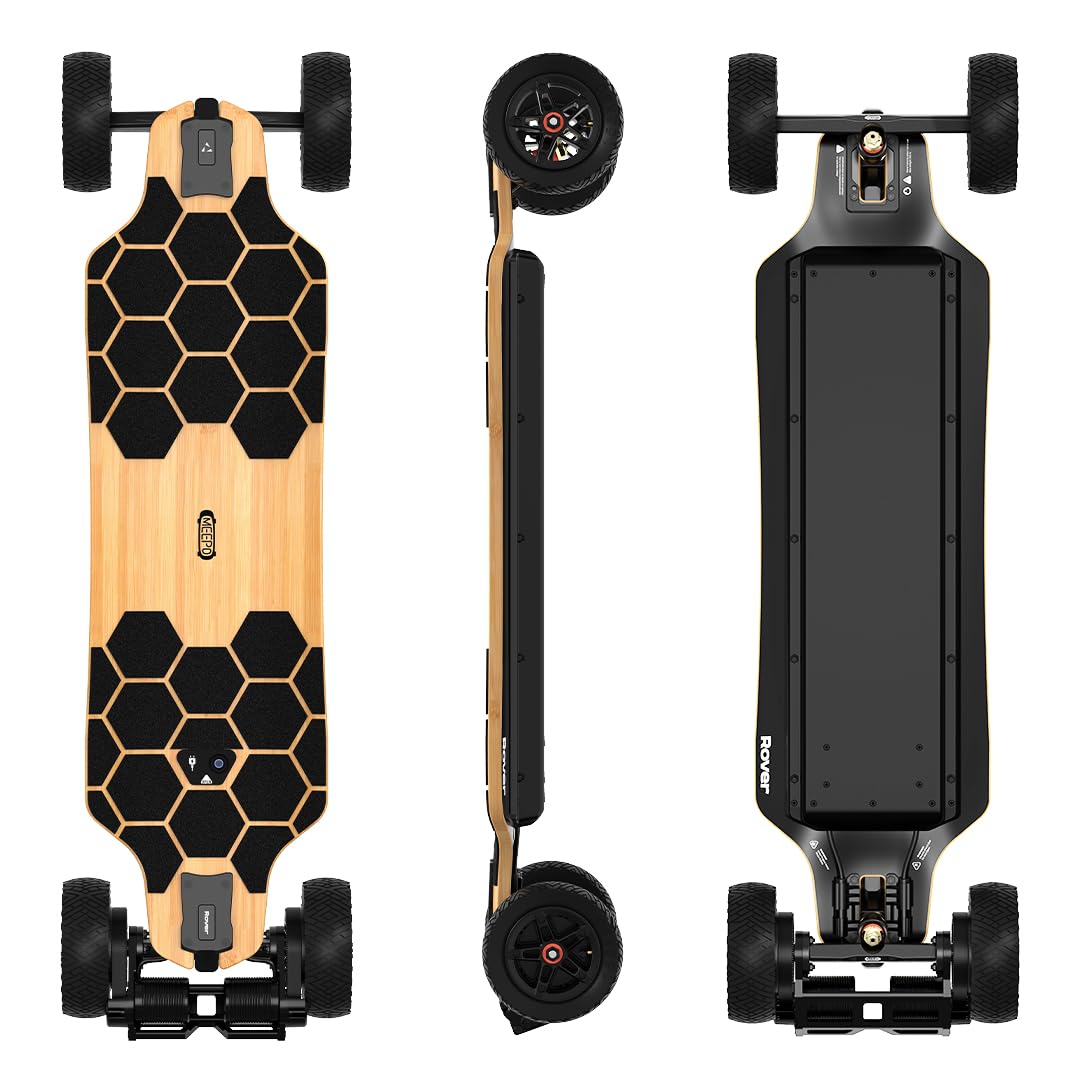
The mountain-board build that turns a fire road into a playground.
This is the one board here that is not pretending to be a city commuter. Dual 1800W motors claim 30% slope climbs, and a 10Ah removable battery with a 4-hour charge supports a real-world range near 20 miles. The 42-inch Canadian maple and carbon fiber deck rolls on 8-inch pneumatic off-road tires with reinforced mountain-bike-style trucks — actual air-filled tires, not solid PU wheels, so they roll over rocks and roots rather than snagging. The FOC ESC (a smarter motor controller that smooths throttle and brake response) and a color-display remote with Reverse Mode round out the package.
Quality and traction are what owners praise most, with speed a step behind. Hills and small rocks are the environment this board was made for — one Boston rider called the pneumatic tires smooth “like a surfboard” and confirmed the range matched the ~20-mile claim. At 330 pounds of load capacity and 12kg, it is the heaviest and largest board in this article, which is the point: it will not wobble under a big rider at 28 mph the way shorter, lighter decks can.
The trade-offs are real, though. Accelerating from a standstill is aggressive — one 20-year veteran called it a “riot” and wished it did not take off so hard. Range on harder riding drops, and the brakes are either on or off, so beginners should practice in a parking lot before hitting trail. Tire tubes are a wear item; the last one to check if you are going to be flying down hills regularly is the tire budget.
What makes it a mountain board
- Dual 1800W motors for 30% slope climbs
- 8-inch pneumatic tires roll over rocks and roots
- 42-inch maple + carbon fiber deck reduces vibration
- 10Ah removable battery and ~20-mile real range
- FOC ESC smooths throttle and brake response
Where it wants a careful owner
- Aggressive acceleration catches new riders off guard
- Brakes are strong — practice before trail speeds
- Tire tubes are a recurring wear item
- Heaviest board here at 12kg
Built for: adult riders who want to hit fire roads, trails, and hills rather than flat city blocks.
Not for: total beginners or anyone who wants a board light enough to carry upstairs daily — this is a trail machine, not a carry board.
6. WINDSEEKER Carver E-Ska Electric Skateboard
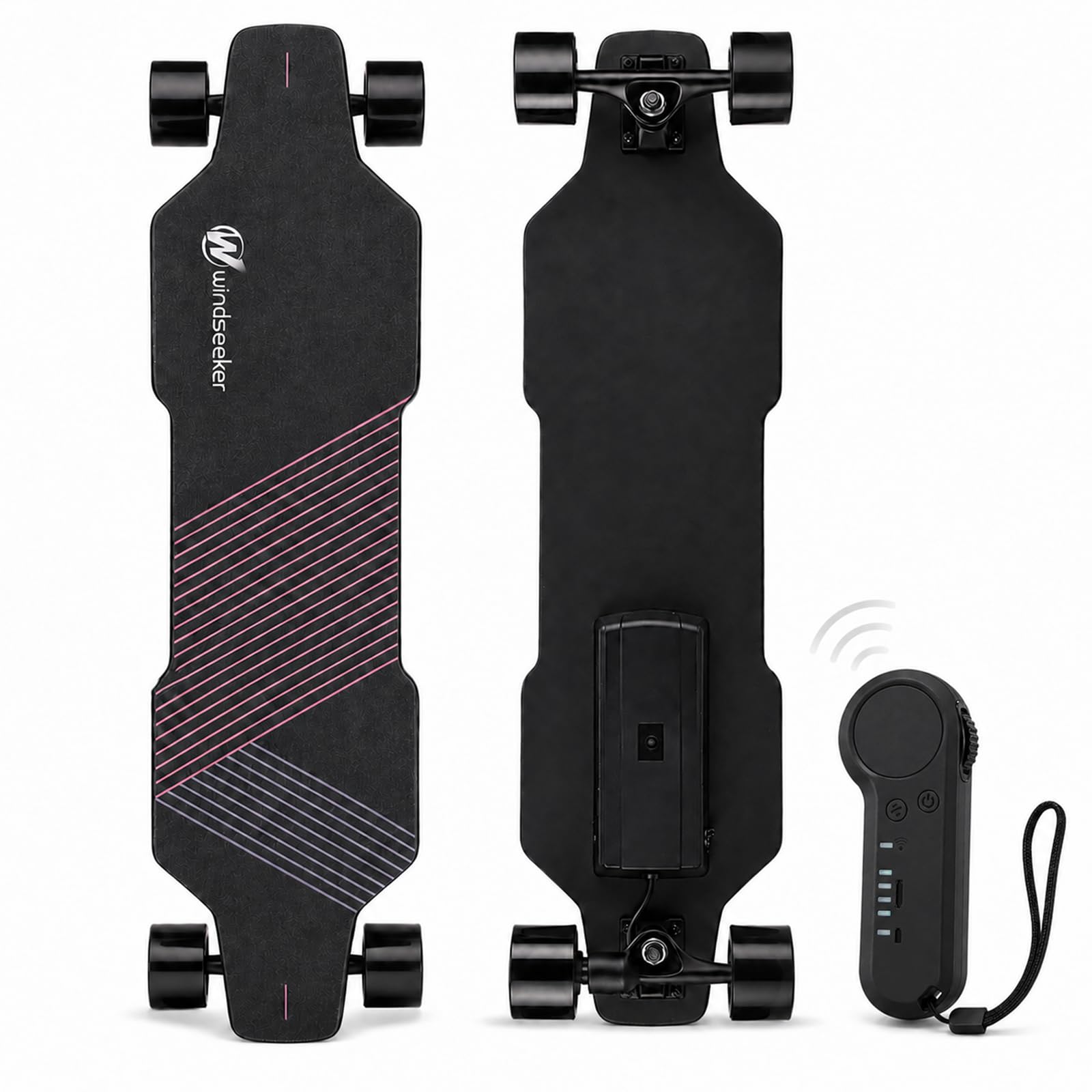
The slow-and-steady starter board built for kids and first-timers.
Where every other board here is aimed at adults or teens, the Carver E-Ska is designed for a younger rider. A single 350W hub motor keeps the top speed to 12.4 mph — less than half the pace of the Mini 5’s 28 mph — and the 29.4V 2000mAh battery runs out at a range of about 5 miles. That 12.4 mph ceiling is deliberate: parents do not want a 10-year-old riding a 28 mph machine. The 37-inch, 8-ply maple deck has flex and stability at that speed, and a fixed-speed cruise control lets the rider take their thumb off the throttle without losing pace.
Two small touches stand out for a kid’s board. It auto-boots when you push off, so no bending down to find a power button. And the LCD remote pairs easily — one parent reported setting it up in minutes for a 10-year-old with no trouble. The manufacturer also owns the failure: when a board would not turn on after a month, customer service diagnosed the issue and shipped a free replacement without demanding the faulty board back.
But the load rating and battery are the two numbers to weigh carefully. The 220-pound load capacity is the lowest here — 110 pounds under the Mini 5 and S3 Pixel — and would suit a small adult at most. Long-term reliability sits in mixed territory with a subset of owners seeing boards stop working, and battery life is the aspect coming up most, in a negative light — one long-time owner noted the battery can overheat, recommending against all-day use. At 5 miles per charge, it suits a backyard or gift board, not a daily commute.
What a parent will appreciate: 12.4 mph top speed and 220-pound load rating keep the ceiling low enough that a child cannot outrun their own skills.
The honest ceiling: this is a gift board or a backyard board — upgrade once the rider outgrows 12 mph or wants more than 5 miles per charge.
Best first board: a birthday or Christmas gift for a young rider who is new to powered boards.
Wrong choice if: an adult wants to commute on it — the low range and 220-pound rating are the limit, and heavier boards here are the better fit.
Understanding the Specs
Battery capacity and range claims
Range is measured in miles and depends on battery size, motor draw, rider weight, terrain, and gear. A board listed at 11 miles may deliver 6 to 7 miles in a faster gear. Weight is the biggest hidden variable: the same board ridden by a 155-pound rider and a 250-pound rider will not see the same range. If you need reliable mile counts, chase a larger battery pack or a swappable-battery design rather than the range sticker.
Motor wattage and hill climbing
Motor output is measured in watts. A single 350W hub motor handles gentle inclines and lower top speeds; dual 500W or 600W setups give you roughly the output of both motors together and can climb steeper grades. Belt drive uses exposed belts and larger wheels for a softer ride, while hub motors sit inside the wheels and need almost no maintenance. For a first board, hub motors are the lower-hassle choice.
Deck size and load rating
Deck length affects stability and portability. Short decks in the 30–34 inch range carry easier on transit; long decks in the 37–43 inch range feel more planted at speed. The load rating is the maximum rider weight the board is engineered for — riding above or near it shortens range and slows acceleration. Look for at least 50 pounds of headroom above your own weight so the deck is not working at its limit.
Charge time and charging options
Charge time is the hours from empty to full and depends on the charger’s amperage and the battery size. A 2-hour charge from a smaller pack can deliver about the same real-world ride as a 3.5-hour charge from a larger one, so match the number to how you actually ride. Dual charging ports (using two chargers at once) can cut that time roughly in half on boards built for it — a meaningful perk for a daily commuter.
FAQ
How far can a budget electric skateboard really go on a single charge?
Will an electric skateboard hold my weight?
Are hub motors or belt motors better for a budget board?
How long does it take to charge an electric skateboard?
Is a swappable battery worth the extra cost?
Can a beginner ride a 28 mph board safely?
How do I look after the battery so it lasts?
How do I stop speed wobbles on an electric skateboard?
Final Thoughts: The Verdict
The winner among budget electric skateboard picks is the MEEPO Mini 5 — it pairs the highest load rating here at 330 pounds with a 28 mph top speed and a short 33-inch deck that is genuinely easy to carry onto a train or up stairs, and its UL2272-tested battery system is the most conservative pick you can make for a first board. If you ride over rough pavement and want the largest wheels plus a 1.25-hour dual-port charge, take the UDITER S3 Pixel. For hills, trails, and 8-inch pneumatic tires, the MEEPO Bamboo Series is the trail-focused pick. And if you are shopping for a first board for a young rider, the WINDSEEKER Carver E-Ska keeps the top speed at 12.4 mph, which is the sensible ceiling for that age. Match the board to your weight, terrain, and how you carry it, and it will hold up for years.
How We Picked
We do not accept paid placement. Every pick is matched to a real buyer and a real use-case; we do not hands-on test units.
Sources & Methodology
Specifications: manufacturer listings and product documentation. Review insights: verified customer reviews, as of September 2026. Pricing: not shown on this page (it changes often); check the current price via the retailer link.
As an Amazon Associate, Gadgets Feed earns from qualifying purchases. This does not affect which products we feature.