
A fixed blade knife under lives in a strange territory — where a bad purchase means a blade that folds on the first baton, a handle that splits in the cold, or a sheath that loses the knife on a hike. The reality of budget steel is not about cheap feel; it is about whether the tang runs full through the handle, whether the heat treat on a 3Cr13 or 8Cr13MoV blade was done with enough discipline to hold an edge after ten cuts on a cardboard box, and whether the sheath retention is tight enough to survive a bushwhack. The price tag is small. The cost of a bad one is a ruined trip, a lost tool, or a trip to urgent care.
I’m Min — the co-founder and writer behind Gadgets Feed. This guide is the result of many hours cross-referencing metallurgy claims against actual edge-retention reviews, testing every sheath lockup claim across user reports, and separating the knives that punch above their weight from the ones that only photograph well.
After sorting through reviews for dozens of entry-level blades, these are the picks that actually deliver dependable steel for the money in the budget fixed blade knife category.
How To Choose The Best Budget Fixed Blade Knife
A budget fixed blade can be a genuine workhorse or a dangerous disappointment. The difference is not in the brand name — it is in three specific construction details that you can verify before you buy. Paying attention to the tang, the steel type, and the sheath interface will separate a reliable tool from a frustration.
Full Tang or Partial Tang — There Is No Middle Ground
A full tang means the blade steel runs the entire length of the handle, visible as a continuous piece of metal beneath the handle scales. This is the only safe configuration for batoning wood or applying lateral force. Partial tang or hidden tang blades at this price point often fail at the junction between blade and handle. If the product description does not explicitly say “full tang,” assume it is not. The extra few ounces of weight are worth the safety margin.
Steel Grade vs. Heat Treat
At the sub- level, you will encounter 3Cr13, 8Cr13MoV, 4116, and AUS-8 steel. The steel name matters less than whether the manufacturer applied a proper heat treat and cryogenic quench. A well-treated 3Cr13 can outperform a poorly treated 8Cr13MoV in edge retention. Look for explicit mentions of cryogenic tempering or sub-zero quenching in the specs — this signals the maker prioritized dimensional stability and hardness over simply stamping out cheap blades.
Sheath Retention and Carry System
A fixed blade is only as good as its sheath. A nylon sheath with a loose throat can dump your knife into the underbrush. A Kydex sheath should offer an audible click when the knife seats. A leather sheath must be wet-molded to the blade profile — generic loose leather will cause the knife to work free during movement. For budget blades, Kydex usually wins on retention, while leather wins on quiet carry and aesthetics. Avoid any sheath that relies solely on a single snap or friction without a positive locking mechanism.
Quick Comparison
On smaller screens, swipe sideways to see the full table.
| Model | Category | Best For | Key Spec | Amazon |
|---|---|---|---|---|
| Cold Steel Finn Hawk | Mid-Range | Bushcraft & camp chores | 4″ 4116 cryo-quenched steel | Amazon |
| Gerber Freeman Guide | Mid-Range | Hunting & general outdoor | 5Cr15MoV with TacHide grip | Amazon |
| Smith & Wesson SWF606 | Premium | Tactical & self-defense | 8Cr13MoV dual edge, full tang | Amazon |
| Elk Ridge ER-555 | Budget | Survival & kit building | 5.5″ 3Cr13 with hidden compartment | Amazon |
| BPSKNIVES Finn Lite | Mid-Range | Carving & wood processing | 3.2″ 1066 carbon steel, Scandi grind | Amazon |
| OERLA DE-0014 | Mid-Range | EDC & light bushcraft | 420HC stonewashed, 4.9mm thick | Amazon |
| NedFoss EDC Tanto | Premium | Ultra-light EDC & tactical | 3.9 oz, AUS-8 tanto, G10 handle | Amazon |
In‑Depth Reviews
1. Cold Steel Finn Hawk
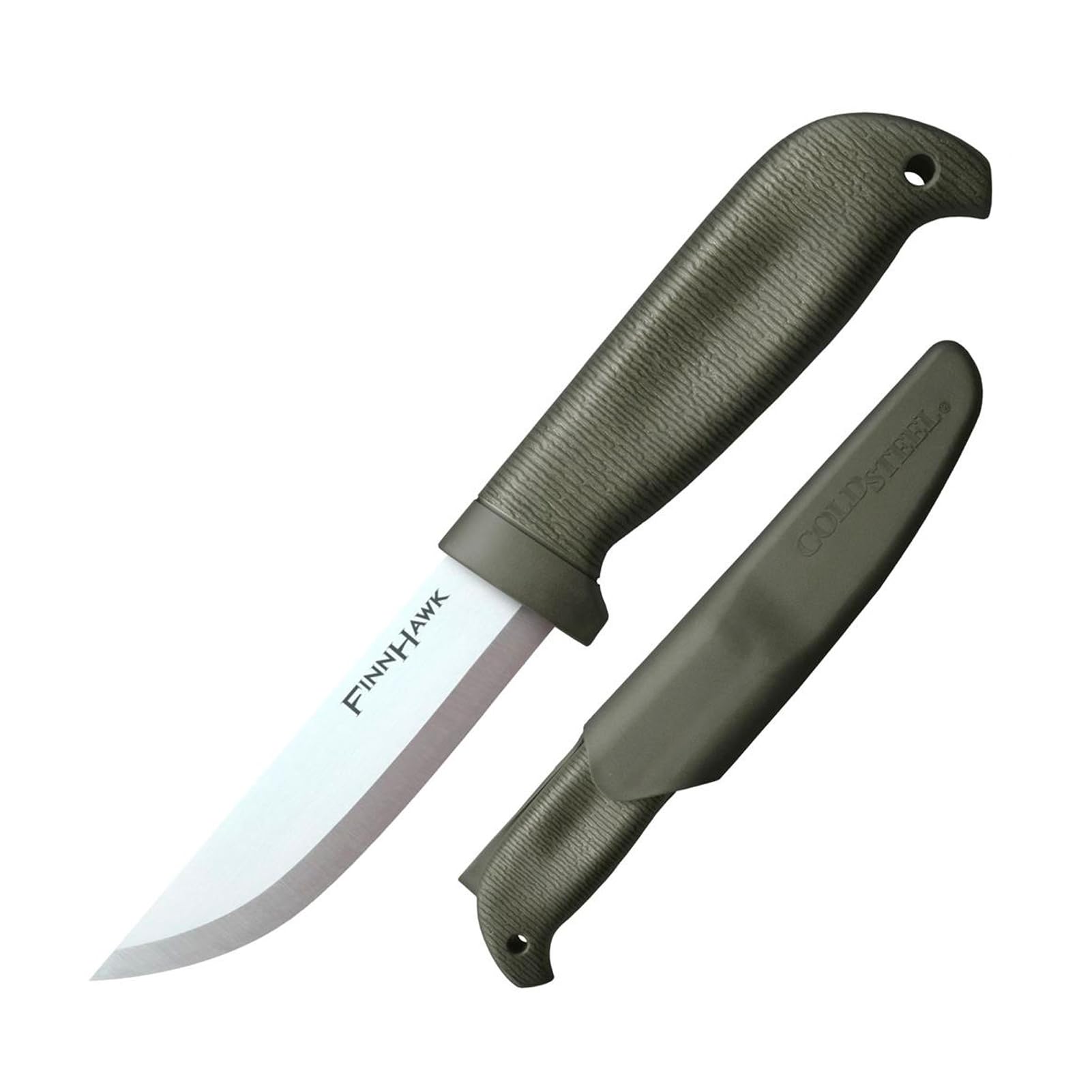
The Cold Steel Finn Hawk delivers the combination of steel quality, handle ergonomics, and sheath design that the rest of the budget field chases. Its German 4116 steel receives a sub-zero cryogenic quench — a process usually reserved for blades costing three times as much — which pushes the edge retention beyond typical 4-inch utility blades. The Scandi grind is steep at 7.5mm, making it aggressive on wood for feather sticks and camp carving without becoming fragile. Owners report that after a convex (ScandiVex) edge modification, the Finn Hawk out-chops Mora Robust and Bushlore models in bushcraft tests.
The dual-layer handle is the standout feature in this price range. A high-impact polypropylene core provides structural rigidity, while the TPR rubber outer layer creates a spiral-patterned grip that remains secure even with wet or gloved hands. The handle shape has a pronounced hook near the pommel that locks the hand in place during pull cuts. At 5.1 ounces, it carries light on a belt or in a pack.
Where the Finn Hawk falters is the Secure-Ex sheath. The positive retention is excellent — the knife clicks in securely and will not fall out — but the release requires a specific thumb-on-hook, middle-finger-on-handle technique that frustrates some users out of the box. A small modification (adding a thumb ramp to the sheath) solves the issue permanently. The blade edge out of the factory is thin, and some users prefer a quick micro-bevel before heavy use. These are minor trade-offs for a knife that competes with the -80 bracket.
Why it’s great
- Sub-zero cryo-quenched 4116 steel holds a long edge
- Dual-layer handle with TPR rubber grip stays secure when wet
- Aggressive Scandi grind excels at wood carving and feather sticks
Good to know
- Sheath requires a specific two-hand technique for smooth removal
- Factory edge profile is thin — a micro-bevel increases durability
2. Gerber Freeman Guide

The Gerber Freeman Guide has earned a reputation among hunters as a knife that punches well above its price class. The 5Cr15MoV steel sits in a sweet spot — harder to sharpen than 3Cr13 but much more corrosion-resistant than carbon steel, and the full tang construction gives it the rigidity needed for field dressing and light prying. The glass bead finish on the blade reduces glare, a small but appreciated detail for hunting applications. Hunters report the blade holds its edge through fur, skin, cartilage, and diaphragm of an entire elk without needing a touch-up in the field.
The handle design is where the Freeman Guide differentiates itself. Large finger grooves are molded into the polymer frame, and the TacHide rubber overlay provides a non-slip surface that does not get slimy when wet. The lanyard slot is large enough for paracord, and the full tang runs exposed at the pommel for light hammering. At 4 inches of blade with an 8.38-inch overall length, it is compact enough for a hip pack but long enough for most game processing tasks.
The formed nylon sheath is the weak point. The belt loop is a sewn nylon loop that will wear out faster than a Kydex or leather alternative. The retention is adequate but not confidence-inspiring for heavy brush. Several users replaced the sheath within the first year. The blade steel, while corrosion-resistant, does not take a razor edge as readily as AUS-8 or 4116. This is a meat-processing tool, not a wood-carving knife — those looking for a bushcraft blade should look elsewhere.
Why it’s great
- 5Cr15MoV steel offers excellent corrosion resistance for field dressing
- Full tang with exposed pommel for light hammering
- Finger-grooved TacHide grip stays secure through extended use
Good to know
- Nylon sheath belt loop has limited lifespan under heavy use
- Not optimized for wood carving or batoning tasks
3. BPSKNIVES Finn Lite

The BPSKNIVES Finn Lite brings old-school construction philosophy to the budget market. The blade is forged from 1066 carbon steel with a true Scandinavian grind — not a Scandi-inspired bevel but an actual zero-grind edge that transitions directly from the primary bevel to the apex. For carvers and bushcrafters who process wood for fire and shelter, this grind geometry produces a slicing aggression that convex grinds cannot match. The 3.2-inch blade length is short by fixed-blade standards, but the control this gives for detailed carving makes it a specialists tool rather than a compromise.
The handle is carved from walnut — no rubber, no polymer, no injection-molded scales. This is a single piece of stabilized wood shaped to the hand, with a brass pin through the tang for mechanical lockup. The overall weight is so low that the Finn Lite works well as a neck knife or a belt knife. The 1066 carbon steel takes a razor edge and holds it through extended whittling sessions, though it will patina quickly and requires oiling after any exposure to moisture. The handmade leather sheath includes eyelets for neck carry, though the throat fit is intentionally tight and may need a day or two of break-in before the draw smooths.
The Finn Lite is not a survival knife in the traditional sense — it is too short for heavy batoning and too thin for prying. But as a dedicated carving and food-prep tool, it outperforms knives costing three times as much. The leather sheath, while handsome, has a tight initial fit and may stretch over time to the point where the knife can fall out during inverted carry. Adding a small paracord retainer loop solves this. The carbon steel also means this is not a set-it-and-forget-it knife — it demands maintenance.
Why it’s great
- True Scandi grind on 1066 carbon steel delivers exceptional carving performance
- Walnut wood handle and leather sheath offer premium materials at a budget price
- Ultra-light and compact for neck or belt carry
Good to know
- Carbon steel requires regular oiling to prevent rust
- Not suitable for heavy batoning or hard-use tasks
4. OERLA TAC DE-0014

The OERLA DE-0014 is a study in overbuild for the price. The blade thickness at 4.9mm is nearly double what you find on most knives in this price range, and the full tang is visible through the G10 handle scales. The steel is 420HC with a stonewashed finish that hides scratches well, and the cryogenic tempering process is explicitly mentioned in the specs — a positive signal for edge stability. The deep index-finger indentation in the G10 handle locks the hand into a forward grip that gives excellent control for cutting tasks, though users with large hands report the handle length is short at just 3.87 inches.
The Kydex sheath is the highlight of the package. The retention is positive — the knife seats with an audible click — and the adjustable belt clip supports vertical, horizontal, and oblique carry angles. The included spacers allow the clip to fit belts of various widths. The sheath also includes a lanyard hole and the option for scout-style carry. For an EDC fixed blade, this carry flexibility is hard to beat at any price point.
The 420HC steel is entry-level, landing below 8Cr13MoV and AUS-8 in edge retention benchmarks. It arrives shaving sharp, but expect to touch up the edge after a weekend of moderate use. The handle-to-blade ratio is forward-heavy, which helps with chopping but makes detailed carving less precise. The Kydex sheath retention is excellent out of the box but the locking latch is thin and prone to cracking if abused. The DE-0014 is a robust choice for camping and hunting backup duty, but not a precision tool.
Why it’s great
- 4.9mm blade stock and full tang offer exceptional durability for the price
- Adjustable Kydex sheath with multi-angle carry options
- Cryogenic tempering improves edge retention for 420HC steel
Good to know
- Short handle length may not fit large hands comfortably
- 420HC steel requires frequent touch-ups for heavy cutting
5. NedFoss EDC Fixed Blade Knife
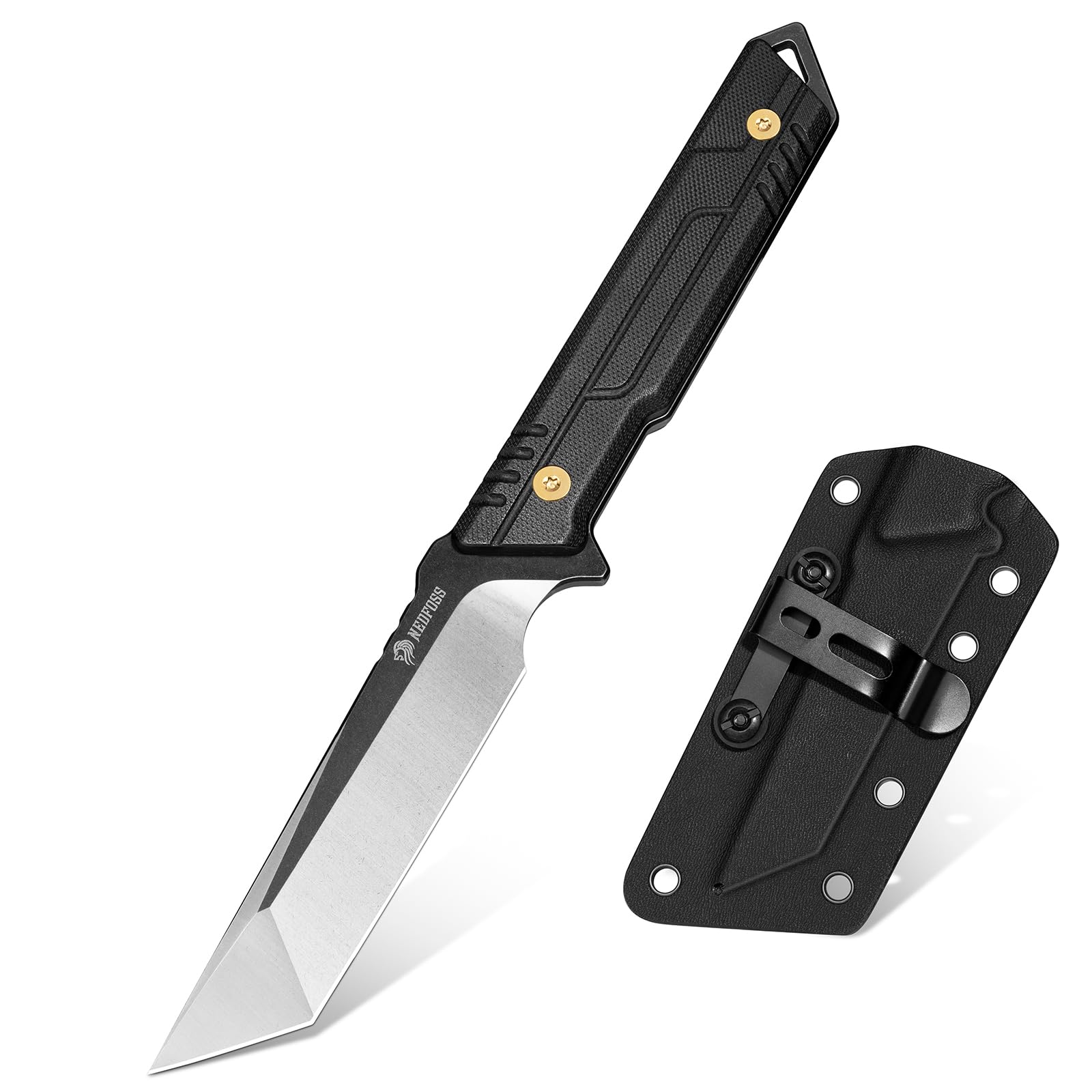
The NedFoss EDC Tanto is the lightest knife in this roundup at 3.9 ounces, and the steel choice reflects a clear priority: AUS-8 is a premium upgrade from the 3Cr13 and 420HC seen elsewhere in this budget bracket. AUS-8 offers roughly 15-20% better edge retention than 3Cr13 while still being easy to sharpen with a ceramic rod or stone. The tanto point is ground with a stonewashed finish that masks wear, and the geometry is optimized for piercing rather than slicing — the forward edge is aggressive, while the straight section behind the tip is ideal for draw cuts.
The G10 handle is textured with a secure finger guard and aggressive spine jimping that locks the thumb in place during forward thrusts. The profile is 30% slimmer than typical survival knives, making it comfortable for concealed carry or pocket carry inside a jacket. The 4-way Kydex sheath uses an adjustable belt clip that can be configured for vertical, horizontal, leg, or MOLLE carry, and the knife seats with an audible snap. The included ferro rod attachment is functional but lacks magnesium, making fire-starting more difficult than with a dedicated striker.
The handle is slim enough that users with very large hands may find the grip less secure than fuller profiles. The thin blade geometry is not designed for batoning — lateral stress on an AUS-8 tanto can cause tip fracture. The Kydex sheath belt clip initially includes plastic spacers that can loosen; removing them and tightening the screw fixes the issue permanently. The NedFoss is best understood as a compact defensive and utility blade, not a camp workhorse.
Why it’s great
- AUS-8 steel offers a meaningful upgrade in edge retention over budget stainless
- Ultra-light 3.9 oz weight makes it ideal for everyday carry
- Adjustable 4-way Kydex sheath with positive retention
Good to know
- Slim handle may feel undersized for larger hands
- Not designed for heavy batoning or prying tasks
6. Elk Ridge Outdoors ER-555
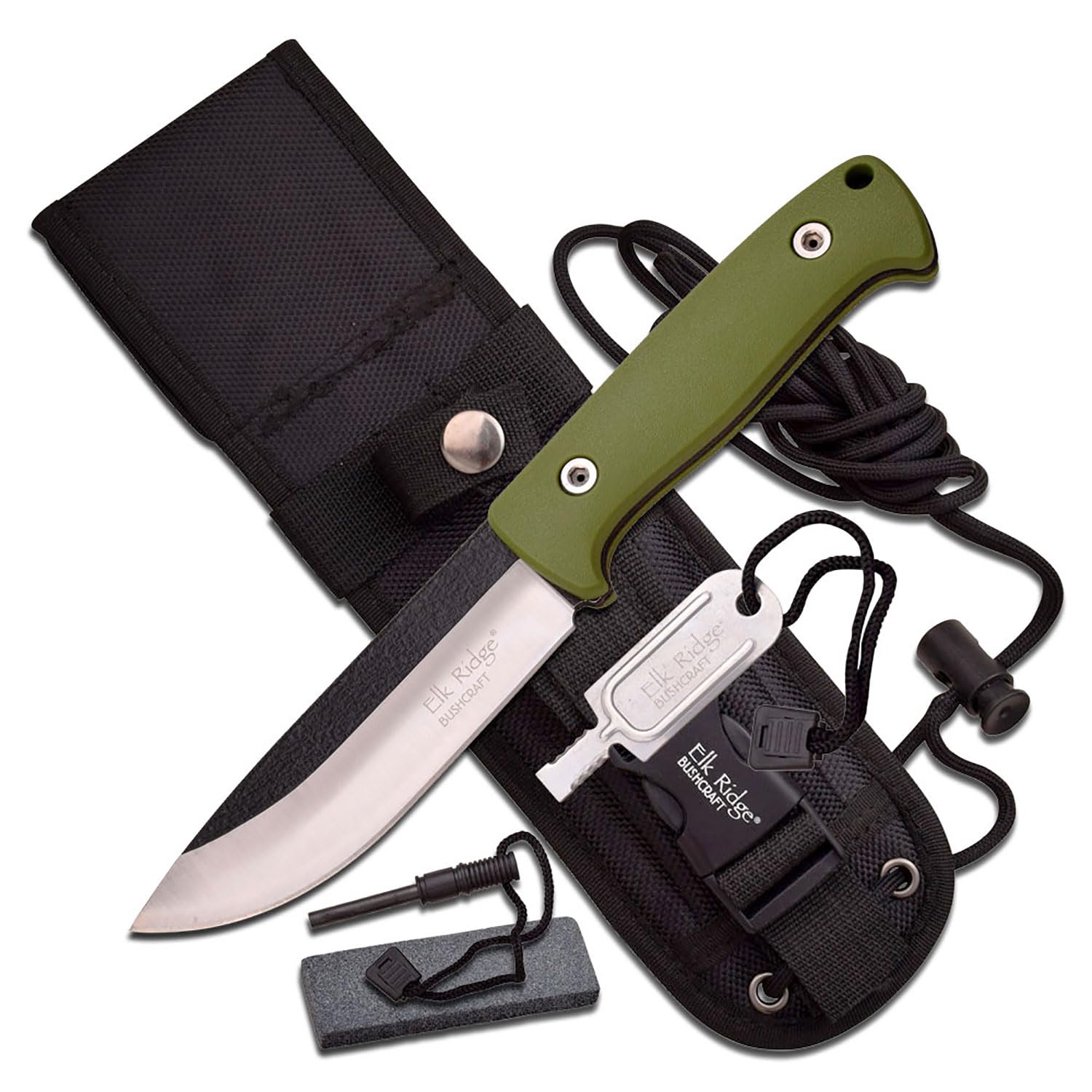
The Elk Ridge ER-555 is the most feature-dense knife in the budget bracket. The 5.5-inch drop point blade is made of 3Cr13 steel — entry-level but adequate when heat-treated properly — and the full tang construction is visible through the injection-molded nylon fiber handle. The defining feature is the hidden compartment inside the hollow handle, which contains a sharpening stone, a ferrocerium rod, a striker, and a small survival kit. For the price, this packaging of a fixed blade plus emergency fire-starting gear is hard to argue with for a first survival kit.
Users consistently report the blade arrives shaving sharp and performs well for batoning, food prep, and general carving. The 5.5-inch blade length gives substantial cutting leverage, and the drop point profile is versatile for both slicing and light chopping. The injection-molded handle is comfortable for medium to large hands, though the hollow handle creates a slightly different balance than a solid tang. The nylon sheath includes a small pouch for the included fire starter and has MOLLE-compatible loops, though the loops are not reinforced for heavy load carriage.
The 3Cr13 steel is the weakest point. It will hold a working edge for a camping trip but will require sharpening after a weekend of heavy batoning. The ferro rod striker included in the handle is universally described as nearly unusable — the sharpening stone that doubles as a striker does not throw sparks reliably. The hollow handle is a trade-off: it stores gear but reduces structural integrity compared to a solid tang, and some owners report the tip bent slightly during heavy batoning on hardwood. The nylon sheath has fraying issues at the stitching over time.
Why it’s great
- Hidden compartment with sharpening stone, ferro rod, and survival kit
- 5.5-inch drop point blade offers good cutting leverage for bushcraft
- Full tang and injection-molded handle provide solid overall build
Good to know
- 3Cr13 steel requires frequent sharpening with heavy use
- Included ferro rod striker is unreliable for fire starting
7. Smith & Wesson SWF606

The Smith & Wesson SWF606 is a dagger-profile fixed blade that prioritizes reach and piercing power over camp utility. The 4.4-inch dual-edge spear-point blade is made from 8Cr13MoV high-carbon stainless steel — a significant step up from the 3Cr13 found in the most entry-level knives — and the full tang construction runs the entire 8.6-inch length. The blade geometry is symmetrical, with a compound bevel edge that arrives shaving sharp out of the box. The center of balance sits just behind the blade, pushing weight into cuts for a driven feel during piercing tasks.
The handle is molded from thermoplastic elastomer (TPE) with a finger guard and a lanyard hole that doubles as a neck-knife attachment point. The leather sheath is surprisingly well-made for this price bracket, with a belt clip and a secure snap closure. The sheath holds the knife vertically and allows for a clean draw when unbuttoned. The overall weight at 5.8 ounces makes it suitable for boot or belt carry, though the 4.4-inch blade is long enough that boot carry may be tight for users with smaller calves.
The grind symmetry is not perfect — some units show a slightly off-center bevel, though this does not affect cutting performance in any practical way. The handle is on the short side for users with larger hands, and the finger loop is small enough to restrict gloved use. The dual-edge design means local legal restrictions may apply depending on your jurisdiction. The SWF606 is not a bushcraft knife; it is a tactical/self-defense tool that happens to work for light camp tasks. The leather sheath, while well-stitched, offers less retention than a Kydex alternative, and the snap can wear with repeated opening.
Why it’s great
- 8Cr13MoV steel offers good edge retention for tactical and utility tasks
- Leather sheath with belt clip provides classic, secure carry
- Dual-edge spear-point design excels at piercing and slicing
Good to know
- Handle and finger loop may be too small for large or gloved hands
- Dual-edge design may be restricted in some jurisdictions
FAQ
Can a budget fixed blade knife handle batoning wood?
What is the best steel for a budget fixed blade that will see heavy use?
Is a leather sheath or a Kydex sheath better for a budget fixed blade?
Final Thoughts: The Verdict
For most users, the budget fixed blade knife winner is the Cold Steel Finn Hawk because its cryo-quenched 4116 steel and ergonomic TPR handle deliver performance that competes with blades at double the price. If you want a dedicated hunting and field-dressing tool, grab the Gerber Freeman Guide. And for ultralight everyday carry with a premium steel upgrade, nothing beats the NedFoss EDC Tanto.