
Picking a dual dash cam on a tight budget used to mean accepting blurry footage that could never capture a license plate, let alone provide solid evidence after a fender bender. The market has shifted dramatically, and entry-level dual camera systems now pack features like 4K resolution, STARVIS sensors, and fast 5GHz WiFi that were once reserved for premium models.
I’m Min — the co-founder and writer behind Gadgets Feed. I’ve spent countless hours analyzing technical specifications, poring over customer feedback, and cross-referencing sensor performance data to find which budget dual dash cams actually deliver on their promises.
Whether you drive for a rideshare service, commute daily in heavy traffic, or simply want to protect your vehicle from parking lot incidents, this guide will help you choose the best budget front and rear dash cam that fits your needs without compromising on the features that matter most.
How To Choose The Best Budget Front And Rear Dash Cam
A budget-friendly dual dash cam must balance upfront cost against long-term reliability and video clarity. The cheapest option is rarely the best when it fails to capture a critical moment. Focus on four key areas before deciding.
Sensor Quality and Night Performance
The image sensor is the heart of any dash cam. Budget models commonly use standard CMOS sensors, but the best options in this tier employ Sony STARVIS sensors that excel in low light. Look for a large aperture around F1.5 to F1.8, which lets in more light and reduces motion blur on moving vehicles at night. Wide Dynamic Range (WDR) is non-negotiable for handling bright headlights and dark shadows simultaneously.
Resolution and Frame Rate Reality Check
Many budget dash cams advertise 4K front recording, but read the fine print — rear cameras often drop to 1080P or lower. True 4K on the front with at least 2.5K on the rear provides the best balance for reading license plates. Frame rate matters too; 30fps is standard, but 60fps on the front captures fast-moving objects with less blur. Be skeptical of inflated claims and check customer sample footage when possible.
Parking Mode and Power Management
Parking mode is a major differentiator among budget dual cams. Most require a separate hardwire kit to function, as the included cigarette lighter adapter only powers the camera while the vehicle runs. If you park on the street or in shared lots, prioritize models with motion detection or time-lapse parking modes. Models with supercapacitors instead of lithium batteries handle extreme cabin temperatures better and last longer in parking mode scenarios.
Quick Comparison
On smaller screens, swipe sideways to see the full table.
| Model | Category | Best For | Key Spec | Amazon |
|---|---|---|---|---|
| ROVE R2-4K DUAL | Premium Budget | Overall Value & Reliability | STARVIS 2 sensor, 5G WiFi, 128GB included | Amazon |
| COOLCRAZY N8 | Mid-Range Tech | STARVIS Night Vision | STARVIS sensor, 5GHz WiFi, 128GB included | Amazon |
| Nanoby M1 3-Channel | Triple Camera | Interior Coverage (Rideshare) | 4K front + 1080P cabin + 1080P rear | Amazon |
| 70mai A410 | Mid-Range | Built-in GPS & Ease of Use | 2.5K front, built-in GPS, F1.55 aperture | Amazon |
| virrow X5 | Touchscreen | User-Friendly Interface | 4K front + 2.5K rear, 3.39″ touchscreen | Amazon |
| AXB V3 | Entry-Level | Price-Sensitive Buyers | 4K front + 2.5K rear, 170° FOV, 64GB included | Amazon |
| THINKWARE U3000 PRO | Premium (Data Point) | Radar Parking Mode, Premium Build | 4K front + 2K rear, STARVIS 2, radar parking | Amazon |
In‑Depth Reviews
1. ROVE R2-4K DUAL Front and Rear

The ROVE R2-4K DUAL earns the top spot by combining a Sony STARVIS 2 image sensor on the front camera with a generous included 128GB microSD card — a rare combination at this price tier. The 4K front footage at 30fps from the IMX675 sensor delivers vivid colors and sharp detail even as dusk settles, while the rear camera holds steady at 1080P. The F1.5 aperture on the front lens pulls in enough light to read plates on unlit streets, and the 150-degree field of view covers four lanes without fisheye distortion.
The built-in 5GHz WiFi pushes download speeds up to 20 MB/s, which means a minute of 4K footage transfers in roughly 15 seconds via the ROVE app. GPS is integrated directly into the mount, stamping speed and coordinates onto the video without requiring a bulky external module. The 3-inch IPS screen shows live speed and compass, and the supercapacitor power system avoids battery swelling issues common in hot cabins. The suction mount holds firmly, and a sticky mount alternative is included for permanent installations.
Customer reviews consistently highlight ROVE’s after-sales support as a major advantage — multiple users reported receiving replacement units quickly when issues arose, even after the standard warranty period. The custom-designed parking mode gives three options: 1fps time-lapse, motion detection, and collision detection, though a hardwire kit is purchased separately. For a budget-conscious buyer who wants STARVIS 2 performance, a free 128GB card, and reliable support, the R2-4K DUAL is the complete package.
Why it’s great
- STARVIS 2 sensor delivers exceptional low-light clarity for reading license plates at night
- Included 128GB card eliminates the need for an immediate accessory purchase
- 5GHz WiFi achieves 20 MB/s downloads for quick footage access
- Supercapacitor design handles extreme cabin temperatures without battery degradation
Good to know
- Parking mode requires a separately sold hardwire kit for full functionality
- Rear camera resolution is 1080P, not 2K like some competitors
- Some users report the adhesive mount loses grip in extreme heat over time
2. COOLCRAZY N8 4K Dash Cam Front and Rear
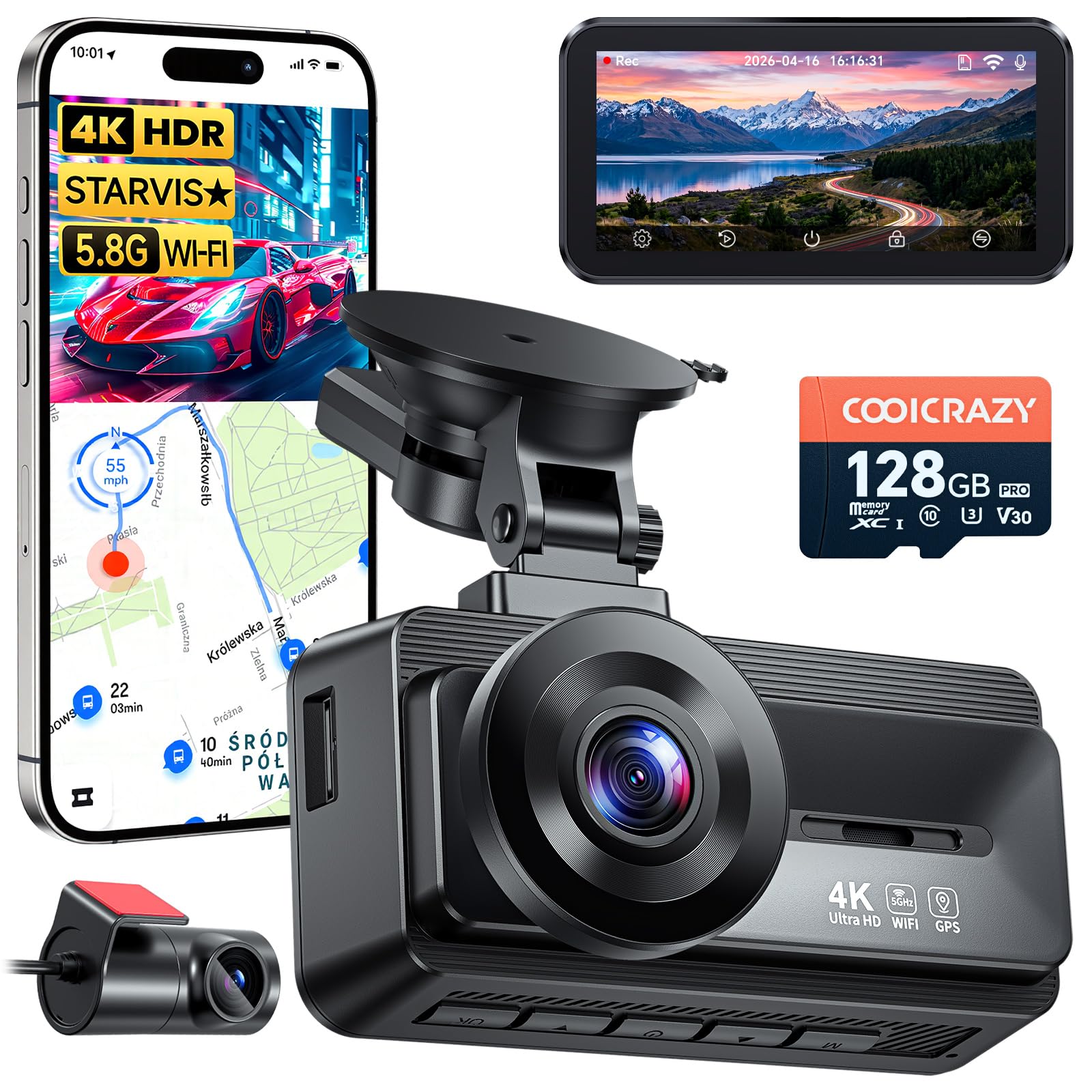
The COOLCRAZY N8 packs a Sony STARVIS sensor that directly targets the biggest pain point of budget dash cams: murky night footage. The front camera records full 4K UHD at 60fps, which is unusually high for this price range and makes a real difference when capturing fast-moving vehicles at intersections. The 170-degree front and 150-degree rear wide angles minimize blind spots without introducing excessive barrel distortion, and the WDR technology cuts the harsh glare of oncoming LED headlights.
Built-in GPS tracking is integrated directly into the suction cup mount, embedding speed, route, and location data into each video file. The 5GHz WiFi module provides up to 20 MB/s download speeds, comparable to the ROVE, making app-based footage retrieval genuinely usable rather than a gimmick. An included 128GB card is pre-installed and already formatted, so the camera records immediately after mounting. The real-time GPS tracking via the app maps your driving route alongside video playback, which is helpful for verifying accident locations.
Installation is straightforward with the 20.3-foot rear camera cable, sufficient for most SUVs and trucks. The electrostatic sticker for the windshield leaves no residue when removed, ideal for leased vehicles. A few customers noted the rear camera adhesive can fail if applied to a textured surface, and the reformat reminder that pops up at every startup is slightly annoying. But for night performance that rivals cameras costing nearly double, the N8 is a standout choice for anyone who drives after dark regularly.
Why it’s great
- STARVIS sensor with 60fps 4K front recording captures sharp night footage and moving plates
- Generous 128GB card included and ready to use out of the box
- 5GHz WiFi enables fast video transfers to smartphone without removing the card
- Built-in GPS mount records speed and route without an external module
Good to know
- Continuous reformat reminder at each startup may become irritating over time
- Rear camera adhesive may not hold reliably on textured or curved surfaces
- App connection can be finicky; some users prefer direct SD card access
3. Nanoby M1 3 Channel Dash Cam Front Rear Inside

The Nanoby M1 breaks the budget dual-cam mold by adding a third interior channel, recording the cabin at 1080P alongside the 4K front and 1080P rear. This makes it the strongest contender for rideshare drivers and parents who want to monitor backseat passengers. The interior camera uses four infrared LEDs with an F1.6 aperture, producing clean cabin footage in total darkness — essential for Uber and Lyft drivers documenting passenger interactions.
The 5.8GHz WiFi module is a standout feature, delivering download speeds up to 8 MB/s — roughly four times faster than standard 2.4GHz dash cams. GPS is integrated and records speed, latitude, and longitude directly into the video metadata, viewable on the companion app or desktop GPS player. The 3.18-inch IPS screen provides a crisp live view of all three cameras simultaneously, and the low-profile design sits discreetly behind the rearview mirror without obstructing the driver’s line of sight.
The car charger includes an extra USB port, allowing you to charge a phone while the dash cam remains powered — a small but practical addition. Loop recording overwrites the oldest footage automatically, and the G-sensor locks collision events instantly. Some users found the button layout takes a few days to memorize, and the cabin camera’s IR LEDs can cause a slight red glow visible to passengers. Still, for the price of a standard dual cam, the M1 gives you three angles of protection that rideshare professionals genuinely need.
Why it’s great
- Three-channel recording covers front, rear, and cabin for rideshare or passenger monitoring
- 5.8GHz WiFi transfers footage significantly faster than 2.4GHz competitors
- Interior IR LEDs capture clear cabin video in complete darkness
- Extra USB port on the charger powers a secondary device simultaneously
Good to know
- Slightly bulkier than standard dual cams due to the third camera sensor
- Button controls are not intuitive and require a brief learning period
- Hardwire kit for parking mode is sold separately and uses Type-C connection
4. 70mai A410 Dash Cam Front and Rear
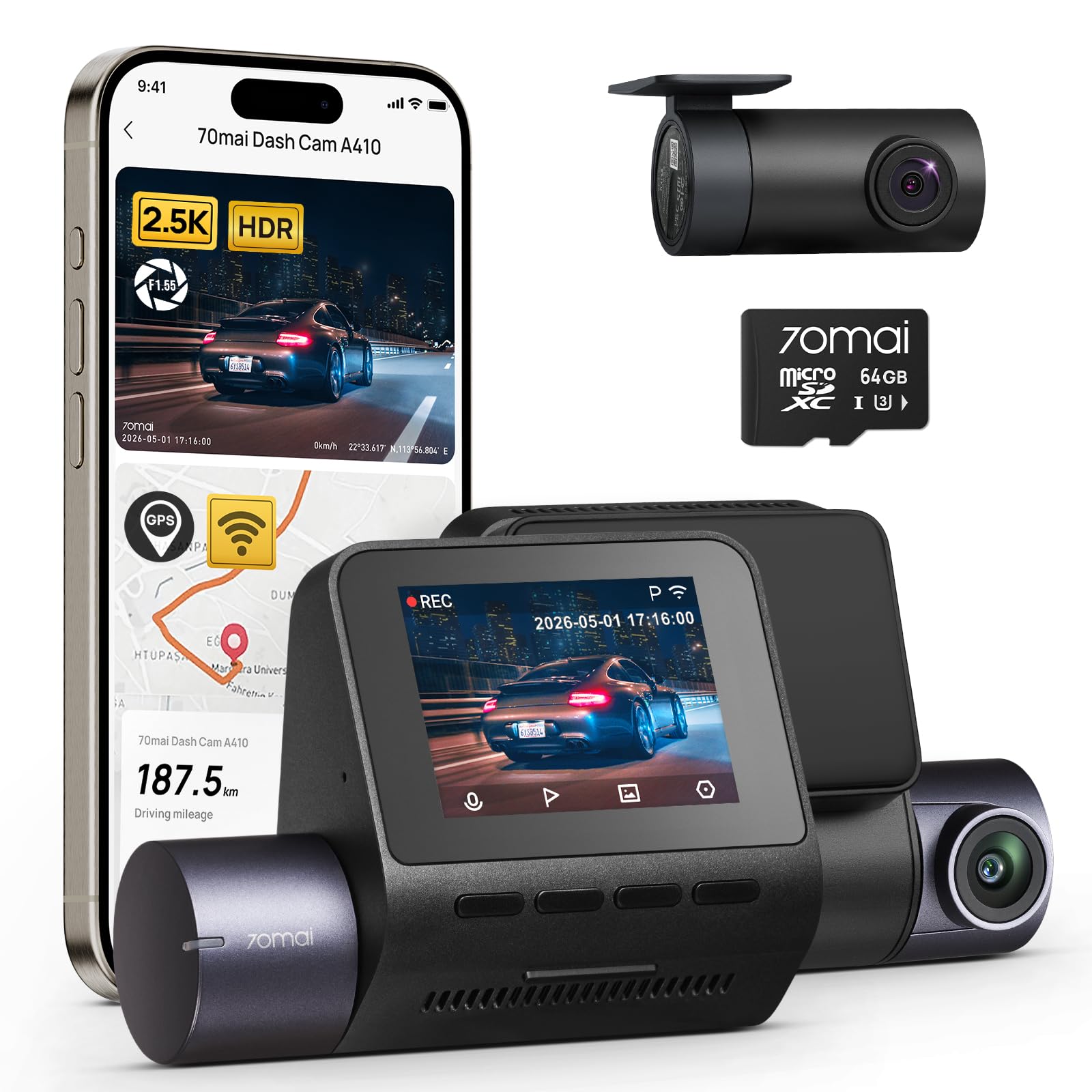
70mai has earned a reputation for reliable, no-nonsense dash cams, and the A410 continues that tradition with a compact 2.5K front and 1080P rear setup. While its front resolution tops out at 2560x1440P rather than 4K, the F1.55 aperture and HDR processing produce exceptionally clear footage in variable lighting conditions. The 125-degree front lens is narrower than some competitors, but the reduced field of view actually reduces fisheye distortion, making license plates more readable at a distance.
Built-in GPS is a headline feature at this price point, embedding speed, coordinates, and timestamps directly onto the footage. The footage can be replayed on a map via the app, which is useful for verifying accident location and speed. The electrostatic sticker mounting system leaves no residue and holds firmly in high heat, a genuine advantage for those in sunbelt states. The included 64GB card provides roughly 6 hours of continuous recording before loop overwrite begins, and the card slot supports expansion up to 256GB.
Voice prompts guide you through installation and operation, which reduces the guesswork for first-time dash cam users. Parking mode is available via a separate hardwire kit (UP03), and the G-sensor locks files upon impact automatically. The rear camera cable is notably long, sometimes requiring extra effort to hide entirely, and the resolution cannot capture distant plates as clearly as 4K units. But for daily commuters who prioritize reliability and GPS documentation over absolute resolution, the A410 is a polished mid-range option.
Why it’s great
- Built-in GPS stamps speed and coordinates onto video for insurance-grade evidence
- F1.55 aperture with HDR produces balanced footage in harsh sun and low light
- Electrostatic sticker mount holds securely without leaving sticky residue
- Voice guidance simplifies setup for drivers new to dash cams
Good to know
- Front resolution is 2.5K rather than 4K, limiting distant plate readability
- 125-degree front FOV is narrower, covering fewer lanes than 170-degree competitors
- Rear camera cable is very long; hiding excess neatly requires patience
5. virrow X5 Dash Cam Front and Rear
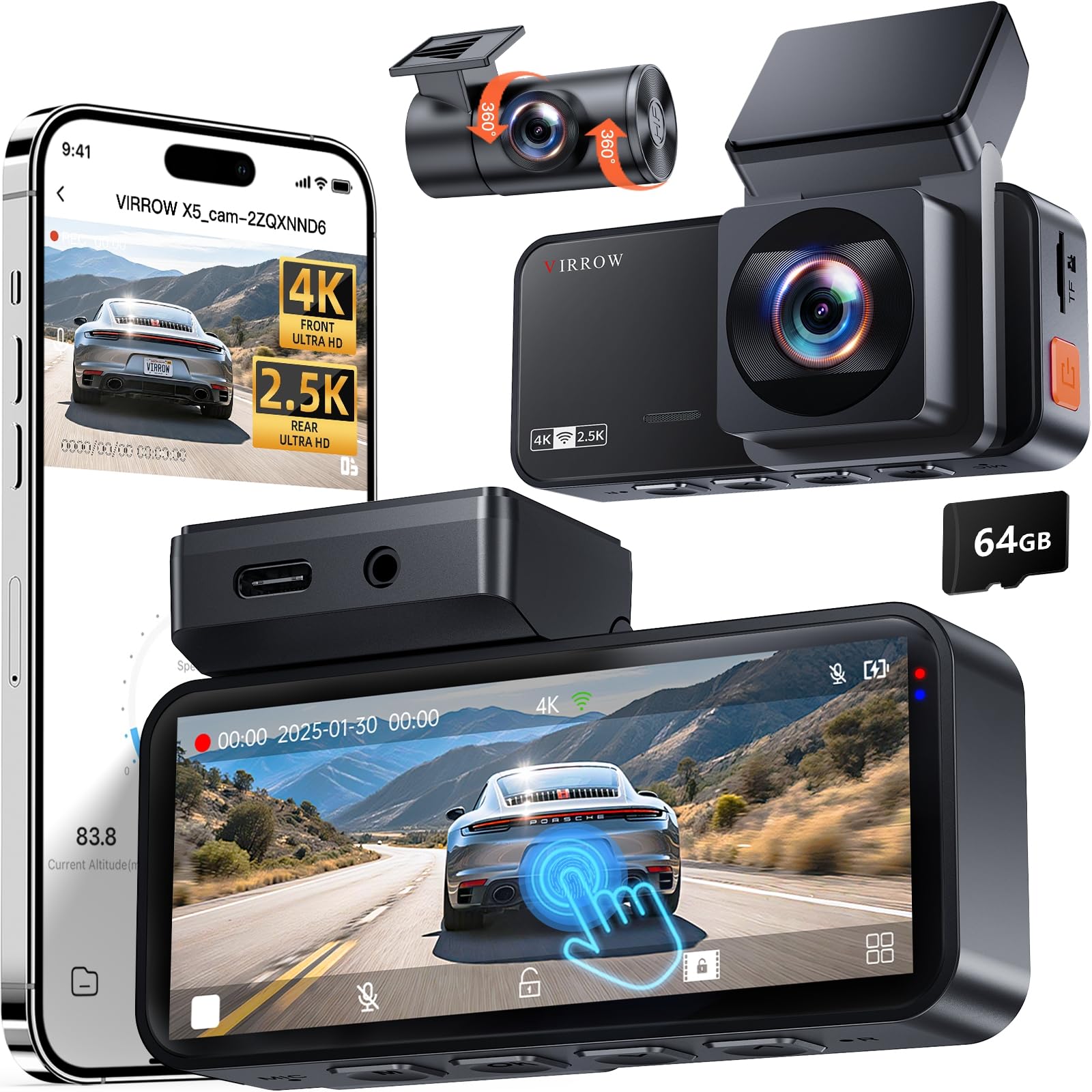
The virrow X5 differentiates itself with a responsive 3.39-inch touchscreen interface, allowing you to review footage, adjust settings, and format the SD card without needing the smartphone app. The front camera records true 4K while the rear captures 2.5K, giving the rear channel noticeably more detail than the 1080P rear cameras found on comparably priced competitors. The dual cameras cover 170 degrees front and 165 degrees rear, providing near-peripheral vision that captures activity in adjacent lanes.
The G-sensor collision detection automatically locks emergency clips in a protected folder, preventing loop overwriting. Night performance is handled by an F1.8 aperture paired with a 6-layer glass lens and WDR technology, which together reduce glare from streetlights and oncoming traffic while pulling detail from shadowed areas. The time-lapse parking mode condenses 24 hours of monitoring into a few minutes of footage, though the hardwire kit must be purchased separately. An included 64GB card gets you started immediately.
Customers particularly praise the plug-and-play experience — the cable clips and pry tool make hiding wires manageable for a DIY install. The touchscreen interface is intuitive enough that most users never need to install the app, though those who do report the WiFi connection can be inconsistent and may require re-pairing. The adhesive mount is secure, but a user reported the camera detached from the bracket after a collision, meaning the mount itself survived but the camera didn’t stay attached. For buyers who prefer physical screen control over app dependency, the X5 is a strong candidate.
Why it’s great
- Touchscreen interface eliminates reliance on a smartphone app for settings and playback
- Rear camera records at 2.5K, offering higher detail than standard 1080P rear cams
- 170-degree front and 165-degree rear FOV minimizes blind spots effectively
- Time-lapse parking mode condenses long monitoring periods into manageable clips
Good to know
- WiFi reconnection can be unreliable, requiring manual re-pairing after each use
- Mounting bracket may separate from the camera body upon hard impact
- Hardwire kit for parking mode is an additional purchase not included in the package
6. AXB V3 Dash Cam Front and Rear
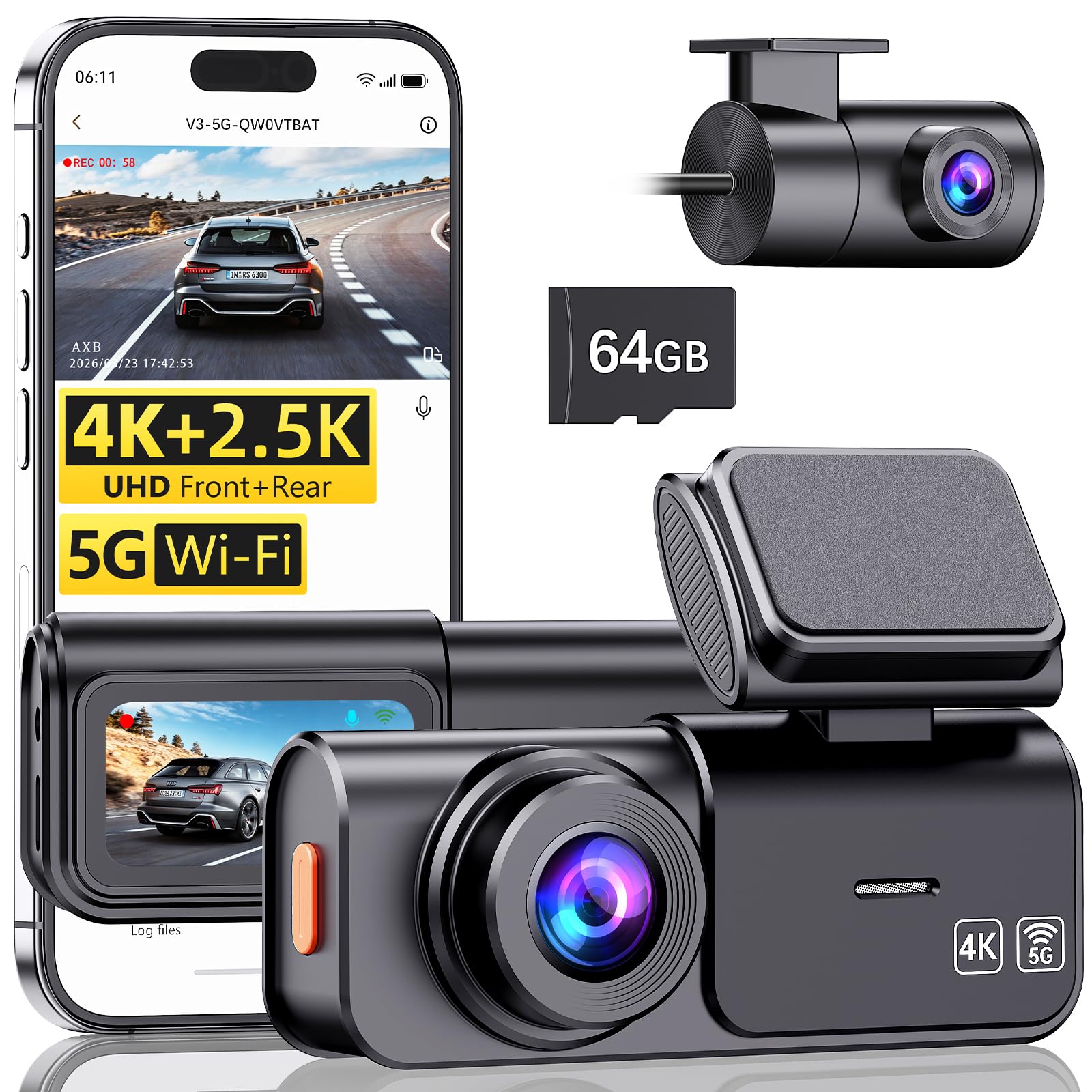
The AXB V3 is a true entry-level contender that punches above its weight with 4K front and 2.5K rear recording at a price that undercuts nearly everything else in this roundup. The 170-degree front lens is among the widest available, capturing traffic in adjacent lanes and activity on sidewalks. The SC2336 sensor and WDR technology work together to reduce blowout from direct sunlight and headlight glare, producing usable footage in most daytime and well-lit night scenarios.
A 64GB card is included, so no immediate accessory purchase is necessary. Loop recording and G-sensor locking function as expected, with emergency clips saved to a protected folder. The parking mode requires a hardwire kit sold separately, and the camera has no internal backup battery — it must remain plugged into the car’s power to function, which means any gap in the cigarette lighter connection will interrupt recording.
The compact size is a genuine advantage for those with limited windshield space, and the included installation tool makes wire hiding straightforward. A customer noted the screen cannot be dimmed or turned off while recording, which may be distracting during night driving. Others pointed out that the claimed 4K resolution does not match the clarity of a modern smartphone camera, and reading plates at highway speeds in low light is inconsistent. For drivers on a strict budget who want dual 4K/2.5K recording and are comfortable with its limitations, the V3 offers the lowest barrier to entry.
Why it’s great
- 4K front and 2.5K rear resolution delivers a higher level of detail than typical entry-level dual cams
- 170-degree front FOV is one of the widest available, covering blind spots effectively
- Includes 64GB card and installation tools for immediate out-of-box use
- Compact form factor fits discreetly behind the rearview mirror
Good to know
- No internal battery means recording stops the instant power is disconnected
- Screen cannot be turned off while recording, creating glare at night
- 4K quality does not match premium sensors; plate capture is inconsistent at highway speeds
- WiFi range is limited, requiring the phone to be very close to the camera
7. THINKWARE U3000 PRO 2CH 4K HDR Dual Dash Cam
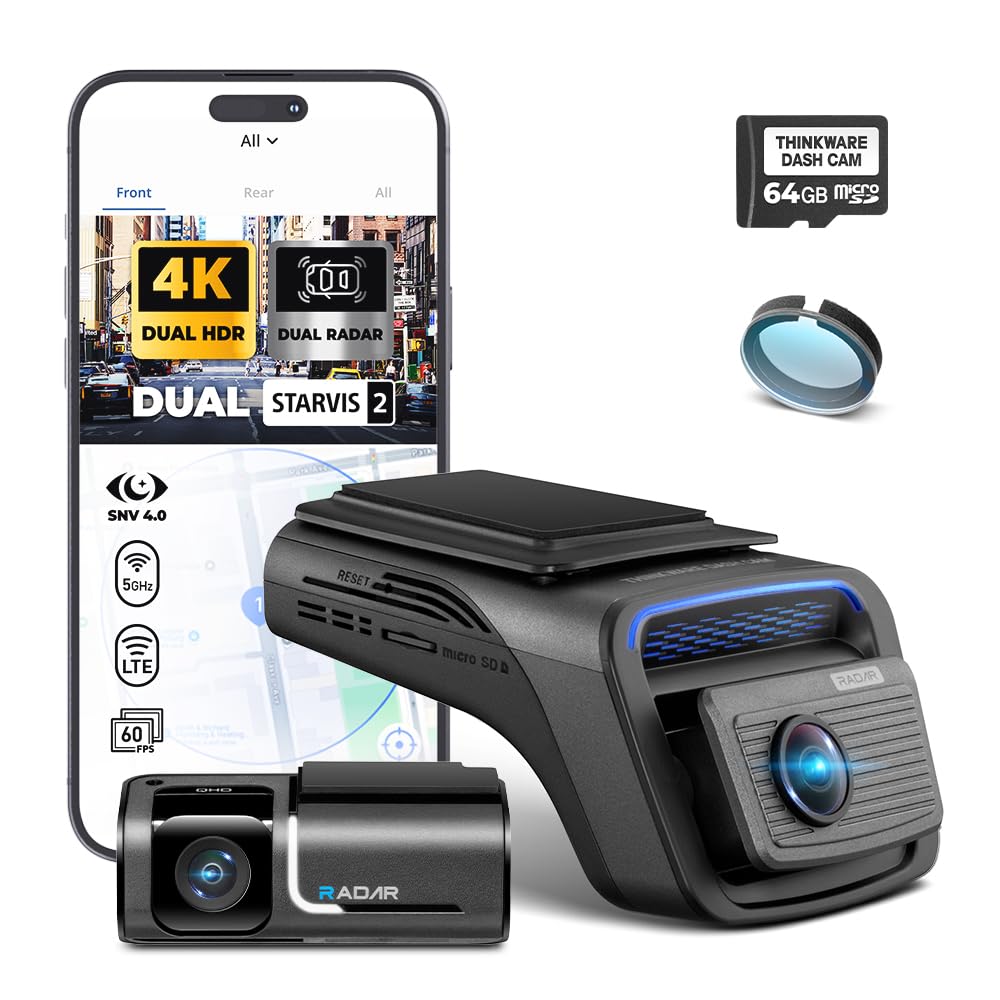
The THINKWARE U3000 PRO is the outlier in this budget roundup — a premium reference point that shows what happens when price constraints are removed. It uses Sony STARVIS 2 sensors on both the front and rear cameras, capturing 4K front and 2K rear footage with HDR processing that balances the harshest lighting conditions. The 147.2-degree field of view is narrower than budget competitors, but the optical quality and sensor performance mean every pixel carries more usable information.
The distinguishing feature is the radar-based parking mode. Instead of relying on motion detection from the camera sensor, radar waves detect movement around the vehicle and wake the camera to record a 20-second clip. This saves significant battery power compared to continuous time-lapse recording. The OBD-II cable is included, simplifying the hardwire installation since it taps into the vehicle’s diagnostic port rather than requiring fusebox access. Forward collision and lane departure warnings add an extra layer of active safety, and the system is LTE-ready for remote live view when paired with the optional module.
The U3000 PRO’s build quality and heat tolerance are best-in-class, with thermal protection preventing shutdown during summer parking. The app experience is smoother than most budget competitors, though some users still prefer pulling the SD card for batch transfers. The 64GB included card is undersized for a 4K system — expect to upgrade to at least 256GB for full utility. For budget shoppers, this camera establishes the ceiling: if radar parking and guaranteed plate capture at night are essential, the investment may be justified, but most buyers will find the ROVE or COOLCRAZY sufficient for their needs.
Why it’s great
- Radar parking mode minimizes battery drain while detecting threats more reliably than motion sensors
- STARVIS 2 sensors on both front and rear cameras deliver unmatched low-light clarity
- Included OBD-II cable simplifies hardwire installation without tapping into fusebox
- Active safety alerts and LTE-ready architecture for remote monitoring
Good to know
- Premium price point far exceeds budget category; only necessary for specific parking mode needs
- Included 64GB card is insufficient for 4K recording; a 256GB+ upgrade is recommended
- App interface, while better than budget units, still lags behind desktop card reader transfers
FAQ
Do I need a hardwire kit for parking mode?
Can a budget dual dash cam read license plates at highway speeds?
What size SD card should I use for a budget dual dash cam?
Is a capacitor-based power system better than a battery?
Final Thoughts: The Verdict
For most users, the best budget front and rear dash cam winner is the ROVE R2-4K DUAL because it combines a STARVIS 2 sensor, 5GHz WiFi, a free 128GB card, and reliable customer support — all at a price that undercuts competitors while delivering genuine night vision performance. If your priority is the absolute best low-light footage and you want 60fps recording, grab the COOLCRAZY N8. And for rideshare drivers who need interior cabin monitoring alongside dual road coverage, nothing in this tier beats the Nanoby M1 3-Channel.