
Our readers keep the lights on and my morning glass full of iced black tea. As an Amazon Associate, I earn from qualifying purchases.
Specs are compiled from manufacturer listings and verified buyer reviews and can change over time — please confirm the key details on the product page before buying.
If your headphones sound thin, quiet, or lifeless straight from a phone or laptop, the problem is usually power, not the headphones themselves. A dedicated headphone amp puts voltage behind your music so planars, high-impedance cans, and even fussy in-ear monitors get the drive they need to perform. This guide sorts the best options by what you actually get: raw power, connectivity, size, and the honest trade-offs at each level.
I’m Min — the founder and writer behind Gadgets Feed. This guide is built by comparing the manufacturers’ published specifications and the patterns across verified customer reviews, so you get each pick’s real strengths and trade-offs instead of marketing spin.
You want a budget headphone amp that makes your headphones sound their best while staying affordable. The right one for you depends on matching its output power and connections to your gear, not just picking the loudest spec sheet.
Our Picks at a Glance


How To Choose The Best Budget Headphone Amp
Before you buy, you need to know your headphones’ impedance, which is measured in ohms, and how you plan to connect the amp. High-impedance headphones like 250Ω or 300Ω models need more voltage to sound full, while low-impedance in-ear monitors need less power but a clean, quiet signal.
Desktop vs. Portable
A desktop amp sits on your desk and plugs into a wall or USB power source, offering higher output and more connection options. A portable dongle draws power from your phone or laptop, so it is much smaller but delivers less raw wattage to the headphones.
Outputs and Connectivity
Balanced 4.4mm output is the feature to hunt for because it delivers more power and lower noise than a standard 3.5mm or 6.35mm jack. Inputs matter too: USB covers computers, while optical and coaxial let you connect CD players, TVs, and other digital sources.
Matching Power to Headphones
Look for an amp with enough milliwatts (mW) for your headphones’ impedance. A 32Ω headphone needs far less power than a 300Ω one, so an amp with 1500mW at 32Ω can still drive high-impedance models effectively — just check the rating at the impedance you own.
Quick Comparison
| Model | Best For | Output Power | Headphone Outputs | Decoding Support | Amazon |
|---|---|---|---|---|---|
| FiiO K11★ Best Overall | Desktop all-rounder | 1400mW | 6.35mm + 4.4mm | 384kHz/24Bit, DSD256 | Amazon |
| Douk Audio U3 PROHigh-Impedance Pick | High-impedance cans | 1500mW at 32Ω | 3.5mm + 6.35mm | Analog only | Amazon |
| Fosi Audio DS2 | Portable phone DAC | 170mW per channel | 3.5mm + 4.4mm | DSD256, 32bit/384kHz | Amazon |
| MOONDROP Dawn Pro 2 | IEM tuning via app | 124mW | 3.5mm + 4.4mm | 32Bit/384KHz, DSD256 | Amazon |
| Fosi Audio SK02 | Compact desktop power | 1100mW at 32Ω | 3.5mm + 4.4mm | DSD256, 32bit/384kHz | Amazon |
| SMSL DS100 | MQA desktop listening | 7Vrms at 600Ω | 6.35mm + 4.4mm | MQA, 32bit/768kHz, DSD256 | Amazon |
| FiiO K11 R2R | R2R sound signature | 1300mW per channel | 6.35mm + 4.4mm | 32-bit/384kHz, DSD256 | Amazon |
In-Depth Reviews
1. FiiO K11 Desktop DAC/Amp
Our pick — over 4.5★ from 700+ verified ratings; the strongest balance of quality and price.
The desktop hub that drives most headphones with balanced clarity.
The K11 leads this list because it pairs a full desktop feature set with genuinely useful power: a 1400mW maximum output that easily handles high-impedance headphones. Its 4.4mm balanced output is the star — buyers report the balanced out makes headphones “ROAR” even on low gain, and it can drive high-impedance models up to 350Ω on medium gain.
It decodes up to 384kHz/24Bit and DSD256, so high-resolution files play at full quality. The aluminum body keeps it looking clean on a desk, while the VA display screen shows sampling rate, volume, gain, and output mode at a glance, so you are never guessing what setting you are on.
Inputs are generous — USB, coaxial, and optical cover computers, TVs, and CD players, plus RCA line-out and coaxial outputs for speakers. The sound is clean and neutral, though purists note the digital filters can lean bright or dark depending on the setting; the natural position is preferred by most.
What wins people over
- Balanced 4.4mm output with real power for high-impedance cans
- USB, coaxial, and optical inputs for multiple sources
- Slim aluminum chassis with a bright VA status display
Worth knowing
- Digital filters shift the tone, so find the natural setting
- ASIO drivers on Windows can be finicky to set up
Reach for it if: you want one desktop box that drives most headphones and takes multiple digital sources.
Look elsewhere if: you need the warmest, most forgiving signature — this stays neutral and revealing.
2. Douk Audio U3 PRO
Big power in a 5.76-ounce box built for hard-to-drive headphones.
The U3 PRO earns its spot as the analog specialist here because it focuses purely on amplification. It delivers up to 1500mW at 32Ω (that’s milliwatts, a measure of power output) and drives headphones from 18Ω to 600Ω (ohms, a measure of impedance, or how much resistance your headphones have). This makes it a natural fit for high-impedance Beyerdynamic DT880s — owners mention it runs them from an iMac without max volume or distortion, with a fuller sound and more bass.
Its class A design uses a voltage boost circuit that keeps a high ±14V operating rail from a DC 5V input, which is what gives it that warm, delicate signature. The pluggable op-amp socket means you can swap the stock OP42 and BUF634 chips for models like OP17, AD797, or OPA627 to tune the sound yourself, which is rare at this level.
At 5.76 ounces it is lightweight for a desktop amp, yet its build and knob feel smoother than pricier rivals. The main quirk is a volume knob that is hard to read, and the amp is powerful enough that owners warn to lower volume before powering on to protect hearing.
Why it stands out
- 1500mW output tames 250-600Ω cans with ease
- Replaceable op-amps let you customize the sound
- Warm, detailed class A signature at a budget price
Who should skip
- Volume knob markings are faint and easy to misread
- No built-in DAC, so you need a source with analog output
Best if: you own high-impedance headphones and want a small amp with serious headroom and tinker-friendly upgrades.
Think twice if: you need a USB DAC built in — this is a pure amplifier.
3. Fosi Audio DS2 USB-C Dongle

A 1.92-ounce dongle that upgrades phone and laptop audio on the go.
The DS2 is the answer when you want better sound from a phone, tablet, or laptop without a desktop box. It uses two Cirrus Logic CS43131 DAC chips (digital-to-analog converters that turn digital audio into sound) to decode up to DSD256 and PCM 32bit/384kHz (high-resolution audio formats). Its 170mW per channel at 32Ω is enough to power both low and high-impedance headphones through a 3.5mm single-ended or 4.4mm balanced connection, so you can plug in almost any pair and hear clearer detail than your device’s built-in output.
Its CNC-machined metal body weighs just 1.92 ounces, so it disappears in a pocket. On the go, owners find it delivers impressive sound clarity and handles formats like DSD 128 without distortion. The independent 60-step volume buttons with volume memory mean you do not need to touch your phone to adjust output.
Compatibility spans iPhone 15 series, iPads, Android phones, and computers, so it works as an external sound card too. The honest catch is battery drain on phones — at the gym, an iPhone dropped from 100% to 84% in two hours — and the included USB cable feels cheap; several owners swapped it out.
Verdict: For pocket-friendly power with balanced output, the DS2 is a standout value. Its size and feature set beat most dongles in the same tier, with the main trade-off being phone battery drain over long listening sessions.
Grab it for: travel, commutes, and squeezing high-res detail from a phone and a decent pair of IEMs.
Pass if: you mostly listen tethered to a desk all day — a desktop amp gives more raw power.
4. MOONDROP Dawn Pro 2
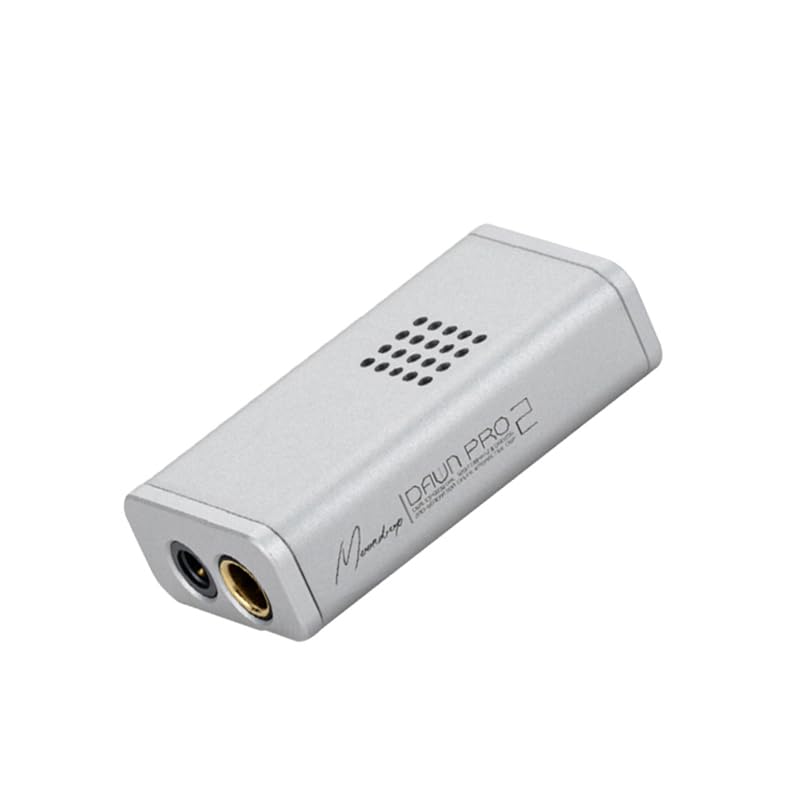
A pocket DAC/amp that lets you EQ every headphone to taste via an app.
The Dawn Pro 2 stands out for its app-driven tuning, which separates it from every other pick here. Through the MOONDROP app you can adjust a parametric equalizer with controls for filter type, frequency point, gain, and Q value, plus consult a headphone frequency response database for reference. That means you can shape the sound to your specific IEMs or cans.
Under the hood it uses dual Cirrus Logic CS43198 chips with three independent LDO power regulators and an independent crystal oscillator, which owners say produces a dead-silent background with excellent micro-detail. On its 3.5mm output it drives sensitive full-size headphones like the LCD-X and HD599, while the 4.4mm balanced output powers IEMs with ample headroom.
Output is rated at 124mW per side with a 4Vrms output voltage, and its aviation-grade aluminum housing is vented above the heat-generating chips for cooling. The trade-offs are a finicky 4.4mm connection on some units and an EQ that resets to factory when you unplug — a quirk owners call annoying but useful.
The biggest draw
- Parametric EQ via app with a headphone frequency database
- Dual CS43198 chips for a black, hiss-free background
- Compact aluminum housing with heat vents above the chips
Where it stumbles
- 4.4mm jack can be fussy when seating the cable fully
- EQ settings reset on unplug, so you reapply them each time
Best for: IEM owners who want to tune the sound profile precisely instead of settling for a fixed signature.
Not for: anyone who wants a set-and-forget amp with no phone app involvement.
5. Fosi Audio SK02

A compact desk unit that drives planars and 300Ω cans with 1100mW.
The SK02 packs a high-end ESS SABRE ES9038Q2M DAC with SGM8262 op-amps into a small aluminum chassis, giving it a sound that owners call neutral and clear with tight bass. Its 4.4mm balanced output delivers 1100mW at 32Ω, which is enough to drive 300Ω Sennheiser headphones to high volume without distortion — a frequent point of praise.
It supports DSD256 and PCM 32bit/384kHz decoding, and its SNR of 120dB with a 3.7μV noise floor keeps the signal clean. The big multi-function knob handles power, play/pause, and volume, while quick-switch buttons toggle high/low gain and input modes between USB and optical.
Unlike the Fosi DS2 dongle, the SK02 is louder and adds an optical input plus a preamp function, so it can feed active speakers or pair with amps like the Fosi V3. The catch is it has no app or tuning, and a single LED volume indicator that some owners found too vague to track exact level.
The take: The SK02 gives you desktop-grade power and versatility without the bulk. It is brighter in the treble than the K11, so it rewards warm headphones more than bright ones.
Choose it if: you want a small desktop DAC/amp that doubles as a preamp for powered speakers.
skip it if: you need app-based EQ or a constant digital volume readout.
6. SMSL DS100

A tiny desktop DAC/amp with MQA unfolding and a high-impedance 7Vrms output.
The DS100 is the pick for anyone with MQA files, since it supports both MQA and MQA-CD decoding via the Cirrus Logic CS43131 chipset. Its distortion rating of 0.00017% (-115dB) is remarkably low, and the XMOS XU-316 USB controller handles PCM up to 32bit/768kHz and DSD256 for maximum headroom on hi-res files.
It offers both 6.35mm and 4.4mm headphone jacks, with a 7Vrms output for 600Ω high-impedance headphones and 61mW for 16Ω low-impedance models. Owners describe the sound as excellent and say it “sounds expensive,” driving IEMs and the DT 990 Pro 80Ω easily from a simple setup.
Four LED lights — HP, COAX, OPT, and USB — show the current volume level. The aluminum CNC body feels sturdy, and a note for Windows users: you need to install a driver from the SMSL website, unlike the plug-and-play FiiO K11.
Where it shines
- MQA and MQA-CD decoding for hi-res streaming
- 7Vrms output drives 600Ω headphones with ease
- Ultra-low 0.00017% distortion for a clean signal
Fine print
- Windows requires a manual driver download
- Lacks a 3.5mm jack, so adapter needed for that size
Best for: MQA collectors and high-impedance headphone owners who want a tiny desktop box with huge voltage swing.
Not ideal if: you want true plug-and-play on Windows without driver setup.
7. FiiO K11 R2R

A desktop amp with a true R2R sound signature and switchable processing modes.
The K11 R2R is the most distinctive-sounding pick here because it uses a fully-differential 24-bit R2R resistor array — 192 high-precision resistors total — instead of a standard chip DAC. That gives it the warm, organic character R2R designs are known for, and owners say it competes with units costing far more.
Its headline feature is the NOS (non-oversampling) and OS (oversampling) dual modes you can switch freely. NOS keeps the original sampling rate for a musical presentation, while OS oversamples everything to 384kHz for more detail and clarity. Owners found NOS ideal for bright or older masters, and it pairs superbly with Hifiman Ananda headphones to tame treble.
Output reaches 1300mW per channel through 6.35mm single-ended and 4.4mm balanced ports, and decoding tops out at 32-bit/384kHz PCM and DSD256. The low-noise power supply uses 17 LDO regulators plus an external 12V supply. A few owners flagged reliability issues, and the knob-based navigation can be fiddly, so budget for care with the controls.
What hooks listeners
- True R2R array for a warm, natural signature
- Instant NOS/OS switching for two sound profiles
- 1300mW balanced output drives demanding planars
Honest cautions
- Knob-based menu navigation takes patience
- A few units have had reliability issues early on
Reach for it if: you want an R2R sound signature and the flexibility to flip between smooth and detailed modes.
Look elsewhere if: you prefer a simpler knob layout and deeply proven reliability over tonal character.
Understanding the Specs
Output Power (mW)
Measured in milliwatts, this tells you how loud an amp can drive your headphones at a given impedance. A 32Ω rating like 1500mW shows raw current; a high-impedance rating like 7Vrms at 600Ω shows voltage swing. Match the spec to your headphone’s impedance for best results.
Impedance Range (Ω)
Impedance, in ohms, is how much resistance your headphones present to the amp. High-impedance models like 250Ω or 300Ω need more voltage; low-impedance IEMs need less power but a very clean signal. An amp rated for 18-600Ω covers most real-world gear.
FAQ
Will a budget headphone amp make a difference with my phone or laptop?
What does balanced 4.4mm output do that 3.5mm does not?
How many ohms can these budget amps drive?
What is DSD256 and do I need it?
Is a portable dongle as good as a desktop amp?
Can I use these amps with active speakers or as a preamp?
What is the difference between the FiiO K11 and FiiO K11 R2R?
Do I need to install drivers for these amps?
Final Thoughts: The Verdict
For the majority of shoppers, the best budget headphone amp is the FiiO K11 because it combines balanced 4.4mm power, multiple digital inputs, and a clean neutral sound in one sleek desktop box. If you own high-impedance headphones and want huge headroom for less, the Douk Audio U3 PRO is the value play. And if you live on your phone, the Fosi DS2 brings serious portable quality at just 1.92 ounces.
How We Picked
We do not accept paid placement. Every pick is matched to a real buyer and a real use-case; we do not hands-on test units.
Sources & Methodology
Specifications: manufacturer listings and product documentation. Review insights: verified customer reviews, as of August 2026. Pricing: not shown on this page (it changes often); check the current price via the retailer link.
As an Amazon Associate, Gadgets Feed earns from qualifying purchases. This does not affect which products we feature.