
Our readers keep the lights on and my morning glass full of iced black tea. As an Amazon Associate, I earn from qualifying purchases.
Specs are compiled from manufacturer listings and verified buyer reviews and can change over time — please confirm the key details on the product page before buying.
Buying a budget inflatable paddle board means chasing stability, weight capacity, and a full accessory kit without paying premium prices. The boards here balance those three things differently, and the right one depends on whether you’re paddling solo, with a dog, or with the whole family.
I’m Min — the founder and writer behind Gadgets Feed. This guide is built by comparing the manufacturers’ published specifications and the patterns across verified customer reviews, so you get each pick’s real strengths and trade-offs instead of marketing spin.
From 300-pound solo cruisers to 450-pound family barges, these eleven picks cover what a budget inflatable paddle board should deliver, and which trade-offs matter most.
Our Picks at a Glance
How To Choose The Best Budget Inflatable Paddle Board
An inflatable paddle board (iSUP) is a rigid board you pump up with air, so it packs into a backpack instead of living on your car roof. The budget tier cuts costs on materials and accessories, but the core questions stay the same: how much weight it holds, how stable it feels, and how long it takes to inflate.
Width is the real stability number
A 35-inch-wide board gives you a noticeably bigger platform than a 33-inch one, which matters for beginners, kids, or anyone doing yoga. That extra width costs speed and maneuverability, making wider boards slower to paddle and harder to turn.
Weight capacity sets your ceiling
Always add your body weight plus gear (and pets). A 300-pound limit works for a solo adult with a dry bag, while a 450-pound board fits two people or one adult plus a large dog. Manufacturers recommend staying under the max for best glide.
Quick Comparison
| Model | Best For | Width | Weight Capacity | Max PSI | Amazon |
|---|---|---|---|---|---|
| Roc 10’6″★ Best Overall | Best Overall Value | 33″ | 350 lbs | 15 psi | Amazon |
| SLOOSH RippleBeginner’s Choice | Beginner Stability | 33″ | 300 lbs | 20 psi | Amazon |
| ZLX 11’6″Touring Pick | Touring Speed | 33″ | 507 lbs (230 kg) | 15 psi | Amazon |
| Flypark 11’x35″ | Fishing & Family | 35″ | 430 lbs | 20 psi | Amazon |
| Overmont 10’6″ | Lightweight Solo Trips | 33″ | 450 lbs | 15 psi | Amazon |
| TIGERXBANG 11’6″ | Kayak Conversion | 35″ | 485 lbs (220 kg) | — | Amazon |
| Flypark 11’x34″ | Yoga & Cruising | 34″ | 420 lbs | 20 psi | Amazon |
| CETANA 11’6″ | Group Stability | 35″ | 450 lbs | 15 psi | Amazon |
| iTAOSTAR Journey | Accessory-Rich All-Rounder | 35″ | 420 lbs | — | Amazon |
| ATPROSS 11’6″ | Heavy-Duty Family Loads | 35″ | 450 lbs | — | Amazon |
| iTAOSTAR Adventure | Long-Distance Fishing | 35″ | 450 lbs | 15 psi | Amazon |
In-Depth Reviews
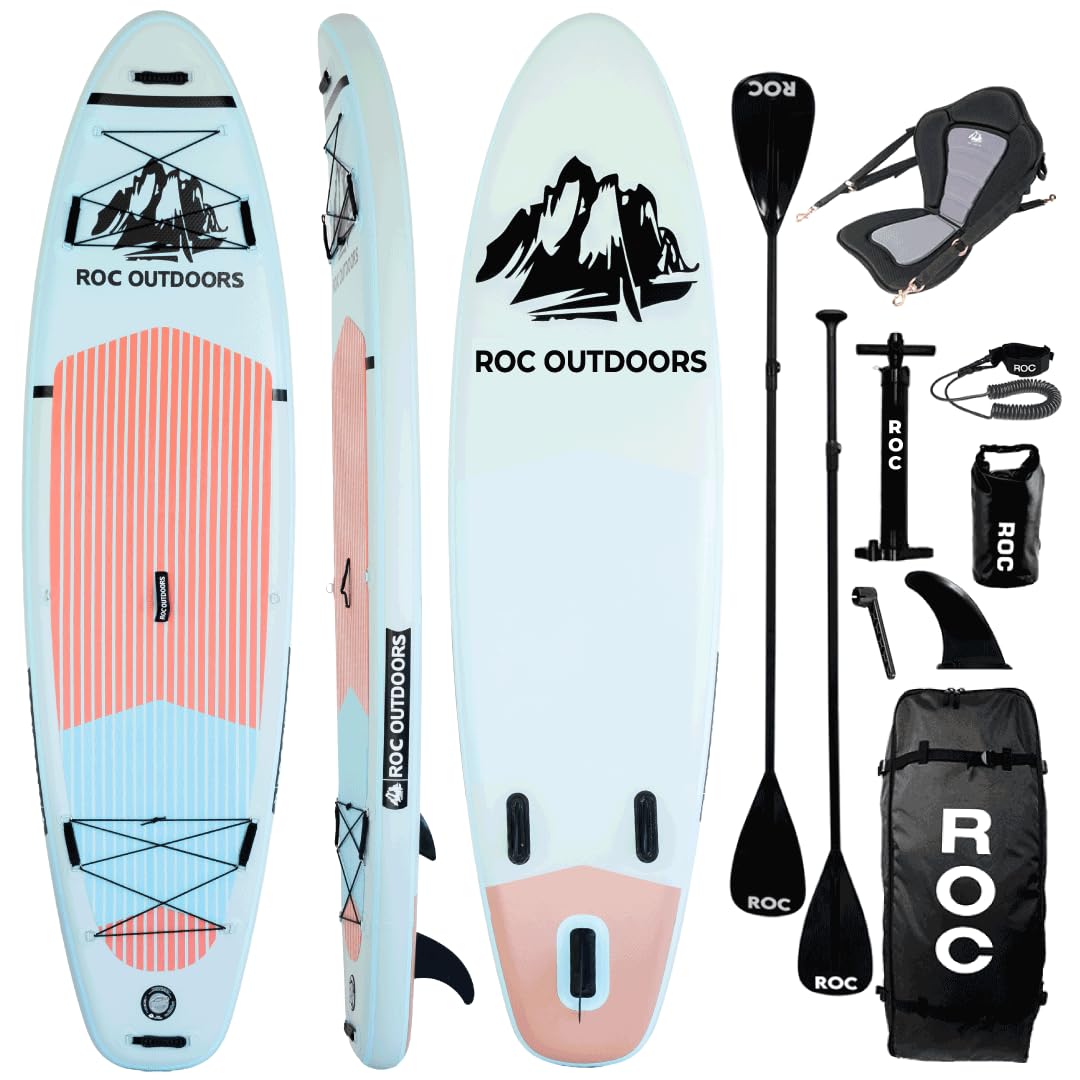
1. Roc Inflatable Stand Up Paddle Board 10’6″
Our pick — over 4.5★ from 18,500+ verified ratings; the strongest balance of quality and price.
The crowd favorite that balances 350 pounds of capacity with a 33-inch-wide deck for beginners.
This is the board that dominates the budget conversation, and the reason is the spec sheet: a 350-pound weight limit on a 10’6″ x 33″ platform. It’s 150 pounds more forgiving than the SLOOSH below, which matters when you’re carrying gear or a dog.
Owners describe it as stable enough to stand on confidently, with a manual pump that gets the board rigid in 5-10 minutes. The bungee storage and anchor points make it versatile, and the full accessory pack is a genuine starter kit rather than filler.
A few buyers report the board popping on first inflation at 13-14 PSI, so inflate slowly and respect the 15 PSI max. It’s rare relative to the overall satisfaction, but it means you should inflate slowly and respect the pressure limit. The 3-year manufacturer’s warranty covers the rest.
What Wins People Over
- The 350lb limit comfortably fits two smaller riders or one adult with a cooler
- Owners mention two summers of hard use with no loss of rigidity.
- Extra-wide deck design stable enough for beginners and dogs
Where It’s Vulnerable
- Max pressure of 15 PSI leaves little margin if you overpump
- A few owners hit unresponsive customer service on defective units
The all-rounder pick: the Roc is for first-time buyers who want one board that handles solo paddling and the occasional passenger without spending premium money.
Treat the valve gently: inflate to the recommended range, not straight to the max, and let the board sit before taking it on the water.
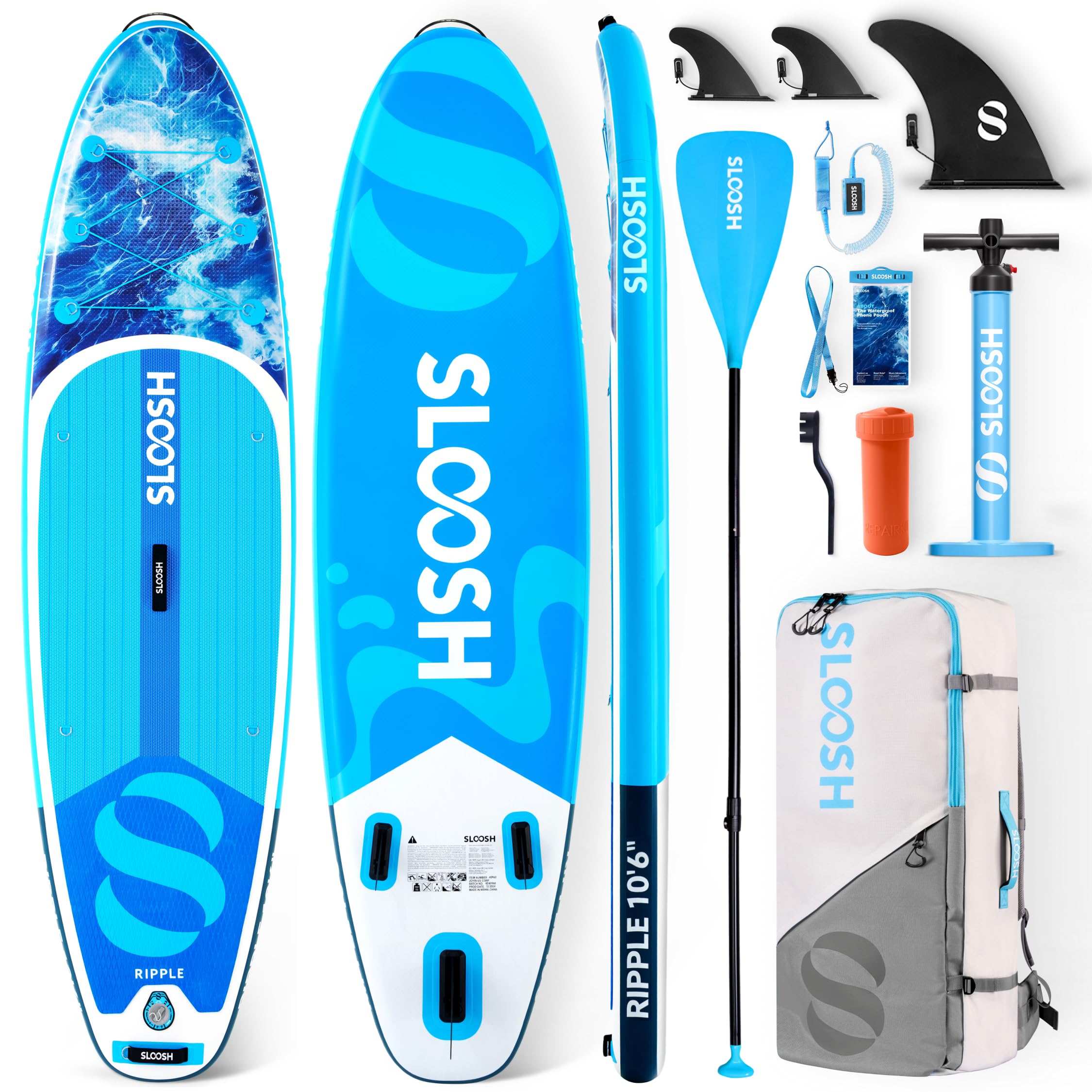
2. SLOOSH Inflatable Stand Up Paddle Board Ripple 10’6″
A 20-PSI-rated board that inflates 30% faster with its dual-action pump.
Where the Roc leans on capacity, the SLOOSH Ripple leans on beginner-friendly engineering. The round nose and 33-inch-wide tail make it forgiving when you’re finding your footing, and the three-fin setup keeps you tracking straight without much effort.
The headline is the 20 PSI maximum pressure — higher than most budget boards — which gives you more rigidity headroom (recommended 12-15 PSI for daily use). The dual-action pump fills the board 30% faster in double-action mode, then switches to single-action for the high-pressure finish. Customers note roughly 280 pumps to reach 12 PSI.
The board’s weight capacity is 300 pounds, so it’s strictly a solo or light-gear cruiser. The carrying experience is good — three reinforced handles and a fully padded backpack — but owners note it’s awkward to carry once inflated.
Built for the first-timer: the SLOOSH is the gentlest learning curve here, with a mixed inflation record that a few owners say includes boards not staying fully inflated. Treat the pump gauge as a guide, not gospel.
Reach for this if: you’re a true beginner under 300 pounds who wants the easiest possible first season, and you value a padded backpack for the walk to the water.
Look elsewhere if: you plan to carry a second person or a full fishing setup — the 300-pound ceiling will feel tight fast.
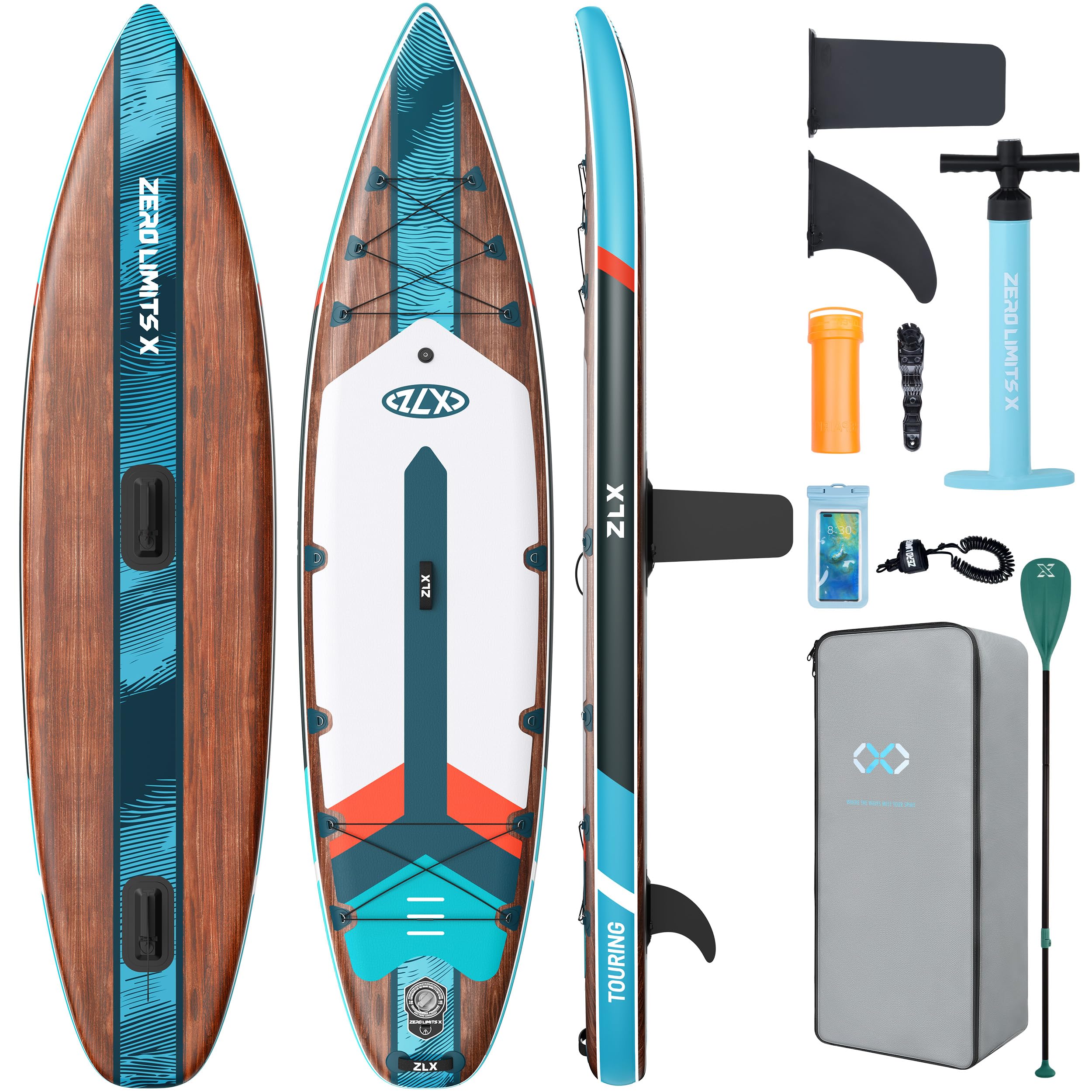
3. ZLX Inflatable Paddle Board 11’6″
An 11’6″ touring shape that trades some width for straight-line speed.
If you plan to cover distance on lakes or calm bays, the ZLX’s longer 11’6″ hull cuts through water with less resistance than the 10’6″ boards. The narrower 33-inch width makes it slightly less forgiving when standing still, but far more efficient when you’re actually paddling.
The clever feature is the removable StabilTrac center fin. Beginners leave it in for the stability boost, and as skills improve, you pull it out to open up faster tracking. The 14 D-rings and front/rear bungee systems give you serious storage for multi-hour trips.
A useful head-to-head: at 28.2 lbs total (board plus accessories), it’s heavier than the Flypark’s 19.8 lb bundle, so the backpack carry is more of a workout. The included pump reaches the recommended 12-15 PSI in about 15 minutes.
Speed over stability: the ZLX is the pick for paddlers ready to move past the wobbly beginner phase and start covering real distance. Durability gets mixed owner feedback, so keep the included repair kit handy.
Who this beats: the shorter blunt-nose boards on glide and tracking, and it holds up to 507 lbs (230 kg) — more than triple the typical solo rider.
Who it doesn’t suit: absolute beginners who want maximum side-to-side stability; the 33-inch width rewards balance work, not instant standing.
4. Flypark 11’x35″ Fishing and Family Paddle Board
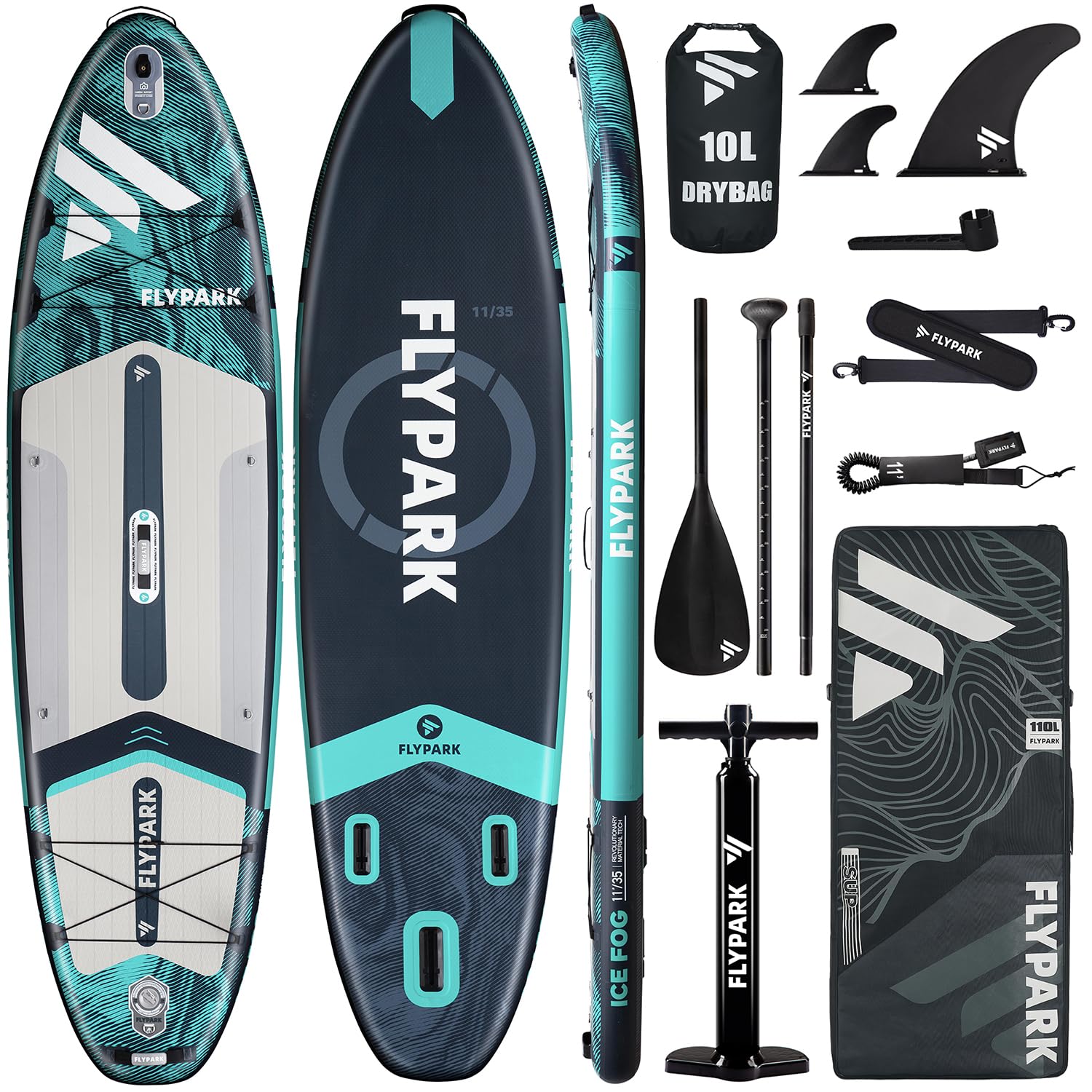
An 11′ board with a built-in rod holder setup and room for three adults.
This Flypark is purpose-built for the angler and the family crowd. At 11′ x 35″ x 6″, it’s 3 inches wider than the standard 32-inch board, which translates directly to less wobble when you’re casting or balancing a kid on the nose. The 430-pound capacity handles three adults or two plus a large breed dog.
The fishing credentials are real: a built-in M6 camera mount for hands-free shots, and reviewers point out the foldable seat and adjustable rod holder make it a genuine fishing platform. The dual 4-point bungee system and 4 center D-rings give you plenty of tie-down points for a cooler and tackle box.
At 19.8 lbs for the whole bundle, it’s among the lightest full kits here — the ZLX weighs in nearly 9 lbs more. The dual-action pump reaches 12 PSI in about 9 minutes, and the 110L backpack fits the entire kit.
The Strong Suit
- Quality is the most-praised aspect — owners call the military-grade PVC tough
- Three handles let two people share the carry to the water
- Tool-free 9″ center fin plus two 7″ side fins for directional stability in wind
The Honest Gripes
- Two rod holder holes on the board, but only one holder included
- The rod holder plastic feels cheap to some owners
The fishing-family hybrid: this is the board to grab if your weekend means casting lines and carrying a kid, not chasing speed records. Stability is the second-most-praised aspect after quality.
Know before you buy: buy a spare rod holder separately if you fish with two rods — the second hole sits empty.
5. Overmont Inflatable Stand Up Paddle Board 10’6″

A 17.6-pound board that a 220-pound rider says holds firm without bending.
The Overmont’s defining trait is portability. At 17.6 lbs for the board itself, it’s light enough for one person to lift and carry solo, and it rolls up small enough to fit in the included backpack. That makes it the easiest pick for a solo paddler who wants to walk from the car to the water without drama.
Despite the light weight, the 33″ x 10’6″ platform handles up to 450 pounds — though Overmont recommends staying under 300 lbs for the best glide and control. A 220-pound rider confirms it supports them without bowing, and a kayak seat fits the deck for a quick sit-down option.
The colorways are bright and fun, and owners praise the complete package: adjustable paddle, removable fins, leash, pump, waterproof phone pouch, and repair kit. The one recurring complaint is a strong chemical smell from the start that needs a week outside to air out. For a budget board, the trade-off is fair.
The solo-travel pick: if your priority is a board that’s genuinely easy to carry and pack, the Overmont is the lightest full kit here — but expect to air it out before first use, and know that under-inflation makes it feel useless.
Who it fits best: solo paddlers and small-framed riders who want to handle every step themselves, plus parents buying for a teenager.
Who should skip it: two-person crews — the light build is designed around a single rider, not a loaded deck.
6. TIGERXBANG 11’6″ Inflatable Paddle Board

A 35-inch-wide deck that converts to a kayak with the included seat.
This TIGERXBANG is built for people who want options. The included kayak seat clips onto the deck and turns the board into a sit-down cruiser in seconds, while the adjustable double-blade paddle works for both standing and seated paddling. It’s the rare budget board that genuinely does both well.
The numbers back the versatility: an 11’6″ x 35″ x 6″ deck with a 485-pound capacity means it can carry two adults, a cooler, and life jackets without stressing. Owners confirm it holds a dog plus gear comfortably. The camera mount and center cup holder base are thoughtful extras for documenting the day.
The accessory list is the longest here — kayak seat, waterproof phone bag, double-blade paddle, three detachable fins, backpack, manual pump, cup holder, and repair kit all come in the box. Some shoppers say fins breaking off over time, so treat the plastic components gently.
Why It Stands Out
- Kayak conversion is a genuine second mode, not a gimmick
- 485 lb capacity fits two paddlers plus gear
- Owners call the pump “awesome” — 10 minutes to on the water
The Trade-Off
- Fins are the weak point — some break off in normal use
- The paddle itself can sink if it’s not properly secured
The two-in-one choice: buy this if you want the freedom to switch between standing paddle and seated kayak on the same outing without buying two boards.
Watch the fins: this is a board to carry carefully and check before each launch — the detachable fins need attention.
7. Flypark 11’x34″ Inflatable Paddle Board
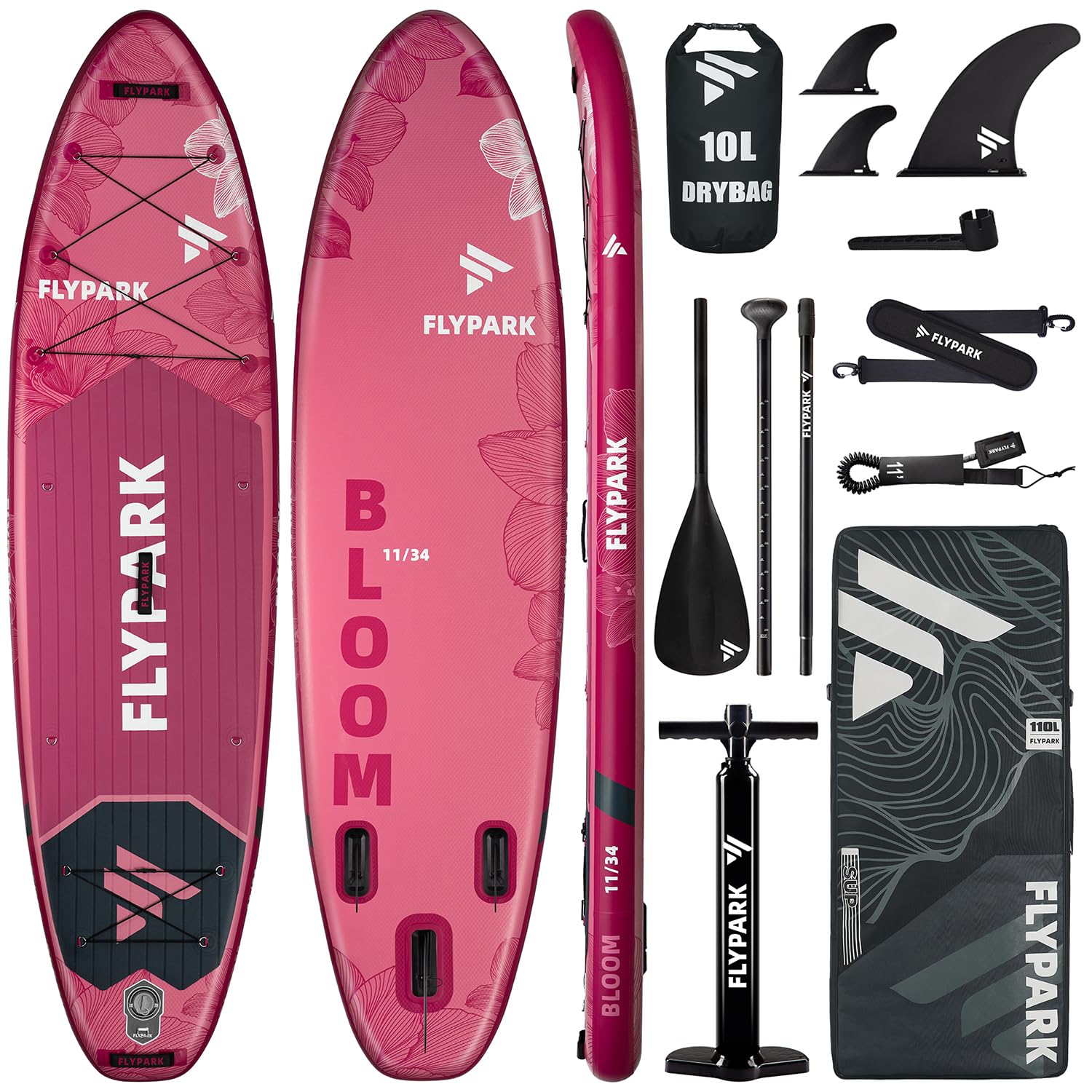
A 34-inch-wide yoga-friendly deck that owners say stands steady even in chop.
This is the Flypark sister board to the angler model, tuned for yoga, cruising, and relaxed family time rather than fishing. The 34-inch width splits the difference — more stable than the 33-inch boards, easier to paddle than the 35-inch barges. The bloom pink colorway gets consistent praise.
At 420 pounds, the capacity handles two adults plus a couple of small children or dogs. Owners describe fitting two kids and two Pomeranians with room to spare. The 6-point front bungee and 4-point rear tie-downs keep a cooler and bags secure.
The inflation story is honest: the dual-action pump works but takes effort. Solo inflation to about 8 PSI runs 10-15 minutes, and owners universally recommend an electric pump for the full 15-20 PSI. One owner noted the carrying strap’s plastic clips broke after first use, replaced easily with steel.
The leisure-first cruiser: quality leads the praise here, and the extra width delivers the stability yoga demands. Durability is the mixed note — a year of hard use is reported, but the strap clips are the weak link.
Best for: calm-water cruisers who want a stable, pretty board that handles a partner or a couple of small kids, and who don’t mind a manual pump workout.
Expect to upgrade: buy steel replacement clips for the carrying strap early, and budget for an electric pump if you value your time.
8. CETANA Extra Wide Inflatable Paddle Board 11’6″
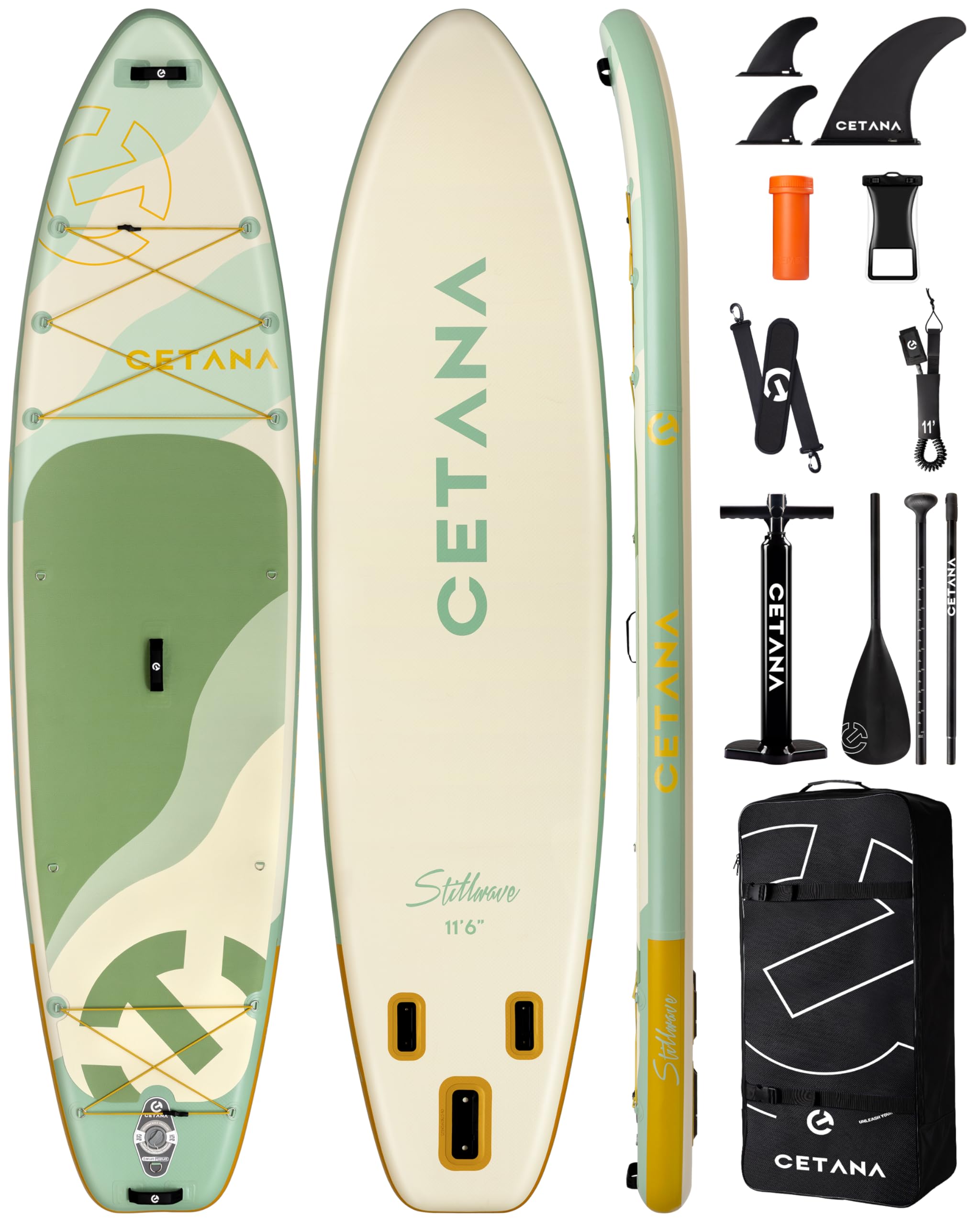
A 35-inch-wide deck that a 6’5″, 270-pound rider calls rock solid.
The CETANA exists for larger paddlers and group sessions. At 11’6″ x 35″ x 6″, it’s one of the widest boards here, and the 450-pound capacity means it handles a big rider plus gear, or two people paddling kayak-style. The marketing leans into photo stability, but the real value is for anyone who’s worried a narrower board will feel tippy.
Owners confirm the stability story: a 6’5″, 270-pound user reports it’s secure, and a 6-foot rider says it handles great with the dogs aboard. The three-fin setup keeps tracking true, and the dual bungee systems (front 6-point, rear 4-point) secure cameras and dry bags.
The accessory kit is solid — adjustable paddle, pump with gauge, waterproof phone bag, and two GoPro mounts included. The included backpack is functional but a few owners call it “dingy,” so don’t expect a premium bag. An electric pump gets it full in 12-15 minutes.
The Confidence Builder
- Extra width removes the wobble that scares off beginners
- Big riders report zero flex even at 270 lbs
- Three handles make it manageable for solo carry
The Minor Costs
- The included backpack is serviceable but not premium
- Wide deck means slower paddling and harder turning
If you’re over 200 pounds, start here: the CETANA’s 35-inch width and 450-pound limit are built exactly for you, and owners confirm it holds firm.
Trade-off to accept: you’re buying stability, not speed — this is a cruiser, not a racer.
9. iTAOSTAR Journey 11’6″ Inflatable Paddle Board
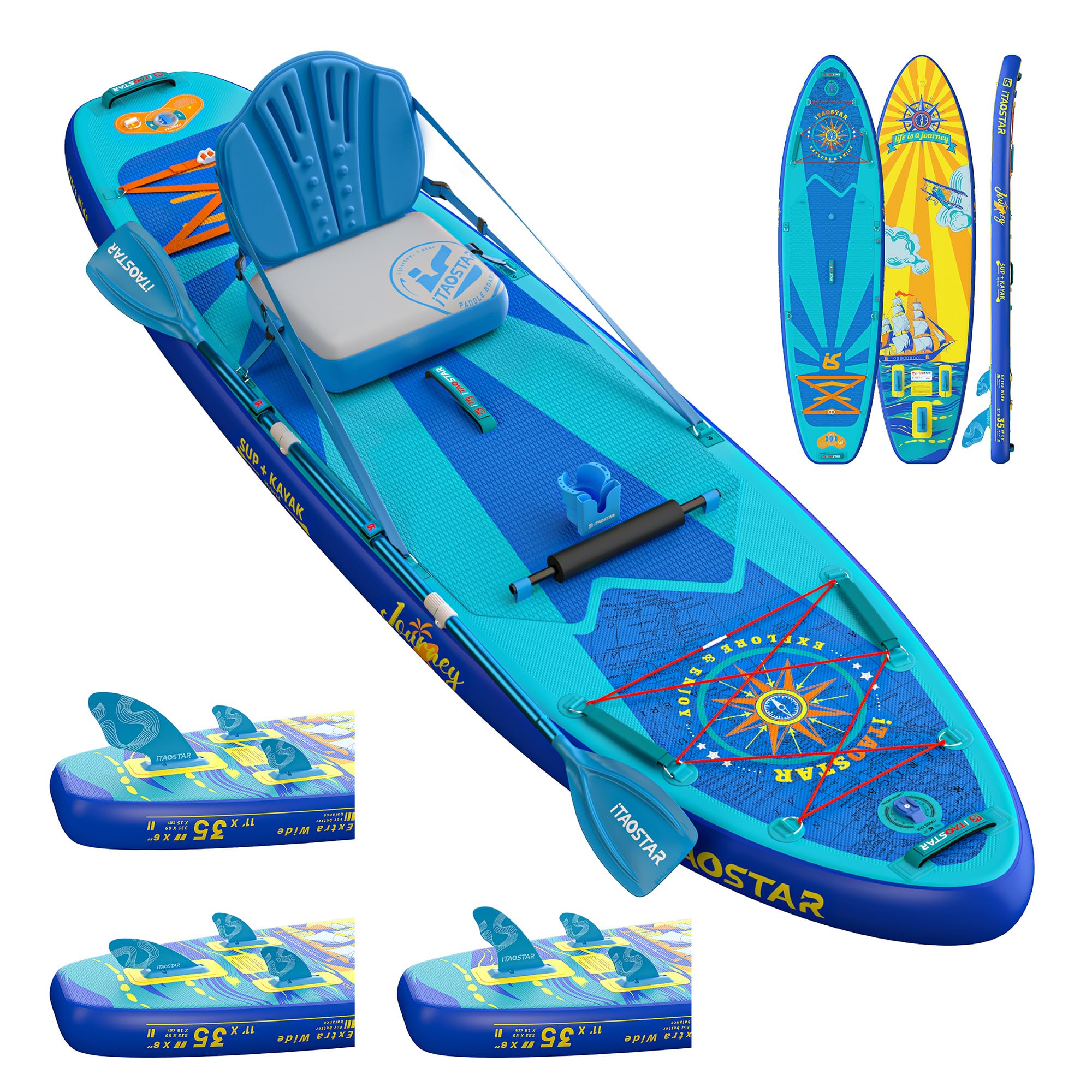
Five removable fins and a kayak conversion kit in one generous package.
The iTAOSTAR Journey is the accessory-overload pick, and in this case, that’s a good thing. The box includes five removable fins (three center, two side), an inflatable seat, a foam footrest, a shoulder strap, a 120L backpack, a 10L dry bag, a cup holder, and a flag. Plus the paddle converts between SUP and kayak modes.
The 11′ x 35″ deck holds up to 420 pounds, and owners say the stability is good enough for a small family. The kayak mode is genuinely useful — one owner with a knee injury uses it exclusively seated, while a petite solo paddler finds it easy to handle alone.
Setup is quick: buyers report 10-minute inflation with the included pump, and the dual-action design with a PSI gauge helps you dial it in. The honest caveat is durability — the highest-count owner sentiment on the paddle and accessories is “mixed,” with some reporting breakage quickly. Buy it for the kit, treat the extras gently.
The everything-included value: stability and accessories are the twin strengths owners praise most, but the durability of the smaller pieces gets the most mixed feedback — expect to upgrade the paddle eventually.
Reach for this if: you want one kit that does SUP, kayak, and fishing without buying a single add-on — and you enjoy accessorizing.
A word of warning: the included cup holder is too small for standard water bottles, and the paddle slips in SUP mode for some owners.
10. ATPROSS Inflatable Paddle Board 11’6″
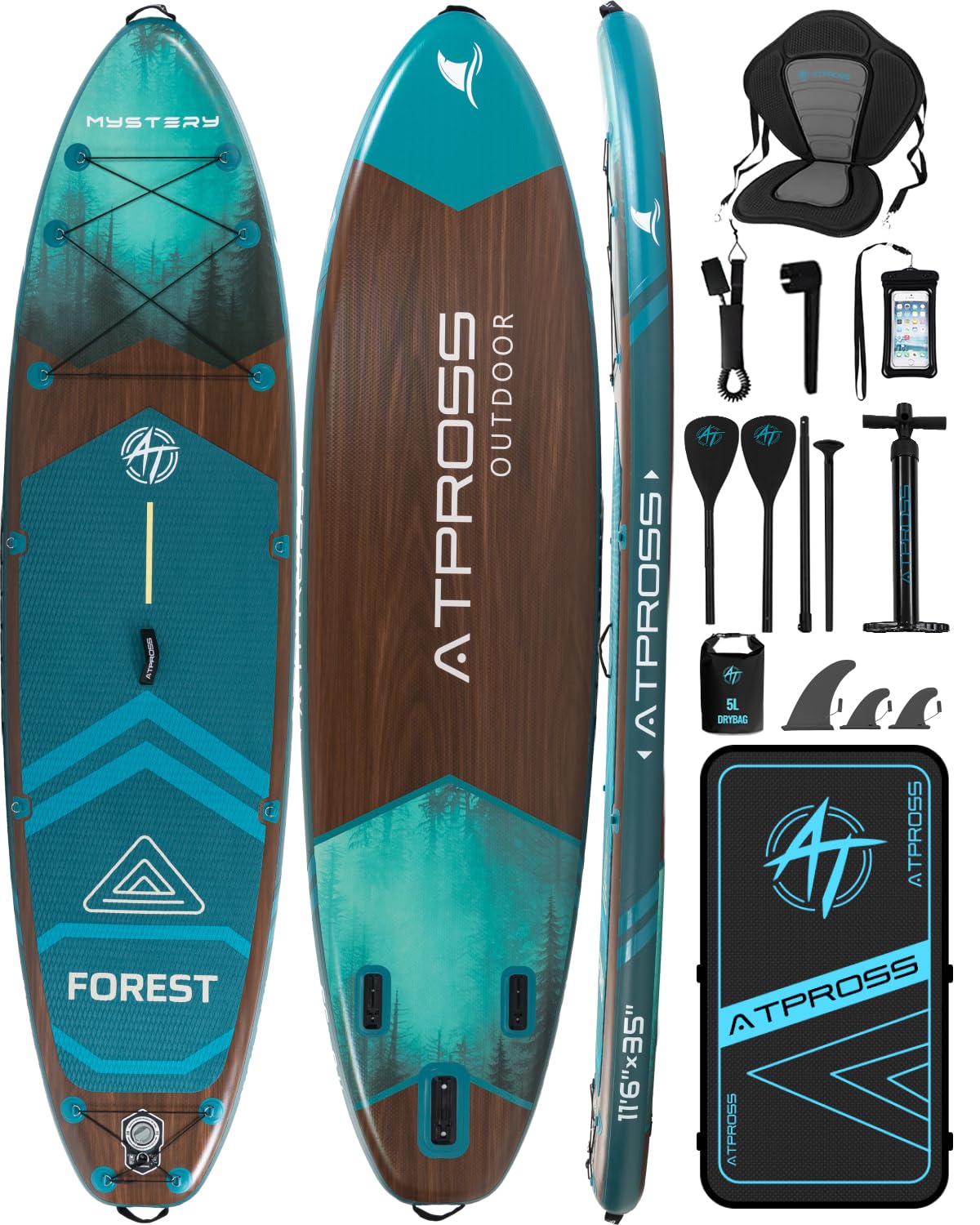
A double-layer PVC board that survives concrete scrapes and tree branches.
The ATPROSS leans on industrial-grade durability. The double-layer PVC with a reinforced sidewall resists abrasion from rocks and sand — one owner says it survived concrete and tree scrapes without damage. If you’re launching from rough shorelines, this is the board that shrugs it off.
At 11’6″ x 35″, it’s a wide, stable platform with a 450-pound capacity. Owners call it “extremely stable” and confirm it holds a dog plus a cooler. The unique bonus is the dual paddle set: both a single-blade SUP paddle and a double-blade kayak paddle come in the box, along with the inflatable kayak seat.
The full kit includes a 600D Oxford backpack, two fins, a safety leash, a two-way hand pump, a repair cylinder, a waterproof phone bag, and a 5L dry bag. The catch: the manual pump works but is slow — owners strongly recommend an electric pump — and it’s awkward to steer in wind.
The Rugged Edge
- Double-layer PVC survives rough launches
- Both SUP and kayak paddles included
- Stylish Aqua Walnut finish looks premium
The Friction Points
- Hand pump has a loose hose and is slow
- Backpack straps lack padding for long carries
- No action camera mount included
The durability-first family board: if your launch spot is rocky or sandy, the ATPROSS’s double-layer build is the insurance policy that the lighter boards lack.
Plan around the pump: budget for an electric pump, because the included manual unit will test your patience and your arms.
11. iTAOSTAR Adventure 12’x35″ Inflatable Paddle Board
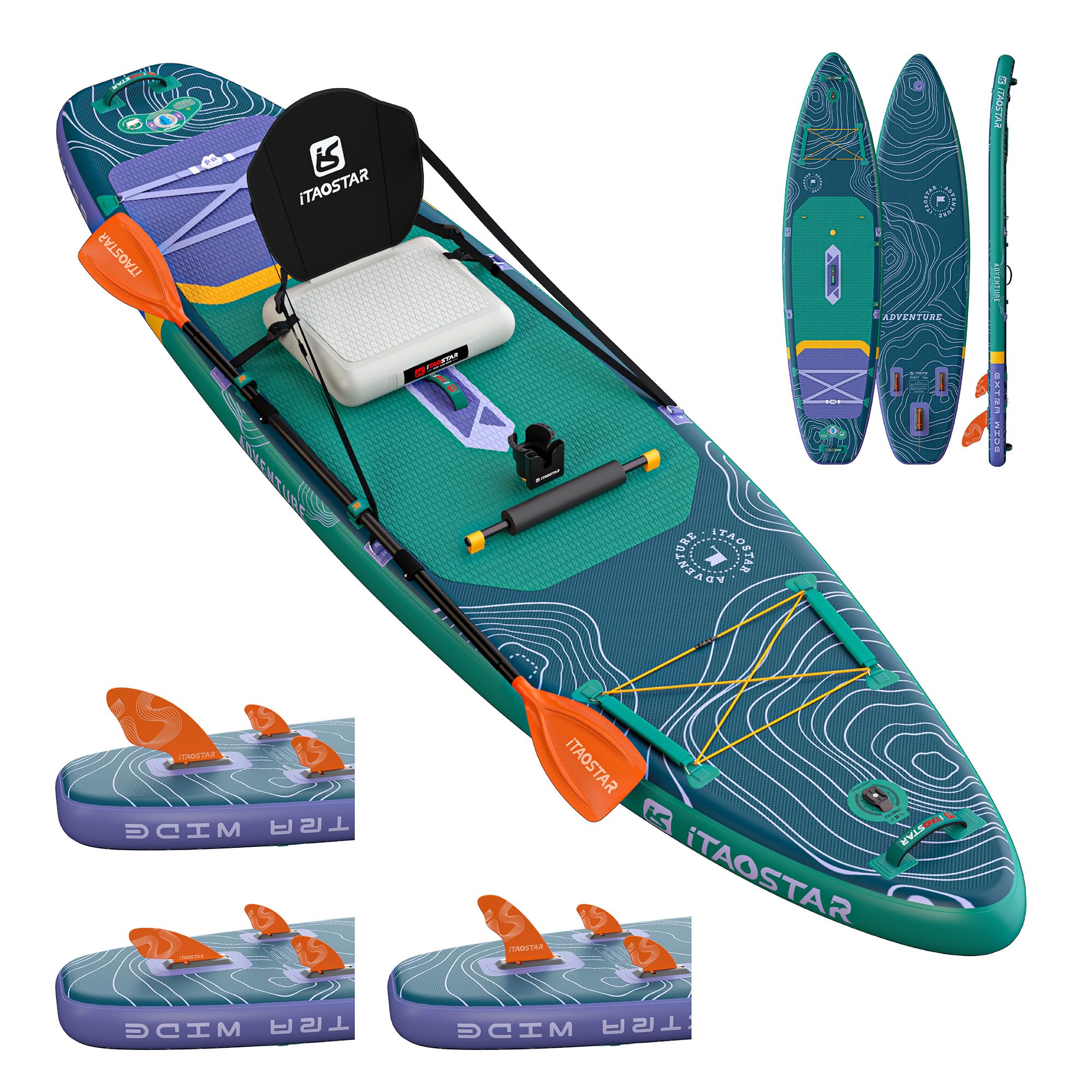
A 12-foot-long board that handles ocean shipping channels and big lakes.
The Adventure is the longest board here at 12′ x 35″, and that length translates to real capability in open water. One owner reports it handles ocean shipping channel waves and big lakes with confidence, stable enough to fish and walk around with an adult son. The 450-pound capacity supports three adults plus a cooler.
The kayak conversion is the star feature: the inflatable seat and foam footrest transform it into a seated cruiser, and the paddle locks into kayak mode. A 260-pound user says it’s ideal for heavy riders, and an 80-year-old owner uses the seat comfortably. The five detachable fins adapt to different water conditions.
Owners mention about 375 pumps to reach 15 PSI (roughly 10 minutes), and the 120L backpack fits the entire kit. The honest weakness is durability — some report seams coming unglued after two trips, and one found deck pads peeling within 12 hours. For the longest trips, check the glue joints regularly.
The Open-Water Credentials
- 12-foot hull tracks straight in waves and chop
- Kayak mode is comfortable for elderly riders and knee injuries
- Stability is the top-praised aspect — hard to flip even loaded
The Long-Haul Caveat
- Adhesive quality is the recurring gripe — seams and deck pads can peel
- Slow and hard to turn due to the long, wide hull
The distance specialist: buy the Adventure if your “paddle” means hours on big water with a fishing rod, and you value kayak-mode comfort on long hauls.
The maintenance reality: this is a board that rewards a glue check before each season — the seams are its known weak point.
Understanding the Specs
PSI and Rigidity
The pressure you pump to — measured in PSI (pounds per square inch) — determines how stiff the board feels. A board rated for 15-20 PSI with a recommended range of 12-15 PSI will feel solid underfoot. Inflate below the recommended range and the board feels soft and paddles terribly.
Drop-Stitch Construction
Inside the PVC shell, thousands of threads connect the top and bottom layers, keeping the board flat and rigid when inflated. Cheap boards skip this and bulge. Look for “drop-stitch” in the materials — it’s the difference between a board that feels like a hard shell and one that feels like a pool toy.
FAQ
How long does it take to inflate a budget paddle board?
What weight capacity do I need for two people?
Is a 33-inch board stable enough for a beginner?
How long does an inflatable paddle board last?
Can I use a paddle board as a kayak?
How much does a budget paddle board weigh to carry?
Is the included manual pump good enough?
What’s the difference between PVC and EVA deck materials?
Final Thoughts: The Verdict
Across the board, the budget inflatable paddle board winner is the Roc 10’6″ because it pairs a crowd-pleasing 350-pound capacity with a 3-year warranty and a deck wide enough for beginners. If you want kayak conversion for varied days on the water, grab the TIGERXBANG. And for fishing with family, the Flypark 11’x35″ is the one to reach for. The crowd favorite — the Roc — holds the highest ratings here, and its long warranty makes it the safest bet for your first season.
How We Picked
We do not accept paid placement. Every pick is matched to a real buyer and a real use-case; we do not hands-on test units.
Sources & Methodology
Specifications: manufacturer listings and product documentation. Review insights: verified customer reviews, as of August 2026. Pricing: not shown on this page (it changes often); check the current price via the retailer link.
As an Amazon Associate, Gadgets Feed earns from qualifying purchases. This does not affect which products we feature.