
Finding a genuinely capable integrated amplifier under serious budget constraints usually means navigating a minefield of exaggerated wattage claims and noisy power supplies. The best options in this category prove you do not need to sacrifice clean, detailed soundstage reproduction or essential connectivity just because you are watching every dollar. The right amplifier anchors your entire system, and getting that choice wrong leads to a thin, lifeless listening experience that no pair of speakers can fix.
I’m Min — the co-founder and writer behind Gadgets Feed. Over hundreds of hours researching the budget audio space, I have analyzed the core amplifier chipsets, measured power supply designs, and scrutinized user feedback to separate the genuinely musical contenders from mere marketing noise in the sub- integrated amplifier market.
Whether you are upgrading from a basic receiver or building your first dedicated hi-fi system, this guide to the best budget integrated amplifier focuses on the models that deliver real-world performance, reliable feature sets, and true value for your audio dollar.
How To Choose The Best Budget Integrated Amplifier
Integrated amplifiers combine a preamplifier and power amplifier into a single chassis, eliminating the cost and complexity of separates. In the budget tier, your choices come down to amplifier topology, connectivity options, and the quality of the power supply. Ignore inflated peak-power numbers and focus on continuous RMS output into your speaker’s nominal impedance — that number tells you what the amp can actually do.
Amplifier Topology: Class D, Class A/B, or Hybrid Tube
Class D amplifiers use switching technology to deliver high efficiency and compact size; the best budget implementations use the Texas Instruments TPA3255 chip with PFFB feedback to achieve low distortion. Class A/B designs run hotter and are larger but offer a traditional linear sound with no switching artifacts. Hybrid tube amplifiers use vacuum tubes in the preamp stage and a solid-state output stage, adding harmonic warmth and a visual aesthetic that many listeners prefer. Your choice depends on whether you prioritize compactness and power efficiency or the classic, slightly rounded tonality of a tube stage.
Critical Connectivity: The Phono Stage and Subwoofer Output
A built-in phono stage is essential if you plan to connect a turntable, saving you the cost and clutter of an external preamp. A dedicated subwoofer pre-out with adjustable crossover allows you to integrate a powered subwoofer seamlessly, which dramatically improves low-end extension for music and home theater. HDMI ARC is a major convenience if the amplifier serves as a hub for your TV audio — it allows volume control and automatic power-on with your television remote.
Power Supply Quality and Real-World Output
The external power adapter or internal transformer is the heart of any budget amplifier. A 48-volt, 5-amp GaN or linear supply provides clean headroom, while lower-voltage adapters limit dynamic range and cause audible compression at moderate volumes. Look for PFFB technology, which corrects load-dependent distortion in Class D chips, and check whether the amplifier uses socketed op-amps — this allows you to upgrade the sound signature later by swapping in chips like the LM4562 or MUSES 8902.
Quick Comparison
On smaller screens, swipe sideways to see the full table.
| Model | Category | Best For | Key Spec | Amazon |
|---|---|---|---|---|
| Ampapa D1 | Class D | Desktop & near-field Hi-Fi | TPA3255 with PFFB, 48V GaN PSU | Amazon |
| AIYIMA A80 | Class D DAC | High-resolution streaming | ES9038Q2M DAC, DSD512 support | Amazon |
| WiiM Amp | Smart Streaming | Multiroom & TV integration | HDMI ARC, 60W RMS @ 8Ω | Amazon |
| Dayton Audio HTA100 | Hybrid Tube | Warm vinyl playback | 50W RMS Class A/B, Bluetooth 5.0 | Amazon |
| Juson Audio JTA100 | Hybrid Tube | Powering large floorstanders | 200W RMS, phono stage | Amazon |
| Dayton Audio HTA200 | Hybrid Tube | High-power hybrid sound | 100W RMS per channel, motorized volume | Amazon |
| Cambridge Audio AXA35 | Class A/B | Pure analog purists | 35W RMS @ 8Ω, built-in phono | Amazon |
| Pyle Hybrid PHA100 | Multichannel | Karaoke & large-room volume | 2000W peak, dual mic inputs | Amazon |
In‑Depth Reviews
1. Ampapa D1
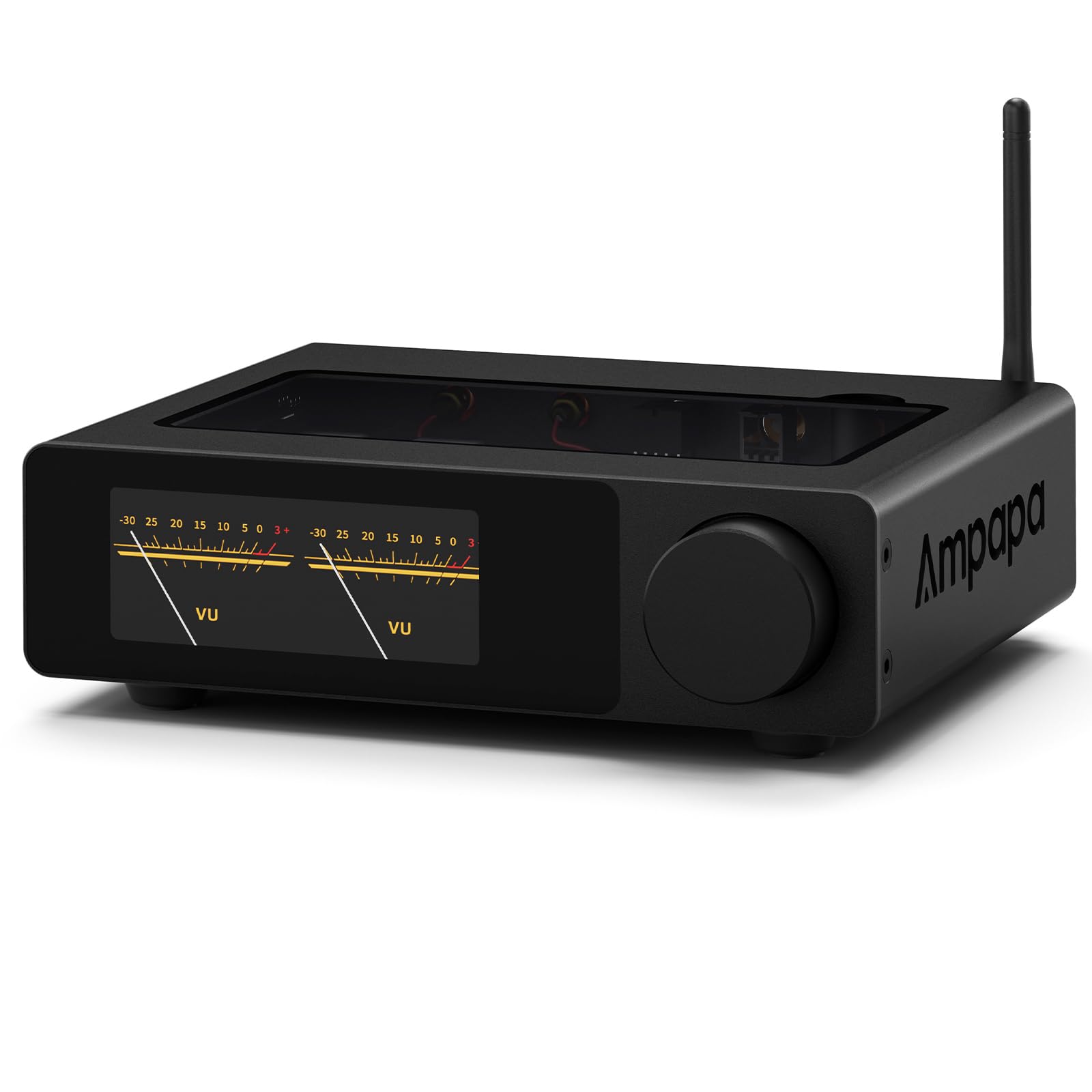
The Ampapa D1 is a Douk Audio collaboration that packs a TPA3255 chipset with PFFB feedback, a 48V GaN power supply, and socketed NE5532 op-amps into a compact aluminum chassis measuring just 6.1 inches wide. Its OLED screen offers seven VU meter styles, while the TRS balanced input, Bluetooth 5.2, and adjustable 30–200Hz high-pass filter make it extraordinarily versatile for a sub- integrated amp. Real-world output sits around 80W per channel into 8 ohms, which is ample for near-field listening with bookshelf speakers.
The glass top panel provides direct access to the op-amps for easy rolling, and the internal NJW1194 volume chip, SAGAMI inductors, and 2oz copper PCB all contribute to a noise floor low enough for desktop use. The PFFB circuit eliminates the frequency-response shifts that plague Class D amps when driving reactive speaker loads, keeping the sound consistent. The subwoofer pre-out lets you build a true 2.1 system, and the 12V trigger input integrates into automation setups seamlessly.
A 5-minute auto-standby cannot be disabled and requires the remote to wake the unit, which some users find inconvenient. The glass top tends to slide out of its metal frame when the unit is moved, so careful handling is necessary. Despite these quirks, the D1 delivers the best combination of feature density, measured performance, and upgrade potential at this price point.
Why it’s great
- Socketed op-amps allow easy sound signature upgrades
- Adjustable high-pass filter protects bookshelf speakers
- GaN 48V/5A power supply provides clean headroom
Good to know
- Non-defeatable 5-minute auto-standby requires remote wake
- Glass top can dislodge from frame during movement
- Bluetooth output level slightly lower than wired inputs
2. AIYIMA A80
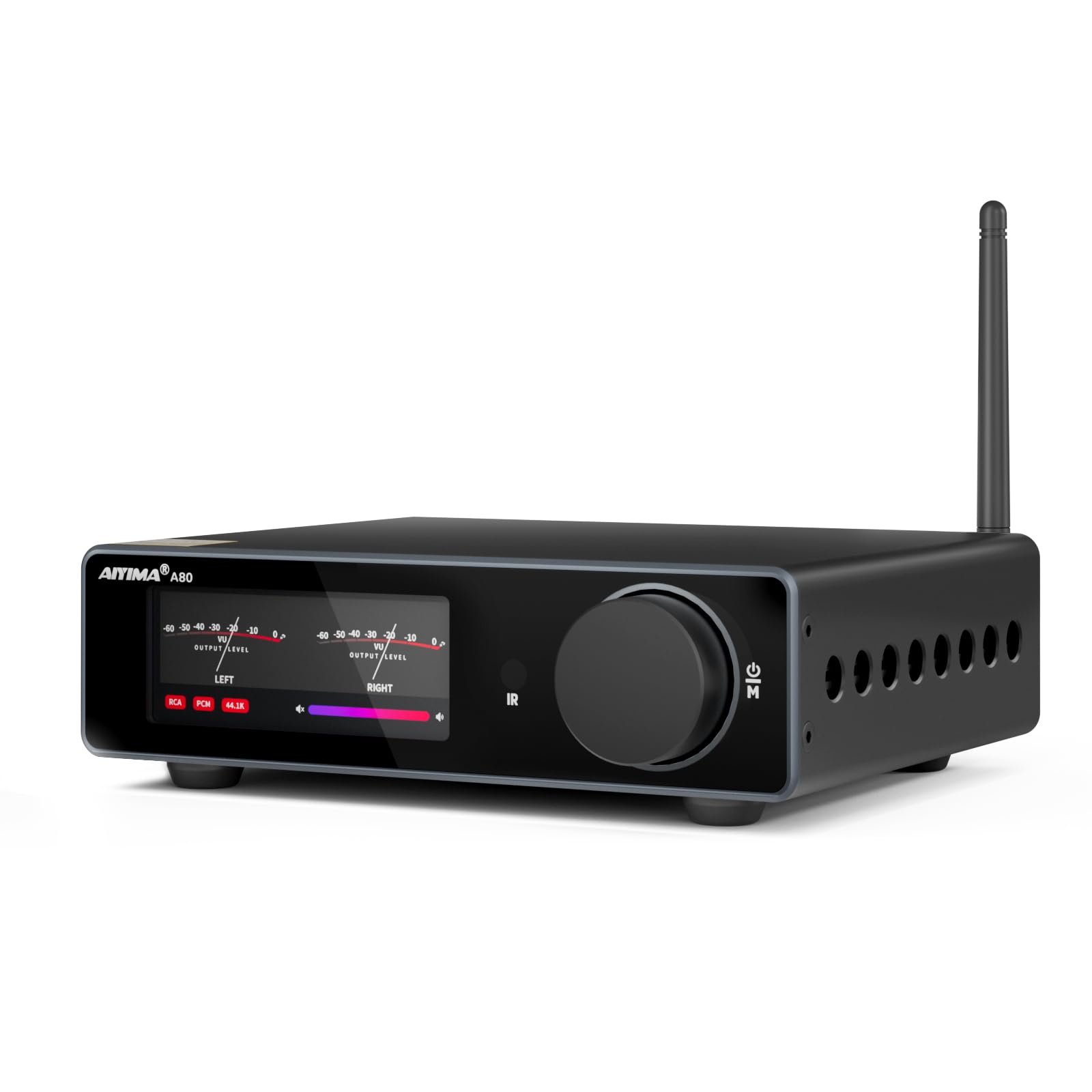
The AIYIMA A80 pairs the ubiquitous TPA3255 amplifier chip with the ES9038Q2M DAC — a flagship-level decoder capable of handling DSD512 and PCM up to 32-bit/768kHz. The result is a SINAD of 109dB and THD as low as 0.006%, numbers that rival separates costing significantly more. The front panel features an electronic VU meter with multiple display modes, and the rear panel offers USB, optical, coaxial, TRS balanced, and Bluetooth inputs, making it the most complete all-in-one streaming hub in the budget category.
User reviews consistently note that the A80 makes bookshelf speakers like the Sony SSCS5 and Pioneer BS22-LR sound noticeably more detailed and controlled compared to earlier AIYIMA offerings, thanks in part to the PFFB circuitry and Rubycon/WIMA capacitors. The 48V 5A GaN power supply runs cool even during extended listening sessions, and the unit supports a 12V trigger for system integration. The optical input delivers particularly clean, jitter-free sound from TV sources.
The A80 is the same compact footprint as the Ampapa D1 and competes directly with it. The critical difference is the A80’s superior DAC stage: if you listen to high-resolution PCM files or DSD content, the A80 maintains the advantage. However, the A80 runs warm at high volumes, and some users have reported longevity concerns when driving low-sensitivity speakers like the KEF Q150. The display, while visually engaging, is fixed and cannot be switched to a simpler mode in dim settings.
Why it’s great
- ES9038Q2M DSD512 DAC outperforms typical budget DAC chips
- Multiple input options including USB and TRS balanced
- PFFB circuitry delivers 109dB SINAD
Good to know
- Runs hot with low-sensitivity speaker loads
- Power output falls short of advertised 300W claims
- Display cannot be dimmed or turned off
3. WiiM Amp

The WiiM Amp redefines what a budget integrated amplifier can do by embedding full multiroom streaming, HDMI ARC, and voice control into a compact chassis that delivers 60W RMS per channel into 8 ohms and 120W into 4 ohms. The WiiM Home App provides gapless playback of 24-bit/192kHz audio from Spotify, TIDAL, Qobuz, and your local library, along with parametric EQ and room correction that adjusts to your specific speaker placement. The amp supports AirPlay 2, Google Cast, and Alexa — it works within the smart speaker ecosystem rather than fighting it.
The HDMI ARC port auto-detects TV signals and powers the amplifier on and off, which makes the WiiM Amp a seamless hub for a living-room stereo system. Reviews show it drives the KEF Q150 with rich imaging and the RP-500M II with confidence, though its 60W RMS clearly limits continuous output when compared to the Ampapa D1 or AIYIMA A80. The unit is designed around a streaming-first approach — it lacks a USB DAC input and has no line-level analog output, so it is not ideal for users who want to connect an external DAC.
The included voice remote works reliably for volume control and input switching. Users note that the subwoofer output with adjustable crossover dramatically improves the low-end performance when paired with a powered sub. The only real miss for the budget-conscious audiophile is the lack of a phono stage — you will need an external phono preamp for turntable use. The WiiM Amp is the best choice if your listening is centered on streaming services and TV audio rather than vinyl or high-res PCM files.
Why it’s great
- HDMI ARC with auto power-on/off for TV integration
- Comprehensive app with parametric EQ and room correction
- Multiroom sync with AirPlay 2 and Google Cast devices
Good to know
- No USB DAC input or analog line-level output
- No built-in phono preamplifier for turntable use
- 60W RMS per channel limits loudness in large rooms
4. Dayton Audio HTA100

The Dayton Audio HTA100 marries a vacuum tube preamp stage with a Class A/B output stage to deliver 50W RMS per channel of warm, musical sound. The front panel features classic VU meters and the exposed tubes glow through a cutout in the chassis, creating the visual allure of vintage hi-fi without the maintenance of a full tube amplifier. The built-in phono stage handles moving-magnet turntable cartridges directly, and the Bluetooth 5.0 input streams from any mobile device. A front-panel headphone jack uses the same tube preamp circuitry, delivering rich sound with high-impedance headphones like the Beyerdynamic DT 880 Pro or Sennheiser HD6XX.
Listening impressions consistently describe the HTA100 as producing a warmer, more organic sound than typical Class D competitors — reviewers note smoother mids, relaxed treble, and a soundstage that feels rounded rather than etched. The tube stage is subtle rather than dramatic: it adds a touch of second-harmonic character rather than massive coloration. The amplifier drives bookshelf speakers like the Sony SSCS5 with authority and provides enough headroom for comfortable listening in medium-sized rooms. Bass and treble tone knobs allow fine-tuning without leaving the listening position.
The HTA100 has a few practical shortcomings. The included remote control is sluggish and offers limited range, which feels out of step with the rest of the design. The unit runs warm during operation, though not excessively. The Class A/B topology means the amplifier is larger and heavier than the Class D competitors in this guide — it measures 11 inches wide and weighs 3.6 pounds. For the listener prioritizing tonal character and visual aesthetic over pure power and feature count, the HTA100 provides a genuinely distinctive experience in the budget integrated amplifier landscape.
Why it’s great
- Tube preamp adds warm harmonic character to the soundstage
- Built-in phono stage for direct turntable connection
- Headphone jack drives high-impedance models up to 600Ω
Good to know
- Remote control has sluggish response and limited range
- Class A/B topology is larger and heavier than Class D alternatives
- Limited to 50W RMS per channel; not for very large rooms
5. Juson Audio JTA100
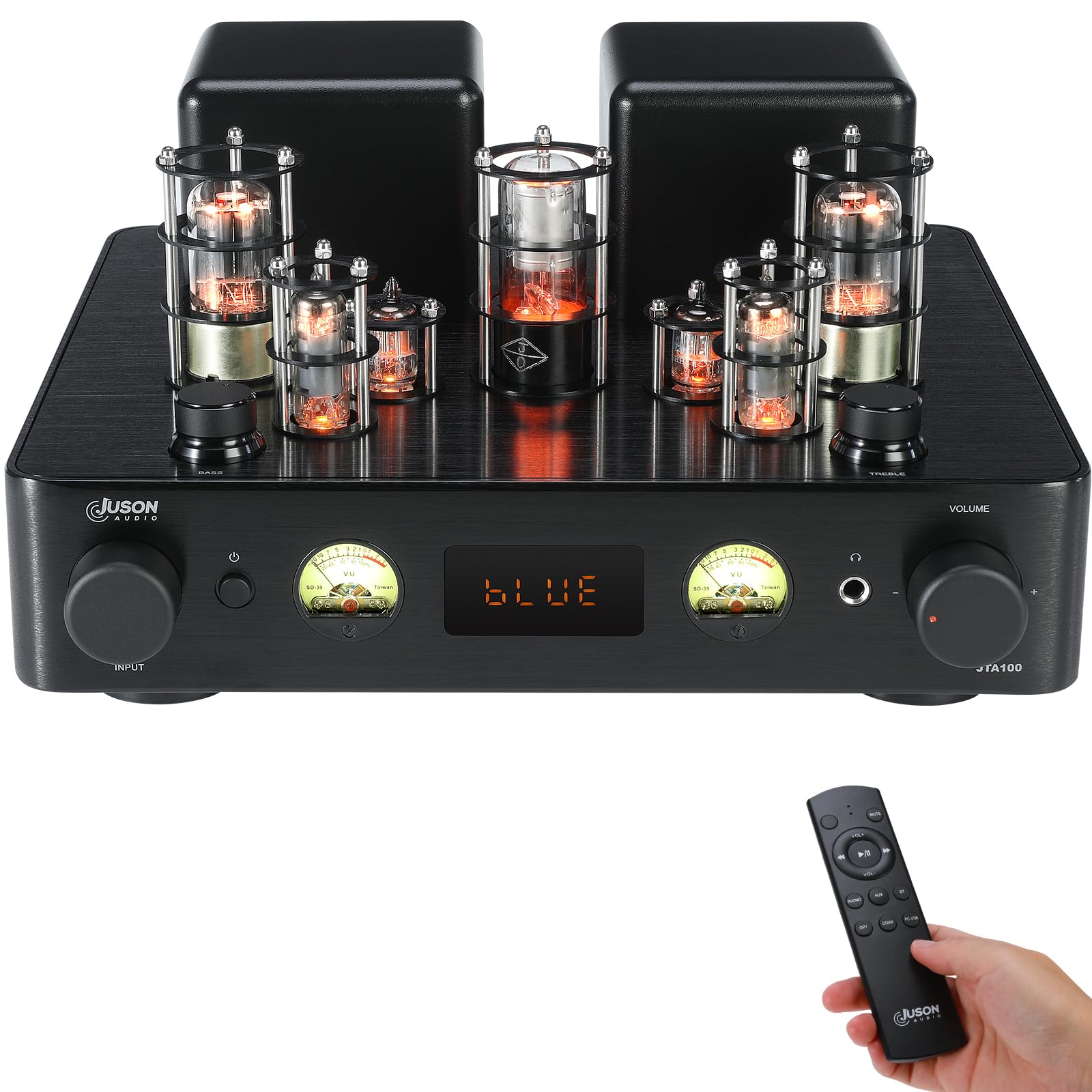
The Juson Audio JTA100 delivers 200W RMS total output from a hybrid tube design that uses vacuum tubes in the preamp and a transistor output stage. This is a heavy, full-size unit measuring nearly 13 inches wide and weighing over 16 pounds — built to drive demanding floor-standing speakers like Cerwin Vega D7s with authority. The rear panel includes AUX, coaxial, optical, phono, and Bluetooth 5.0 inputs, plus a subwoofer output and a high-pass filter. The headphone output features a high/low gain switch capable of driving 16 to 600 ohm headphones.
User feedback confirms that the JTA100 produces authentic tube warmth with clarity, especially when paired with sensitive speakers like the Klipsch RP-600M II. The soundstage is described as wide and immersive, with particularly strong performance on complex classical and jazz tracks. The LED display and VU meter add modern usability to the classic aesthetic. The front-panel treble and bass knobs provide independent EQ control, giving listeners direct tonal adjustment without needing an external EQ unit.
Some users report that the knobs feel slightly loose and electronic in operation, lacking the damped, mechanical precision of higher-end components. One reviewer noted a loose foot that introduced audible vibration, though this appears to be a unit-specific quality-control issue. Customer service has been flagged as unresponsive in some instances. If raw power and tube warmth are your priorities and you have a full-size audio rack, the JTA100 stands as the most powerful hybrid integrated amplifier at this price tier.
Why it’s great
- 200W RMS output drives large floor-standing speakers easily
- Phono stage and subwoofer output add system flexibility
- Headphone output with high/low gain handles 16 to 600Ω
Good to know
- Control knobs lack damped mechanical feel
- Unit weight exceeds 16 pounds for placement planning
- Customer service responsiveness reported as inconsistent
6. Dayton Audio HTA200

The Dayton Audio HTA200 doubles the power of its HTA100 sibling to 100W RMS per channel while retaining the same hybrid tube topology with a Class A/B output stage. The brushed aluminum chassis, exposed tubes, and VU meters share the same retro-modern design language, but the HTA200 adds a motorized volume knob that works with the included remote for convenient control from across the room. The input selection includes RCA, optical, Bluetooth 5.0, USB DAC, and a built-in phono stage — enough connectivity to serve as the hub of a serious vinyl-based system.
Users report that the HTA200 drives demanding speakers like Focal Aria 926 towers with surprising ease, delivering a rounder, more organic presentation than fully solid-state alternatives. The tube preamp adds harmonic density that makes vocals sound more present and cymbals less sharp. The HTA200 runs cooler than the HTA100, and the internal fan rarely activates during normal listening. The built-in phono stage works well with entry-level to mid-range turntables, making it a natural choice for listeners building a system around vinyl.
The Achilles heel once again is the remote control — it is the same sluggish, poorly responsive unit found with the HTA100, which feels incongruous in a product aimed at more serious listeners. There is no HDMI ARC input, so TV integration requires an optical or analog connection. The HTA200 is the right choice for listeners who want the distinctive sound and visual appeal of a hybrid tube amplifier but need enough power to drive full-range floor-standing speakers in a dedicated listening room.
Why it’s great
- 100W RMS per channel comfortably drives large floor-standers
- Motorized volume knob and full-function remote control
- Integrated phono stage for turntable systems
Good to know
- Remote control has poor responsiveness and range
- No HDMI ARC input for simplified TV connection
- Class A/B design produces more heat than Class D alternatives
7. Cambridge Audio AXA35

The Cambridge Audio AXA35 is a fully analog integrated amplifier that delivers 35W RMS per channel into 8 ohms — a modest figure by modern standards, but one backed by a high-quality toroidal transformer and careful circuit layout. The front panel features a straightforward layout with input selector, bass and treble controls, and a 3.5mm aux input. The rear panel offers four RCA line-level inputs and a dedicated moving-magnet phono stage that reviewers consistently praise for its musicality at this price point. The unit measures 16.9 inches wide, a standard full-width chassis that fits into traditional audio racks.
The AXA35 lacks digital inputs entirely — there is no Bluetooth, no USB, no optical, no HDMI. This is a deliberate choice: Cambridge Audio builds the AXA35 for listeners who want a pure analog path from source to speakers, free of the switching noise and clock jitter that digital stages can introduce. Users report that the 35W rating is deceptive — the amplifier drives Polk and Bowers & Wilkins bookshelf speakers with surprising punch, producing an open, spacious soundstage with clean bass and detailed highs. The phono stage in particular is singled out for making vintage turntables sound livelier than they do through external preamps at a similar cost.
The speaker connectors are basic binding posts that do not accept banana plugs easily, which is frustrating for users with terminated cables. The lack of a subwoofer output means you will need speakers with sufficient low-end extension or a separate high-level adapter for subwoofer integration. For the listener who values signal purity and has a turntable and CD player as primary sources, the AXA35 remains a benchmark for analog sound quality under — it lacks features but nails the fundamentals of musical reproduction.
Why it’s great
- Pure analog signal path with no digital switching noise
- Musical phono stage enhances vintage turntables
- Toroidal transformer delivers clean, stable power
Good to know
- No digital inputs or Bluetooth at all
- No subwoofer pre-out for 2.1 system expansion
- Speaker terminals do not accept banana plugs easily
8. Pyle Hybrid PHA100
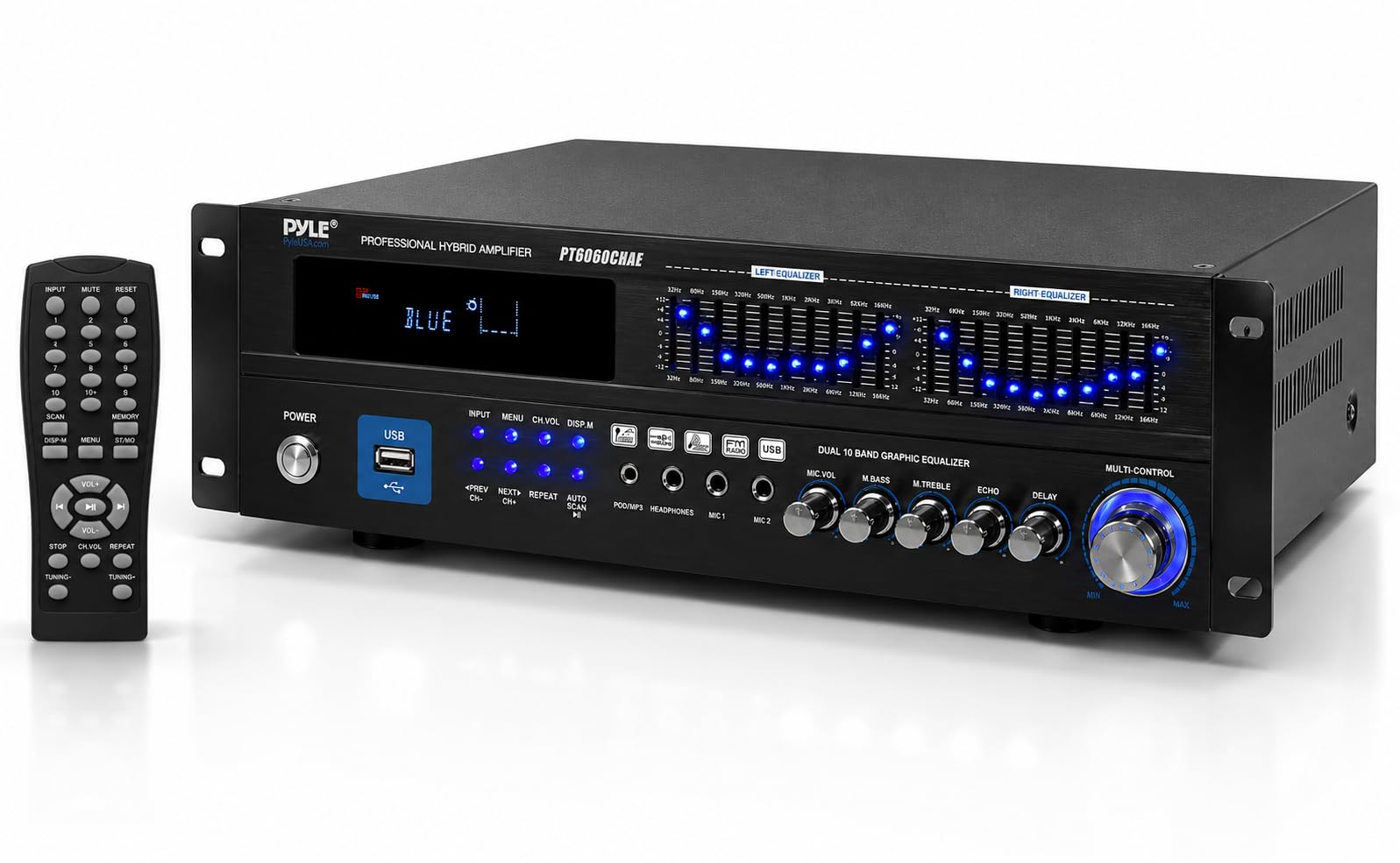
The Pyle 6-Channel Hybrid Home Theater Amplifier is a different beast from the other products in this guide — it is built for brute-force volume delivery rather than audiophile subtlety. With a claimed 2000W peak output, dual microphone inputs with independent echo controls, a 10-band graphic equalizer, and HDMI inputs, this unit is designed for karaoke parties, DJ setups, and commercial spaces where loudness is the primary priority. The rack-mount chassis includes a built-in cooling fan and radio antenna, and the front panel offers a VFD display, input selector, and individual controls for mic volume, treble, bass, and master volume.
Reviews consistently describe the Pyle as delivering real, window-shaking power. Users report it driving four speakers without strain and producing clean output at high volume levels. The Bluetooth streaming works well, and the dual mic inputs with echo effects make it functional for karaoke right out of the box. The 5.1 channel configuration allows for a basic surround sound setup, and the inclusion of HDMI inputs means it can serve as a living room AV receiver for mixed use.
The Pyle’s build quality does not match the refinement of the other amplifiers here. Multiple reviews mention that the graphic EQ sliders and control knobs have minimal or no effect on sound, suggesting a quality-control issue across production batches. There is a noticeable noise floor hum at low volume — the amplifier is designed for high-output operation and does not perform well at whisper levels. The Pyle is the right choice only if your primary need is maximum volume for parties, events, or commercial sound reinforcement. For critical listening, the other seven products in this guide offer far superior fidelity and build quality.
Why it’s great
- Extreme peak power output for large-room volume
- Dual microphone inputs with independent echo for karaoke
- Rack-mount chassis with built-in cooling fan
Good to know
- EQ controls reported non-functional on some units
- Noticeable noise floor hum at low listening volumes
- Build quality inconsistent compared to audiophile options
FAQ
Is a 35W RMS integrated amplifier enough power for bookshelf speakers?
Can I use a budget integrated amplifier with a turntable?
What is the difference between a budget integrated amplifier and a home theater receiver?
Should I buy a Class D or Class A/B budget integrated amplifier?
Do budget integrated amplifiers need an external DAC for good sound?
Final Thoughts: The Verdict
For most users, the best budget integrated amplifier winner is the Ampapa D1 because it combines the proven TPA3255 PFFB chipset, socketed op-amps, a high-quality 48V GaN power supply, and the most comprehensive set of inputs and outputs in its price class. If you want a superior built-in DAC and the highest digital resolution support, grab the AIYIMA A80 — its ES9038Q2M DAC is a genuine advantage for high-resolution PCM and DSD listeners. If you prize seamless TV integration and multiroom streaming over raw spec sheet numbers, the WiiM Amp offers HDMI ARC and app-based control that no other budget competitor can match. And for the listener who values a warm, musical presentation and the visual charm of glowing tubes, the Dayton Audio HTA100 delivers a genuinely distinctive experience at a price that does not punish the budget.