
Our readers keep the lights on and my morning glass full of iced black tea. As an Amazon Associate, I earn from qualifying purchases.
Growing plants indoors or setting up a studio requires knowing your actual light intensity, not just guessing based on how bright a bulb looks. A budget light meter removes the uncertainty by giving you a concrete lux or foot-candle reading, letting you dial in your grow lights or adjust your workspace lighting with precision.
I’m Min — the co-founder and writer behind Gadgets Feed. I’ve spent countless hours cross-referencing technical specifications and analyzing user data across dozens of light meters to identify which budget-friendly models deliver consistent, reliable readings without the premium price tag.
Whether you’re fine-tuning an LED grow tent or ensuring a film set meets exposure standards, this guide breaks down the top contenders for the best budget light meter that provides accurate, repeatable results without breaking your wallet.
How To Choose The Best Budget Light Meter
Not all budget light meters serve the same purpose. A meter that works wonders for your vegetable seedlings might be useless for calculating the correct aperture on a vintage film camera. Before you buy, understand the specific scenario you are buying for, then check the specs that matter most for that use case.
Lux Meter vs Exposure Meter: Know the Difference
The single biggest mistake buyers make is confusing a lux meter with a photographic exposure meter. A lux meter measures incident light intensity — it tells you how bright a surface is in lux or foot-candles. This is perfect for plants, workspaces, and general lighting audits. A photographic exposure meter, on the other hand, outputs shutter speed, aperture, and ISO combinations. If you buy a lux meter expecting to set your camera’s exposure automatically, you will be disappointed. Choose the type that matches your actual task.
Sensor Quality and Measurement Range
A meter with a 0 to 200,000 lux range covers most indoor and outdoor scenarios, but entry-level meters often cap out lower. For LED grow lights, you want a sensor that handles intense light without saturating or requiring awkward conversion math. Also check the sampling rate — a meter that reads twice per second gives you fluid feedback as you move the sensor, while a slower meter makes fine-tuning frustrating.
Build and Portability
A budget light meter lives a hard life — it gets knocked off workbenches, dropped in plant trays, and shoved into crowded camera bags. Look for a rubber bumper or a protective case. A 270-degree swivel sensor is a huge convenience because you can read the display while pointing the detector at any angle. For photographers, a cold shoe mount and USB-C rechargeability are major quality-of-life upgrades.
Quick Comparison
On smaller screens, swipe sideways to see the full table.
| Model | Category | Best For | Key Spec | Amazon |
|---|---|---|---|---|
| Dr.meter LX1330B | Lux/FC Meter | Plants & Indoor Growing | 0–200,000 lux, 9V battery | $42.74$44.99PrimeAmazon |
| BTMETER BT-881D | Lux Meter | High-Range Light Checks | 0.01–400,000 lux, 270° sensor | $39.99$42.99PrimeAmazon |
| Dr.meter 1332B | LED Lux Meter | LED Specific & Plants | 0–200,000 lux, 270° head | $33.99Amazon |
| LightMate AirPro | Exposure Meter | Film Photography | ±0.1 EV, 35°, USB-C | $92.99Amazon |
| TTartisan Light Meter II | Exposure Meter | Rangefinder Cameras | 34g, cold shoe, 23 speeds | $71.00Amazon |
| E130 Light Meter | Lux & CCT Meter | Color Temp & Light Mapping | 99-point mapping, CCT | $68.80Amazon |
| AstrHori Light Meter | Exposure Meter | Vintage Camera Mount | USB-C, 30° metering | $79.00Amazon |
In‑Depth Reviews
1. Dr.meter LX1330B Digital Illuminance Light Meter

The Dr.meter LX1330B is a ruggedly built lux meter that covers the full 0 to 200,000 lux range with a fast sampling rate of twice per second. It features a rubberized body with a thick bumper, giving it a reassuring heft that protects against bench-top drops. The toggle between FC and LUX units is effortless, and the PEAK data recording function lets you capture instantaneous high light pulses from lightning or a laser flash.
This meter uses a standard 9V battery (included) and delivers consistent readings across LED, CFL, T5, HPS, and metal halide grow lights. Users report that it reliably reveals when manufacturer-specified lumens are inaccurate, making it an excellent tool for comparing real-world output between different fixtures. The hardwired sensor cable is a small snag risk, but the build quality and measurement stability make it the go-to choice for serious indoor gardeners.
The LCD display lacks a backlight, which can be annoying in dim grow tents, but the bright white text remains readable under most conditions. The included case has cheap latches, but the meter itself is built to last. For anyone needing a dependable, dedicated lux meter for plants without spending for color temperature or PAR conversion features, this is the benchmark unit.
Why it’s great
- Sturdy rubber bumper and robust build quality
- Accurate and consistent readings across multiple light types
- PEAK hold mode captures brief high-intensity pulses
Good to know
- No backlight on the LCD display
- Hardwired sensor cable can create a snag hazard
- Only stores peak values, no multi-point memory
2. LightMate AirPro Light Meter
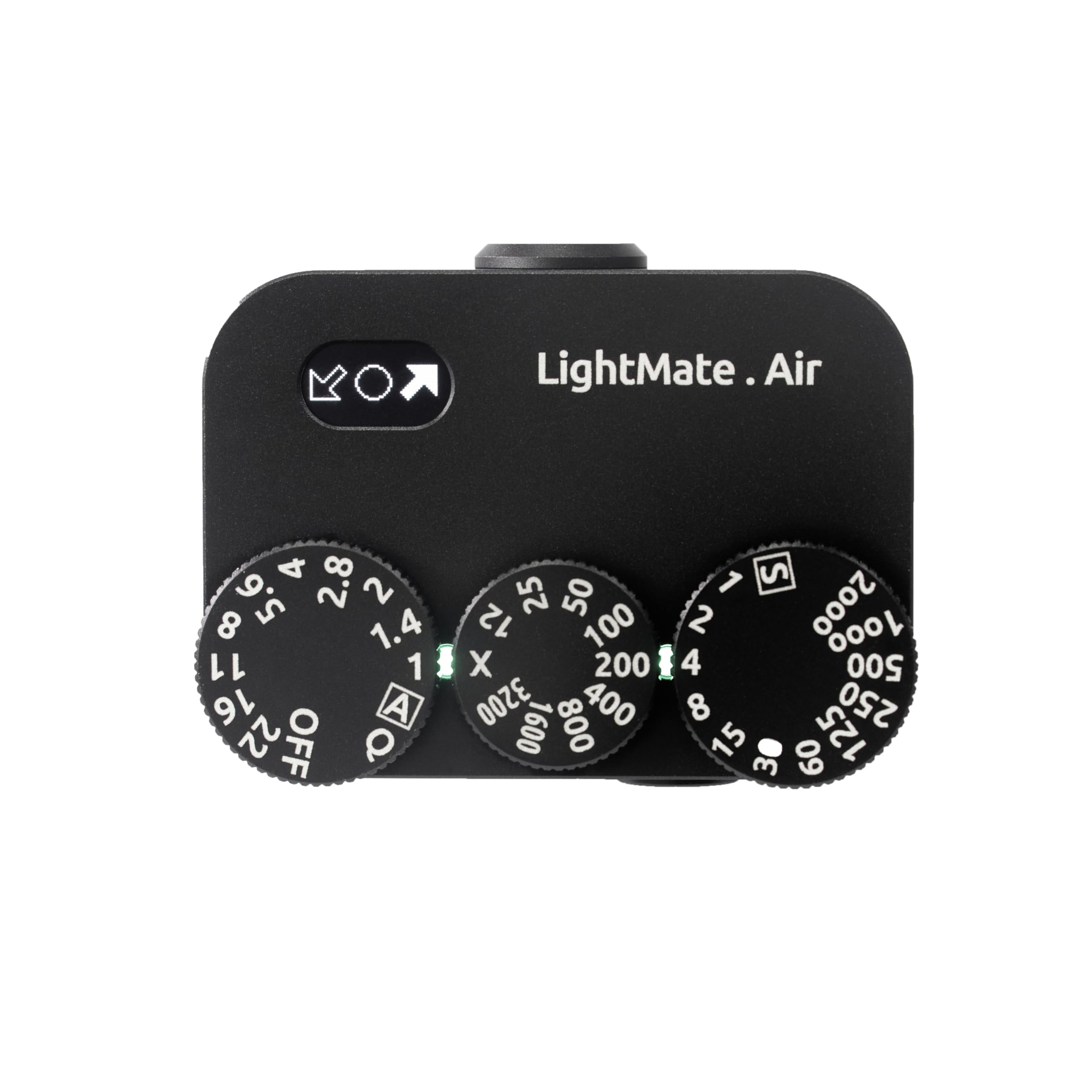
The LightMate AirPro is the premium choice for film photographers who want an intuitive exposure meter that fits directly into a camera’s cold shoe. Its 35-degree wide-angle reflective metering delivers ±0.1 EV accuracy, and the three independent dials for aperture, ISO, and shutter speed provide tactile feedback with satisfying half-stop clicks. The full metal shell gives it a durable, premium feel that matches classic camera builds.
Battery life is a standout feature here — the built-in rechargeable cell lasts over 20 hours of continuous use and can sit in standby for more than six months when fully charged. The USB-C charging is quick and convenient. The meter offers Aperture Auto, Shutter Auto, Manual, and EV modes, plus customizable LED exposure indicators with over ten color options, letting you tailor the visual feedback to your shooting style.
The learning curve is roughly ten minutes for most users, and calibration requires two to three attempts initially, but once dialed in, the AirPro stays accurate over months of heavy use. It works seamlessly with cameras like the Canon FTB and even obscure folding cameras. For film shooters who want a modern, rechargeable exposure meter that looks vintage and performs reliably, this is the clear winner.
Why it’s great
- Exceptional ±0.1 EV metering accuracy
- Long 20-hour rechargeable battery with USB-C
- Customizable LED indicators with multiple colors
Good to know
- Requires 2-3 calibration attempts for best accuracy
- Limited to 35-degree reflective metering only
- Not suitable for incident light measurement
3. BTMETER BT-881D Digital Illuminance Light Meter

The BTMETER BT-881D stretches the measurement range to an impressive 0.01 to 400,000 lux and 0.01 to 40,000 foot-candles, making it the widest-range budget meter in this lineup. The 270-degree rotatable sensor lets you measure from any angle while keeping the display facing you — a simple but brilliant design choice that saves time when checking light distribution across a grow room or office layout.
Accuracy is rated at ±4% for readings under 10,000 lux and ±5% for the highest ranges, which is solid for a mid-range meter. The 0.4-second response time with two to three samples per second gives real-time feedback as you move the sensor. It also stores up to 33 data sets and includes a relative measurement mode that compares current readings against stored values — handy for tracking lighting changes over time.
Anecdotal evidence from long-term users confirms that this meter stays accurate for over five years of occasional use when stored properly. It comes with a carrying case and includes its own screwdriver for the tiny sensor assembly screw. The only downside is the lack of a backlight, but the bright digital display and the included organizational pouch make up for it.
Why it’s great
- Huge 400,000 lux measurement range
- 270-degree swivel sensor for easy angle reading
- 33-point data memory with relative mode
Good to know
- No backlit display for dark environments
- Sensor assembly screw is very small
- Accuracy drops slightly at the highest range
4. Dr.meter Professional LED Light Meter 1332B

The Dr.meter 1332B is the rotating-head sibling of the LX1330B, trading the long cable for a compact body with a 270-degree swivel detector built directly into the housing. This design is significantly more portable and eliminates the snag risk of a wired sensor. It covers the same 0 to 200,000 lux range with four adjustable measuring ranges (200, 2,000, 20,000, and 200,000 lux) and features a tripod-mountable screw base for hands-free operation.
User reviews consistently praise its accuracy with LED, HPS, CMH, and T5 grow lights — one owner even created their own PAR conversion chart and found the meter measured within ±50 PAR of a far more expensive spectrometer. The data hold function and auto-power-off settings make it easy to use, and the simple two-button interface is intuitive even for first-time light meter users.
The plastic build feels adequate rather than premium, and the meter does require a 9V battery (not included). It is not designed for photographic exposure metering — owners who tried to use it for photography were disappointed. But for plant growers who need a compact, tripod-compatible lux meter with a rotating sensor, this is an outstanding option.
Why it’s great
- Compact body with 270-degree rotating detector
- Tripod mountable for hands-free use
- Accurate LED readings, convertible to PAR
Good to know
- Plastic build feels less rugged than LX1330B
- 9V battery not included
- Not suitable for photography exposure metering
5. E130 Light Meter – Accurate Lux & CCT
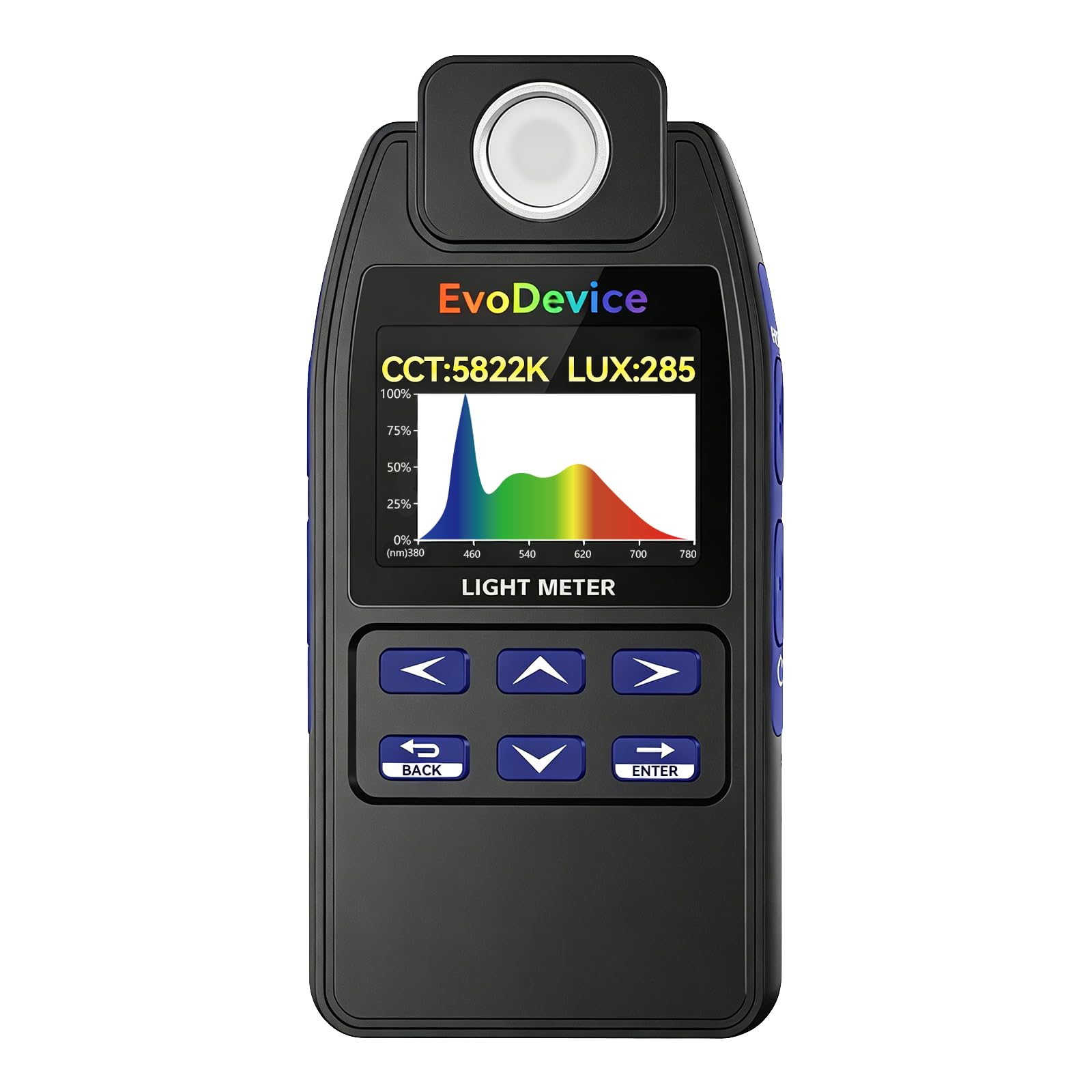
The E130 from De-Power is the only meter in this budget roundup that measures both illuminance in lux and correlated color temperature (CCT) in Kelvin. This dual functionality makes it invaluable for photographers balancing color temps in a shoot or reef tank owners checking the exact spectrum hitting their corals. The 99-point light mapping feature is genuinely unique — you can record readings across a grid to visualize hot spots and shadow falloff across an entire workspace.
The spectrum mode is specifically accurate for phosphor-converted white LEDs excited by 420nm or 450nm chips. For sunlight, sodium, or metal halide sources, the E130 still gives accurate lux and CCT numbers, though the spectral curve display should not be used for analytical purposes. Users report CCT accuracy within 200 to 300 K of professional spectrometers, which is impressive for this price tier.
The handheld design is straightforward, and the auto-shutoff feature prevents battery drain on the included AAA cells. The sensitivity to distance is noticeable — moving the meter just two inches can change the reading significantly — so consistent placement is essential. While not a replacement for a spectrometer, the E130 offers a practical balance of features for anyone who needs both light intensity and color temperature data.
Why it’s great
- Measures both lux and color temperature (CCT)
- 99-point light mapping for spatial distribution analysis
- Accurate CCT within 200-300K of pro gear
Good to know
- Highly sensitive to distance — consistent placement required
- Spectrum curve not intended for detailed analysis
- CCT accuracy varies with non-LED sources
6. TTartisan Light Meter II

The TTartisan Light Meter II is designed specifically for the vintage camera enthusiast. Weighing just 34 grams, it is the lightest exposure meter here, and its retro aesthetic matches beautifully with older Leicas, folding cameras, and rangefinders. The dial has been upgraded with clickable detents, and the shutter speed options have expanded to 23 gears, giving you fine-grained control over exposure settings.
The cold shoe mount is adjustable, ensuring compatibility with a wider range of old-style camera bodies. The meter runs on two included button-cell batteries and offers silver or black color options. For photographers who want a period-correct accessory that does not sacrifice metering functionality, the TTartisan hits the right visual and practical notes.
Build quality consistency is a concern — some units arrive with sensors that are slightly misaligned during assembly, leading to inaccurate readings. A few users reported receiving dead-on-arrival units or meters that failed within a week. The user interface for ISO adjustment requires a specific sequence of button presses that some find unintuitive. When it works, it is a charming and functional tool, but buyer beware on quality control.
Why it’s great
- Extremely lightweight at only 34 grams
- Vintage aesthetic matches rangefinder cameras
- Clickable dial with 23 shutter speed gears
Good to know
- Inconsistent build quality and sensor alignment
- ISO adjustment sequence is unintuitive
- Some units arrive defective or fail quickly
7. AstrHori Light Meter with OLED Display

The AstrHori Light Meter brings a modern build philosophy to the vintage cold-shoe exposure meter category. Its bronze plate metal body weighs 59 grams and feels substantial without being heavy. The built-in 120 mAh lithium battery charges via USB-C in about 40 minutes and provides roughly 12 hours of continuous metering, with a low-power sleep mode that kicks in after 25 seconds of inactivity.
Metering range covers EV1 to EV22 at ISO 100, with aperture adjustment from F1 to F32 and shutter speeds from 32 seconds down to 1/8000th. The A/T mode switching lets you prioritize either aperture or shutter speed, and the exposure compensation ranges from +3 to -3 EV in 1/3-stop increments. The OLED display is clear and bright, a notable upgrade over LCD-based competitors in the same price tier.
User reports on reliability are mixed — several purchasers received units with non-functional buttons or sensors that were soldered slightly off-center, causing metering inaccuracies. The cold shoe mount has also been described as too tight for some camera models. If you get a properly assembled unit, the AstrHori offers excellent feature density for the money, but the quality control lottery is a real risk to consider.
Why it’s great
- USB-C rechargeable with 40-minute full charge
- Bright OLED display with clear readouts
- A/T priority modes with 1/3-stop adjustments
Good to know
- Frequent quality control issues reported
- Cold shoe may not fit some camera models
- Button feedback can be unreliable
FAQ
Can I use a lux meter for setting camera exposure?
How do I convert lux readings to PAR for plant growth?
What does the 270-degree swivel sensor actually help with?
Final Thoughts: The Verdict
For most users, the best budget light meter winner is the Dr.meter LX1330B because it combines durable construction, a full 200,000 lux range, and consistent accuracy that growers and lighting auditors rely on. If you want color temperature measurement and spatial light mapping, grab the E130 Light Meter. And for film photographers seeking a modern rechargeable exposure meter, nothing beats the LightMate AirPro.
Product prices and availability are accurate as of the date/time indicated and are subject to change. Any price and availability information displayed on Amazon at the time of purchase will apply to the purchase of this product. As an Amazon Associate I earn from qualifying purchases.
CERTAIN CONTENT THAT APPEARS ON THIS SITE COMES FROM AMAZON. THIS CONTENT IS PROVIDED "AS IS" AND IS SUBJECT TO CHANGE OR REMOVAL AT ANY TIME.
Amazon and the Amazon logo are trademarks of Amazon.com, Inc. or its affiliates.