
Switching from cheap potentiometer pedals to load cell pedals is the single most effective way to lower your lap times in sim racing. A load cell measures actual force applied to the brake pedal rather than travel distance, which eliminates the inconsistent, spongy feel that makes trail braking a guessing game. For anyone serious about consistency, upgrading to a set of budget load cell pedals closes the gap between entry-level gear and professional-grade hardware without demanding a four-figure investment.
I’m Min — the co-founder and writer behind Gadgets Feed. I’ve spent hundreds of hours analyzing the technical specifications, material quality, sensor types, and user feedback for every load cell pedal set that sits in the sub- bracket, so you can make a confident buying decision based on real engineering differences rather than marketing claims.
Whether you are building your first rig or upgrading from a Logitech G29, the right set of budget load cell pedals will transform your braking consistency and unlock faster, more repeatable lap times without emptying your wallet.
How To Choose The Best Budget Load Cell Pedals
The load cell brake is the heart of any modern sim racing pedal set, but the total package involves frame rigidity, sensor accuracy, adjustability range, and software configuration depth. Users new to the category often fixate solely on the load cell rating in kilograms, overlooking elastomer stack tuning, hall effect throttle sensors, and mounting compatibility with existing rigs.
Load Cell Rating and Elastomer Stack
The load cell’s maximum force rating — typically 75 kg on entry-level units up to 200 kg on mid-range options — defines the physical pressure range the sensor can measure accurately. However, the elastomer stack (rubber or polyurethane bushings of varying Shore hardness) determines how that force translates to pedal resistance. A 200 kg load cell paired with overly stiff 85A elastomers can feel wooden and unresponsive without a softer spring or elastomer alternative. Look for sets that include multiple hardness options or an accessible replacement path.
Pedal Material and Frame Rigidity
Bending a lightweight aluminum pedal plate under 75 kg of brake force introduces flex that corrupts the load cell reading and destroys consistency. Steel frames with 3 mm to 6 mm thickness, or CNC-machined aluminum with a carbon fiber heel plate, resist torsional flex much better than thin stamped steel. The pedal face material — rubber-coated steel or bare aluminum — also affects foot slippage during long sessions.
Sensor Technology for Throttle and Clutch
Load cell sensors belong on the brake pedal, but the throttle and clutch benefit from Hall effect contactless sensors that eliminate mechanical wear and provide consistent linear output. Some budget sets use a load cell on all three pedals, which is redundant for throttle modulation but can improve clutch bite-point feel. Hydraulic damper systems add progressive resistance but require maintenance and can introduce leaks on poorly sealed units.
Quick Comparison
On smaller screens, swipe sideways to see the full table.
| Model | Category | Best For | Key Spec | Amazon |
|---|---|---|---|---|
| MOZA CRP2 | Premium | Best overall with aerospace build | 200 kg load cell, CNC aluminum, 15-bit angle sensor | Amazon |
| Fanatec CSL Elite V2 | Premium | Console compatibility plus PC | 90 kg load cell, RJ12/USB, 3 elastomer hardness options | Amazon |
| SIMSONN Plus X | Mid-Range | Hydraulic brake feel on a budget | 200 kg load cell, hydraulic damper, dual bearing design | Amazon |
| Logitech G RS | Mid-Range | Plug-and-play with Logitech ecosystem | 75 kg load cell, Hall effect accelerator, steel frame | Amazon |
| Thrustmaster Raceline III | Mid-Range | Modular upgrade path to load cell | Hall effect H.E.A.R.T. sensors, all-metal, upgrade kit sold separately | Amazon |
| Simjack UT-P3 | Mid-Range | Heusinkveld clone with strong value | 200 kg load cell, 32-bit dual-core processor, 3 mm steel plate | Amazon |
| Extreme Sim Racing Inverted Kit | Budget | Inverted upgrade for Logitech G-series | Steel inverted frame, extra brake load mod, 5000 g weight | Amazon |
| MOZA R3 Bundle (SR-P Lite) | Budget | Entry-level direct drive bundle | 3.9 Nm DD base, Hall sensor pedals (no clutch), table clamp | Amazon |
In‑Depth Reviews
1. MOZA CRP2 Load Cell Pedals

MOZA’s CRP2 pedals represent the ceiling of what you can get from a load cell set that still falls within a sensible budget for serious sim racers. The main body is CNC-machined from aerospace-grade aluminum, while the heel plate uses genuine carbon fiber — a combination that eliminates the pedal deck flex that plagues stamped-steel designs under heavy brake application. The 200 kg load cell sensor is overkill for most drivers, but its headroom ensures the sensor operates in its linear range even when you lean on the brake with full body weight. The 15-bit high-precision angle sensor on the throttle and clutch pedals delivers granular input resolution that makes trail brake modulation and throttle blip matching feel immediate and repeatable.
Brake feel is configurable through 125 possible damper combinations using the included elastomer stack and spacers, allowing you to dial in everything from a soft initial bite with progressive ramp to a rock-hard wall that mimics a GT3 car. The pedal spacing and face angle are fully tool-free adjustable, so swapping between a formula and GT driving position takes seconds rather than a full rig disassembly. Mounting supports both floor and inverted configurations, giving cockpit builders flexibility without requiring additional brackets. The carbon fiber heel plate also reduces the risk of the pedal base scratching expensive aluminum profile rigs during installation or adjustment.
Some users note that swapping the rubber brake dampers requires substantial physical force, especially when using the firmer durometer options — a polyurethane bushing pusher tool would be a welcome future addition. The pedal set ships as a two-pedal throttle-and-brake configuration, so a separate MOZA clutch pedal module must be purchased if you need the third pedal for heel-toe or clutch-kick maneuvers. Despite these minor friction points, the CRP2 stands as the most impressive load cell pedal option for its price point, delivering build quality and sensor accuracy that rivals sets costing twice as much.
Why it’s great
- CNC aerospace aluminum frame eliminates flex under 200 kg brake load
- 125 combination brake damper system allows fine-grained feel tuning
- Tool-free adjustability for pedal spacing and angle
Good to know
- Brake damper changes require significant physical force without a tool
- Clutch pedal sold separately as an add-on module
2. Fanatec CSL Elite Pedals V2

Fanatec’s CSL Elite Pedals V2 bring the company’s established load cell brake architecture into a more accessible price tier while retaining full compatibility with both PC and PlayStation and Xbox consoles when paired with the appropriate Fanatec wheel base. The brake system uses a dual-stage load cell rated up to 90 kg on the pedal plate, paired with a metal spring and three elastomer hardness options — 65A, 75A, and 85A Shore — that can be swapped tool-free. This elastomer stack provides a progressive resistance curve that feels natural for trail braking, while the included metal spring option adds a stiffer preload for drivers who prefer a more abrupt initial bite. The throttle and clutch use contactless Hall effect sensors, which eliminate the potentiometer wear that causes inconsistent input over time.
Build quality is all-metal, with detachable rubber pedal covers that improve grip during long stints and a pedal plate that can be repositioned sideways along the heel rest to accommodate different foot sizes. Connection flexibility is a standout feature: RJ12 direct to compatible Fanatec bases for console compatibility, or USB for standalone PC use. This means the pedals work independently of the wheel ecosystem, opening them up to drivers using Moza, Simucube, or other direct drive bases. The pedal set also supports easy reconfiguration as a two-pedal set by removing the clutch module, which simplifies mounting on compact rigs where footwell space is at a premium.
Some users report that the brake force setting occasionally resets to 50% on wheelbase power-on, requiring a quick re-selection in the Fanatec control panel. The firmware update process requires a direct USB connection to a PC, which is inconvenient for console-only users who lack a gaming computer nearby. Additionally, the pedal plate may need slight modification for certain rigs to achieve the optimal pedal angle. Despite these firmware quirks, the Fanatec CSL Elite V2 offers a seamless console-to-PC bridge that few budget load cell pedals can match, making it the top choice for multi-platform sim racers.
Why it’s great
- RJ12 direct connection to Fanatec bases plus standalone USB for PC
- Three elastomer hardness options and a metal spring included
- Contactless Hall sensors on throttle and clutch
Good to know
- Brake force setting can randomly reset to 50% on power-on
- Firmware updates require a PC USB connection
3. SIMSONN Plus X Racing Simulator Hydraulic Pedals

SIMSONN’s Plus X pedals push hydraulic braking technology into the budget bracket, using a premium hydraulic damper system on the brake to replicate the progressive, nonlinear resistance of a real race car pedal. Instead of relying solely on elastomer compression, the hydraulic damper slows the pedal’s travel speed in and out, producing a swept resistance curve that feels distinctly more organic than elastomer-only setups. The brake uses a 200 kg load cell sensor to measure actual applied force, while the throttle and clutch incorporate load cell sensors as well — providing consistent 1:1 input mapping across all three pedals. The new upgraded damping system uses three elastomer options (60HA, 70HA, 80HA) plus 13 spacers, allowing for extensive feel customization to match different car types and driver preferences.
Construction relies on high-strength steel with a dual bearing design — flange bearings combined with plane bearings — that ensures the pedal arm moves smoothly without lateral slop. The upgraded control box features stronger interference rejection and three vibration module ports for connecting optional SIMSONN haptic reactors, adding wheel-lock and traction-loss feedback through the brake pedal itself. The SIMSONN Manager software supports nonlinear pedal output curve configuration, dead zone adjustments, and custom brake curve profiles that can be saved and loaded between sessions. The 24-month warranty on the main unit and 3-month coverage on accessories shows solid confidence in the build quality.
Several users have swapped the supplied 60/70/80 HA elastomers for softer white alternatives from SIMSONN, finding the stiffest options too harsh for daily use — a 40HA or 50HA option in the box would reduce this aftermarket search. Angle adjustment of the pedal faces is a tedious process requiring partial disassembly, and the bolts can loosen over time, particularly when haptic reactors are installed and active. The included grounding cable must be connected to prevent static electricity buildup that can cause erratic input behavior. Despite these adjustment quirks, the SIMSONN Plus X delivers hydraulic brake texture and 200 kg load cell accuracy at a price that undercuts similarly equipped sets by a wide margin.
Why it’s great
- Hydraulic damper provides progressive nonlinear brake resistance
- 200 kg load cell sensor across all three pedals
- SIMSONN Manager software with full curve and dead zone control
Good to know
- Stock elastomers may be too stiff for some drivers
- Pedal angle adjustment requires partial disassembly
4. Logitech G RS Pedals
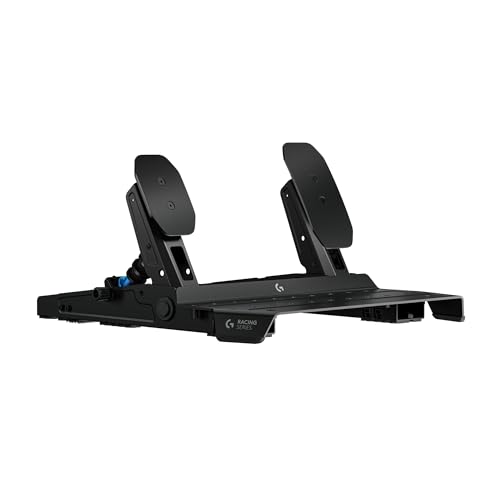
Logitech G’s RS Pedals are the brand’s first dedicated step beyond the entry-level G29/G923 pedal design, incorporating a 75 kg load cell brake and Hall effect sensors on both the accelerator and clutch. The 75 kg load cell delivers consistent brake force measurement that allows repeatable trail braking inputs, a major leap from the rubber grommet-based resistance system in older Logitech pedal sets. The accelerator uses a contactless Hall effect sensor that provides precise throttle modulation without the surface abrasion that causes potentiometer drift over time. The steel frame includes an anti-tip design and an extendable wall brace that prevents the pedal base from sliding forward under hard braking, even on carpet without a dedicated cockpit.
Cross-range compatibility is a major strength: the RS Pedals connect directly to Logitech’s PRO and RS50 racing wheel bases for console use, or via USB for PC, supporting other brand wheels as well. The pedal positions are adjustable along the frame rails, allowing drivers to fine-tune the spacing and reach to match their seating position. Large rubber feet grip hard floors, while carpet grippers keep the unit planted on softer surfaces. The build quality feels substantial compared to the hollow plastic of previous Logitech pedal sets, with a solid steel plate that resists flex even during aggressive brake stabs.
G-Hub software integration has had stability issues, with some users reporting calibration problems that were resolved by a December 2025 firmware update. The pedal set does not include a clutch pedal by default — the RS Clutch Pedal Module is sold separately, which adds cost if you need the three-pedal configuration. The brake feel, while much improved over rubber grommets, lacks the progressive elastomer stack adjustability found on competing options like the Fanatec CSL Elite V2. For Logitech ecosystem loyalists who want a genuine load cell upgrade without switching platforms, the RS Pedals provide a clean, integrated path forward.
Why it’s great
- 75 kg load cell brake with consistent force measurement
- Hall effect accelerator and clutch eliminate potentiometer wear
- Cross-range compatibility with Logitech PRO and RS50 bases
Good to know
- Clutch pedal module sold separately
- G-Hub software required early firmware updates for stability
5. Thrustmaster Raceline Pedals III

Thrustmaster’s Raceline Pedals III are an all-metal three-pedal set built around drift-free Hall effect H.E.A.R.T. sensors that deliver consistent input without degradation over thousands of hours. The set ships without a load cell brake, but Thrustmaster sells a separate Raceline Pedals Upgrade Kit that adds a pressure-sensitive load cell, giving buyers a modular upgrade path that spreads the cost over time. Each pedal has three built-in pressure adjustment notches and multiple included springs, allowing drivers to tune the resistance curve for throttle, brake, and clutch independently without opening the housing. The non-slip support pads keep the pedals planted on any surface including hardwood, carpet, and tile, which is helpful for drivers who have not yet invested in a dedicated cockpit.
The fully metal construction — including the pedal arms, face plates, and base plate — ensures the unit can handle aggressive heel-toe downshifts and hard braking without structural flex. The set pairs seamlessly with any Thrustmaster force feedback wheel via a proprietary RJ-style connection, but a USB adapter is not included, so PC users running non-Thrustmaster wheels will need to look elsewhere or wait for an official adapter. The pedal spacing is generous enough for large feet to operate each pedal independently without accidental double-presses, and the face plates have enough texture to prevent foot slip during long endurance sessions.
The load cell upgrade kit costs extra, and the base model’s brake pedal uses a spring-and-elastomer system that, while adjustable, does not provide the same force-sensing accuracy as a true load cell. The proprietary connection cable (a phone-jack style RJ connector) means you cannot simply plug these into a PC via standard USB without the matching Thrustmaster base. Users who plan to pair these with a non-Thrustmaster direct drive wheel should confirm compatibility before purchase. For Thrustmaster ecosystem racers who want a solid foundation that can grow into a load cell braking system, the Raceline III offers a clear modular pathway.
Why it’s great
- Fully all-metal construction with Hall effect H.E.A.R.T. sensors
- Modular upgrade path to load cell braking
- Three pressure adjustment notches per pedal
Good to know
- Load cell upgrade kit sold separately
- Proprietary connection cable requires Thrustmaster wheel base
6. Simjack UT Sim Racing Pedals (UT-P3)

Simjack’s UT-P3 pedals have built a strong reputation as the go-to budget alternative to premium Heusinkveld Sprints, sharing a similar three-pedal layout and 200 kg load cell architecture at a fraction of the price. The brake uses a 200 kg load cell sensor housed in an aluminum casing, paired with imported rubber elastomers in 60, 80, and 90 Shore hardness options that allow drivers to choose their preferred brake stiffness. The throttle and clutch also use load cell sensors rather than Hall effect, which some drivers find provides a more consistent bite-point feel on the clutch but can feel linear on the gas. A 32-bit dual-core processor with a 16-bit independent ADC chip handles real-time mapping and three-channel simultaneous data sampling, ensuring the pedal inputs are processed without latency even when all three pedals are activated simultaneously.
The pedal plates are CNC precision laser-cut from 3 mm stainless steel, with the brake load bearing section thickened to 6 mm for added rigidity. The throttle plate features an increased heel and toe position, while the brake panel is wider to accommodate different foot placements. The Simjack Control software allows configuration of linear pedal output curves, dead zones, and brake response curves, all of which can be saved as profiles and applied across any simulator without per-game remapping. The set is PC-only via USB, with no driver installation required, and ships from a US warehouse to avoid international shipping delays.
Stock brake elastomers are very stiff, with many users reporting they needed to swap them for aftermarket springs from Etsy to achieve a more progressive trail braking feel. The gas pedal damper is widely considered useless and can introduce resistance that makes throttle modulation feel unnatural. Some units develop squeaks over time that require lubrication, and a few users have reported static electricity buildup when feet are on the pedals that stops when they lift off. Compatibility is limited to PC only, so console gamers will need to look elsewhere. Despite these rough edges, the UT-P3 delivers 200 kg load cell performance and Heusinkveld-compatible form factor at a price that makes load cell braking accessible to budget-conscious sim racers.
Why it’s great
- 200 kg load cell on all three pedals at an aggressive price point
- 32-bit dual-core processor with 16-bit ADC for low-latency sampling
- Heusinkveld-compatible form factor and mounting pattern
Good to know
- Stock brake elastomers are very stiff for most drivers
- Gas pedal damper offers limited utility
- PC-only — no console compatibility
7. Extreme Sim Racing Inverted Pedals Kit Upgrade

The Extreme Sim Racing Inverted Pedals Kit is not a standalone pedal set — it is a steel inverted frame upgrade designed specifically for Logitech G25, G27, G29, G920, and G923 pedal units. Inverting the pedals positions the hinge point at the top rather than the bottom, which changes the leverage angle and provides a more realistic foot motion that closely mimics a road car or race car pedal box. The kit includes an extra brake load mod that adds more resistance to the brake pedal, bringing it closer to the firm feel of a proper load cell brake despite Logitech’s original potentiometer sensor. The frame is constructed from high-quality steel with all mounting screws included, and the pedals are fully adjustable for angle and spacing once mounted.
Compatibility extends to all Extreme Sim Racing wheel stands and cockpits, and users report successful mounting to third-party rigs like the Playseat Challenge using zip ties and velcro. The kit’s steel construction eliminates the flex that occurs with Logitech’s plastic pedal base, making brake inputs feel more consistent and stable during hard braking. The hanging pedal design also improves accelerator sensitivity and clutch engagement feel by changing the natural resting angle of the foot. The entire swap takes between 30 minutes and 2 hours depending on experience level, with some users reporting that taking photos of the original wire routing before disassembly dramatically simplifies the process.
The kit does not include any instructions — only a techno music video that shows the assembly process, which can be frustrating for first-time installers. The brake improvement from the included load mod is described by some users as soft and underwhelming, requiring a third-party Ricmotech V3 load cell kit to achieve true load cell brake performance. The accelerator and clutch retain Logitech’s original potentiometer sensors, so they remain susceptible to dust and wear over time. For Logitech G-series owners who want the ergonomic benefits of inverted pedal geometry without buying a completely new pedal system, this kit provides a cost-effective entry into a more realistic pedal layout.
Why it’s great
- Steel inverted frame improves foot angle realism
- Extra brake load mod increases brake pedal resistance
- Compatible with all Logitech G-series pedal units
Good to know
- No written instructions included — relies on video guide
- Brake improvement is modest without third-party load cell upgrade
8. MOZA R3 Racing Simulator Bundle

MOZA’s R3 bundle provides a complete entry point into direct drive sim racing, coupling a 3.9 Nm DD wheel base with the SR-P Lite two-pedal set that uses high-precision Hall sensors rather than traditional potentiometers. While the SR-P Lite pedals are not load cell pedals themselves, they serve as the foundation that can be upgraded later with MOZA’s separate SR-P load cell brake module or replaced entirely with the CRP2 pedals reviewed above. The Hall effect sensors in the SR-P Lite set ensure consistent throttle and brake input without the wear and calibration drift that plagues potentiometer-based entry-level pedals. The steel pedal construction feels more substantial than common plastic pedal units, and the pedal spacing and face angle are adjustable to fit different foot sizes.
The R3 wheel base features an aviation-grade aluminum X-shape housing with an intelligent temperature control system that manages heat buildup during long sessions, preventing torque fade. The included 11-inch ES Lite steering wheel uses a durable ISF PU grip with an aluminum alloy rim and 22 customizable buttons, providing enough inputs for most sim racing titles without requiring an immediate button box purchase. The table clamp is CNC-machined from 5 mm high-intensity steel, angle-adjustable, and fits various table thicknesses, making the bundle usable for desktop racers who lack a dedicated cockpit. The MOZA Pit House software handles device status, custom settings, and game launching from a single interface.
The SR-P Lite pedal set lacks a clutch pedal, which is a limitation for drivers who need heel-toe or clutch-kick techniques in rally or drifting. The brake pedal uses a rubber stopper for resistance rather than a load cell, so the brake modulation consistency does not match dedicated load cell pedals. The 3.9 Nm torque output is adequate for learning direct drive feel but will feel weak for experienced sim racers accustomed to higher torque bases. For sim racing newcomers who want a turnkey direct drive setup with a clear upgrade path to proper load cell braking, the R3 bundle represents the most coherent entry-level package available.
Why it’s great
- Complete direct drive bundle includes base, wheel, pedals, and clamp
- Hall effect sensors in pedals prevent potentiometer wear
- Clear upgrade path to MOZA CRP2 load cell pedals later
Good to know
- SR-P Lite pedals are not load cell — rubber stopper brake
- No clutch pedal included — two-pedal configuration only
FAQ
Can I use budget load cell pedals without a dedicated racing cockpit?
What is the difference between load cell and Hall effect sensors for sim racing pedals?
Final Thoughts: The Verdict
For most users, the budget load cell pedals winner is the MOZA CRP2 because it combines aerospace-grade aluminum construction, a 200 kg load cell, and 125 combination brake damper settings that allow fine-grained pedal feel tuning. If you want console compatibility plus PC flexibility, grab the Fanatec CSL Elite V2. And for hydraulic brake texture at a mid-range price, nothing beats the SIMSONN Plus X.