
Our readers keep the lights on and my morning glass full of iced black tea. As an Amazon Associate, I earn from qualifying purchases.
Specs are compiled from manufacturer listings and verified buyer reviews and can change over time — please confirm the key details on the product page before buying.
You want a monitor that shows your design work exactly as it is—rich, accurate colors, sharp 4K detail—without spending what a pro display usually demands. The good news is that several monitors now deliver factory-calibrated panels and wide color gamuts at prices that actually fit a real project budget. This guide cuts through the noise to help you pick the one that earns its place on your desk.
I’m Min — the founder and writer behind Gadgets Feed. This guide is built by comparing the manufacturers’ published specifications and the patterns across verified customer reviews, so you get each pick’s real strengths and trade-offs instead of marketing spin.
The short answer is that the budget monitor for graphic design category now includes models with 99% sRGB coverage, Delta E under 2, and single-cable USB-C convenience, so you no longer have to choose between accuracy and affordability.
Quick Picks
- Dell 27 Plus 4K USB-C Monitor (S2725QC) — Best Overall
- ViewSonic VP2756-4K 27 Inch 4K ColorPro Monitor — Pantone Certified
- ASUS ProArt Display PA279CV 27” 4K HDR Monitor — Calman Verified
- BenQ PD2706U Mac-Ready Monitor 27” 4K UHD — Mac Ready 90W
- ASUS ProArt Display PA279CRV 27” 4K HDR Professional Monitor — Pro Gamut
- BenQ PD2705U Mac-Ready AQCOLOR Monitor 27″ 4K UHD — Color Under 1K
How To Choose The Best Budget Monitor For Graphic Design
The core promise of a budget design monitor is color accuracy at a price that does not break your workflow. But not every 4K screen with a low sticker price delivers the consistent hues and even backlight that design software demands. Here is what actually separates a true budget design monitor from a general office display.
Color Gamut Depth Matters More Than Resolution Alone
Every design monitor in this guide hits 4K (3840 x 2160), which gives you the pixel density to see fine details in a vector path or a texture layer. But the real difference lives in color gamut coverage. Look for 99% sRGB as a bare minimum for web and print work. If you also touch video, 95% DCI-P3 or 99% Adobe RGB gives you the wider palette needed for grading and photo editing without banding in skin tones.
Delta E Accuracy and Factory Calibration
Delta E (a measurement of how far a displayed color is from the true intended color) tells you how much you can trust what you see. For graphic design, a Delta E under 2 means the difference between the screen color and the real color is essentially invisible to the human eye. Each pick here is factory-calibrated, so you can unbox and start color-critical work without immediately renting a calibrator.
Connectivity That Keeps Up
A single USB-C cable that delivers video signal, data transfer, and power to your laptop keeps your desk clean and your workflow fast. Look for at least 65W Power Delivery (the wattage your monitor sends back to charge your laptop) so you do not need a separate charger. Additional USB ports (often called a hub) let you plug in a mouse, a graphics tablet, or an external drive without reaching behind your tower.
Quick Comparison
On smaller screens, swipe sideways to see the full table.
| Model | Best For | Color Gamut | Contrast Ratio | USB-C Power | Amazon |
|---|---|---|---|---|---|
| Dell S2725QC | Best Overall Value | 99% sRGB | 1500:1 | 65W | $314.99$349.99Amazon |
| ViewSonic VP2756-4K | Pantone Validated Accuracy | 100% sRGB | 1000:1 | 60W | $379.99Amazon |
| ASUS PA279CV | Calman Verified Budget | 100% sRGB / Rec. 709 | 1000:1 | 65W | $399.00Amazon |
| BenQ PD2706U | Mac Ready with 90W PD | 99% sRGB, 95% P3 | 1000:1 | 90W | $399.99$649.00Amazon |
| ASUS PA279CRV | Pro-Grade Color Gamut | 99% DCI-P3, 99% Adobe RGB | 1000:1 | 96W | $429.00Amazon |
| BenQ PD2705U | Highest Budget Tier Accuracy | 99% sRGB & Rec.709 | 1000:1 | 65W | $676.00Amazon |
In‑Depth Reviews
1. Dell 27 Plus 4K USB-C Monitor (S2725QC)
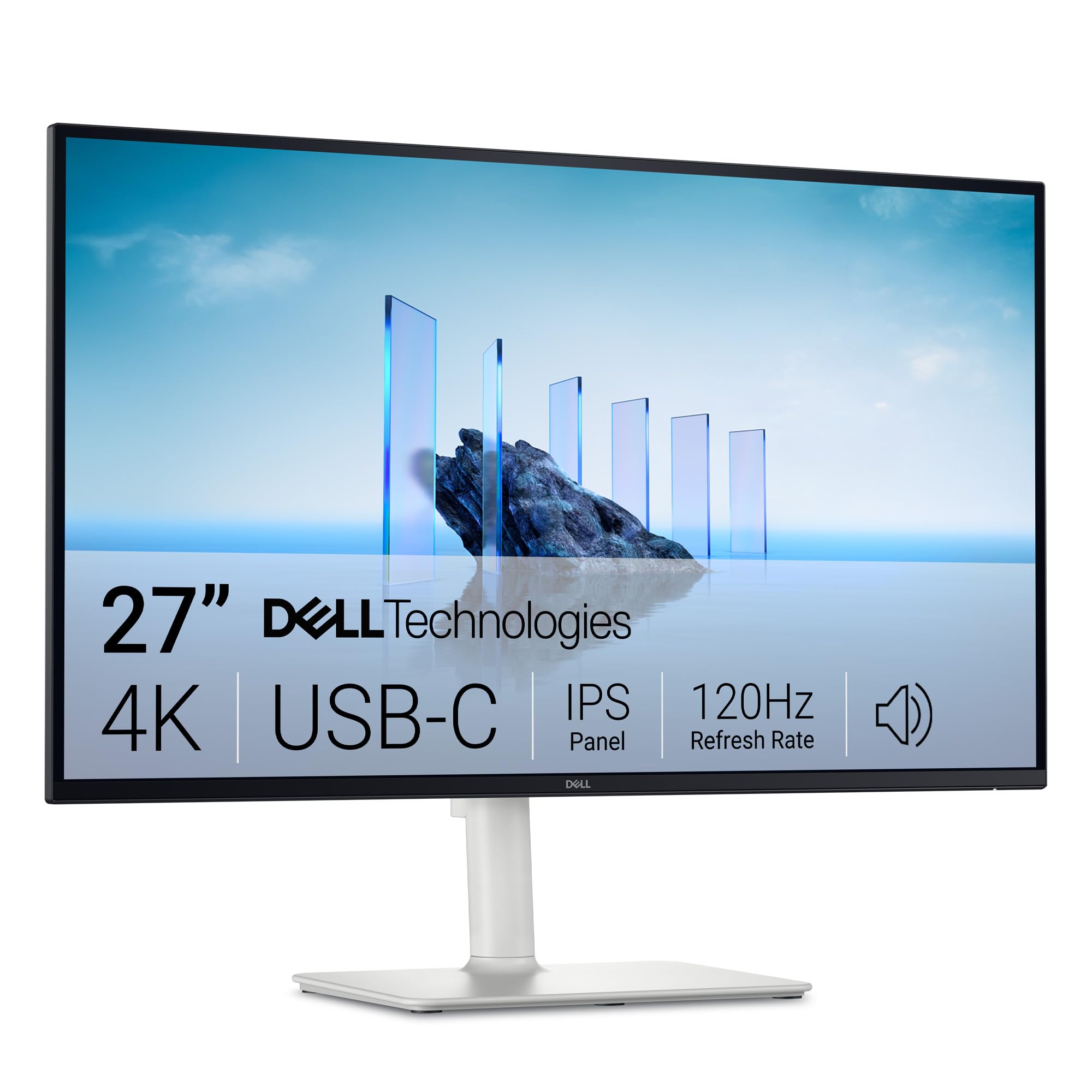
The 120Hz refresh paired with 4K color accuracy that does not compromise on budget
You get a rare combination here: a 120Hz refresh rate (how smoothly motion appears on screen) alongside 99% sRGB and a 1500:1 contrast ratio which is 50% deeper than the standard 1000:1 found on the ViewSonic VP2756-4K. That deeper contrast means blacks look richer in a dark UI or a moody photo edit, giving you more depth without spending extra. The single USB-C cable handles 65W Power Delivery, video, and data transfer, keeping your desk clean.
Buyers report “great color, no bad pixels, easy menu, USB data transfer, 120Hz, quick on/off, sleek bezel” — and note the recessed VESA mount requires M4x10mm standoffs if you plan to use an arm. The built-in speakers are serviceable for Zoom calls, and the ComfortView Plus reduces blue light emissions to 35% while keeping color intact, so late-night editing sessions do not strain your eyes.
One honest trade-off: the ash-white finish and slim bezel look modern, but the stand lacks full pivot rotation and the back panel is glossy, so it shows fingerprints if you frequently reach behind to plug cables.
Defining Strengths
- 120Hz refresh gives smoother cursor and scroll than typical 60Hz design displays
- 1500:1 contrast ratio delivers visibly deeper blacks than the competition
- Single USB-C cable with 65W power delivery simplifies the setup
Real-World Limits
- No full pivot or swivel adjustment on the stand
- White bezel may not match every studio aesthetic
- Recessed VESA mount requires specific standoff screws for arms
Your go-to if: you want a vivid, smooth 4K panel for both design and light gaming, with a single-cable desk setup.
Look elsewhere if: you need portrait rotation or absolute full-height adjustability from the stock stand.
2. ViewSonic VP2756-4K 27 Inch 4K ColorPro Monitor
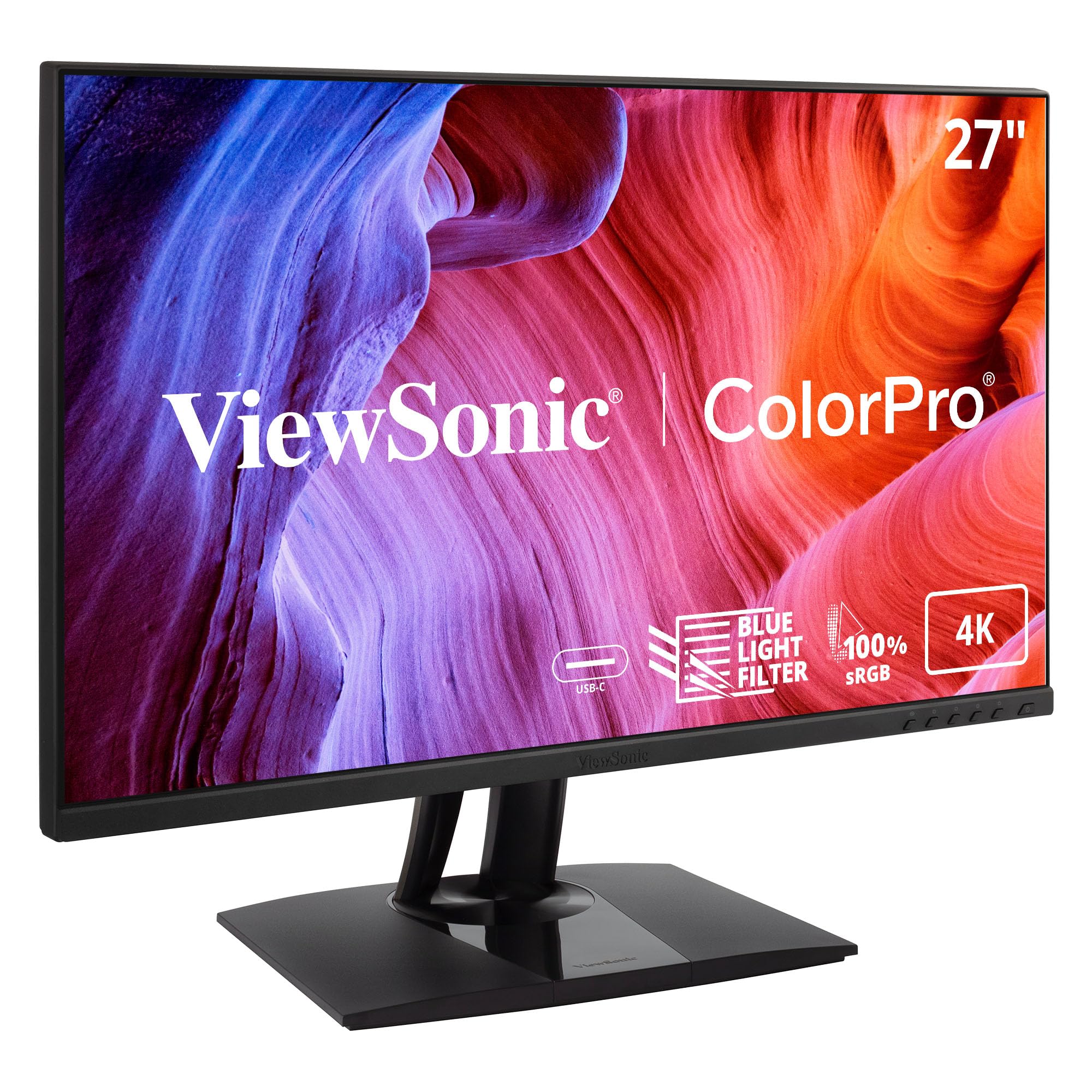
Pantone Validation baked in, so your brand color stays faithful on every print run
The VP2756-4K is Pantone Validated, meaning it has been certified to reproduce Pantone Matching System colors accurately — a critical guarantee if you work with corporate brand guidelines or product packaging. It covers 100% sRGB with a Delta E under 2, and its 4K IPS panel (a type of screen technology known for wide viewing angles and consistent color) keeps hues stable even when you lean in close to check a gradient. The 1000:1 contrast ratio is standard, though the Dell S2725QC beats it here with 1500:1.
Owners mention the monitor is “bright, extremely detailed, ultra-life-like image” and “highly recommended for content production.” The advanced ergonomic stand gives you tilt, swivel, pivot, and height adjustment for all-day comfort, and the 60W USB-C charges your laptop while passing video. A reviewer specifically praised the single-cable USB hub that switches between a MacBook, Lenovo Legion Go, and iPad Air M2 — a real productivity boost for multi-device designers.
The catch some users found: the on-screen display (OSD) menu is clunky to navigate with the bottom buttons, though the ViewSonic desktop software gives you a better control panel. Also, a buyer flagged that you cannot rotate the display 90 degrees with a Mac — the company did not advertise that limitation upfront.
Standout Credentials
- Pantone Validated and Delta E < 2 for true color reproduction
- Full ergonomic stand with tilt, swivel, pivot, and height adjustment
- 60W USB-C with a built-in 2-port USB hub that switches devices
Trade-Offs
- 1000:1 contrast ratio is standard, not as deep as the Dell S2725QC
- OSD button controls feel clunky; desktop software is a better alternative
- Pivot rotation does not work correctly with macOS, despite the hardware support
Reach for this if: Pantone-accurate color is non-negotiable for your client work and you need flexible ergonomics.
skip it if: you rely on portrait-mode rotation on a Mac — that compatibility is not guaranteed.
3. ASUS ProArt Display PA279CV 27” 4K HDR Monitor

Calman Verified factory calibration that lands true color from the start
ASUS factory-calibrates the PA279CV and backs it with a Calman Verification (an independent certification that the display meets strict color accuracy standards) and a reported Delta E under 2. It covers 100% sRGB and 100% Rec. 709 (the color standard for broadcast video), making it a solid fit for both print and video editing. The USB-C port delivers 65W Power Delivery, and the monitor also includes a DisplayPort, HDMI, and a 4-port USB 3.1 hub, so you can plug in a graphics tablet and a card reader without swapping cables.
Customers note “Great 4K color and performance for video editing with Nvidia GPU” and note the split-screen feature lets you compare two HDMI inputs side-by-side, which is handy for matching a camera feed to your edit. Another reviewer who uses it with a 2021 MacBook Pro M1 Max found it “matches MacBook screen out-of-box for graphic design” and praised the lack of eye strain. The 5-year warranty (3 years plus 2 years with online registration) adds confidence for long-term use.
One review mentions a slight green tint from the start, which was fixed by adjusting the tint setting to -7 in the menu. So while the pre-calibration is close, some buyers still fine-tune it. The included 3-month Adobe Creative Cloud trial is a nice bonus if you are starting a subscription.
Calibrated Right Out: Calman Verified and factory-calibrated to Delta E < 2 — the closest a budget monitor gets to a pro reference display.
One Fine-Tune Needed: A small green tint on some units is easily corrected in the menu, but it is not flawless for everyone straight from the start.
Pick it for: Calman-verified accuracy and versatile connectivity at a budget-friendly price, especially if you work across print and video.
Consider another if: you want deeper contrast — the standard 1000:1 ratio is fine, not punchy.
4. BenQ PD2706U Mac-Ready Monitor 27” 4K UHD

90 watts of power delivery to charge a MacBook Pro while you edit
The BenQ PD2706U delivers 90W via USB-C — enough to charge a 14-inch MacBook Pro at full speed while carrying the 4K video signal. This matters because most budget monitors cap at 60W or 65W, which can slowly drain a demanding laptop during heavy rendering. The panel covers 99% sRGB and 95% P3 (a wider color space than sRGB, used for video and HDR content) with a Delta E of 3 or less, and it is Pantone and Pantone SkinTone Validated, making it suitable for portrait and product photography.
Buyers call it a “really good photo editing monitor” and praise the AQCOLOR technology for faithful skin tones. The built-in KVM switch (Keyboard Video Mouse — a feature that lets you control two computers with one keyboard and mouse) saves desk space if you work between a Mac and a PC. The HotKey Puck (a small remote control for quick menu adjustments) makes switching color modes faster than fiddling with rear buttons. The ergonomic stand tilts, swivels, pivots, and adjusts height.
A few users report defective units with poor secondary packaging, so inspect the box on arrival. The native contrast ratio is 1000:1, which is standard but behind the Dell S2725QC’s 1500:1. And at 250 nits of brightness, it is dimmer than the 350-nit panels from ViewSonic and ASUS, so it is better suited to a controlled studio than a sunlit room.
Highest Power Delivery: 90W USB-C charges demanding laptops at full speed — beats the 65W from the Dell and ASUS competitors.
Studio-Only Brightness: 250 nits is fine indoors but not bright enough for rooms with direct window glare.
Best for: MacBook users who want true single-cable charging and color-accurate skin tones for portrait or product work.
Skip if: your workspace has strong ambient light or you need punchy HDR brightness above 300 nits.
5. ASUS ProArt Display PA279CRV 27” 4K HDR Professional Monitor

Full Adobe RGB and DCI-P3 coverage for the widest color palette at this price
The PA279CRV covers both 99% DCI-P3 and 99% Adobe RGB — a rare achievement at this price point. DCI-P3 is the standard for digital cinema and HDR video, while Adobe RGB is wider than sRGB and captures more of the subtractive CMYK print space. If you edit photos destined for glossy magazines or grade video for broadcast, this monitor gives you the gamut to see and correct colors that fall outside the sRGB triangle. The 96W USB-C Power Delivery is the highest wattage in this lineup, charging even a 16-inch MacBook Pro under load.
Buyers confirm it is “great for semi-pro video/photo editing; true color saturation” and note the matte finish has “minimal sparkle” compared to some anti-glare coatings that add a grainy texture to solid colors. The stand is fully adjustable with tilt, swivel, pivot, and height, plus built-in cable management to keep wires tidy. The 5-year warranty (3 years plus 2 with registration) matches the PA279CV, and it includes a 3-month Adobe Creative Cloud subscription.
The 60Hz refresh rate is standard for a design monitor, so gamers will look elsewhere. A reviewer mentions slight light leakage and a minor red/green caste on pure gray screens, but notes it is “unnoticeable in use” and the average delta E across the panel was 0.4 — excellent for a unit at this tier. The button controls on the bottom right are functional but not as premium as a joystick.
Widest Gamut
- 99% DCI-P3 and 99% Adobe RGB — covers the two most demanding color spaces
- 96W USB-C PD charges even large MacBook Pros at full speed
- Fully adjustable stand with cable management and matte anti-glare coating
Honest Downsides
- 60Hz refresh rate is fine for design but not for fast-paced gaming
- Minor light bleed and color caste on gray screens reported by a few buyers
- Button controls replace a joystick, which some find less intuitive
Choose this if: your work spans both print (Adobe RGB) and video (DCI-P3) and you need the widest color palette possible.
Pass if: you only work with web design and sRGB is sufficient — you can save money with the PA279CV.
6. BenQ PD2705U Mac-Ready AQCOLOR Monitor 27″ 4K UHD

Professional-grade color that calibrates below a Delta E of 1 for serious editors
The PD2705U is BenQ’s earlier Mac-ready workhorse, covering 99% sRGB and Rec. 709 with a brightness of 350 nits (the same as the ViewSonic and the ASUS PA279CV, but brighter than the PD2706U’s 250 nits). A buyer who calibrates monitors reports this unit reaches a Delta E below 0.8 — well under the 2.0 threshold, making it a legitimate choice for motion graphics designers and retouchers who need critical accuracy. The 65W USB-C handles charging and video over a single cable, and the built-in KVM switch lets you toggle between two computers with one keyboard and mouse.
Reviewers point out it is a “great 4K screen for my Mac Mini M2” and note it serves as a good iMac 5K replacement if you want to avoid Apple’s display cost. One reviewer commented the settings were “spot on to my 2019 MacBook Pro” and the text is clean with no color haloing. The metal base feels solid, and the firmware update via Mac software worked smoothly.
The trade-off is age: this model lacks the 95% P3 coverage of the newer PD2706U, so it is less suited for HDR video work. The on-screen menu is described as clunky, and the manual is sparse, though the color rendition makes up for it. At its price point, it competes closely with the ASUS PA279CV, beating it on measured accuracy but lacking the DCI-P3 gamut.
Precision Color
- Can calibrate to under 0.8 Delta E — excellent for critical retouching
- 350 nits brightness matches brighter competitors in this roundup
- KVM switch lets you control two computers with one mouse and keyboard
Age-Related Limits
- No DCI-P3 or Adobe RGB coverage — limited to sRGB/Rec. 709
- On-screen menu controls are clunky; the manual is not very helpful
- Defective units reported, so inspect packaging and test immediately
Grab this if: you need sRGB accuracy down to Delta E under 1 for high-end retouching and do not require P3 color.
pass on it if: you edit video or HDR content that demands a wider DCI-P3 or Adobe RGB gamut.
Understanding the Specs
Color Gamut: sRGB, DCI-P3, and Adobe RGB
Color gamut is the range of colors a monitor can display, and each standard serves a different medium. sRGB is the baseline for web and most consumer screens — aim for 99% or higher for reliable on-screen color. DCI-P3 is a wider palette used in digital cinema and HDR video; 95% or higher means your video edits look accurate on modern TVs and phones. Adobe RGB expands into the CMYK print space, so 99% coverage helps you predict how an image will look in a glossy magazine. A monitor that covers both DCI-P3 and Adobe RGB, like the ASUS PA279CRV, gives you the widest creative flexibility.
Contrast Ratio and Brightness
Contrast ratio measures the difference between the brightest white and the darkest black a monitor can produce. A 1500:1 ratio, like the Dell S2725QC’s, makes blacks look noticeably deeper than the typical 1000:1 found on most IPS design monitors, which helps you see shadow detail in photos and dark UI elements. Brightness, measured in nits (cd/m²), determines how well the screen fights glare. 350 nits is comfortable for a typical indoor studio; 250 nits, as on the BenQ PD2706U, is fine in controlled light but struggles near a window.
FAQ
Is 4K resolution necessary for graphic design on a 27-inch monitor?
What is the difference between sRGB and DCI-P3 for a designer?
Can I use a budget design monitor for gaming?
How important is USB-C Power Delivery for a monitor?
What does Pantone Validated mean on a monitor?
Do I need to calibrate a factory-calibrated monitor?
What is Delta E, and why does under 2 matter?
Can I rotate a design monitor to portrait mode?
What is a KVM switch on a monitor, and why would I use it?
How does matte vs glossy screen finish affect graphic design work?
Final Thoughts: The Verdict
For most people, the clear winner for the budget monitor for graphic design is the Dell S2725QC because it combines a rare 120Hz refresh rate with 99% sRGB, a deep 1500:1 contrast ratio, and easy single-cable USB-C at a very approachable price. If you need Pantone-accurate color and a fully adjustable ergonomic stand, grab the ViewSonic VP2756-4K. And for the widest color gamut covering both DCI-P3 and Adobe RGB, the ASUS PA279CRV is the one that pushes furthest into pro territory without leaving the budget zone.
How We Picked
We do not accept paid placement, and we did not hands-on test every unit. Instead, we match each pick to a real buyer and use-case by comparing the manufacturers’ published specifications against the patterns in verified customer reviews — so you get each pick’s real strengths and trade-offs instead of marketing copy.
Sources & Methodology
Specifications: manufacturer listings and product documentation. Review insights: verified customer reviews, as of July 2026. Pricing: not shown on this page (it changes often); check the current price via the retailer link.
As an Amazon Associate, Gadgets Feed earns from qualifying purchases. This does not affect which products we feature.
Product prices and availability are accurate as of the date/time indicated and are subject to change. Any price and availability information displayed on Amazon at the time of purchase will apply to the purchase of this product. As an Amazon Associate I earn from qualifying purchases.
CERTAIN CONTENT THAT APPEARS ON THIS SITE COMES FROM AMAZON. THIS CONTENT IS PROVIDED "AS IS" AND IS SUBJECT TO CHANGE OR REMOVAL AT ANY TIME.
Amazon and the Amazon logo are trademarks of Amazon.com, Inc. or its affiliates.