
Our readers keep the lights on and my morning glass full of iced black tea. As an Amazon Associate, I earn from qualifying purchases.
Specs are compiled from manufacturer listings and verified buyer reviews and can change over time — please confirm the key details on the product page before buying.
If you own a classic CRT television, a retro game console, or a home with old coax wiring, you already know the struggle: modern HDMI sources simply refuse to talk to a TV that only has a round antenna jack. A multi-channel RF modulator fixes that by taking your HDMI or RCA signal and broadcasting it over good old coaxial cable, letting you watch modern content on vintage screens or send one source to several TVs at once. This guide breaks down the best budget-friendly options, focuses on multi-input models that genuinely earn the “multi-channel” name, and helps you pick the one that actually works with your setup.
I’m Min — the founder and writer behind Gadgets Feed. This guide is built by comparing the manufacturers’ published specifications and the patterns across verified customer reviews, so you get each pick’s real strengths and trade-offs instead of marketing spin.
The right budget multi channel rf modulator bridges old and new tech while staying affordable or your patience.
Quick Picks
- HDMI to RF Modulator (RQG) — Best Overall
- Tangxi HDMI Modulator RF Modulator — Retro Pick
- ADRFClub HDMI/RCA to RF Modulator — Most Versatile
How To Choose The Best Budget Multi Channel RF Modulator
Before you click buy, you need to know what you’re actually plugging in. An RF modulator is a small box that converts a digital HDMI or analog RCA signal into an analog radio-frequency (RF) signal that travels down a coaxial cable — the same kind of cable that carries cable TV or antenna broadcasts. You then tune your old TV to a specific channel, like 3 or 4, and the picture appears. The “multi-channel” part means the box accepts more than one type of input, usually HDMI and RCA, so you can switch between a modern streaming stick and a classic VCR without swapping cables.
Check the input types carefully
The whole point of a multi-channel modulator is flexibility. Look for a unit that has both an HDMI input and a composite RCA input (the red, white, and yellow cables). That way, one box handles your Fire Stick and your retro console. If a listing only mentions one input type, it’s a single-channel converter in disguise and won’t earn the “multi” label.
Match the video format to your TV
Televisions broadcast in one of two analog color systems: PAL or NTSC. If your TV is from North America, it’s almost certainly NTSC. Many budget modulators support both, but some need a manual switch or a specific menu setting to get it right. A common gotcha: selecting the wrong region setting in the menu can leave you with a black screen or rolling picture, so check the manual before you panic.
Understand the frequency bands
Modulators output on either VHF (very high frequency) or UHF (ultra high frequency) bands. VHF usually lands on channels 2-13, while UHF covers channels 14 and up. If you live in an area with strong broadcast signals, picking a less crowded band helps avoid interference. Some models let you choose, some are locked to one band.
Quick Comparison
| Model | Best For | Inputs | Video Modes | Output | Amazon |
|---|---|---|---|---|---|
| HDMI to RF Modulator (RQG) | Multi-TV coax distribution | HDMI + CVBS RCA | 1080P/1080i/720P/576P/576i/480p | Coaxial F Female | Amazon |
| Tangxi HDMI Modulator | Retro gaming & CRT setups | HDMI + AV | 1080P/1080i/720P/576P/576i/480p | Coaxial F Female | Amazon |
| ADRFClub HDMI/RCA to RF Modulator | Streaming sticks & game consoles | HDMI + CVBS RCA | NTSC & PAL, up to 136 channels | Coaxial F Female | Amazon |
In-Depth Reviews
1. HDMI to RF Modulator (RQG)
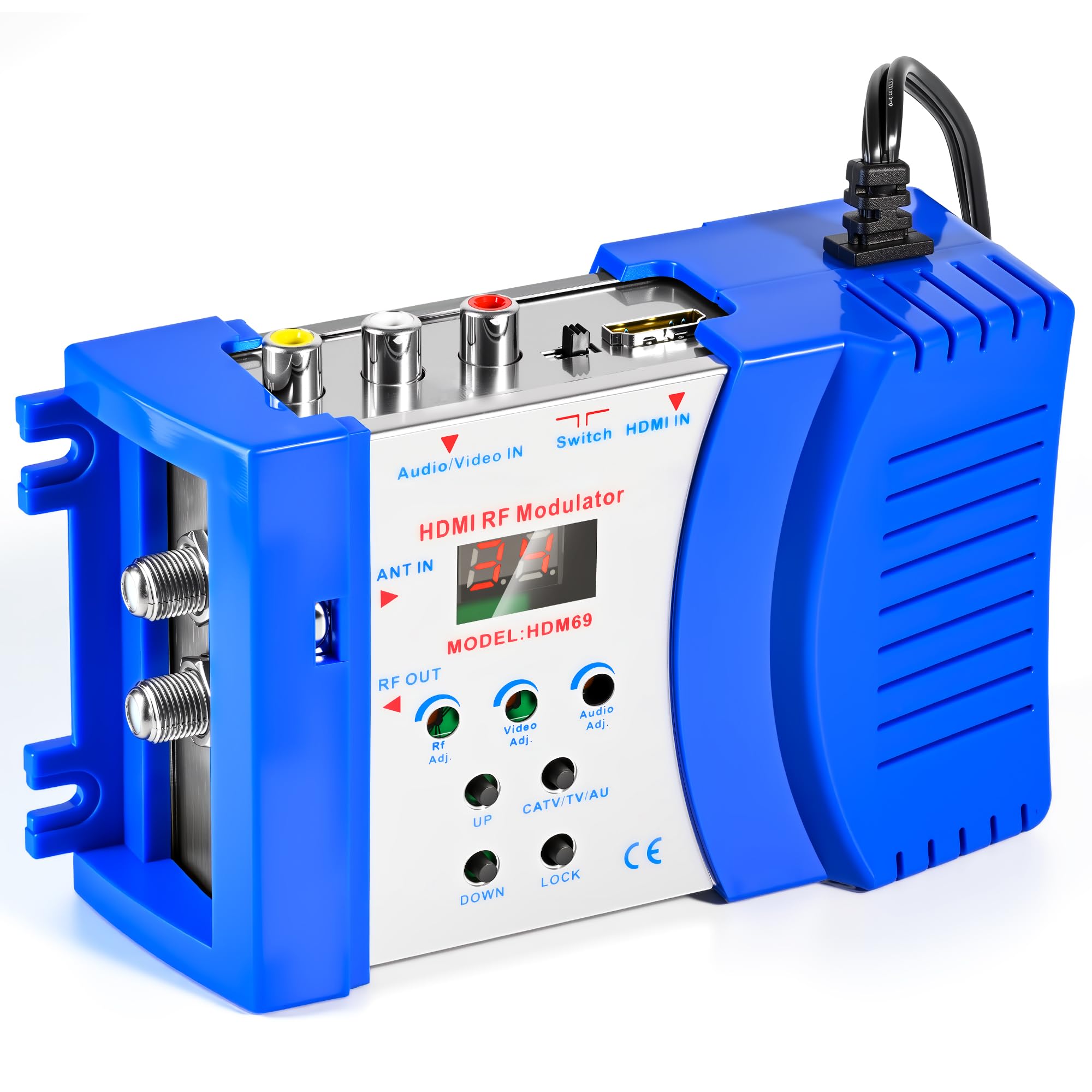
This HDMI-to-coax modulator distributes one source to up to seven TVs over standard coaxial cable.
If your goal is distributing a single modern source to multiple older TVs over coax, this is the box to beat. It accepts both HDMI and CVBS RCA inputs and outputs through a direct F Female coaxial connector, so you can chain it to a splitter or run long cable runs to different rooms. The crowd favorite use case here is impressive: buyers report powering 7 TVs from one HDMI source using old-school coax, all working fine in the same area — a trick HDMI itself can’t pull off when TVs process signals at different speeds.
For picture quality, you get wide resolution support spanning 1080P, 1080i, 720P, 576P, 576i, and 480p, plus a wide frequency response. Owners running older games from a laptop call the 480p output sharp, and audio quality over RF earns praise. Setup involves selecting the channel on both the modulator and the TV, and there’s a minor potentiometer adjustment (a small dial on the box) to fine-tune the AV output level — you don’t need to be a technician to handle it.
The honest trade-off: this is a straightforward, no-frills unit, and a rare unlucky unit can arrive with issues that troubleshooting won’t solve. The 13.4-ounce body is made of high-quality ABS and metal, so it feels built to sit on a shelf and just work. There’s no driver installation required, which keeps things simple.
What Owners Cheer
- Handles a 7-TV coax distribution setup flawlessly
- Wide resolution support from 1080P down to 480p
- No driver install — pure plug and play
The Fine Print
- Needs a small dial adjustment for the best picture
- An occasional unit may not sync with every smart TV
Reach for this if: you need one HDMI feed spread across several coax-connected TVs.
Look elsewhere if: you want a plug-and-forget box with zero tuning on the dials.
2. Tangxi HDMI Modulator RF Modulator
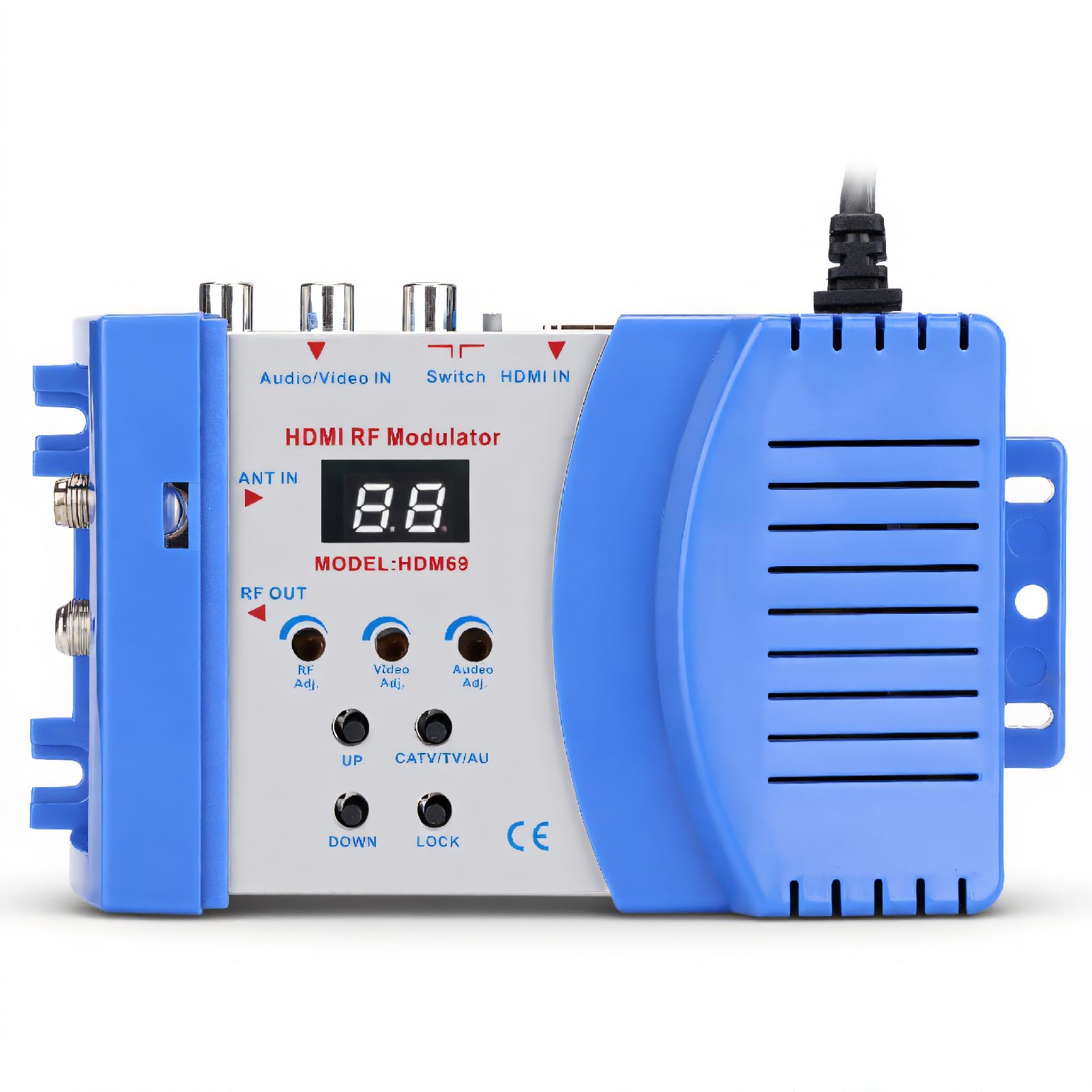
This compact modulator supports PAL and NTSC to revive vintage consoles on CRT TVs.
Retro gamers, this one speaks your language. The Tangxi is a hit as a gift for enthusiasts reviving vintage consoles, converting AV to RF with support for both PAL and NTSC formats so it can match whatever standard your old TV uses. Its dual working frequency on VHF or UHF gives you flexibility on the dial, and the HDM69L modulator chip inside keeps the connection stable while you play.
Picture quality on a CRT comes through fine, and the box conveniently retains its settings even after a power outage — a small detail that saves you from reconfiguring everything each time. The multi-resolution support runs the full ladder from 1080P down to 480p, and the AV output level is adjustable. Both HDMI and AV inputs are present, confirming its genuine multi-channel nature with 2 channels total.
Here’s where it stumbles: the included manual is poorly translated English, and the PAL/NTSC setup is confusing — the fix for USA users is to select “AU” for the region. Owners mention the same frustration, noting it would earn a much higher score if the instructions were properly quality-checked. No antenna is included either, so you’ll need your own coax cable to connect to the TV.
Build to trust: The ABS and metal construction feels durable, and the plug voltage spans 90-240V, so it adapts to different regional power standards.
Patience required: This is not a true plug-and-play device — expect a few minutes of menu fiddling on first setup, especially for USA users.
Best suited for: retro tech fans willing to spend a bit of time on initial configuration for a clear CRT picture.
Not for: anyone who expects a flawless English manual and zero setup guesswork.
3. ADRFClub HDMI/RCA to RF Modulator

This converter connects streaming sticks and game consoles to CRT TVs via up to 136 selectable channels.
This is the modulator with the longest compatibility list in the group — it happily takes HDMI or CVBS RCA and converts it to coaxial RF for Apple TV, Fire Stick/Cube, Roku, Chromecast, DVRs, Blu-ray players, and consoles like PS2/PS3/PS4/PS5, Xbox 360/One, and NS. The built-in channel switch lets you tune it to any of up to 136 channels across VHF and UHF bands, so you can park your cable on channel 3 and your HDMI source on a different channel entirely — a feature buyers call “very cool.”
Owners with CRT TVs that only accept coaxial input report this box is exactly what they needed, piping in both HDMI and RCA sources without any fuss. It’s also a practical answer for setting up multiple TVs on the same antenna line, with one buyer so satisfied they bought a second unit for another location. The adjustable audio volume and video brightness give you control over the final output quality, and audio comes through in stereo.
The catch is durability. Customers note the device works great for a month or two and then stops working, with one noting it failed after minimal use between February and May — a warning worth heeding before you rely on it for a permanent install. The image adjustment dials are also made of soft material and can feel fragile while tuning. If you’re handy and patient, it’s a powerful tool; if you want a set-and-forget box, treat it as a temporary solution.
Functionality wins: The core conversion works well, and the ANT-in loop lets you combine a cable feed and your HDMI source on different channels.
Watch the lifespan: Reliability concerns are the trade-off for this versatility — budget for possible replacement down the line.
Pick this if: you have a pile of modern devices and one old CRT that needs them all.
skip it if: you need a permanent, always-on installation and can’t tolerate a possible early failure.
Understanding the Specs
PAL vs NTSC Format
These are the two analog color encoding systems used by broadcast TVs worldwide. NTSC is the standard for North America and Japan; PAL is used across most of Europe, Australia, and parts of Asia. If your modulator outputs the wrong format for your TV, you’ll see a black-and-white picture, rolling bars, or no picture at all. A true multi-channel modulator supports both and lets you select the right one in its menu.
VHF vs UHF Frequency
These are the two radio frequency bands a modulator uses to send its signal. VHF covers lower channels (typically 2-13), while UHF covers higher channels (14 and up). Choosing the right band helps you avoid interference from local broadcast stations. If you live in a city with strong signals, UHF usually offers more open channels to park your modulator on.
FAQ
What does multi-channel actually mean on an RF modulator?
Will this work with my old CRT television?
How do I connect a Fire Stick to an old TV with only coax?
Can I send one HDMI source to multiple TVs?
What is the difference between PAL and NTSC?
Why is my picture black and white after connecting the modulator?
Do I need a special antenna to use an RF modulator?
Will this support 1080p output to my TV?
Final Thoughts: The Verdict
For most people, the winner for a budget multi channel rf modulator is the RQG HDMI to RF Modulator because it handles the hardest job — feeding one HDMI source to seven TVs over coax — without breaking a sweat. If you’re a retro gamer reviving vintage consoles on a CRT, the Tangxi Modulator offers dual PAL/NTSC support in a compact body. And if your shelf is full of streaming sticks and game consoles that all need to reach one old TV, the ADRFClub Modulator is the versatility king — just be ready for possible reliability hiccups down the road.
How We Picked
We do not accept paid placement. Every pick is matched to a real buyer and a real use-case; we do not hands-on test units.
Sources & Methodology
Specifications: manufacturer listings and product documentation. Review insights: verified customer reviews, as of August 2026. Pricing: not shown on this page (it changes often); check the current price via the retailer link.
As an Amazon Associate, Gadgets Feed earns from qualifying purchases. This does not affect which products we feature.