
Finding a pair of alpine ski boots that won’t crush your feet or empty your wallet is the single biggest hurdle for any skier shopping on a tighter budget. The wrong boot turns a day on the mountain into a session of constant buckle adjustments and numb toes, robbing you of the very joy you’re chasing. A quality entry-level or mid-range boot needs to balance a forgiving flex with a comfortable last width, because nothing kills a ski day faster than shin bang or a cramped forefoot.
I’m Min — the co-founder and writer behind Gadgets Feed. I’ve spent countless hours cross-referencing industry flex ratings, last widths, and liner technologies to identify which budget-friendly models actually deliver reliable performance without demanding a premium price tag.
After digging through hundreds of real-world wear reports and technical spec sheets, I’ve assembled this guide to help you find the best budget ski boots that keep you comfortable and in control all season long.
How To Choose The Best Budget Ski Boots
The right ski boot for a budget-conscious buyer isn’t the cheapest one on the shelf — it’s the one that matches your foot shape and skill level. A boot that fits poorly will ruin your technique and your day, regardless of the discount you got. Focus on these three factors before you click add to cart.
Flex Rating: Matching Stiffness to Your Ability
The flex rating — usually a number between 50 and 130 — tells you how resistant the boot is to forward pressure. Beginners and lighter skiers should look for a flex between 60 and 80, as this allows easier forward movement and smoother learning. Intermediate skiers can step up to an 80 or 90 flex for more power transmission without feeling like a concrete cast. Avoid anything over 100 unless you’re an aggressive expert — the stiffness will fight your movements, not complement them.
Last Width: The Single Most Important Fit Metric
The last width, measured in millimeters across the forefoot, determines whether the boot will squeeze your foot into submission or let it breathe. A 98mm to 100mm last is considered narrow, suitable for slender feet with low volume. A 102mm to 104mm last is medium-to-wide, ideal for the average skier or those with wider feet. Many budget-friendly models now offer a 104mm last (often labeled HV or High Volume), which provides the forgiving fit that prevents cold toes and circulation loss over a full day of skiing.
Liner Quality and Shell Customization
A budget boot’s liner is your primary layer of comfort. Look for models that offer at least a partially heat-moldable liner, which conforms to your foot’s unique shape after a quick professional bake. Some shells also allow for spot grinding or heat molding to relieve pressure points on the ankle or instep. Boots with a “dual soft flap” or “easy entry” design significantly reduce the struggle of getting in and out, saving energy that’s better spent on the slopes.
Quick Comparison
On smaller screens, swipe sideways to see the full table.
| Model | Category | Best For | Key Spec | Amazon |
|---|---|---|---|---|
| Rossignol Evo 70 | Premium | Relaxed all-day comfort | 104mm last, flex 70 | Amazon |
| K2 BFC 80 | Premium | Wide feet and heat-moldable shell | 104mm last, flex 80 | Amazon |
| Nordica Cruise 80 (Men’s) | Mid-Range | High-volume comfort for larger calves | 104mm last, flex 80 | Amazon |
| DALBELLO Veloce 90 MV | Premium | Medium volume with mid-flex precision | 100mm last, flex 90 | Amazon |
| Head Edge LYT RX HV | Mid-Range | Wide foot entry-level performance | HV last, flex 70 | Amazon |
| NORDICA The Cruise (Men’s) | Mid-Range | Easy-entry for beginner/intermediate men | 104mm last, flex 80 | Amazon |
| Nordica Cruise S W (Women’s) | Mid-Range | Easy entry for beginner/intermediate women | 104mm last, flex 80 | Amazon |
| Helly Hansen Men’s Garibaldi V3 | Value | Warm waterproof winter boot (non-ski) | Primaloft 400g insulation | Amazon |
| Helly-Hansen 11424 Men’s Fremont | Value | Lightweight casual winter boot | Narrow fit, lace-up design | Amazon |
In‑Depth Reviews
1. Rossignol Evo 70 – Ski Boots for Men – Relaxed Fit Snow Ski Boots
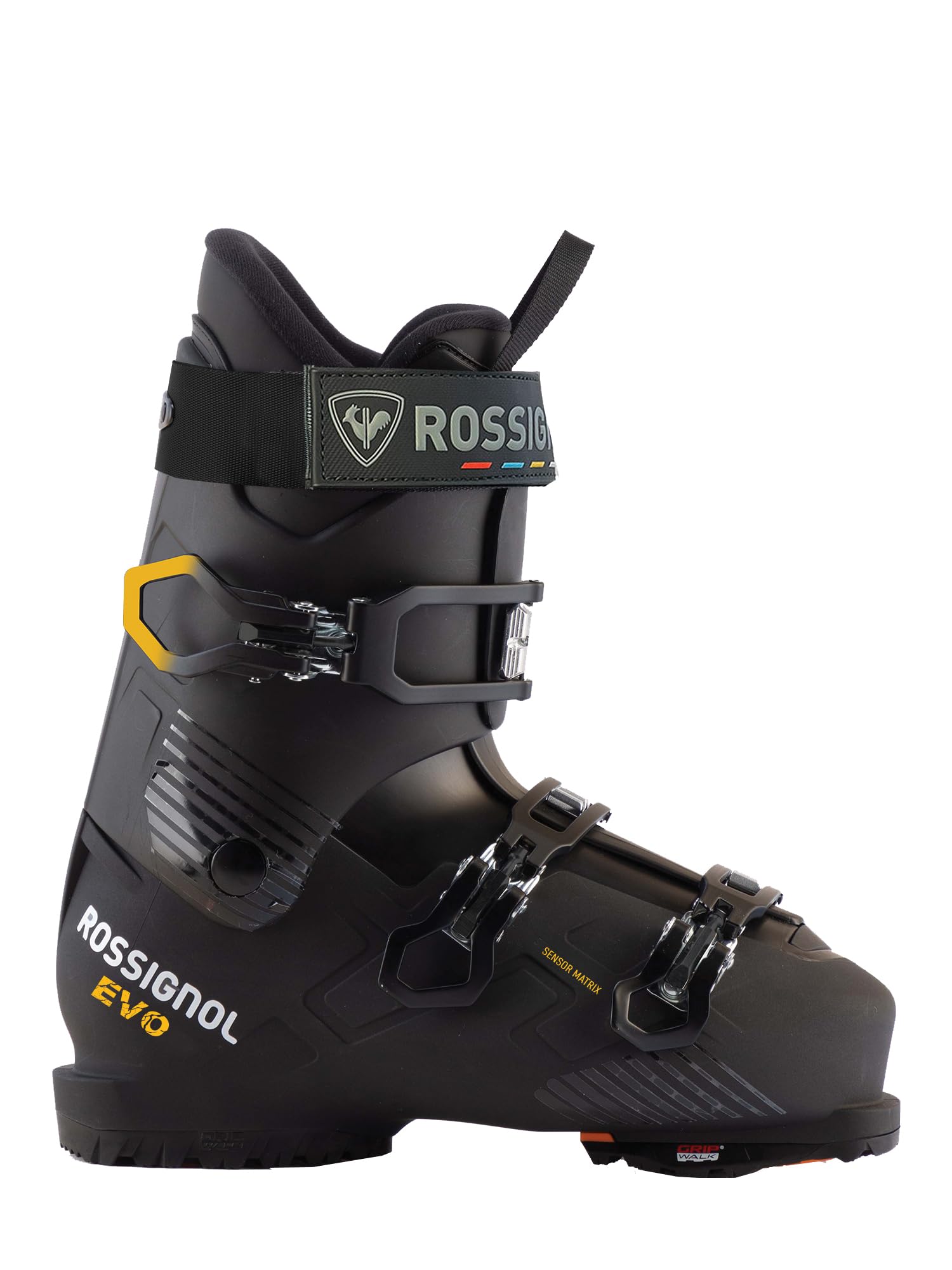
The Rossignol Evo 70 hits the sweet spot for skiers who want a relaxed, forgiving ride without paying flagship prices. Its 104mm last offers generous room through the forefoot, toe box, and ankle — exactly what you need if you’ve ever experienced pinching in narrower boots. The Sensor Matrix shell design keeps the overall weight down while maintaining solid energy transfer to the ski, so you don’t feel like you’re fighting a sponge.
This boot ships with a custom fit liner that has targeted heel support and softer padding around the ankle and instep. The overlap construction opens wide for easy entry and exit, which is a huge quality-of-life improvement on cold mornings when plastic stiffens up. Users consistently report zero shin pain after full-day sessions, and the flex 70 rating is ideal for intermediates progressing toward carving turns.
The Evo 70 is also GRIPWALK sole compatible, meaning you can swap to a treaded rubber sole for better grip when walking in the lodge or parking lot. Given its lightweight build, roomy fit, and smooth flex pattern, this boot represents the best balance of value and performance in the budget-friendly segment.
Why it’s great
- Roomy 104mm last provides all-day comfort for wider feet.
- Custom fit liner with heel support reduces shin bang.
- GRIPWALK ready for safer walking on icy surfaces.
Good to know
- Flex 70 may be too soft for advanced skiers seeking aggressive response.
- Some users with narrow feet may need extra liner padding for a secure heel hold.
2. K2 BFC 80 Men’s All-Mountain Ski Boots
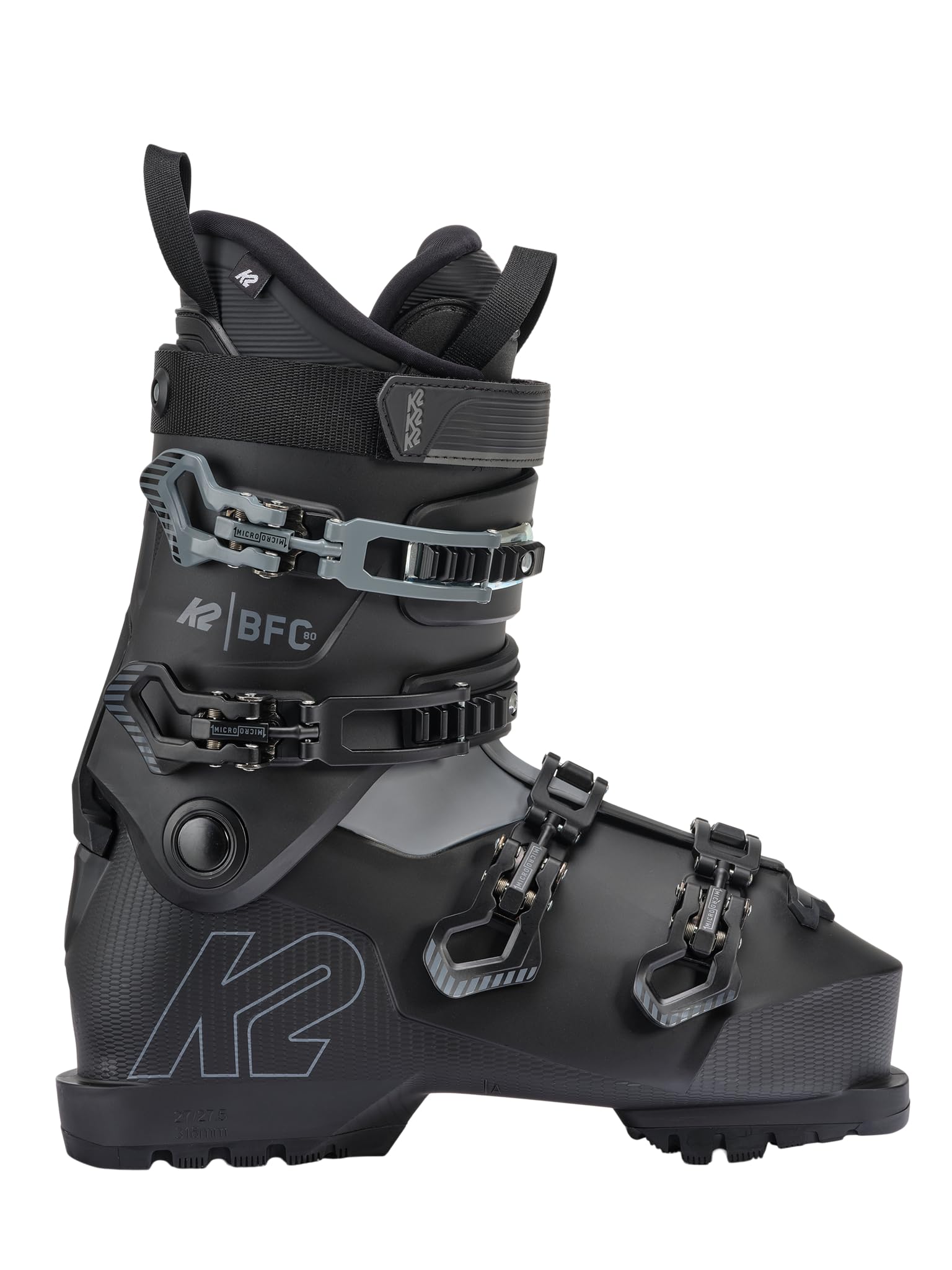
The K2 BFC 80 stands out in the budget-conscious market because both the shell and cuff are fully heat-moldable. This is a rare feature at this tier — it means a boot fitter can widen specific pressure points on the plastic itself, effectively tailoring the boot to your foot’s exact geometry. The hands-free entry system uses a dual-material overlap that lets you step in and out without wrestling with the tongue.
Inside, the Cushfit Comfort liner adds extra foam in high-pressure zones for a plush out-of-box feel that many owners describe as luxurious compared to generic liners. The flex 80 rating is a versatile middle ground — stiff enough for groomers and light all-mountain terrain, but soft enough to stay forgiving for skiers who only make a few trips per season. The boot weighs about 8 pounds per pair, which is reasonable for its class.
Several long-term reviews note zero foot pain even after six consecutive days of skiing, which speaks volumes about the liner’s anatomical shaping. The GRIPWalk sole is standard, giving you better traction and a more natural walking stride. If you have wide feet or stubborn pressure points that other budget boots can’t solve, the BFC 80’s moldable shell is a genuine game-changer at this price point.
Why it’s great
- Full shell and cuff heat-moldable for a custom fit.
- Cushfit liner provides immediate plush comfort with zero break-in pain.
- Hands-free entry/exit reduces morning frustration.
Good to know
- Color may vary from product images — some buyers received different colors than shown.
- Flex 80 may feel a bit soft for heavier or more aggressive skiers.
3. Nordica The Cruise 80 Men’s Comfort Fit All Mountain Alpine Ski Boots

The Nordica Cruise 80 is engineered specifically for men with high-volume feet and larger calves. Its 104mm last provides the widest anatomical fit in Nordica’s budget line, and the patented Instep Volume Control (IVC) system lets you adjust the boot board height by plus or minus 4mm, effectively changing the instep clearance without needing a shell alteration. This is a genuinely useful feature for skiers who need extra vertical room through the top of the foot.
Dual soft flap inserts integrated into the boot’s throat allow for remarkably easy entry — the throat opens wide so you don’t have to jam your foot in. The Infrared Technology zones on the shell can be heat-treated by a shop to relieve specific hot spots. Skiers with larger calves reported all-day comfort without circulation loss, which is a common complaint in tighter-cuffed models.
Feedback does indicate that the liner can be unforgiving around the ankle for some users, occasionally causing blisters before it breaks in. A pro fitting session or spot grinding can resolve this. The flex 80 rating pairs well with intermediate skiing on groomed runs. For skiers who prioritize calf volume and instep clearance above all else, this boot deserves a top spot on your shortlist.
Why it’s great
- IVC system adjusts instep volume for a tailored fit.
- Dual soft flap design makes entry and exit effortless.
- Wide 104mm last accommodates high-volume feet comfortably.
Good to know
- Liner may cause ankle blisters before break-in; professional molding recommended.
- Limited control feedback for advanced skiers pushing aggressive turns.
4. DALBELLO Men’s Veloce 90 MV Polar/Black Ski Boots

The Dalbello Veloce 90 MV targets the skier who has outgrown beginner flex ratings and wants a more precise edge-to-edge feel without jumping to a four-buckle race boot. With a 100mm last — slightly narrower than the 104mm options above — it offers a snug wrap for medium-volume feet while still being approachable for advancing intermediates. The flex 90 rating is noticeably stiffer than entry-level boots, giving you better power transmission when carving parallel turns.
This boot uses a three-piece overlap design common in Dalbello’s higher-end models, which provides a smooth forward flex rather than a sudden hinge. The medium-volume fit locks the heel down effectively, and users with size 10 shoes found the 27.5 sizing chart to be spot on. Multiple buyers reported being comfortable straight out of the box, though a light break-in period is still expected for the liner to fully settle.
Construction feels solid for the mid-range tier: aluminum micro-adjustable buckles let you dial in tension precisely, and the 1-year warranty adds peace of mind. At roughly 5.3 kg per pair, it’s not the lightest option here, but the added stiffness translates to better energy return. If you’re ready to move past a 70-flex boot and want a medium-volume fit, the Veloce 90 is a strong contender.
Why it’s great
- Flex 90 delivers responsive carving performance for intermediate skiers.
- 100mm last provides a precise fit for medium-volume feet.
- Aluminum micro-adjustable buckles offer accurate tension control.
Good to know
- Narrower last may feel tight for skiers with wide forefeet.
- Heavier than some competitors at nearly 12 lbs per pair.
5. Head Edge LYT RX HV Alpine Ski Boots

The Head Edge LYT RX HV is built for the skier who skis only a few days per year and wants a comfortable, no-hassle boot that won’t fight back. The HV (High Volume) last offers generous room through the forefoot and instep, making it one of the most forgiving fit profiles in this list. The PU shell construction keeps the weight reasonable while providing enough structure for groomed run cruising.
With a flex rating around 70, this boot is squarely aimed at beginners and light intermediates. It won’t overpower your shins or make you feel locked into a rigid position. The four-buckle system is standard, and the overall design is straightforward without unnecessary gimmicks. Users consistently mention that the fit feels “great” and “comfortable to walk in,” which is a good sign for lodge-to-lift transitions.
At roughly , you’re getting a legitimate alpine boot from a major brand without paying for features you don’t need. The trade-off is a simpler liner that lacks heat-moldable properties, so getting a professional fitting is still advisable if you have unusual foot shapes. For the occasional skier who values room and ease, the Edge LYT RX HV delivers a solid foundation without budget-breaking.
Why it’s great
- HV last provides generous space for wider feet.
- Flex 70 is forgiving and easy for beginners to control.
- Price-to-performance ratio is excellent for occasional use.
Good to know
- Standard liner is not heat-moldable for personalized fitting.
- Lower flex may limit performance for advancing skiers.
6. NORDICA Men’s The Cruise Boots – Adult Winter Sports Downhill Alpine Ski Boots

This men’s version of Nordica’s Cruise series shares the same 104mm last and dual soft flap instep found in the women’s model, but with a slightly different flex profile tuned for male skiers. The boot opens exceptionally wide at the throat, making it one of the easiest budget boots to step into — a huge plus for skiers who hate fighting with cold, stubborn plastic first thing in the morning.
The micro-adjustable aluminum buckles on the shell and cuff give you fine-grained control over fit tension, and the Infrared Technology means a shop can customize the shell in sensitive areas if needed. Multiple parents reported buying these for their growing teens and receiving feedback that the boots were “very comfortable” right away, a good sign that the liner doesn’t need a painful multi-day break-in.
At roughly 3.8 kg per pair, these boots are lighter than many of their peers, which reduces fatigue over a long weekend. The polyurethane shell offers decent damping of vibrations, making for a smoother ride on icy or chopped-up snow. If you’re looking for a straightforward, functional boot that nails the basics of comfort and entry ease at a sensible price, this Nordica Cruise is a reliable choice.
Why it’s great
- Dual soft flap instep opens wide for effortless entry.
- Aluminum micro-adjustable buckles allow precise fit tuning.
- Lightweight polyurethane shell reduces leg fatigue.
Good to know
- Flex rating may be too soft for advanced or aggressive skiers.
- Lacks rubber toe and heel tips for improved grip when walking.
7. Nordica Women’s Cruise S W Ski Boots

The Nordica Cruise S W is built specifically for women who want a forgiving, comfortable boot that won’t require a PhD in buckle engineering to operate. The 104mm last provides a relaxed fit that accommodates wider feet, and the softer shell construction makes the flex feel smooth and progressive rather than abrupt. Beginner and intermediate women have reported skiing all day without foot pain — the single most common win condition for this boot.
The Dual Soft Flap Instep design opens the throat wide, making entry and exit noticeably easier than traditional overlap shells. The boot also comes with a heat-moldable liner and a customizable shell, meaning you can have a boot fitter dial in the fit at the sensitive points around the ankle and heel. Several skiers noted that these were the “most comfortable” boots they’d owned despite being priced well below premium options.
A thoughtful detail is the streamlined anatomical shape, which improves control response without sacrificing the forgiving nature beginners need. The flex 80 rating works well for progression — it’s stiff enough to support carving technique, but soft enough to stay manageable during those first parallel turns. For women entering the sport or refining their skills, this is a standout budget-friendly companion.
Why it’s great
- 104mm last with soft shell provides a forgiving, comfortable ride.
- Dual soft flap design makes on/off effortless.
- Heat-moldable liner and shell allow for customized fit.
Good to know
- Buckle quality feels less robust than higher-end models.
- Lacks rubber toe and heel tips for grip on hard surfaces.
8. Helly Hansen Men’s Garibaldi V3 Waterproof Winter Boots

The Helly Hansen Men’s Garibaldi V3 is not an alpine ski boot — it is a premium insulated winter boot designed for cold-weather wear around town, work sites, and casual outdoor activities. However, it earns a position here because many budget-conscious skiers also need a reliable winter boot for non-ski days, and the Garibaldi V3 excels in that role with 400-gram Primaloft insulation that keeps feet warm down to -11°F based on user reports.
The LWG-certified leather upper is fully waterproof, and the Max Grip outsole provides solid traction on ice and packed snow. The Hover-Stride technology offers decent cushioning for all-day walking, and the Pro Guard reinforcement protects the toe and heel areas from scuffs. Weighing about 3.1 pounds per boot, these are lighter than many fully insulated snow boots, which makes them practical for extended wear.
User feedback overwhelmingly confirms the warm, dry, and comfortable experience, with many owners reporting years of durability. If your ski vacation involves non-ski activities like snowshoeing, walking resort towns, or just commuting through winter slush, the Garibaldi V3 is a versatile complement to your main alpine boot setup. Just know it is not compatible with ski bindings.
Why it’s great
- 400g Primaloft insulation offers exceptional warmth in extreme cold.
- Full-grain waterproof leather construction is durable and weather-resistant.
- Lightweight for its insulation level — comfortable for all-day wear.
Good to know
- Not a ski boot — incompatible with any binding system.
- Sizing can be inconsistent; some users recommend ordering a half size down.
9. Helly-Hansen 11424 Men’s Fremont
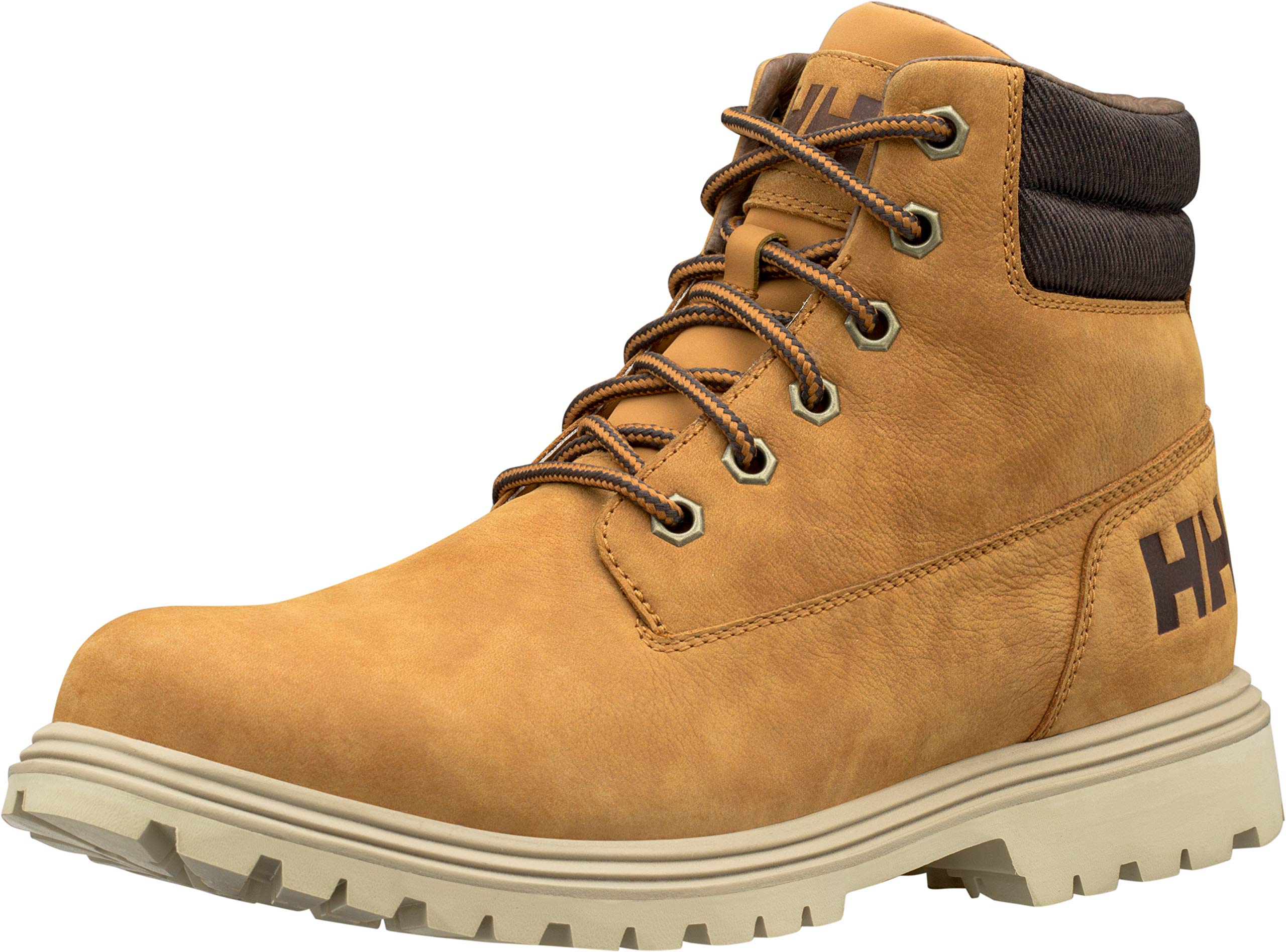
The Helly-Hansen Men’s Fremont is a lightweight, lace-up winter boot designed for everyday cold-weather wear rather than alpine skiing. It’s listed here because it represents an alternative for skiers who want a casual, comfortable boot for the lodge or for travel to the mountain, but who don’t need the stiffness of an alpine shell. The boot features clean Scandinavian styling with modern color blocking that looks sharp in casual settings.
User reviews highlight that these boots are very warm despite being light, and the craftsmanship is tight with good attention to detail. However, a consistent note is that the fit runs narrow, so skiers with wider feet should size up or avoid. The break-in period is real — the boots are not immediately plush out of the box and require a few wears to mold to your feet.
At its price point, the Fremont is a solid value for someone who wants a versatile winter boot that transitions from the parking lot to the bar without looking bulky. Just be aware that the narrow fit may not work for everyone, and like the Garibaldi, this is not a ski boot — it won’t fit any standard binding.
Why it’s great
- Lightweight construction reduces fatigue during extended wear.
- Clean, modern design works well for casual and travel use.
- Good warmth-to-weight ratio for moderate winter conditions.
Good to know
- Narrow fit may be uncomfortable for skiers with wider feet.
- Requires a break-in period before reaching full comfort.
FAQ
Can I use a budget ski boot for advanced carving or off-piste skiing?
How do I know if I need a 98mm, 100mm, or 104mm last width?
Can I heat mold a budget ski boot’s liner at home?
Final Thoughts: The Verdict
For most skiers shopping on a tighter budget, the clear winner for the best budget ski boots is the Rossignol Evo 70 because it nails the exact combination of a forgiving 104mm last, a smooth flex 70 rating, and a custom-fit liner that eliminates shin pain. If you need something for wider feet and want the ability to heat mold the entire shell, grab the K2 BFC 80 — its moldable shell and plush liner make it a standout for comfort. And for skiers with high-volume feet or large calves, nothing beats the instep adjustability of the Nordica Cruise 80.