
Dragging a generator into the wilderness defeats the purpose of going off-grid. The best budget solar panels let you leave the fumes and fuel cans behind, turning direct sunlight into usable energy for your power station, phone, or RV battery without the premium price tag. The challenge is separating the panels that actually deliver their rated wattage from the ones that fold up and fail under a passing cloud.
I’m Min — the co-founder and writer behind Gadgets Feed. I’ve spent hundreds of hours analyzing conversion efficiencies, connector compatibility, and real-world output data across the portable solar market to find the panels that give you the most power per dollar.
This guide breaks down the top contenders so you can confidently choose the best budget solar panels for your camping trips, emergency kit, or van build without wasting money on undersized or overpriced gear.
How To Choose The Best Budget Solar Panels
Not all affordable solar panels are created equal. The cheapest option often skimps on cell quality, connector variety, or weather sealing — leaving you stranded with a panel that can’t charge your power station. Here’s what separates a smart buy from a sun-dependent paperweight.
Cell Efficiency and Type
The conversion efficiency of the solar cells determines how much of the sunlight hitting the panel actually becomes electricity. Budget panels commonly land between 23% and 25% efficiency. Monocrystalline cells are standard at this price point; they outperform polycrystalline in low-light conditions and pack more power into a smaller foldable footprint. Higher efficiency means you don’t need as much surface area to hit your target wattage.
Connector and Power Station Compatibility
A 100W panel is useless if its output cable doesn’t match your power station’s input port. Look for panels that include multiple adapter cables — XT60 for EcoFlow and Anker, Anderson for older Jackery models, DC7909 for Bluetti and newer Jackery units. Some budget panels now ship with a 5-in-1 cable that covers virtually every major brand, removing the need to buy separate adapters.
Portability and Build Quality
Foldable panels should weigh under ten pounds for easy carrying and stow away to the size of a laptop bag. Check for sturdy kickstands that allow you to angle the panel toward the sun — adjustable supports can boost daily energy harvest by up to 25%. Weather resistance matters too: IP65 or IP67 ratings protect against rain and dust, while ETFE or CPC lamination resists scratches and UV degradation better than basic PET coating.
Quick Comparison
On smaller screens, swipe sideways to see the full table.
| Model | Category | Best For | Key Spec | Amazon |
|---|---|---|---|---|
| Ecosonique 100W | Portable | Ultralight backpacking | 6 lbs, 23.5% CPC cells | Amazon |
| HQST 200W | Portable | High-power portable | 25% N-Type, 11 lbs | Amazon |
| ZOUPW 100W | Portable | Universal compatibility | IP67, 5-in-1 cable | Amazon |
| DOKIO 100W | Suitcase | 12V battery charging | Built-in PWM controller | Amazon |
| Luvknit 100W | Portable | Direct device charging | 24%, USB QC3.0 & PD | Amazon |
| JJN 200W | Rigid | Permanent roof mounting | 2x100W panels, 23% | Amazon |
| Callsun 200W | Rigid | Bifacial roof install | 25%, N-Type 16BB | Amazon |
In-Depth Reviews
1. Ecosonique 100W Portable Solar Panel
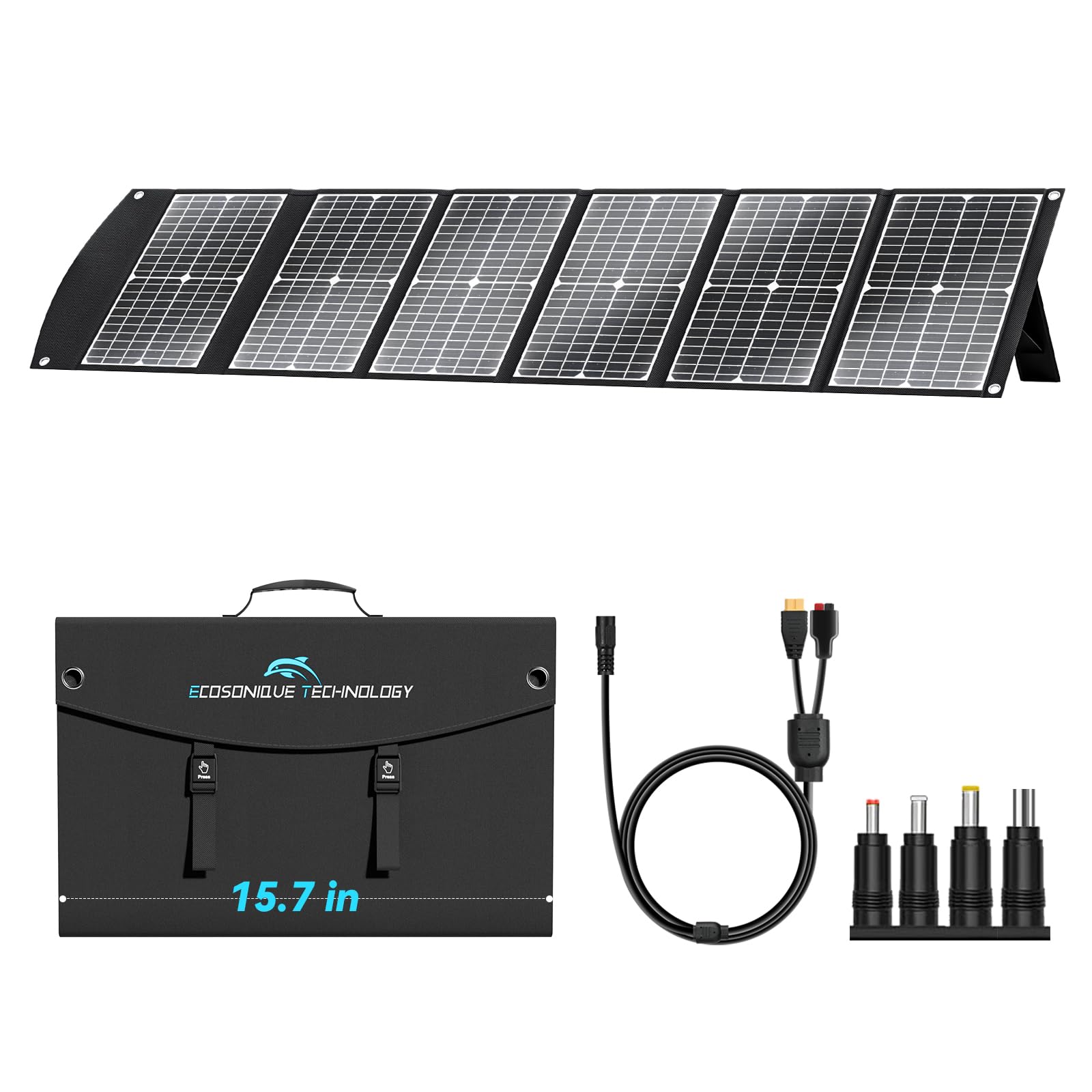
Weighing just six pounds and folding down to the size of a laptop bag, the Ecosonique 100W is the lightest full-wattage panel in this roundup. Its six-fold design packs into a compact package that fits inside a backpack, making it ideal for hikers and backpackers who count every ounce. The CPC lamination resists scratches and corrosion better than the PET coating found on cheaper competitors, and the auto-reboot feature adjusts to changing sunlight without any manual fiddling.
The connector package covers nearly every modern power station out of the box: XT60 for EcoFlow and Anker, Anderson for older Jackery models, plus DC7909 and DC5521 adapters. USB-C PD3.0 delivers up to 45W for direct smartphone or tablet charging, while the QC3.0 USB-A port hits 24W. The 3-meter DC5521 extension cable lets you keep the panel in full sun while your devices stay shaded and cool.
Real-world owners report it delivers the full 100W on sunny days and still performs respectably in overcast conditions. The kickstands offer stable setup on uneven ground, and the waterproof Oxford cloth holds up to light rain. For the money, it achieves the best power-to-weight ratio in the budget segment.
Why it’s great
- Extremely lightweight at 6 lbs for easy backpacking
- Comprehensive adapter set covers XT60, Anderson, DC7909, and DC5521
- CPC coating is more durable than standard PET lamination
Good to know
- USB-C PD output maxes at 45W, not the full 60W some rivals hit
- Folded dimensions are slightly thicker than some competitors
2. HQST 200W Ultra-Light Portable Solar Panel
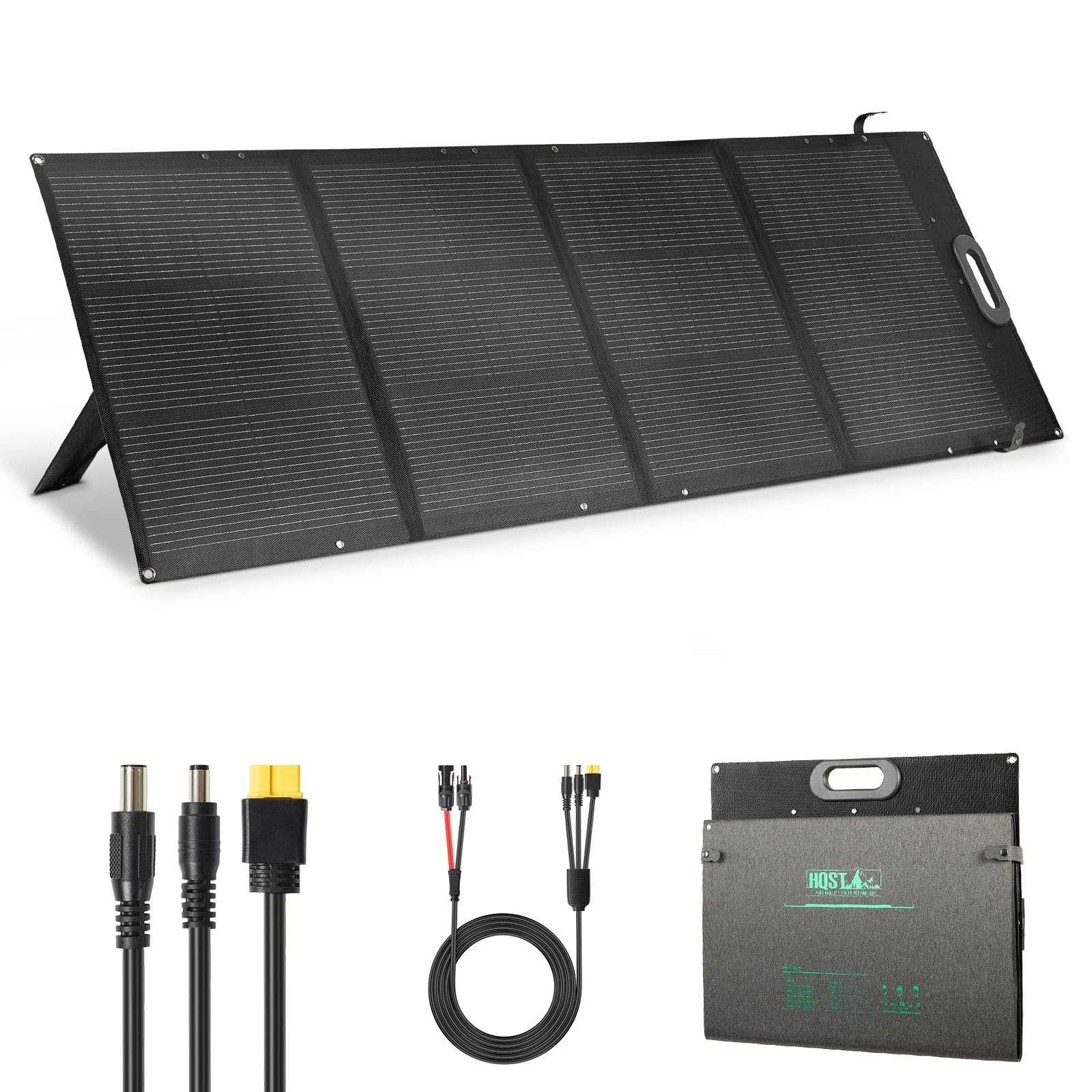
HQST steps into the premium budget space with a 200W portable panel that uses next-generation 16BB N-Type cells to achieve 25% conversion efficiency — a full two points above the 23% standard. This panel captures more energy from the same patch of sunlight, which translates to faster charging on cloudy days or during winter months when the sun sits lower in the sky. At 11 pounds, it’s 37% lighter than most 200W portable panels, folding down to just 1.97 inches thick.
The 4.9-foot 3-in-1 adapter cable includes XT60, DC7909, and DC5521 connectors, covering the majority of modern power stations from Jackery, EcoFlow, Bluetti, and Anker. Two adjustable kickstands (40° to 60° range) provide stable positioning on uneven terrain, and the rigid design avoids the sagging problem common with soft fabric panels. The IP67 waterproof rating means it can handle rain and splashes without issue.
Buyers in the field report consistent 180-190W output in full sun, slightly below the 200W rating but still excellent for this price tier. The 16BB cell design reduces micro-cracks and hot spots, extending the panel’s usable lifespan. For anyone needing double the wattage of a standard 100W panel without doubling the weight, this is the smart move.
Why it’s great
- 25% efficiency with N-Type 16BB cells outperforms standard panels
- Very lightweight for its wattage class at 11 pounds
- IP67 waterproofing handles rain without concern
Good to know
- Peak output typically hits 180-190W rather than the full 200W
- Adapter cable is only 4.9 feet, limiting placement flexibility
3. ZOUPW 100W Portable Solar Panel

The ZOUPW 100W panel solves the single biggest headache of portable solar: connector compatibility. Its unique 5-in-1 cable includes DC8020 (for Jackery Explorer 1000V2 and newer models), XT60, Anderson, DC7909, and DC5521 — covering 99% of power stations on the market without requiring a single extra adapter. The 10-foot cable length means you can position the panel in full sun and keep your power station in the shade, improving overall charging efficiency.
Grade A+ monocrystalline cells with an ETFE coating deliver 23.5% efficiency and full IP67 waterproofing. The ETFE coating transmits more light than PET while resisting heat and UV damage better over time. Two adjustable kickstands lock in at a 45° angle, which ZOUPW claims captures up to 25% more sunlight than laying the panel flat. The built-in intelligent controller includes a USB-C PD 15V/3A port and two USB-A outputs (one with QC3.0) for direct device charging.
At 9.48 pounds, it’s slightly heavier than the Ecosonique but still well within the comfortable carry range. The magnetic easy-carry handle and sturdy Velcro closure make deployment quick. Owners consistently mention that it outperforms expectations with Jackery and Goal Zero power stations, often maxing out the generator’s input limit on sunny days.
Why it’s great
- True 5-in-1 cable eliminates the need for additional adapters
- 10-foot cable length for flexible panel placement
- IP67 waterproof rating with durable ETFE coating
Good to know
- Heavier than the Ecosonique by about 3.5 pounds
- Kickstands are not adjustable to multiple angles
4. DOKIO 100W Solar Suitcase
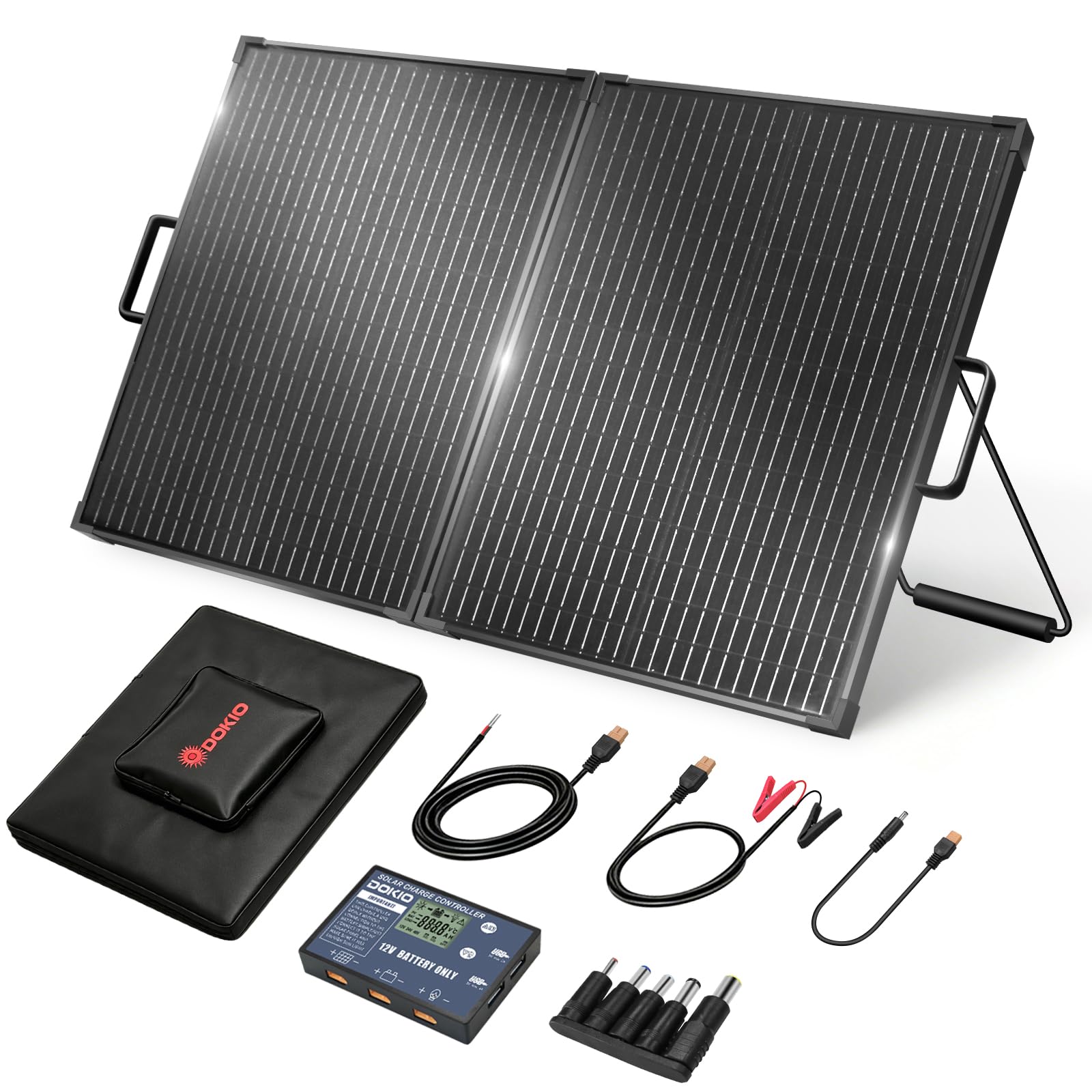
The DOKIO 100W is the only panel in this lineup that ships with a built-in PWM charge controller and alligator clips, making it the simplest plug-and-play option for charging 12V lead-acid batteries directly. No power station required — just unfold the rigid glass panels, connect the clips to your battery terminals (watching polarity), and the smart PWM controller handles overcharge, reverse polarity, and short-circuit protection automatically. This makes it ideal for maintaining a deep-cycle battery in an RV, boat, or off-grid shed.
The briefcase-style design with a rubber handle folds to 23 x 19.3 x 1.3 inches and uses a corrosion-resistant aluminum frame around monocrystalline glass panels. The 9.8-foot cable gives you enough slack to follow the sun while keeping the battery in the shade. Two integrated 5V 2A USB ports let you charge phones or tablets directly alongside the battery charging.
Users report peak outputs around 102W in direct sun, slightly exceeding the 100W rating. The primary downsides are the flimsy built-in kickstand legs and the non-swivel controller housing. Several owners upgraded to an external MPPT controller for faster bulk charging, finding the included PWM unit adequate but not exceptional. If you want a set-and-forget solution for a 12V battery bank, this is the most straightforward option.
Why it’s great
- Works right out of the box with included PWM controller and alligator clips
- Rigid glass panels are more durable than foldable fabric designs
- 9.8-foot cable allows flexible placement away from the battery
Good to know
- Kickstand legs are flimsy and limit angle adjustment
- PWM controller is basic; upgrading to MPPT significantly improves charge speed
5. Luvknit 100W Portable Solar Panel

The Luvknit 100W panel achieves 24% conversion efficiency from its premium monocrystalline cells, putting it ahead of the 23% baseline common at this price point. It includes DC5521, DC5525, DC7909, DC8020, XT60, and Anderson adapters, plus USB-A and USB-C outputs for direct device charging. The IP65 rating covers dust and light rain, while the reinforced zippers and Oxford fabric build suggest a panel that can handle regular outdoor use.
The foldable design weighs 8.2 pounds and packs down to 21 x 23.6 inches — a bit bulkier than the Ecosonique but still manageable for car camping and RV trips. The built-in kickstand lets you angle the panel, though some users found the cardboard support stands inadequate in windy conditions. The package also includes a PWM controller for those who want to charge a 12V battery directly without a separate power station.
Customer feedback highlights that the panel delivers 95-96W max in ideal conditions and charges a Jackery Explorer 240 in about 2.5 hours. A known weak point is the USB 3.0 port, which some owners reported breaking after repeated use. Luvknit provides a 12-month warranty and responsive customer support, which resolved issues for affected buyers quickly. For the price, it offers solid efficiency and broad connector compatibility.
Why it’s great
- High 24% cell efficiency for its price tier
- Comprehensive adapter set covers most power stations
- Includes a PWM controller for direct battery charging
Good to know
- USB 3.0 port has reported durability issues
- Cardboard kickstands are flimsy in windy conditions
6. JJN 200W Solar Panel (2x100W)
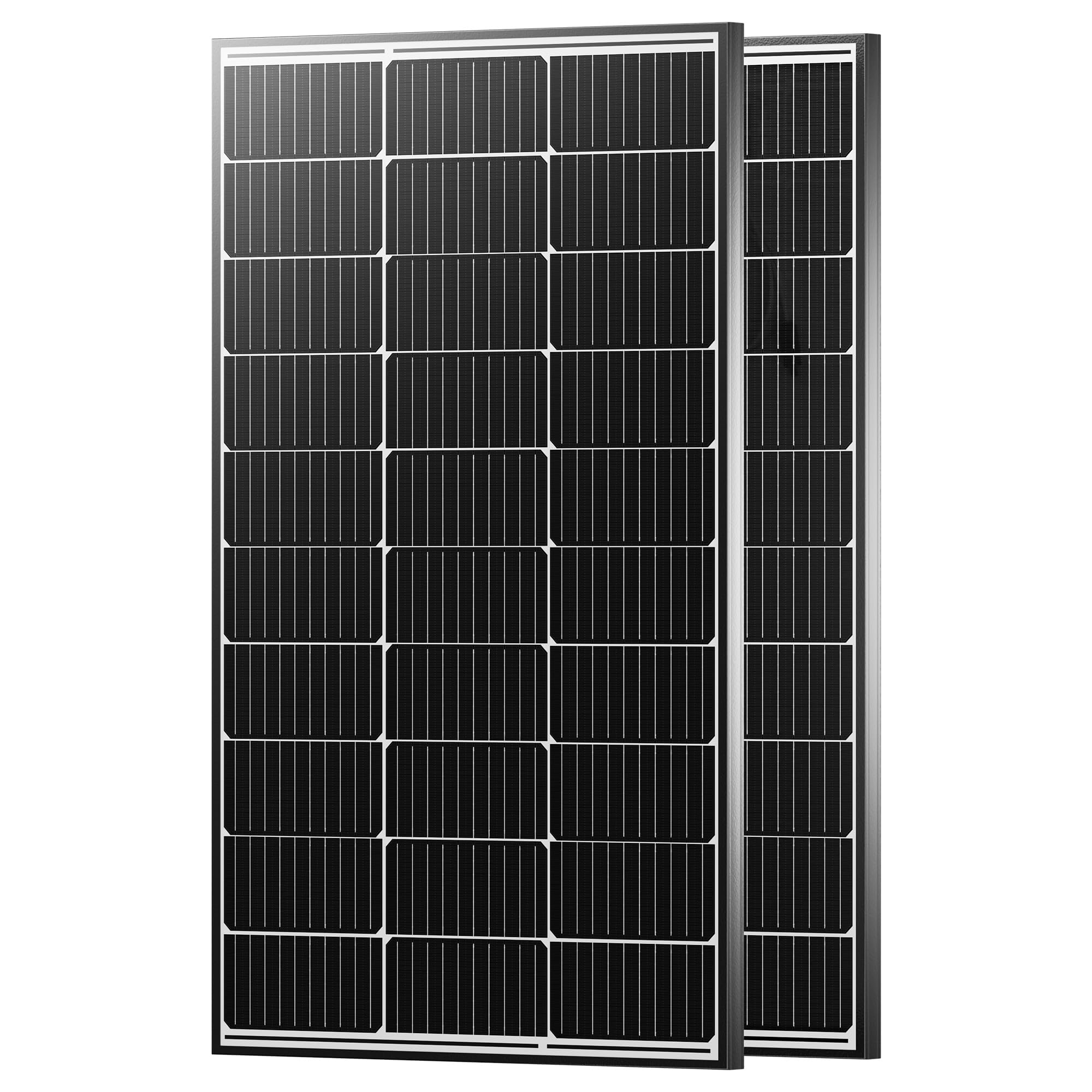
The JJN 200W kit provides two separate 100W rigid panels, each with Grade A+ monocrystalline cells and a 10BB busbar design that boosts efficiency to 23% while reducing the risk of micro-cracks. Unlike the foldable panels above, these are built for permanent installation on an RV roof, home shed, or boat — they aren’t portable. The corrosion-resistant aluminum frame with pre-drilled holes simplifies mounting, and the tempered glass surface withstands hail and debris.
Each panel measures 38.2 x 22.7 x 1.2 inches and weighs in around 12 pounds individually. The 17.5V output voltage is ideal for 12V battery systems, and the 6.42-amp current per panel works well with both PWM and MPPT charge controllers. Key certifications include CE, ETL, and ISO9001, providing confidence in the manufacturing quality. JJN backs the panels with a 30-year transferable power output warranty, which is exceptional at this price point.
Buyers consistently report peak outputs of 102W per panel in full sun, totaling over 200W for the pair. The panels handle rain, snow, and high winds without issue, and owners with multiple panels power full workshops and AC tools. The packaging is the main complaint — some units arrived with bent frames or damaged corners — but JJN’s customer service has a good track record of replacing damaged units.
Why it’s great
- Two 100W panels for flexible series or parallel wiring
- 30-year transferable power output warranty is industry-leading
- Rigid glass and aluminum frame stand up to weather extremes
Good to know
- Packaging often leads to cosmetic damage during shipping
- Not portable; requires permanent mounting
7. Callsun 200W Bifacial Solar Panel

The Callsun 200W is the only bifacial panel in this roundup, using a transparent backsheet to capture sunlight from both the front and rear sides. This design can boost total output by up to 30% in high-reflectivity environments like snow-covered rooftops or concrete driveways. The N-Type 16BB cells deliver 25% conversion efficiency with a low temperature coefficient of -0.3%/K, meaning it loses less power in hot summer conditions than standard P-Type panels.
TwinCell anti-shade technology splits the panel into two independent halves, so if one section is shaded by a vent or tree branch, the other half keeps generating at full power — a smart feature for RV roofs with obstructions. The panel measures 51.3 x 30.3 x 1.4 inches and weighs 23.8 pounds, making it a tight fit for Class B vans but ideal for larger Class C RVs or home ground-mount arrays. IP68 waterproofing and 3.8mm tempered glass ensure durability through decades of outdoor exposure. Callsun backs the panel with 10 years of support and a 25-year performance guarantee at 84.5% output.
Real-world owners see consistent overproduction, with single panels regularly hitting 240-275W in full sun thanks to the bifacial capture. Series-parallel arrays of six panels have been measured at over 1300W from a 1200W rated system. The panel works with 12V battery systems when paired with an MPPT controller, and the pre-drilled holes on the back make rail mounting straightforward. It’s the most technologically advanced option here and earns its premium position.
Why it’s great
- Bifacial design captures up to 30% more power from reflected light
- 25% N-Type cells with low temperature coefficient for hot climates
- TwinCell anti-shade halves maintain output during partial shading
Good to know
- Large footprint requires significant roof or ground space
- Rigid and heavy at 23.8 lbs; not portable
FAQ
Can I use a 100W solar panel to directly charge my phone or laptop?
Is a rigid glass panel better than a foldable fabric panel?
Do I need a charge controller between the solar panel and my power station?
Final Thoughts: The Verdict
For most users, the best budget solar panels winner is the Ecosonique 100W because it delivers the best power-to-weight ratio at just six pounds while including a comprehensive adapter set that works with virtually every modern power station. If you need more wattage for extended off-grid trips, grab the HQST 200W for its 25% N-Type cells and lightweight 11-pound build. And for a permanent RV roof installation where max energy harvest matters, nothing beats the Callsun 200W Bifacial with its dual-side power capture and 25-year performance guarantee.