
Our readers keep the lights on and my morning glass full of iced black tea. As an Amazon Associate, I earn from qualifying purchases.
Specs are compiled from manufacturer listings and verified buyer reviews and can change over time — please confirm the key details on the product page before buying.
If your speakers sound flat, thin, or just wrong, the cable between them and your amp is the cheapest thing to fix first. The short answer: buy oxygen-free copper in the right gauge for your run length, and ignore anything that only looks like a bargain. This guide covers nine budget speaker cables that actually hold up, sorted so you can find the right one in under a minute.
I’m Min — the founder and writer behind Gadgets Feed. This guide is built by comparing the manufacturers’ published specifications and the patterns across verified customer reviews, so you get each pick’s real strengths and trade-offs instead of marketing spin.
You will see the difference between copper and copper-clad aluminum, why gauge matters more than brand, and which spool suits a bookshelf setup versus a buried outdoor run. The crowd favorite is also the top-scoring pick here, at 4.5+ stars across 15,000+ ratings. Read on for the full breakdown of every budget speaker cable worth putting behind your amp.
Our Picks at a Glance

How To Choose The Best Budget Speaker Cable
Speaker cable is one of the few places in audio where spending less can cost you nothing in sound — as long as you get two things right. Get the conductor material and the wire gauge correct for your run, and you are done. Everything else is convenience.
Gauge first, brand second
Gauge (AWG) is the thickness of the metal inside the jacket, and a lower number means thicker wire. Thicker wire carries current with less resistance, which matters more the longer your cable run gets. For a short hop from an amp to a bookshelf speaker, a 16-gauge cable is typically plenty. For a long run across a room or out to a patio, a 14-gauge cable tends to hold up better.
OFC versus CCA — the real difference
OFC stands for oxygen-free copper, meaning the conductor is refined copper with the oxygen pulled out. CCA stands for copper-clad aluminum, which is an aluminum core with a thin copper skin. Copper conducts better and resists corrosion longer. Aluminum is lighter and cheaper, which is why CCA cables land at lower prices. Neither is “bad” — but if your run is long or your system is demanding, copper is the safer pick.
Connectors and installation
Bare wire is the most flexible option: you strip the end and clamp it into any spring clip or binding post. Banana plugs are the push-in style that click into the back of most receivers and speakers, which makes swapping gear much faster. Spade tips sit under a screw-down terminal. If you plan to move equipment around, pre-terminated banana cables save a lot of fiddling.
In-wall, outdoor, and burial ratings
A CL2 rating means the jacket is approved for running inside the walls of a residential building. Direct-burial cable is built to go into the ground without a conduit. If your cable is staying in open air behind a cabinet, you do not need either rating — but if you are fishing it through a wall, do not skip it.
Quick Comparison
| Model | Best For | Gauge | Length | Conductor | Amazon |
|---|---|---|---|---|---|
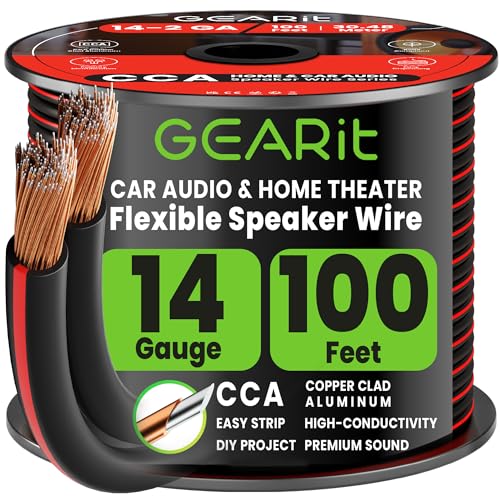
| GEARit 14 Gauge Speaker Wire 100FT★ Best Overall | Whole-home installs on a budget | 14 AWG | 100 ft | CCA | Amazon |
| InstallGear 16 Gauge 100 ft Soft TouchBest for Long Runs | Long surround-sound runs | 16 AWG | 100 ft | — | Amazon |
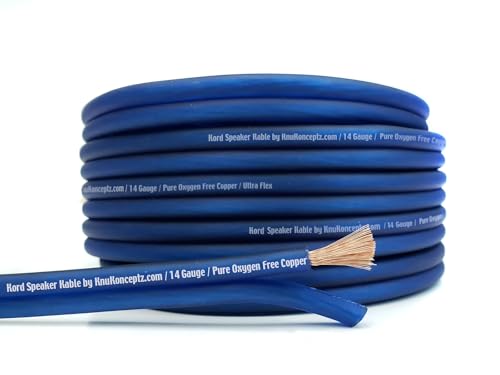
| KnuKonceptz Kord Kable 14 Gauge OFCBest for Tight Spaces | Audiophile copper on a budget | 14 AWG | 50 ft | OFC | Amazon |
| Monoprice 102819 CL2 In-Wall 14 Gauge | Fishing cable through walls | 14 AWG | 50 ft | OFC | Amazon |
| 2 Pack 16/2 Flat Wire with Banana Tips 15 FT | Mess-free stereo hookup | 16 AWG | 15 ft | Tinned OFC | Amazon |
| CNCESS Banana Plug Speaker Cable 12AWG | Studio and PA quick-swaps | 12 AWG | 3 ft | Tinned copper | Amazon |
| Install Link 16 AWG OFC 30 Feet | Car audio and small rooms | 16 AWG | 30 ft | OFC | Amazon |
| DS18 SW-16GA-100RB Ultra Flex | Flexible routing in tight spots | 16 AWG | 100 ft | CCA | Amazon |
| Mygatti 16/2 Nylon Braided Direct Burial | Outdoor and underground runs | 16 AWG | 25 ft | OFC | Amazon |
In‑Depth Reviews
1. GEARit 14 Gauge Speaker Wire 100FT
Our pick — 4.5+★ from 15,000+ verified ratings; the strongest balance of quality and price.
One hundred feet of 14-gauge cable that covers an entire home theater without a second trip to the store.
Thicker wire at a longer length is the combination most people actually need, and this spool delivers both. The conductor is 14-gauge, which is the thicker end of what most budget cables offer, and it runs the full 100 feet. For a surround setup with rear speakers across the room from your receiver, that length is what saves you from splicing two shorter runs together.
It bends around furniture legs and threads through tight cabinet gaps without kinking, so you can route it the way your room is actually shaped. Foot markers are printed directly on the jacket — a small thing that makes a big difference when you need exactly matching lengths for left and right. The polarity markings let you spot positive and negative in seconds, which is the single most common wiring mistake to avoid.
What wins people over is the build quality for the price — the jacket and connectors feel as solid as cables that cost noticeably more. The honest catch: the conductor is copper-clad aluminum (CCA), not pure copper. Aluminum is lighter and cheaper, and for a home setup at moderate volume it works fine. If you are pushing a high-power amplifier or running a very long run, a pure-copper cable is the more careful choice. This is the cable to grab when you want a full-room install sorted in one order without overthinking it.
Where it earns its keep
- 14-gauge thickness across a full 100 feet, enough for most whole-room runs
- Foot markers and polarity printing make cutting matching pairs fast
- Soft PVC jacket routes around furniture without kinking
- Fits banana plugs, spade tips, and standard spring terminals
What to weigh first
- Copper-clad aluminum conductor, not pure copper
- 2.3-pound spool is bulky to store between projects
Buy it if: you are wiring a full room or a 5.1 setup and want one spool to cover every run.
Look elsewhere if: your amp is high-output and you want pure copper — go for a 14-gauge OFC spool instead.
2. InstallGear 16 Gauge Speaker Cable 100 ft Soft Touch
A hundred feet of soft-touch 16-gauge that survives boats, garages, and rear-channel runs alike.
The single most useful thing here is the length-to-flexibility ratio. A hundred feet of 16-gauge cable on a spool is the amount you need for rear surrounds, outdoor patios, or a vehicle install, and the soft-touch jacket is built to bend rather than fight you. The red and black insulation is colour-coded for polarity, which means you spend less time tracing which wire is negative.
The build is pitched at tougher environments than a living room. InstallGear calls it marine-grade, and the stated use cases include boats and outdoor setups where moisture and vibration are part of daily life. If your cable is going near a garage door, a deck, or a vehicle floor pan, that durability claim is the reason to pick this over a plain indoor spool.
The practical caveat is that it is 16-gauge, not 14. For runs under 30 feet, 16-gauge keeps resistance low enough that most systems will not notice. On a very long run with a demanding speaker, thicker 14-gauge cable is the safer route — the GEARit above covers that case with the same 100-foot length. For everything else, this spool is a quiet workhorse. Owners consistently rank it a great-value pick for runs over 30 feet, and the easy-to-use spool saves real time.
The durability pitch: marine-grade construction and a 16-gauge conductor make this the pick for garages, decks, and vehicles where a plain indoor cable would be the wrong tool.
Fair warning: it is a 3-foot pair — check your run length against the 100-foot spool before you commit, because a short run does not need this much cable.
Right answer for: rear-channel surround runs, outdoor patios, and boat or vehicle audio where moisture is a factor.
Pass if: your receiver and speakers sit within a few feet — the extra length would be wasted.
3. KnuKonceptz Kord Kable 14 Gauge OFC 50 Feet
Pure oxygen-free copper in 14-gauge, and the jacket lays flat the moment you uncoil it.
Here is the one that answers the copper-versus-aluminum question with a real spec on the label. The conductor is 14-gauge oxygen-free copper, which KnuKonceptz states is at least 99.99% copper, and the material spec is printed on every foot of the jacket so you know exactly what you got. That is a genuinely useful bit of transparency in a category where “copper” often means copper-coated aluminium.
The jacket is what really stands out. It has almost no memory — the brand calls it ultra-flex PVC — so it lays flat immediately after uncoiling rather than refusing to sit straight. That makes it easy to hide under a carpet or along a baseboard without a fight. The strand count is 189, which gives it a dense, flexible feel that strips cleanly, and the wire diameter is 8.8 millimetres.
Fifty feet of 14-gauge copper is enough for a stereo pair with some to spare, and the flexibility is the pick’s real personality — it earns more praise for that than anything else. The trade-off is that 50 feet runs out fast on a full surround setup, and if you are burying in a wall you will want a CL2-rated jacket rather than this general-purpose one. It is a general audio cable for home theater, car audio, and general low-voltage work, and it is honest about that.
What makes it special
- 99.99% oxygen-free copper in 14-gauge for lower resistance than CCA
- Gauge and material printed directly on the jacket
- Ultra-flex PVC with no memory — lays flat right after uncoiling
- 189 strands strip cleanly and route easily
Before you buy
- 50 feet only — tight for a full surround install
- Not CL2-rated for in-wall use
Locking this one in: you want real oxygen-free copper at a budget price and your runs live outside the walls.
Not your cable: you are fishing through drywall, where a CL2 jacket is the correct choice.
4. Monoprice 102819 CL2 In-Wall 14 Gauge 50ft

The only spool here rated for the inside of your walls, and it is pure bare copper.
In-wall cable is a different job from open-air cable, and the spec that matters is the CL2 rating. That rating means the jacket is approved for running inside the walls of a residential building, which is a code requirement in many installations and a genuine safety consideration. This is the pick for anyone fishing cable up a stud cavity to a wall-mounted surround, and the white PVC jacket hides neatly when the run finishes behind a painted wall plate.
The conductor is 14-gauge oxygen-free copper, described as 99.95% pure bare copper, on a 50-foot spool. Each conductor has its own colour-coded inner jacket inside the outer white CL2 jacket, which makes polarity obvious at a glance.
The honest tension is that Monoprice advertises 14-gauge and the gauge has drawn scepticism from buyers who measured the actual conductor. If your installation is inspected or you are running serious current, that matters. For a standard residential surround setup behind drywall, the CL2 rating and pure copper still make it the right tool. It is the cable you buy when the run is permanent and hidden, not when you are experimenting.
The single best reason: a CL2 rating plus 99.95% oxygen-free copper means the cable can legally and safely live inside a wall, which no plain-jacket spool here can claim.
The one thing to check: the 14-gauge claim has drawn mixed feedback from buyers who measured the conductor, so verify it suits your load before closing up the drywall.
Your cable if: the run goes inside a wall and you need the safety rating plus pure copper in one spool.
Overkill for: a short open-air run behind a cabinet, where a cheaper 16-gauge cable does the same job.
5. 2 Pack 16/2 Flat Wire with Banana Tips 15 FT

Pre-terminated with gold banana plugs, so your stereo is playing two minutes after the box opens.
If you would rather not strip and screw bare wire into spring clips, this pair skips that entire step. Each cable arrives with 24K gold-plated banana plugs already attached — the push-in connector type — so it clicks straight into the back of a receiver and a speaker. The gold plating resists corrosion and discoloration, which keeps the connection stable over time. Two cables are included, one per channel, at 15 feet each.
The flat profile is the other useful detail. Flat cable lies against a wall, runs along an edge, or slides under a carpet without creating a bulge, so a stereo in a shared room can look tidy without hiding the wire in the wall. The conductor is 16-gauge tinned oxygen-free copper, the jacket is transparent with a yellow polarity marker, and the connectors themselves are colour-coded red for positive and black for negative.
Where you need to be careful is the plug fit. The banana connectors are deliberately springy to hold tight, which means they need a firm push — and some setups with narrower speaker ports will feel tight or refuse them altogether. Fit is the one thing drawing split verdicts from owners, so measure your speaker terminals before committing. For a standard receiver with banana-compatible binding posts, this is the least-effort path to a clean stereo. Owners rate value and sound highly for the price.
The case for it
- Pre-attached 24K gold-plated banana plugs — no stripping required
- Flat jacket hides under carpet or along a wall edge
- Tinned OFC conductors and colour-coded polarity markers
- Two 15-foot cables, one per channel
Where it bites
- Banana plugs may be too large for narrow speaker ports
- 15 feet is short for a wide room layout
The easy route: you want a stereo wired in minutes and your speakers take banana plugs.
Think again if: your speaker terminals are small or you need more than 15 feet of reach.
6. CNCESS Banana Plug Speaker Cable 12AWG 3 Feet

Twelve-gauge thickness in a three-foot jumper — the elephant in a room full of thin wires.
Gauge for gauge, this is the thickest conductor on the list. Twelve AWG is thicker than the 16-gauge cables that dominate budget speaker wire, and thickness is exactly what lowers resistance when the run is short and the current is high. The conductor is tinned copper, which resists corrosion better than bare copper at the connection point. Two cables are included, one per channel, each three feet long.
At three feet, these are jumper cables — the kind that sit between an amplifier and a speaker on the same shelf. That is the studio and PA scenario where equipment moves around, and the male banana plugs make swapping fast. The soft silicone insulation stays flexible during routing, which is a real difference from a stiff PVC jacket that holds its coil. Gold-plated terminals add a secure fit and resist oxidation at the contact.
It earns its place on durability and connection quality — the banana plugs seat snugly and the tinned copper resists corrosion. The obvious limitation is length: three feet will not reach across a room, and these are not the cable for a surround install. They are the right answer for a desktop rig, a studio rack, or a speaker sitting right beside its amp. Eight ounces total makes them easy to coil and store between sessions.
Why it stands out: 12-gauge is the thickest conductor here, and it comes pre-terminated with banana plugs so there is no stripping at all.
Where it stops: three feet is a jumper length, so it will not cover a room-spanning run — you need a spool for that.
Made for: studio racks, desktop systems, and PA setups where the amp and speaker sit side by side.
The wrong pick for: a living-room surround, where three feet runs out before you reach the sofa.
7. Install Link 16 AWG Speaker Wire 30 Feet

A thirty-foot OFC run sized for a car door or a small room, not a whole house.
For a single pair of speakers, 16-gauge oxygen-free copper (copper refined to remove oxygen and impurities) is the balance, and this spool is sized to match. Thirty feet covers two runs from a receiver to a pair of speakers in a small room, or a door speaker and a rear speaker in a vehicle. The conductor is pure oxygen-free copper, which the brand refines to remove impurities and oxygen, so it gives lower resistance than a copper-clad aluminium alternative. The stranded construction also makes stripping easy.
The frosted red-and-black jacket is more than cosmetic: it gives you instant polarity identification, so you never have to guess which conductor is positive. The SoftFlex jacket is soft and flexible, which makes it easy to thread through a car’s trim panels or along a baseboard. It is also a genuinely durable jacket, which matters in a vehicle where vibration is constant.
The catch is that 30 feet is the whole supply. If you are wiring a full surround system, this will not stretch to rear channels — the 100-foot GEARit and InstallGear spools above cover that. If your system is a single stereo pair or a car speaker upgrade, 30 feet is exactly right. The gauge difference from the 12-gauge CNCESS above is noticeable: 16 AWG is thinner, which is fine for short runs but not for a long one. For a simple stereo or car install, it is the practical middle of the list.
What works well
- Pure oxygen-free copper, not copper-clad aluminium
- Frosted red/black jacket makes polarity obvious
- Soft, flexible jacket threads through trim and corners
- 30 feet suits a stereo pair or a car speaker upgrade
Keep in mind
- 30 feet will not cover a full surround layout
- 16-gauge is thinner than the 12-gauge options here
Ideal scenario: a car audio upgrade or a stereo pair, where 30 feet of pure copper is all you need.
Skip the spool if: your surround layout needs rear channels — you need a longer run.
8. DS18 SW-16GA-100RB Ultra Flex 100 Ft

A hundred feet of 16-gauge placed under DS18’s Ultra Flex banner — its whole identity is bending easily.
DS18 names its jacket Ultra Flex, and the praise it gets is dominated by flexibility and ease of use. A flexible 16-gauge cable that routes cleanly around tight car-interior curves and cabinet corners makes the install go faster and reduces the chance of a kink. The conductor is stranded for bendable, resistant wire.
The length is the headline number — 100 feet against the 25 feet of the Mygatti below, which is a genuine difference in scope. The DS18 runs four times the distance of that 25-foot option, so it covers a whole-room install or multiple car runs from one spool. The conductor is copper-clad aluminium, which keeps the weight and price low. For very high-current systems, the brand itself recommends considering oxygen-free copper instead.
The honest weak spot is durability. Buyers split on whether the jacket holds up: some call it strong, others describe it coming apart under tension. That is not a cable to yank hard when pulling through a tight space — coax it, do not force it. For moderate-volume home theater and car audio, where flexibility is what you want, it does its job. It is the pick when routing is the hard part and you want a hundred feet of forgiving cable.
Why you would choose it: 100 feet of 16-gauge with an ultra-flex jacket, which is a real advantage when the wire has to snake around car interiors or cabinet backs.
Handle it gently: the jacket has split verdicts on durability, so treat it as flexible rather than rugged and pull with care.
Choose it when: flexible routing through tight curves is the biggest obstacle in your install.
Go copper instead: if your system pulls serious current — the CCA conductor is better for moderate loads.
9. Mygatti 16/2 Nylon Braided Direct Burial 25 Feet

Built for the dirt: nylon-braided, flat, and rated to go straight into the ground.
This is the only cable on the list that makes direct burial its whole pitch. The outer jacket is nylon braided rather than plain PVC, so it resists abrasion, and the manufacturer states it is built to prevent small animals from tearing through it. Flat rather than round, it slides under a carpet or runs flat along a wall edge for a hidden indoor install. It is suited to ground runs, conduit, and in-wall use.
The conductor is oxygen-free copper, 16-gauge, with two conductors and 10 strands. Mygatti makes a point of saying OFC outperforms CCA on conductivity, and for a long outdoor run that claim matters. Copper resists corrosion better than aluminium, and an underground run will see moisture. There is also a stated corrosion and heat-resistance advantage over CCA, which is exactly what you want from cable going into the ground.
The trade-off is that the sheathing has drawn mixed reports. It is a 25-foot spool, which is a short run — enough for a patio speaker or a garden setup near the house, not for a long burial across a yard. The flat jacket is genuinely helpful for a clean outdoor install. For an underground run to an outdoor speaker, this is the rare budget cable with a direct-burial rating.
Why this one
- Nylon-braided jacket rated for direct burial and in-wall use
- Oxygen-free copper conductor with 10 strands
- Flat shape slides under carpet or along edges
- Stated corrosion resistance suits damp ground runs
Before you commit
- 25 feet is a short run — tight for a long burial
- Sheathing durability gets mixed feedback
Built for: patio speakers, garden runs, and any cable that has to go into the ground.
Not for: a long yard burial — 25 feet will not cross much ground.
Understanding the Specs
Gauge (AWG) and run length
Gauge is the thickness of the conductor: lower numbers mean thicker wire. Thicker wire carries current with less resistance, which matters more as the run gets longer. A 16-gauge cable is often fine for a short run from a receiver to a nearby speaker. A 14-gauge cable tends to hold up better over a longer run or with a more demanding speaker. When in doubt, going one gauge thicker is the safe move.
OFC versus CCA conductor
OFC means oxygen-free copper, where the metal is refined to remove oxygen and impurities. CCA means copper-clad aluminium, where an aluminium core wears a thin copper skin. Copper carries current better and resists corrosion longer; aluminium is lighter and cheaper. For a high-current system or a long run, copper is the safer conductor. For a moderate home setup, a CCA cable can be entirely workable.
Connector types
Bare wire is stripped and clamped into a spring clip or binding post, so it fits almost anything. Banana plugs are the push-in style that click into the back of most receivers and speakers. Spade tips sit under a screw-down terminal. Pre-terminated cables with banana plugs save time, but the plug may be too large for narrow speaker ports.
CL2 and direct burial ratings
A CL2 rating means the jacket is approved for running inside the walls of a residential building. Direct burial cable is built to go into the ground without a conduit. Both are installation ratings rather than sound-quality specs, but skipping them can turn a tidy install into a code problem. If the cable is staying in open air, you do not need either one.
FAQ
Is 16-gauge speaker wire good enough, or do I need 14-gauge?
Does oxygen-free copper actually sound better than copper-clad aluminum?
Can I use speaker cable for an in-wall install?
What does direct burial mean and do I need it?
Can I use banana plugs and bare wire on the same speaker?
How long does speaker cable last?
Why does my speaker cut out or sound weak on one channel?
Can I join two shorter lengths of speaker wire?
Is 12-gauge cable overkill for a desktop setup?
What length of speaker cable should I buy for a 5.1 surround setup?
Final Thoughts: The Verdict
The strongest all-rounder is the GEARit 14 Gauge 100FT, because 14-gauge thickness across a full 100 feet covers almost any home setup in a single spool, and its foot markers and polarity printing make a tidy install easy. If you want genuine oxygen-free copper and your runs stay out of the walls, grab the KnuKonceptz Kord Kable 14 Gauge OFC. And if the cable has to run inside a wall, the Monoprice 102819 CL2 is the one to reach for, since it is the only spool here rated for that job. Whichever you pick, match the gauge to your run length first — that single decision does more for your sound than any brand name on the jacket.
How We Picked
We do not accept paid placement. Every pick is matched to a real buyer and a real use-case; we do not hands-on test units.
Sources & Methodology
Specifications: manufacturer listings and product documentation. Review insights: verified customer reviews, as of November 2026. Pricing: not shown on this page (it changes often); check the current price via the retailer link.
As an Amazon Associate, Gadgets Feed earns from qualifying purchases. This does not affect which products we feature.