
Our readers keep the lights on and my morning glass full of iced black tea. As an Amazon Associate, I earn from qualifying purchases.
Specs are compiled from manufacturer listings and verified buyer reviews and can change over time — please confirm the key details on the product page before buying.
Finding a pair of speakers that actually sound good without costing a fortune feels like a scavenger hunt. You want something clear enough to hear every detail in your music, punchy enough for movie night, and reliable enough that you are not replacing them in six months — all without emptying your wallet. This guide cuts through the noise to spot the few models that deliver real performance for a reasonable price.
I’m Min — the founder and writer behind Gadgets Feed. This guide is built by comparing the manufacturers’ published specifications and the patterns across verified customer reviews, so you get each pick’s real strengths and trade-offs instead of marketing spin.
Whether you are setting up a desktop workspace, a vinyl listening corner, or a compact home theater, this roundup of the best budget stereo speakers gives you clear, honest picks that actually earn their place on your shelf.
Our Picks at a Glance


How To Choose The Best Budget Stereo Speakers
The biggest mistake first-time buyers make is grabbing the cheapest powered set without checking what it actually needs to work with their gear. Before you click buy, know which type fits your setup — it will save you both money and frustration.
Powered vs. Passive — Which One Do You Actually Need?
Powered speakers (often called active speakers) have the amplifier built right inside one of the cabinets. You plug them into a wall outlet and connect your phone, computer, turntable, or TV directly to the speaker. No extra box, no separate amp — just wire and go. Most budget buyers should lean this way unless they already own a stereo receiver or amplifier, because powered speakers keep the setup simple and the total cost predictable.
Passive speakers do NOT contain an amplifier. They need an external receiver or amplifier to drive them. This route makes sense if you already have a decent amp sitting around or if you plan to upgrade components piece by piece over time (a better amplifier or subwoofer later). Just remember to budget for that amp, because a passive speaker with no power behind it is just a paperweight.
Inputs — Matching the Speakers to Your TV, Turntable, or PC
The connection options on the back of the speaker are the gatekeepers of compatibility. If your turntable only has a PHONO output, you will likely need either a speaker with a built-in phono preamp or a separate preamp box — most budget speakers do not have one. If your TV has an optical audio output, look for speakers with an optical input (or ARC over HDMI) so you are not stuck using a headphone jack with lower quality. Desktop users need at least a 3.5mm AUX input for a PC or laptop. Bluetooth is a nice bonus for streaming from a phone, but it should not be your only connection if you plan to use the speakers with a stationary device.
Driver Size and Cabinet Build
The size of the main driver (the woofer) directly sets a floor on how much bass the speaker can physically produce. A 3-inch driver can sound clear and balanced, but it will not shake the room. A 4 or 5-inch woofer gives noticeably deeper, fuller lows without needing a separate subwoofer. The cabinet itself also matters — speakers with MDF (medium-density fiberboard) cabinets or wood construction typically vibrate less than plastic ones, which means cleaner sound at higher volumes and less muddiness.
Quick Comparison
| Model | Best For | Speaker Type | Driver Size | Inputs | Amazon |
|---|---|---|---|---|---|
| Electrohome Huntley EB10★ Best Overall | Budget entry with classic wood look | Powered | 3″ driver | Bluetooth 5, RCA, AUX | $54.99Amazon |
| Edifier MR3Also Great | Versatile desktop with app EQ | Powered | 3.5″ woofer + 1″ tweeter | Bluetooth 5.4, TRS, RCA, AUX, headphone out | $149.99Amazon |
| Mackie CR3.5 | Near-field monitoring & gaming | Powered | 3.5″ woofer + silk tweeter | TRS, RCA, 3.5mm | $99.99Amazon |
| Edifier R1280T | Classic vinyl & home listening | Powered | 4″ full-range + 13mm tweeter | 2x AUX (RCA) | $119.98$149.99Ends inAmazon |
| Ortizan C7 | Desktop content creation | Powered | 3.5″ carbon fiber + 0.75″ tweeter | Bluetooth 5.3, TRS, RCA, AUX, USB-C, headphone out | $79.99$109.99Amazon |
| Saiyin Passive 40W×2 | Wired hi-fi with existing amp | Passive | 5″ woofer + 20mm silk tweeter | Speaker wire terminals | $69.99Amazon |
| Saiyin DS6701S Pro | Turntables needing a compact powered set | Powered | 3.75″ woofer + 20mm silk tweeter | Bluetooth, TV-ARC, Optical, AUX, sub out | $59.99$69.99PrimeAmazon |
In‑Depth Reviews
1. Electrohome Huntley EB10 Powered Bookshelf Speakers
A good-sounding entry point with retro wood cabinets and Bluetooth that gets the job done.
These are the lowest-cost powered speakers in the lineup, and they lean into a classic look: handcrafted teak-finished wood cabinets with a rear-port design that helps pump out more bass from the 3-inch drivers than you would expect. One buyer calls them “small speakers with big sound quality” and specifically notes they were “pleasantly surprised” given the price tag. The Bluetooth 5 connection has a range of 60 meters — enough to stream from across a large room or even a different floor — plus there are RCA and AUX inputs for a turntable, TV, or computer.
Buyers who use these with a turntable (a Technics SL-1200MK2, for instance) report “really impressed” sound quality when paired with a proper preamp. The catch is limited bass depth — several reviews mention a “need for a separate equalizer for bass and treble” to get the low end how they want it, and the cable management is “tricky” because the included 8-foot speaker wire is fixed. These also lack the TV-ARC and optical connections of the Saiyin DS6701S Pro, so they are best suited for a basic desktop or turntable setup where simplicity matters more than future expansion.
For the absolute lowest entry price into decent powered sound, the EB10 delivers a warm, natural profile in an attractive wood box — just know you are trading bass depth and connectivity options for that low barrier to entry.
What keeps them on the list: They produce “warm and natural” sound from an acoustically tuned wood cabinet with a 60-meter Bluetooth range — impressive for the price.
The honest limit: Bass is modest from the 3-inch drivers; you will likely want a separate EQ or a subwoofer for fuller low-end. Cable management is also finicky per user reports.
Choose these if: your budget is tight and you want a stylish, powered pair for casual listening or a basic turntable setup without needing an extra amplifier.
Spend a little more if: you need deeper bass, TV-ARC input, or a subwoofer output — the Saiyin DS6701S Pro delivers all three for a small step up in cost.
2. Edifier MR3 Powered Studio Monitor Speakers
A versatile desktop monitor that pairs audiophile credentials with modern connectivity.
These are the only speakers in this roundup with Hi-Res Audio certification — meaning they reproduce a wider frequency range, from 52Hz up to 40kHz, so you hear the full texture in a recording without harshness. The 3.5-inch mid-low drivers and 1-inch tweeters work together to keep the sound balanced whether you are editing a video, playing guitar through an interface, or just streaming your daily playlist. Buyers report that the sound is “clean, neutral, and detailed” with “tight bass and sparkling highs,” and they note that Bluetooth pairing is easy once you figure out the mode switch.
Where these pull ahead of most budget monitors is the connectivity depth. You get balanced TRS inputs (rare at this level, important if you ever plug into a mixing console or pro gear), plus standard RCA and AUX, a headphone output, and Bluetooth 5.4 with multi-point support. The EDIFIER ConneX app lets you switch between Music, Monitor, and Custom modes with a proper EQ, so you are not stuck with one tuning. Compared to the Mackie CR3.5, the MR3 adds Bluetooth and app-based tuning, while the Mackie keeps its advantage in pure wired studio simplicity.
One trade-off you should know about: a few reviewers mention that the mid-range can feel a bit flat from the start, needing an external EQ or the T5 subwoofer to fill the warmth. But for a set that covers pro inputs, wireless streaming, and detailed monitoring in one package, the MR3 is tough to top at this price tier.
What shines: Hi-Res Audio certification (52Hz–40kHz range) and balanced TRS inputs in a budget monitor — you rarely get both at this price.
The honest catch: The stock sound profile leans neutral-flat; some listeners will want the app EQ or a separate subwoofer to add warmth for casual listening.
Reach for this if: you need a do-everything desktop speaker for music production, daily listening, and wireless streaming — and you want the flexibility of an app EQ plus pro-grade inputs.
Look elsewhere if: you only need a simple wired pair for a vinyl setup and do not want to fiddle with app settings. The Edifier R1280T is simpler and cheaper for that job.
3. Mackie CR3.5 Creative Reference Powered Studio Monitors

A compact studio monitor that doubles as a party speaker with a simple twist of a knob.
The CR3.5 is built around a trick that makes it unusually flexible for a monitor: a front-panel tone knob. Turn it to zero and you get the flat, transparent sound you want for mixing or critical listening. Crank it up and it gradually boosts the bass and high-end sparkle, turning the same speaker into something that feels lively for gaming or a casual listening session. Under the hood, a 3.5-inch woven woofer and a silk dome tweeter handle the sound, and owners mention the combination delivers “clear highs, balanced mids, and surprisingly solid bass” for the driver size.
A true standout feature is the location switch on the back. Flip it to “desktop” mode when the speakers sit close to you on a desk (near-field), or “bookshelf” mode when they are across the room on a shelf. This compensates for how the bass behaves at different distances and keeps the sound consistent. For wired connections, you get TRS and RCA inputs plus a 3.5mm input — no Bluetooth here, so you are committing to cables, which keeps the signal path pure. Reviewers consistently call the setup easy and appreciate the included foam isolation pads, though a handful note they upgraded only when they wanted more raw power for a bigger room.
Weighing in at 10.21 pounds for the pair, these are not the lightest option, but the solid build and the clever tone/location tuning make them a focused pick for anyone who wants a serious monitor without going wireless.
Reasons to buy
- Tone knob lets you switch between flat monitoring and boosted listening without extra gear
- Location switch (desktop/bookshelf) tune sound for your room layout
- Includes foam isolation pads in the box
Reasons to consider
- No Bluetooth — wired connections only
- At 10.21 lbs, heavier than many similarly sized desktop monitors
Stick with these if: you want a true studio monitor that can also fill a small room with fun, boosted sound at the twist of a knob.
Pass if: you need Bluetooth streaming or plan to connect a turntable with optical/ARC — the Saiyin DS6701S Pro covers those needs for less.
4. Edifier R1280T Powered Bookshelf Speakers

A classic wood-finished pair with a remote control that brings warmth to your records.
The R1280T is among the most recognized budget bookshelf speakers for a simple reason: it delivers a natural, easy-to-listen-to sound from a 4-inch full-range driver paired with a 13mm silk dome tweeter, all housed in an MDF wood cabinet. Customers note it sounds “great for vinyl” and pairs well with turntables like the Audio Technica LP60X. The two AUX inputs let you connect your computer and your phone at the same time — no switching cables — which is a small convenience that makes daily use feel smoother than most budget sets.
A remote control is included, something not all budget speakers offer, and the bass and treble knobs sit on the side panel of the main speaker so you can tweak the EQ without hunting through menus. Some listeners note that the bass is not as deep as larger speakers — “a subwoofer is recommended for balanced sound,” one review points out — but for casual music listening and TV dialogue, the 42 watts RMS of total power is more than enough for a medium room. The wood-effect vinyl finish adds a classy look that does not scream “budget” when guests walk by.
Between this and the Edifier MR3, think of the R1280T as the simpler, more affordable cousin. It trades the MR3’s pro inputs and Bluetooth for a lower price and a more traditional stereo experience centered on wired audio.
Why it wins for vinyl: Wood cabinet, dual AUX inputs for simultaneous turntable + phone connection, and a physical remote — a complete package for a record player setup.
What holds it back: No Bluetooth, no optical input, and the bass may leave you wanting more if you listen to bass-heavy genres without a separate subwoofer.
Pick the R1280T if: you want a no-fuss powered speaker with classic wood styling, a remote, and simple dual-input convenience for your turntable and PC.
skip it if: you need Bluetooth or plan to connect your TV via optical/ARC — check the Saiyin DS6701S Pro for those features at a similar price.
5. Ortizan C7 Dual-Mode 2.0 Studio Monitors

A feature-packed desktop monitor with a built-in DAC and pro connections that punch above its weight.
The C7 stands out in the budget space because it combines a 24-bit DAC (a digital-to-analog converter that you plug in via USB-C) with a balanced 6.35mm TRS input — two features normally found on pricier studio monitors. This means you can plug a computer or mixing console into the TRS input for a cleaner, noise-free signal, or use the USB-C connection to bypass your computer’s often-noisy internal sound card. The driver setup uses a 3.5-inch carbon fiber mid-bass driver plus a 0.75-inch silk dome tweeter, and one reviewer describes the sound as “crisp and powerful with deep bass for the size,” noting a near-flat frequency response that extends to around 45Hz.
Bluetooth 5.3 is on board for wireless streaming, and the front panel also includes a headphone output and two AUX inputs, so you can switch between sources without crawling behind your desk. Buyers consistently praise the build quality and the variety of included cables, though several mention the volume dial feels “choppy” rather than smooth, and that idle hiss is faintly audible in a quiet room. The C7 gives you a broader range of inputs than the Mackie CR3.5 (which sticks to wired only), though the Mackie’s tone knob and location switch give it an edge in sound shaping for mixed-use listening.
If your goal is a near-field desktop setup where you switch between a computer, a mixing console, and a phone, the C7’s input versatility is hard to match at this price.
Why it fits content creators
- 24-bit DAC via USB-C for cleaner digital audio than standard aux
- 6.35mm TRS balanced input for pro gear like mixers and instruments
- Front-facing headphone output for quick monitoring
What to watch for
- Volume dial feels choppy, not smooth
- Faint idle hiss reported in quiet listening environments
Buy this for: a compact desktop studio or gaming setup where you want USB-C audio, balanced TRS inputs, and wireless all in one box.
Consider something else if: you prioritize smooth volume control and dead-silent background noise — the Mackie CR3.5 delivers a cleaner analog path.
6. Saiyin Passive Bookshelf Speakers 40W×2
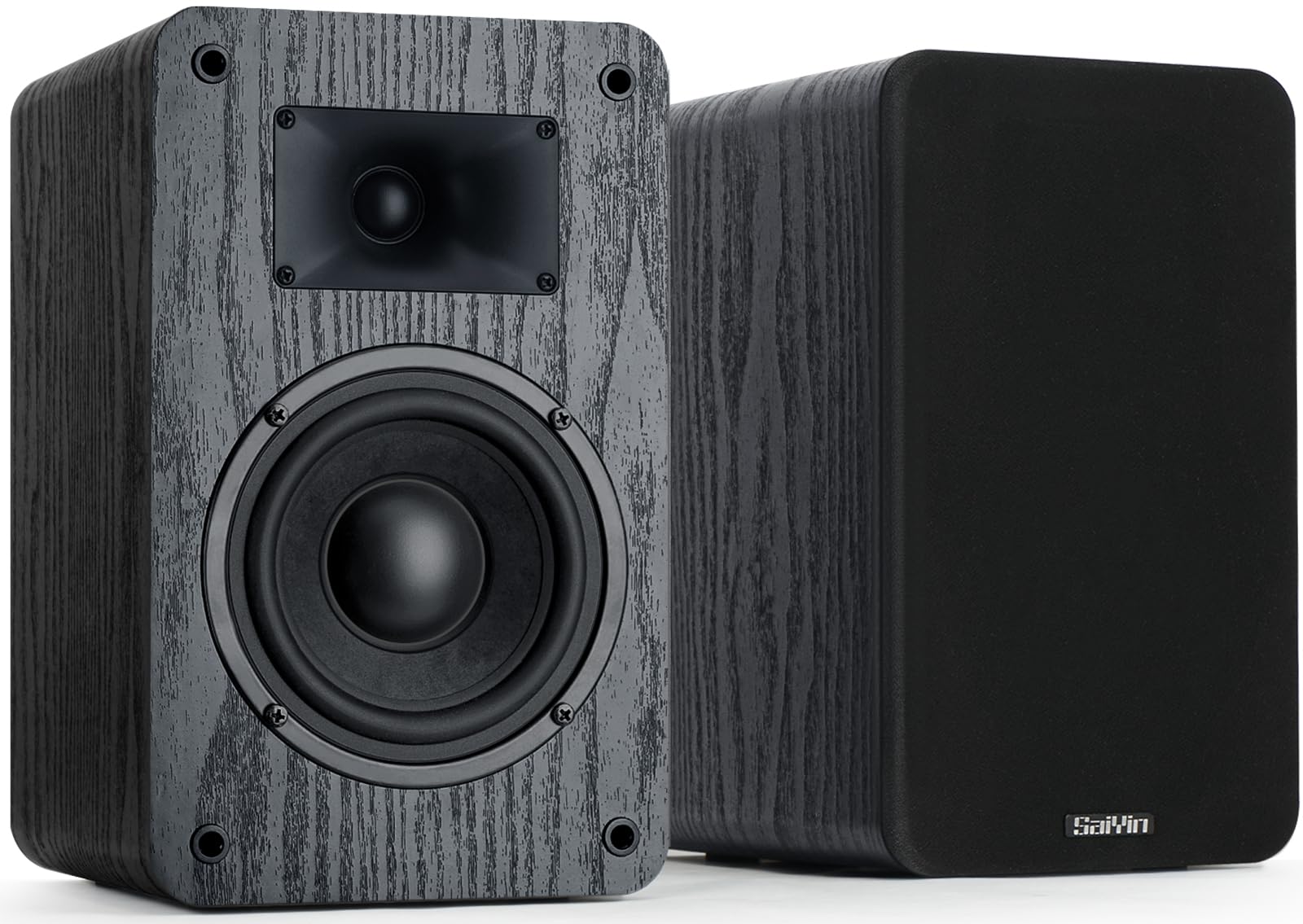
A passive pair that brings serious bass and vocal detail when paired with a decent amp.
These are the only passive speakers in this roundup, meaning they need an external amplifier or receiver to make any sound at all. But for anyone who already owns a compact amp (buyers mention Fosi Audio mini amps in particular), the payoff is big: a 5-inch woofer — the largest driver in this entire buying guide — paired with a 20mm silk dome tweeter that delivers what the brand calls “enhanced vocal clarity.” The result, according to one reviewer, is “surprising sound quality for the price” with “excellent vocal and bass performance and no boominess.”
The rated frequency response of 55Hz to 20kHz means you get lower bass extension than most 3 or 4-inch powered speakers can produce, and the 83dB SPL sensitivity means they get plenty loud with the right amp. However, you absolutely need to verify your amplifier will work with 4-ohm speakers — the Saiyins are 4-ohm, and many older amps are designed for 8-ohm speakers and may overheat or distort. Reviewers also warn that the “bass clips on big drops at high volume” and that the sound “lacks mids” when pushed, so a subwoofer or a well-matched amp helps fill the middle range.
Compared to the powered Saiyin DS6701S Pro below, these passive speakers trade Bluetooth convenience for significantly better bass depth (5-inch vs 3.75-inch woofer) and the long-term flexibility of building a separates-based system. Reviewers point out that pairing them with a Fosi Audio mini amp “makes a believer out of the listener,” and that the sound “improves with a center speaker” if you eventually build a surround set.
What makes them special: A 5-inch woofer and silk dome tweeter in a proper MDF cabinet that can reach 55Hz on the low end — deeper bass than any powered speaker on this list at the expense of needing an external amp.
The real trade-off: No speaker wire included, no Bluetooth, and you must confirm your amp handles 4-ohm loads. This is a wired, separates-centric path.
Best for: listeners who already own a compatible stereo receiver or a mini amp (like a Fosi Audio unit) and want the biggest drivers possible for the money.
Not for: anyone who wants a plug-and-play experience without an external amplifier — grab the Edifier R1280T or the Mackie CR3.5 instead.
7. Saiyin DS6701S Pro Powered Bluetooth Bookshelf Speakers
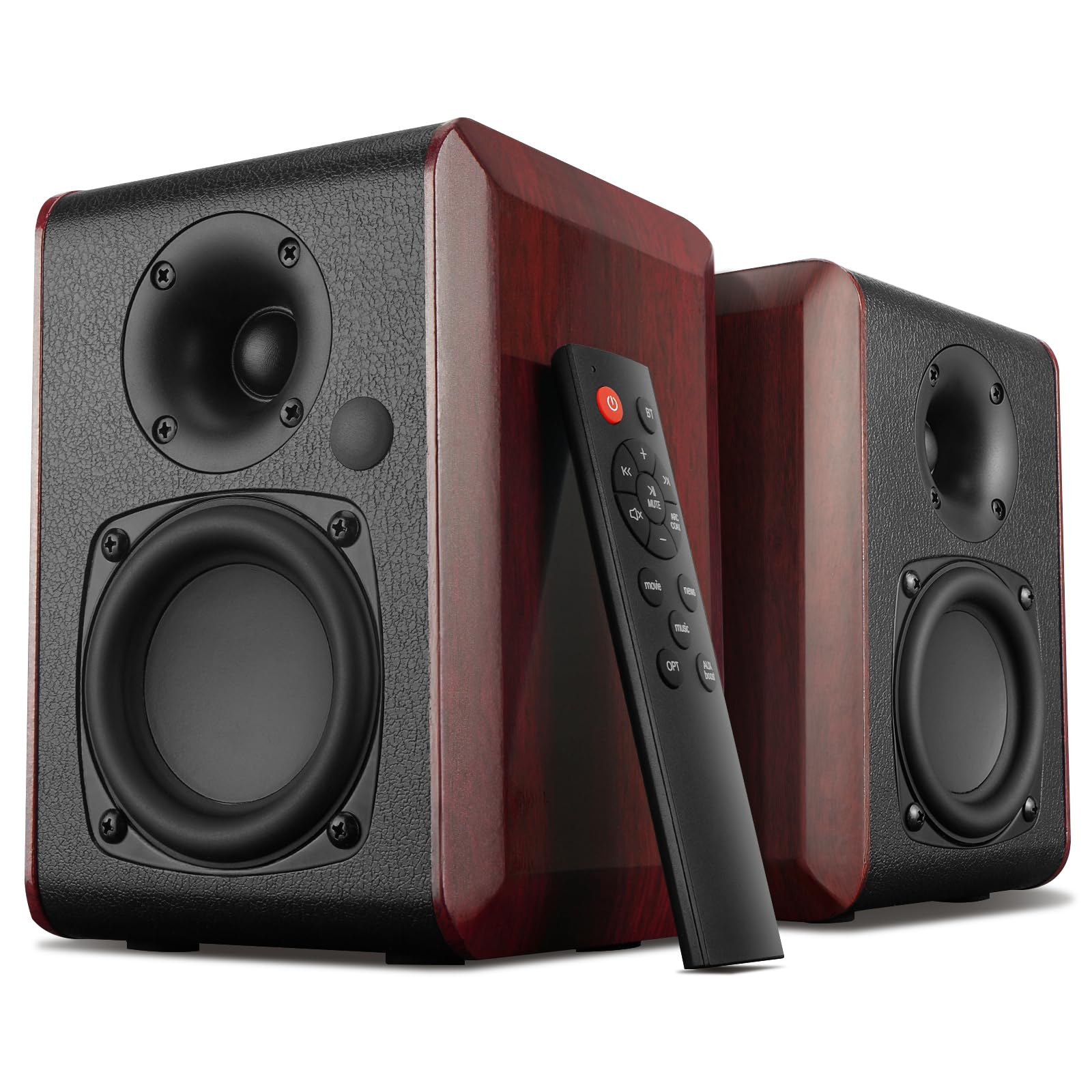
A compact powered set that brings TV-ARC, optical, and a subwoofer output to the budget floor.
If you need to hook speakers to a modern TV, the DS6701S Pro is the only budget option here with a TV-ARC port and an optical input — the two connections that most flat-panel TVs use for clean digital audio. The 3.75-inch woofer and 20mm silk dome tweeter produce what buyers describe as “rich, balanced sound with clear lows, mids, and highs” even at high volume. The set also includes a subwoofer line output, so you can plug in a powered subwoofer later without buying a separate splitter or amp. One buyer who connected their TV (wired) and an Echo Dot (Bluetooth) calls the sound “fabulous” and notes the button switch between sources works smoothly.
At 5.9 inches wide and 8 inches tall, these are genuinely compact — they fit easily on a narrow shelf or a small desk — and the burgundy piano lacquer finish is more visually interesting than most black boxes. Note that the speakers do not come with grilles, and the maker is specific about audio source settings: if you use the optical or ARC input, your TV must be set to output PCM or stereo (not Dolby/DTS surround) or you will get crackling or no sound at all. Reviewers praise the “excellent customer service” from Saiyin, with one reporting a replacement part arriving within a week.
Compare this to the Electrohome EB10 below: the Saiyin adds TV-ARC, optical, and a subwoofer output — connections the Electrohome lacks — making it a better pick if your primary source is a television rather than a phone or basic PC.
Why it works for TV setups
- TV-ARC and optical inputs for direct digital TV connection
- Subwoofer output for easy bass upgrade later
- Compact footprint (5.9″ x 8″) fits most shelves
Things to check before buying
- TV must output PCM/stereo signal for optical/ARC — no Dolby/DTS pass-through
- No speaker grilles included
Grab these if: your main goal is upgrading a TV’s built-in sound with a compact, clean-looking pair that keeps the door open for a subwoofer later.
Pass if: you need a centered soundstage for music (a passive setup with a good amp often delivers wider stereo imaging) or if your TV only supports Dolby/DTS without PCM output.
Understanding the Specs
Power Handling (Watts RMS)
The “watts RMS” number tells you how much continuous power the speakers can handle without distorting or damaging the drivers. Higher RMS generally means louder, cleaner sound at higher volumes. Most powered bookshelf speakers in the budget range deliver between 20W and 50W RMS per channel — plenty for a bedroom, office desk, or small living room. Passive speakers list their power rating per speaker, so a “40W×2” spec means each speaker can handle 40 watts RMS, and you need an amplifier that can deliver at least that much.
Impedance (Ohms)
Impedance is the electrical resistance the speaker presents to the amplifier, measured in ohms. Most budget speakers are 4-ohm or 8-ohm. A 4-ohm speaker draws more current from the amp, which can produce more volume from the same wattage — but not all amps are stable at 4 ohms. If you plug a 4-ohm passive speaker into an older 8-ohm-only amplifier, you risk overheating the amp or triggering protection mode. Always check your amplifier’s specification to make sure it is compatible with the speaker’s impedance.
Frequency Response (Hz – kHz)
This spec describes the range of sound frequencies the speaker can reproduce, measured in Hertz (low bass) to Kilohertz (high treble). Human hearing typically spans about 20Hz – 20kHz, but budget bookshelf speakers commonly cover around 55Hz – 20kHz, which means they will reproduce bass guitar and kick drums but may roll off the very deepest sub-bass frequencies you feel in movie explosions. A lower starting number (like 52Hz) means deeper bass; a higher top number (like 40kHz) means extended treble detail for formats like hi-res audio.
Driver Size (Woofer + Tweeter)
The woofer is the larger driver responsible for midrange and bass. The tweeter handles the high frequencies. A larger woofer (5-inch vs 3-inch) can physically move more air, producing deeper and punchier bass without help from a subwoofer. A silk dome tweeter typically sounds smoother and less harsh than a metal dome tweeter, making it a common choice for budget speakers where cost and listenability need to balance. Some speakers use a single full-range driver (covering both bass and treble in one unit), which saves cost but often sacrifices detail at the extreme ends of the frequency range.
FAQ
Can I connect these speakers directly to my television?
Do I need a separate amplifier for powered speakers?
Why do some speakers have a subwoofer output?
What is the difference between RCA, AUX, and TRS inputs?
Can I use passive speakers with any amplifier?
Are studio monitors good for normal music listening?
What does Bluetooth version matter for sound quality?
How do I know which speaker size fits my desk or shelf?
Do budget speakers need a break-in period?
Can I wall-mount bookshelf speakers?
Final Thoughts: The Verdict
Across the board, the best budget stereo speakers overall is the Edifier MR3 because it combines Hi-Res Audio certification, app-based EQ tuning, balanced TRS inputs, and Bluetooth 5.4 in a single powered package that works for music production, daily listening, and wireless streaming without demanding a separate amplifier. If you want a simple, classic wired pair with a remote for your turntable, grab the Edifier R1280T. And for the absolute deepest bass on a tight budget when you already have an amplifier, the standout is the Saiyin Passive 40W×2 with its 5-inch woofer and silk dome tweeter.
How We Picked
We do not accept paid placement. Every pick is matched to a real buyer and a real use-case; we do not hands-on test units.
Sources & Methodology
Specifications: manufacturer listings and product documentation. Review insights: verified customer reviews, as of July 2026. Pricing: not shown on this page (it changes often); check the current price via the retailer link.
As an Amazon Associate, Gadgets Feed earns from qualifying purchases. This does not affect which products we feature.
Related Guides
Product prices and availability are accurate as of the date/time indicated and are subject to change. Any price and availability information displayed on Amazon at the time of purchase will apply to the purchase of this product. As an Amazon Associate I earn from qualifying purchases.
CERTAIN CONTENT THAT APPEARS ON THIS SITE COMES FROM AMAZON. THIS CONTENT IS PROVIDED "AS IS" AND IS SUBJECT TO CHANGE OR REMOVAL AT ANY TIME.
Amazon and the Amazon logo are trademarks of Amazon.com, Inc. or its affiliates.