
Drilling into drywall without a map is a gamble with your walls, your time, and your sanity. You either miss the stud entirely, hit a live wire, or end up with a row of patched holes that scream “first attempt.” A capable electronic or magnetic finder removes that blindfold, turning a risky poke into a precise, confident placement — without draining your wallet.
I’m Min — the co-founder and writer behind Gadgets Feed. After cross-referencing detection depths, sensor reliability, and user-reported success rates on over a dozen models, I’ve narrowed the field to the seven that actually earn their spot in your toolbox.
The models below strip away the guesswork, focusing on the specs that matter: scan depth in inches, material coverage, display clarity, and battery life. This guide delivers the definitive best budget stud finder for anyone who wants walls that stay clean and shelves that stay put.
How To Choose The Best Budget Stud Finder
Choosing the right budget stud finder is about matching your wall type to the detection technology. A magnetic finder is the simplest and most reliable for standard drywall with metal fasteners, while an electronic scanner provides deeper insight into wood studs, metal pipes, and live wires. The key is knowing which trade-offs you can afford to make.
Electronic vs. Magnetic Detection
Electronic models use capacitive sensors to detect density changes behind drywall. They shine at finding wood studs and can often identify live AC wires, but they require a flat, smooth wall surface for accurate calibration. Magnetic finders are passive — they locate the nails or screws holding the drywall to the stud. They require no batteries, work on lath and plaster, and are virtually foolproof, but they only tell you where a fastener is, not the stud’s edges.
Scan Depth and Material Versatility
The maximum scan depth determines what you can reliably detect. For standard ½-inch drywall, a ¾-inch depth is sufficient for studs. If you have thicker walls, tile, or want to find metal pipes, look for a model that reaches 1.5 inches for studs and up to 4.7 inches for ferrous metals. Multi-mode options let you switch between wood, metal, and AC wire detection, giving you a fuller picture of what’s behind the wall.
Quick Comparison
On smaller screens, swipe sideways to see the full table.
| Model | Category | Best For | Key Spec | Amazon |
|---|---|---|---|---|
| FNIRSI WD-02 | Electronic | Deep scans & metal pipe location | Stud depth 1.5 in, metal depth 4.7 in | Amazon |
| PREXISO 2-in-1 | Electronic | Laser-guided hanging & marking | Built-in laser level & bubble vials | Amazon |
| FNIRSI WD-01 | Electronic | All-around DIY detection | 6-in-1 modes, rechargeable battery | Amazon |
| RYOBI ESF5002 | Electronic | One-handed center marking | Integrated center punch marker | Amazon |
| Zircon StudSensor A100 | Electronic | Trusted edge-finding accuracy | WireWarning AC detection up to 2 in | Amazon |
| TIMORUN 6-in-1 | Electronic | Feature-packed entry-level pick | Gear-shaped body, 3 depth settings | Amazon |
| CH Hanson 03040 | Magnetic | Zero-tech reliability on any wall | No batteries, pack of 2 | Amazon |
In‑Depth Reviews
1. FNIRSI WD-02 TFT Display Stud Finder

The FNIRSI WD-02 stands out with a bright TFT display and an HPC chip that processes density changes through three sensitivity levels per detection gear. The stud mode reaches a full 1.5 inches deep, enough for thicker drywall and light lath, while the metal mode pushes to 4.7 inches for ferrous objects like iron pipes. The integrated positioning hole lets you mark the edge or center immediately after the audio alarm triggers.
A built-in lithium-polymer battery powers the unit, removing the need for disposable 9V replacements. The device weighs only 4.2 ounces, making it one of the lightest full-featured electronic models in this group. The instructions can be unclear due to translation issues, but once you calibrate on a known non-stud area, the three-sensitivity system provides reliable depth adjustments.
Users report strong performance on standard drywall and painted surfaces, with accurate AC wire detection up to 2 inches. The alert beep is loud and can be slightly shrill, but a buzzer-off option is available. For a budget-friendly electronic scanner that packs deep metal detection and a rechargeable battery, the WD-02 delivers premium-tier versatility without the premium price.
Why it’s great
- TFT display with 3 sensitivity gears per detection mode
- Rechargeable lithium battery saves ongoing battery costs
- Deep ferrous metal scan up to 4.7 inches
Good to know
- Translated instructions can be hard to follow
- Metal detection may show false positives near dense rebar
2. PREXISO 2-in-1 Stud Finder with Laser Level

The PREXISO 2-in-1 merges a stud scanner with a manual-leveling cross-line laser level, turning one tool into a complete hanging station. In stud mode, the device automatically projects a vertical laser line when it detects an edge, and the top LED flashes red while an audio alert sounds — giving you three simultaneous cues. Its scan depth reaches ¾ inch for studs and 1.5 inches for live AC wires.
The laser level uses two lighted bubble vials that only activate when the device is flat against the wall or floor. The working range extends up to 30 feet indoors, enough for most room layouts. A 360-degree wall mount with adhesive strips and metal pins gives you hands-free marking options on smooth and rough surfaces. Note: this model is not designed for lath and plaster walls.
The internal battery charges via USB-C and often arrives with enough charge for immediate use. Users praise the laser alignment for taking the guesswork out of picture frame placement and shelf installation. If your primary project involves hanging items straight and level on drywall, the PREXISO eliminates a separate level purchase and keeps your workflow streamlined.
Why it’s great
- Auto-projecting vertical laser pinpoints stud edges
- USB-C rechargeable battery saves on disposables
- Three mounting methods for hands-free marking
Good to know
- Not compatible with lath and plaster walls
- Laser is manual-leveling, not self-leveling
3. FNIRSI WD-01 6-in-1 Wall Scanner

The FNIRSI WD-01 is a 6-in-1 electronic scanner that covers wood studs, metal studs, ferrous metal, non-ferrous metal (copper), live AC wires, and copper wires. The stud mode offers two depth options: a standard 0.75-inch scan and a deep 1.5-inch scan for thicker barriers. The ferrous metal detection extends to 4.7 inches, while the non-ferrous mode reaches 3.9 inches for copper pipes.
It uses a rechargeable lithium-ion battery, so you never need a spare 9V cell. The digital LCD screen shows detected object type and location clearly, and the audio alarm adds an extra alert layer. The design includes a gear-shaped body with a positioning hole that helps you mark the drilling center with a pencil tip before removing the device.
Users report consistent accuracy on painted drywall, wood flooring, and even acoustic ceilings. The auto-calibration feature simplifies startup — just place it flat on the wall and press the button. Some users note that the metal detection can be overly sensitive near reinforcement mesh, but for general home DIY, the WD-01’s mode variety at this price point is hard to beat.
Why it’s great
- Six dedicated scan modes cover wood, metal, and AC wire
- Dual stud depth (0.75 in / 1.5 in) adapts to wall thickness
- Rechargeable battery eliminates disposable cell costs
Good to know
- Metal mode can false-trigger near wire mesh in walls
- Requires still hand for consistent calibration
4. RYOBI Whole Stud Finder ESF5002

The RYOBI ESF5002 redefines convenience with an integrated center punch that physically dimples the drywall when you press the button, leaving an exact mark for your drill bit or nail. It uses an LED guide strip rather than a full LCD screen — the lights illuminate sequentially as you approach the center of the stud, turning solid when you’re aligned. This visual feedback makes it intuitive even without reading the manual.
The unit weighs 9.12 ounces and measures 9.65 inches long, giving it a comfortable reach for larger hands. It requires a 9V battery (not included). The detection technology is electronic and works on standard drywall up to about ¾ inch depth. RYOBI also includes a bubble level on the side for basic alignment, though the center punch is the standout feature that saves you the extra step of reaching for a pencil.
Users consistently emphasize the punch marker as a project speed-up: no more fumbling for a marker after finding the spot. The trade-off is a slightly higher entry cost and the lack of a dedicated metal mode. If your primary goal is finding and marking wood studs for hanging, the ESF5002’s one-handed workflow is the most efficient option in this list.
Why it’s great
- Built-in center punch leaves a physical mark on drywall
- Sequential LED guide shows approach to stud center
- Ergonomic body fits comfortably in larger hands
Good to know
- No dedicated metal or AC wire detection mode
- Requires 9V battery (not included)
5. Zircon StudSensor A100

Zircon’s StudSensor A100 is the category standard for edge-finding. It detects wood and metal studs up to ¾ inch deep and uses WireWarning technology to alert you to live, unshielded AC wires up to 2 inches deep. The display uses an arrow and a center indicator light to guide you to the stud edge, and an audio beep confirms the location. It does not show the object type on screen — it focuses purely on edge location.
The ergonomic, contoured grip reduces hand fatigue during repeated passes, and the yellow body is easy to spot in a cluttered toolbox. It takes one 9V battery (not included). The device is best suited for drywall installations where you need to find the stud’s edge before drilling. For users who prefer a simple, no-frills interface from a heritage brand, the A100 delivers consistent results on standard surfaces.
Multiple reviewers note that fresh batteries are critical — old batteries cause frequent error beeps and false triggers. Once calibrated with a new 9V cell, accuracy is reliable. The WireWarning feature is a safety alert only, not a precise locator, so treat it as a last-layer precaution rather than a wire tracing tool. For a mid-range entry with zero learning curve, the A100 is a solid, repeatable performer.
Why it’s great
- WireWarning alerts you to live AC wires up to 2 inches deep
- Simple arrow display requires no mode switching
- Ergonomic grip reduces hand strain during multiple scans
Good to know
- Works best with fresh, high-quality 9V batteries
- AC detection is a safety alert, not a wire locator
6. TIMORUN 6-in-1 Stud Finder
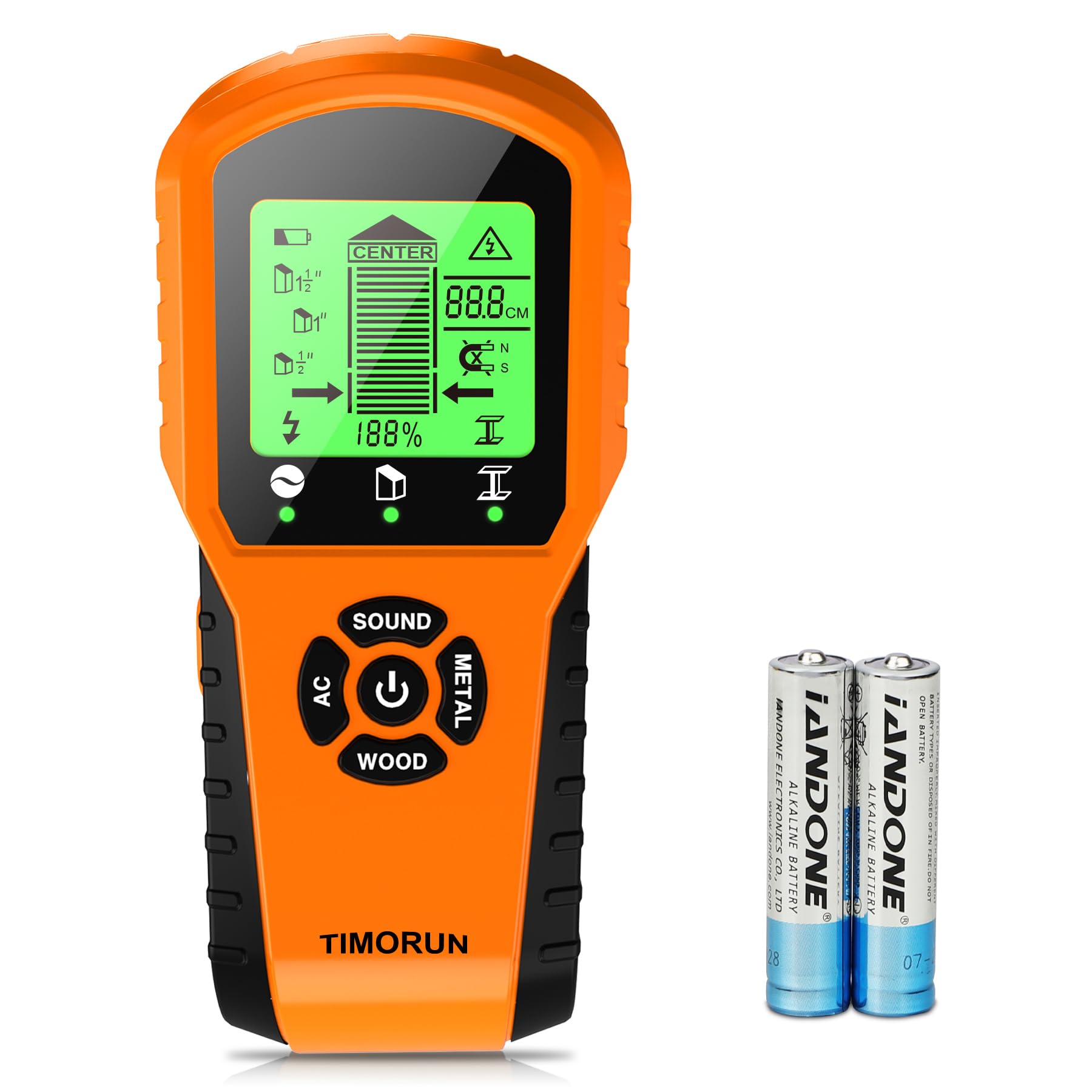
The TIMORUN 6-in-1 wall scanner packs an HD LCD screen, three adjustable depth settings, and detection modes for stud center, wood, metal, and AC wires. Its gear-shaped body doubles as a marking guide — the indentations help you hold a pencil or marker at the correct angle while tracing the center point. The magnetic sensor aids in locating non-ferrous metals like copper water pipes alongside standard ferrous fasteners.
The device requires two AAA batteries (included), so you can start right out of the box. The auto-calibration takes about two seconds and works on most flat surfaces. The audio alert has a handy buzzer-off button for quiet work environments. Some users report that the AC mode can produce a continuous beep in areas with clustered wiring, but turning off the sound solves the annoyance.
Customer feedback indicates strong accuracy for stud detection on drywall up to ¾ inch, with occasional inconsistency in metal and AC modes at deeper ranges. For the price, the feature set is excellent — you get a mode selector, depth toggle, and magnetic sensor all in one lightweight package. It’s a solid entry-level choice for someone building their first toolkit.
Why it’s great
- Gear-shaped body doubles as a marking guide
- Three depth settings adapt to different wall thicknesses
- Magnetic sensor helps locate copper pipes
Good to know
- AC mode can beep continuously in wiring-dense areas
- Battery life shorter than claimed with heavy use
7. CH Hanson 03040 Magnetic Stud Finder (2-Pack)
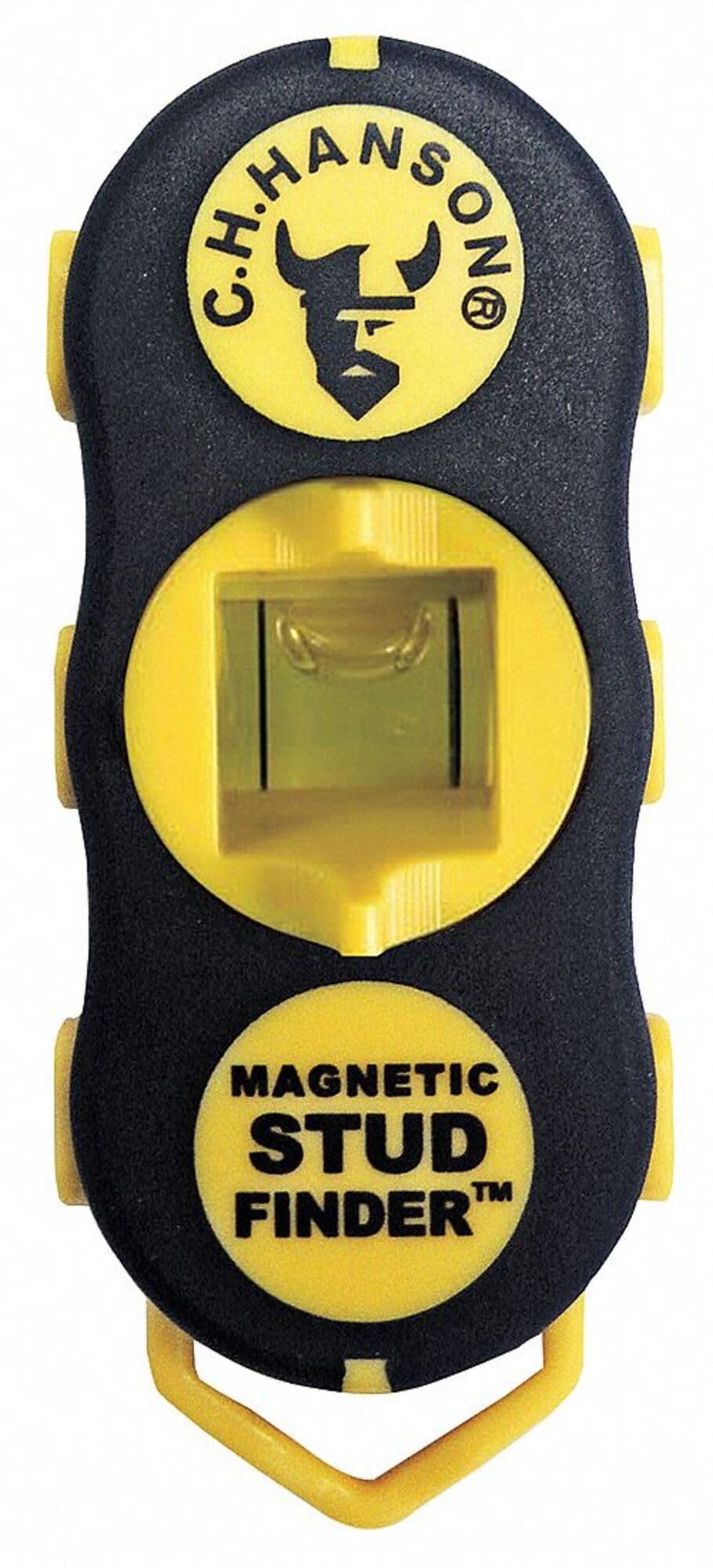
The CH Hanson 03040 relies on four powerful neodymium magnets housed in a compact ABS body to locate drywall screws and nails. It requires zero batteries, zero calibration, and zero instruction reading. You simply slide it across the wall until the magnets catch on a fastener, and the built-in bubble level lets you confirm you’re aligned vertically. The angled ends provide a built-in marking surface.
Each pack contains two finders. The weight is just 1.76 ounces for the pair — almost negligible in a toolbox. This model excels where electronic finders fail: on lath and plaster walls, on textured surfaces, and over metal studs where capacitive sensors struggle. Because it detects the fastener rather than density, it is immune to false triggers from moist drywall or inconsistent wall composition.
The trade-off is that it only tells you where a nail or screw is, not the stud’s edge or center. You’ll need to find two fasteners vertically and estimate the midpoint. But for the price of a takeout meal, you get a tool that works on every wall type indefinitely. For anyone who wants a no-nonsense backup or works with older construction, the CH Hanson is the most reliable dollar you’ll spend.
Why it’s great
- Works flawlessly on lath and plaster walls
- No batteries, no calibration, no learning curve
- Pack of two provides backup or shareability
Good to know
- Only finds fasteners, not stud edges or center
- Magnets can attract each other when stored together
FAQ
Can a budget stud finder reliably detect live AC wires?
Why does my electronic stud finder give false readings on textured walls?
What is the difference between stud edge detection and center detection?
Final Thoughts: The Verdict
For most users, the budget stud finder winner is the FNIRSI WD-01 because its 6 detection modes, rechargeable battery, and dual-depth stud scanning cover virtually every DIY scenario without breaking the bank. If you want a laser-guided hanging assistant for perfectly level installations, grab the PREXISO 2-in-1. And for zero-tech reliability on lath and plaster or as a foolproof backup, nothing beats the CH Hanson magnetic 2-pack.