
Our readers keep the lights on and my morning glass full of iced black tea. As an Amazon Associate, I earn from qualifying purchases.
You buy a budget telescope to see the moon’s craters and Saturn’s rings, not to spend an hour assembling a wobbly tripod. The problem is that at entry-level prices, the difference between a clear view and a frustrating blur often depends on just one or two specs (aperture and focal length) you have probably never heard of before you start shopping.
I’m Min — the founder and writer behind Gadgets Feed. This guide is built by comparing the manufacturers’ published specifications and the patterns across verified customer reviews, so you get each pick’s real strengths and trade-offs instead of marketing spin.
If you want a reliable first scope that does not eat your whole paycheck, the key is knowing which numbers actually matter — aperture (the main lens diameter in millimeters), focal length (how far light travels inside the tube, also in mm), and tripod stability. This review of 7 of the best current models breaks down exactly what to expect from a budget telescope before you click buy.
Quick Picks
- Dianfan Telescope for Kids & Adults, 90mm Aperture 550mm — Best Overall
- Gskyer Telescope, 70mm Aperture 400mm AZ Mount Astronomical Refracting — Wider Views
- Hawkko Telescope for Adults & Kids, 80mm Aperture 500mm — Best Value
- HUGERSTAR Telescope, 80mm Aperture 600mm Refractor — Longer Reach
- HUGERSTAR Telescope, 90mm Aperture 800mm Refractor — Premium Pick
- Celestron StarSense Explorer LT 80AZ — App-Enabled
- MEEZAA Telescope, 90mm Aperture 800mm Refractor — Solid Build
How To Choose The Best Budget Telescope
Before you get lost in the numbers, here is the single shortcut: the aperture (the diameter of the main lens, measured in millimeters) is the real deciding factor for how much light the telescope collects. More light means you see fainter objects — craters on the moon, Jupiter’s bands, Saturn’s ring. The magnification claim on the box is almost meaningless on its own because without enough aperture you are just magnifying a dim, blurry image.
Aperture — the light bucket
Think of the aperture as a window. A 70mm window lets in a certain amount of light; a 90mm window lets in significantly more. That extra light is what turns a hazy blob into a crisp image. The product data shows that the Dianfan 90mm aperture captures 29% more light than the Gskyer’s 70mm aperture — that is the difference between seeing Saturn’s ring faintly versus seeing it clearly.
Focal length and magnification range
The focal length (in millimeters) combined with the eyepieces determines your final magnification. A longer focal length, like 600mm or 800mm, gives you higher potential magnification with the same eyepieces than a 400mm scope. The HUGERSTAR 80mm scope uses a 600mm focal length versus the Celestron’s 400mm — that is a 50% longer tube, which means you get closer to the planet before you even switch eyepieces.
Mount and tripod stability
An unstable mount is the fastest way to ruin a stargazing session. Every tiny vibration shakes the view. Look for an altazimuth mount (the simple up-down and left-right motion) with a sturdy tripod. The stainless steel tripods on the premium picks (HUGERSTAR 90mm and MEEZAA 90mm) adjust from 28.7 to 46.4 inches and are noted in buyer reports as far more stable than the lightweight aluminum legs on entry-level kits.
Quick Comparison
On smaller screens, swipe sideways to see the full table.
| Model | Best For | Aperture | Focal Length | Max Magnification | Amazon |
|---|---|---|---|---|---|
| Gskyer 70mm | Kids & casual moon viewing | 70mm | 400mm | — | $96.99$129.99Amazon |
| Dianfan 90mm | Price-to-value balance | 90mm | 550mm | 165x | $99.98$139.99Limited time dealAmazon |
| Hawkko 80mm | Family kit with stickers | 80mm | 500mm | 150x | $79.99$99.99Amazon |
| HUGERSTAR 80mm | Buyers who want extra reach | 80mm | 600mm | 180x | $85.49$109.99Limited time dealAmazon |
| HUGERSTAR 90mm | Premium moon & planet detail | 90mm | 800mm | 240x | $149.98$199.99Limited time dealAmazon |
| Celestron 80AZ | App-guided sky tours | 80mm | 400mm | — | $229.99$249.95Amazon |
| MEEZAA 90mm | Serious beginners, best build | 90mm | 800mm | 240x | $169.99$199.99Amazon |
In‑Depth Reviews
1. Dianfan Telescope for Kids & Adults, 90mm Aperture 550mm
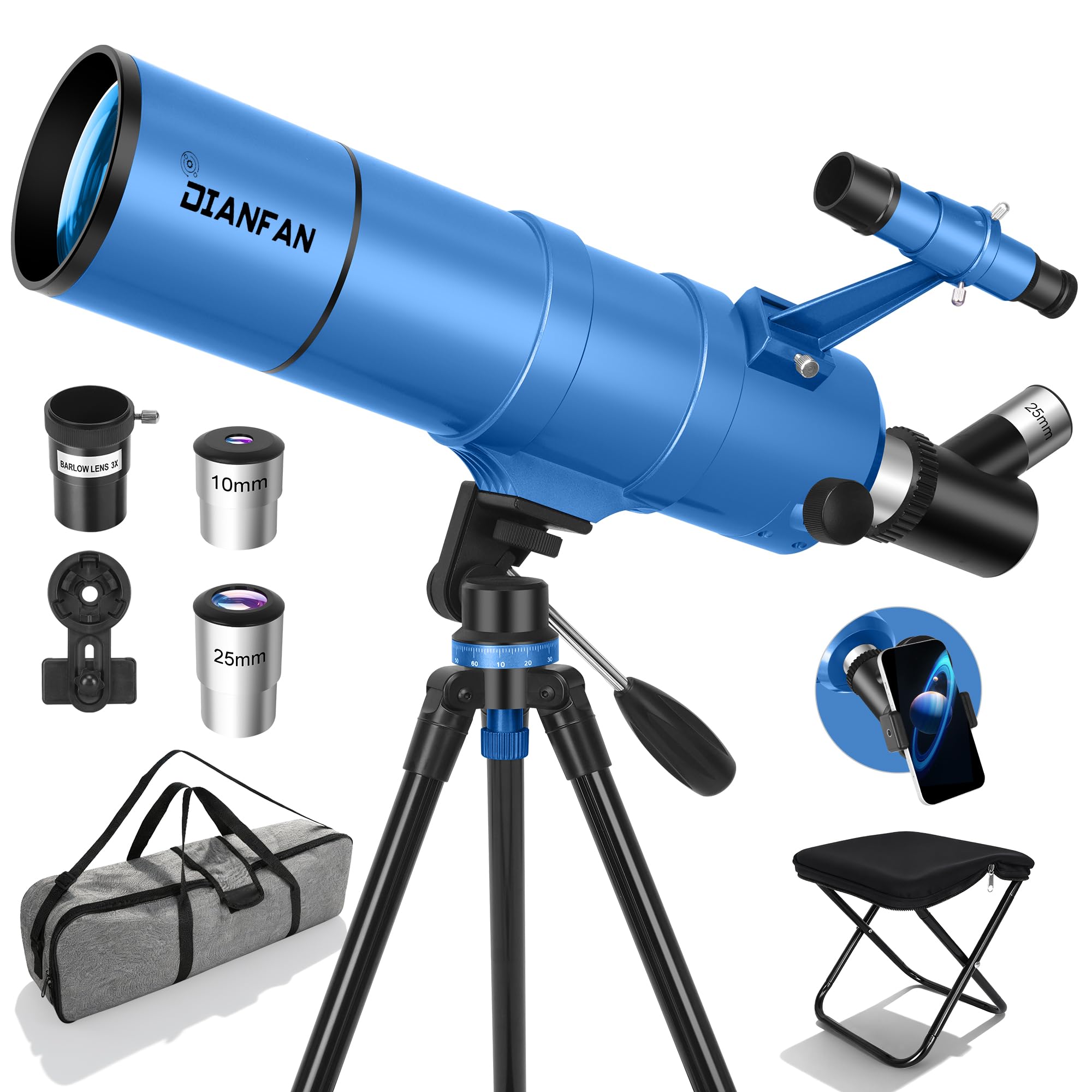
A 90mm aperture (the main lens diameter) pulls in 29% more light than the 70mm Gskyer, so you see Jupiter’s bands and Saturn’s ring clearly, not as a bright dot.
This scope gives you a 90mm aperture and a 550mm focal length — a combination that, according to the comparison data, captures 29% more light than the 70mm Gskyer model. That extra light is what makes Jupiter’s bands and Saturn’s ring faintly visible rather than just a bright dot. The package also includes a folding stool that supports up to 198 lb (90 kg), so you do not have to crouch for long sessions.
Buyers report that a husband assembled it in 15 minutes and that the phone photo capability worked well. The kit also includes a carry bag, making it genuinely portable. Compared to the HUGERSTAR 80mm which has a longer 600mm focal length, the Dianfan’s 550mm is slightly more forgiving for beginners who struggle with a narrow field of view — its 2.3-degree field is still much tighter than the Gskyer’s 5.8-degree view, so you will need to aim more carefully.
The case for it: An excellent balance of a big 90mm aperture and a carry-along kit (including the folding stool) that beats most budget scopes on light-gathering from the start.
The catch: The lightweight tripod is noted in reviews as shaky in wind, and the 2.3-degree field of view is narrow — you will spend more time centering objects than with wider-field scopes.
Best for: Any beginner or family who wants the most aperture for the money without jumping to premium pricing.
Skip if: You want a wider field of view for scanning the night sky — the 5.8-degree view of the Gskyer is easier for casual sweeping.
2. Gskyer Telescope, 70mm Aperture 400mm AZ Mount Astronomical Refracting

A light 5.7-pound kit with a 5.8-degree field of view — over 2.5 times wider than the Dianfan’s view, so you can sweep across the Milky Way without constant re-centering.
Its 70mm aperture (2.75 inches) is entry-level, as one reviewer put it, and its 400mm focal length is the shortest in this list — giving you a wide 5.8-degree field of view. That is 2.5 times wider than the Dianfan’s 2.3-degree field, so sweeping across the Milky Way or tracking the moon is much easier for a first-timer. The kit includes a wireless camera remote and a smartphone adapter, letting you snap shots without touching the scope.
Buyers consistently note that it is easy to set up for an 8-year-old, sturdy, and not a toy. The downside is that the 70mm aperture limits what you can see. One experienced reviewer notes that most galaxies and nebulas appear as hazy blobs and that you will spend more time hunting than viewing compared to larger scopes. The short stand also requires crouching unless you have a chair.
Why it’s great
- 5.8-degree field of view is the widest in this roundup, making it very beginner-friendly for casual sweeping
- Light at 5.7 lbs with a carry bag, so it travels easily to a dark-sky spot
- Includes a wireless remote and phone adapter for simple moon photography
Good to know
- 70mm aperture is entry-level — Saturn’s ring appears faint, and deep-sky objects are blurry at best
- Short tripod requires you to crouch or sit low, which can get uncomfortable fast
Best for: Absolute beginners, especially kids, who want a wide, easy view of the moon and don’t yet need high planetary detail.
Skip if: You are serious about seeing Saturn’s ring or Jupiter’s cloud bands clearly — step up to at least 80mm or 90mm aperture.
3. Hawkko Telescope for Adults & Kids, 80mm Aperture 500mm
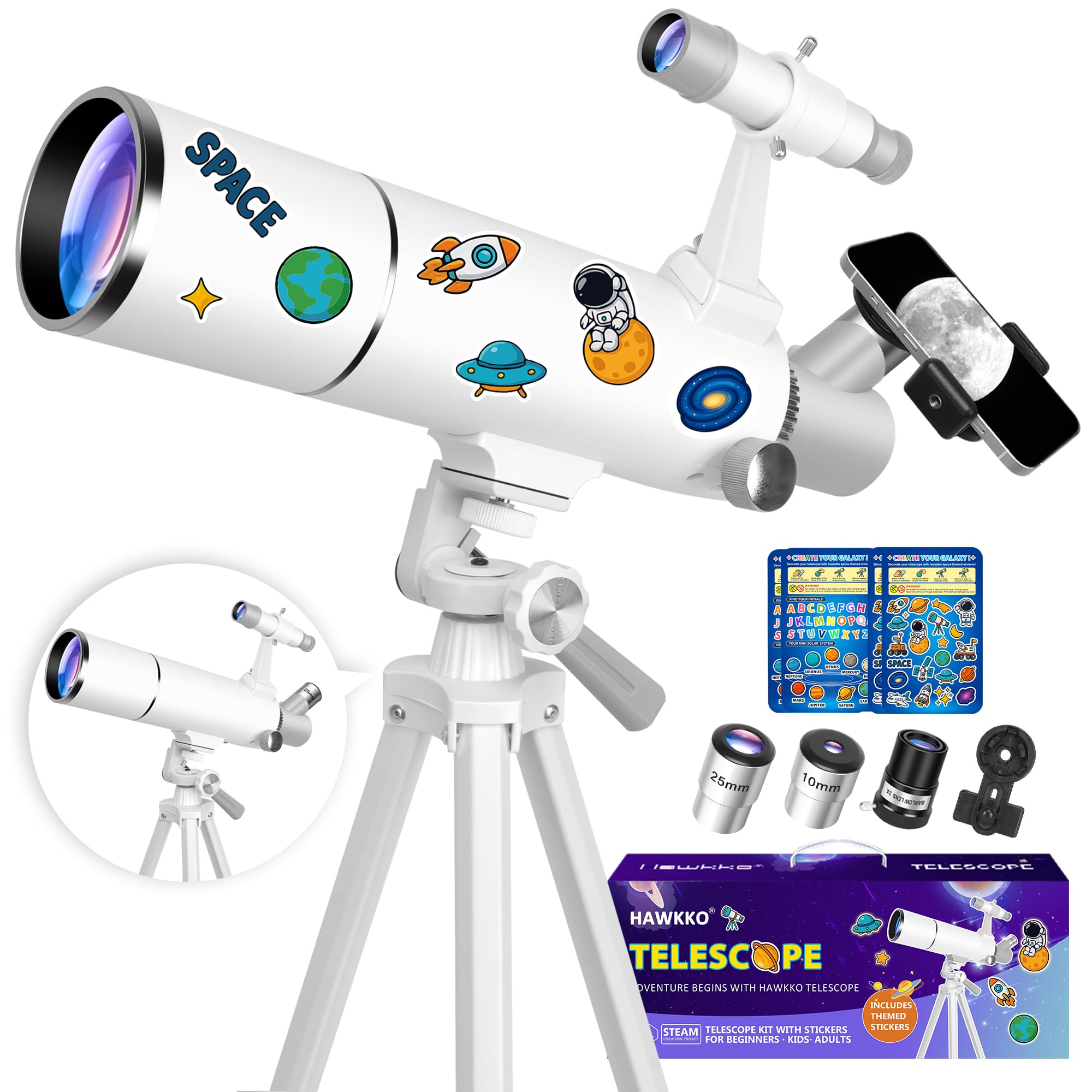
Its 80mm lens pulls in more light than the 70mm Gskyer, so you see moon craters and Jupiter’s moons without the price jump to 90mm models.
This 80mm aperture refractor gives you a step up in light gathering compared to the 70mm Gskyer without the price jump. It collects more light than 70mm models. The kit includes a 20mm and a 10mm eyepiece plus a 3x Barlow lens, giving you a zoom range from 20x up to 150x. With a 500mm focal length, it sits between the short 400mm scopes and the longer 600mm/800mm models, offering a middle-ground view that is good for both moon craters and terrestrial viewing.
Owners mention seeing clear moon craters and even Jupiter’s moons with this scope, and they praise the easy, no-tools setup. One reviewer tested it during travel in Utah and found the adjustable tripod stable on uneven ground. The included stickers are a fun touch for kids. However, one review notes poor image quality — blurry at higher magnifications — and a flimsy tripod that shakes easily, so consistency may vary.
The case for it: A well-priced 80mm kit with a 500mm focal length that hits the balance between portability and power, plus a 2-year manufacturer warranty for confidence.
The trade-off: Customer experiences are split — some report great views, while others describe blurry images at high zoom and a shaky tripod that makes fine focusing frustrating.
Best for: Families wanting an affordable 80mm starter kit that can be personalized and taken on trips for stargazing or birdwatching.
Skip if: You are a stickler for consistent optical quality and stable tracking — scopes like the Hugerstar 80mm or Dianfan 90mm have more reliable feedback.
4. HUGERSTAR Telescope, 80mm Aperture 600mm Refractor
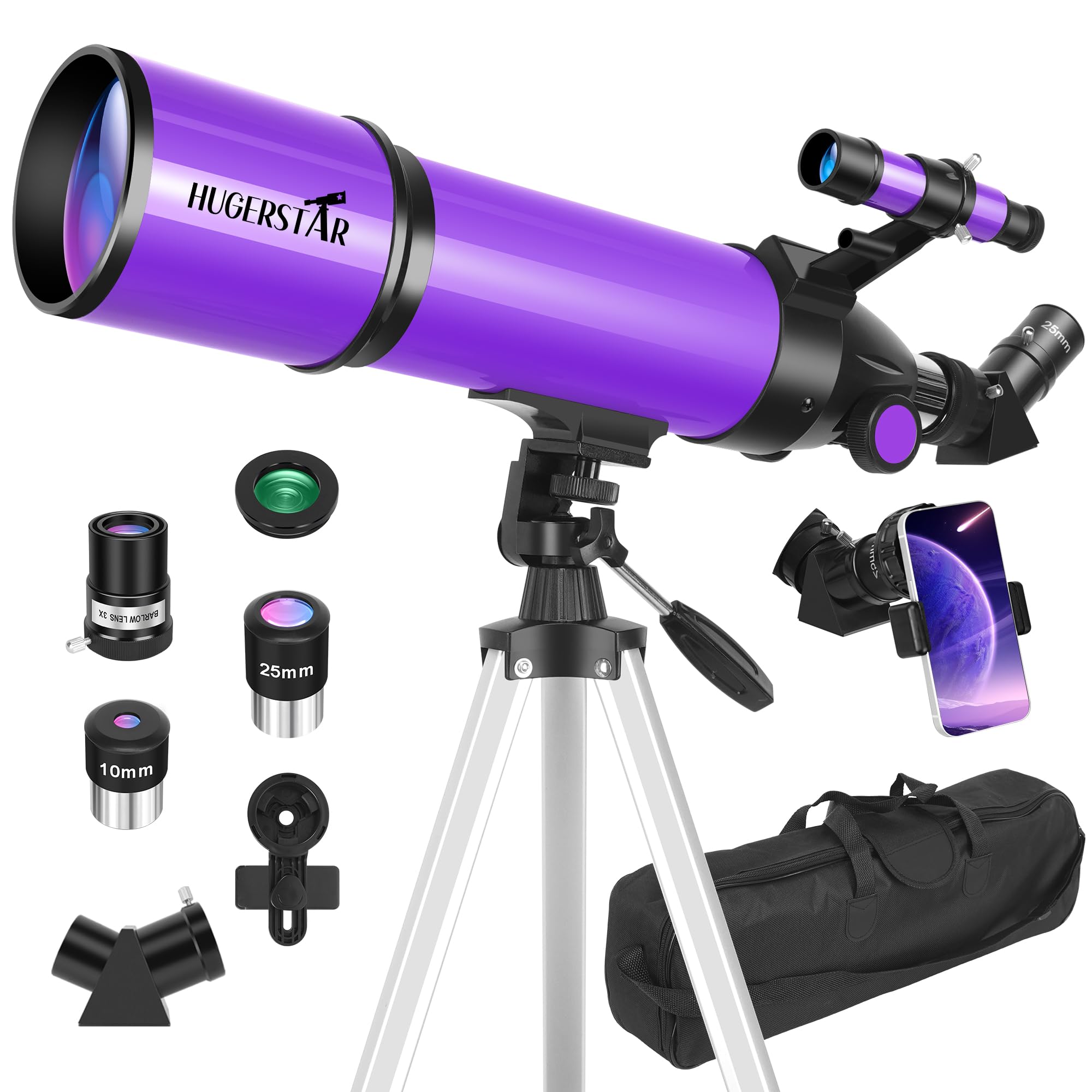
With a 600mm focal length you get 50% more reach than the 400mm scopes, so the moon looks closer and more detailed right out of the box.
The extra 200mm in the tube (600mm vs 400mm on the Celestron or Gskyer) means you get higher magnification from the same eyepieces without needing a Barlow lens. At 24x-180x, it is a step up from the Hawkko’s 500mm range. The kit comes with a moon filter — a threaded lens that reduces glare so moon viewing is more comfortable — plus a phone adapter and a carrying bag. The tripod adjusts from 21.2 to 44 inches, which customers note works for a 6-foot adult.
Buyers are largely impressed with the clarity, noting that the fully multi-coated optics give sharp, high-contrast views with minimal chromatic aberration (color fringing around bright objects). One reviewer mentions that it is better to view the moon and planets with this scope rather than deep-sky objects. Another notes that the instructions could be clearer. Unlike the smaller 70mm scopes, this 80mm model gives you a realistic view of Jupiter’s cloud bands.
Why it’s great
- 600mm focal length gives you noticeably closer views of the moon and planets than 400mm scopes
- Includes a moon filter, phone adapter, and carrying bag — useful accessories you would otherwise buy separately
- Smooth altazimuth mount and stable tripod that reviewers point out is comfortable for adults up to 6 feet tall
Good to know
- No motorized tracking — you have to nudge the scope manually to keep objects centered as they drift
- A few buyers mention the instructions could be more detailed for a complete beginner
Best for: Buyers who want a simple upgrade in reach over the basic 400mm scopes without jumping to the 90mm premium tier. skip it if you want an app-guided experience — the Celestron is better for that.
5. HUGERSTAR Telescope, 90mm Aperture 800mm Refractor

A 90mm aperture and 800mm focal length deliver up to 240x magnification — the highest in this budget list — so Saturn’s rings and Jupiter’s cloud bands appear sharp, not hazy.
Compared to the 600mm scopes, the 800mm focal length gives you a significantly closer view of planets with the same eyepieces, and the 90mm aperture captures noticeably more light than any 70mm or 80mm model. The stainless steel tripod (adjustable from 28.7 to 46.4 inches) is a material upgrade over the aluminum legs on cheaper kits — shoppers say it eliminates the wobble problem entirely. The kit includes a phone adapter and a moon filter.
Buyers report crisp, 3D-like lunar images and the ability to see Saturn’s rings clearly, Jupiter’s moons, and even some detail in Jupiter’s cloud bands. One reviewer calls it a serious observation tool, not a toy, and notes that it doubles as a decent spotting scope for daytime bird watching. The setup is tool-free, with 90% of users ready in under 10 minutes. One limitation: The accessory tray holds eyepieces but the included phone adapter can struggle with short eyepiece necks, as one reviewer noted.
The case for it: The best light-gathering and magnification in this price bracket — you get professional-quality lunar views and stable planetary observation from a beginner-friendly kit.
The compromise: The 90mm aperture and 800mm tube make it heavier to carry than compact 70mm scopes, and the phone adapter may not fit all phone cases without an extra adapter purchase.
Best for: Beginners who want a serious telescope that shows Saturn’s rings and Jupiter’s bands clearly, without stepping up to a computerized mount. If portability matters more than raw power, the 5.7-lb Gskyer is far easier to carry.
6. Celestron StarSense Explorer LT 80AZ

Dock your phone, follow on-screen arrows, and the scope’s StarSense technology guides you to planets — no star charts needed, unlike every other scope here.
The patented StarSense technology uses your phone’s camera to analyze star patterns and pinpoint the telescope’s position, then generates a list of the best visible objects based on your location and time. This is the only scope here that actively helps you find things — no manual star charts needed. It is an 80mm refractor with a 400mm focal length and fully coated glass optics. The package includes a 25mm and a 10mm eyepiece, plus a 2x Barlow lens.
Owners mention excellent moon views (craters and mountains), and that Jupiter’s four moons are easy to spot, though the planet’s bands are not visible. Saturn’s ring is visible. One reviewer notes that a wider-field eyepiece would reduce the drift you see as the earth rotates. The mount is a manual altazimuth with a sliding rod for altitude slow-motion adjustment. Compared to the Dianfan 90mm, it has a smaller 80mm aperture but a much more beginner-friendly guiding system.
Why it’s great
- Patented StarSense app turns your phone into a navigation system — no prior astronomy knowledge needed
- Highly portable and easy to assemble, as reported by multiple buyers including a 15-year-old who set it up alone
- Backed by a leading telescope brand with a 2-year US warranty and customer support since 1960
Good to know
- 80mm aperture and 400mm focal length limit deep-sky views — most galaxies and nebulas will appear hazy
- The red-dot finderscope has been reported as non-functional on some units, though Celestron support replaces it quickly
Best for: Absolute beginners who want a guided sky tour without learning star charts or manual alignment. If you want the maximum possible aperture for the money, the Dianfan 90mm or HUGERSTAR 90mm give you better light-gathering for the same or lower price.
7. MEEZAA Telescope, 90mm Aperture 800mm Refractor

A 90mm aperture with an 800mm focal length in a metal tube that, customers note, stands up to wind far better than the lightweight aluminum competitors.
Like the HUGERSTAR 90mm, this scope gives you a large 90mm aperture and a long 800mm focal length for up to 240x magnification. The key difference is that reviewers point out the MEEZAA has a particularly solid build — a metal tube and a sturdy stainless steel tripod that holds steady even in breezy conditions. The fully multi-coated optical glass lenses with high transmission coatings are designed to improve brightness and clarity. The kit includes a phone adapter and a carry bag.
Buyers mention seeing moon craters in good detail and that the altazimuth mount is easy to use for moon, Jupiter, and Saturn viewing. One reviewer notes that the tripod needs occasional re-tightening of the leg locks. Some users found the inverted viewfinder confusing at first. The inverted locator scope and a slight wobble when using the phone attachment are the downsides mentioned.” One buyer states: “Excellent beginner/novice telescope on a budget.”
The case for it: A well-built 90mm kit with a metal tube and stainless tripod that provides the most light and sharpest potential planetary views in this budget category.
The drawback: The finder scope image is inverted (normal for astronomy but confusing for beginners), and the phone adapter can cause enough wobble to blur your photos during capture.
Best for: A beginner who values build quality and stability over a phone adapter that works perfectly — this scope holds its own in wind and delivers clear moon-and-planet views. If you want a fuss-free astrophotography setup, the phone adapter stability issue is a real frustration for casual sharing.
Understanding the Specs
Aperture — the lens diameter
The aperture is the diameter of the main objective lens, measured in millimeters (mm). It determines how much light the telescope can collect. More light means you see fainter objects and more detail on bright ones. A 90mm aperture captures about 29% more light than a 70mm aperture — the difference between seeing Saturn’s ring as a thin line versus a clear oval.
Focal length — how far the light travels
The focal length (in mm) is the distance the light travels inside the tube before it reaches the eyepiece. A longer focal length (like 600mm or 800mm) gives you higher magnification with the same eyepiece than a shorter one (like 400mm). It also creates a narrower field of view — which is good for planet detail but harder for sweeping the Milky Way.
FAQ
What aperture is best for a budget telescope?
Why does my telescope show an inverted image?
Can I take photos with a budget telescope?
How do I know what magnification I am getting?
What is a Barlow lens and do I need one?
Why do I need a moon filter?
Is a tripod really that important?
Can I see galaxies and nebulas with a budget telescope?
What eyepieces should I use first?
What does “altazimuth mount” mean?
Final Thoughts: The Verdict
If you want one dependable pick, the budget telescope winner is the Dianfan 90mm because it pairs the largest aperture in this price range with a useful kit including a folding stool and carry bag — making real lunar and planetary detail accessible without a premium price. If you want an app-guided sky tour that practically finds objects for you, grab the Celestron StarSense Explorer LT 80AZ. And for the beginner who prioritizes build quality and the widest field of view for casual scanning, the Gskyer 70mm remains the lightest, most portable option that still delivers a satisfying first view of the moon.
How We Picked
We do not accept paid placement, and we did not hands-on test every unit. Instead, we match each pick to a real buyer and use-case by comparing the manufacturers’ published specifications against the patterns in verified customer reviews — so you get each pick’s real strengths and trade-offs instead of marketing copy.
Sources & Methodology
Specifications: manufacturer listings and product documentation. Review insights: verified customer reviews, as of July 2026. Pricing: not shown on this page (it changes often); check the current price via the retailer link.
As an Amazon Associate, Gadgets Feed earns from qualifying purchases. This does not affect which products we feature.
Product prices and availability are accurate as of the date/time indicated and are subject to change. Any price and availability information displayed on Amazon at the time of purchase will apply to the purchase of this product. As an Amazon Associate I earn from qualifying purchases.
CERTAIN CONTENT THAT APPEARS ON THIS SITE COMES FROM AMAZON. THIS CONTENT IS PROVIDED "AS IS" AND IS SUBJECT TO CHANGE OR REMOVAL AT ANY TIME.
Amazon and the Amazon logo are trademarks of Amazon.com, Inc. or its affiliates.