
Our readers keep the lights on and my morning glass full of iced black tea. As an Amazon Associate, I earn from qualifying purchases.
Specs are compiled from manufacturer listings and verified buyer reviews and can change over time — please confirm the key details on the product page before buying.
You want flat, ready-to-use boards from warped, rough lumber, but you worry about buying a planer that leaves snipe (deep gouges at the start and end of a board) or tears out chunks of grain. You do not need a cabinet-shop budget to get a genuinely great cut. The machines below deliver smooth, accurate results without demanding you remortgage the garage.
I’m Min — the founder and writer behind Gadgets Feed. This guide is built by comparing the manufacturers’ published specifications and the patterns across verified customer reviews, so you get each pick’s real strengths and trade-offs instead of marketing spin.
When shopping for a budget thickness planer, the deciding factors are cutterhead design, feed speed, and how much snipe the machine actually produces.
Our Picks at a Glance

How To Choose The Best Budget Thickness Planer
Buying a planer on a budget means you are trading features, not quality. The two biggest mistakes shoppers make are chasing the lowest price with straight knives and ignoring how loud and messy these machines really are. Focus on the cutterhead first: a spiral head with many small inserts cuts quieter and leaves a smoother surface than three long straight blades.
The Cutterhead Is Everything
A straight-knife head uses two or three long blades that spin fast. They work well on softwoods and edge grain but can tear out chunks on figured or hard wood. A spiral cutterhead uses dozens of small, staggered tungsten carbide or HSS inserts that slice across the grain at an angle. The result is a finish that often needs little to no sanding, plus noticeably less noise. On a budget, a spiral head is worth stretching for.
Feed Speed vs. Finish
Feed speed is how fast the board moves through the machine, measured in feet per minute (FPM or ft/min). A faster feed clears stock quickly but leaves a rougher surface. A slower feed gives a finer finish. Two-speed planers let you pick: a quick pass to remove material, then a slow pass for a sand-free surface. If a planer only has one speed, look for a moderate rate around 20 ft/min.
Depth of Cut and Snipe
Depth of cut is how much wood the cutterhead removes in one pass. Budget planers typically handle up to 6 inches of stock thickness. Snipe is the small dip at the ends of a board caused by the rollers losing pressure. Anti-snipe features — like extra table extensions or an automatic carriage lock — prevent this waste. On a budget, a machine with a snipe minimizer or longer tables saves you money on wasted wood.
Quick Comparison
| Model | Best For | Cutting Width | Cutterhead | Motor RPM | Amazon |
|---|---|---|---|---|---|
| DEWALT DW735X★ Best Overall | Pro-level finish in a benchtop | 13 inches | Three Knife, Two Speed | 20,000 RPM motor | Amazon |
| WOODSTARTER TP20KFast Feeder | High-volume stock removal | 13 inches | 3-Blade HSS | 10,000 RPM | Amazon |
| WOODERS PL13-15ABErgo Pick | Senior-friendly ergonomics | 13 inches | 4 HSS Blades | 10,000 RPM | Amazon |
| VEVOR 12.5″ Foldable | Portable, repurposed wood | 12.5 inches | 2 Double Cutter Blades | 8,000 RPM | Amazon |
| VEVOR Three-Blade Two Speed | Quiet operation for the price | 13 inches | Three-Knife Steel | 23,500 RPM motor | Amazon |
| WEN PL1326 | Spiral-head value | 13 inches | Spiral, 26 HSS Blades | 10,000 RPM | Amazon |
| CUTECH 40700H | Carbide inserts, quiet cut | 12.5 inches | Spiral, Tungsten Carbide | 10,000 RPM | Amazon |
| CUTECH 40600H | Heavy hardwood milling | 13 inches | Spiral, 26 Carbide Inserts | 10,000 RPM | Amazon |
| WEN PL1337 | Two-speed spiral finishing | 13 inches | Spiral, 26 HSS Blades | 10,000 RPM | Amazon |
In‑Depth Reviews
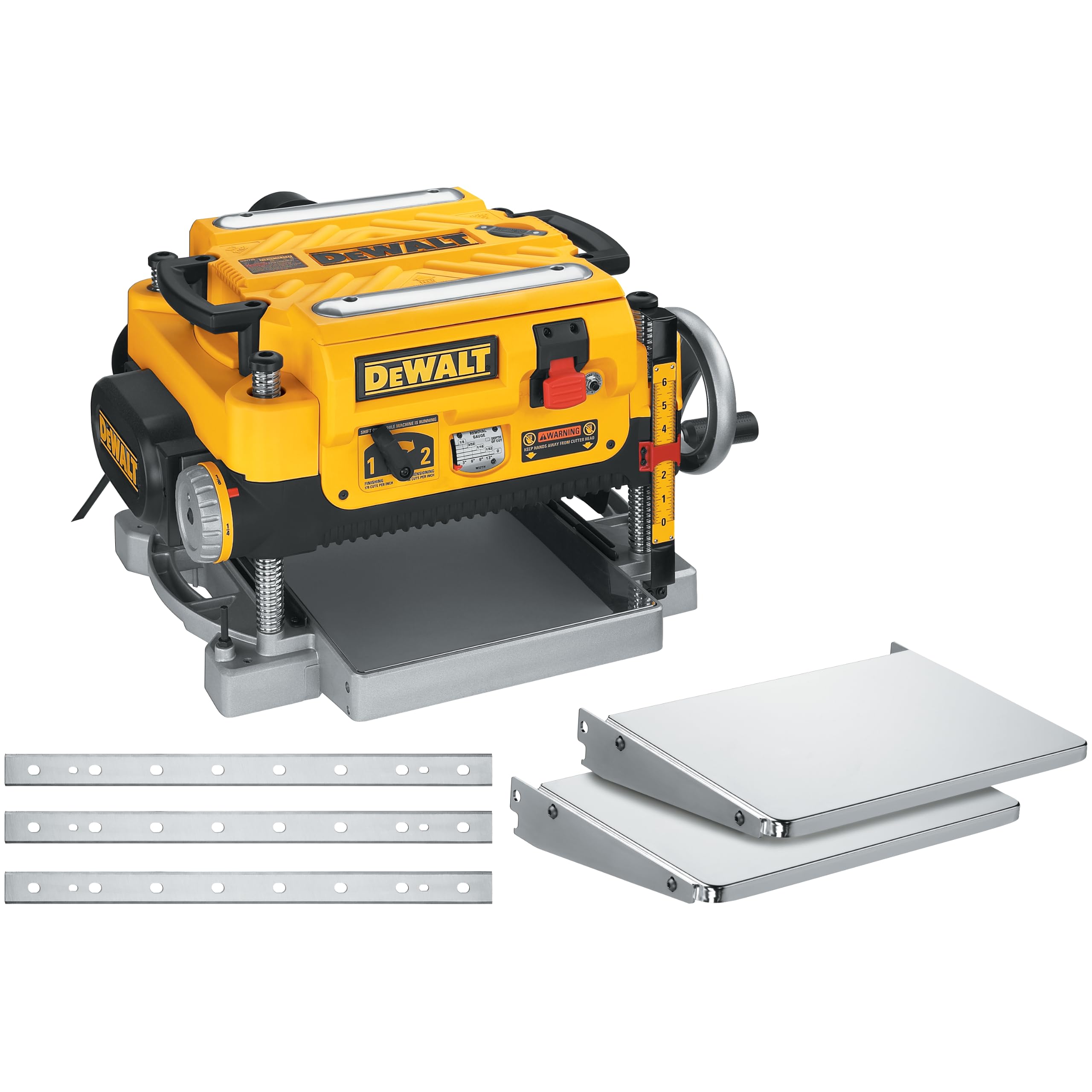
1. DEWALT Thickness Planer, 13-inch, Three Knife Two Speed (DW735X)
Our pick — over 4.5★ from 7,000+ verified ratings; the strongest balance of quality and price.
The benchtop planer that finishes like a stationary machine, with a two-speed gearbox that earns its pro reputation.
This planer sets the standard for the whole category. Its 15 amp, 20,000 RPM motor spins a three-knife cutterhead, so it handles larger cuts in wider materials with ease. The two-speed gearbox lets you choose between 96 or 179 cuts per inch (CPI, the number of blade strikes per inch of board) — you trade a rougher, faster pass for a smooth, slow finish on figured stock. Buyers report a butter-smooth finish on rough ash, comparing the 96 CPI setting to about 100 grit sandpaper, so boards come off nearly ready for finish.
The DW735X also solves snipe without you thinking about it. An automatic carriage lock reduces the movement that causes snipe, so there is no manual lever to remember — just set your depth and let the machine hold itself steady. The 19-3/4-inch cast aluminum base is twice as rigid as a standard 10-inch base., and the fan-assisted chip ejection blows shavings out the included dust chute rather than letting them clog the cutterhead. At about 90 to 100 pounds, it is a heavy, stable workhorse that stays planted on the bench.
The trade-off is real: it is loud, it throws shavings with authority (you want a cyclone or bucket, not a shop vac), and the blades dull faster than you would like on hardwoods. The durability feedback is mixed — some see zero tear-out, others find the knives chip. But the sheer consensus is why this remains the most recommended planer on the market; assembly takes about ten minutes and the extra set of knives is included.
What Wins People Over
- Two-speed gearbox (96 or 179 CPI) for finish control
- Automatic carriage lock virtually eliminates snipe
- Three-knife head extends knife life by 30%.
- Knife swaps take about 45 seconds thanks to easy access.
The Honest Trade-offs
- Heavy at roughly 100 lbs, tough to move around
- Very loud with powerful chip blowout
- Needs a 20-amp circuit — spikes up to 30A on start
- Hardwoods may push you toward a helical head upgrade
The pro pick: Reach for this if you want a finish that skips the sanding stage — the 96 CPI setting on this is a genuine step up.
Look elsewhere if: You have a small shop with only 15-amp circuits — the inrush current can trip breakers and overheat the safety mechanism.
2. WOODSTARTER 13-Inch Benchtop Wood Planer, 10,000 RPM, 3 HSS Blades
The aggressive 21 ft/min feed rate that plows through rough cedar and keeps moving.
This WOODSTARTER is built for speed and stock removal. A 2000W motor holds 10,000 RPM even under heavy loads, and the 21 ft/min feed rate processes boards noticeably faster than the 13 ft/min feed of the DEWALT above. Owners mention planing 60 feet of rough cedar 2x8s successfully, which shows the machine can take a real workload without bogging down. The three razor-sharp HSS blades slice through any wood species at that speed, giving finish-ready boards straight off the machine.
You can plane stock up to 6-3/16 inches thick and 13 inches wide. The extended 29-inch worktable with adjustable infeed and outfeed tables eliminates snipe on long boards, so you get clean, usable wood from end to end without wasting cutoffs. The 3-in-1 dust port (1-2/5″, 2-1/2″, 4″) connects to most vacuum systems to capture debris at the source. Overload and overheat protection automatically shuts the machine down during excessive current draw, protecting both the motor and you from costly repairs.
The honest catch here is quality control. Customers note the listing claims 3 blades but some units arrive with a 2-blade version, and shipping damage is a recurring theme — one unit arrived with a broken handle, another with a damaged box. One early failure showed waviness and scoring on the second day, though the shop vac captures about 95% of shavings when it works well. It is lighter and quieter than the old yellow model it replaced, with solid controls and low vibration.
The Speed Advantage
- 21 ft/min feed clears stock fast
- 29-inch worktable reduces snipe on long boards
- 3-in-1 dust port fits varied vacuum hoses
- Overload and overheat protection
Check on Arrival
- Blade count may differ from listing (2 vs 3)
- Shipping damage reported by some
- Dust collection can clog with heavy use
Best for speed: Choose this when you need to dimension a stack of rough lumber quickly, not finesse a figured board.
Think twice if: You want plug-and-play reliability — inspect the unit and blade count the day it arrives.
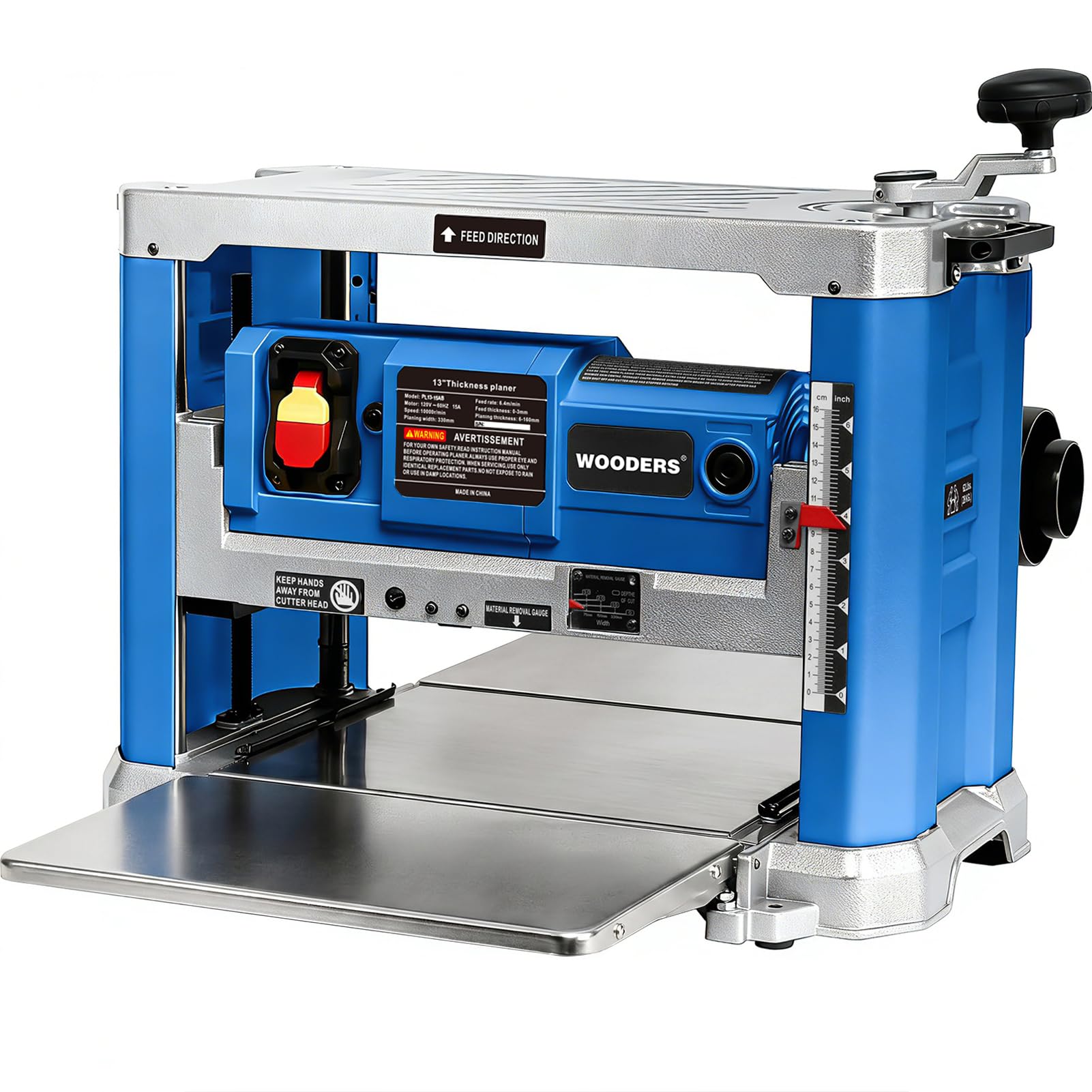
3. WOODERS 13-Inch Benchtop Thickness Planer, 15A, 4 HSS Blades
The planer designed for aching hands, with an oversized crank and high-visibility depth scale.
This WOODERS model is built with the older craftsman in mind. The oversized, smooth-turning depth adjustment crank and high-visibility height indicator (0 to 1/8 inch) minimize hand and wrist strain, which makes a big difference for users with arthritis or joint fatigue — you get micro-precision without the painful cranking. Inside, a 2000W all-copper motor delivers 10,000 RPM cutterhead speed that slices through dense hardwoods like oak or walnut without bogging down or chattering.
It handles a 13-inch max width and a height range from 1/4 to 6.3 inches. The high-speed dual-edge cutterhead pairs with an tune infeed and outfeed structure to eliminate annoying snipe, keeping boards flat and dimensionally accurate from end to end. The package includes 2 extra replacement HSS double-edged planer blades in a storage box for quick swaps, plus an integrated dust port to keep the workspace breathable. The heavy-duty iron blade shaft and rugged frame stay firmly planted on the workbench to reduce vibrations.
The value story here is strong — buyers turn pallet lumber into beautiful work pieces and call it an excellent machine at a great price. Quality and functionality lead the feedback, and most owners find it works exactly as hoped. The durability question is the honest caveat: one unit broke in under 2 months, which is a reminder that budget machines are a lottery on longevity. You also give up a two-speed gearbox, so you are locked to one feed rate.
The ergonomic edge: A high-visibility depth gauge and oversized crank make this the most accessible planer for older users or anyone with joint pain — a rare design focus that is genuinely useful, not gimmicky.
The budget reality: The 2000W all-copper motor out-specs its price tier, but longevity is unproven — treat the included spare blades as a welcome hedge.
Reach for this if: Crank effort and readability matter as much as cut quality — the ergonomics here are a genuine differentiator.
Look elsewhere if: You need two feed speeds for fine finishing on figured hardwoods — this is a single-speed machine.
4. VEVOR Thickness Planer 12.5 inch, Foldable, 1500W

The foldable planer that turns old, weathered wood into smooth stock — designed for repurposing and small spaces.
This VEVOR is specifically built to repurpose old, weathered, and worn wood, giving it an extraordinarily smooth finish. A 15-amp motor spins 2 double cutter blades at 8,000 RPM with a feeding speed of 236 inches per minute (6 meters per minute), which is a fast feed for moving through salvage lumber quickly. The HSS blades resist breaking, extending their service life., and the max cutting width is 12.5 inches with a cutting thickness of 0.2 to 6.3 inches.
The standout feature is its portability. A heavy-duty stand provides solid fixation, but the table planer is compact and space-saving with a detachable stand and foldable extension plates, plus ABS grooves on both sides for easy mobility. Reviewers point out planing a cedar slice in 30 minutes and milling logs with good results — it is a genuine workhorse for repurposing projects. A dust exhaust interface connects to dust collectors, and a power-off protection electromagnetic switch trips the over-current protector when the motor is overloaded.
The real-world feedback is mostly positive on function and value — one owner said it paid for itself quickly. But the stand draws consistent criticism: it is not sturdy and needs a custom locking-wheel stand to feel secure. The short bed is also a limitation, since long boards need an outfeed table to prevent dipping and divots. And if something breaks, replacement parts are reportedly very hard to source — the company’s support is a real gap.
The value play: For the money, this folds down to nothing and still produces a nice finish on rough wood — the “paid for itself” sentiment appears regularly.
The stability gap: The detachable stand is the weakest link; plan on mounting it to a stout base for long or heavy boards.
Best for repurposers: Grab this when you work with reclaimed lumber and need a machine that stores flat between projects.
Think twice if: You plan to run long 8-foot boards or need reliable parts support down the line — the short bed and thin support network are real limits.
5. VEVOR Power Benchtop Planer, Three-Blade Two Speed, 13 Inch

A two-speed 13-inch planer that runs quieter than planers costing twice as much.
This VEVOR three-blade planer is the quiet surprise of the group. Shoppers say it runs much quieter than machines at twice the price, which matters when you are planing for hours in a home shop. The 2000W motor spins at 23,500 RPM and provides one of the finest finishes of any portable planer in this class. The quick-change, solid steel three-knife cutter head is hardened to HRC55-60 for long-lasting, consistent cuts.
It planes boards up to 6 inches thick and 13 inches wide on a precision-machined cast iron bed. The two speeds — 24 f/m for quick planing or a slower 15 f/m for a smooth finish on figured stock with minimal to no tear-out — give you control that single-speed machines simply lack. Easily adjusted tables and extensions supply 35 inches of total length for better support on long stock, and a vacuum port connects to a dust collector. A built-in 20A over-current protector cuts power if total current exceeds 20A.
The build quality and value-for-money get strong praise, and a first-time planer owner successfully ran rough red oak to smooth on the low speed. However, the cutting performance gets mixed feedback: several buyers report the factory blades arrive dull, which ruins both feed rate and finish until you swap in a spare set. Durability is also a worry, with multiple reports of breakdowns and a company that offers limited support after 30 days. Treat the blades as a first-swap item.
The Quiet Edge
- Two speeds (24 f/m and 15 f/m) for feed control
- Cast iron bed keeps boards flat
- 35-inch total table length supports long stock
- Quieter operation than more expensive planers
The Blade Lottery
- Factory blades reported dull by several owners
- Breakdown reports beyond 30 days
- Limited parts and support from the brand
The value pick: You want two-speed control and a quieter session without paying premium prices.
The caveat: Plan on installing a sharp spare set of knives before serious work — dull factory blades are the most common complaint.
6. WEN PL1326 15-Amp 13-Inch Spiral Benchtop Thickness Planer

The budget spiral-head that leaves boards looking sanded and smooth, with hardly any snipe.
This is the planer that brings spiral-head performance to a budget-friendly price. The spiral cutterhead uses 26 staggered and rotatable HSS blades for a clean, smooth finish, and it handles even the hardest woods with ease — one owner ran hickory (a Janka hardness of 2140) successfully at shallow passes. The 15A motor generates 10,000 RPM at a 26 feet per minute feed rate, and buyers repeatedly describe the cut quality as leaving boards looking sanded and smooth, with minimal snipe and hardly any sanding needed afterward.
You can plane boards up to 6 inches thick and 13 inches wide on a cast iron base. The onboard material removal gauge tells you the cutting depth of each pass, so you know exactly how much you are taking off. The spiral head is noticeably quieter than straight-knife planers, though the motor itself is loud — a dust collector is recommended over a shop vac because the machine produces large curly chips that need real extraction. The included depth stop and adjustable dust port round out the package.
The value argument here is compelling. Owners call it the best value planer they have owned, surpassing expectations against more expensive name brands, and the spiral head handles knots and hardwoods that would tear out on a straight knife. The trade-offs are modest: shavings are not perfectly controlled through the exit tube, and the HSS inserts could be upgraded to carbide later, but the stock performance is excellent for the price. It runs slightly heavier than the DEWALT, but that added mass aids stability.
The Spiral Advantage
- 26-blade spiral head for a sanded finish
- Handles hardwoods and knots with ease
- Quiet cutter with minimal snipe
- Front material removal gauge
The Practical Notes
- Motor is loud even though cutter is quiet
- Produces large curly chips needing extraction
- Slightly heavy at roughly 100 lbs
Best for finish-first buyers: Choose this when you want spiral-head smoothness without the premium price tag.
Note: Pair it with a real dust collector, not a shop vac — the curly chips overwhelm small vacuums.
7. CUTECH 40700H 12½-Inch Spiral Cutterhead Planer, Tungsten Carbide
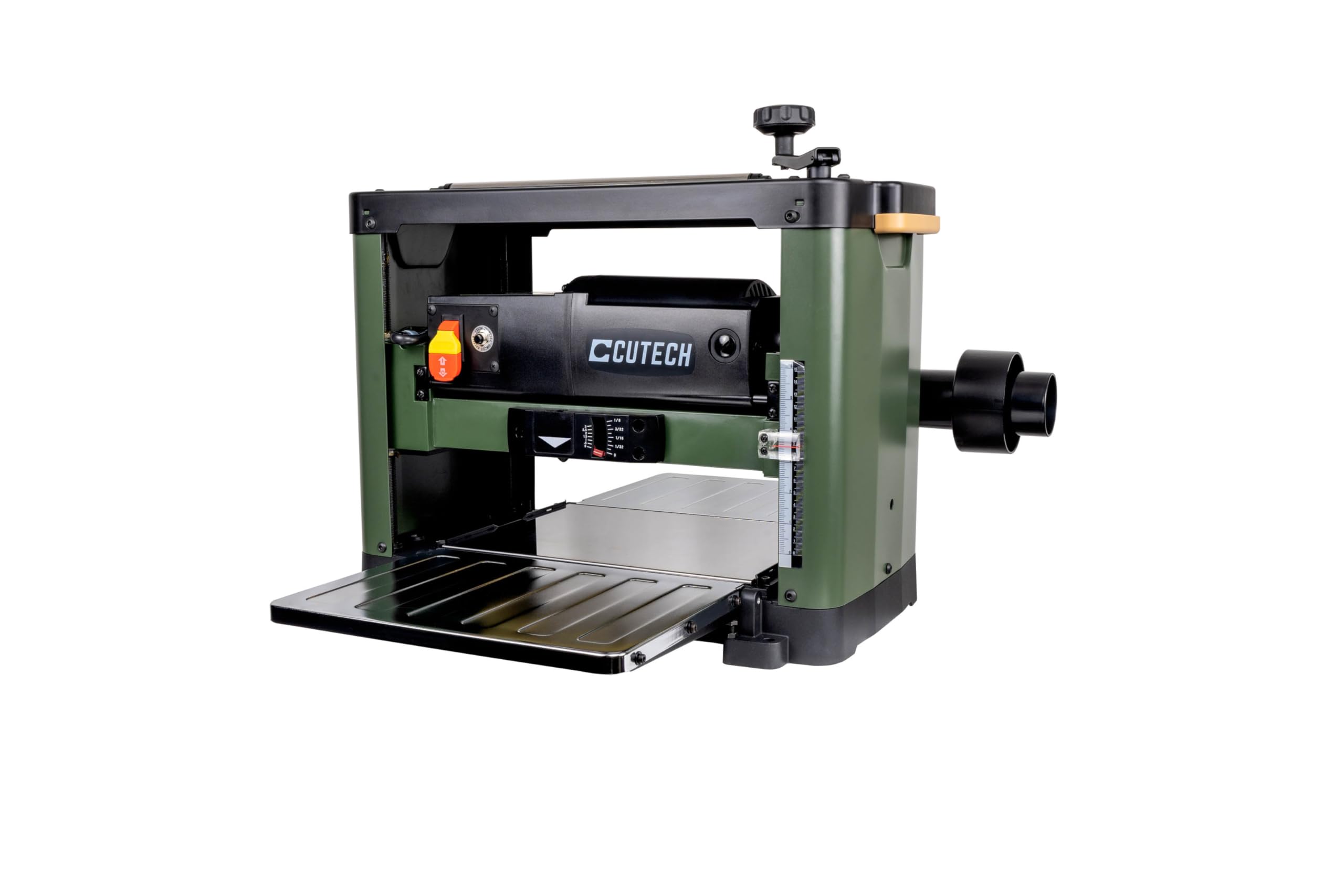
Tungsten carbide inserts in a spiral head that is quieter and smoother than the 20-year-old planer it replaced.
This CUTECH brings tungsten carbide inserts to the benchtop planer, and that makes a real difference in the shop. The spiral cutterhead holds 6 rows of staggered inserts for a smooth finish, and the two-sided carbide inserts sit in such precise alignment that they make cuts with the lowest amp draw compared to others. Owners mention using it just 5 minutes after unboxing and planing pine, cedar, and oak extremely well, with a quieter operation than a 20-year-old 12 inch Delta planer.
The snipe minimizer is the engineering gem here. Cutech’s 4 lead screws and patented coupling design automatically minimize snipe, so you do not need an additional snipe lock — it just works, which owners confirm with minimal to no snipe on every pass. The depth of cut indicator on the front shows exactly how much will be taken off in the next planing, and the newly added board return rollers send boards back to the front for the next pass without you walking around the machine.
The value story is exceptional for a carbide planer. The radial blades make quick work of trim boards, and owners call it a smooth cut that performs better than any other planer they have owned, at a reasonable price. Tungsten carbide inserts last far longer than HSS steel, so you swap them less often and get a more consistent finish. The 12.5-inch width is the only real limitation if you regularly run wider stock, and the single-speed feed means you can’t slow down for a finer finish on figured wood.
The carbide win: Tungsten carbide inserts hold an edge dramatically longer than steel, keeping this planer smooth and quiet for far more board feet.
The trade-off: At 12.5 inches it is a half-inch narrower than the 13-inch standard, and a single feed speed means less finish control on tricky grain.
Reach for this if: You want carbide longevity and a whisper-quiet spiral cut in a compact, beginner-friendly package.
skip it if: You routinely plane boards wider than 12.5 inches or need two feed speeds for figured hardwoods.
8. CUTECH 40600H 13-Inch Spiral Cutterhead Planer, 26 Carbide Inserts

A 13-inch carbide spiral planer that punched through 2,000+ board feet of air-dried oak without losing its edge.
This is the CUTECH for serious hardwood milling. The 13-inch spiral cutterhead holds 26 staggered tungsten carbide inserts, and customers note planing over 2,000 board feet of hard air-dried oak, cherry, and ash with the inserts still sharp afterward — that is the kind of longevity carbide delivers that HSS steel cannot touch. The finish feels like 180-grit sanded right off the machine, with no snipe, not even a little, which is exactly what you want when every board is expensive hardwood.
The comprehensive 8-position depth stop makes thicknessing a batch of boards to the same size easy, and the depth of cut indicator on the front shows the amount to be taken off in the next planing. A versatile flip dust hood lets you either let sawdust naturally blow out the back or flip it down to attach a dust collector for optimal chip removal. The board return rollers on top send boards back to the front for the next planing, and the 4 lead screws with patented coupling design automatically minimize snipe without a manual lock.
It is described as working better than more expensive planers, punching way above its weight class. The quality engineering shows in the fully-adjusted-out-of-the-box experience and the ability to handle the hardest woods. The mixed feedback centers on adjustability — the side handle takes some getting used to, and the dust collection could be better — but the cut quality is consistent. At a 13-inch width with a single speed, it trades feed-speed flexibility for carbide durability and smoothness.
Built for Volume
- 26 carbide inserts stay sharp for 2,000+ board feet
- 8-position depth stop for batch thicknessing
- No snipe with patented coupling design
- Flip dust hood for collector or natural blow-out
The Adjustability Curve
- Side handle takes getting used to
- Dust collection not perfect
- Single-speed feed only
Best for hardwood milling: This is the budget-carbide pick for owners who feed it oak and cherry all day and need inserts that last.
The note: Be prepared for a short learning curve on the side handle — the payoff is a flawless surface finish.
9. WEN Thickness Planer, Two Speed, 13-Inch Spiral Blade (PL1337)

The two-speed spiral planer that takes big boards and delivers a sand-free finish on every pass.
This WEN combines a spiral cutterhead with two-speed operation, a combination that is rare in this price range. Two-speed operation provides a 26 FPM feed rate for quick dimensioning and a 16 FPM feed rate for perfect finishes — so you can rough out material fast, then slow down for a final pass that requires almost no sanding. The 15-amp motor generates 10,000 cutterhead rotations per minute and up to 1354 cuts per inch, which is why the spiral head produces such a smooth, clean finish on pine, cherry, oak, and even epoxy.
It planes boards up to 6 inches thick and 13 inches wide, and the spiral cutterhead utilizes 26 staggered and rotatable HSS blades. Reviewers point out handling 13-foot boards easily with minimal snipe, and a 600 CFM dust collector captures almost all the dust. The package is complete: a depth stop, an onboard material removal gauge, a combination 2-1/2-inch and 4-inch dust port, onboard wrench storage, workpiece return rollers, and a two-year warranty. Made in Taiwan with mostly metal construction, it feels well-built for the price.
Owners who ran 3,000 board feet of ash before flipping the inserts confirm the dual-speed system delivers a sand-free finish, and it handles large pieces as well as small ones. The recurring gripe is dust collection — shavings tend to spray out the feed side, so it really needs that collector. One owner noted the stock steel inserts dull eventually (carbide is a popular upgrade), and after a few months the rubber feed wheels can lose stickiness and fail to pull stock through occasionally. Value for money is strong for non-commercial users.
The Two-Speed Advantage
- 26 FPM for fast removal, 16 FPM for fine finish
- Up to 1354 cuts per inch for smooth surfaces
- Handles 13-foot boards with minimal snipe
- Two-year warranty included
The Practical Limits
- Dust collection is the weak point — shavings spray out
- Steel inserts dull; carbide is the common upgrade
- Feed wheels can lose grip over months of use
Best for the home shop: Reach for this when you want spiral-head smoothness plus the flexibility of two feed speeds for varied projects.
The fair warning: Budget for a good dust collector and consider carbide inserts — the two upgrades solve its only real weaknesses.
Understanding the Specs
Motor Power: Amps and RPM
Amperage (like 15 amps) tells you how much electrical current the motor draws. A 15-amp motor is the standard benchmark for benchtop planers — it provides enough torque to power through thick stock without stalling. The motor RPM (like 20,000 RPM on the DEWALT or 10,000 RPM on most others) is the motor speed, but what really matters is the cutterhead speed — the speed at which the cutting head itself spins. Most planers list cutterhead speeds around 10,000 RPM, which is the industry balance for a clean cut. A higher motor RPM with the same cutterhead speed typically means more torque is available at the cutter.
Feed Rate: Feet per Minute
Feed rate measures how fast a board moves through the planer, in feet per minute (ft/min or FPM). A faster feed (like 26 FPM) removes material quickly, which is great for dimensioning a stack of stock. A slower feed (like 16 FPM) takes more time but leaves a finer finish. Two-speed planers let you have both — fast for roughing, slow for finishing. Single-speed planers typically land around 20-26 ft/min, which is a decent compromise. If finish quality is your top priority, look for a slow feed option so you are not stuck with a rough surface on figured wood.
FAQ
What is snipe and how do I avoid it?
Is a spiral cutterhead worth the extra money over straight knives?
What does two-speed operation actually do for me?
How thick and wide a board can a benchtop planer handle?
HSS blades or tungsten carbide inserts — which is better?
Will a planer work on hardwood like oak or walnut?
How much dust does a benchtop planer produce and how do I manage it?
What’s the difference between a thickness planer and a jointer?
How much bench space and power does a planer need?
How often do I need to change the blades on a planer?
Final Thoughts: The Verdict
If you want one dependable pick, the budget thickness planer winner is the DEWALT DW735X because the two-speed gearbox, automatic carriage lock, and fan-assisted chip ejection together deliver the most polished benchtop experience — the crowd favorite at 4.7 stars across thousands of owners. If you want a spiral-head finish on a tighter budget, grab the WEN PL1326 for its 26-blade smoothness. And for carbide longevity that survives 2,000+ board feet of hardwood, the CUTECH 40600H is the one to reach for.
How We Picked
We do not accept paid placement. Every pick is matched to a real buyer and a real use-case; we do not hands-on test units.
Sources & Methodology
Specifications: manufacturer listings and product documentation. Review insights: verified customer reviews, as of August 2026. Pricing: not shown on this page (it changes often); check the current price via the retailer link.
As an Amazon Associate, Gadgets Feed earns from qualifying purchases. This does not affect which products we feature.