
Our readers keep the lights on and my morning glass full of iced black tea. As an Amazon Associate, I earn from qualifying purchases.
Specs are compiled from manufacturer listings and verified buyer reviews and can change over time — please confirm the key details on the product page before buying.
Finding a mountain bike under a few hundred dollars that actually survives a rocky climb feels impossible — most listings promise “all-terrain” but ship with plastic pedals and wobbly wheels. The truth is that a handful of genuinely capable budget builds exist, and they separate themselves with one thing: a real suspension fork that absorbs roots and drops instead of bouncing you off the saddle. This guide digs into nine of them, sorting the honest trail bikes from the driveway cruisers, so you know exactly where your money lands before you click buy.
I’m Min — the founder and writer behind Gadgets Feed. This guide is built by comparing the manufacturers’ published specifications and the patterns across verified customer reviews, so you get each pick’s real strengths and trade-offs instead of marketing spin.
Whether your next bike needs to handle loose gravel, muddy singletrack, or daily commuter miles, the right budget trail bike balances frame material, suspension travel, and braking power for under. That balance is what separates a toy from a trail tool, and the reviews below prove it exists.
Our Picks at a Glance


How To Choose The Best Budget Trail Bike
Budget trail bikes live and die by three things: the frame material, the front suspension, and the brakes. A cheap bike with a stiff fork will rattle your wrists on every root, while a bike with weak linear-pull brakes can feel scary on a steep descent. Here’s the plain-English breakdown of what actually matters.
Frame Material: Aluminum vs. Steel vs. Alloy
Aluminum alloy frames are the clear winner for a budget trail bike because they keep the whole build light enough to lift onto a rack or carry up stairs. Steel and carbon-steel frames weigh more — some foldable builds tip the scales at 40 lb or more — but they often feel burlier and absorb vibration differently. If you’re climbing hills, the lighter aluminum frame will make every pedal stroke easier.
Suspension: Front Only vs. Full
A front suspension fork is the minimum you need for real trail riding, since it takes the sting out of rocks and roots on the handlebars. Full suspension adds a rear shock too, which soaks up big drops but adds weight and cost — on a budget, a good front fork usually beats a mediocre rear shock. Look for a fork with lockout (a switch that stiffens it for pavement climbs) so you don’t waste energy bobbing on the road.
Brakes: Disc vs. Linear Pull
You get reliable stopping power on wet or muddy trails with disc brakes — a rotor and caliper at each wheel — which grip more strongly and predictably than rim pads. Linear pull brakes, which pinch the rim with pads, cost less but lose bite in the rain. For a budget trail bike, mechanical disc brakes hit the balance: better braking than rim pads, without the higher price of hydraulic systems.
Quick Comparison
| Model | Best For | Frame | Suspension | Drivetrain | Amazon |
|---|---|---|---|---|---|
| Gravity FSX 1.0★ Best Overall | Best Overall Trail Value | Aluminum | Full (Front & Rear) | 24-Speed | Amazon |
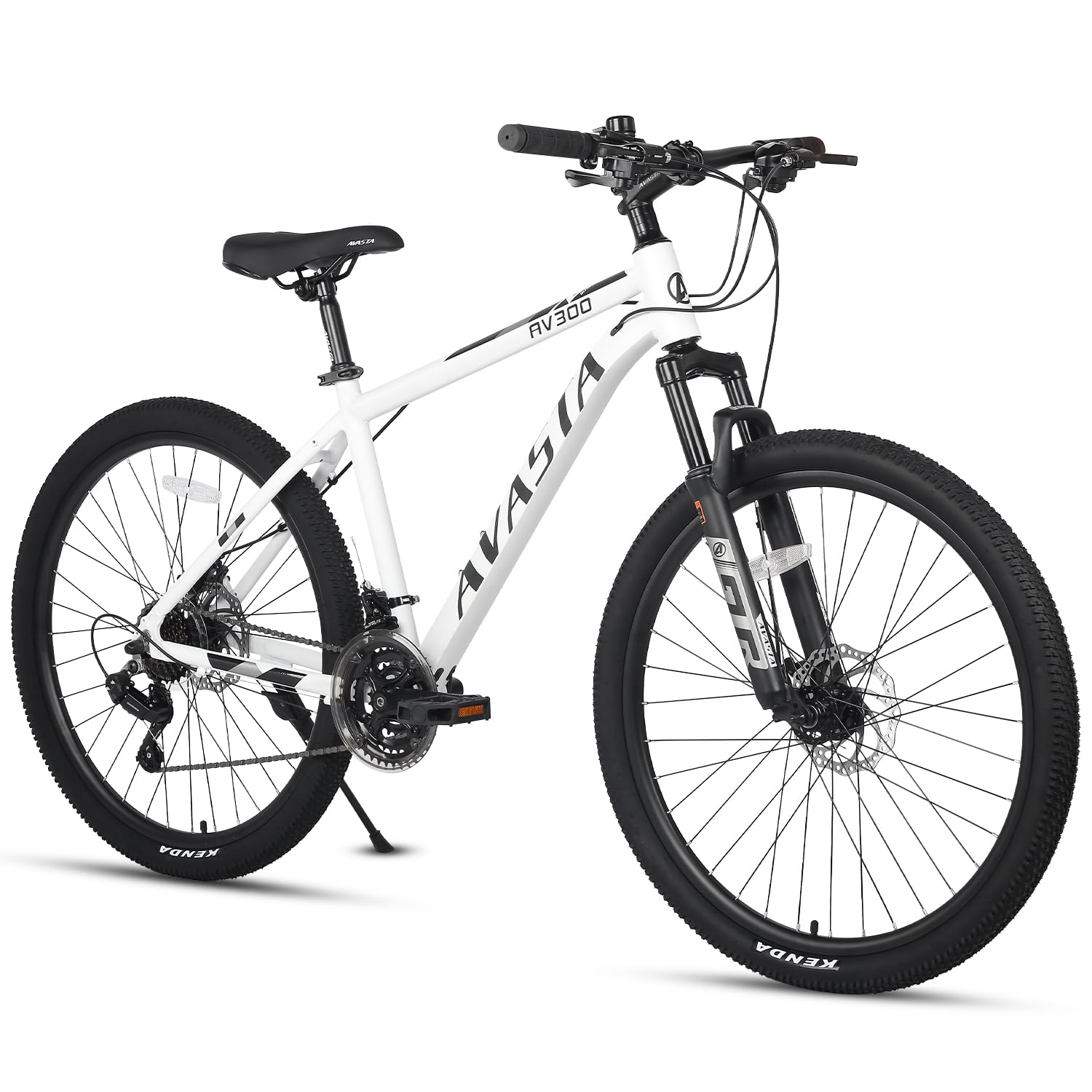
| AVASTA AV300Clean Build | Clean Internal Cables | Aluminum Alloy | Front | 21-Speed | Amazon |
| AVASTA Earth 26Smart Value | Easy Setup & Commutes | Aluminum Alloy | Switchable Front | 21-Speed | Amazon |
| SPATIAL MTB | Multiple Size Fits | Aluminum Alloy | Lockout Front | 8 or 21-Speed | Amazon |
| Xspec Folding | Car Trunk Storage | Alloy Steel | Front & Rear | 21-Speed | Amazon |
| CamPingSurvivals Foldable | Compact Folding Hauls | Carbon Steel | Full (Thickened Fork) | 21-Speed | Amazon |
| HILAND 18-Speed | Tall Riders (5’8″–6’5″) | Aluminum Alloy | Adjustable Front | 18-Speed | Amazon |
| Huffy Stone | Budget Commuter | Alloy Steel | Front | 21-Speed | Amazon |
| Huffy 21-Speed | Value All-Terrain | Aluminum | Front | 21-Speed | Amazon |
In-Depth Reviews
1. Gravity FSX 1.0 Dual Full Suspension Mountain Bike
Our pick — over 4★ from 400+ verified ratings; the strongest balance of quality and price.
The crowd favorite proving full suspension is possible on a budget, with 24 speeds and disc brakes both ends.
This is the pick that gives you both a front fork and a rear shock — genuine full suspension — so rock gardens and root sections get absorbed at both wheels instead of hammering your spine. The aluminum frame keeps it manageable at 15.9 kg, while the double-wall rims (sturdier than single-wall rims that dent easily) and quick-release wheels make trail-side repairs and cleaning far less painful. Owners rally around the quality and the value-for-money balance, calling the forks, shocks, and brakes “excellent for price.”
Assembly is the honest trade-off — buyers agree it is manageable but warn the front brake may arrive needing adjustment because the disc can sit against the caliper. The seat draws the most consistent grumbling, with several riders swapping it out for a padded replacement. Tires also arrive under-inflated and can go flat within an hour, so budget for a pump (one is included) and possibly fresh rubber.
Ride it downhill and the adjustable front suspension shines, with real absorption on descents; the rear shock is slower but fine for jumps. The mechanical disc brakes are strong and quiet. The thing everyone raves about is the sheer value — a capable full-suspension build with the components of pricier bikes, just 10–15 lb heavier since there is no carbon or titanium here.
What Riders Love
- Real full suspension soaks up roots and jumps
- Disc brakes front and rear stop strong and quiet
- Aluminum frame keeps weight reasonable at 15.9 kg
- 24-speed drivetrain gives climbing range
What to Know Before You Ride
- Hard stock seat — most buyers swap it out
- Brakes often need a quick caliper adjustment from the start
- Tires arrive low and may need replacing
- No kickstand mount available
Reach for it when: you want a true full-suspension trail bike that keeps pace with bikes costing far more.
Look elsewhere if: you want zero assembly hassle — this one arrives 80% built and demands a little mechanical patience.
2. AVASTA AV300 21-Speed Mountain Bike
A Shimano-equipped trail bike with half-hidden internal cables that keep the frame looking clean and protected.
This one wins people over with its tidy construction — the brake cables route inside the frame, which buyers call out as a clean look that also shields the lines from snags on brushy trails. It rolls on a lightweight aluminum alloy frame and rims, with a premium suspension fork up front and dual disc brakes, all wrapped in a 21-speed derailleur system. Owners consistently describe it as well-made and easy to assemble, with one noting ride quality and the ability to downshift three gears at once.
Assembly runs about 90 minutes with the included tools, and the instructions get solid marks. Shimano parts show up throughout the drivetrain, which is why shifting feels smooth and braking feels strong from the start after minor tweaks. A few buyers mention a bent rear derailleur hanger on arrival — a sacrificial part that can be straightened or replaced to get the largest gear working.
It arrives 75% pre-assembled, with a bell, kickstand, reflectors, and tool kit included, plus an installation video on the product page. The stock seat and grips earn praise for comfort, which is rare at this price tier. The recurring grumble is the chain guard, with several buyers reporting it breaking — a small plastic piece best checked after assembly.
Why it stands out: internal cable routing and a full Shimano drivetrain at a price where most bikes cut corners on both.
The catch: the plastic chain guard can snap, and a bent derailleur hanger is an occasional arrival defect.
Pick this if: you want a light, clean-lined trail bike with quality shifting and a comfortable saddle.
Think twice if: you need a rugged bike for abusive downhill riding — this leans toward trail-and-commute duty.
3. AVASTA Earth 26/27.5-Inch Mountain Bike
The trail bike that flips its fork from plush to firm, making it as happy on pavement as on gravel.
The standout feature here is the switchable suspension fork — flip a switch and the fork stiffens for efficient road climbing, then opens back up to soak up rocky trail chatter. That dual personality makes it a smarter pick than a fixed-fork bike if your rides mix commutes with weekend dirt. The aluminum alloy frame and rims keep it light, and the 21-speed derailleur with disc brakes covers the shifting and stopping basics with room to spare.
Buyers take it on real trails — including Montana singletrack — and report it handles the terrain well for the price, with one rider calling it “excellent for city riding” as a daily commuter. Assembly is genuinely easy, helped by a 75% pre-assembled build and a clear installation video; the front derailleur may need a slight tune but the rear comes pre-set. A bell, kickstand, reflectors, and tool kit ride along in the box.
The honest gripes are comfort-related: the seat is too small for some, causing pain after about 30 minutes, and one owner’s chain snapped at the three-week mark (a replacement part). Quality and value-for-money are the most-praised aspects, with riders repeatedly calling it a better build than comparably priced department-store bikes.
The big win: the lockable fork is rare at this price and genuinely useful for mixed road-and-trail riders.
Read the fine print: plan to swap the seat, and know the chain is budget-tier.
Choose it for: riders who split time between pavement commutes and weekend trail rides and want one bike for both.
skip it if: you plan marathon-length rides without replacing the stock saddle.
4. SPATIAL Mountain Bike (24″/26″/27.5″/29″)
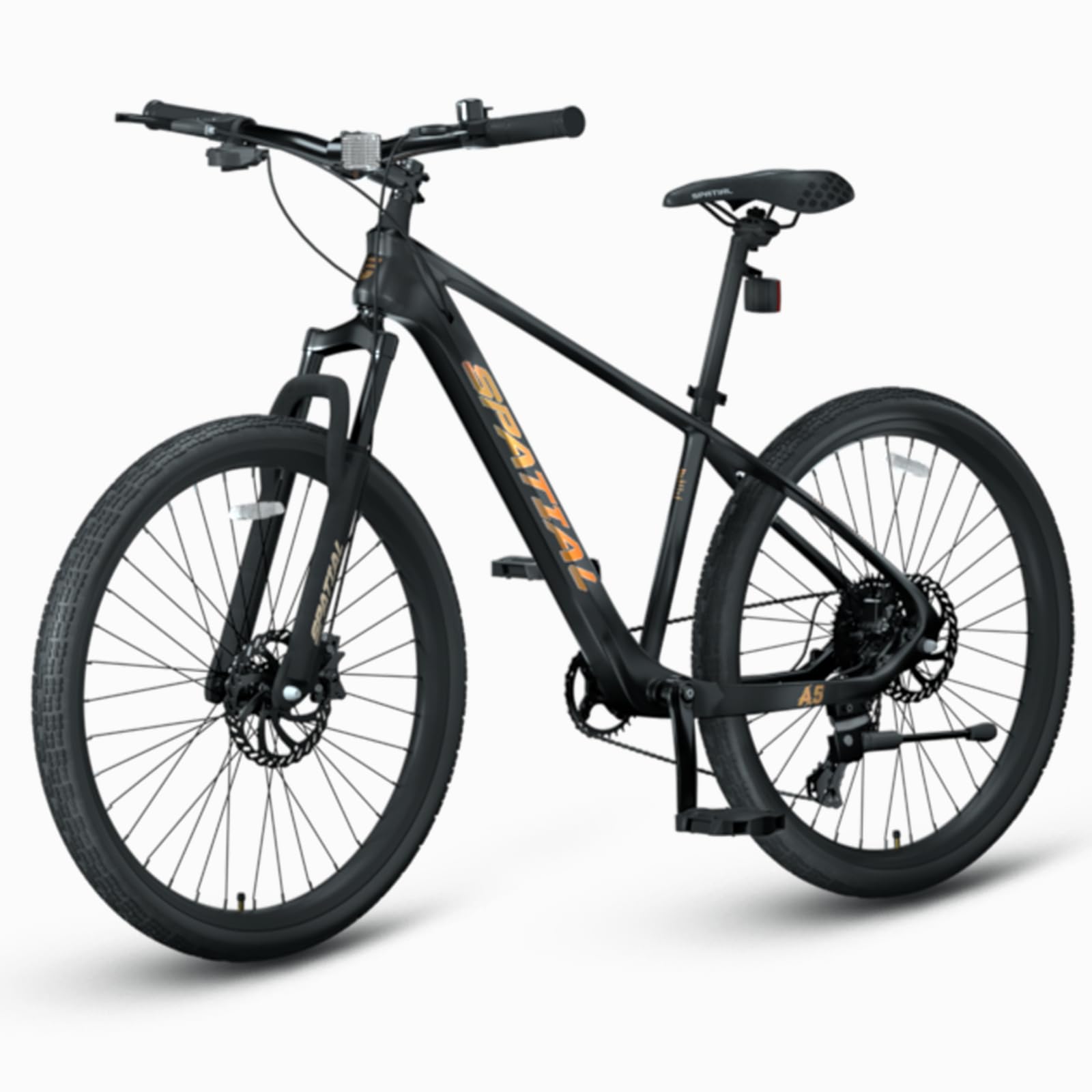
A 33 lb aluminum build with four wheel sizes, a lockout fork, and Shimano gearing that fits teens to tall adults.
This is the size-flexible option — it comes in 24-inch, 26-inch, 27.5-inch, and 29-inch wheel versions, with an adjustable seat post that fits riders from 146 cm to 195 cm tall. That broad range makes it a rare budget pick a growing teen can keep riding, or a taller adult can actually stretch out on. The lightweight 33 lb aluminum alloy frame is paired with a lockout front fork, so you can stiffen the suspension for efficient climbing on the road.
Shimano gearing drives the shifting — an 8-speed or a 21-speed 3×7 setup depending on the model — and buyers call the shifters quick and smooth. All-weather mechanical disc brakes front and rear keep stopping power reliable in rain, mud, and dirt. The 2.10-inch tires add traction on loose trails while the lockout fork improves climbing efficiency.
Assembly lands at 85% preassembled with clear instructions and an installation video, and buyers report a fairly easy build. The ride quality earns consistent praise, with bikes holding up well through six months of use. The durability of the brake handles draws a few complaints, and the fit is mixed for some riders, so measure your height against the size chart before ordering. The seat runs small — a gel cushion is a common add-on.
Rider Favorites
- Four wheel sizes fit everyone from junior-high kids to tall adults
- Lockout fork stiffens for pavement and road climbs
- Shimano shifters feel quick and smooth
- All-weather disc brakes stop confidently in rain
Watch Points
- Brake handle breakage appears in a few reports
- Stock seat is small and often needs a cushion
- Check your height against the sizing chart first
Best for: families or riders whose height sits between size charts and who need one bike that fits now and later.
Worth noting: treat the brake levers gently and swap the saddle early for long-ride comfort.
5. Xspec 26″ 21-Speed Folding Mountain Bike

A 42 lb folding MTB that drops into a car trunk in seconds, with dual shocks and 21 speeds for trail or commute.
If storage is your bottleneck, this is the bike that disappears — it folds flat in seconds with no tools, collapsing to 41″H x 32″L x 22″W so it slides into a sedan trunk or an apartment corner. Weighing in around 42 lb, it is heavy to carry but light on footprint, and the high-tensile steel folding frame handles both tough trail miles and daily commutes. Front and rear shock absorbers smooth out the ride, while the alloy double-wall rims with 26-inch wheels add durability.
The Shimano multi-speed drivetrain with trigger shifters delivers accurate gear changes — owners mention the shifting is reliable once the bike is assembled and tuned. Disc brakes give stronger, more predictable stopping power than rim pads, which matters when a trail turns wet. The recommended rider height is 5’3″ to 6’0″, with a max user weight of 220 lb (customers note it holding up fine for a 210 lb rider).
Assembly is the weak spot: the manual is generic and often shows the wrong bike, so expect trial-and-error time (roughly two hours) and a trip to YouTube. The stock seat is genuinely uncomfortable and gets swapped by most owners. A few report broken pedals and a bent disc brake from the start, though the frame, fold, and suspension earn consistent praise.
The payoff: fold-and-go portability few trail bikes offer, with a sturdy frame and good gears underneath.
Budget for it: a shop tune-up around and a replacement saddle transform the ride experience.
Reach for this if: you need a trail-capable bike that stores in a trunk or closet between rides.
Pass it by if: you want a smooth out-of-box build with clear instructions.
6. CamPingSurvivals 21-Speed Foldable Mountain Bike

A sturdy 40 lb carbon-steel folder with professional 21-speed shifting that stows in a Jeep or sedan back seat.
Reviewers point out a “sturdy 40lb carbon-steel frame, no cheap plastic” — the first thing that stands out here is a genuinely solid build. It arrives 85% assembled, so you only attach the handle, cushion, front wheel, and pedals, then adjust brake and gear. The quick-release clamp folds the bike in half, which owners confirm fits inside a Jeep and even across the back seat of a 4-door sedan — perfect for taking it anywhere.
The 21-speed professional shifting system with front and rear derailleurs makes quick, precise gear changes across gravel, dirt, and rocky paths. A thickened shock-absorbing front fork pairs with a shock-absorbing cushion for a double damping effect, while mechanical dual disc brakes deliver strong stopping force. Owners note the disc brakes and shocks feel smooth, and the package arrives with some of the best protective packaging in the category — heavy nylon ties secure everything.
You can assemble it easily with the included tools, and the English manual is clear. The honest caveats: there is no lock when folded, the bike is heavy (40 lb carbon steel), and at least one taller adult found it too small despite the 27-inch wheel claim — so check your height against the frame before ordering. Shoppers say the company responds quickly, even replacing a whole bike after a video showed a bent front wheel.
The appeal: an uncommonly sturdy folding frame and excellent customer support for a budget folder.
The trade-off: 40 lb of steel is a workout to carry, and fit runs small for taller adults.
Best for: teens, smaller adults, and campus riders who need a tough bike that folds into a car.
Not ideal for: riders over about 5’10” who need a full-size frame stretch.
7. HILAND 26/27.5-Inch 18-Speed Mountain Bike
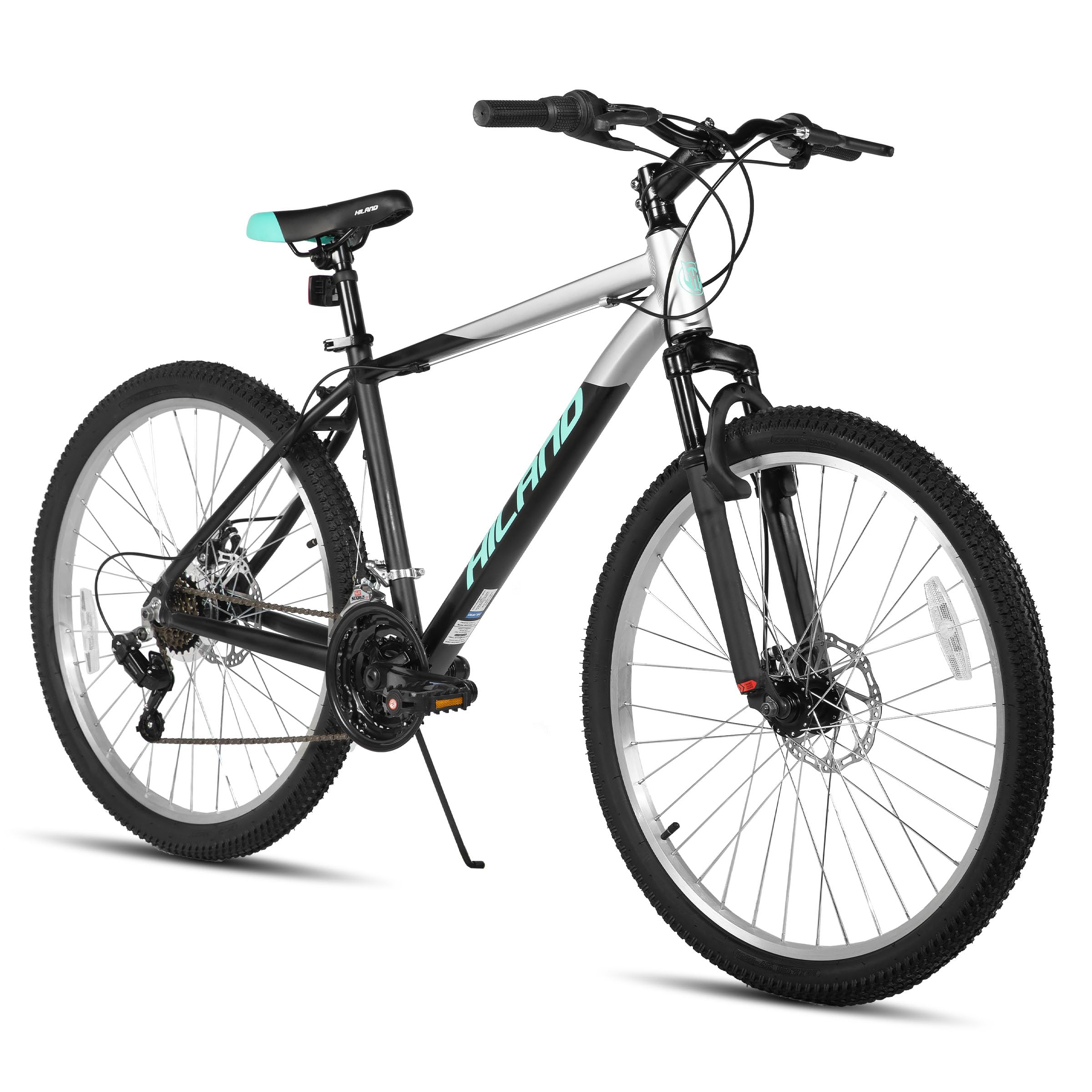
A corrosion-resistant aluminum frame with internal cable routing, sized specifically for riders from 5’8″ to 6’5″.
Tall riders get a genuine nod here — the recommended rider height is 5’8″ to 6’5″, with a minimum user height of 68 inches, so this is one of the few budget builds that actually fits a long-legged adult. The high-quality aluminum alloy frame resists corrosion and stays light, and internal cable routing protects the lines for longer life while giving the bike a clean profile. The responsive front suspension fork has adjustable damping, so you can dial the fork stiffness to match the trail or the pavement.
The 18-speed gear system shifts smoothly across hills, gravel, and dirt, while dual disc brakes deliver dependable stopping power in dry and wet conditions. Fast-rolling XC tires on durable double-wall alloy rims add grip and puncture resistance. Assembly is quick at 85% preassembled with tools included — buyers report about 30 minutes of build time and an overall well-made impression.
Owners mention the front disc rotor may need adjusting on arrival, and the front rim can arrive slightly out of true, needing a quick straightening. One owner had a gear issue fixed at a local shop for, fully reimbursed under the warranty — a sign the company stands behind the product. The lack of printed instructions is a minor gripe; a quick video search covers the rotor adjustment.
Why it earns a spot: genuine tall-rider sizing plus a corrosion-resistant frame and adjustable fork at a mid-range price.
Small caveats: budget for a possible rotor tweak and check the front rim trueness on arrival.
Reach for it if: you are 5’8″ or taller and tired of budget bikes that force you to hunch over the bars.
Look elsewhere if: you are under 5’8″ — the frame geometry starts well above that.
8. Huffy Stone Mountain Bike (20″/24″/26″)

A 37 lb steel commuter with 21-speed Shimano twist shifting and a front suspension fork for mixed terrain.
This Huffy leans toward the commuter end of the trail spectrum — a sleek matte black alloy-steel frame with a 21-speed Shimano twist shifter that handles flat roads, hills, and moderate trails. The front suspension fork smooths out bumps, and the padded comfort saddle supports longer rides. It ships in multiple wheel sizes — 20″, 24″, and 26″ — so it fits everyone from kids up to adults.
The standout praise is value-for-money, with hundreds of owners calling it a solid deal. One rider reports it survived a full year and 1,000 miles of daily all-weather commuting, and heavier riders (up to about 230 lb) report a comfortable, enjoyable ride. Durability reviews mention it is “not for hard trails” — it is happiest on pavement, gravel paths, and bumpy woods rather than aggressive downhill. Assembly gets mixed marks: some find it easy, others struggle.
The recurring grumbles are the uncomfortable seat (near-universal across budget bikes), a slow middle gear, and suspension that does not rebound with any spring. A heavier rider reported the handlebar loosening each ride and a pedal falling off. If you keep it on mild terrain and upgrade the seat, grips, and pedals (roughly total), it becomes a genuinely pleasant trail cruiser.
The strength: unbeatable commuter value with Shimano twist shifting and a comfort saddle from the box.
Set expectations: this is a light-trail and pavement bike, not an aggressive mountain machine.
Pick this if: your “trail” is a gravel path or woodsy commute and you want a proven, cheap daily rider.
Avoid it if: you plan rocky descents or hard singletrack — the durability reports get rougher there.
9. Huffy 26″/27.5″ 21-Speed Mountain Bike

A lightweight 17-inch aluminum frame with knobby tires and 21 speeds that grips loose ground on a budget.
This Huffy trades the steel frame of its sibling for a 17-inch lightweight aluminum build, which makes it noticeably easier to maneuver and lift. The 21-speed drivetrain shifts precisely for hills and flat paths alike, while rugged knobby tires grip rocky trails and gravel. Alloy linear-pull brakes — which pinch the rim — provide dependable stopping power on descents, and the ergonomic saddle, comfortable grips, and kickstand round out the package.
Buyers call it well-made and affordable for amateur riders, with a build that handles pavement and easy trails smoothly. One owner reports the fat tires provide real help on loose ground, and assembly runs under an hour for most. The brakes are not grabby from the start — a plus for control. It fits a 5’10” rider comfortably.
The honest negatives cluster around durability: several customers note pedals breaking within weeks of light use, and the seat is hard enough to cause pain in about 15 minutes — replace it immediately. The front derailleur may require hours of YouTube-guided tuning to get all 21 gears working. A few buyers hit tire-seating problems where the tube pushed off the rim; Huffy’s support did ship replacement wheels and tubes in those cases, though email support is inconsistent.
The draw: a light aluminum frame and fat knobby tires that grip loose ground, all at entry-level pricing.
Plan upgrades: a new saddle is essential, and the pedals may need early replacement.
Best for: casual riders who want a light, grippy bike for easy trails and pavement cruising.
Think twice if: you hammer hard terrain regularly — the drivetrain and pedals are budget-tier.
Understanding the Specs
Frame Material
Aluminum alloy keeps a budget trail bike light enough to lift onto a rack and agile on climbs, which is why most picks here favor it. Steel and carbon-steel frames feel burlier and often cost less, but they add real weight — some foldable builds reach 40 lb. If you carry your bike up stairs or onto a bus, aluminum is the better daily choice.
Suspension Type
A front suspension fork is the bare minimum for trail comfort because it absorbs the rocks and roots that reach the handlebars. Full suspension adds a rear shock that soaks up bigger drops but adds weight and cost. A lockout fork — a switch that stiffens the suspension — helps you climb pavement efficiently without the fork bobbing. On a budget, a quality front fork beats a cheap rear shock.
FAQ
Is full suspension worth it on a budget trail bike?
How do I know if the bike fits my height?
What does “21-speed” actually mean for trail riding?
Are disc brakes really better than linear pull brakes?
How much assembly should I expect?
Why is the stock seat so uncomfortable on budget bikes?
Can a folding mountain bike actually handle trails?
How much does delivery damage affect budget bikes?
Final Thoughts: The Verdict
For most riders, the budget trail bike winner is the Gravity FSX 1.0 because it delivers genuine full suspension, disc brakes, and a 24-speed drivetrain on an aluminum frame — the most trail-ready package at this price. If you want clean internal cable routing and a comfortable stock saddle, grab the AVASTA AV300. And for riders who need a bike that folds into a car trunk between rides, the Xspec Folding is the one to reach for. Whichever you pick, budget a little for a better saddle and a basic tune-up — those two small upgrades make every one of these bikes ride like it costs more.
How We Picked
We do not accept paid placement. Every pick is matched to a real buyer and a real use-case; we do not hands-on test units.
Sources & Methodology
Specifications: manufacturer listings and product documentation. Review insights: verified customer reviews, as of August 2026. Pricing: not shown on this page (it changes often); check the current price via the retailer link.
As an Amazon Associate, Gadgets Feed earns from qualifying purchases. This does not affect which products we feature.