
Our readers keep the lights on and my morning glass full of iced black tea. As an Amazon Associate, I earn from qualifying purchases.
Specs are compiled from manufacturer listings and verified buyer reviews and can change over time — please confirm the key details on the product page before buying.
Picking a budget ultralight sleeping bag means juggling two things that pull against each other: keeping your pack weight down and staying warm when the temperature drops. The lightest bags can leave you shivering below 50°F, while the warmest budget options often push past the 3-pound mark that defeats the whole point of going ultralight.
I’m Min — the founder and writer behind Gadgets Feed. This guide is built by comparing the manufacturers’ published specifications and the patterns across verified customer reviews, so you get each pick’s real strengths and trade-offs instead of marketing spin.
You’ll find the top nine contenders ranked by warmth-to-weight ratio, packability, and real owner feedback to help you choose the budget ultralight sleeping bag that actually fits your trails and your sleeping style.
Our Picks at a Glance


How To Choose The Best Budget Ultralight Sleeping Bag
The real job of an ultralight bag is to disappear inside your pack while still keeping you warm on a cold night. Every model here is a compromise, so the trick is knowing which trade-off you can live with before you spend a dollar.
Start with the Comfort Rating, Not the Extreme Rating
The number printed on the tag is usually the “limit” or “extreme” rating, which assumes you’re wearing warm layers and are a warm sleeper. For a realistic idea of comfort, look for the comfort rating — the temperature at which an average sleeper stays warm without extra clothes. On budget bags, this can be 10 to 20 degrees higher than the headline number, so plan your trips around the comfort figure.
Weigh the Fill Power Against the Weight
Fill power measures how much loft (fluffy dead-air space) an ounce of down creates. Higher fill power like 650 or 700 means more warmth for less weight, which is why it’s the first spec ultralight buyers check. But fill power is only half the story — total bag weight is what your back feels at the end of the day, so check both numbers together.
Match the Shape to How You Sleep
A mummy bag hugs your body to trap heat efficiently, making it the warmest and lightest option, but it can feel restrictive if you toss and turn. An envelope cut gives you room to move and often unzips into a blanket, but it costs extra weight and warmth. Hybrid designs split the difference, with a snug upper body and a roomier footbox — ideal if you move around but still want efficiency.
Quick Comparison
| Model | Best For | Weight | Fill Power | Comfort Rating | Amazon |
|---|---|---|---|---|---|
| Kelty Cosmic 20★ Best Overall | Warm 3-season mummy | 2.6 lbs | 550 | 21°F (limit) | Amazon |
| Naturehike 650FPBest Value | Featherweight budget pick | 1.3 lbs | 650 | 51.8°F | Amazon |
| QEZER 600FP SummerMost Versatile | Warm-weather roomy bag | 1.3 lbs | 600 | 68°F | Amazon |
| QEZER 600FP Semi-Rect | Spacious mild-weather | 1.68 lbs | 600 | 61°F | Amazon |
| ZOOOBELIVES Alplive T400 | Compressible quilt-style | 1.7 lbs | 650 | 50°F | Amazon |
| ATEPA Coldmaster | Pad-attachment security | 2.5 lbs | 650/700 | 50°F | Amazon |
| QEZER 0°F | Cold-weather emergency | 1.9 lbs | 600 | 63°F | Amazon |
| Litume 700FP | Minimalists & travel | 1.3 lbs | 700+ | 59°F | Amazon |
| Naturehike Hybrid | Side sleepers & room | 2 lbs | 650 | 40.4°F | Amazon |
In‑Depth Reviews
1. Kelty Cosmic 20 Down Mummy Sleeping Bag
Our pick — over 4.5★ from 100+ verified ratings; the strongest balance of quality and price.
The warmest pick here, built for real 3-season nights without the flimsy feel.
Warmth is the story with this one — it’s the bag reviewers reach for when the forecast dips into the 20s. Buyers report it keeps them comfortable into the high 20s°F with just a base layer, thanks to the good loft, a snug hood, and a draft collar that blocks cold air at the neck.
The weight is the honest trade-off: at 2.6 pounds it’s noticeably heavier than the 1.3-pound Naturehike above, but you’re paying for insulation that actually handles cold weather. It packs down small enough to disappear into a 50L backpack, and the dual-direction zipper makes midnight exits easier. The fit leans snug through the shoulders, so if you’re broad-chested, expect a close hug rather than room to sprawl.
Owners mention the quality stands out at this level — high-stitching standards and a smooth zipper that’s easy to work even in the dark. The recycled shell and liner with PFAS-free water repellent keep the sustainability angle honest, and the RDS traceable down means you can verify where the insulation came from. It’s a “great value, not ultralight” pick, as the reviews put it — the one to grab when warmth outranks a few saved ounces.
Why Owners Love It
- Warmth is the most-praised trait — the thing everyone raves about is how cozy it stays in cold weather
- Packs down surprisingly small for its warmth
- Roomy footbox gives your feet space to move
Who Should Think Twice
- At 2.6 lbs it won’t win any gram-counting contests
- Snug through the shoulders for broader builds
Grab this for: 3-season campers who want genuine warmth without a premium price tag.
Pass if: you’re counting every ounce for long backcountry miles — the lighter bags below save a full pound.
2. Naturehike Ultralight Backpacking RDS Down Sleeping Bag
The featherweight that carries like a water bottle and lives in your pack.
At 1.3 pounds, this is the lightest bag on the list — about the weight of a single water bottle, which is exactly the kind of math ultralight hikers love. The 650 fill power down beats the Kelty’s 550 fill, meaning it creates more loft per ounce, so you get that compressibility without hauling bulk.
You get a bag that packs down small and light, but customers note it’s “very lightweight and compact, but not too warm.” It keeps you comfortable on mild nights into the upper 40s and low 50s, and it doubles as a travel comforter for chilly hotel rooms or summer campouts. The envelope-style cut (a roomy, rectangular shape) lets you move freely, and it fully unzips into a blanket — so it stays useful even when the weather warms up.
Quality punches above the price point, with a smooth YKK two-way zipper that doesn’t snag and a durable 20D nylon shell that resists moisture. The RDS-certified down keeps the ethics clean, and at this price it’s the rare bag that works for both beginners and experienced campers who know exactly what they’re skipping — serious warmth.
Featherweight favorite: the go-to pick for warm-weather hikers who prioritize pack space and ounces over insulation.
Reality check: comfortable down to about 50°F, so leave it home for cold-weather trips — that’s the Naturehike’s honest limit.
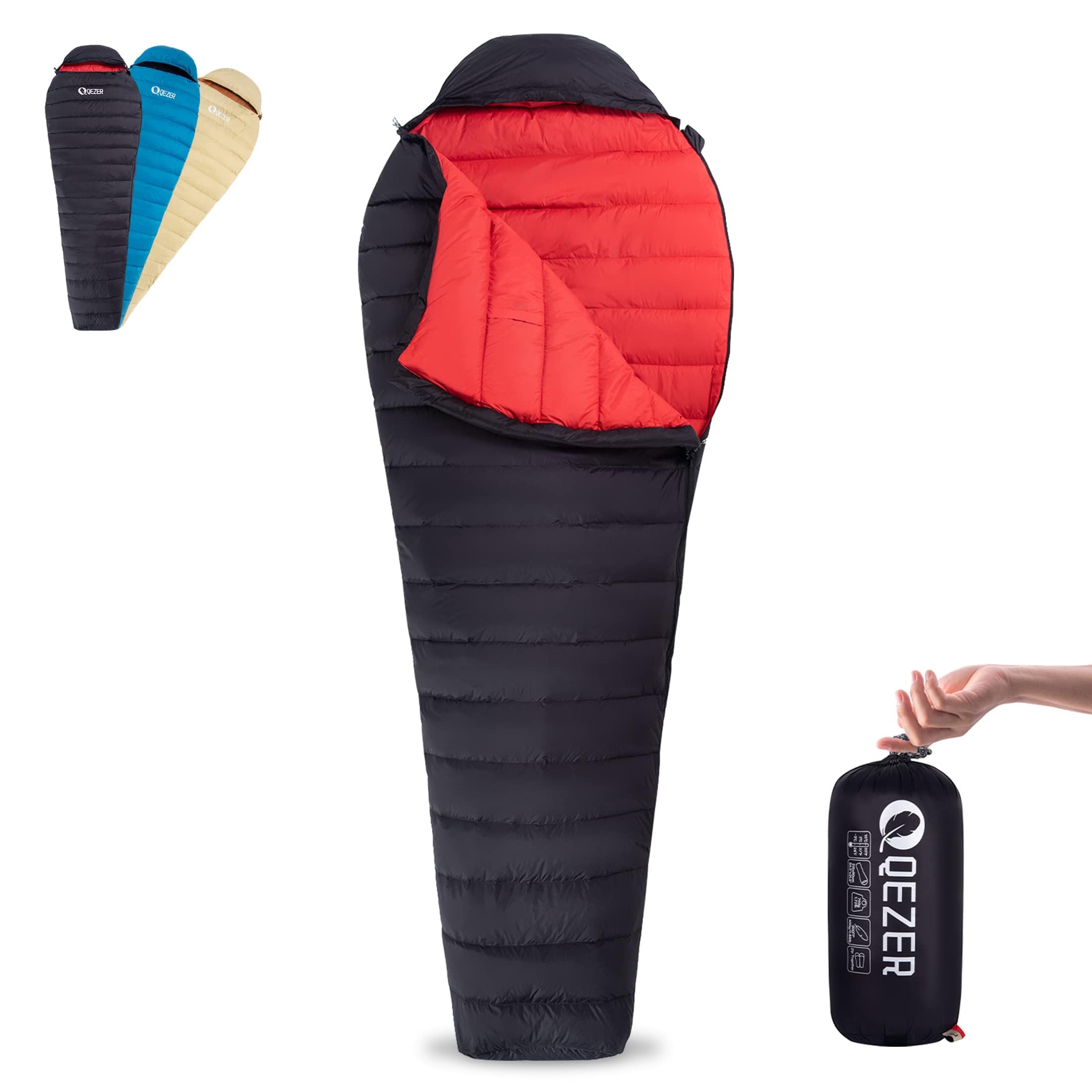
3. Ultralight Down Sleeping Bag for Adults (QEZER 600FP)
The roomiest ultralight, giving tall sleepers space to sprawl without the weight.
This one stretches the definition of “mummy” — at 84.65 inches long and 32.28 inches wide, it’s about 13% longer than the Naturehike above, a difference tall campers feel immediately in their toes. The wide trapezoidal footbox means you won’t wake up with cramped feet, which is the classic mummy-bag complaint.
The warmth rating tells you exactly what it’s for: comfortable at 59°F-68°F with an extreme rating of 45°F. That’s a summer and warm-weather bag, plain and simple. The 600 fill power duck down keeps it at just 1.3 pounds, and the dedicated compression sack shrinks it to 9.84″ x 5.51″ — small enough to fit in a handlebar bag, which cycle tourers appreciate. The zipper got mixed feedback in reviews, with most finding it smooth while an occasional unit arrived with a finicky one.
Owners describe it as a summer staple that “kept me warm without being overly warm,” and the left-right zipper lets two bags zip together for couples. Just remember the golden rule: shake it and give it 3-4 hours to loft after unpacking, because it arrives extremely compressed. This is the pick for warm-weather campers who refuse to feel claustrophobic in their bag.
What Wins People Over
- Weight is the most-praised trait — owners keep noting how light it feels
- Spacious footbox and wide cut beat standard mummies for comfort
- Compresses down to handlebar-bag size
The Honest Limits
- Strictly a warm-weather bag — not the one for nights below 60°F
- Zipper quality is a roll of the dice on some units
Ideal for: summer campers and tall sleepers who want mummy efficiency without the cramped feel.
Look elsewhere if: you need a bag for shoulder-season nights — the warmth simply isn’t there.
4. Down Sleeping Bag for Adults (QEZER 600FP Semi-Rectangular)

A semi-rectangular cut that trades a little weight for a lot of sleeping freedom.
The semi-rectangular silhouette is the whole point here — it fits your head snugly but opens up through the body, so you can shift positions and stretch out in ways a mummy won’t allow. At 85.04″ x 31.5″, it’s one of the roomiest bags on this list, and a foot zipper adds ventilation when the night warms up.
This is a mild-weather companion, rated comfortable at 45°F-61°F with a 36°F limit. The 600 fill power down keeps the weight at a manageable 1.68 pounds, and the 400T high-density nylon resists tears and moisture. Owners note the material quality and light weight as the standout traits, and it compresses to a coffee-can size that’s easy to justify in any pack.
The honest caveat is warmth — it’s the most-discussed aspect, and it’s a mixed one. Some owners find it “warm for its weight” at 40°F, while others report it’s “not so warm” at 47°F and best suited to summer nights. If you run cold, this one needs a liner or extra layers. The double zipper design helps seal in heat, and the left-right zipper lets you combine it with a second bag for couples camping.
Space-first choice: the right bag if you prioritize stretch-out room and light weight over maximum warmth.
Know before you go: owners are split on how warm it runs — treat it as a summer-to-mild-fall bag, not a cold-weather shield.
5. ZOOOBELIVES Ultralight Backpacking Down Sleeping Bag (Alplive T400)
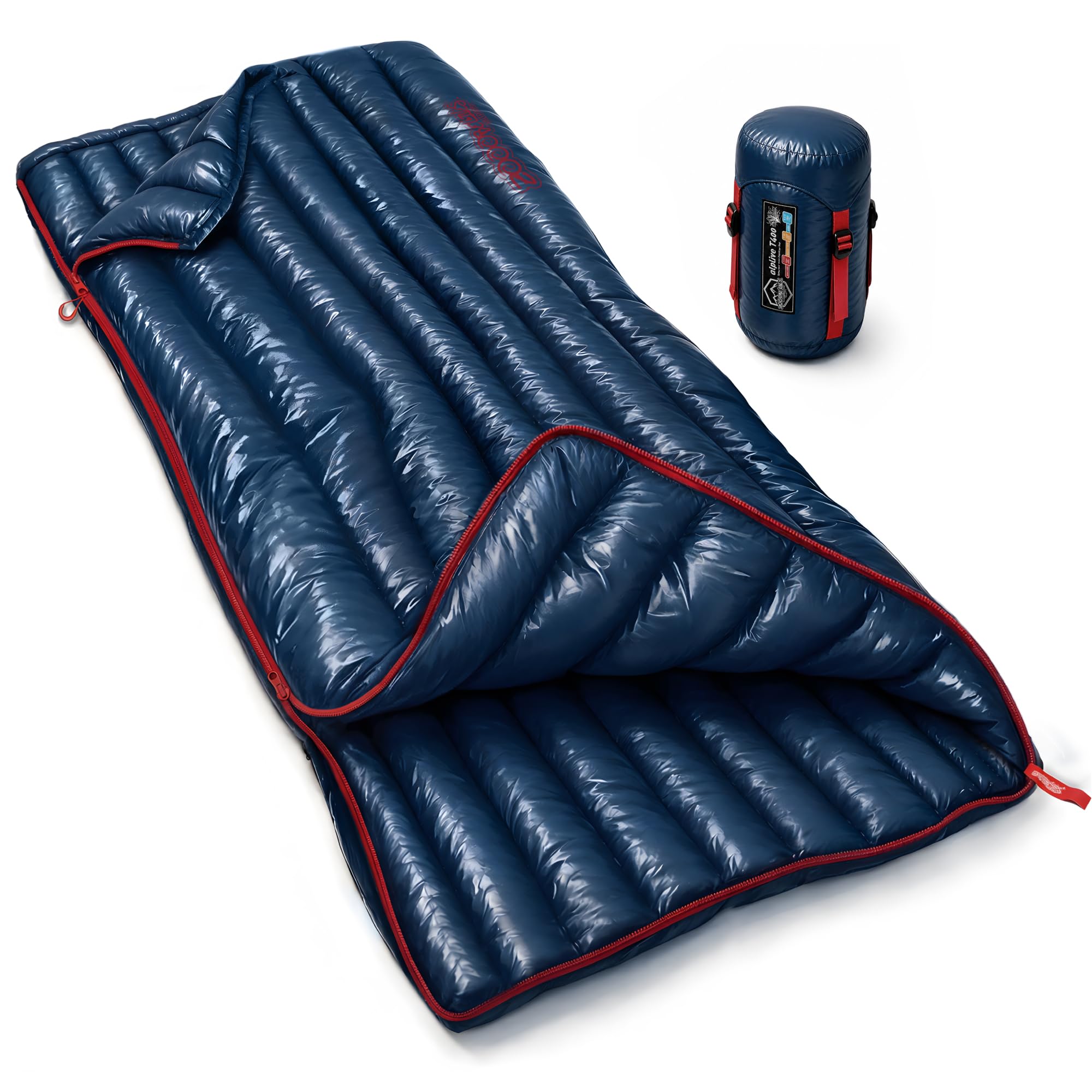
The dual-personality bag that unzips into a quilt when you want room to breathe.
Versatility is the defining trick here — it works as a traditional bag, or unzips flat into a roomy quilt or blanket setup that campers swear by for warm nights. At 27 oz (1.7 lb) with 650 fill power, it compresses down to 11.8 × 6.7 inches, smaller than a Nalgene bottle, which is the kind of pack-saving stat that wins over long-distance hikers.
The shape is a tapered envelope: 79 inches long with a 63-inch shoulder circumference, fitting users up to 6’2″ with room to shift positions. The 50°F comfort rating and 32°F lower limit place it firmly in the 3-season mild range. A full-length YKK main zipper plus a separate footbox zipper give you ventilation control, and the collar drawcord lets you cinch in warmth around camp.
What wins people over is the weight — it’s the most-praised aspect by far, with owners noting how it disappears into a pack. One reviewer tested it at 50°F in shorts and a T-shirt on an insulated pad and stayed warm all night, highlighting that 650 fill outperform expectations. The honest trade-off is the tube stitching (not baffled), which means less warmth than the fill power suggests, and owners emphasize it’s a summer-to-mild bag — “do not mistake this for a winter bag” is the recurring advice. It also needs a good shake to loft the down properly.
The Biggest Strengths
- Weight is what owners praise most — 110 people single it out as the headline trait
- Unzips into a quilt for flexibility
- Compresses smaller than a water bottle
What to Watch
- Warmth runs thin below 50°F — it’s a summer bag at heart
- Tube stitching means less warmth than baffled construction
Reach for this if: you want one piece of gear that switches between bag and quilt for warm-weather trails.
Choose something else if: you need insulation for cold nights — the warmth just isn’t built for it.
6. ATEPA Down Sleeping Bag with Pad Attachment
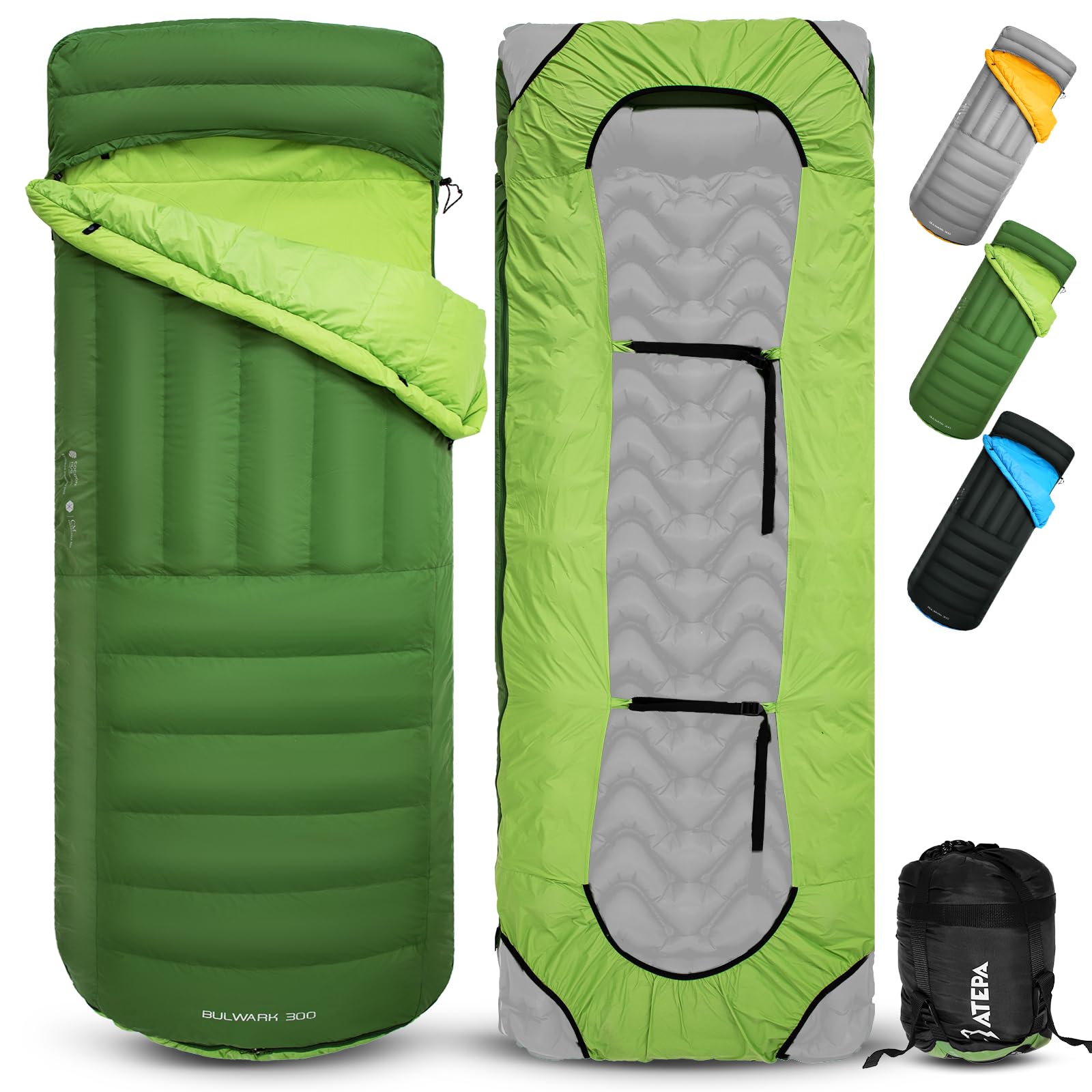
The night-time security blanket that straps you to your pad so you stop sliding off.
The standout feature is a reinforced pad-attachment system — corner straps that wrap around your sleeping pad to keep you centered all night, even on sloped or rugged terrain. For restless sleepers who constantly wake up half-off their pad, this solves a real problem that most bags ignore entirely.
Beyond the straps, it’s a 3-in-1 design: a traditional bag, a down blanket when unzipped, or a poncho around the campfire. At 78.7″ x 33.5″, it’s generously wide, and the 300g Coldmaster down with vertical/horizontal 3D baffle stitching is designed to prevent cold spots. Ratings sit at 50°F comfort, 45°F limit, and 25°F extreme — a true 3-season window.
Compactness is the most-praised trait, with owners noting how small it packs and how well it handles genuinely cold nights — one Michigan trip in freezing weather left the owner warm all night. The catch: the pad-retention rope drew complaints for being uncomfortable and non-removable, and the zipper occasionally catches the thin fabric in the dark. Also, warmth and attachment both get mixed feedback, so it’s not a universal win for every sleeper.
For restless sleepers: the pad-lock system is a genuine innovation if you’re tired of sliding around at night.
Fair warning: the pad strap can dig in, and the zipper needs patience — treat both gently and it’s a capable 3-season pick.
7. QEZER 0 Degree Down Sleeping Bag
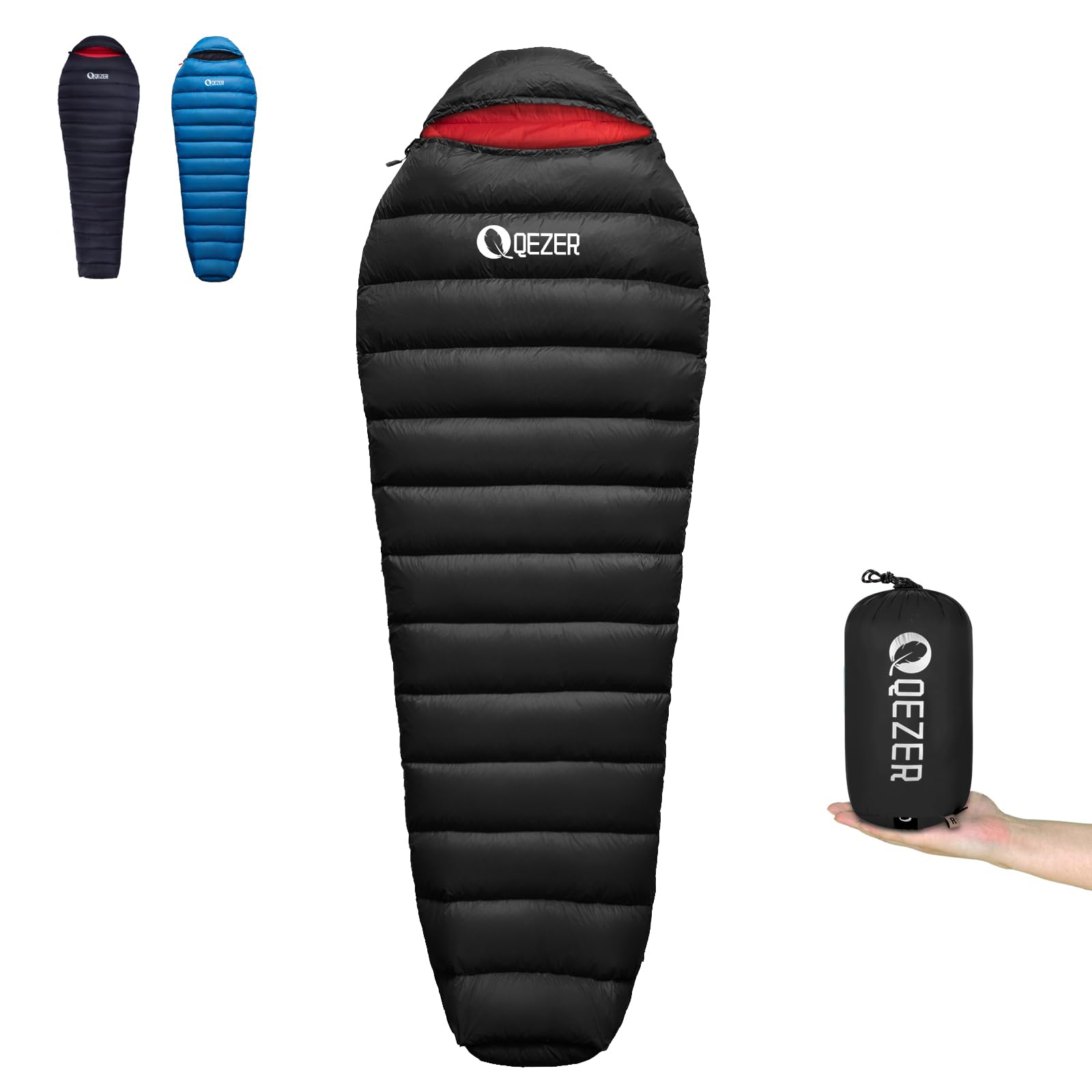
The 0°F-rated workhorse that punches way above its weight class for emergencies.
Despite the “0 Degree” name, the realistic range is 46°F to 63°F comfort with a 36°F limit — the rating assumes heavy layers. What makes this bag special is the real-world cold-weather stories attached to it: one owner survived a -10°F night in it, and another recommends it for UTV and snowmobile emergency kits in harsh winters. That’s the kind of cold-proofing that earns trust.
At 1.9 pounds with 600 fill power, it’s a middle-weight that packs down to 10.63″ x 6.69″ — small enough for motorcycle camping, which several owners do. The wide trapezoidal footbox and snug upper body give that classic mummy efficiency, and the 400T ripstop nylon resists tears and moisture. An interior pocket keeps your phone and headlamp close at hand.
Warmth is the most-praised aspect, and material quality comes second — owners repeatedly note the durable, comfortable build. The honest limits: the zipper quality draws negative feedback for occasional jamming, and durability is mixed, with one unit breaking after a few uses. It fits up to 6’5″, making it ideal for taller, heavier campers who struggle to find roomy bags. Bottom line, it’s a warm-weather-rated bag with cold-weather stories that just won’t quit.
Where It Excels
- Warmth is the #1 praised trait — owners consistently report cozy nights
- True down fill that compresses well for its class
- Fits tall users up to 6’5″
The Trade-Offs
- Zipper is the weak link — occasional jams reported
- Listed 0°F rating is optimistic; plan for 32°F as your real comfort floor
Best for: tall campers and anyone building a car or emergency kit that needs to handle sudden cold snaps.
Skip if: you need a dependable zipper on every trip — treat this one as a workhorse, not a precision instrument.
8. Litume Ultralight Down Sleeping Bag (700 Fill Power)
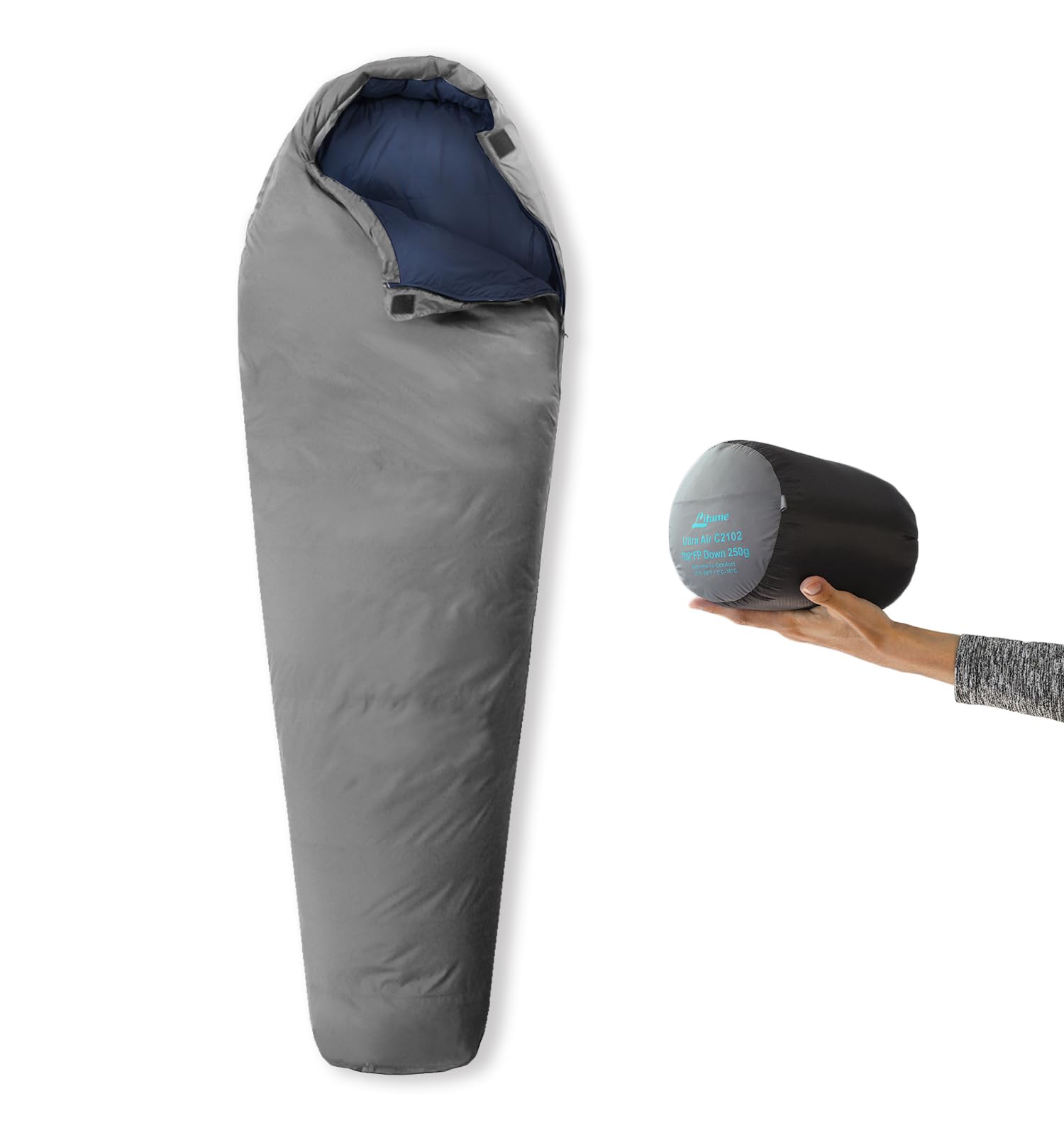
The highest fill power on the list, delivering maximum loft per ounce for true minimalists.
The 700+ fill power down is the headline here — the most efficient insulation on this list, creating more warmth per ounce than any 600 or 650 fill bag. At just 1.3 pounds (0.59 kg), it’s tied for the lightest weight while offering better loft potential. The 20D nylon shell is soft, water-repellent, and PFAS-free, keeping the eco-credentials clean.
The temperature ratings are honest about its purpose: 59°F comfort, 50°F limit, and 37°F extreme. That’s a summer and mild-weather bag through and through, with owners reporting the smallest pack size they’ve seen in 40 years of camping. It fits airline carry-on luggage easily, which makes it a favorite for travelers who want a real bag without checking baggage.
What buyers praise most is the size, with weight close behind — the compactness genuinely impresses. Owners have taken it through Acadia, Nova Scotia, Banff, and Iceland without issue. The honest caveat is warmth: it’s mixed, with one cold Grand Canyon night at 48°F left an owner shivering. But for summer treks and emergency kits, the combination of 700 fill (a measure of down loft quality) and 1.3 pounds is tough to top. The zipper opens from both inside and out, and the hood’s Velcro strap holds reliably.
For the weight-obsessed: the best loft-to-ounce ratio on this list makes it the minimalist’s dream.
The reality check: it’s a summer bag, full stop — bring layers if the forecast hints at below 50°F.
9. Naturehike Ultralight Down Sleeping Bag (Hybrid Cut)

The hybrid that pairs a mummy’s warmth with a rectangular bag’s side-sleeper freedom.
This is the smartest shape on the list: a mummy-style upper body that hugs your head and traps heat, paired with a rectangular lower body that gives your legs and feet room to move. The design is aimed squarely at side sleepers who hate the confinement of a full mummy but want better warmth than a plain envelope bag delivers.
At 2 pounds with 650 fill power RDS-certified down, it’s a middle-weight option that packs down to 13.8″ x 7.1″ with its compression sack. The 40.4°F comfort rating makes it the warmest budget hybrid here, and owners have confirmed it’s cozy down to 45°F on multi-day trips. The 400T 20D ripstop nylon is waterproof and durable, and the YKK zipper earns consistent praise for smooth operation.
Warmth is the most-praised aspect by a clear margin, with weight close behind — owners love how much heat it holds for its size. The roomy rectangular cut is repeatedly called out as a blessing for side sleepers, and it doubles as a quilt when layered over a colder-rated bag. The one note of caution is the zipper, which gets mixed feedback — mostly smooth, occasionally fidgety. This is the pick for anyone who refuses to choose between sleeping warm and sleeping comfortably.
Why It Stands Out
- Warmth is the thing everyone raves about — 30 owners call it out as the top trait
- Roomier than mummy bags, perfect for side sleepers
- Packs small with included compression sack
Minor Gripes
- YKK zipper can be fidgety on some units
- At 2 lbs it’s not the lightest, but the warmth justifies it
The verdict: the best comfort-to-warmth ratio on this list, made for side sleepers who want real insulation.
Think twice if: you’re a strict gram-counter — the lighter bags below save weight but leave you colder.
Understanding the Specs
Fill Power
Fill power measures how many cubic inches one ounce of down occupies when fully lofted. Higher numbers — 650, 700, 850 — mean the down is fluffier and traps more warm air per ounce, so you get more warmth for less weight. Budget bags typically land between 550 and 700, which is plenty for 3-season use. Just remember to shake the bag after unpacking to give the down time to re-loft, especially if it arrived vacuum-compressed.
Temperature Ratings
The number on the tag is the “limit” or “extreme” rating, not the comfort rating. Your real-world comfort floor is usually 10-20 degrees warmer than the listed number, assuming you’re in a base layer. For example, a bag rated to 32°F extreme might only feel comfortable down to 50°F for an average sleeper. Plan your trips around the comfort figure, and always add a sleeping pad — the ground steals heat fast regardless of the bag’s rating.
FAQ
What does fill power actually mean for warmth?
Is a 50°F comfort rating warm enough for most camping?
What’s the difference between a mummy and an envelope sleeping bag?
How small should an ultralight sleeping bag pack down?
Can two ultralight sleeping bags zip together?
Why does my new down sleeping bag need time to loft?
Is down or synthetic better for a budget ultralight bag?
How should I store my down sleeping bag to make it last?
What’s the best temperature rating for a 3-season ultralight bag?
Do I still need a sleeping pad with an ultralight bag?
Final Thoughts: The Verdict
For most people, the budget ultralight sleeping bag winner is the Kelty Cosmic 20 because it delivers genuine 3-season warmth that the featherweight options can’t match, while still packing down small enough for real backpacking trips. If you want the ultimate weight savings for warm-weather miles, grab the Naturehike 650FP. And for side sleepers who refuse to choose between comfort and warmth, the Naturehike Hybrid is the one to reach for.
How We Picked
We do not accept paid placement. Every pick is matched to a real buyer and a real use-case; we do not hands-on test units.
Sources & Methodology
Specifications: manufacturer listings and product documentation. Review insights: verified customer reviews, as of August 2026. Pricing: not shown on this page (it changes often); check the current price via the retailer link.
As an Amazon Associate, Gadgets Feed earns from qualifying purchases. This does not affect which products we feature.