
Our readers keep the lights on and my morning glass full of iced black tea. As an Amazon Associate, I earn from qualifying purchases.
Specs are compiled from manufacturer listings and verified buyer reviews and can change over time — please confirm the key details on the product page before buying.
You need a radio that actually keeps working after lunch and doesn’t cut out over a single hill. Cheap FRS radios often look good on paper but fail on the trail. This guide compares five rechargeable models by their real specs and verified customer patterns so you can pick the one that works for your actual trip.
I’m Min, founder and writer at Gadgets Feed. This guide is built by comparing manufacturers’ published specs and patterns from verified customer reviews, so you get each pick’s real strengths and trade-offs.
After looking at battery life, charging, range, and extras like NOAA (National Oceanic and Atmospheric Administration) weather alerts, here is a clear breakdown of the top contenders for a budget walkie talkie that won’t leave you mid-conversation.
Quick Picks
- DURLK ZX-808 Walkie Talkies — Best Overall
- Wishouse M9 Walkie Talkies — For The Trail
- Motorola Solutions T210 Two-Way Radio — Compact Everyday
- Retevis RT68 Walkie Talkies — Tough & Dependable
- BAOFENG GT-18 Walkie Talkies — Budget Starter
How To Choose The Best Budget Walkie Talkie
Choosing a reliable FRS radio depends on battery life, charging convenience, and real-world range for your activity.
Check the Battery Life and How You Charge It
A dead battery halfway through a hike is the top frustration with cheap radios. Look at the mAh (milliampere-hour) rating to compare capacity — a higher number means you can talk longer between charges. Also consider charging method: USB-C is incredibly convenient because you can charge from a car, power bank, or laptop, while models with a dedicated charging base are a bit slower but more organized.
Understand Real-World Range vs. Advertised Range
Every radio on this list advertises a “maximum range,” but in real-world conditions — through trees, up hills, inside buildings — your usable range will be much shorter. These are low-power FRS radios (generally 0.5 to 2 watts). Expect reliable communication between 0.5 and 1.5 miles in typical suburban or wooded areas. The “3 mile” figure is only possible in perfect, flat, line-of-sight conditions.
Extra Features That Actually Matter
Features like NOAA (National Oceanic and Atmospheric Administration) weather alerts can be a lifesaver on a hike, giving you a direct broadcast of severe weather warnings. An LED flashlight is handy in a pinch, and VOX (voice-activated transmission) is useful for hands-free operation, like when you’re biking or fishing. For most budget buyers, clear signal, long battery life, and USB charging are the top priorities.
Quick Comparison
| Model | Best For | Battery Capacity | Battery Life | Max Range | Amazon |
|---|---|---|---|---|---|
| DURLK ZX-808 | All-Day Outdoor Use | 1800mAh | 96 hours (standby) | 3 miles | $29.99Amazon |
| Wishouse M9 | Multi-Day Adventure | 3000mAh (AA batteries) | — | — | $35.99Amazon |
| Motorola Solutions T210 | Family & Home Use | 800mAh | 18 hours | — | $38.98$48.99Amazon |
| Retevis RT68 | Worksite Durability | 1200 mAh | 24 hours | — | $29.98$39.99Limited time dealAmazon |
| BAOFENG GT-18 | Budget Family Starter | 1500mAh | 24 hours | 3 miles | $28.99$32.99Amazon |
In‑Depth Reviews
1. DURLK ZX-808 Walkie Talkies
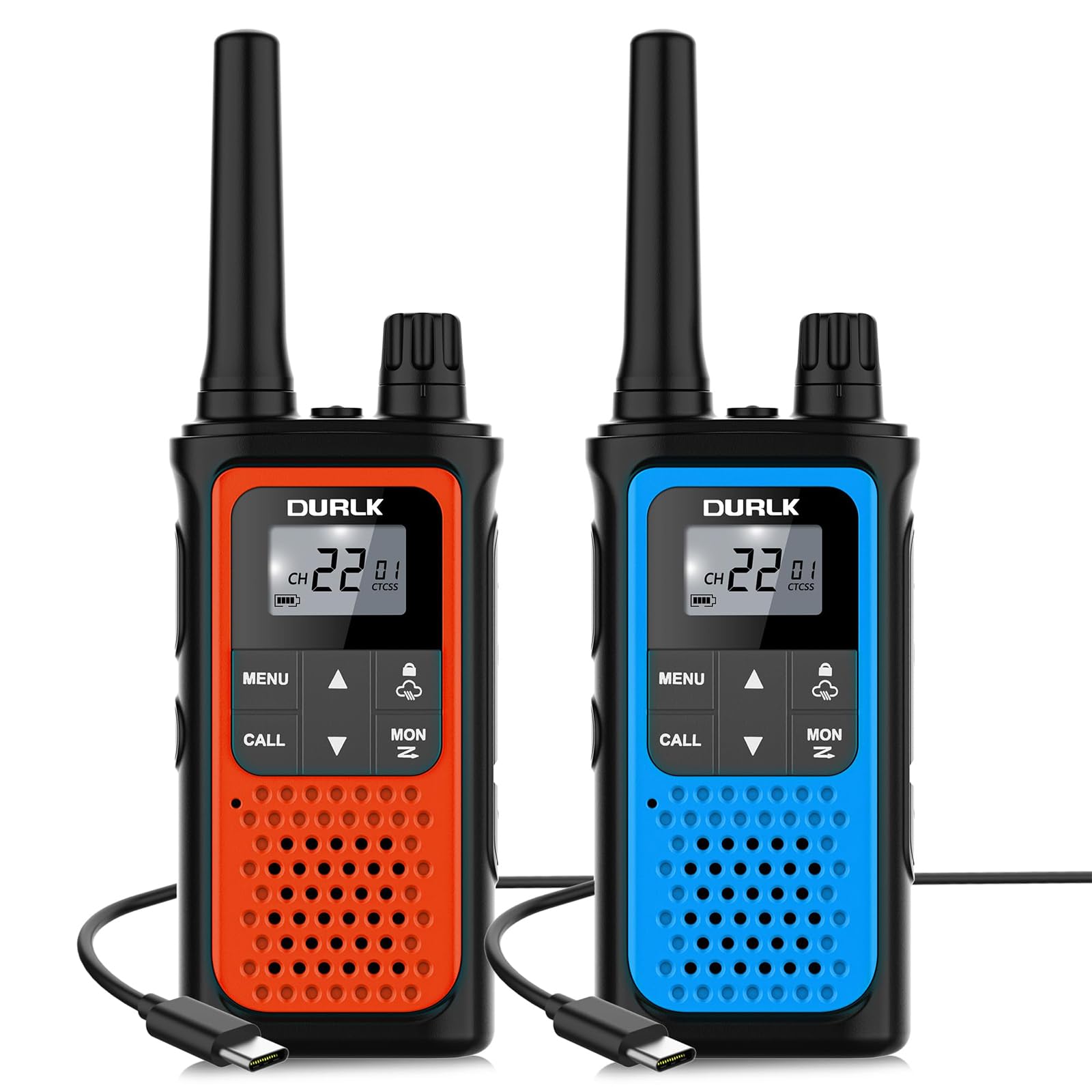
The DURLK ZX-808 lasts a full weekend trip without needing an outlet.
You get superb staying power with a built-in 1800mAh lithium battery — that’s 50% more capacity than the Retevis RT68’s 1200 mAh battery. This translates into a claimed 96 hours of standby time, so you aren’t constantly worrying about the charge level. Buyers report a “clear 1/2 mile range through trees/uphill,” a “3-4 day battery,” and even a “1-hour charge” using the included 2-in-1 USB-C cable, which is far faster than most competitors.
It also comes with 22 FRS channels, 121 privacy codes, a backlit LCD screen, and a built-in NOAA weather radio that scans 10 weather channels for real-time alerts — a crucial safety net for hikers or campers. The LED flashlight adds another layer of utility for night use. Unlike the Wishouse, which uses removable AA batteries, this model’s battery is built-in and recharges directly via USB-C.
One thing to keep in mind: while the advertised maximum range is 3 miles, that line-of-sight figure is idealistic. In the real world, owners mention that the usable range is closer to a mile, which is still on par with the rest of this class.
Standout battery champ: With its 96-hour standby and the fastest charging in this price bracket, this is the set to grab if you need reliable communication on a multi-day camping trip or any scenario where outlets are scarce.
Reach for it if: You need the longest possible battery life and want the convenience of a single USB-C cable to charge both units.
Consider the trade-off: The advertised 3-mile range won’t hold up in hilly or dense forest terrain — plan for about a mile in real use.
2. Wishouse M9 Walkie Talkies

The Wishouse M9 uses swappable AA batteries for unlimited power on the trail.
This model takes a different approach than the DURLK: it comes with six 1000mAh rechargeable AA batteries, giving you a total of 3000mAh of power across both units. The advantage is that if the batteries die, you can instantly slot in standard alkaline AAs from any convenience store — a big plus for extended backcountry trips. It includes 22 channels, NOAA weather alerts, and a three-year warranty via registration.
Buyers found it was very easy to set up with pre-charged batteries and reported “crisp voice even across a large house with closed doors.” The SOS siren and LED flashlight are practical extras for emergencies. However, navigating the menus without the manual can be confusing — one reviewer noted there were “no directions” included, which meant a bit of trial and error to find the right channel.
Why It Works
- Swappable AA batteries mean you can carry spares and never be without power.
- Includes NOAA weather alerts and an SOS alarm for safety.
- Backed by a 3-year warranty, offering better confidence than most competitors.
The Confusion Point
- No printed manual included, making the initial setup a guessing game.
- The AA batteries require an external charger, unlike the simple USB-C of the DURLK.
Best for the prepared adventurer: If you want the freedom to swap batteries on the trail and prefer a safety-focused radio with an SOS feature, this is a strong choice.
A potential hassle: You’ll need to remember the manual or YouTube the setup, and you lose the integrated single-cable charging of the DURLK.
3. Motorola Solutions T210 Two-Way Radio
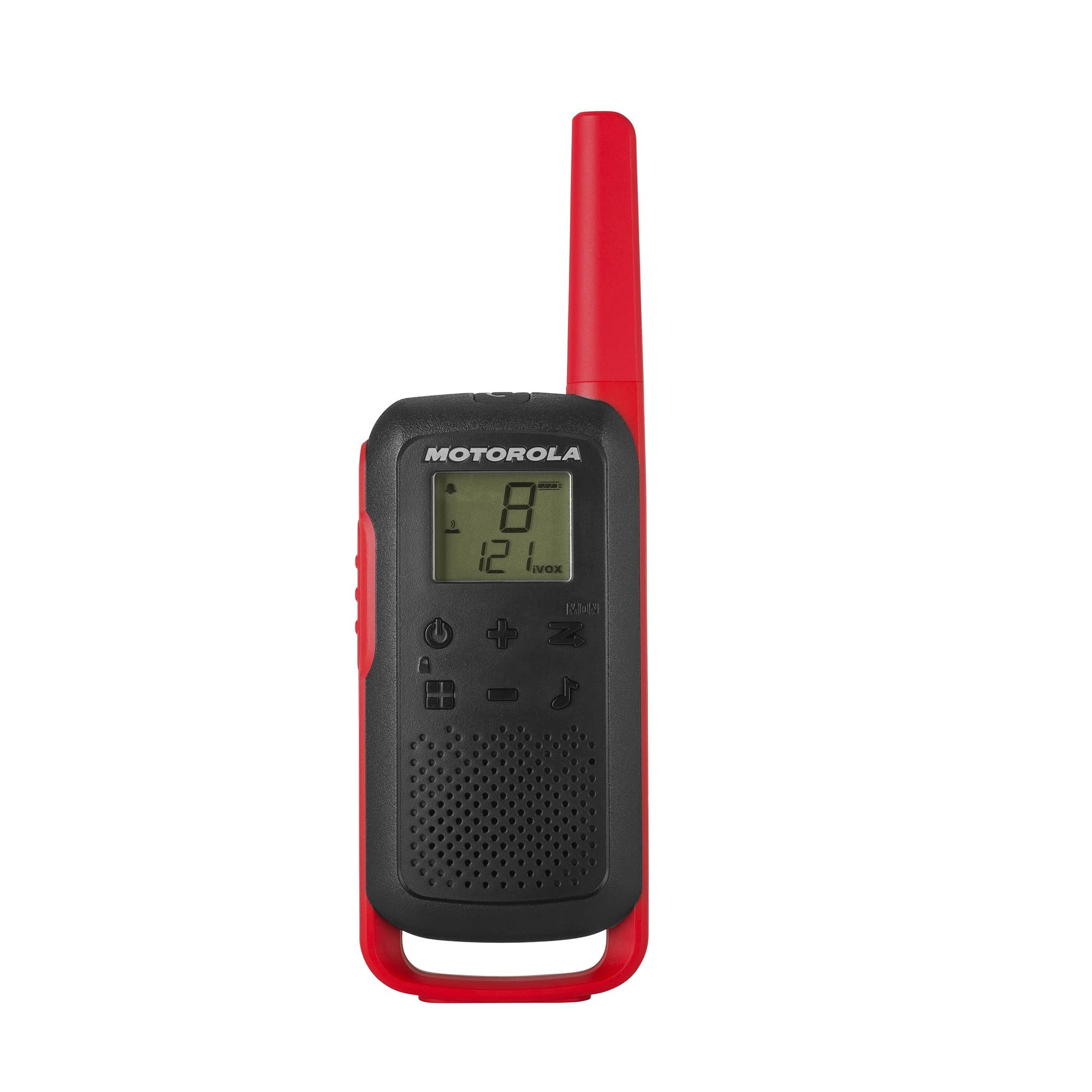
For a single day of skiing or a neighborhood walk, the Motorola T210 is easy to use but has an 800mAh battery while the DURLK has 1800mAh.
Its 800mAh battery is the smallest on this list, giving you about 18 hours of life. That is fine for a ski slope or a backyard watch, but customers note it needs a charge after a few hours of heavy use. Reviewers point out it works “easily on the ski slope” and was “dependable” on a cross-country road trip.
It has 22 channels, 121 privacy codes, and a backlit display. But it has “no NOAA weather capabilities,” which is a major gap compared to every other pick here. The mic picks up wind noise, according to one review. On the plus side, it uses a “Y” cable for dual micro-USB charging and comes with 16 personalization stickers, a fun detail for kids.
A straightforward workhorse for short trips: Great for parents who want a dead-simple radio for a day at the slopes, but skip it if you need weather alerts or multi-day battery power — the DURLK beats it on both.
Go for it if: You want a reliable, easy-to-use radio for short, predictable day trips and like the Motorola brand.
Hold off if: You need all-day battery or the safety of NOAA weather alerts — the DURLK or Wishouse have both.
4. Retevis RT68 Walkie Talkies
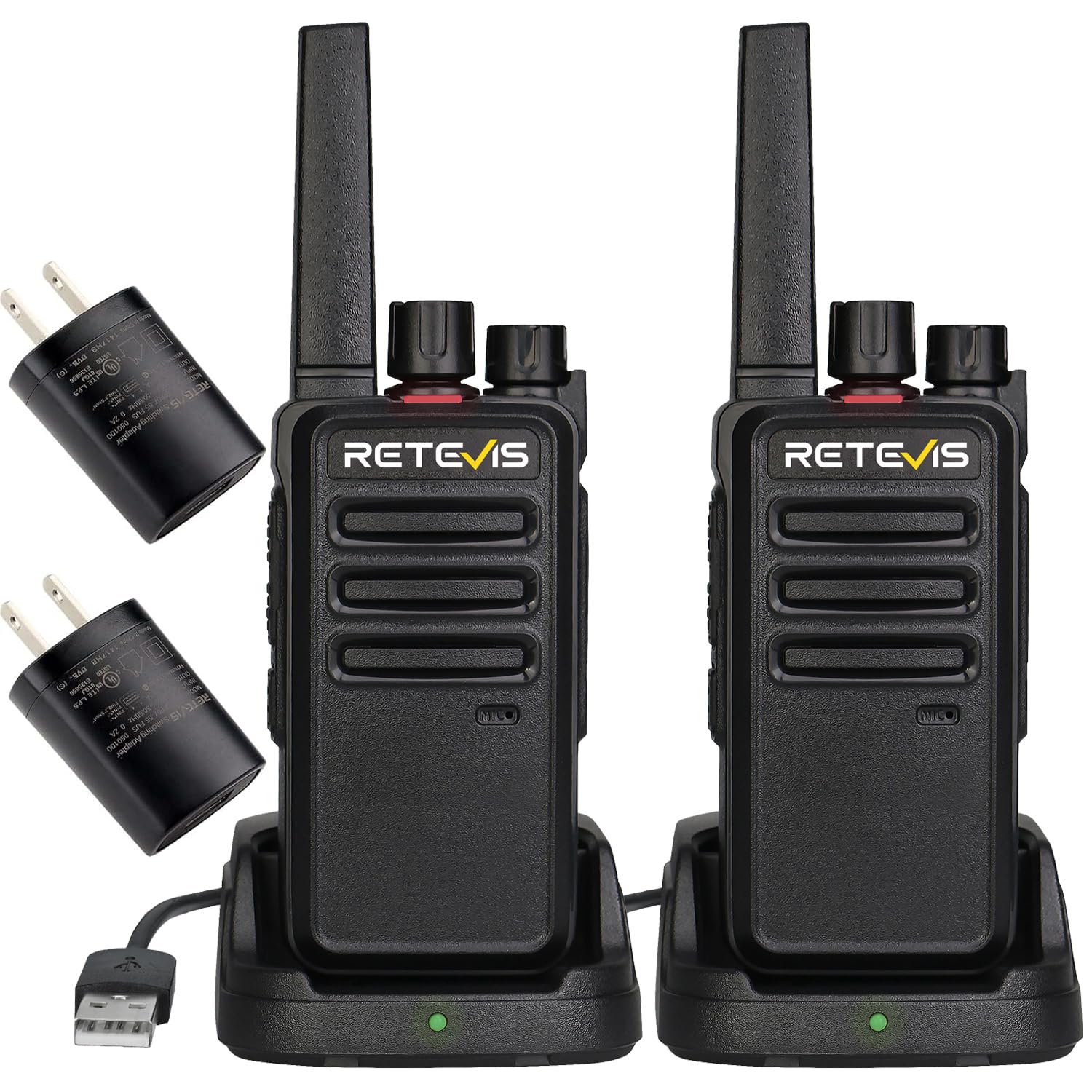
The Retevis RT68 is the rugged workhorse built to survive drops and keep talking in a noisy environment — it handles a 1-meter free fall that would crack other models.
Its 1200 mAh battery offers 24 hours of average life — shoppers say it “lasts a work shift with 50/50 duty,” meaning constant transmitting and receiving. The 2-pack is designed with a rugged enclosure and a “one meter free fall” rating. The battery capacity is smaller than the DURLK’s 1800mAh, but the trade-off is a tougher shell that can survive a drop from a truck tailgate.
One drawback is charging: the RT68 uses a USB charging base, not a direct USB-C cable like the DURLK. A reviewer flagged a compatibility issue: “only channels 1-5 work with other brands,” which can be a real problem on a group hike. The data also shows a 40-decibel audible noise rating, which is relatively loud for a quiet radio.
Built to Last
- Ruggedized enclosure can survive a 1-meter drop without damage.
- Battery lasts a full work shift under heavy use.
Brand Compatibility
- Only the first 5 channels work with non-Retevis brands, limiting group use.
- No NOAA weather alerts or direct USB-C charging.
Best for worksites and drop-prone uses: If your priority is a radio that can survive being knocked off a workbench, this is the pick. But if you need to talk to friends with different brands, you will be stuck on channels 1-5, which is a real frustration.
Skip it for mixed-brand groups: The channel limit makes this a headache for group trips where people bring different radios.
5. BAOFENG GT-18 Walkie Talkies

The BAOFENG GT-18 is a friendly, colorful 3-pack that’s perfect for getting kids into radio while staying affordable.
It packs a 1500mAh battery for up to 24 hours of battery life with USB-C charging, similar to the DURLK’s convenience but with half the standby time. It comes in three fun colors (Yellow, Green, Blue) and includes wearable lanyards and earpieces. The 22 channels and NOAA weather scan are nice extras for the price. Buyers report “performance is what you’d expect from a low-power FRS radio—around a mile of usable range in typical conditions.” Another reviewer noted it is “lightweight and compact” and “great for kids to use in the neighborhood or camping.”
The main compromise is the advertised 3-mile range, which is simply not realistic in the real world — one buyer mentioned it “transmits about a mile or less due to low wattage.” Compared to the DURLK, which has stronger audio and substantially more battery life, the GT-18 is a simpler, more colorful unit best suited as a starter set.
Kid-friendly and affordable: The ideal choice for parents who want a cheap, cheerful 3-pack for the kids to play with at the campsite, but not the best for serious, long-range communication.
Perfect for families: If you need a set for kids to communicate on the campsite or in the neighborhood, this is a great value.
But not for serious use: The real-world range is limited, and the battery life is half of the DURLK’s. It’s a toy for communication, not a tool for it.
Understanding the Specs
Battery Capacity (mAh) and Battery Life
The mAh, or milliampere-hour, rating tells you the total energy a battery can hold. A higher number like 1800mAh means more talk time before you need to recharge. However, battery life is also affected by how often you transmit (talk) vs. listen. A radio with 96 hours of standby time might only get 24 hours of mixed use, so the mAh rating is a better apples-to-apples comparison than “hours.”
License-Free FRS and Real-World Range
FRS (Family Radio Service) radios operate on specific frequencies and do not require a license from the FCC. They are limited to 2 watts of power, which restricts their range. The “3 mile” figure on the box is a theoretical maximum in a flat, open field with a direct line of sight between you and the other person. In hilly terrain, forests, or near buildings, expect the range to drop to 0.5 to 1.5 miles. That’s just the physics of low-power radio.
FAQ
Can I use these budget walkie talkies without a license?
Will these budget walkie talkies work over the advertised 3 mile range?
How long does the battery actually last on these models?
Can I use a walkie talkie from a different brand with these?
Can I charge a walkie talkie from a power bank?
What does a NOAA weather alert do on a budget walkie talkie?
What is VOX on a walkie talkie?
What is the difference between FRS and GMRS?
Why is the DURLK ZX-808 considered the best budget walkie talkie overall?
Are the headphones and earpieces included with any of these radios?
What is the difference between a walkie talkie’s standby time and talk time?
Final Thoughts: The Verdict
For most people, the budget walkie talkie winner is the DURLK ZX-808 because it combines the largest battery capacity (1800mAh) with the fastest USB-C charging and essential safety features like NOAA weather alerts. If you want a radio built to survive drops and constant use on a worksite, grab the rugged Retevis RT68. And for a budget-friendly, colorful set to get kids into radio communication, the standout is the simple 3-pack of BAOFENG GT-18s.
How We Picked
We do not accept paid placement. Every pick is matched to a real buyer and a real use-case; we do not hands-on test units.
Sources & Methodology
Specifications: manufacturer listings and product documentation. Review insights: verified customer reviews, as of July 2026. Pricing: not shown on this page (it changes often); check the current price via the retailer link.
As an Amazon Associate, Gadgets Feed earns from qualifying purchases. This does not affect which products we feature.
Related Guides
Product prices and availability are accurate as of the date/time indicated and are subject to change. Any price and availability information displayed on Amazon at the time of purchase will apply to the purchase of this product. As an Amazon Associate I earn from qualifying purchases.
CERTAIN CONTENT THAT APPEARS ON THIS SITE COMES FROM AMAZON. THIS CONTENT IS PROVIDED "AS IS" AND IS SUBJECT TO CHANGE OR REMOVAL AT ANY TIME.
Amazon and the Amazon logo are trademarks of Amazon.com, Inc. or its affiliates.