
Our readers keep the lights on and my morning glass full of iced black tea. As an Amazon Associate, I earn from qualifying purchases.
Specs are compiled from manufacturer listings and verified buyer reviews and can change over time — please confirm the key details on the product page before buying.
Feeding a rough board through a benchtop planer for the first time can feel like a gamble — will it come out glass-smooth or gouged at the ends? The real question for a sensible budget is which machine gives you the finish you want without requiring a second mortgage. This guide breaks down the best budget-friendly options for a budget wood planer by looking at cutting systems, motor power, and the honest trade-offs owners live with daily.
I’m Min — the founder and writer behind Gadgets Feed. This guide is built by comparing the manufacturers’ published specifications and the patterns across verified customer reviews, so you get each pick’s real strengths and trade-offs instead of marketing spin.
Spiral cutters, straight knives, snipe control, and dust ports all shape the final verdict, and we sort through them so you can plane with confidence.
Our Picks at a Glance


How To Choose The Best Budget Wood Planer
Picking a benchtop thickness planer on a budget depends on understanding what each spec actually does in your shop. The goal is to get boards to a uniform thickness with a smooth surface, and the machine you choose dictates how easy that is.
The Cutterhead: Spiral vs. Straight Knives
The cutterhead determines finish quality, noise, and maintenance demands. A spiral cutterhead with staggered inserts—like the ones on the WEN PL1326—tends to produce a cleaner, quieter cut and is generally easier on the motor. Straight two- or three-blade systems are simpler and cheaper to maintain, but they can be louder and are more prone to leaving a rougher finish that needs more sanding.
Motor Power and Feed Rate
Amperage tells you how much grunt the motor has; most benchtop models use a 15A motor. The feed rate (measured in feet per minute) tells you how fast the board moves through. A higher feed rate means faster work, but a slower feed rate can sometimes produce a finer finish. A motor that produces 10,000 RPM at a 26 feet per minute feed rate, for example, is a solid baseline for a 13-inch machine.
Cutting Depth and Snipe
Cutting depth is how much material you can remove in a single pass, usually measured in fractions of an inch. Taking lighter passes reduces strain on the motor and minimizes snipe—that annoying dip at the start and end of a board. Some models include anti-snipe features or infeed/outfeed tables to help, but feeding technique and using scrap pieces at the ends is often the simplest fix.
Quick Comparison
| Model | Best For | Cutterhead | Cutting Capacity | Motor Power | Amazon |
|---|---|---|---|---|---|
| WEN PL1326★ Best Overall | Smooth Finishes | Spiral (26 Blades) | 13″ Wide, 6″ Thick | 15A, 10,000 RPM | Amazon |
| VEVOR Two-BladeEntry-Level Value | Entry-level Value | Straight (2 Blades) | 13″ Wide, 6″ Thick | 15A, 23,500 RPM | Amazon |
| WOODERS PL13-15ABHardwood Specialist | Hardwood Cutting | Straight (4 HSS Blades) | 13″ Wide, 6.3″ Thick | 15A, 10,000 RPM | Amazon |
| VEVOR Dual Roller | Precision Depth Control | Straight (2 HSS Blades) | 13″ Wide, 6″ Thick | 15A, 16,000 CPM | Amazon |
| WEN PL1303 | Versatile Budget Pick | Straight (3 Reversible Blades) | 13″ Wide, 6″ Thick | 15A, 30,000 CPM | Amazon |
| CRAFTSMAN CMEW320 | Small Projects | Straight (2 Reversible Knives) | 12.25″ Wide | 15A | Amazon |
| Hoteche Combo | 2-in-1 Space Saving | Straight | 10″ Wide (Jointer), 10.6″ Wide (Planer) | 13A, 9,000 RPM | Amazon |
| Cutech 40700H | Quiet Professional Results | Spiral (Tungsten Carbide) | 12.5″ Wide | 10,000 RPM | Amazon |
In‑Depth Reviews
1. WEN PL1326 15-Amp 13-Inch Spiral Benchtop Thickness Planer
Our pick — over 4.5★ from 700+ verified ratings; the strongest balance of quality and price.
The spiral-cutterhead crowd-pleaser that turns rough lumber into a smooth-as-glass surface.
This is the pick that resolves the classic budget dilemma: get a pro-level finish without pro-level spending. Its defining feature is the spiral cutterhead, which uses 26 staggered and rotatable HSS blades instead of two or three straight knives. That design is what delivers the “smooth as glass” results owners talk about, with less tear-out on tricky grain and noticeably less noise than a straight-knife machine.
The 15A motor spins the cutterhead at 10,000 RPM with a 26 feet per minute feed rate, so it moves through stock at a practical pace. It planes boards up to 6 inches thick and 13 inches wide, and the cast iron base keeps it planted on your bench. An onboard material removal gauge shows your cutting depth per pass, which takes the guesswork out of sneaking up on a final dimension. Buyers report even a retired pro who owns a Felder was impressed enough to buy this for, praising the finish on red oak and minimal snipe — though that same feedback recommends pairing it with a proper dust collector, since a shop vac struggles with the volume of shavings.
Owners consistently describe the finish as butter-smooth, needing only minimal sanding, and they like that rotating a blade is easy and inexpensive. Hardwoods like hickory and walnut respond best to a conservative 1/32″ per pass, while pine can take 1/16″. The trade-offs are real but manageable: snipe, noise, and weight are the main ones.: snipe on the ends can creep in (the classic fix is scrap boards at the start and end), the brush motor is loud enough to warrant hearing protection, and the chip ejection can leave you with cleanup duty. It is a solid 80 lbs, so it is not a machine you’ll move around casually, but that heft is part of why it cuts so well.
Why It Wins Fans
- Spiral cutterhead gives the smoothest finish in this price range
- 26 rotatable blades mean cheap, easy refresh vs. sharpening straight knives
- Depth gauge takes the guesswork out of each pass
The Honest Trade-offs
- Loud brush motor demands hearing protection
- Snipe on board ends unless you use scrap pieces
- Heavy at roughly 80 lbs; not a tool you stash in a closet
Reach for this if: you want the best surface finish a budget can buy and don’t mind adding a dust collector to the setup.
Think twice if: your workshop is small or you want a machine you can heft around; its weight and noise are the price of performance.
2. VEVOR Thickness Planer, Two-Blade, 13″ Width
An absolute stud of a budget machine that handles pallet wood and butcher block projects with ease.
VEVOR positions this as the no-nonsense entry point, and owners agree it is a great entry-level planer that does a nice job without all the bells and whistles. The heart is a quick-change, solid steel two-knife cutter head hardened to HRC55-60, which is what gives the tool its reputation for long life. A 15A motor spins that head at 23,500 RPM, which is fast enough to leave a fine finish on both hard and soft woods.
It planes boards up to 6 inches thick and 13 inches wide, and the extended worktable — with pull-out extensions supplying 35 inches of total length — helps keep long stock steady. Owners mention it planes oak pallets flawlessly with minimal snipe right up until the stock gets very thin (under 7/16″), and it’s a favorite for charcuterie boards and butcher blocks. The built-in 20A over-current protector cuts power automatically if the load spikes, a smart safety net for a budget tool.
The catch is that this machine asks for a little patience. It’s not DeWalt-level, so you’ll want to take light passes and give the motor cooldown breaks — one owner noted a chemical smell when it runs hot. Dust collection is poor, so a vacuum is essentially required, and the blades are only sold singly, which adds to running costs. It’s also worth oiling the sliding parts regularly to keep things smooth.
The Strong Suit: For the money, this VEVOR outperforms its price tag. Its 54-pound frame and 27.4-inch length make it a stable workhorse that won’t break the bank, and the 22% larger footprint versus the WOODERS model below gives you more table to work with.
Best for: a first-time buyer who wants to learn on a capable machine and doesn’t mind a few quirks.
Look elsewhere if: you want zero fuss and consistent high-volume work — the cooldown breaks and blade cost will frustrate a heavy user.
3. WOODERS 13-Inch Benchtop Thickness Planer, 15A
The budget machine built to chew through dense hardwoods without bogging down.
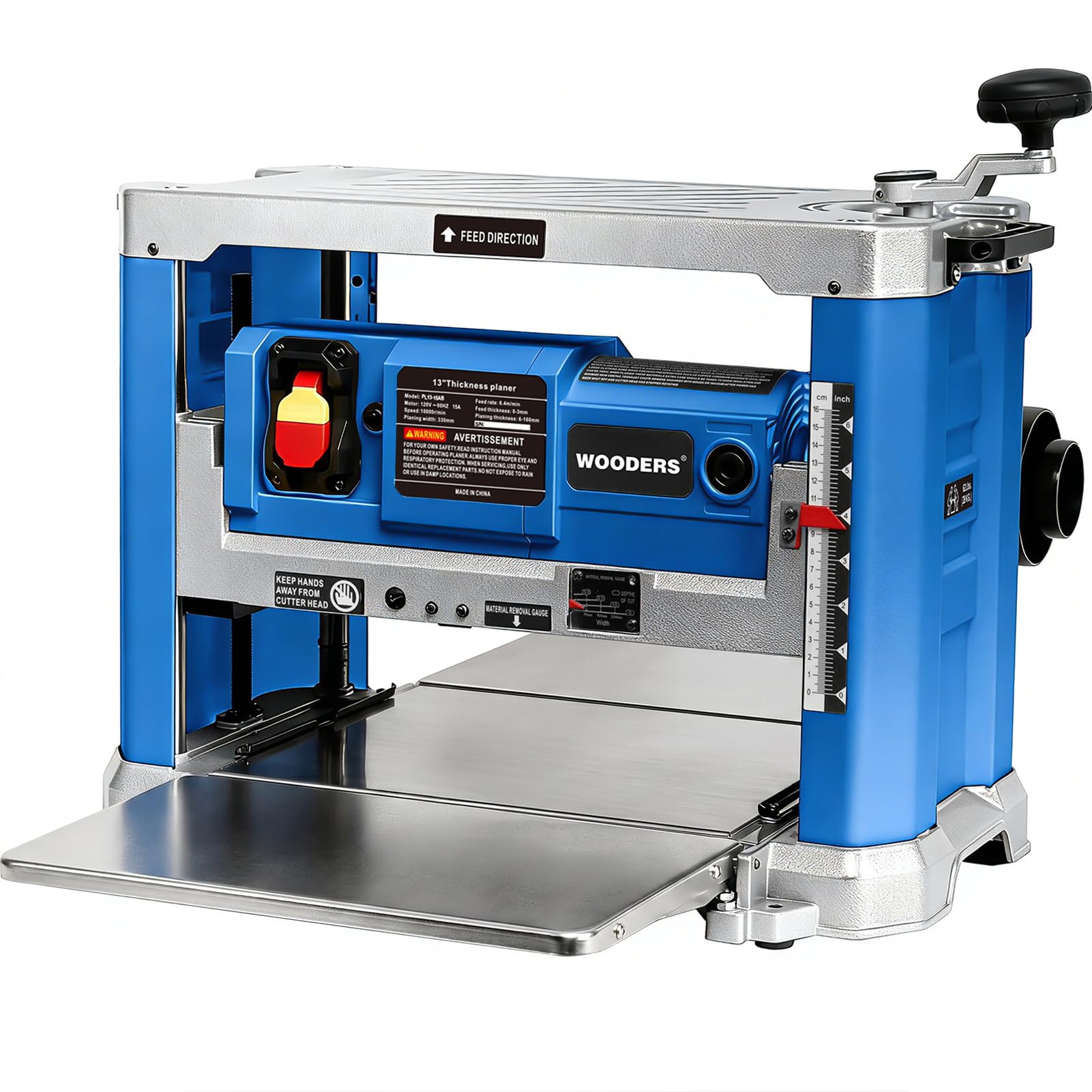
Where some budget planers shy away from oak and walnut, this WOODERS model leans in. Its 2000W all-copper motor delivers 10,000 RPM at the cutterhead, which the specs say slices through dense hardwoods “without bogging down or chattering.” That raw power is paired with a dual-edge cutterhead and four HSS blades (two installed, two spares in a storage box) so you can keep working when the first set dulls.
The cutting capacity is genuinely generous: 13 inches wide and a height range of 1/4 to 6.3 inches, which beats the usual 6-inch max on some rivals. An oversized, smooth-turning depth adjustment crank and a high-visibility height indicator (0 to 1/8 inch) make it accessible for older users or those with wrist strain, without losing micro-precision. Customers note it turns pallet lumber into beautiful finished boards and that it works very well for small projects.
At 60 pounds, it’s heavy, which helps it stay planted but makes it a permanent bench resident. Fit is the real thing to weigh here: this is a machine people love or have bad luck with. While many report fantastic results, there are also reports of a unit breaking within two months of light use. The integrated dust port helps keep the air clean, and the heavy-duty iron blade shaft and rugged frame are built for stability.
The Bottom Line: This is a power-first planer for hardwoods, with an ergonomic crank that separates it. It’s the right call if you’re consistently working with dense species, but its mixed reliability record means a careful unboxing and test pass are wise.
Choose this if: you regularly plane oak or walnut and want a machine that won’t stall.
Proceed with caution if: you need a tool you can trust from the start — QC reports are split between “excellent machine” and a rare early failure.
4. VEVOR Thickness Planer, Dual Roller, 13-Inch
The consistent-feeding workhorse that one owner says outperformed a borrowed DeWalt.
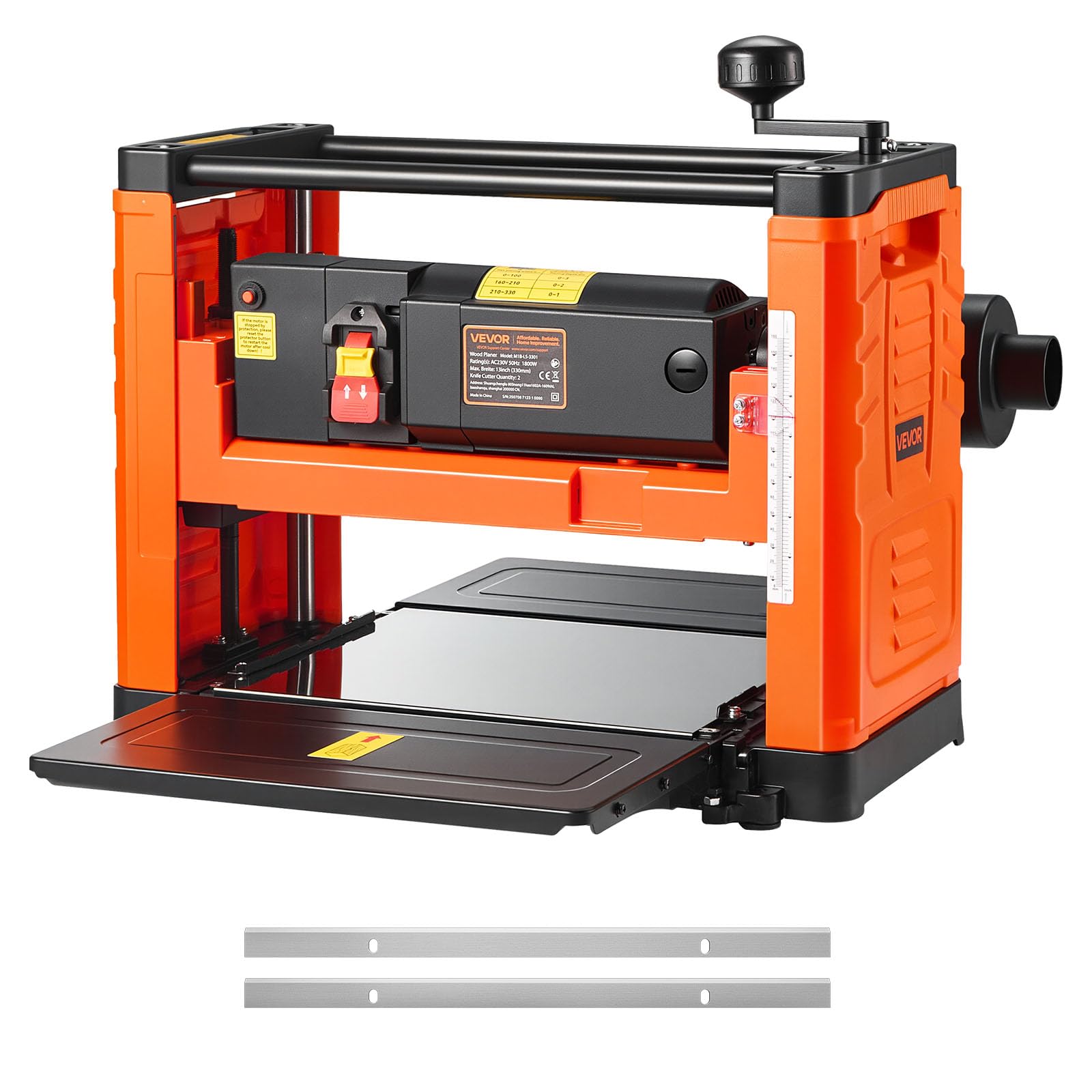
This VEVOR variant earns its spot with a dual-roller feeding system that advances boards with precision, reducing vibration and alignment issues for straight cuts. Paired with two sharp HSS blades, it’s designed to deliver glass-smooth edges free of splinters. The large 28.2-inch worktable keeps long or warped boards steady, and that extra length directly helps reduce snipe and boost control.
Depth control is the standout feature here: you can adjust cutting depth in precise 1/8-inch increments with millimeter-level accuracy for repeatable results. That makes it ideal for high-volume projects where consistency matters. The 1800W motor delivers up to 16,000 CPM, which handles oak, maple, and other hardwoods with ease. Practical touches include compatibility with both 2-inch and 4-inch dust hoses, so you can likely hook it into your existing dust collection setup.
Owner feedback is notably strong: one buyer called it “powerful zero snipe,” while another said it outperformed a borrowed DeWalt planer — with the only complaint being that the 13-inch width is too narrow for epoxy river table slabs. The usual caveats apply: blades chip on hidden nails, and a light sanding may still be needed.: blades will chip if you hit hidden nails in reclaimed wood, so a metal detector is a smart investment, and the finish may still need a light sanding for perfection. At 57.8 pounds with an aluminum base, it’s slightly lighter than its steel-bodied sibling.
Reach for this if: you want repeatable depth of cut and stable feeding for consistent, high-volume work.
skip it if: you’re working on extra-wide slabs wider than 13 inches — you’ll be hand-planing the overhang.
5. WEN PL1303 15-Amp 13-Inch Three-Blade Benchtop Thickness Planer
A three-blade design that delivers super smooth cuts and spares you hours of sanding.
WEN’s straight-knife offering is a masterclass in value, giving you a 13-inch wide, 6-inch thick cutting capacity with a 15A motor that generates 30,000 cuts per minute at a 26 feet per minute feed rate. The three reversible 13-inch SK5 blades are the key: with three cutting edges spinning, you get a smoother finish than a two-blade machine, and the “super smooth cuts” reviewers highlight are a direct result of that setup.
Owners love that it handles live edge projects effectively and creates surfaces without chipping, even on end grain. The depth of cut adjusts anywhere from 0 to 1/8 of an inch per pass, giving you fine control. Feedback frequently notes that it’s lighter than a comparable DeWalt — one owner measured the gap at 30-40 lbs — while performing equally or better. The front gauge aids initial cut depth, and the side depth gauge is accurate for repeatable settings.
The trade-offs are practical: a fiddly dust chute, mixed noise levels, and a fragile gauge. The dust chute is hard to install and blocks the outfeed tray from folding, which is annoying for storage. There are mixed feelings on noise level (some find it quiet, others loud), and one owner had the plastic feed thickness gauge break after a few weeks — though WEN’s customer service promptly sent a replacement, which speaks well of the brand. Snipe is minimal but present, and you’ll want to avoid running pressure-treated lumber through it without understanding the risks.
What Owners Applaud
- Three blades deliver a smoother cut than typical two-blade budget models
- Lighter than DeWalt by 30-40 lbs — easier to move around the shop
- Accurate depth gauges for repeatable results
What To Know
- Dust chute install is fiddly and blocks tray folding
- Noise level gets mixed reviews — wear protection
- Plastic gauge can fail (though WEN replaces it fast)
Best for: budget shoppers who want a smooth cut and don’t need a spiral cutterhead’s ultimate finish.
Know before buying: it’s a fantastic value, but expect a learning curve with the dust chute and some bench-top noise.
6. CRAFTSMAN Planer, 15 Amp, For Benchtops

The compact, sturdy benchtop planer that owners say turned rough cut lumber into usable boards.
CRAFTSMAN brings a trusted name to the budget tier, and this 15-amp benchtop model is built around a two-knife, quick-change, solid steel cutter head mounted on ball bearings for smooth operation and long life. The high-carbon steel, double-edged reversible knives are designed for long cutting life. It handles both hard and soft wood material removal with a poly-v cutterhead drive that boost stock removal.
At 12.25 inches of cutting width, it’s slightly narrower than the 13-inch machines on this list, but it’s also more compact at 23.5 inches long and 15.4 inches high — a better fit for a smaller bench. What it lacks in width it makes up for in user-friendliness: buyers describe a quick setup under 15 minutes and operation that’s smooth and consistent, with accurate thickness results. One owner noted it “saved thousands in repurposing old boards,” and another gave it as a gift, praising how it perfectly aligns wood to be even.
The durability story is more mixed than the praise. While many say it holds up wonderfully for small projects, the aspect data flags durability as a mixed bag, and snipe is the most common negative complaint — it persists unless you take light passes and support long boards. It’s loud and dusty, so ear and respiratory protection are non-negotiable. The dust port is poorly designed according to some owners. Blades also wear faster when you hit hardwoods or impurities in the wood.
What Shines
- Compact footprint fits small benches (23.5″L x 15.4″H)
- Trusted brand with quick setup and accurate results
- Excellent value for hobbyists and weekend users
Where It’s Limited
- Snipe is the most common complaint — needs light passes and board support
- Durability is mixed; mostly great, occasionally early failure
- Loud and dusty; protection is a must
Who it’s for: hobbyists with limited bench space who want a trusted brand name without the premium price.
Who should pass: anyone working with boards wider than 12.25 inches or running high-volume daily production.
7. Hoteche 10-Inch Benchtop Planer and Jointer Combo

Two essential tools in one footprint that turns pallet boards into expensive-looking finished lumber.
This is the space-saver’s dream: a 10-inch jointer and a 10.6-inch planer in one machine with a sturdy stand included. The 13A motor delivers a no-load speed of 9,000 RPM with a feeding speed of 6 meters per minute, which is efficient enough for hobbyists. The jointer table measures 37.3 inches by 10 inches for long stock, and the planer table is 10.6 inches by 12 inches — enough for most small-to-medium projects.
When it works, it’s a revelation. One owner described it as “small but powerful,” turning pallet boards into finished pieces that “came out like expensive finished boards.” The included stand ensures stable operation, and the 120V 60Hz motor keeps it compatible with standard home outlets. For a shop that’s tight on space, having both a jointer and planer without buying two separate machines is a genuine win.
The honest picture, though, is that this is the riskiest pick on the list. The star rating is dragged down by real assembly frustrations — multiple reviewers point out confusing instructions, a manual that references non-existent parts, and some units arriving with missing pieces or needing a hidden “upper limit plate” to be snapped in before power flows. There’s also a report of bearings failing after 200 boards. It works great for some, but the QC and documentation are clearly inconsistent.
The Verdict: A great concept with shaky execution. If you get a good unit and can navigate the assembly, it’s a fantastic space-saver. If you’re not comfortable troubleshooting assembly issues, the risk may not be worth it.
Best for: a hobbyist with very limited space who wants both jointing and planing capability in one machine.
Not for: anyone who wants a plug-and-play tool — the assembly and occasional QC issues demand patience.
8. Cutech 40700H 12½-Inch Spiral Cutterhead Benchtop Planer
A quiet spiral cutterhead with tungsten carbide inserts that delivers professional results for beginners.
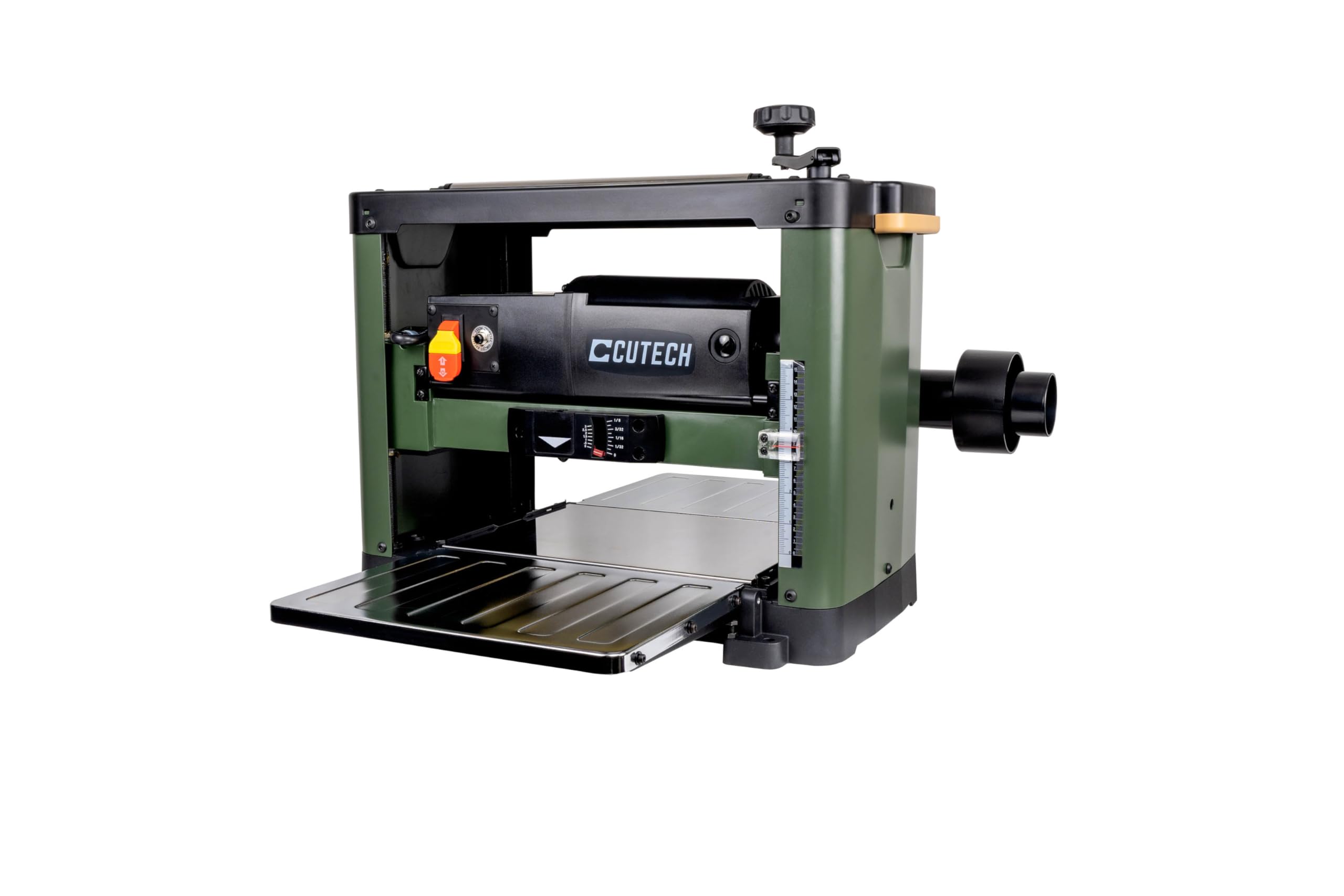
If there’s a “buy once, cry once” pick in the budget tier, this is it. The Cutech 40700H uses a spiral cutterhead with 6 rows of staggered tungsten carbide inserts — a design normally found on machines costing considerably more. The payoff is a smoother finish, reduced noise levels, and the lowest amp draw compared to other cutterheads, making it ideal for beginners who want professional results without frustration. At 10,000 RPM, it’s got plenty of cutting speed.
The two-sided inserts sit in perfect alignment and are designed to prevent skewing while planing, which is superior to 4-sided inserts in terms of precision. The snipe minimizer uses 4 lead screws and a patented coupling design to automatically reduce end-gouging — no extra snipe lock needed. A depth of cut indicator on the front shows exactly how much you’ll take off in the next pass, and the new board return rollers send boards back to the front for the next planing without you walking around. Shoppers say using it within 5 minutes of unboxing, planing pine, cedar, and oak “extremely well,” and one noted it’s much quieter than their 20-year-old 12″ Delta planer.
The trade-off is capacity: at 12.5 inches wide, it gives up a half-inch versus 13-inch models.: at 12.5 inches wide, it gives up a half-inch versus the 13-inch machines, which matters if you routinely work with full-width stock. It’s also toward the upper end of the budget spectrum, but the tungsten carbide inserts last far longer than HSS blades, so you’re trading upfront cost for lower running costs over time. The cast iron and aluminum base keeps it stable, and the rifle green finish is a nice touch of personality in the shop.
The Thing Everyone Raves About: The performance-to-smoothness ratio. Owners consistently describe a smooth cut with minimal to no snipe, and it’s genuinely quieter than the straight-knife machines — a huge quality-of-life win in a small shop.
Reach for this if: you want spiral-cutterhead quality and low noise, and you’re okay with a 12.5-inch max width.
Think twice if: you regularly plane boards wider than 12.5 inches or need the absolute lowest upfront cost — the tungsten carbide inserts command a premium.
Understanding the Specs
Spiral vs. Straight Cutterheads
The cutterhead is where the cutting action happens, directly shaping the board’s surface. A spiral cutterhead uses many small, staggered inserts arranged in a spiral pattern, which slices the wood with a shearing action. This typically produces a smoother finish, runs quieter, and places less strain on the motor. Straight-knife cutterheads (two or three blades) are simpler and cheaper to maintain, but they tend to be louder and can leave a finish that needs more sanding — especially on figured or cross-grain wood.
Feed Rate and Cutterhead Speed
Feed rate is how fast the board moves through the planer, usually measured in feet per minute (FPM). Cutterhead speed is measured in revolutions per minute (RPM) or cuts per minute (CPM). A balance of these two determines your surface finish quality. A faster feed rate gets work done quicker, but a slightly slower feed can yield a finer finish. A sturdy motor (like a 15A) keeps the cutterhead speed consistent even when you’re taking a deeper cut through hardwood.
FAQ
What does a thickness planer actually do?
What is snipe and can I prevent it?
Spiral cutterhead or straight knives — which is better for a beginner?
How much cutting depth should I take per pass?
How important is dust collection for a benchtop planer?
Will a 13-inch planer handle all my boards?
How often do I need to replace or rotate the blades?
Is a jointer-planer combo a good idea for a small shop?
How loud is a benchtop planer?
Final Thoughts: The Verdict
For the majority of shoppers, the budget wood planer winner is the WEN PL1326 because its spiral cutterhead delivers a finish that rivals far more expensive machines, and it’s backed by a crowd of owners who consistently call it a high-quality, smooth-operating tool. If you want the absolute smoothest surface and quietest operation, the Cutech 40700H is the premium choice with its tungsten carbide inserts. And for a first-time buyer who wants a solid, budget-friendly entry point without a lot of bells and whistles, the VEVOR Two-Blade is the one to reach for.
How We Picked
We do not accept paid placement. Every pick is matched to a real buyer and a real use-case; we do not hands-on test units.
Sources & Methodology
Specifications: manufacturer listings and product documentation. Review insights: verified customer reviews, as of August 2026. Pricing: not shown on this page (it changes often); check the current price via the retailer link.
As an Amazon Associate, Gadgets Feed earns from qualifying purchases. This does not affect which products we feature.